Scotland NC500 – day 8 – a hidden pass, palm trees, and a famous castle

This article is part of the series “2025-10: Northern Scotland”.

October 20

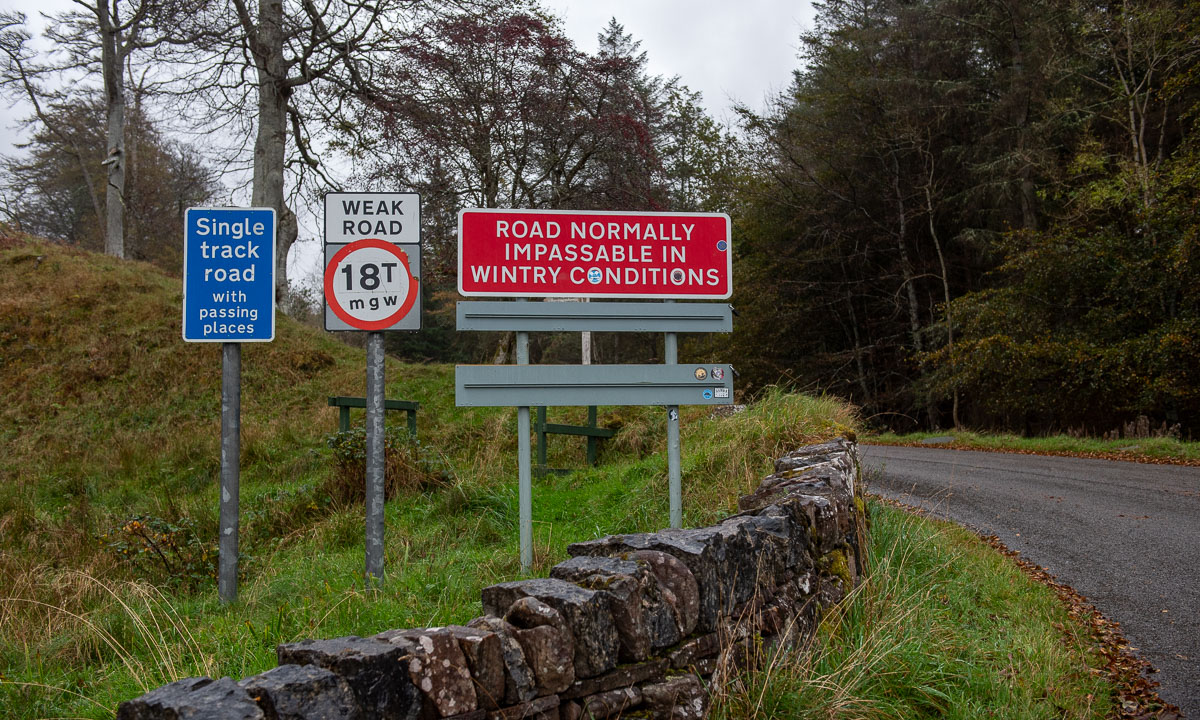
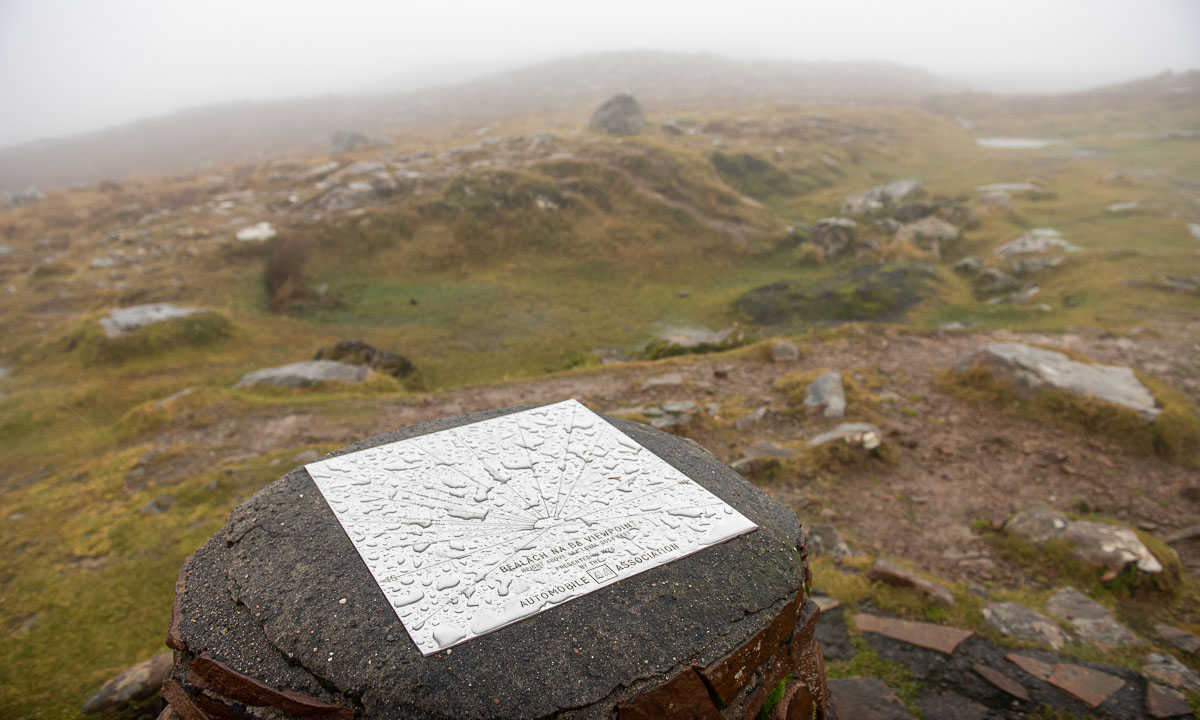
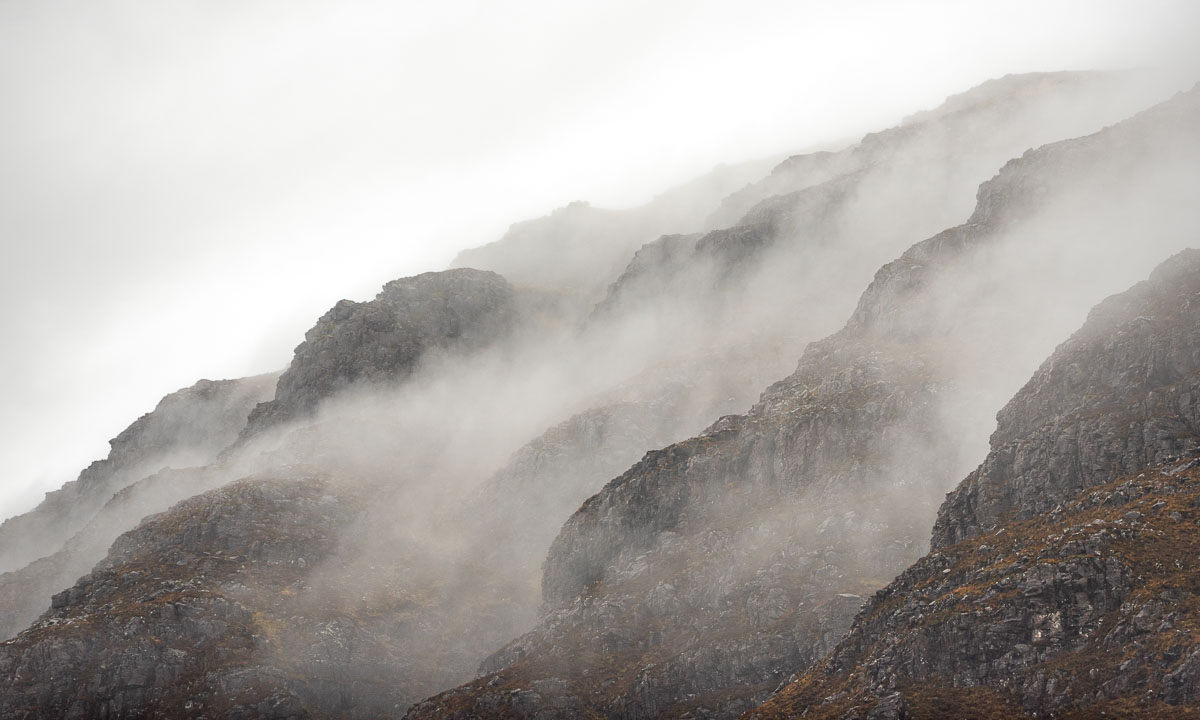
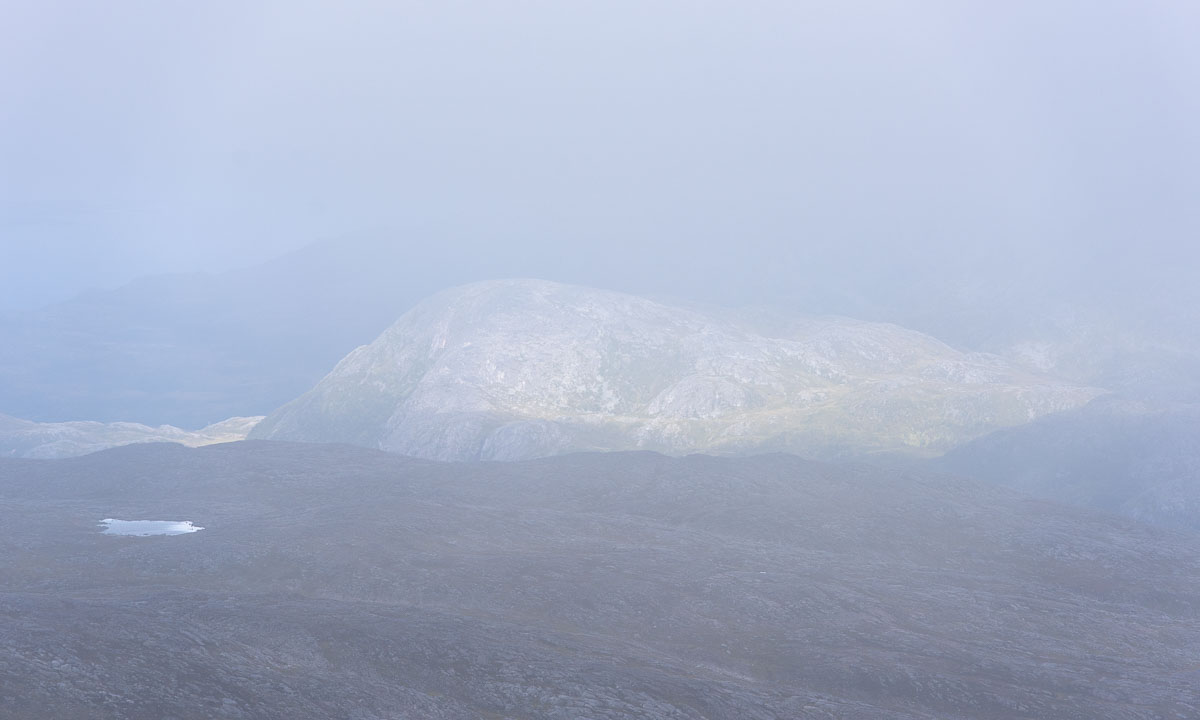
Today is the eighth day of our road trip in Northern Scotland, which my wife and I are taking together. Last night we slept in a hostel near Applecross. Now we want to take the road over Bealach na Bà pass, that is known for its hairpin bends and scenic views. Unfortunately it is still raining and the clouds are low. The beginning of the road is marked with several warning signs, but Annika can drive single track roads and we do not have wintry conditions, so we can take the road. But clouds we have. Soon we are in the middle of them. It is raining and the visibility is pretty bad. And so is the view of the hairpin turns from the top of the pass. Well, you cannot have everything.

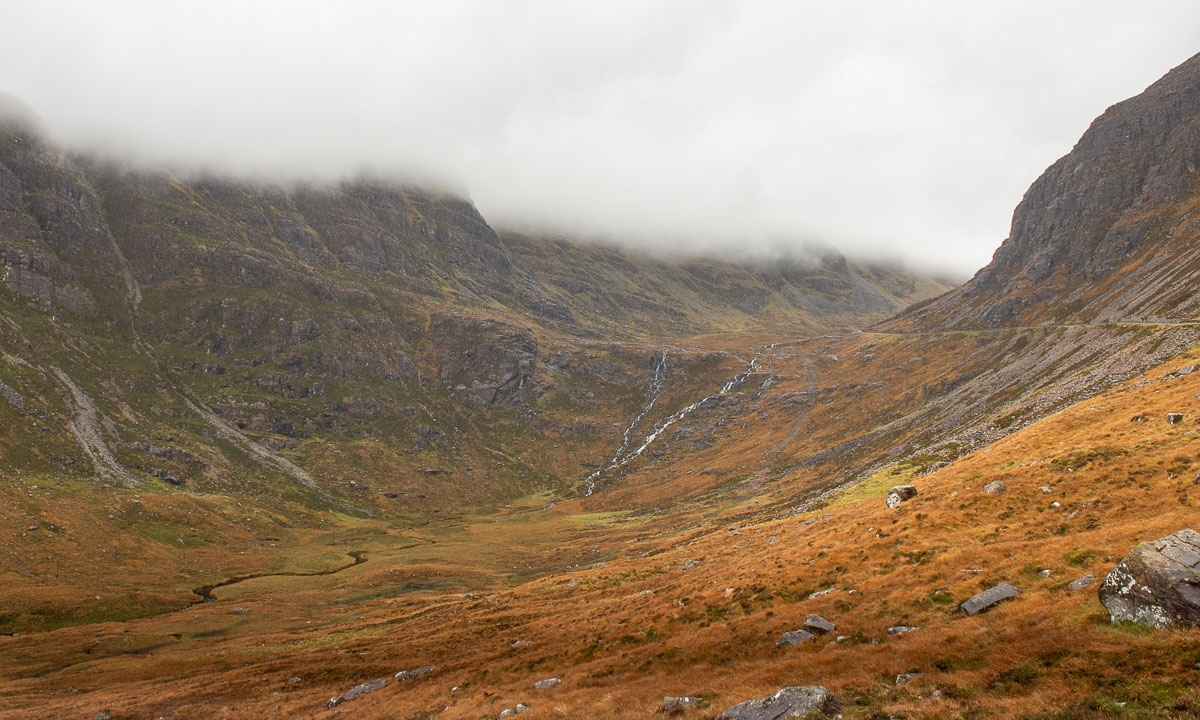
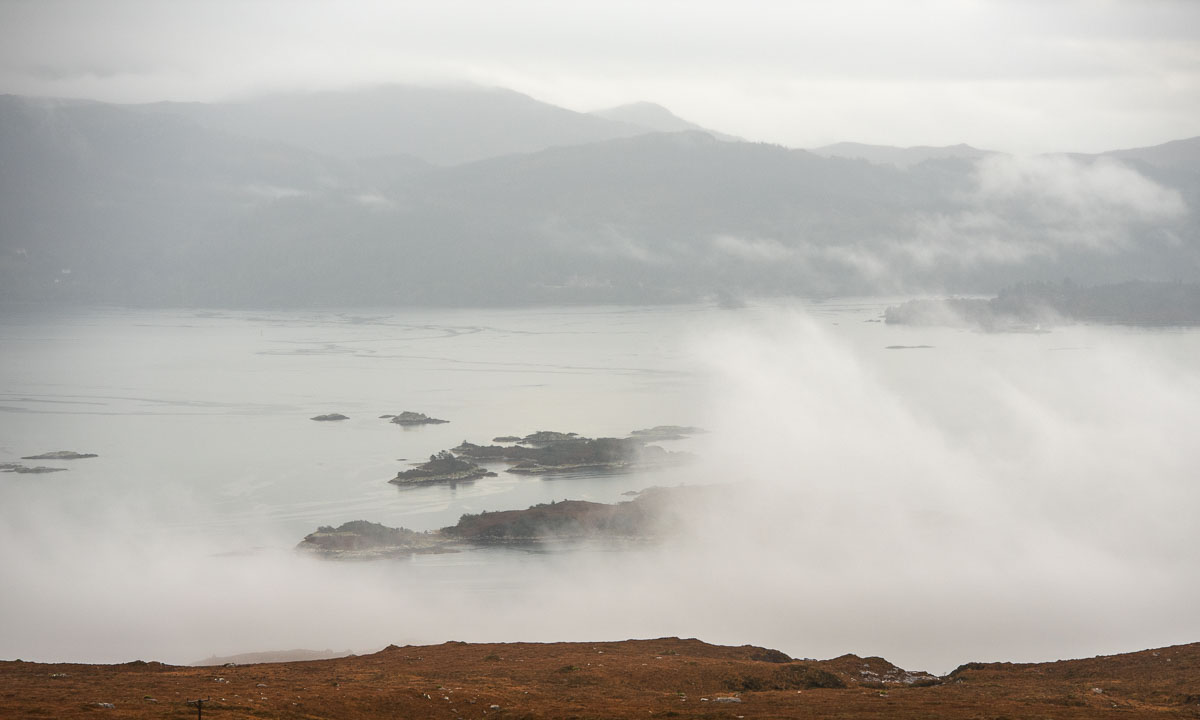
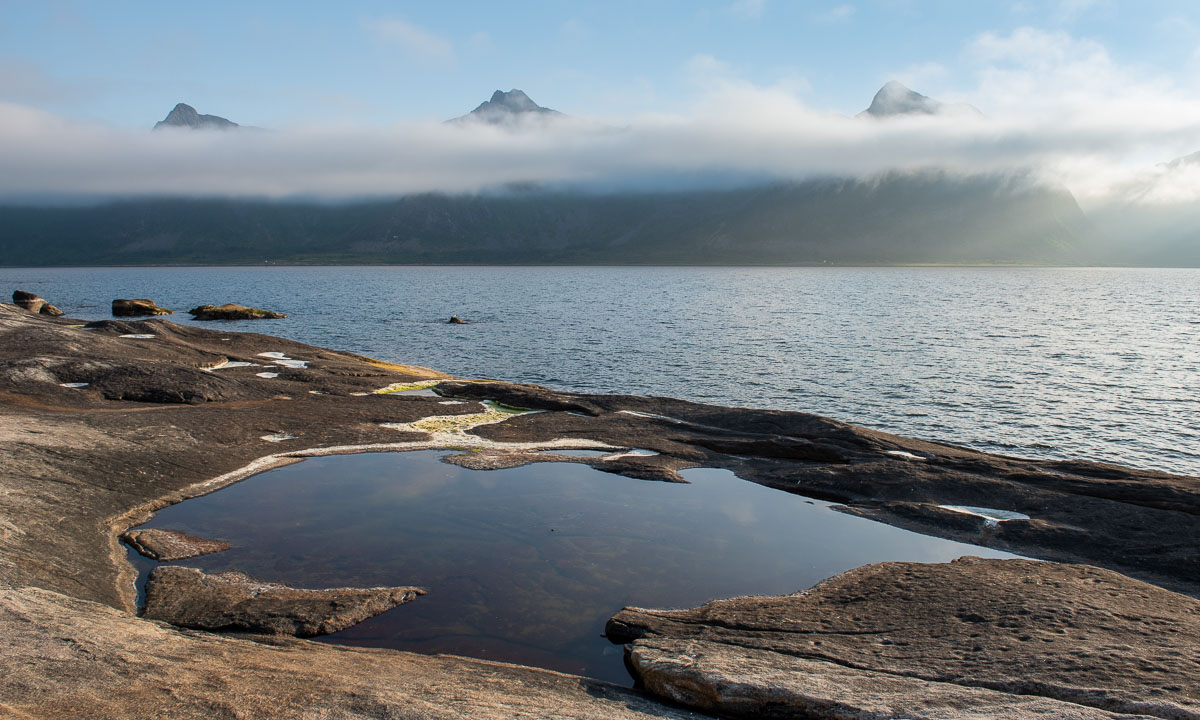
We descend and slowly visibility improves. When we look back we can see the colourful mountain scenery with the summits in the clouds. In front of us we see the other clouds floating down to the sea loch Loch Kishorn, where they start hiding the coastal islands.

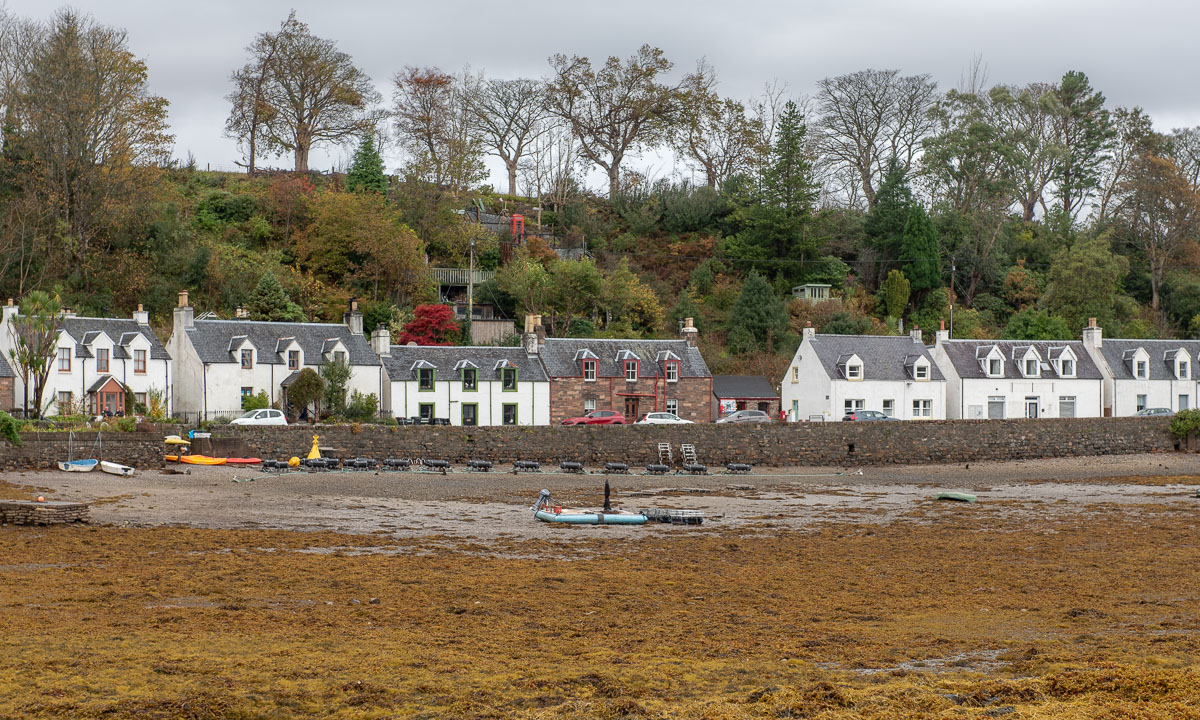
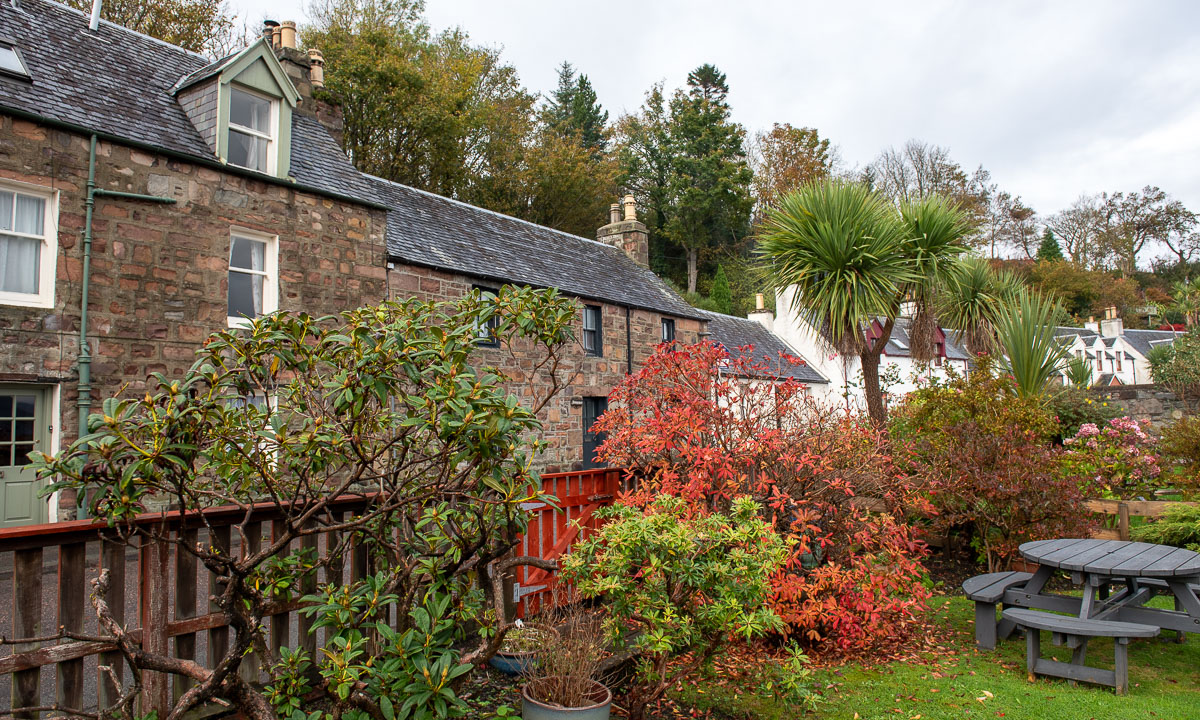
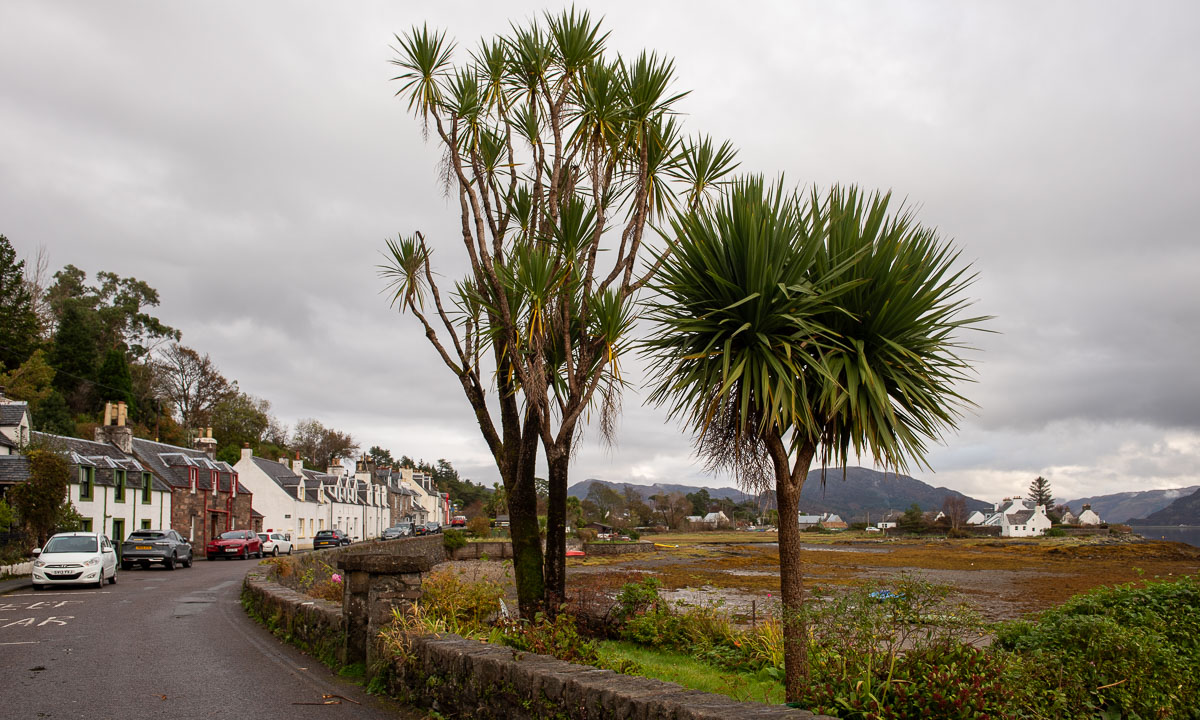
Two hours later we arrive in Plockton, a beautiful village by the sea. The climate is particularly mild, so that palm trees can grow here. An older chap I meet in the street tells me that he has different sorts of palms, a eucalyptus tree and other trees I never heard of in his garden.

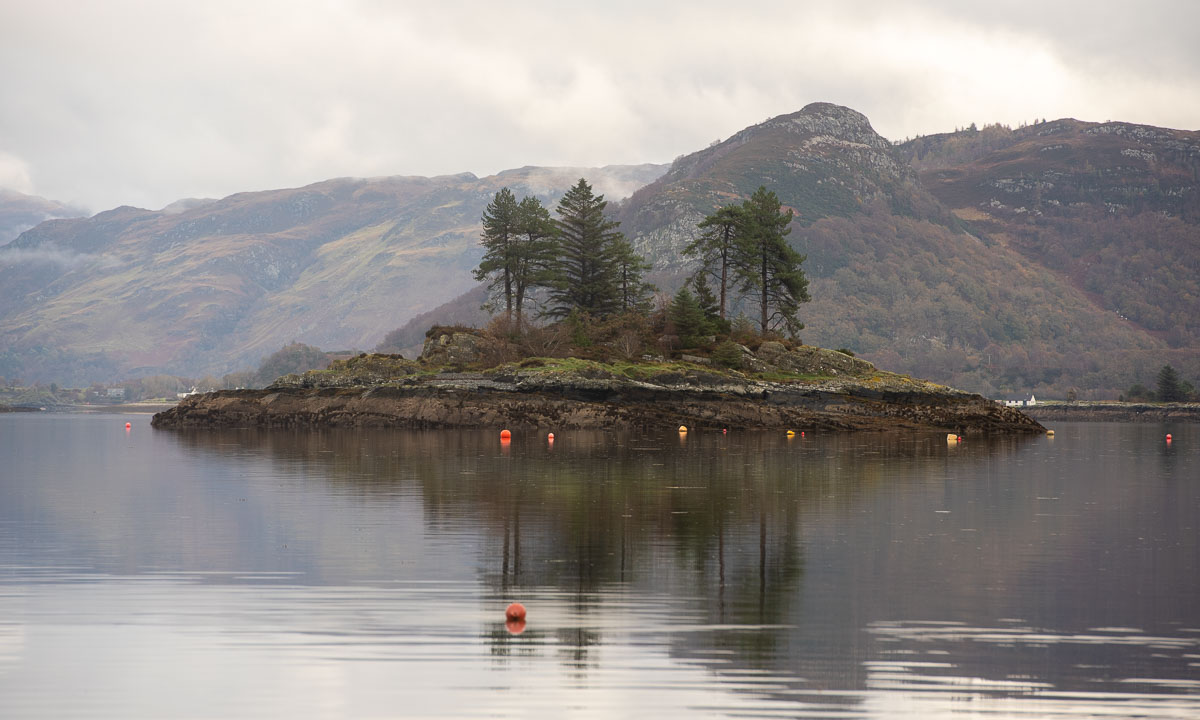
It is low tide. Some fisher boats lie in the mud and it is possible to go to an island nearby. From the sandy tidal flat you can see the long row of houses by the seaside – sea view for everyone. We spend an hour and a half here to visit the craft fair, to go to the island, to pet a cat, to take photos and to find a geocache. A charming place with views of the sea, an island called Sgeir Bhuidhe, Duncraig Castle, hills, and steep mountains.

Finally we continue our tour. Next stop: Eilean Donan Castle. This castle is regarded one of the most photographed landmarks in Scotland, and it’s very popular with tourists. Visiting the interior costs money, and there’s even a charge to cross the bridge, so I take photos from the outside. It is not easy to take photos without too many tourists in the shot.

From Eilean Donan Castle it is not far to the An Spiris Accommodation at Dundreggan Rewilding Centre, our last overnight stay on our road trip. My highlight of the evening is the toddler in the large common room singing “Do-Re-Mi” from the Sound of Music.


Just a pick-up at the station… – part II

< to part 1

Tuesday, 22 July

When I wake up early, the mountains and the sea have vanished. Thick fog surrounds our overnight stay Marmelkroken on the island Andøya. I take a walk through the wet grass to the bird observation place but beside of some seagulls and a lonely curlew that flies around there is nothing to see.

One hour later Annika and I sit inside enjoying our gorgeous breakfast. We get a table-side presentation of the dishes. More or less everything has been produced locally and we eat it all.

Then we head of. We want to catch the one o’clock ferry in Andenes that will bring us to the next island Senja, second largest in Norway (again, when we ignore Svalbard). The weather soon gets fair again, but around the mountains still some clouds are hanging.

Yesterday we took the western road, today we cross the boggy island to take the eastern one. On the way there we pass the village Å. There are several Norwegian places called Å, the most famous one is on the Lofoten. The next stop is the octagonal church in Dverberg.

A bit north near Myrset there is a huge area of peat mining. Andøya has large areas of peat bogs and parts of it has been drained to extract the peat. I climb on a hill of peat – it bounces like a water bed – to take some photos of this moonscape. Then I protect my camera lens, because each step emits a cloud of brown dust. But that’s nothing compared to the huge double-wheeled tractors anyhow that produce huge clouds of peat dust while driving. My car is brown now.

We take it easy, we have time – that’s what I thought. When we however arrive at the ferry terminal it becomes quite obvious that we would not join the next ferry. Too many cars are ahead of us waiting. So the one o’clock the ferry departs without us, leaving us behind but in a much better start position. Now we have to wait for four hours. Time to explore Andenes a bit.

As hoped and expected we find place on the next ferry. Now we are on the way north to Senja. Soon we are in open water, accompanied only by some sea birds.

The ferry trip takes one hour and forty minutes. Then we arrive in Gryllefjord on Senja.

Unfortunately we won’t catch the last ferry to Kvaløya today, they are not coordinated. We have to drive via the mainland – a large detour. Although it is another detour we decide to take the coastal route. 289 more kilometres to go which means a five hour drive in Norway. It is evening and we will make less breaks now.

Stop one – Tungeneset, a scenic rest area.

Stop two – another one of the many beautiful views on a fjord and the mountains on the other side. Here we see something special: a cloud waterfall. Clouds fall down a steep mountain range where they vanish in thin air. New clouds come from behind. The cloud waterfall is several kilometres broad and looks like a huge waterfall in slow motion. An impressive view.

(Note to the meteorologists: is this a orographic cloud spillover?)

We take the bridge from Silsand to Finnsnes. After two days we are on the Norwegian mainland again. Although it is still midnight sun season – the sun won’t set, it just moves lower and lower until it is hidden behind the mountain. I took the next photo at eleven o’clock in the evening.

At half past twelve we arrive home in Tromsø, my “work home”. Although it was only one evening and two days of travelling together it felt like real holidays.

We think about doing the same in half a year. I have to check the ferries, but it would be interesting to visit the same places in wintertime.

Just a pick-up at the station…

When Annika travelled to me last weekend, her train from Boden to Narvik was cancelled and the next and last train was heavily delayed. Unfortunately train problems have become common in Northern Sweden over the years. I had to use the airplane several times because trains didn’t run at all for days or it was impossible to buy tickets.

To keep Annika from being stranded, I drive to Narvik to fetch her. From Tromsø it takes me about three and a half hours plus some breaks.

Meanwhile Annika has booked a hostel in Bogen where we stay overnight. Our plan is not to drive back the direct route, but to visit the islands Andøya and Senja.

Monday, 21 July

The next morning starts sunny.

However it soon gets foggy. After crossing the Tjeldsund we are on Hinnøya, the largest Norwegian island (when we ignore Svalbard). We decide against a swim in the sea due to the fog and continue to Refsnes. From here go ferries cross the Gullesfjorden to Flesnes. On my trip to Narvik yesterday it was often 28 °C, now in the fog it is hardly 15 °C.

We have missed the 10 o’clock ferry, but they run hourly and we don’t have to wait for long. The journey itself takes only 20 minutes.

From Flesnes we continue to Risøyhamn. Hurtigruten travellers may know this place not only because it is one of the stops but also because of Risøyrenna – a man-made underwater channel that allows larger vessels to pass between Andøya and Hinnøya. The Hurtigruten ships has to go quite slow there.

We take the bridge over the Risøysundet and drive through Risøyhamn. Twice. Because I didn’t know that it is so small. Only round 200 people live there.

The weather is sunny again and we become more beach focussed. The first beach is for having lunch. We share it with a flock of sheep.

The second beach is for bathing. 16 °C in the water – surprisingly warm for the region.

We continue north. To the west the Norwegian Sea. Next shore westwards is Greenland, more than 1500 kilometres away. Our next stop is much closer: a public toilet at Bukkekjerka. But what a one! It is a designed block of concrete and mirrored glass. From the outside you cannot look in, but from the inside you can switch the huge glass windows between being transparent or opaque.

Around this place – a lighthouse on a peninsula, interesting looking rocks, a baaing sheep and of course the sea.

We follow the coastal road further north to Bleik. Here you can find beaches and turquoise water as well as ridiculously looking rock needles.

After refuelling my car in Andenes we drive south again to Marmelkroken, where we will stay overnight. With an additional photo stop.

To part 2 >

Ice station two and icebergs

This article is part of the series “2024-08: Fram Strait cruise KPH”.

When I woke up in the morning of the 20th of August my first thought was: will there be another ice station? I peeked through the port hole and – yes – we were at least in the ice. From the helicopter deck it looked like this:

Round nine o’clock the ice station is started. Eleven people are involved – four scientists and students actually doing science, a polar bear guard on the ice and two times three bridge watches taking turns to observe everything from above. I take the morning shifts, the weather is not good for drone flying anyhow. Yesterday we had a lot of polar bears on the ice, today it is quiet. It is more the fog that could lead to problems, but even the visibility is ok. Good luck.

In the afternoon it has become too windy to fly the drone. I get onto the ice anyhow to take photos for outreach. Time to show people doing research on the ice. It is a lot of manual work. Carrying things down the gangway, pulling sledges, using drills with coring equipment, a saw to slice the ice cores, a digital thermometer and for a lot of data – paper and pencil. This may sound antiquated but writing down notes works often works better in harsh environments than using electronics.

Later, just before dinner people who never have stood on the sea ice before become an opportunity to do that. I was on the sea ice three times since yesterday, so I volunteer for bridge watch again. The weather has become more and more nasty. It is raining and wind is blowing with temperatures round +1 °C. So it looks from the bridge:

At 17:30 (dinner time) the second ice station is finished. Now we will head back more or less the same way we came from. I take some photos from the helicopter deck, especially from the turquoise coloured melt ponds that I have never seen before like that.

At 9 o’clock we reach the ice edge and sail through the open sea again. Time to say farewell. I do not know when I’ll may see my beloved sea ice again.

Anyhow one thing was different than on our way there some days ago: icebergs are drifting on the sea. We see a lot of them on this and the following day. Some of them are small or medium sized …

… one of them was huge. I am able to take a drone photo from above. I estimate that the cliff to the right has a height of 10-15 metres.

There was one difference between the two ice stations. It is visible on the map:

While the 2nd ice station started and ended at the same place, the 1st ice station didn’t. This is because the 1st station was on drift ice while the 2nd station was on fast ice. Fast ice is either grounded or it is connected to land, in this case Greenland.

Although Greenland with islands was more than 50 km away it was visible on the 19th of August. I was really surprised and also happy – I have never seen Greenland before. And I managed to take some blurred photos (cropped image, 600 mm focal length).

Feels like I should visit that place sometimes …

Mooring recovery and deployment

This article is part of the series “2024-08: Fram Strait cruise KPH”.

Yannick using the hydrophoneFor science it is important to get measurements, preferably a lot of measurements. That’s not so easy if you have to take the icebreaker, you have only one and very limited ship time. One thing to go round this is to have sets of instruments that are moored at different locations in the sea. A weight and a buoy keep the communication cable with the instruments vertically and make the mooring stationary

On this cruise we had to recover seven moorings between 78° und 79° N and between 2° and 10° W. To communicate with the mooring a so-called hydrophone is used which can transmit and receive acoustical signals. The hydrophone is used to find the mooring and also to release it. Then the mooring will detach from the weight at the bottom and the upper buoys will slowly drift to the surface.

Then you have to find the mooring . Visually. That’s not an easy task because you will release the mooring in a certain distance to the ship to avoid crashing it into the hull. Beside of that it was pretty foggy this day when a team of NPI engineers and the ship’s crew tried to recover the first mooring with the id F10-19.

But look: There it is! It was found a while ago and our ship Kronprins Haakon is already in position for the recovery.

Now it takes a while to get everything on board without to destroy the scientific instruments. A lot of winch work is involved in the process.

This recovery at 2° W took approximately took one and a half hours. I think that’s quite fast if you consider, that the depth of the sea is round 2650 m at this place. That’s a lot of cable to pull up.

In the afternoon the second mooring recovery took place, this time at 3° W. I’ll show some more photos because this was one of the rare occasions when we actually had sun.

When the mooring was on board the collected data had to be fetched from the instruments and checked while other research was going on in parallel. And so the work continued until the last mooring was recovered three days later.

Of course you want to proceed with the continuous measurements. So on our way back the same amount of moorings had been deployed at the same places. Sometimes a mooring could be re-used, sometimes instruments had to be calibrated on mainland and a replacement was deployed. Each deployment started with the heaviest part, the iron weight that moors the cable to the ground following by the cable, the instruments and some buoys. And then again – a lot of winch work, setting carbines and so on.

Today we got the message: “All moorings are deployed! 🎈” – Great news!

P.S.: One instrument was lost but already in November. The data anyhow is saved elsewhere in the mooring and could be recovered.

Disclaimer: This is a private blog. I try to stick to the facts as good as I can. However this article has not proofread by any other people. Therefore some facts can be slightly inaccurate or even plainly wrong. If you find a mistake, please let me know and I will correct it. Thank you!

Wind and weather, water and ice

This article is part of the series “2024-08: Fram Strait cruise KPH”.

Wednesday, 21 August 10:36. It’s Annika’s and my fourth wedding anniversary, but I’m far away from her. I’m on the icebreaker Kronprins Haakon in the Fram Strait at 78° 50′ N, 12° 16′ W, that’s between Greenland and Svalbard. Air temperature is +0.2 °C, water temperature -0.1 °C. It is day 9 of the scientific cruise FS2024 of the Norwegian Polar Institute. Today I have found some time to write a blog article and also to publish it thanks to the fast satellite internet on board.

This article is about the journey, about the elements, not about research. I’ll come to this later in other articles.

13 August

Today the 2024 expedition to the Fram Strait begins. Short name: FS2024. 19 participants and 20 crew members are on board. Round 18:00 we leave the port, sail along the Adventfjorden and turn into the 107 km long Isfjorden. When we reach the open sea the sea gets rough and our ship starts to pitch and roll in the waves and not all people feel well. I have a cabin in the bow of deck 3 and the larger waves splash sea water against the port hole.

14 August

In the night the wind has calmed down. We are heading west and it is quite foggy. This year there is much less sea ice in the Fram Strait then usual at this time. Less ice coverage means increased air humidity and that results in fog.

15 August

It continues to be foggy, no need to take any photos of the sea. But in the afternoon the sun manages to fight its way through the fog. This results in two hours with blue sky and also in a phenomenon I never experienced before. A fog bow. As with usual rainbows the sun is in the back so it is not a halo. The water droplets of the fog are so small, that the colours are very weak and so the fog bow looks almost white.

16 August

Research as usual: Two mooring recoveries and several CTD casts, MSS casts, optical casts. The weather: also as usual. It is foggy again and it will stay like this the whole day.

It is not clear whether we will have any ice station on this cruise. The ice stations planned for yesterday and today have already been canceled due to the lack of sea ice and tomorrow it doesn’t look better. At lunch time at least the first chunks of ice have appeared.  That’s a nice change in the uniformness of the foggy weather.

17 August

For days we have been checking the wind speed on windy that forecasted winds up to 40 knots for today. That’s 20 m/s. And the gale has already reached us. The waves have started to get larger with spray on the top. They splash against the few ice floes drifting around us.

In the afternoon all research has been cancelled because of the increasing wind and growing waves. After dinner I go down to deck 3 and into my room. We have average wind speeds of 22-23 m/s now. The ship pitches a lot and in combination with the high waves (I think, 3–4 metres) the port hole of my cabin is occasionally under water. These are some screenshots of a short movie I made with my mobile:

Now the ice floes are not gently drifting anymore but are at the mercy of the waves. Is the storm our friend and blows that one nice looking ice floe in the north towards us? Or will the swell break the ice into smithereens?

18 August

Half past seven – breakfast time. Wind has calmed down to 15 m/s. We are at 78°50′ N und 9°30′ W. I work a lot this day on my computer, hardly looking out of the window. We want to reach 14° W tonight. That’s not so so far away as it sounds, since one degree west means a distance of just 21.5 km at these latitudes.

At 18:30 all people involved in sea ice work meet up. That’s also the people doing “bridge watch” looking for polar bears from the bridge at deck 8. We get a safety briefing for being on the ice and then we see a presentation created by ice expert Henrik that shows the ice situation. There are two possibilities for an ice station for the next day.

It’s hardly believable – we are still in open water with less than 1% ice. But we have a fresh satellite image and people who know ice so I’m optimistic. If only the ice is stable enough.

At least there are some flat ice bergs around.

19 August

At 4 o’clock in the night I wake up. I know this noise, the vibrations, these movements. Kronprins Haakon breaks though the ice! I look through the porthole – we are in the ice! Despite the early hour I get up to take photos on the helicopter deck. It looks so different from the previous days.

Shortly after nine o’clock I take my mobile phone to make this photo:

And this means – after a year and two month I finally stand on the arctic sea ice again. I missed it, I just love this environment! Today’s mission: Flying a drone to produce images for a so-called orthophoto. But that is another story to be told a bit later.

Travelling from ice to summer

This article is part of the series “2023-06: Arctic Ocean cruise KPH”.

This photo was taken three days ago:

These photos were taken three hours ago:

Quite a contrast, isn’t it?

18 June (four days ago)

I stand on the sea ice for the last time as part of the polar research expedition with the ice breaker Kronprins Haakon. It has become quite foggy and we will close the ice station earlier due to bad visibility. If you cannot spot the polar bears it is not safe and we had quite a few of them the last two weeks.

19 June (three days ago)

Today we stop the ship several times for the usual CTD casts to get the salinity and temperature of the sea water in different depths. For science it is always interesting to get comparable measurements. One way is to do a transect, a series of the same type of measurements in different locations, mostly in a line. Today we do CTD casts at 2° W, 1° W, 0°, 1° E, and 2 °E. So today we have crossed the Prime Meridian.

For doing CTD casts the ship must stand still. At 1° E I use this to fly my private drone from the helicopter deck for the first picture above. (Memo to myself: do not fly a drone in fog, it is hard to land.)

20 June (two days ago)

After four days of fog it finally clears up in the evening. And for the first time in 18 days we can see land again, the long and narrow island Prins Karls Forland.

We can get a lot of information about what’s going on on the TV. On channel 9 there is OLEX, a navigation system. I see, that Helmer Hanssen, another research vessel owned by the University of Tromsø is nearby. The ships are getting closer and closer and I go up to the helicopter deck to take some photos. There’s a reason for the ships to meet. Malin, a researcher in the field of arctic and marine biology is transferred from our ship to Helmer Hanssen by boat. She will join another cruise.

21 June (yesterday)

In the morning we have approached Adventfjorden, where the main city Longyearbyen is located. Due to the touristic cruise ships occupying all dock places we will stop in the open water. From there we are transferred to land by boat as well. I’m in the first boat because I want to meet people in Longyearbyen at Forskningsparken. There UNIS, the university of Svalbard is located and a department of the Norwegian Polar Institute, too.

We get a car transport there and I meet Vegard, that helped me with drone flying and Luke, that I have worked with quite a bit. Luke and I have even time to get some outdoor lunch in the summery town. It’s sunny and more than 10 °C. (Too warm for me.) He mentions that it got quite green in Longyearbyen. And I spot the first flowers.

At the airport there are long queues everywhere. It is not build for large groups of slightly disorientated tourists. But we arrived early. Shortly after half past two we lift off. I glue myself to the window to see the fjords, the mountain chains and the glaciers of Svalbard passing by.

Amidst between Svalbard and Tromsø I manage to spot the arctic island Bjørnøya in the haze. For the first time in my life! The photo is heavily processed to make Bjørnøya visible.

And then we land in Tromsø where the vegetation just has exploded in my three weeks of absence. Everything is green and there are flowers everywhere. I am lucky and get a lift home. (Thank you, Tore!)

22 June (today)

I drop by in the office to meet my colleagues. Good to see them in real life. We talk about the cruise and many other things. But after work I take a bath in the sea. So refreshing when it is summer and 25 °C! That’s more than twenty degrees warmer than four days ago when I navigated my small drone to take a photo of Kronprins Haakon in the sea ice somewhere between Greenland and Svalbard.

23 June (tomorrow)

Tromsø is my work home, but Obbola in Sweden is my home home. Tomorrow I will travel there. If everything goes well it “only” takes 18 hours. And then I finally will be united with my wife Annika again in our cosy house by the Baltic Sea.

A cloudy hike up the Stor-Kjølen

The weather forecast promised sun for most of the day today. Nice conditions for hiking up the Stor-Kjølen. I’ve been there once almost exactly one year ago, today I chose the other route coming from the Northeast.

I was there, my camera was there, however the sun wasn’t. Thick and low clouds hung over the whole mountainscape.

1 – The trail

5-5½ km long, leading up 560 metres in altitude. It is well marked and a visible trail most of the time. One boulder field has to be crossed and the last part is mainly pathless, but not steep.

2 – The reindeer

Much less shy than the Jämtland reindeer. They let me get quite close and one of them came within 3 metres. It seemed to be very curious and I expected it to touch me with its soft nose asking for goodies, but it went away. Another reindeer with huge antlers was much more careful and stayed with its small herd.

3 – The summit

Visible from a lot of places in and round Tromsø because of its prominent, mushroom shaped flight radar station at the top. Beneath the station – a small hut. It’s the varmebua, a heated hut driven by Troms Turlag. Very welcoming today, when it was foggy and round 4 °C.

4 – The weather

According to yr.no 4 °C and sunny. While the temperature might have been correct the rest wasn’t. It was cloudy and foggy and partially also drizzly. But then the sea started to shine and glare. While the sun itself was still hidden by clouds the reflection of the water surface sent sunlight upwards to the Stor-Kjølen. Amazing light, nearly unphotographable.

I waited in the hut for the weather to change, but in vain. On my way back to the car the cloud layer lifted and I could see a bit more of the fantastic surrounding scenery. But if took some more hours until the sun came out today and then I was long home.

A nice tour anyway. Or as the Norwegians say: ut på tur aldri sur – Out on a trip, never sour.

Polar expedition AeN JC3 – day 5: marine fauna · entering the ice · temperature drop

This article is part of the series “2022-02: Winter cruise KPH”.

Day 5 · 23 February 2022

12:30 – it gets colder

Over night it has become much colder and windier. Temperature has dropped to -17 °C and the relative wind speed has increased to 17 m/s (ca. 60 km/h). According to the wind chill formula that feels like -33 °C. The taut nets around the deck are covered with ice structures and ice fog hovers over the still open sea.

14:00 – marine fauna

A large trawl net is being pulled up. Scientist are waiting on deck, they look eager. What will the trawl reveal?

The net is up and the haul is emptied onto the deck.

At once the marine biologists gather round the catch and start browsing, identifying, sorting. I know some of the animals, but neither taxonomy nor latin name. It’s a childhood’s memory – me walking along the shore, my eyes glued to the soil to search for shells, jellyfish, worms, starfish. As a child I wanted to become a researcher but live has changed many times. Anyhow it finally brought me here on this polar expedition on Kronprins Haakon. But I digress, back to some photos of marine fauna and scientists:

I would love to know a bit more about the taxonomy of all these species but this will take some time and efforts, nothing you will get for free.

14:37 – the first sea ice

And there it is. The first sea ice is ahead.

The photo is awful. Noisy, underexposed two levels but I want it here in the blog. Not only for you but also for me because it’s the very first photo of sea ice on this cruise.

But there is more. While we continue north, soon the Barents Sea gets covered with pancake ice – called because of the rounded shapes of the ice floes – that soon make place for larger ice floes. That takes only 20 minutes.

(The images are not in chronological order for layout reasons)

For more than an hour I stand at the bow of the heli deck and watch the changes of the ice coverage. I love ice, I love the sea, I love cold winter and here I can get it all together. I feel happy! And cold it has become. Temperature -22 °C, relative wind speed 16 m/s resulting in a wind chill of -39 °C. The Canada Goose Snow Mantra parka starts to make sense. It shows what it can: keeping me warm under these conditions.

I use a pair of gloves and two pairs of mittens to keep hands and fingers warm. With one exception: Smartphone selfies. These I take bare-handed. While doing that the pinky of my right hand gets really cold and I will feel this for many hours. I’m lucky, the fingertip has no frostbite but I decide to stop making selfies in such harsh conditions. I love the arctic, but I play piano, too. I need my fingers. All of them.

15:59 – dinner pleasures

The haul caught a lot of animals, amongst others a lot of shrimps. Only some of them are needed for research. I help cleaning them, plucking away starfish and other species while a huge pot with salt water starts boiling. And at dinner we all get shrimps. Freshly caught in the Arctic. Delicious!

19:00 – photo shooting

A. a marine taxonomy expert asks me if he can borrow a tripod, he wants to take photos of some of the animals. Oops – I forgot the mount for attaching other cameras. I make another proposal: I’ll drop by and take pictures by myself. From this day I’m the “official court photographer” of non-microscopic animals. That’s work I really like. The first results are not the best, but I’ll share them anyhow:

Species identification taken from the cruise report of Andreas Altenburger. Thanks a lot!

21:30 – Sailing through the night

It’s dark. Ice has become thicker and you can hear the cracking and feel the vibrations from Kronprins Haakon breaking the ice. Again I stand on the heli deck looking ahead. Two strong spotlights illuminate the ice.

And for some minutes there is even a Northern light palely glowing in the sky.

While I stand there, happily watching the ice and the sky, muffled up warmly in my down parka and pants, temperature has dropped even more. -28 °C, windchill -44 °C.

temperate in °C | wind speed relative to the ship in m/s | resulting windchill in °C.


Kayaking in the fog

Before I post some more black-and-white photographs from our car trip through Finland I’ll show you some photos from Annika’s and my kayak tour today. I cannot remember a week as foggy as this one since I moved to Sweden and it was foggy today, too. We couldn’t see the islet Lillskär from our house because it was hidden in the fog. It was however visible from the place where our kayaks lie. Or should I write float, because we had a water level of +45 cm.

Our tour wasn’t long but fun as every kayak tour. Now our kayaks lie on land and are waiting to be cleaned and dried. Then mine will be stored in the garage because I’ll travel to Tromsø on Tuesday and won’t be here before next year.