My first winter paddling 2026

It may not look like the ideal conditions for kayaking: -10 °C, snowfall and winds of 7–10 m/s, according to SMHI. Anyway, I wanted to open this year’s kayak season today, though not for a long trip.

It all start with dressing properly: stay warm, stay dry. Then I dragged my kayak to the small bay. I was lucky, the ice was thick enough to cross, so I was in the water within minutes.

I followed the coastline southwards. I would have loved to come closer to the photo scenes, but there are a lot of underwater rocks there and the waves were breaking on the shore. So I had to keep my distance.

Paddling became much easier with every metre away from shore. Most rocks were covered with ice, a result of the cold, windy weather over the past few days. The sea was open but some long bands of wet ice floes were drifting on the open Baltic Sea.

I turned right and headed to Vitskärsudden, our nearest sandy beach.

I turned my kayak and paddled the same way back. First to the south, then south-east, and finally east

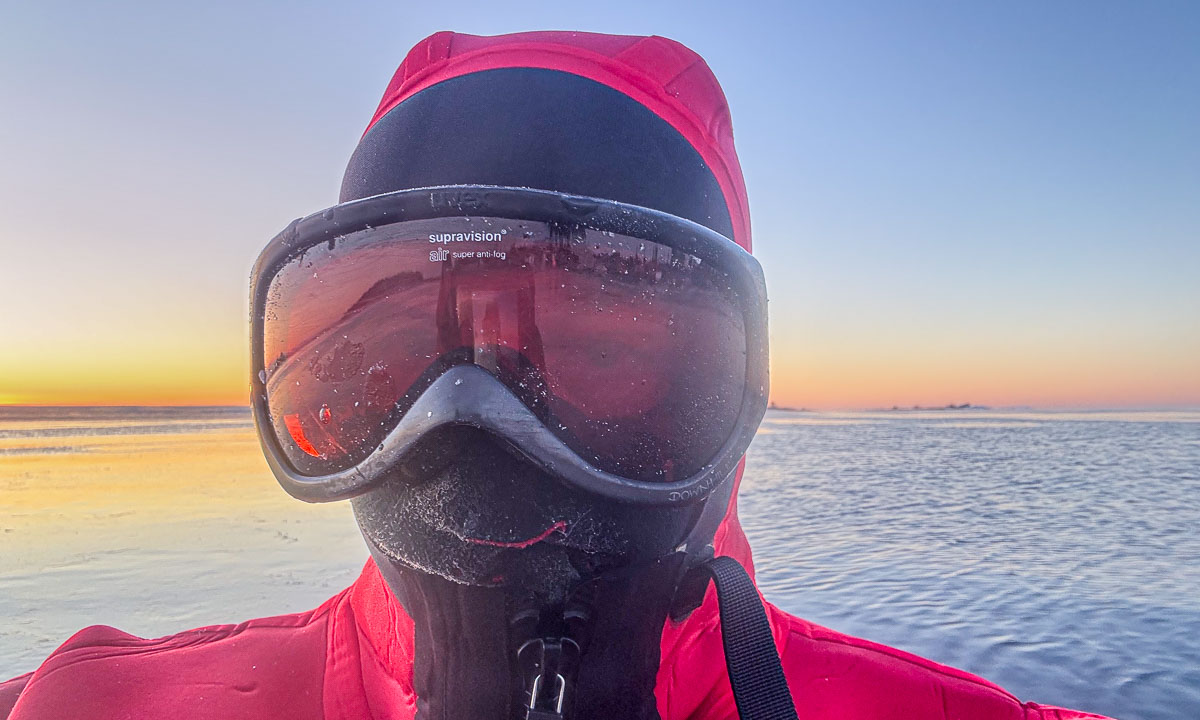
And then home again, which lies to the north-northeast – that’s where the cold wind and snow come from. I can feel the cold air behind my face mask. Time to put on the ski goggles. (Nice side effect of being bundled up like this: you do not have to smile on your selfies ;-) )

I tried to take some more photos but was blown back by winds with around 1 m/s. Time to reach the ice edge – from there it’s less than 100 metres home.

The 3.8 km took me an hour. Partly because of the wind, partly because my neoprene survival suit is pretty stiff but mostly because of the photos I took. Even though my iPhone, in its waterproof case, hangs around my neck, it always takes time to put off the warm mittens and put the paddle aside.

Despite the forecast, it has been snowing all day and the kayak lying on the terrace is covered with snow. The survival suit is still drying in the shower. Sleeves and legs were encrusted with ice when I hung it up.


Low water level in Obbola

On the evening of 23 December, it got colder and frost patterns formed on the windows of the unheated winter garden.

It takes some effort to cross the new layer of ice in the bay when my wife Annika and I go kayaking on the morning of Christmas Eve, but we manage and most of the sea is free of ice.

Two days later – on 26 December – the situation has changed. It has become much warmer – up to +7 °C – and the ice is gone.

Yesterday – on 29 December – the water is gone as well, maybe caused by the storm Johannes that crossed Sweden two days before.

Today I have a day off and used the sunny weather to take a long stroll by the coast. The water level is even lower at –66 cm, so I walk part of my route in the Baltic Sea. Air temperature is around -8 °C and so you can see ice on the sea and on land, as well as huge fields of boulders that normally are underwater. Some photos from this morning:

Larger parts of the shallow bay Nagelhamnsviken by the camping ground Fläse have completely fallen dry. That looks pretty strange, when you know how it normally looks like.

The only thing we do not have at all in Obbola is any snow, but it seems to be a matter of days before it snows. And Tromsø – I’ll travel there at the end of the week – has 60 cm of snow right now.

Sunrise winter paddling

Three days ago it thawed and stormy weather crushed all the sea ice. The day after, the temperature dropped below zero again. This morning the weather was clear and calm at -12 °C. Time for another morning kayak tour, just like four days ago.

At 7:50 I stood on the leftovers of the old ice that covered the small bay. In front of me – a fresh layer of new ice. How thick may it be? I have the feeling it will not hold my weight.

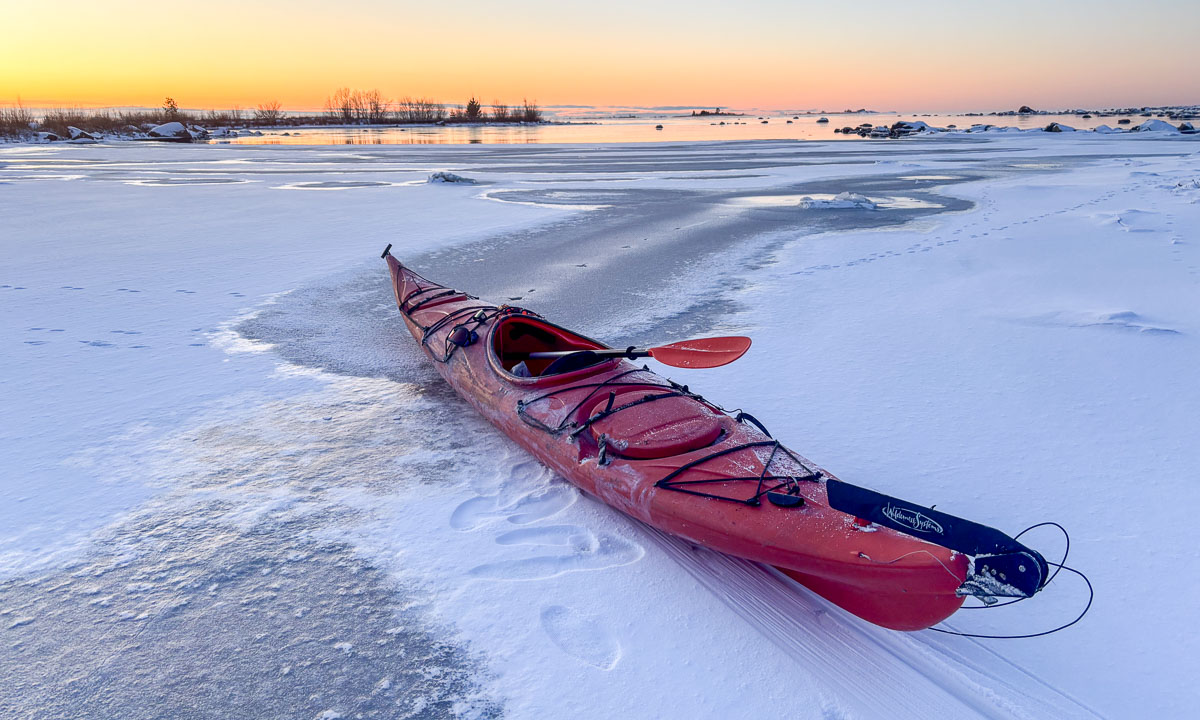
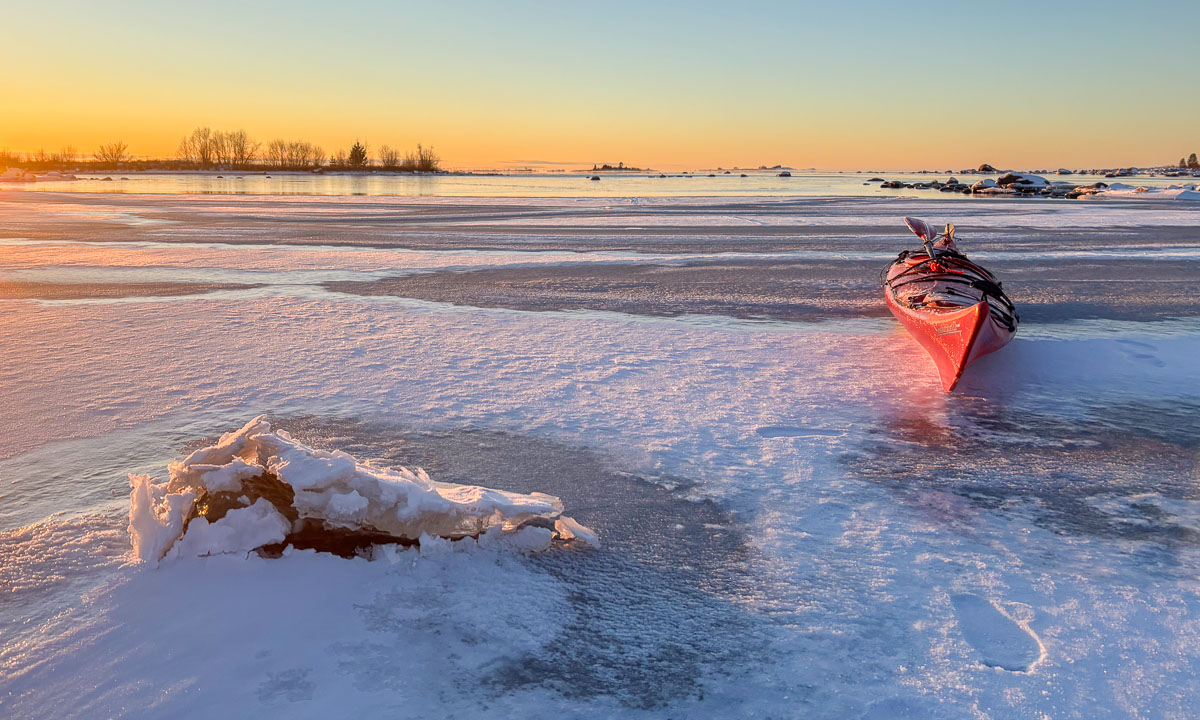
You see the photo above? The kayak is tilted sideways. That’s not because of the waves or because I’m edging, but because the kayak is lying on the ice. The ice is stable enough to bear us with me sitting in the kayak. I move forward by using ice safety picks that I drive into the ice in front of me and then pull the kayak and myself forward. It’s exhausting, but it works. I have done it many times before. The ice is approximately 3 cm thick.

But then the ice gets thinner and has exactly the thickness I loathe: between 1.5 cm and 2 cm. Then the kayak breaks through and is jammed in a narrow water channel, where it’s almost impossible to use your paddle – no open water reachable – or the ice picks – the ice will break when pulling. Luckily the water channels often tend to widen, so you can kayak back some metres, get some forward momentum using the paddle and break another two metres of ice. That takes a lot of time and extends the distance paddled by a factor of four or more.

But then – finally – I reach open water by the island Lillskär. It took me almost half an hour for less than 300 metres!

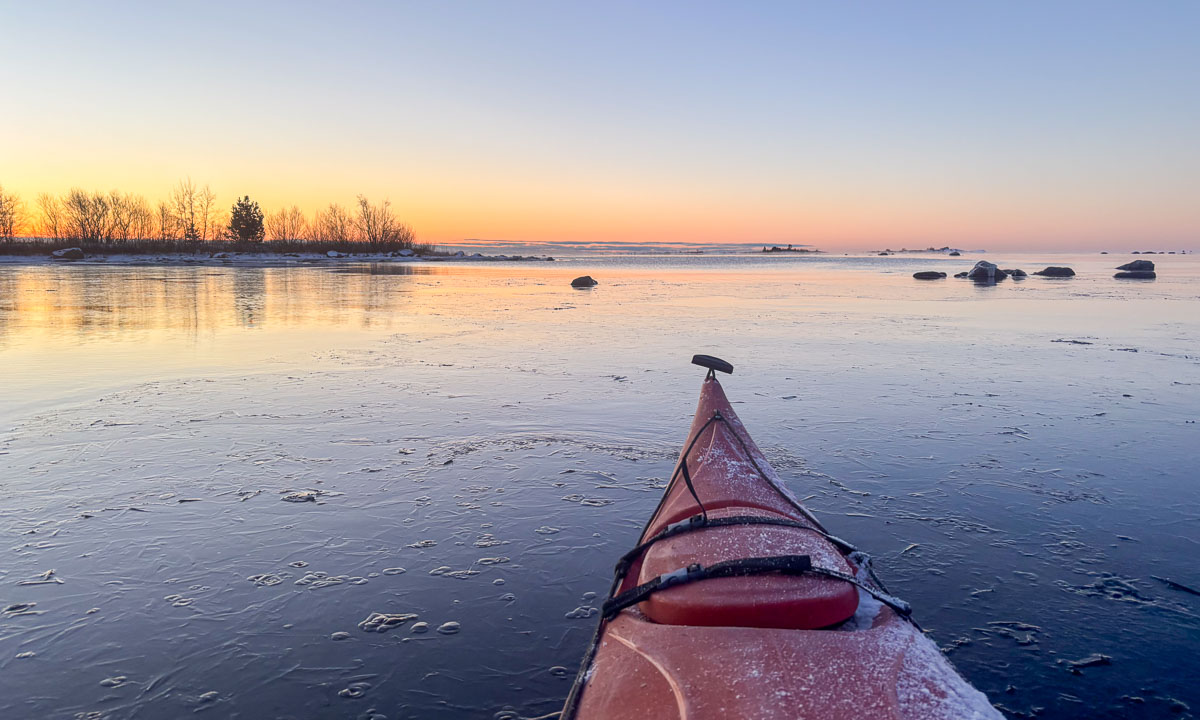
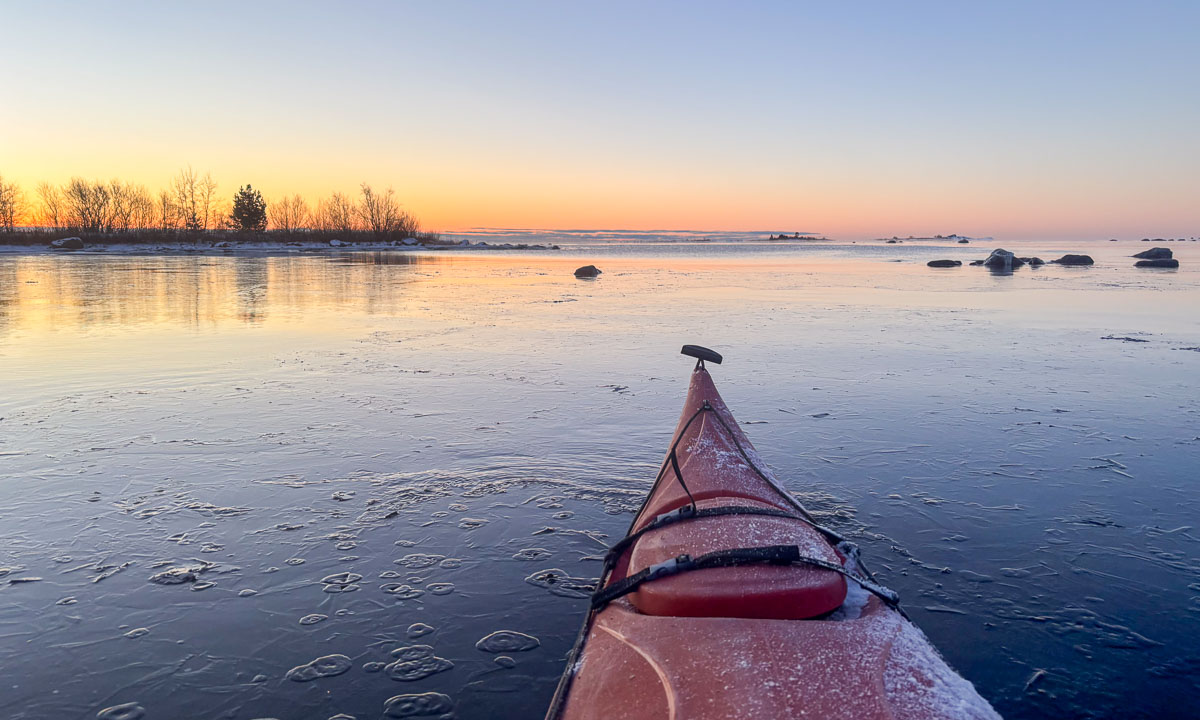
Anyhow I manage to reach the sunrise in time. Now the surface of the sea is multicoloured. The back of the waves are reflecting the orange horizon, the front of the waves the blue sky above.

Now I just paddle a short round, because it is a weekday and I have to work. Just some more photos with my mobile phone in its waterproof bag …

… before I return home. First it is easy, because the channel that I had broken through the ice is open and I can easily follow it. Then the ice gets thicker again. I’m tired and since the water is pretty shallow I exit the kayak and walk the kayak home. I learn that the ice does not bear me at all. So I break it with my knees or – when deeper – with my rear. I would not dare to do this with my kayaking drysuit, but today I wear my survival suit made of thick neoprene, which is very sturdy.

I reach the shallow part of the bay where I manage to grab a large piece of ice and put it upright. Time to play a bit with the translucent motif in front of the sun.

It is two o’clock in the afternoon when I decide to take another break from my desk to watch the sunset. To make a long story short – I got it. No kayaks involved this time.

Season’s first winter paddling in Northern Sweden

While there is a lot of snow in Tromsø, is is only round 2 cm here in Obbola in Northern Sweden. Here it is the coldness that defines the winter. Today I took my kayak and made a small tour on the Baltic Sea which is just outside the garden. With temperatures round -13 °C and a light wind it was pretty chilly. The small bay is frozen and you can walk on it and on the open sea thin layers of ice are building where the sea is calm. Here are some photos from today’s kayak tour.

Now the kayak is lying in the floor of the house. The kayak’s steering mechanism was frozen and is currently thawing.

Kayaking around Håkøya

Yesterday I finally had time to join the Thursday paddling in Tromsø again. The weather was calm and the tour leaders suggested to take a tour to the island Håkøya. After the usual preparations I entered the club’s kayak that I’d reserved – a Valley Etain 17,5 – waited for the others to be ready and off we went. Fourteen paddlers we were, including the tour leaders.

First we head west over the sound Sandnessundet. After 3 km we reach the northern tip of the island Håkøya.

First I was a bit disappointed about the gathering clouds after the clear and sunny day. Then I realised again, what wonderful light the combination of clouds and the low sun can produce. The houses and farms on the island look extremely picturesque in this light.

We slow down a bit and go on land to take a break. While sitting, eating, chatting we decide to circumvent Håkøya. Great – a new tour for me!

We enter the kayaks and continue our counterclockwise circumvention. Since I’ve been on Håkøya before I’m looking forward to some of the attractions such as the red sail boat anchoring near the shore and especially the 330-metre-long bridge Håkøybrua, built 1961 with its prominent wooden construction.

What however comes completely unexpected are the three catamarans anchoring on the southern side of the bridge. Huge, modern and probably ridiculously expensive sailing catamarans. What a contrast to the other sailing boats and the wooden bridge.

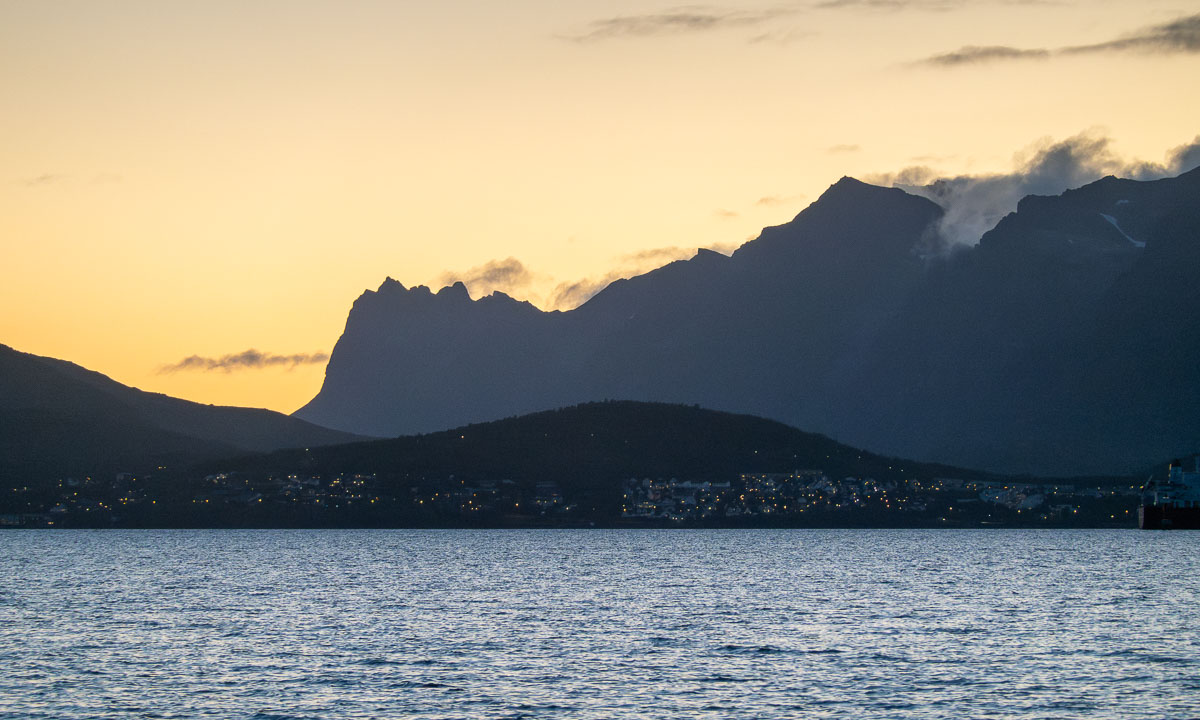
It is half an hour to sunset. The clear sky in the southeast has turned red and the light on the mountains is spectacular. Alas, My only camera on the water is my iPhone, so no telephoto shots.

When we reach the east side of the island the sea is getting rougher and choppier. The next photo is probably my favourite shot from the tour showing the sea, the evening light and some of my kayaking mates.

With the waves comes the wind and of course it comes right from the front. Together with the waves I have to focus more on paddling than on taking pictures on the last 3½ kilometres. Just two snapshots. On the second one you may see the lights at the kayaks. We’re in navigable waters with commercial traffic and we have to be seen. I have a light on the kayak as well and a second one attached to my life vest. And by the way, the clouds are vanishing.

After 13.5 km we arrive at the boat houses of the Tromsø Sea Kayakers Club at half past nine and it is pretty dark. Soon the kayak season will be limited not by temperature but by available daylight. Until then I’ll hopefully can join some more “Thursday paddlings”.

Here is a map of our route (including some zigzagging when taking photos.

I want to thank my paddling mates for good company and our tour guides for guiding and guarding. Takk for turen!


Fremdriftstak

Monday 19 May

On Monday I joined a kayak training on fremdriftstak. That’s Norwegian for forward stroke, the most basic kayak stroke. We had two experienced trainers, one for the euro paddle, one for the Greenland paddle. I joined the euro paddle group and learned some new details that hopefully will help me kayaking a bit more effortlessly in the future. The weather was a mixture of sun and clouds and the last hour it rained. Doesn’t matter, we are fully waterproofed when on the sea anyhow.

Thursday 22 May

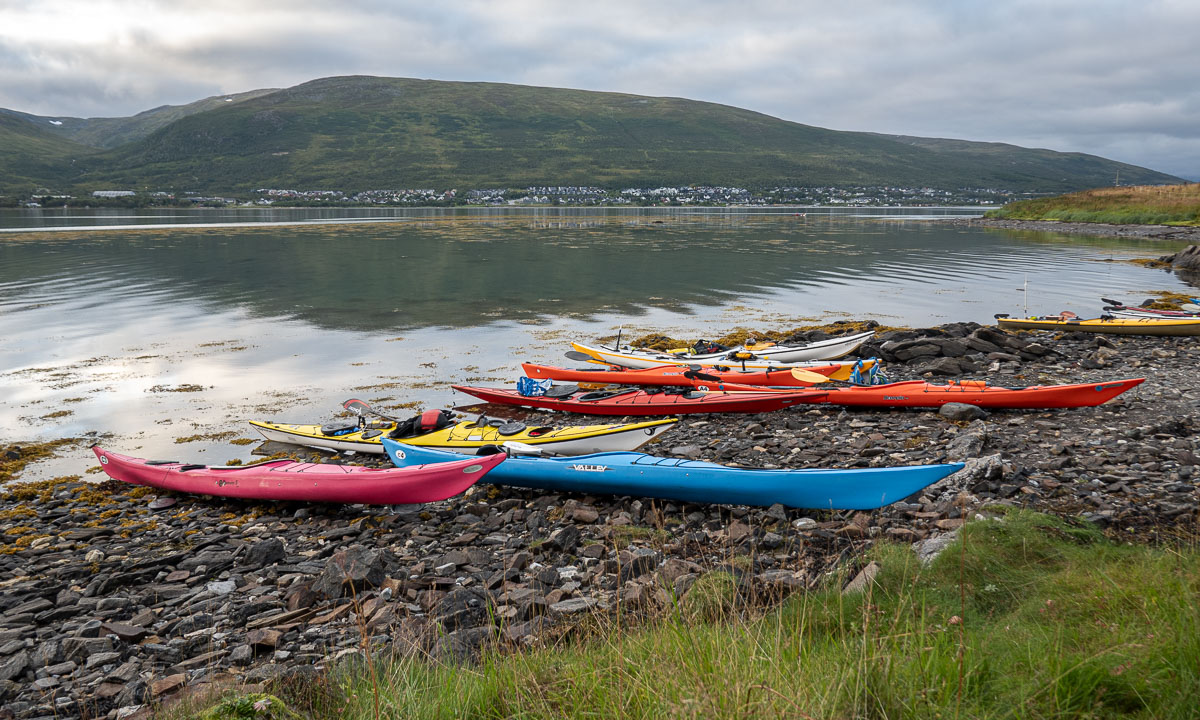
Yesterday was the regular Thursday paddling with eighteen eager kayakers and fantastic spring weather. I joined the group kayaking to the island Grindøya as the week before. While the tour leaders told us about their plans and checked, that we all know the basic communication signs, the colourful kayaks had already been brought to the shore.

My own kayak is in Sweden so I always rent a kayak from the kayak club. A good opportunity to finally test another model. I had used the same on Monday, now I checked it a bit again while waiting for the others to join.

We paddled to “Monsterbygget” – a large cuboid building that is one of the favourite orientation marks for kayakers. There we split and our group of eleven headed west to the island Grindøya.

It is round 2.5 kilometres to the southern tip of the island. A good opportunity to recap my learning from the Monday training. It went well but it will take time until it is in the muscle memory. At the small bay with the sandy beach we parked our kayaks. This is one of the two locations where you may enter the island during the bird breeding season. Time for a break, enjoying the sun, drinking water and eating chocolate.

On our way back we paddled along the western shore of the island. We saw a lot of eider ducks and other sea birds that I cannot name. After two kilometres we had passed the northern tip and were heading back to Tromsøya crossing the strait Sandnessundet.

This is a great season for paddling, especially on such a sunny day. The coast is green, the sea is blue (and very cold) and the mountains are still covered with snow.

In the south we could spot a ship. Where will it go? We decided to wait. The ship was sailing along the strait and since ships are not only much bigger than us but also much faster we decided to paddle back a bit and then to a sea mark north to wait for the ship to pass.

First the ship’s movements were hardly visible but when it approached it seemed to become faster and faster. While it was passing we spotted another ship in the distance, this time in the south and decided to cross the strait instantly. I took two photos, then I had to keep up and since we wanted to cross the strait quickly I didn’t make any further photos.

At half past nine we were back at the boat houses. Takk for turen – thanks for the tour!

Today

I’m proud. I paddled 11.3 km yesterday and I don’t have any pain in my right arm as occasionally after other tours. Just for that the training on fremdriftstak this Monday was a full success. Thanks, B. for your tipps and advice.

These are the two recorded tracks from kayaking to Grindøya. The first one from last week, the second one from yesterday.

From Obbola to Tromsø – home home and work home

Thursday, 20 March – Obbola

Annika and I are in Obbola, my “home home”. In the morning we get visitors. Three deer stand in our garden – always alert. Are they happy, that much of the snow is gone?

In my lunch break I am kayaking round the island Bredskär. That’s just 3 km. There is still some ice round the rocks at the shore, but much snow and ice has melted away the last weeks. What a warm winter.

Friday, 21 March

Annika and I take the car to Tromsø. We will make a stopover in Jokkmokk, because the total distance is almost 1000 km. Hejdå home home!

In warm and sunny weather we head northwards to Piteå and then northwest to Jokkmokk. Now we are north of the Polar Circle.

In Jokkmokk we meet a good friend and take a walk round the lake Talvatissjön. Around the sun a halo appears .

Saturday, 22 March

After a good sleep in the hostel Åsgård Annika and I continue our car trip. Gällivare, Kiruna, Abisko. Torneträsk – the 6th largest lake in Sweden – is still completely frozen. Good for recreation such as skiing.

Parts of the road were closed some days ago. You can still see some remains of the snow storm.

Some weeks ago it would have been impossible to drive from Jokkmokk to Tromsø in daylight. Anyhow two days ago astronomical spring has started and the days are as long as everywhere. After hours of driving the sun is low but visible. It illuminates the beautiful clouds. And then we arrive at our apartment in Tromsø, my “work home”.

Sunday, 23 March

On Sunday the weather gets nasty. Max temperature: +9 °C and wind gusts up to 23.5 m/s. Annika and I take a promenade anyhow. With spiked shoes because some of the ways are just bare, wet ice and the friction is next to zero. We arrive at home before the rain. Good luck.

Monday, 24 March

On my way to work I spot the first spring flowers in front of the Tromsø Cathedral. I could believe in spring …

Tuesday, 25 March

… but do know the forecast and it is correct: Snow, snow, snow on the next day. So it looks like in the morning outside of the apartment …

… and so in the afternoon, when I walked home.

So we did not solely travelled between countries but also between seasons. Anyhow I hope for some more winter days (or weeks), before my seasonal clock will jump to spring mode. Perhaps in mid-May?


Kayak – 3rd try and success

It’s less the temperature than the wind who makes the sea ice on the Baltic Sea vanish. Although we had -10 °C this morning the sea was more or less open. Time for a slightly longer kayak tour in the afternoon under a blue sky enjoying the calm weather.

But still there is some ice shield attached to the coast. As the days before I push myself forward using ice spikes.

First the ice holds then I crash through. It takes me 10 minutes to cross 100 metres of ice until I reach open water. Yay!

I decide to paddle round the islands Obbolstenarna. There is hardly any ice left on the way there but at the eastern shore it still looks pretty wintry.

The western part of  Obbolstenarna however looks like another season. Is winter over now? Anyhow, time to kayak home.

If you look carefully at the photo with the red bow of my kayak you see that the water is very smooth but with some crystal like structures. Let’s take a close look:

Despite of the sun air temperature is still below zero. Not only the sea water on the kayak freezes but new ice is also formed on the water surface. It is thin and fragile but so soft, that the smooth waves do not break it. An even closer photo (heavily edited):

Through this smooth though icy water I paddle back until I reach the ice edge again. I choose another place, take a run-up and paddle onto the ice. I’m lucky. This ice is more stable and I do not break through. I slide back to the shore. Meanwhile the sun is already low. I was slower than planned, because it took some time to take all these photos.