Just a pick-up at the station… – part II

< to part 1

Tuesday, 22 July

When I wake up early, the mountains and the sea have vanished. Thick fog surrounds our overnight stay Marmelkroken on the island Andøya. I take a walk through the wet grass to the bird observation place but beside of some seagulls and a lonely curlew that flies around there is nothing to see.

One hour later Annika and I sit inside enjoying our gorgeous breakfast. We get a table-side presentation of the dishes. More or less everything has been produced locally and we eat it all.

Then we head of. We want to catch the one o’clock ferry in Andenes that will bring us to the next island Senja, second largest in Norway (again, when we ignore Svalbard). The weather soon gets fair again, but around the mountains still some clouds are hanging.

Yesterday we took the western road, today we cross the boggy island to take the eastern one. On the way there we pass the village Å. There are several Norwegian places called Å, the most famous one is on the Lofoten. The next stop is the octagonal church in Dverberg.

A bit north near Myrset there is a huge area of peat mining. Andøya has large areas of peat bogs and parts of it has been drained to extract the peat. I climb on a hill of peat – it bounces like a water bed – to take some photos of this moonscape. Then I protect my camera lens, because each step emits a cloud of brown dust. But that’s nothing compared to the huge double-wheeled tractors anyhow that produce huge clouds of peat dust while driving. My car is brown now.

We take it easy, we have time – that’s what I thought. When we however arrive at the ferry terminal it becomes quite obvious that we would not join the next ferry. Too many cars are ahead of us waiting. So the one o’clock the ferry departs without us, leaving us behind but in a much better start position. Now we have to wait for four hours. Time to explore Andenes a bit.

As hoped and expected we find place on the next ferry. Now we are on the way north to Senja. Soon we are in open water, accompanied only by some sea birds.

The ferry trip takes one hour and forty minutes. Then we arrive in Gryllefjord on Senja.

Unfortunately we won’t catch the last ferry to Kvaløya today, they are not coordinated. We have to drive via the mainland – a large detour. Although it is another detour we decide to take the coastal route. 289 more kilometres to go which means a five hour drive in Norway. It is evening and we will make less breaks now.

Stop one – Tungeneset, a scenic rest area.
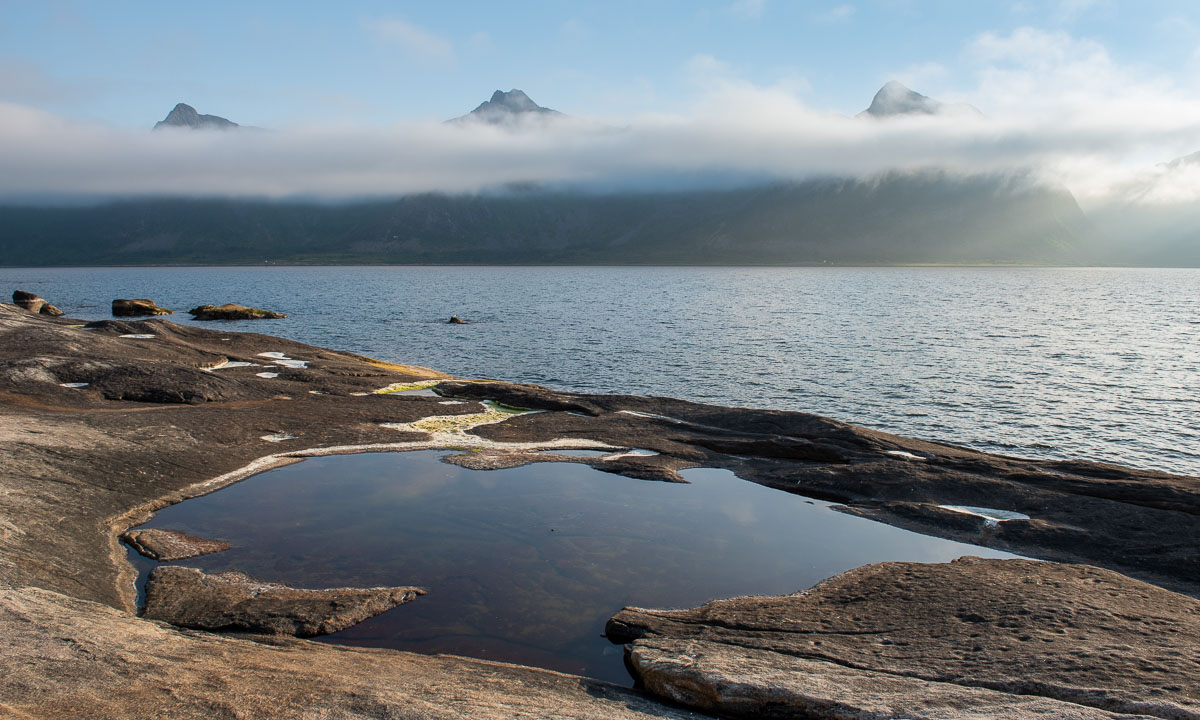
Stop two – another one of the many beautiful views on a fjord and the mountains on the other side. Here we see something special: a cloud waterfall. Clouds fall down a steep mountain range where they vanish in thin air. New clouds come from behind. The cloud waterfall is several kilometres broad and looks like a huge waterfall in slow motion. An impressive view.

(Note to the meteorologists: is this a orographic cloud spillover?)

We take the bridge from Silsand to Finnsnes. After two days we are on the Norwegian mainland again. Although it is still midnight sun season – the sun won’t set, it just moves lower and lower until it is hidden behind the mountain. I took the next photo at eleven o’clock in the evening.

At half past twelve we arrive home in Tromsø, my “work home”. Although it was only one evening and two days of travelling together it felt like real holidays.

We think about doing the same in half a year. I have to check the ferries, but it would be interesting to visit the same places in wintertime.

Just a pick-up at the station…

When Annika travelled to me last weekend, her train from Boden to Narvik was cancelled and the next and last train was heavily delayed. Unfortunately train problems have become common in Northern Sweden over the years. I had to use the airplane several times because trains didn’t run at all for days or it was impossible to buy tickets.

To keep Annika from being stranded, I drive to Narvik to fetch her. From Tromsø it takes me about three and a half hours plus some breaks.

Meanwhile Annika has booked a hostel in Bogen where we stay overnight. Our plan is not to drive back the direct route, but to visit the islands Andøya and Senja.

Monday, 21 July

The next morning starts sunny.

However it soon gets foggy. After crossing the Tjeldsund we are on Hinnøya, the largest Norwegian island (when we ignore Svalbard). We decide against a swim in the sea due to the fog and continue to Refsnes. From here go ferries cross the Gullesfjorden to Flesnes. On my trip to Narvik yesterday it was often 28 °C, now in the fog it is hardly 15 °C.

We have missed the 10 o’clock ferry, but they run hourly and we don’t have to wait for long. The journey itself takes only 20 minutes.

From Flesnes we continue to Risøyhamn. Hurtigruten travellers may know this place not only because it is one of the stops but also because of Risøyrenna – a man-made underwater channel that allows larger vessels to pass between Andøya and Hinnøya. The Hurtigruten ships has to go quite slow there.

We take the bridge over the Risøysundet and drive through Risøyhamn. Twice. Because I didn’t know that it is so small. Only round 200 people live there.

The weather is sunny again and we become more beach focussed. The first beach is for having lunch. We share it with a flock of sheep.

The second beach is for bathing. 16 °C in the water – surprisingly warm for the region.

We continue north. To the west the Norwegian Sea. Next shore westwards is Greenland, more than 1500 kilometres away. Our next stop is much closer: a public toilet at Bukkekjerka. But what a one! It is a designed block of concrete and mirrored glass. From the outside you cannot look in, but from the inside you can switch the huge glass windows between being transparent or opaque.

Around this place – a lighthouse on a peninsula, interesting looking rocks, a baaing sheep and of course the sea.

We follow the coastal road further north to Bleik. Here you can find beaches and turquoise water as well as ridiculously looking rock needles.

After refuelling my car in Andenes we drive south again to Marmelkroken, where we will stay overnight. With an additional photo stop.

To part 2 >

Back to Tromsø

Friday

This week spring has come to Umeå and Obbola. Temperatures above 15 °C make the snow melt every hour and the first Tussilago blossoms in Obbola peek through the dry, brown grass. I take a promenade wearing a t-shirt and in the evening Annika and I sit by our barbecue place. The very same place that was snowed in up the top edge three weeks ago.

Saturday

The alarm clock rings at 1:00 in the night. It’s a dreadful time to get up, but there is a direct train to Narvik with a bus connection to Tromsø and this train departs in Umeå at 2:12.

Near Bastuträsk, 3:57. The bogs look dull and depressing. – Gällivare, 8:12- It is snowing but everything is wet. How deep might the enormous water puddle on the parking place be?

The lake Torneträsk, 10:29. Here it looks like winter, but I wouldn’t dare to step on the lake any longer. Somewhere in Norway, 12:08. Fresh snow covers the birch trees.

We arrive in Narvik punctual to the minute. Half an hour later the bus to Tromsø departs. A local bus and I’m back at my “work home” in Tromsø. The journey took 16½ hours from door to door.

In Tromsø it looks wintry. The average temperatures were above zero for 18 days, but not it’s slightly subzero and about 10 cm of fresh snow cover my car and parking place.

Sunday

I wake up at 5 o’clock. Sunrise was an hour ago and the sun shines on the freshly fallen snow. – 3 °C. I put on some clothes and walk to the beach to take some photos. But then it’s time to sleep a bit more.

So it looks like winter is still present here. It may take a bit of time until I can see the first Tussilago in Tromsø. I’ll post a photo of the first wild flower as soon as I find one.

#escapism – microvacation

Two days ago Annika took the train from Umeå to Narvik to visit me in Tromsø. But what do you do when there is no bus connection to Tromsø the same day? Normally you’d take a hotel and continue the next day.

This time we made it slightly different. I took the car to Narvik as well – a very stormy ride – and fetched Annika from the train station.

Then we took the car to Harstad and stayed over night there. The next day we went up early and waited for our transportation to arrive. The Hurtigruten ship MS Nordnorge.

We left Harstad round 7:45 and passed the ship Havila Castor. Havila Kystruten serves the same route as Hurtigruten.

Then we took an extensive breakfast that we had booked with our 6½ hour cruise back to Tromsø. After that we listened to a lecture about the Arctic and the Antarctic. Then one of the main attractions followed: the hot tubs at the stern of the ship.

To my delight the weather forecast was wrong. It didn’t rain the whole journey, it snowed. That’s much nicer when you travel in February – even in the hot tub. Sometimes snow fall was intense enough to hide most of the scenic mountains we passed. A pity for the tourists.

At the Norwegian Polar Institute I often hear the tooting of the arriving Hurtigruten ship in the early afternoon. Now we heard it while we were standing on the top deck, passing the southern part of Tromsøya, where I live and then the Framsenteret, the building where I work. When we arrived I went to the car deck and fetched my car.

After arriving in my small apartment we were quite tired but decided not to take a nap but a walk to the bay Telegrafbukta. The reason: 15–20 cm fresh snow had fallen in Tromsø and it was still snowing. Just beautiful. The forecast however predicted warmer weather and a lot of rain for the next day.

This time the weather forecast unfortunately was correct. Today it really has been raining most of the day and the snow transformed into large puddles of ice and brown slush. Well, we will have snow and cold temperatures the day after tomorrow, when we travel to Svalbard for a week.


Norwegian summer journey I

This article is part of the series “2021-08: Northern Norway”.

Annika and I have two weeks holiday and are travelling through Northern Norway. Our southernmost point: Lofoten, right now we are in Hammerfest.

Ten images looking back:

10 – We are on the high plateau Sennalandet. There are hardly any trees and the road E6 crosses the plateau in a straight line. I can imagine how rough and lonely this place may be in winter.

9 + 8 – The Øksfjordjøkelen is definitely worth the 16 km detour. The parking place and the small path leading through the sparse birch forest grant impressive views on this glacier. When the weather is clear.

7 – It’s grey on our passage from Andenes, Vesterålen to Gryllefjord, Senja. I stand on the top deck of the ferry and wonder how many tourists may have rung this bell and what had happened then.

6 – We just left Andenes by ferry. The razor sharp mountain line of Bleik will soon transform into a whitish grey scheme slowly vanishing in the drizzle.

5 + 4 – It is grey on our short ferry passage from Fiskebøl, Lofoten to Melbu, Vesterålen, too.

3 – One of the typical features of the Norwegian landscapes is the presence of high summits and fjords. Sometimes the mountains are reflected in the water surface of the sea.

2 – Hauklandstranda is one of these incredible beaches on the Lofoten islands with white sand and turquoise water. The sun is shining – time for a bath. Air temperature 11 °C, water 12 °C. Not as cold as expected.

1 – We pass Sildpollnes kapell on the Lofoten twice. Once on our way south and once when heading back again. There’s a parking place by the road where stairs and ways lead up to some hills that present a view over the landscapes around.

0 – On Saturday I leave Tromsø to fetch Annika from Riksgränsen train station in Sweden. It’s still not possible to travel further to Narvik by train. Our destination today: a room in Tjeldsundbrua.

On the road III – Hemavan—Sneringsvika – 296 km

From the wintry fjäll to the rainy coast

It’s only one day of travelling, hardly 300 km, but today was filled with a lot of varying great experiences and feels like a complete holiday.

After breakfast I leave Hemavan behind and again I travel to Norway, this time taking the road 73 via Joesjö. It’s just below zero and it’s snowing. I cross Norway and now the snowfall intenes. It’s snowing handkerchiefs and the visibilty is poor. Within minutes the road is covered with a fresh layer of snow.

The heavy snowfall lasts only short and soon visibility is much better. Twice I pass an open barrier. This route section can be closed when the weather is severe. If this should happen to me I’d choose to wait on the western side. What a cozy shelter the Norwegians have built there.

Now I’m really in Norway. It’s just impossible to describe the zillions of different impressions. It’s the endless combinations of different landscapes, different moods and different weather that makes travelling through Norway so interesting and inspiring.

An example image, from bottom to top: a river rushing through a canyon. Above that a hill with a green coniferous forest. Above that a mountain with a forest covered with fresh snow. Above that a high mountain over the timber line, completely encased with white snow. Above that clouds bringing snow or rain (depending on the altitude) and the sun trying to peek through a cloud gap. And that’s one of a thousand images.

I do not even try to photo all the different scenic moods because it would take ages. And by the way: there are hardly any parking opportunities by the roads.

So I publish just some travelogue photos, mostly taken through the windscreen.

At 14:25 I arrive in Vennesund. Here I have to take a ferry to continue my trip south. An hour later my car is in the belly of the ship and I am on deck. It’s windy, but warm with +4 °C. I’m the only one on deck. The journey takes only 20 minutes.

After leaving the ferry I continue my road trip and the landscape is as gorgeous as before.

Anyway I got quite tired and I’m longing for a cosy place to stay. I plan to take the first opportunity. At the branch, where the 802 leaves to Bogen I see some kind of camping kiosk. I leave the car and meet an elderly man, who gives me his cabin for a night. It costs 800 NOK, but first it’s Norway and then this cabin by the fjord is a welcome luxury after travelling by car for three days.

Now I have to check the weather forecast for tomorrow. I’m in a winter mood and long for snow!


On the road II – Jäckvik—Hemavan via Norway – 300 km

When I look through the window of my stuga in Jäckvik I see, that my car is covered with snow. Appoximately 8 cm have fallen over night. I take a frugal breakfast, pack the car, clean the room and pay for the stay. Then I continue my zigzag car trip south. Today I want to reach Hemavan. I prefer the way via Norway to the way through the Swedish inland.

I drive northwest on the road 95. Due to the warm weather of winter 2019/20 many watercourses are still open.

After 40 kilometres I cross the polar circle again, but I’m more intested in the small shop where I buy food and goodies. (What’s a road trip without goodies?)

I continue following road 95. The road slowly ascends and the trees give way to the treeless kalfjäll. After a while I leave Sweden and enter Norway.

In Norway I expect higher mountains (when visible in the snowy and foggy weather) and tunnels. But first I have to wait. A Latvian truck blocks the road. The driver already had put snow chains round some tyres but in vain. The  road is covered with slippery ice and the wheels carve themselves deeper and deeper into the thick layer of ice. It doesn’t take long until a man from vegvesen arrives to free the truck. The magic ingredience? A lot of sand!

The road is free again and I continue driving. And there they are: mountains and tunnels. “Norwegian essentials.”

It has started snowing more intense. The road 95 descends and leads through forests until it meets the E6, the European route connecting many Norwegian cities from Oslo to Kirkenes. It’s the first time that I turn left, in direction Mo i Rana. There I want to take the E12 back to Sweden again. But first the E6 leads over another mountain passage.

After this passage the road descends and both weather and road gets a bit ugly.

Normally I had turned onto the E12 in Mo i Rana but today Google Maps was my Navigator. It recommends to turn left already in Røssvoll. I follow a tiny path and stop in front of a small suspension bridge. Is it really for cars? It is, other cars use it, too. So I cross the river Raneelva and follow the narrow winding path through forests and settlements. A nice route, but probably much slower than turning in Mo. By the way: the locals don’t seem too happy me using this road. They all glare at me. Perhaps there are many others, who follow Google Maps’ shortcut as well.

The E12 rises and leads over kalfjell a third time this day. I make some photos on the parking places.

Soon I am back in Sweden. I love the bare mountains and so I really enjoyed the ride today. But not it starts getting dark and I am longing for a bed. So I continued to Hemavan without any breaks. I arrived there 16:20 and get a room in the Fjällcenter. Tomorrow I’ll even get a real breakfast! Luxury!

Travelling with the MS Lofoten: Øksfjord – Stamsund

This article is part of the series “2019-02: Northern Norway”.

Disclaimer: Many, many photos, some of them pretty mediocre but all part of the journey.

Still Saturday, 16 February

After we left Øksfjord we continued our journey through the darkness. The people on board were idle, they chatted, read a book, look through the window and of course most of them used their computers, tablets or smartphones.

Three hours later we were in Skervøy, stop #9 of my Hurtigruten journey.

After a short stay we continued to Tromsø, Norway’s largest town north of Trondheim. I took a night image of the passing Hurtigruten ship MS Trollfjord then I went to sleep.

Our stays in Tromsø and Finnsnes I overslept completely.

Sunday, 17 February

At 7 o’clock I woke up, half an hour later I stood outside and took the first pictures in the blue hour. The weather was much better than the other days and the temperatures had dropped below zero in the night. We were on our way to Harstad, with 25000 inhabitants the third largest town in Northern Norway. Stop #12.

While we were stopped in Harstad the sun was rising and was bathing the landscape in purplish light. Harstad started to glitter. It was the many windows reflecting the warm sunlight.

The sun rose higher and after a while the sky was blue. I stood outside with my large telephoto lens and tried to catch the impressive snowy mountain ranges by the fjords and sea.

Risøyrennan, a deepened part of Risøysundet came into view.

After a short stay in Risøyhamn, part of the Vesterålen and stop #13 of my journey we continued south. The sheltered  was covered with a closed layer of thin pancake ice. You could hear it crack when it met the bow wave of the ship.

Some more images taken between Risøyhamn and Sortland:

I left the MS Lofoten in Sortland, stop #14, but only for a short time. In Norway all shops are closed on Sundays and then the towns may be a bit boring. Partly the ways still covered with a bit of frozen snow, but mostly it was slippery ice and some deep water puddles. Home in Skelleftehamn it had been very warm the last days and I expect the same road conditions when I’ll come home in a couple of days.

After 30 minutes the MS Lofoten continued its tour. At the horizon the steep mountains of the Lofoten islands came into view.

The backlit Lofoten mountain ranges looked amazing as if they were from another world. I’ll show you two photos but I’m not at all happy with them. In reality the landscape looked more aerial or as if made of light.

These mountains were in the far. The nearer mountains to the left or right looked more normal when it comes to light but still unreal because they were so steep and snowy.

The large island Hinnøya on the port side, the island Langøya on starboard side of the ship I stood at the starboard and peeked through my telephoto lens. I have friends near Stokmarknes on the Vesterålen and was I looking for their house. I found it ;-). Unfortunately R. was ill but J. visited be on the ship with the children. They went on board while the ship lay at the port of Stokmarknes, stop #15. Shortly before departure my friends left the ship. Thank you very much for your visit!

Oh, I forgot the photo of the islet (or holm) Gjæva. I already knew it from earlier stays with my friends.

Now we headed for the impressive sound Raftsundet where we would even take a small detour to the entrance of the Trollfjorden. Due to the narrowness of the fjord and the risk of avalanches it’s not possible to drive into it in wintertime.

We left the blue sky behind us, the weather worsened.

First the weather still was quite fair but then it started to snow. The snowfall was so strong and the cloud layer was so thick and low that it was decided not to visit the Trollfjorden. You hardly would have seen anything.

The camera was wet, I was wet, too and it was so dark that it was near to impossible to take any pictures. It was twenty to five and I went into my cabin and took a nap.

Just some photos “for the archives” of the next stays: Svolvær and Stamsund, stops #16 and #17, both on the Lofoten.

Travel remainders

This article is part of the series “2018-03: Varanger peninsula”.

Some unpublished photos from my winter journey. I want to show them as long it is still wintry here.

2 February – Jokkmokk

While the grown-up huskies are doing their job the puppies have to wait in the trailer. I guess it is very boring for them. There are curious and seek contact.

21 February – Kirkenes

While Chris, Annika, Ørjan and I are enjoying the gorgeous breakfast in the hotel Thon an asian tourist is waiting outside. She seems to be well protected against the elements but why has the fur to be pink …?

1 Mars – Ekkerøy

On the way to Kiberg Annika and I make a stopover in Ekkerøy where we enjoy a beach walk. Here we meet H. who invites us to visit her. We will make that true some days later. I take a photo of Annika’s and H.’s footwear. Tradition, meet modern world.

1 Mars – Ytre Kiberg

Cape East Arctic Adventure, our stay lies directly at the beach. I could spend weeks with only watching the tides and the changing weather.

4 Mars – Ytre Kiberg

There’s hardly any commercial fishing left in the small former fisher villages and the large drying racks for drying cod remain empty. Some people however still dry cod for personal usage.

5 Mars – Ytre Kiberg

A view through the window of Cape East Arctic Adventure. Today we will continue our journey.

10 Mars – Berlevåg

We hardly have the time to explore Berlevåg, we only buy food. Two images of Berlevåg anyway. Just for the records …

11 Mars – Kjølnes Fyr

This snowstorm shaken rocky shore appears more arctic than many other places of this journey.

14 Mars – Hurtigruten, near Øksfjord

A woman has found a wind protected place and watches the Norwegian winter landscape.

16 Mars – Saltstraumen

On our long car trip back from Ørnes to Skelleftehamn we pass Saltstraumen, a small strait with one of the strongest tidal currents in the world. We are too early to see the strongest maelstroms and I’m too eager to continue home. It’s still 500 km to drive.

Now I finally can erase my “later” folder on the computer.