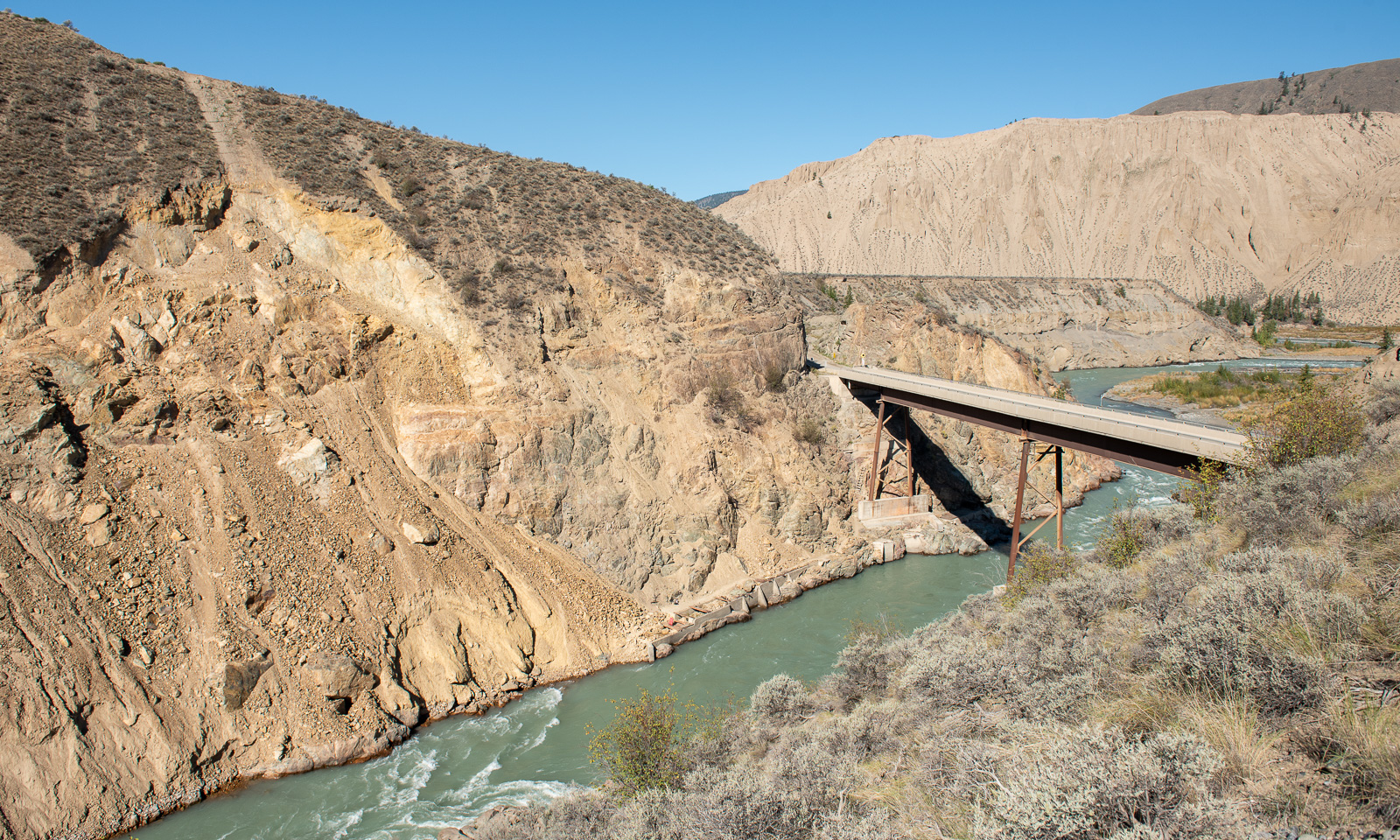
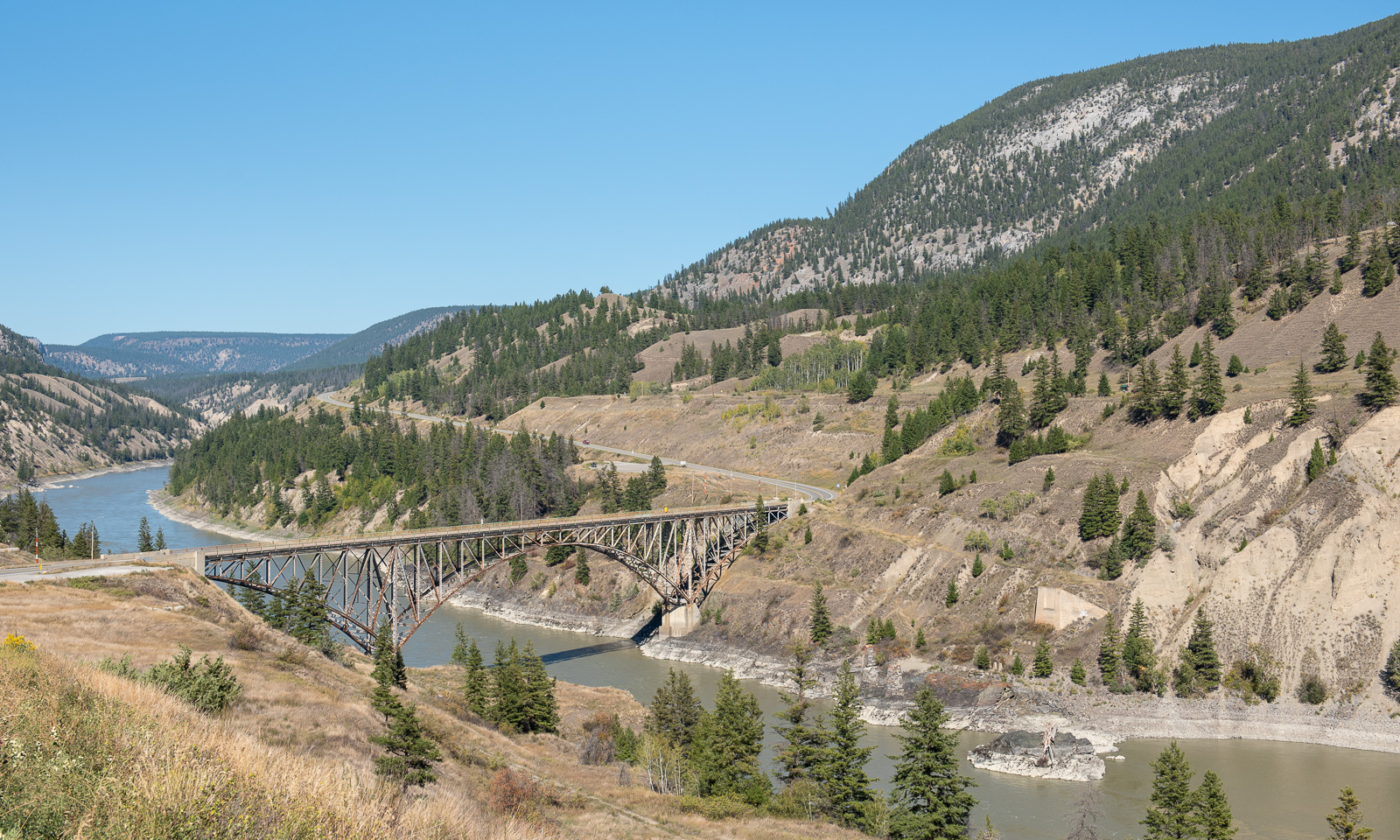
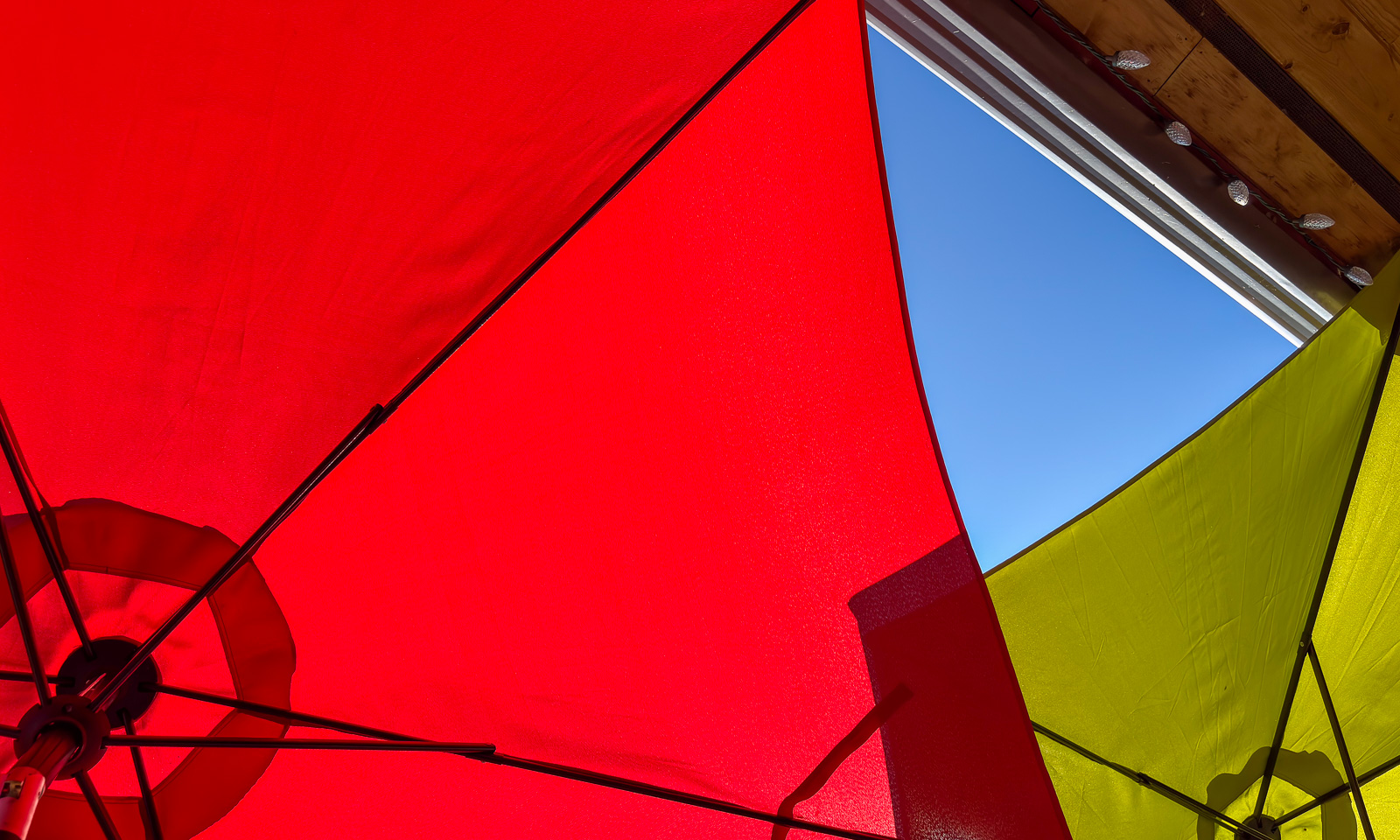
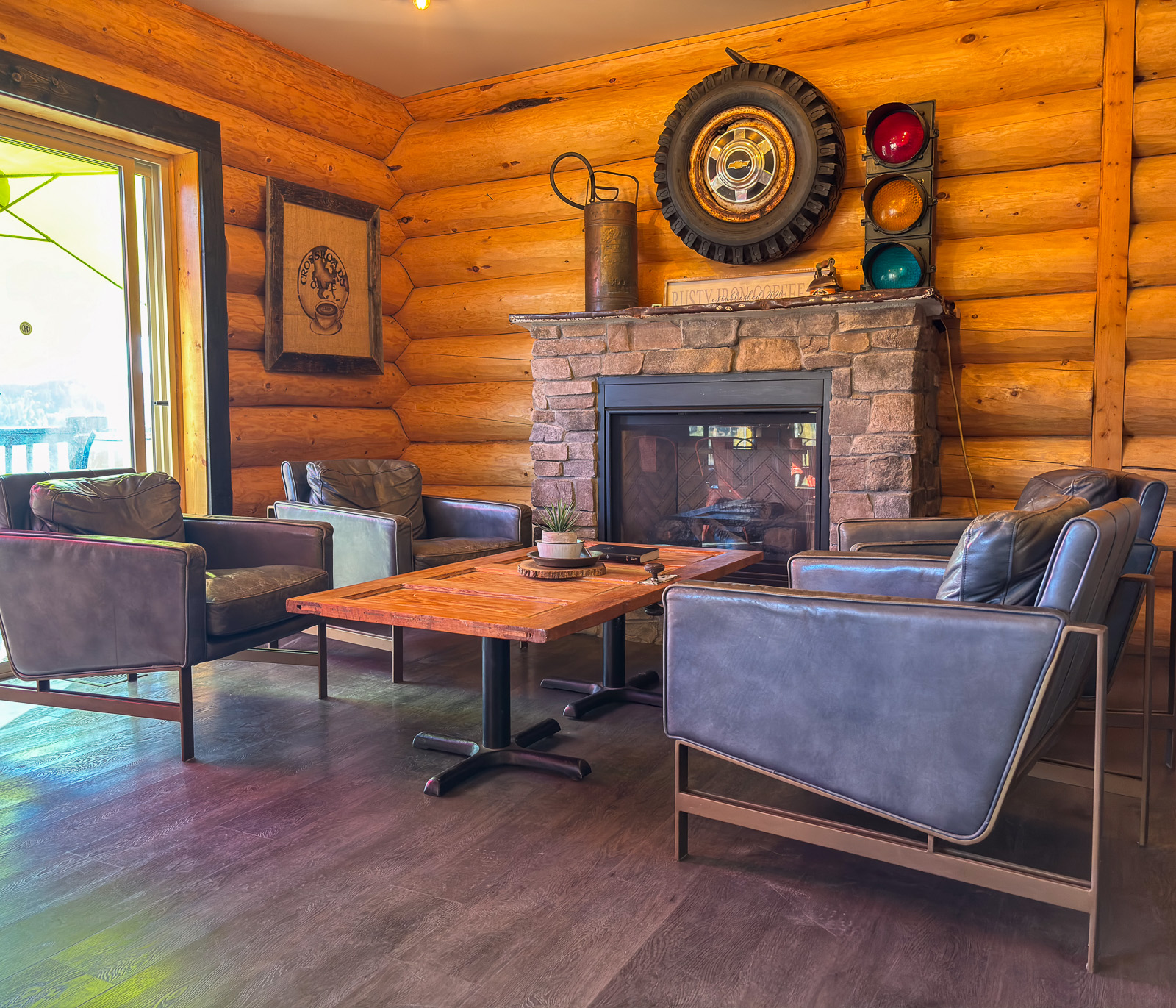
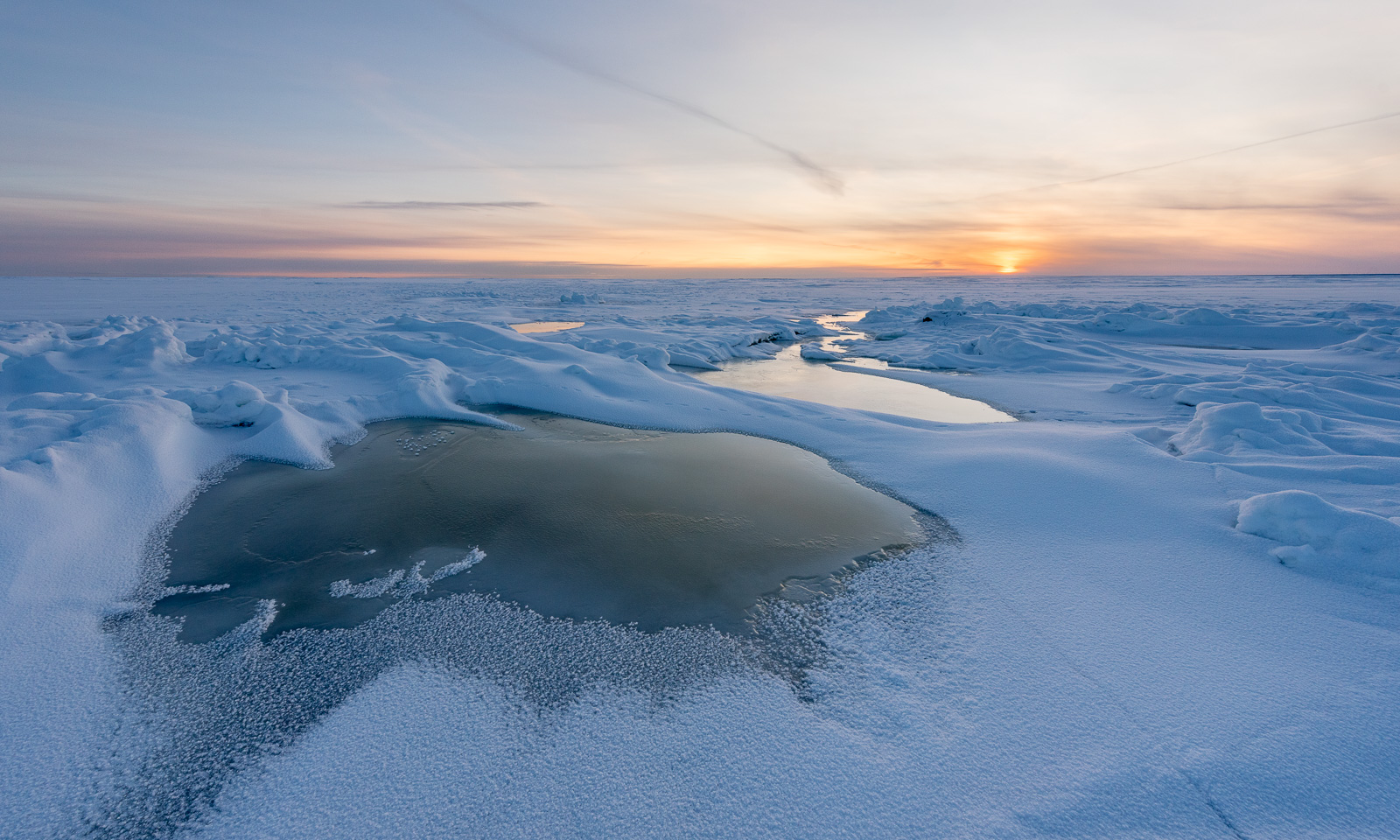
Scotland NC500 – day 1 – the road trip starts

This article is part of the series “2025-10: Northern Scotland”.

13 October

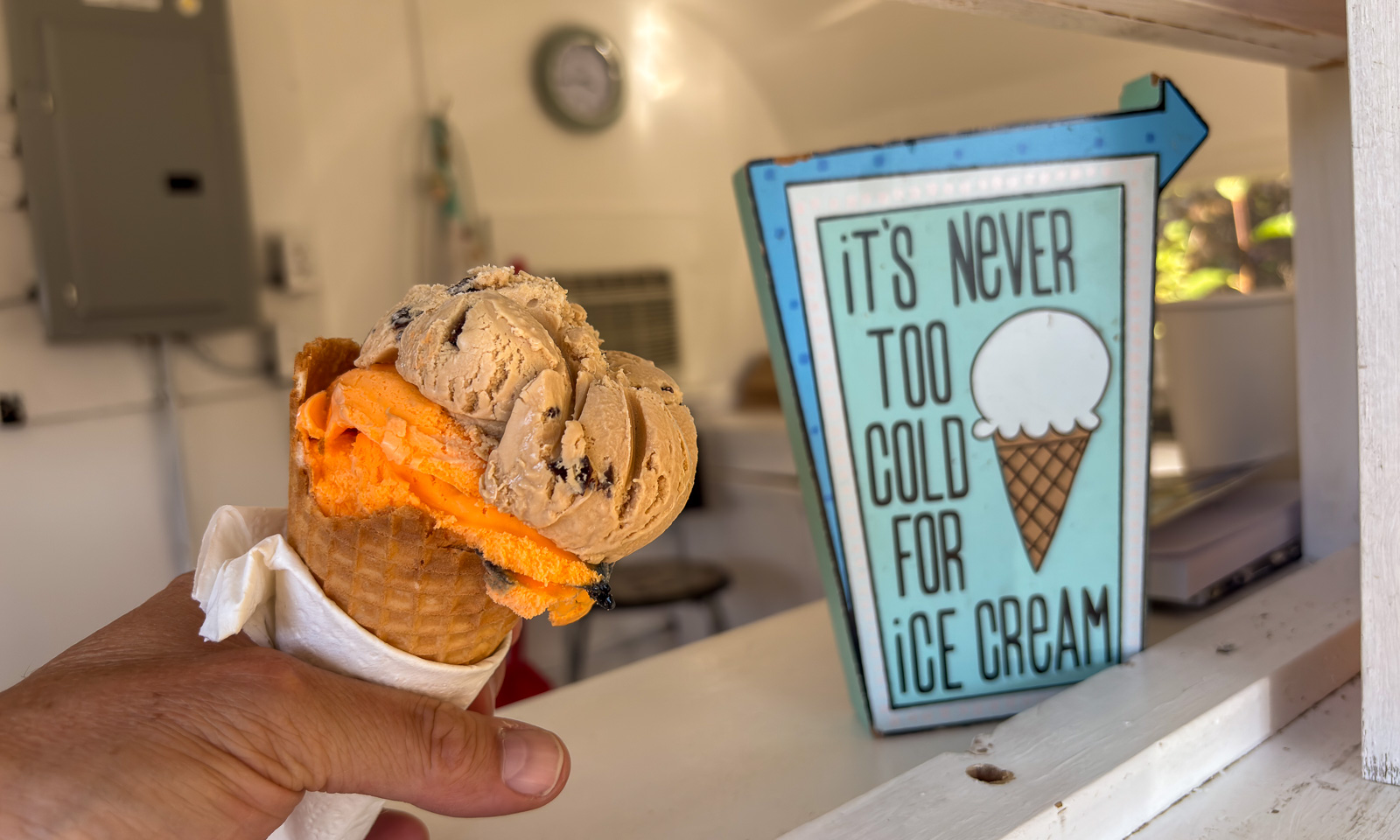
It is one o’clock. Annika has driven the first 70 kilometres in our rental car, and we’ve arrived in Dornoch. We already visited the cathedral with its beautiful stained-glass windows. Now we are sitting at the only table outside the SandStone cafe enjoying the sun. I also enjoy something else: An Irn-Bru, this legendary Scottish soft drink with its bright orange colour. It won’t be the last one the next days.

From there it is not far away to our first beach: Durness beach with its beautiful sandy shoreline. It has some features beyond the usual such as a park with outdoor metal musical instruments or the box where you can lend beach toys.

We continue our road trip, but instead of following the main route we take a detour to the Falls of Shin. It is said that in summer and early autumn the salmons swim up the River Shin to spawn. When they pass the Falls of Shin they have to jump up the rapids. I thought, October was already off-season, but we do not only spot the waterfall but also some jumping salmons. And another species: salmon watchers with their binoculars and cameras with huuuge telephoto lenses. With my smaller telephoto lens I manage to take some photos of a lot of water with a tiny fish. I wonder how the salmons master this waterfall? We have not seen any salmon succeed.

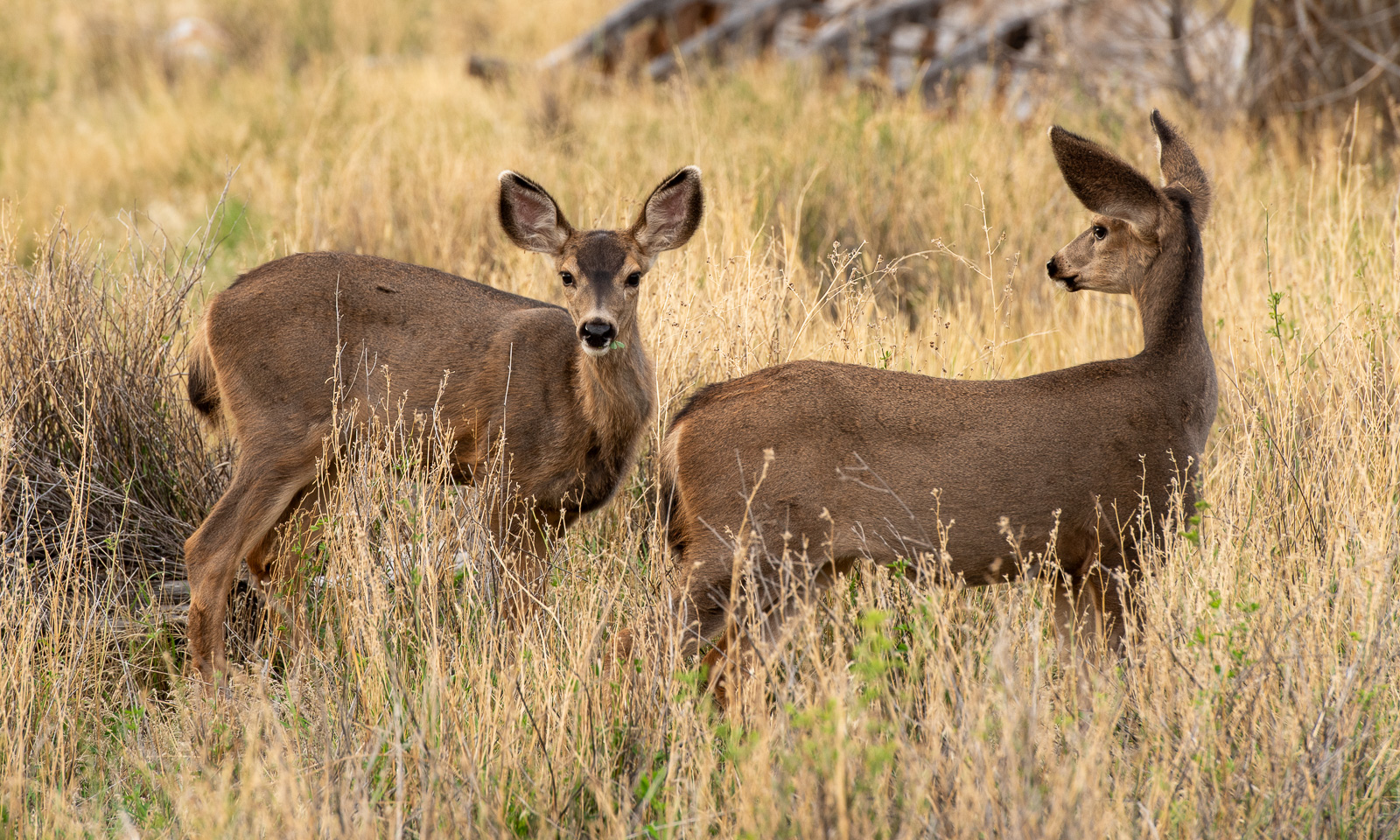
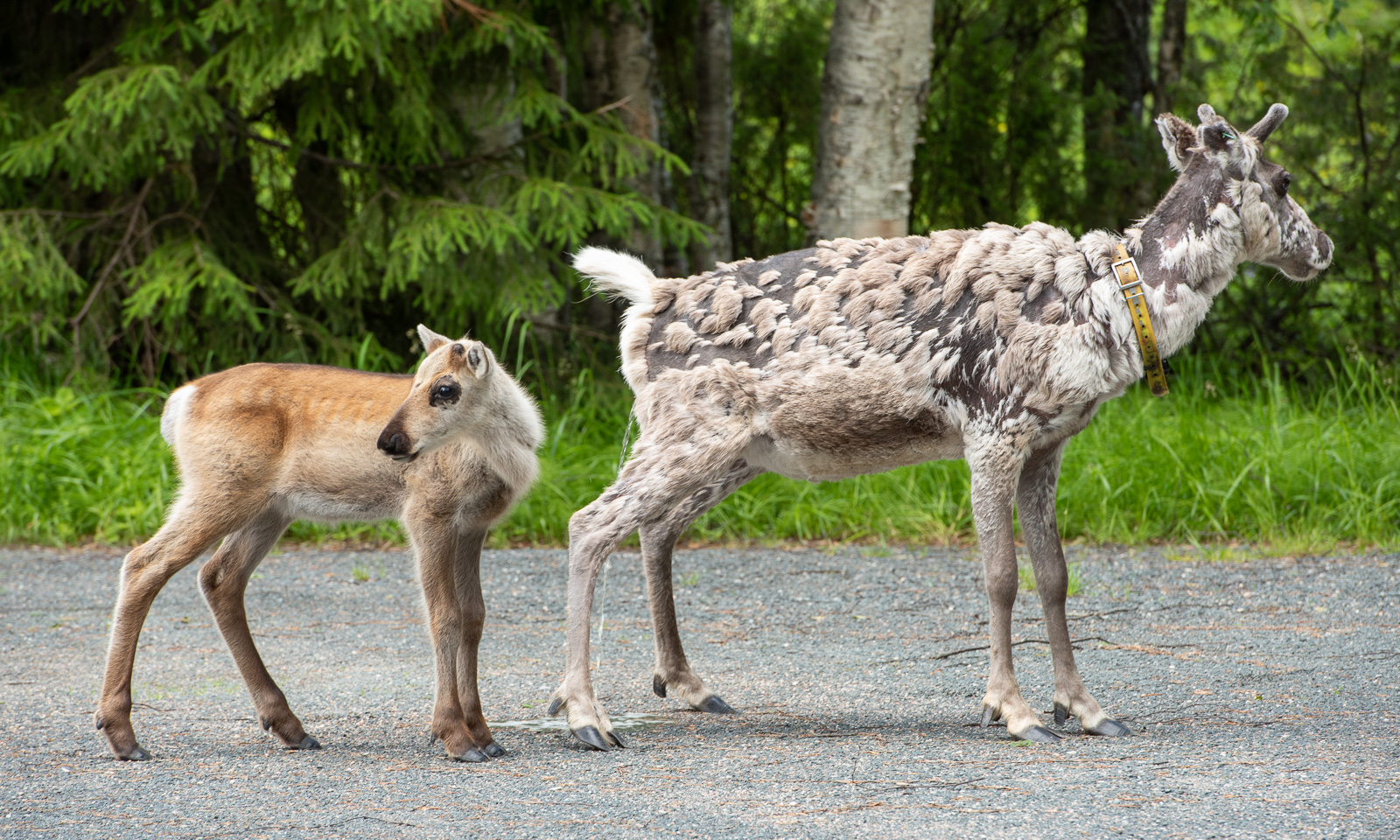
Back in the car we take the road north and pass Lairg. Then we pick minor roads that lead east again. A deer is crossing one of the roads, taking its time.

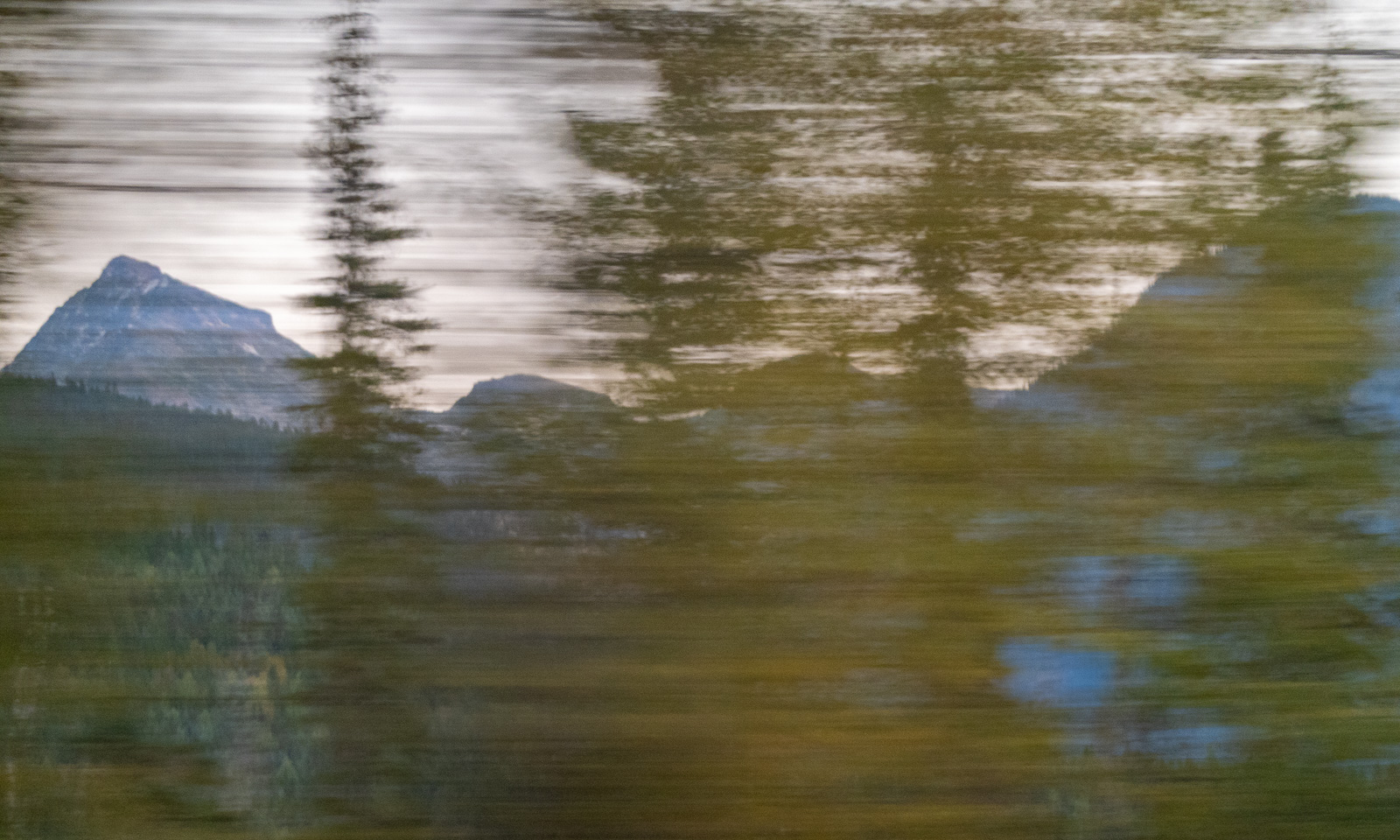
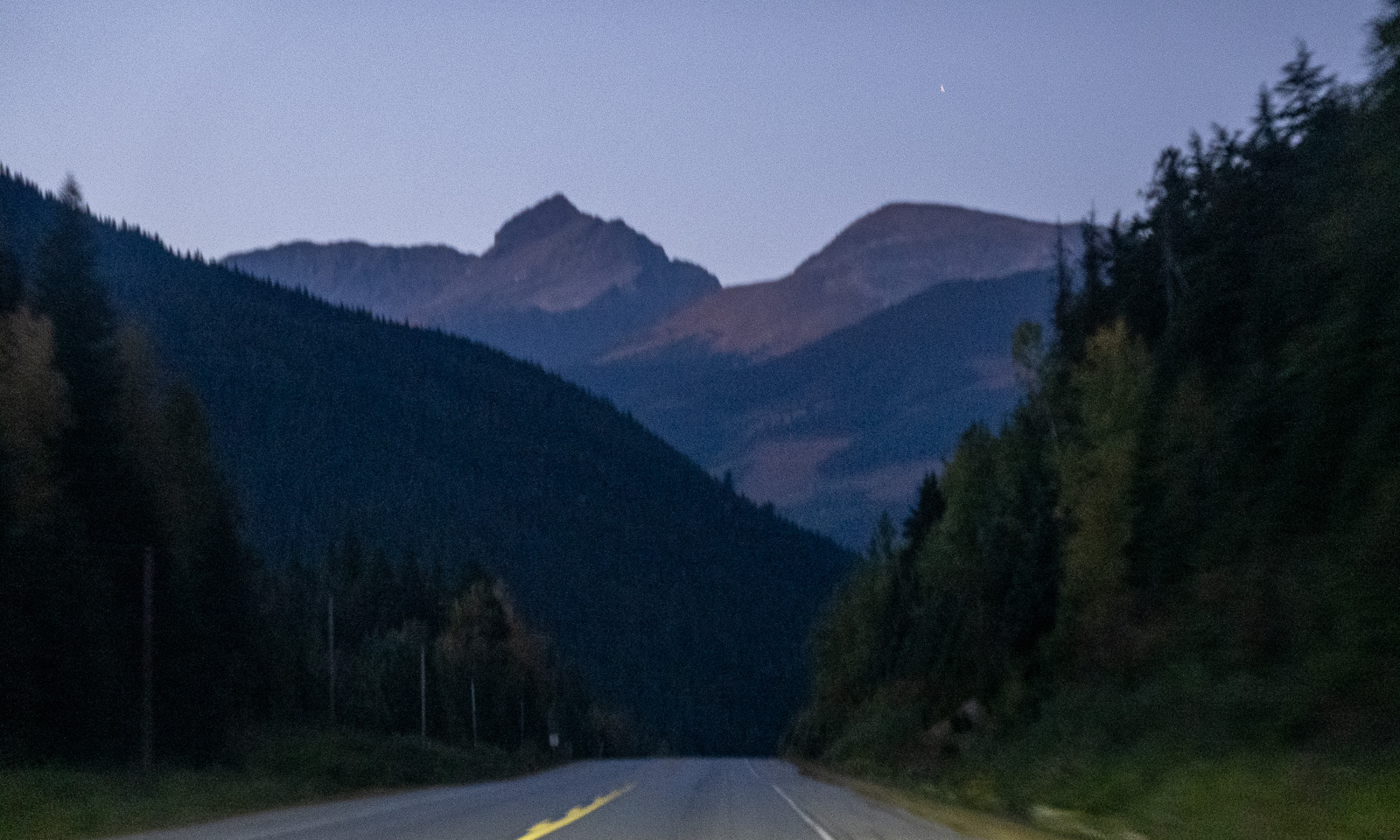
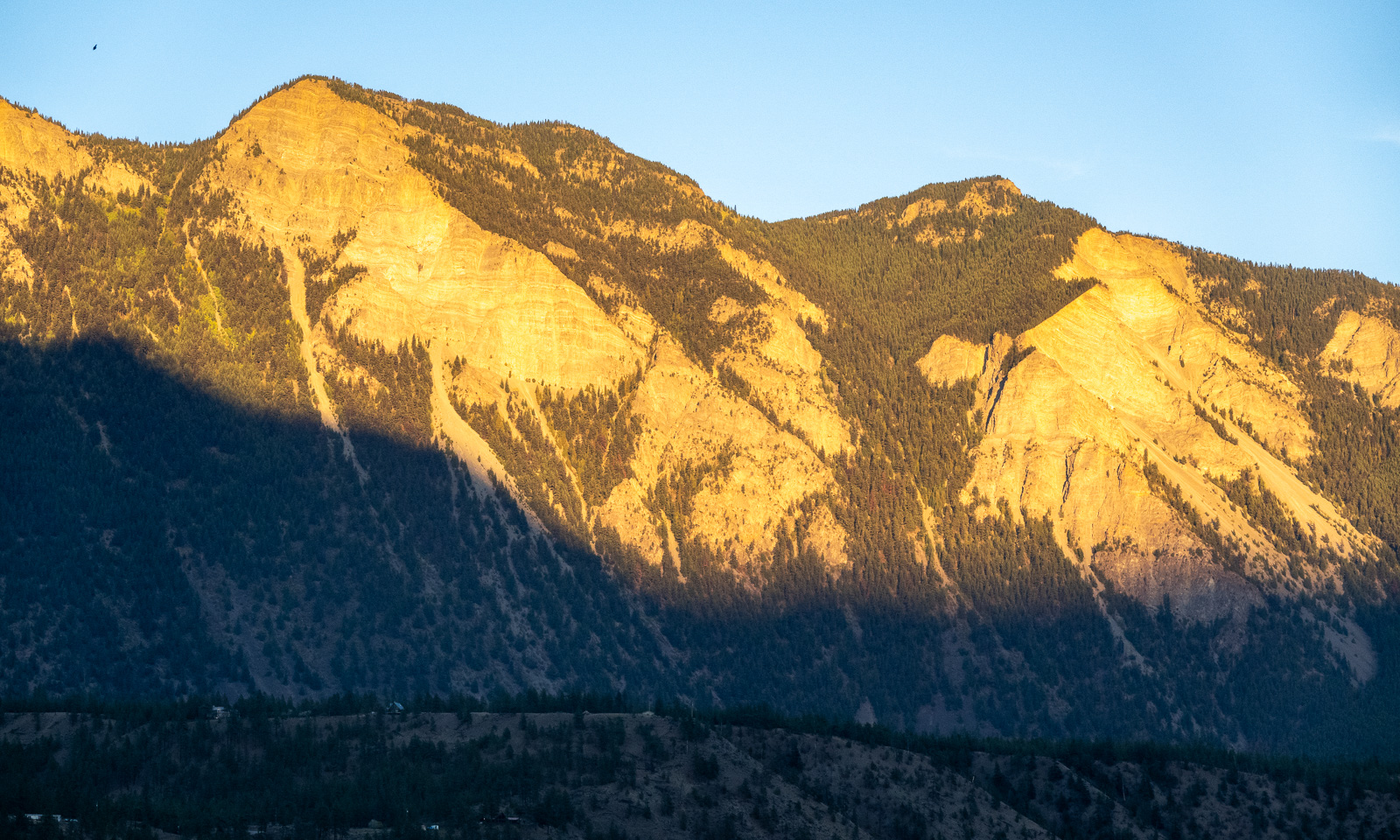
The sun is setting much faster than in Northern Europe and soon the colours of the scenery become warm. Photographers call this the golden hour and in my humble opinion it is especially beautiful in autumn.

It is not only the golden hour, it is the hour of the pheasants. First we see one here and two there, then some are on the road and all of a sudden a whole flock is blocking the narrow road. completely. They totally ignore our car and I have to exit, running towards them, waving my arms like a madman to shoo them away. Never have I seen so many pheasants in my life.

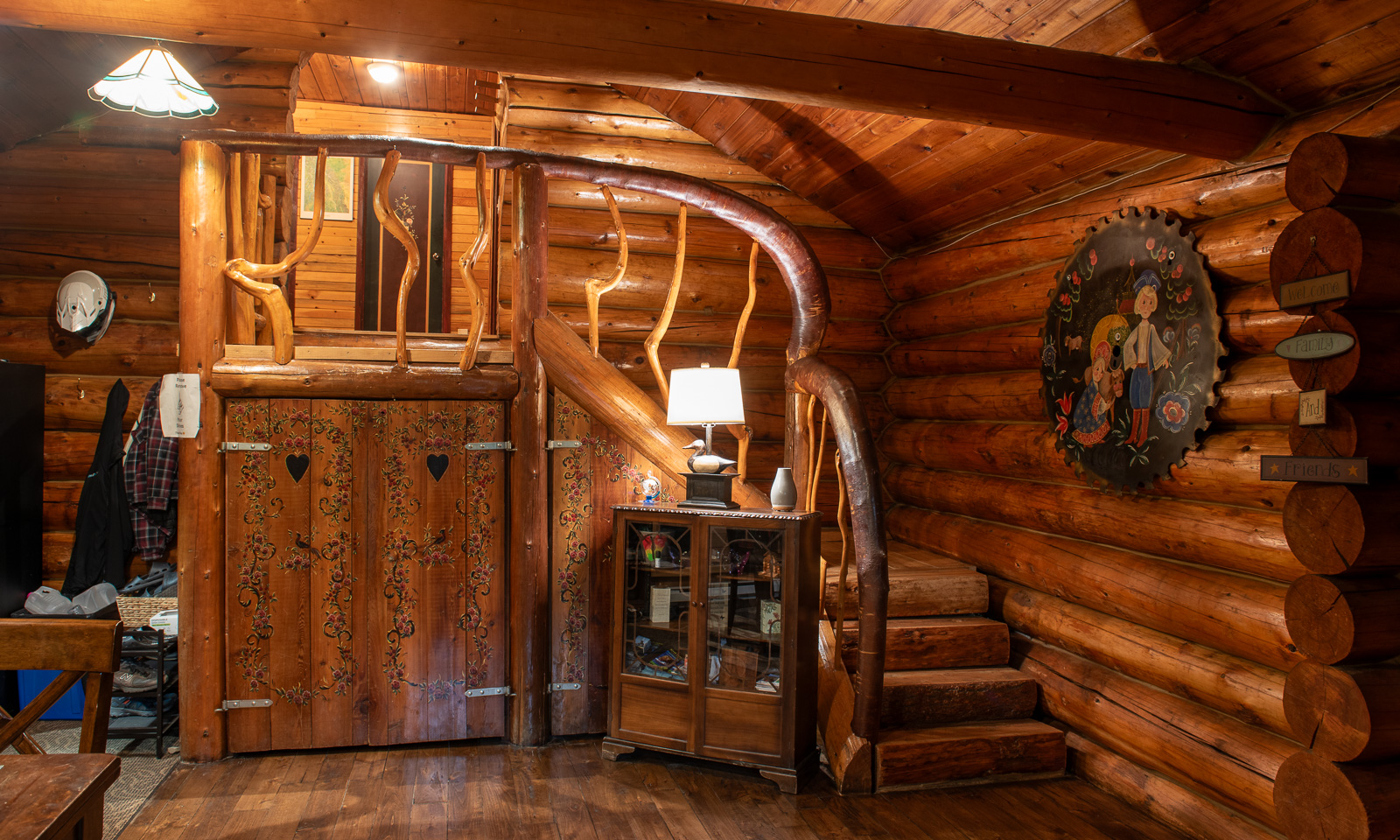
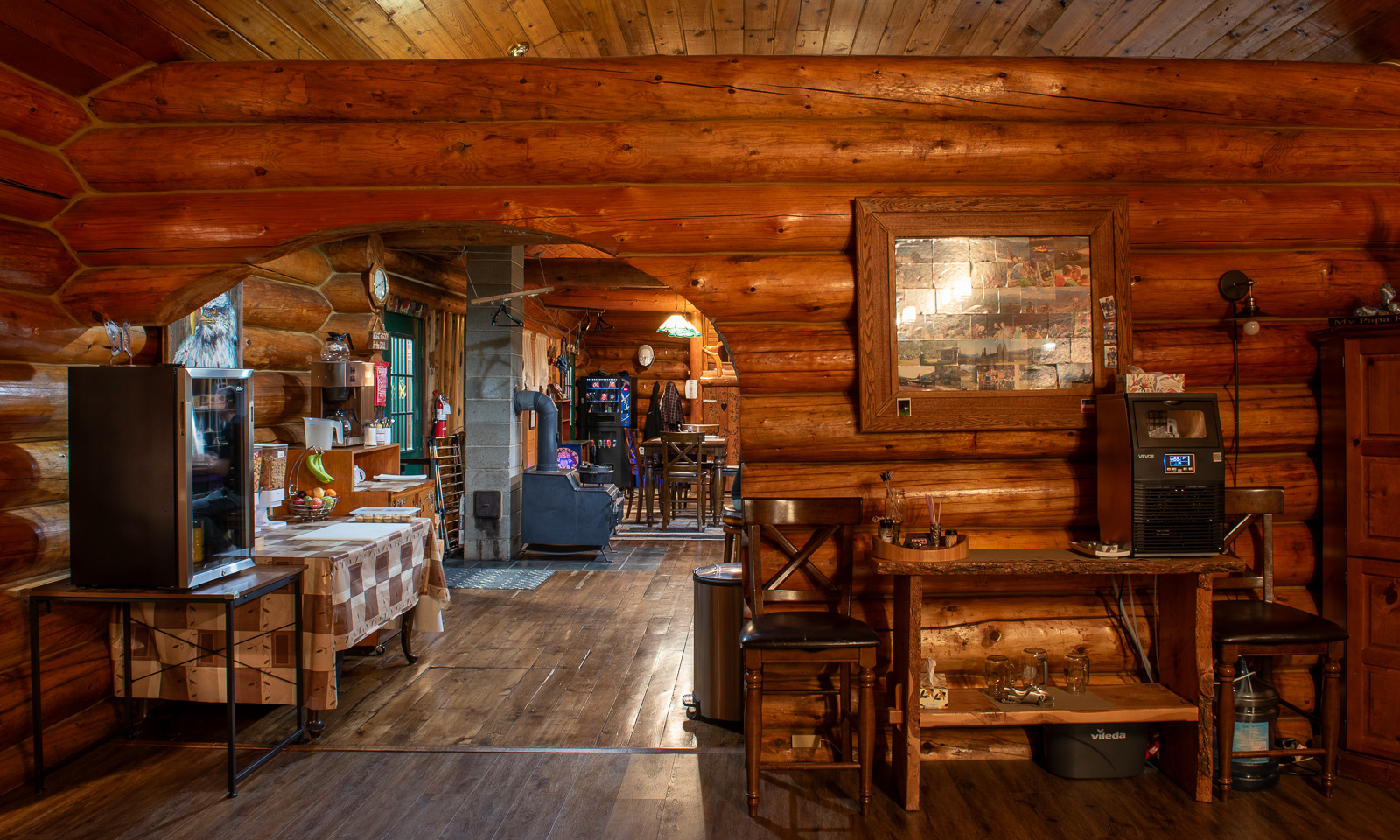
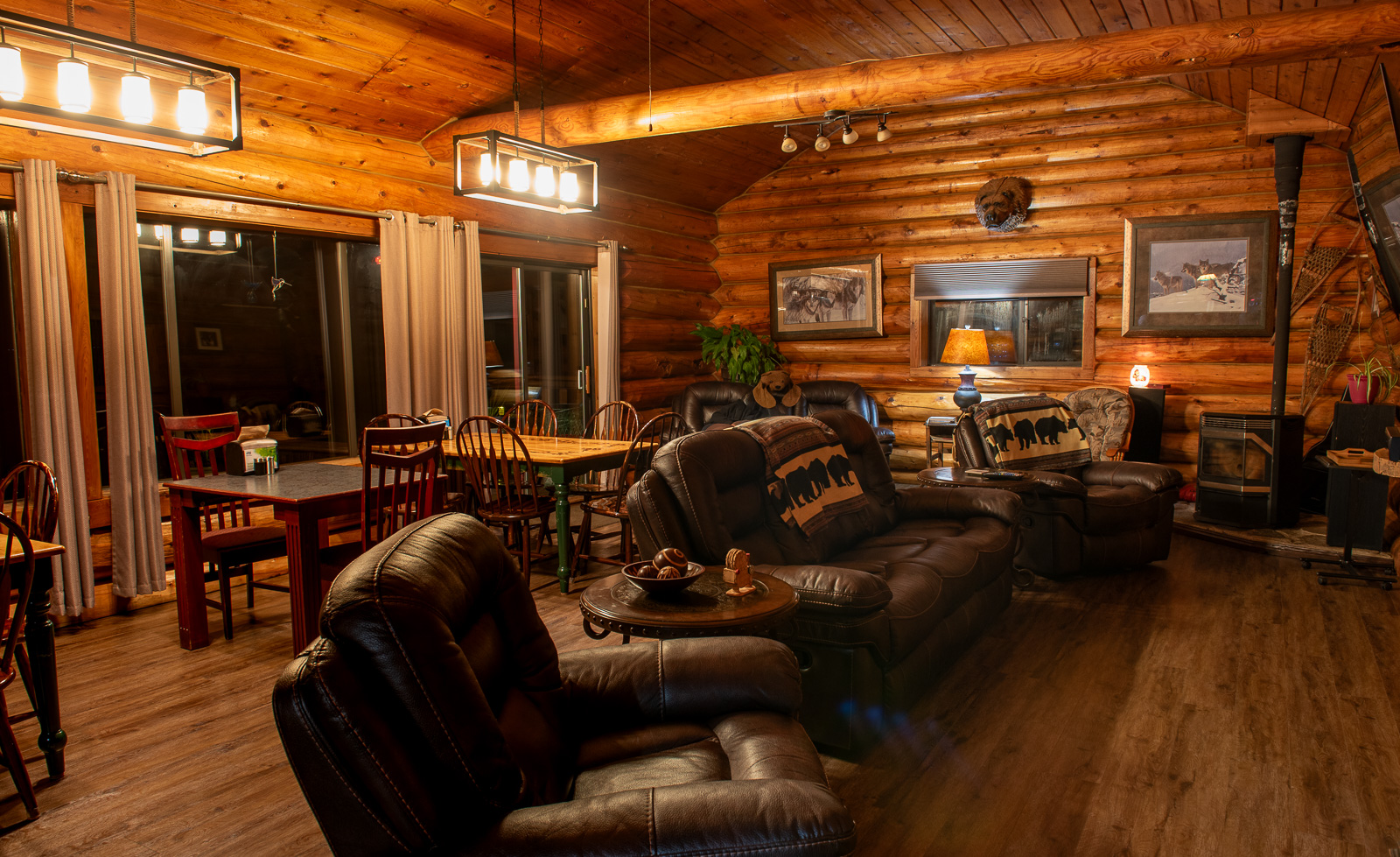
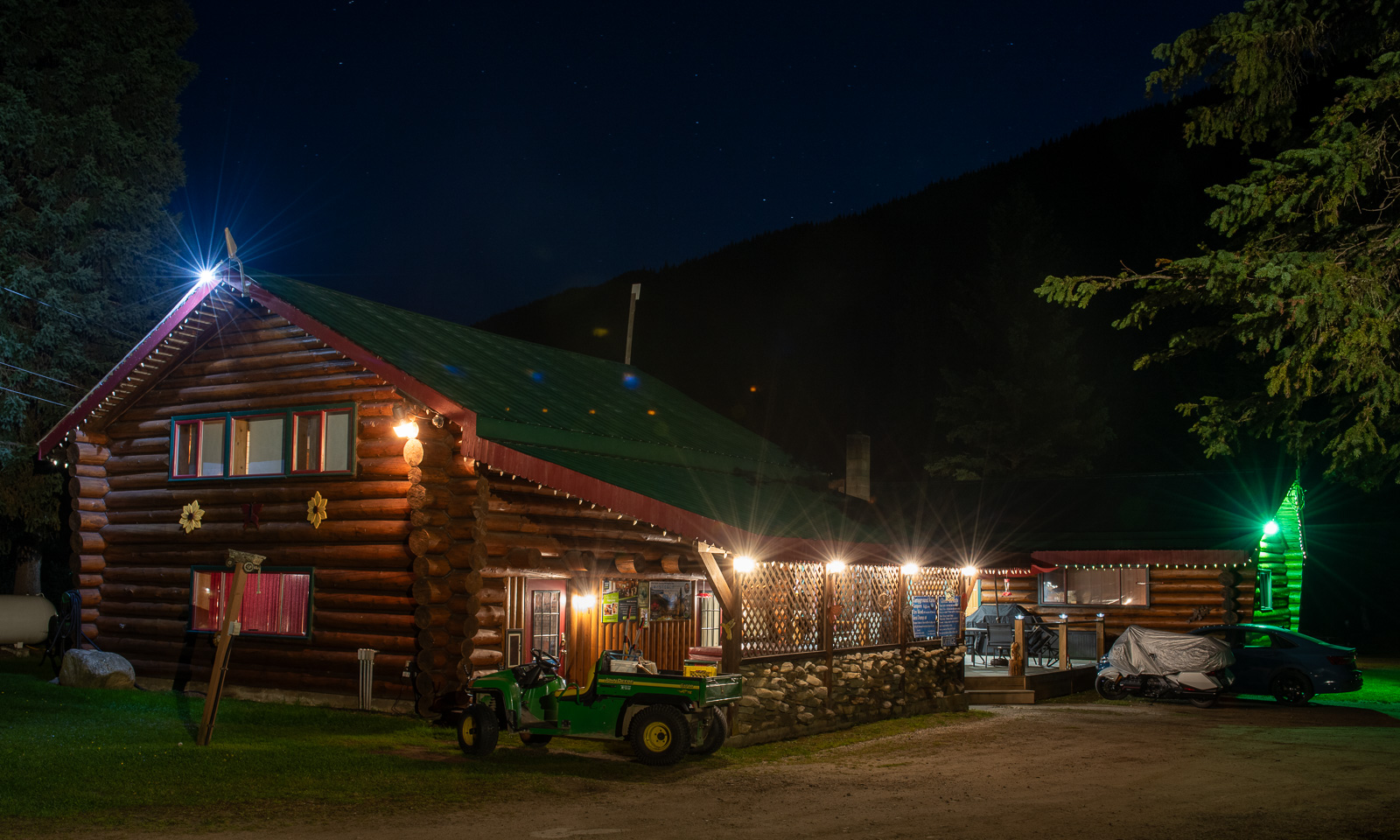
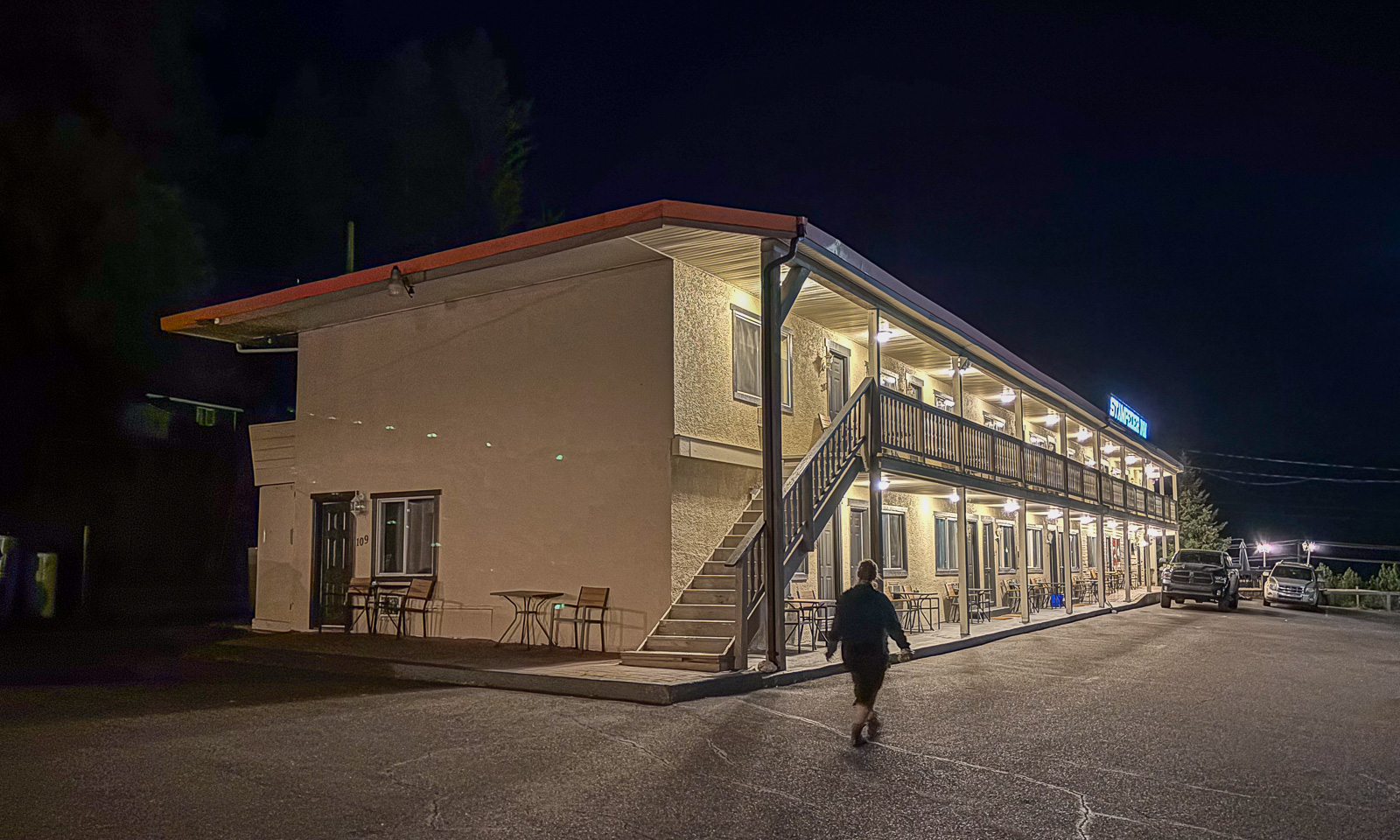
Near Brora we come back to the main road A9. Another eighteen kilometres and we arrive at the “Song of the Sea, Selkie House” in Helmsdale, our first stay for the night. Just half a day’s drive, and we’ve seen so much already. Now we’re heading to a pub for some food, and before long we’re lying in the huge double bed in our cosy room.

Tomorrow we will continue north.

Late summer mountain hike

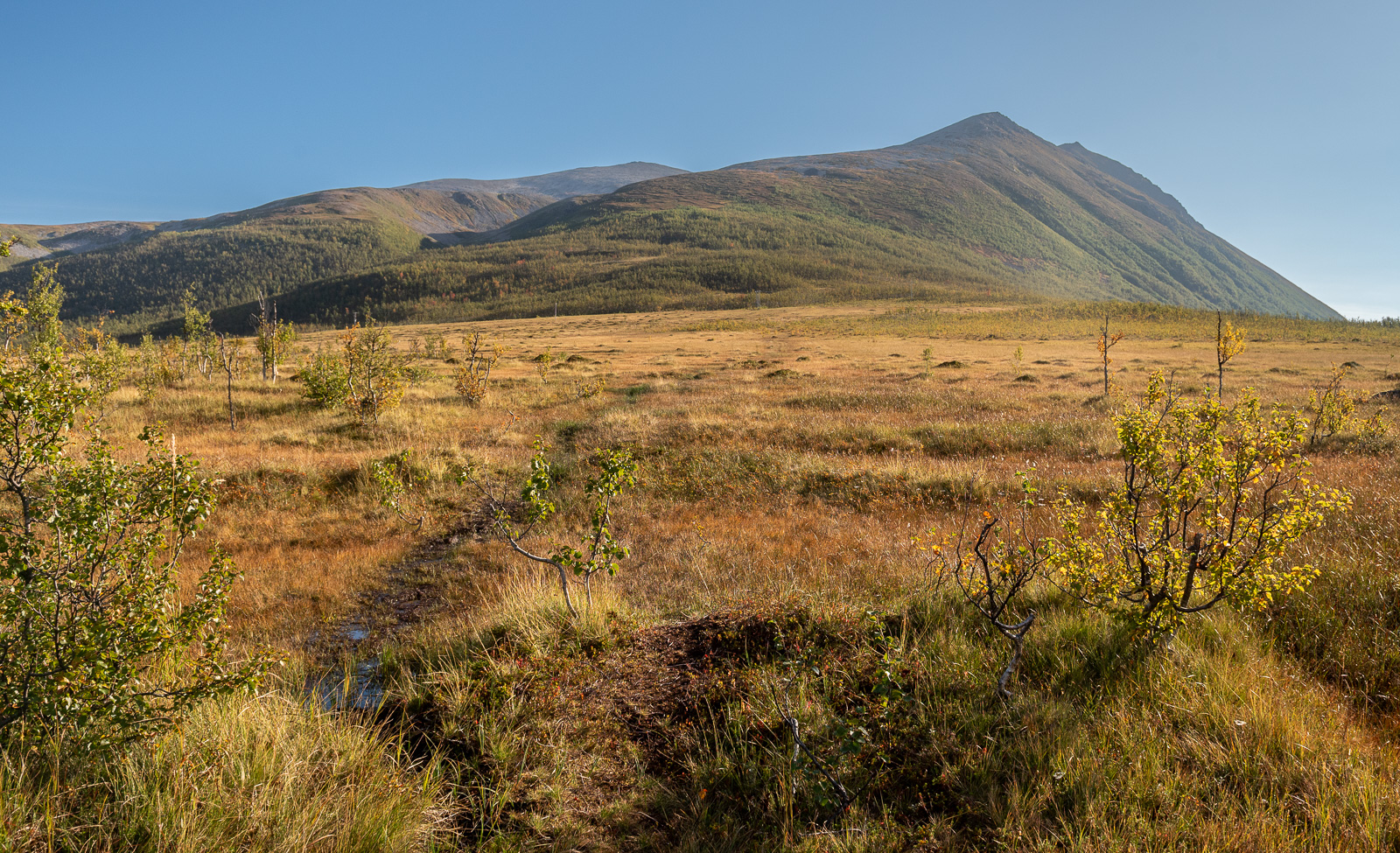
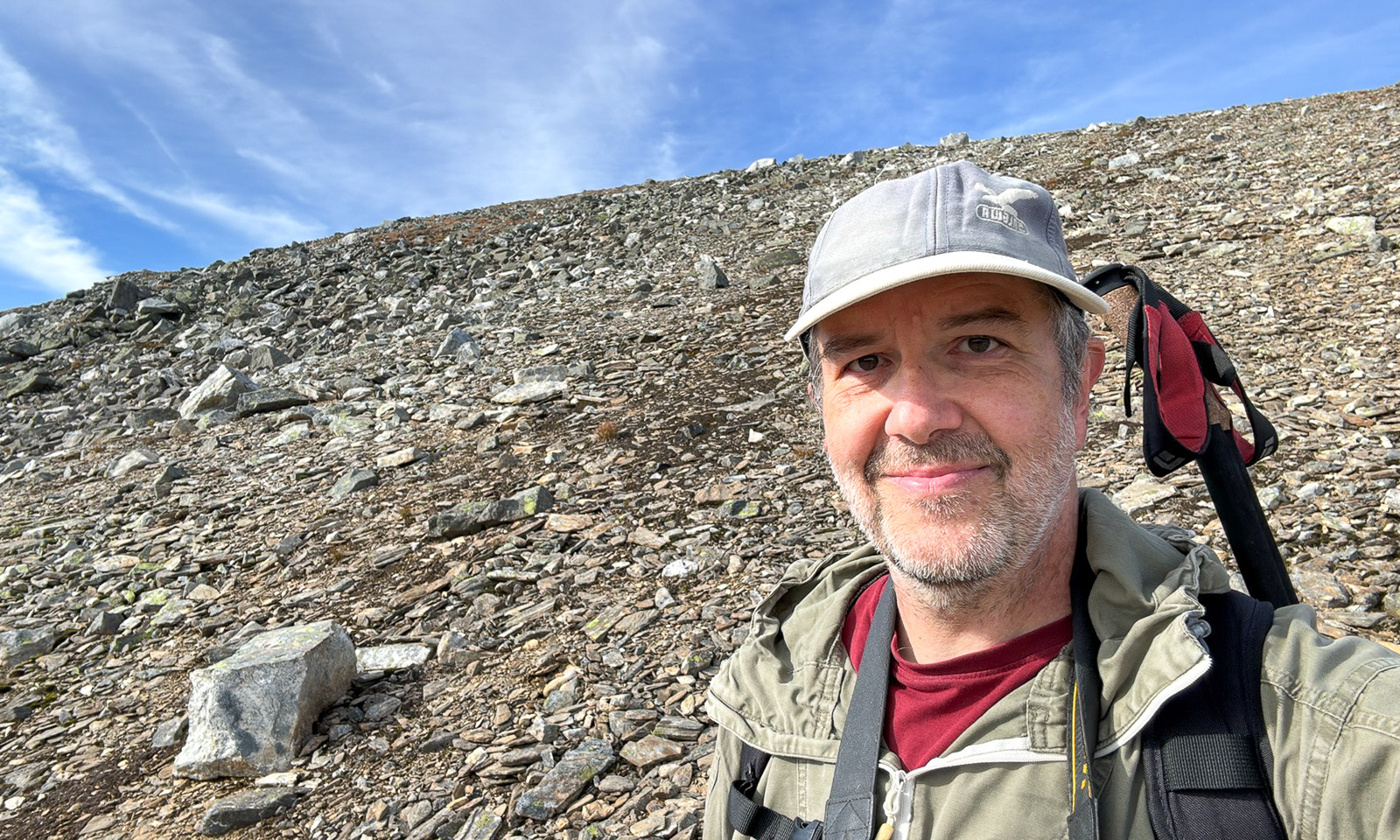
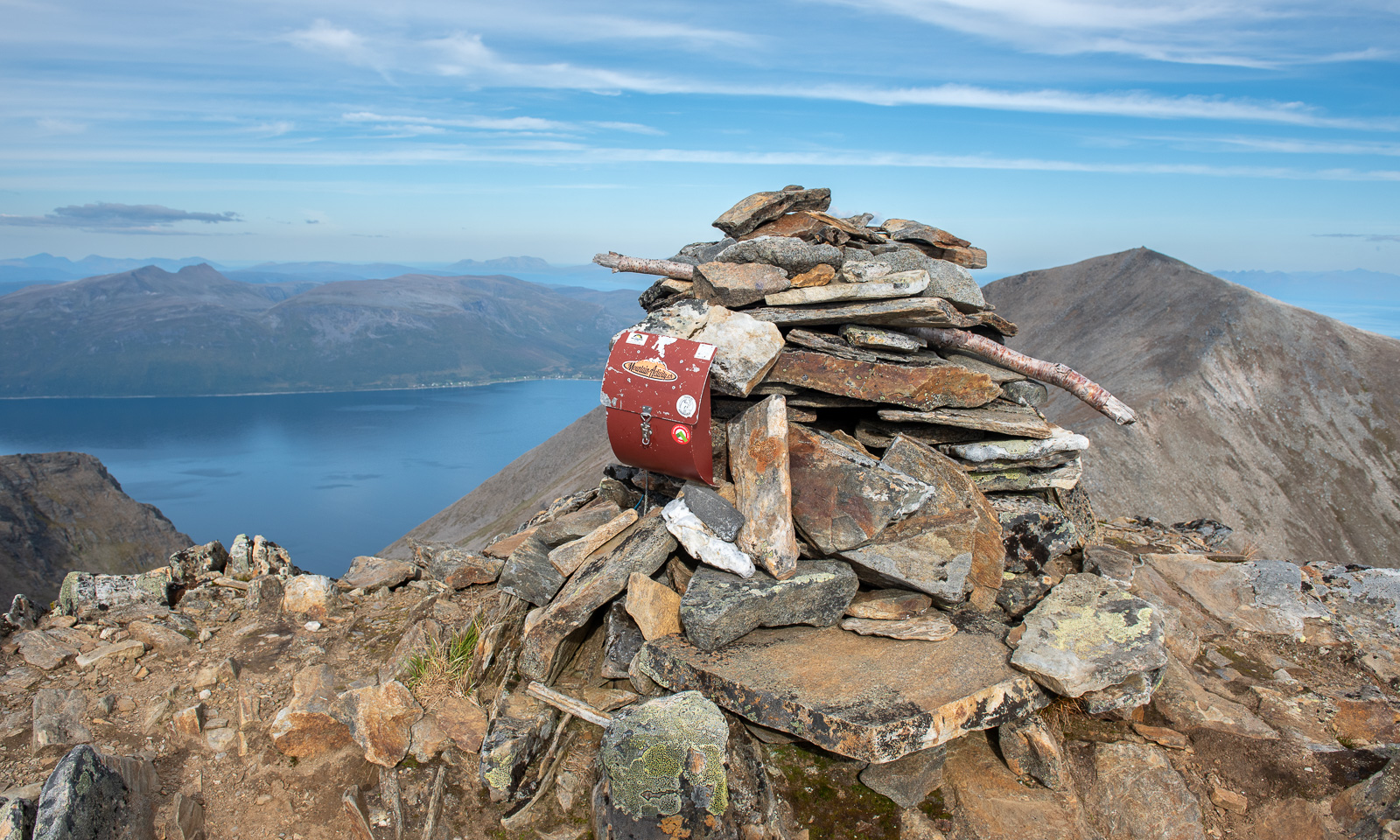
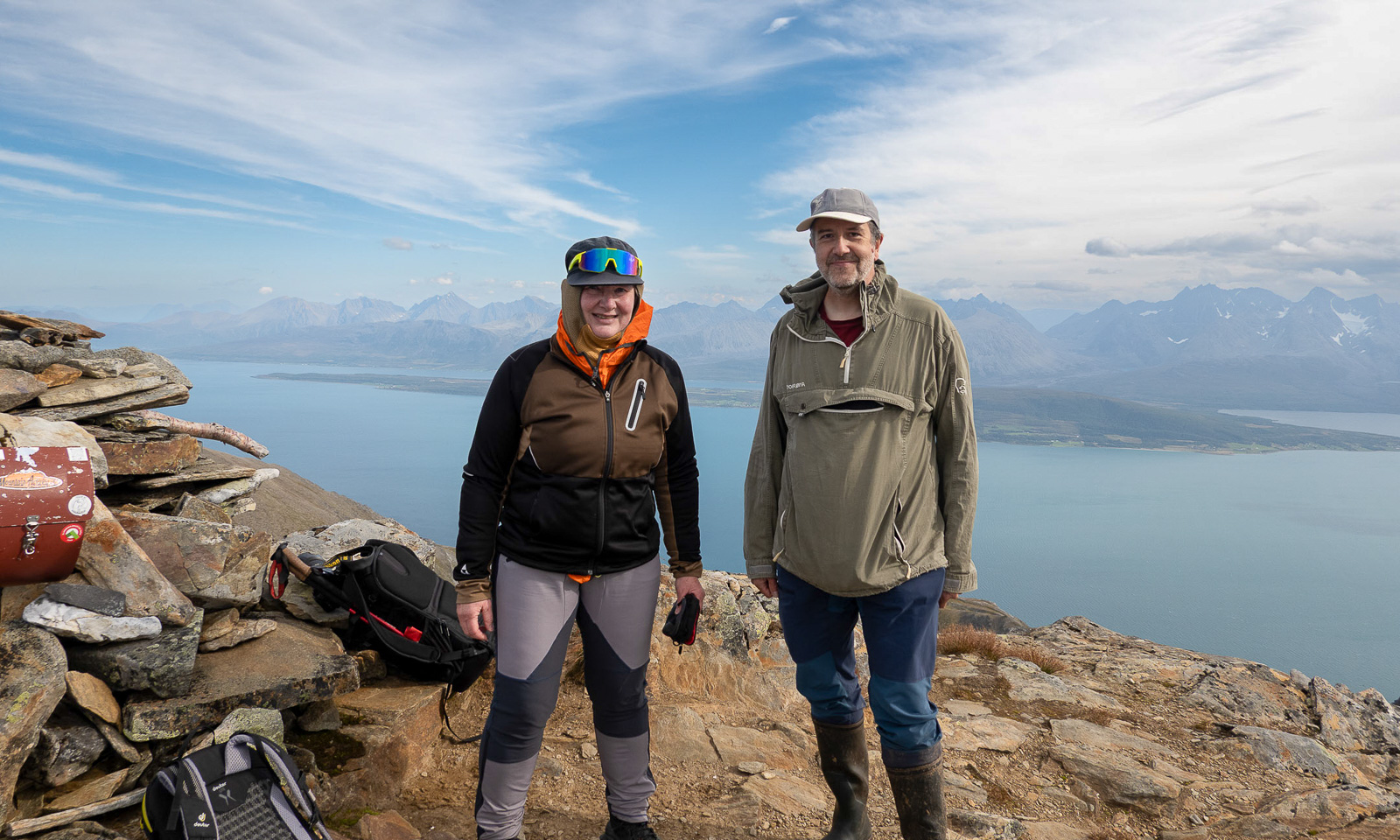
The forecast was correct – the sky was blue the whole day today. At 9 o’clock I meet my friend Chris on a parking place and we start a mountain hike. The morning air is a bit chilly and some leaves even have frost on them.

After we have crossed the river Tromsdalselva we follow a path and some quiet residential streets and arrive at the way up to Sherpatrappa. That’s is a stone staircase of 1,203 steps leading up the mountain. Today is Sherpatrappa Opp – a competition where people run up the stairs. We however prefer walking and are lucky, that the competition will not start before eleven.

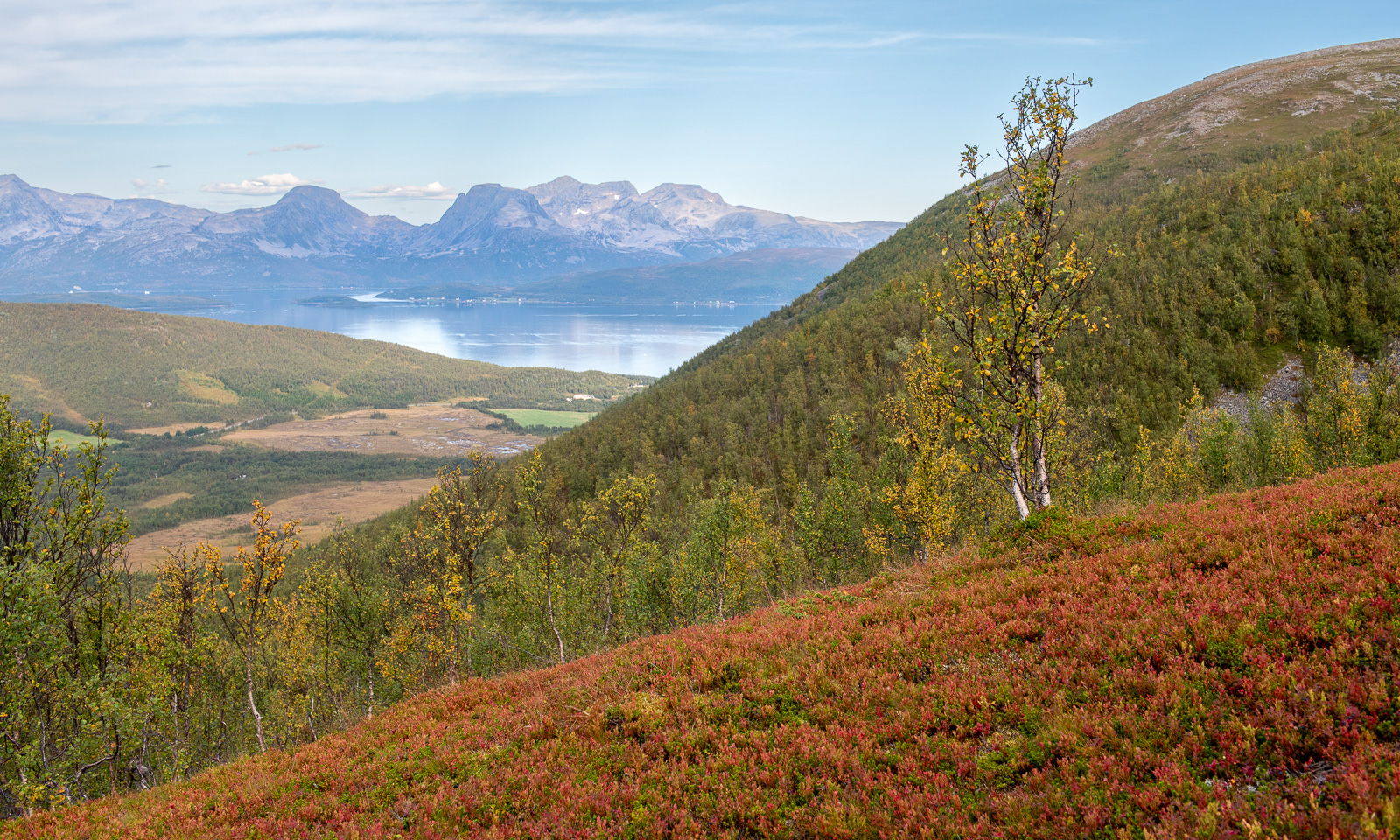
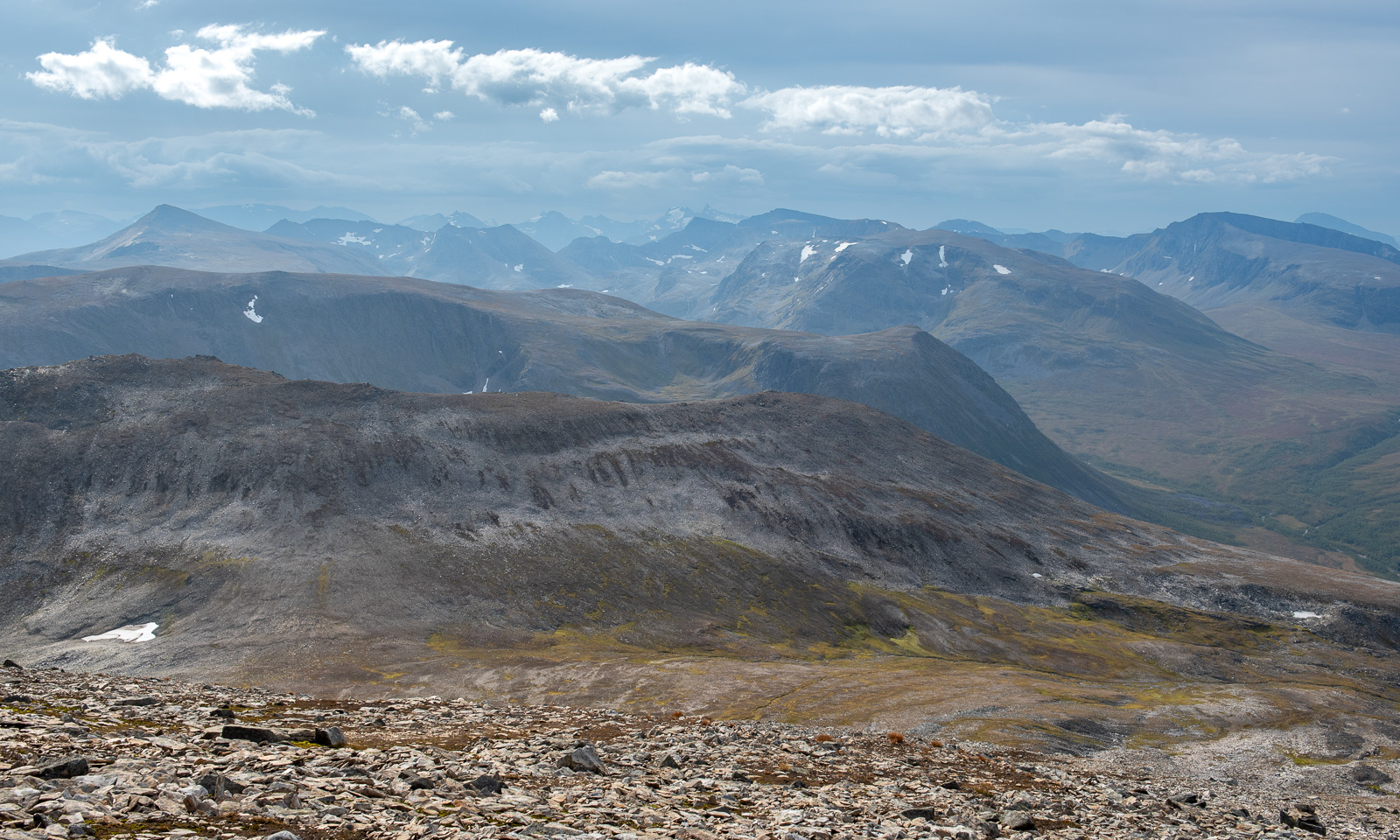
At the end of the stairs the terrain becomes less steep and you have a gorgeous view on the island Tromsøya and its beautiful surroundings. I see the island Håkøya that I circumvented by kayak two days ago. And today there is another competition: Tromsøya rundt, a 24 km long kayak tour round the island. From 400 metres up, we spot a group of kayakers passing below.

I assumed it was too late in the year for cotton grass – a clear sign for wet ground – but by a small and shallow pond we find a field of these candyfloss like flowers.

A lake always gives an awesome extra perspective in the mountainous landscapes, especially when it is as clear and blue as this one.

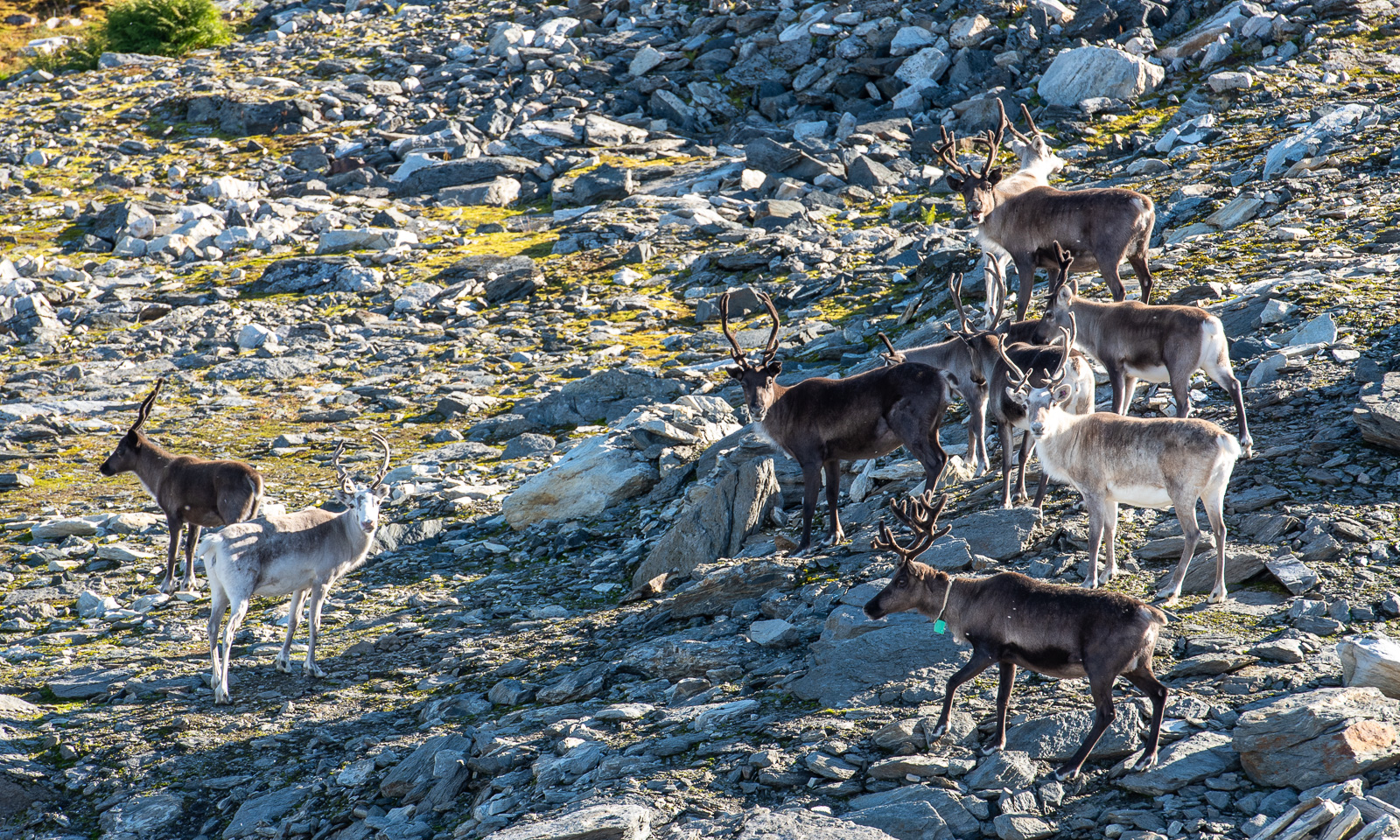
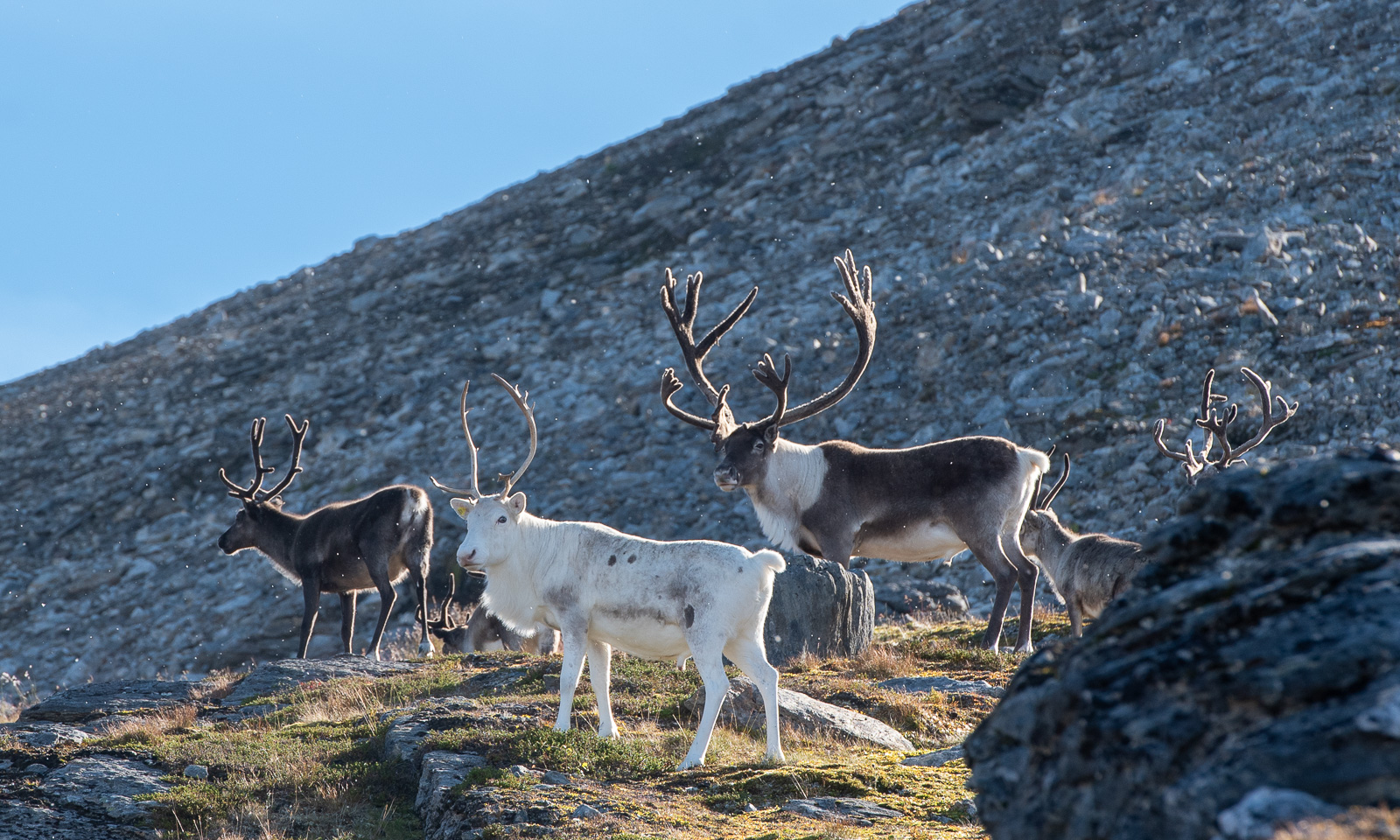
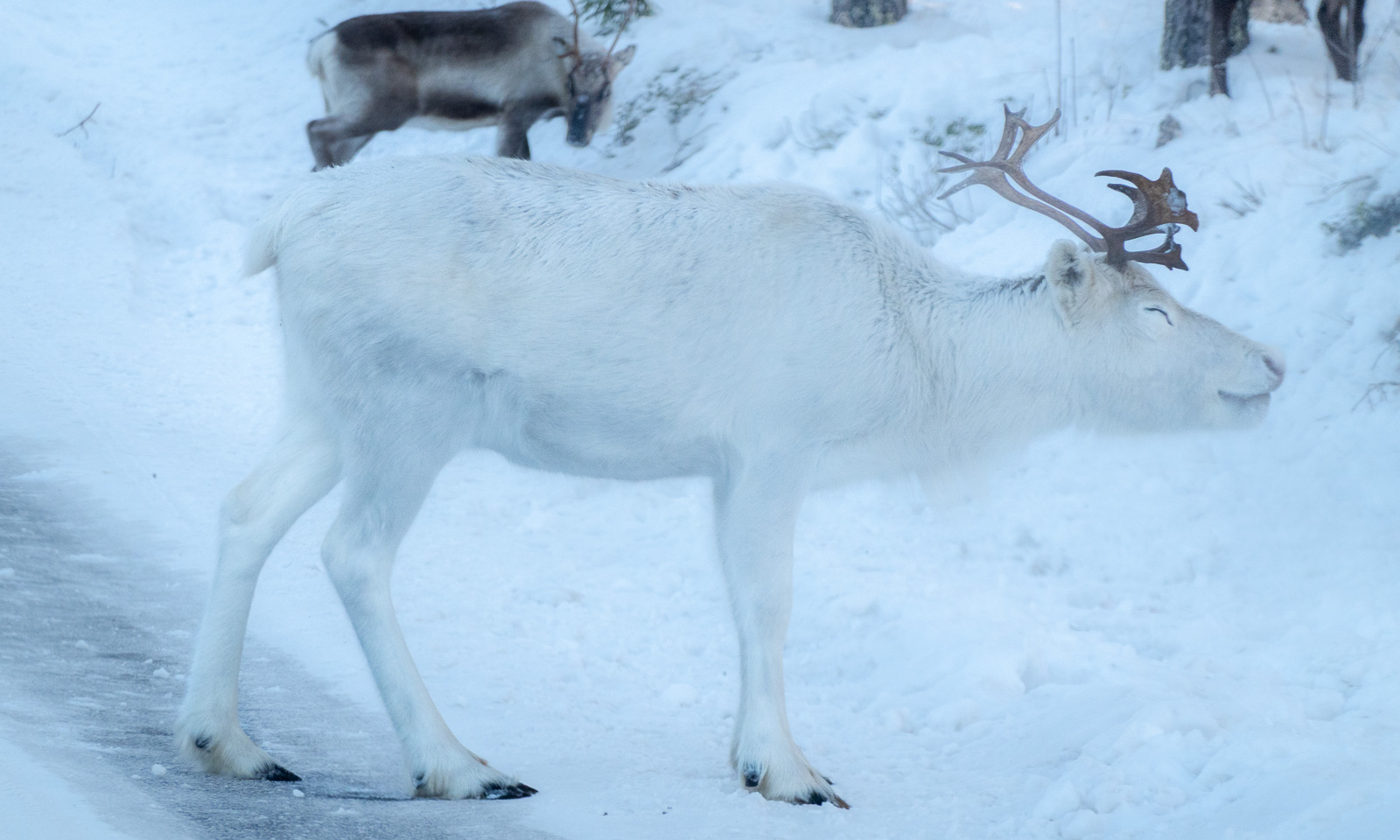
A white reindeer is grazing by the trail. It is not shy at all and ignores us while looking for food. On the way back we will meet it again.

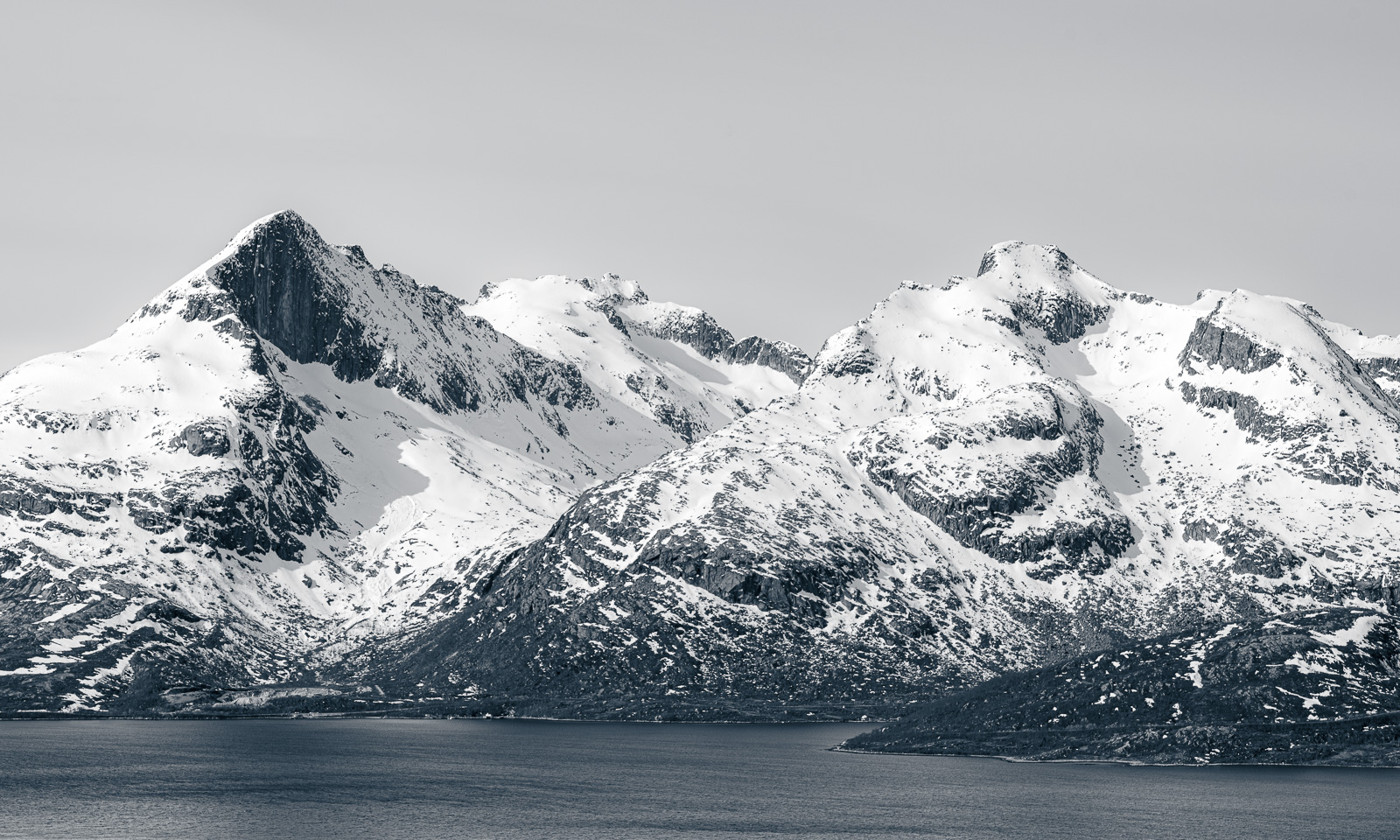
I will never loose the fascination for the Norwegian landscapes, where sea and summits meet. I paddled to Grindøya – the island in the middle – several times. In the back lies mountain range on the island Kvaløya. This island is more than 1200 times larger than Grindøya and mainland Norways 5th largest island.

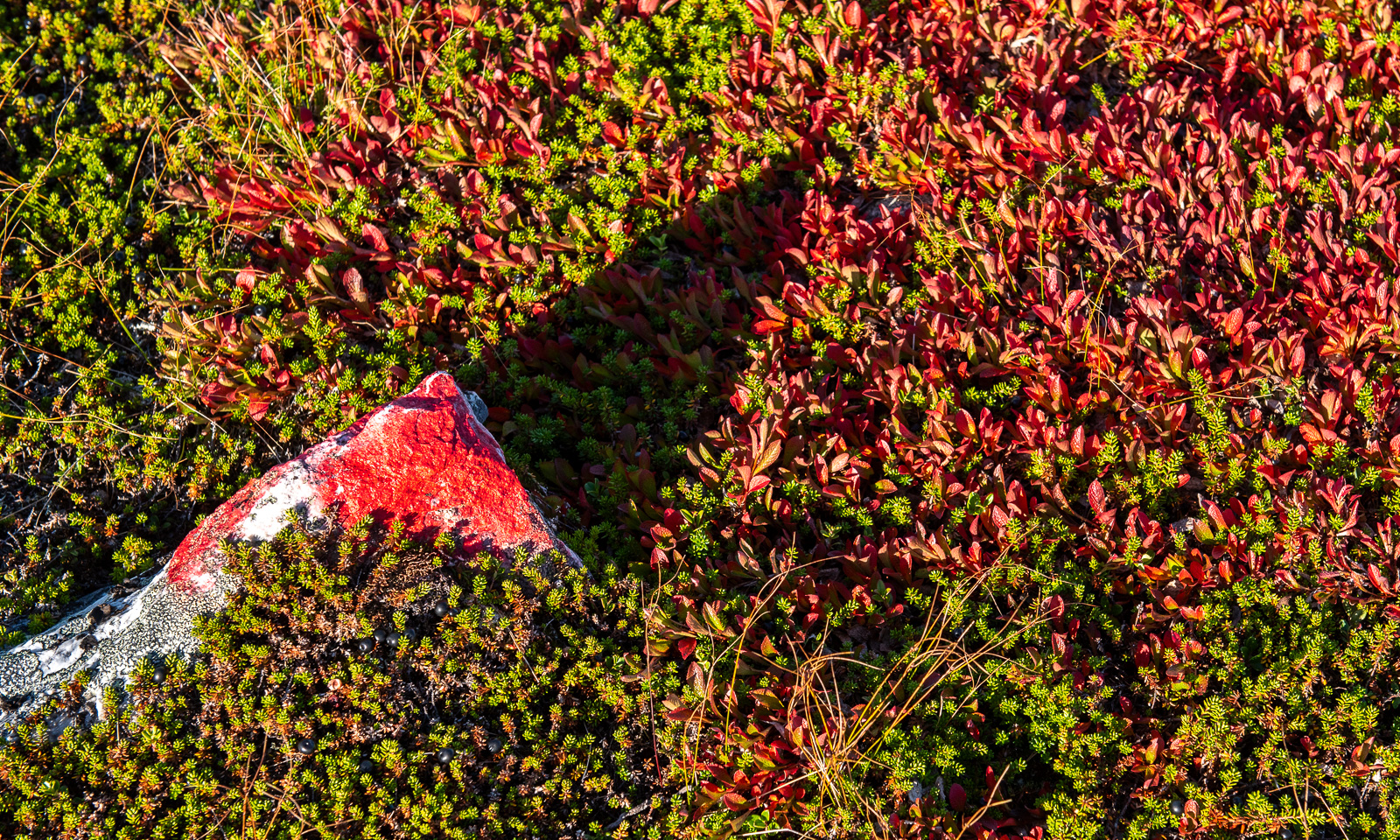
The weather has become warm and summery. Anyhow you can see the signs that the summer comes to an end. The colours have started changing.

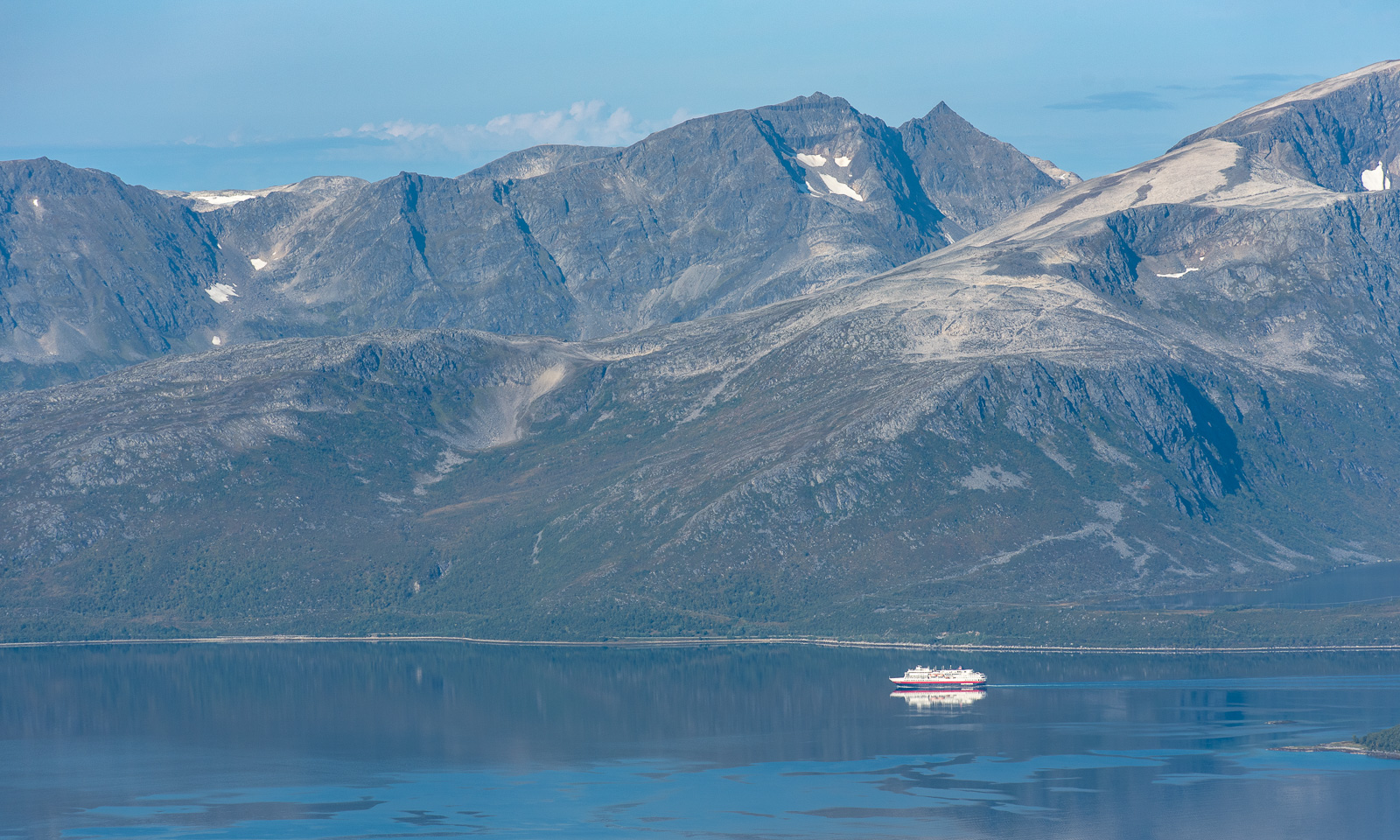
On our way back we use Sherpatrappa again and get an awesome view on the town. Tromsø in a nutshell: Two Hurtigruten ships – the bridge Tromsøbrua – the iconic church Ishavskatedralen. And in the background the mountain Kjølen, where I’ve seen the midnight sun seven weeks ago (I and II).

Takk for turen, Chris!

July 2025 – photo supplement

No matter whether I blog little or much, there are always photos left, that could be published but weren’t. Today I just show four photos from this month that comes to its end in less than two hours from now.

4 July – Obbola

Just on the eve of my journey from Obbola to Tromsø, when my telephoto lens was already safely packed in the suitcase for next days travel the doe with its two fawns came back. This time they didn’t just passed by but all three stayed in our garden. First the fawns were frolicking around, running back and forth, then they joined their mother and grazed the long culms round the rock in our garden. Meanwhile I found my old telephoto lens and took photos through the window pane. That’s far from being ideal but I didn’t wanted to disturb our visitors peace.

11 July – Tromsøya

One week later I walked home through the forests on top of Tromsøya. Four weeks ago there still had been deep patches of snow, now it was blooming everywhere. Fields of lilac cranesbills, patches of yellow globeflowers and where it was wet und muddy a favourite of mine, marsh-marigold with its bright yellow petals. There is still snow on the mountains, but on the island Tromsøya it is summer.

23 July – Tromsøya

17 °C may not sound hot, but when the wind is calm and it is sunny it makes a summer day in Tromsø. A day Annika and I used for taking a bath in the lake Langvannet. There’s a sandy beach over there at this woodland lake and some quite curious ducklings. After the bath we took another way home that led us to another lake. Lillevannet is far from being a lake for bathing but it shows the beauty of Tromsøya’s nature.

27 July – Tromsøya again

A good friend will start a very special trip the following week. She will embark the three-master Statsraad Lehmkuhl and sail from Nuuk in Greenland through the Northwest Passage to Cambridge Bay in Arctic Canada. What a journey! Time to bid farewell with a barbecue in the forest, but before that another hike to Langvannet – 2 km from my place – to take another bath. We met an acquainted duck with three ducklings (last time one of them tried to nibble my toes all the time). Then another duck family arrived with much younger ducklings – still nestlings. While being less curious they were equally confiding and we could take some photos of them. This is my favourite.

That’s all for today. Perhaps I have some photo leftovers again in the end of August but I guess I’ll blog before that. See you soon in the digital world.

Just a pick-up at the station…

When Annika travelled to me last weekend, her train from Boden to Narvik was cancelled and the next and last train was heavily delayed. Unfortunately train problems have become common in Northern Sweden over the years. I had to use the airplane several times because trains didn’t run at all for days or it was impossible to buy tickets.

To keep Annika from being stranded, I drive to Narvik to fetch her. From Tromsø it takes me about three and a half hours plus some breaks.

Meanwhile Annika has booked a hostel in Bogen where we stay overnight. Our plan is not to drive back the direct route, but to visit the islands Andøya and Senja.

Monday, 21 July

The next morning starts sunny.

However it soon gets foggy. After crossing the Tjeldsund we are on Hinnøya, the largest Norwegian island (when we ignore Svalbard). We decide against a swim in the sea due to the fog and continue to Refsnes. From here go ferries cross the Gullesfjorden to Flesnes. On my trip to Narvik yesterday it was often 28 °C, now in the fog it is hardly 15 °C.

We have missed the 10 o’clock ferry, but they run hourly and we don’t have to wait for long. The journey itself takes only 20 minutes.

From Flesnes we continue to Risøyhamn. Hurtigruten travellers may know this place not only because it is one of the stops but also because of Risøyrenna – a man-made underwater channel that allows larger vessels to pass between Andøya and Hinnøya. The Hurtigruten ships has to go quite slow there.

We take the bridge over the Risøysundet and drive through Risøyhamn. Twice. Because I didn’t know that it is so small. Only round 200 people live there.

The weather is sunny again and we become more beach focussed. The first beach is for having lunch. We share it with a flock of sheep.

The second beach is for bathing. 16 °C in the water – surprisingly warm for the region.

We continue north. To the west the Norwegian Sea. Next shore westwards is Greenland, more than 1500 kilometres away. Our next stop is much closer: a public toilet at Bukkekjerka. But what a one! It is a designed block of concrete and mirrored glass. From the outside you cannot look in, but from the inside you can switch the huge glass windows between being transparent or opaque.

Around this place – a lighthouse on a peninsula, interesting looking rocks, a baaing sheep and of course the sea.

We follow the coastal road further north to Bleik. Here you can find beaches and turquoise water as well as ridiculously looking rock needles.

After refuelling my car in Andenes we drive south again to Marmelkroken, where we will stay overnight. With an additional photo stop.

To part 2 >

Welcome, kids

Just minutes ago a deer with two young fawns passed the shore by our house. We could the kids jumping around and following their mother for quite a while. They were far away and I didn’t want to go outside to avoid any disturbance. So I took some photos with my mobile through an old field glass. The image quality is abysmal, but hey – I got a photo!

From Obbola to Tromsø – home home and work home

Thursday, 20 March – Obbola

Annika and I are in Obbola, my “home home”. In the morning we get visitors. Three deer stand in our garden – always alert. Are they happy, that much of the snow is gone?

In my lunch break I am kayaking round the island Bredskär. That’s just 3 km. There is still some ice round the rocks at the shore, but much snow and ice has melted away the last weeks. What a warm winter.

Friday, 21 March

Annika and I take the car to Tromsø. We will make a stopover in Jokkmokk, because the total distance is almost 1000 km. Hejdå home home!

In warm and sunny weather we head northwards to Piteå and then northwest to Jokkmokk. Now we are north of the Polar Circle.

In Jokkmokk we meet a good friend and take a walk round the lake Talvatissjön. Around the sun a halo appears .

Saturday, 22 March

After a good sleep in the hostel Åsgård Annika and I continue our car trip. Gällivare, Kiruna, Abisko. Torneträsk – the 6th largest lake in Sweden – is still completely frozen. Good for recreation such as skiing.

Parts of the road were closed some days ago. You can still see some remains of the snow storm.

Some weeks ago it would have been impossible to drive from Jokkmokk to Tromsø in daylight. Anyhow two days ago astronomical spring has started and the days are as long as everywhere. After hours of driving the sun is low but visible. It illuminates the beautiful clouds. And then we arrive at our apartment in Tromsø, my “work home”.

Sunday, 23 March

On Sunday the weather gets nasty. Max temperature: +9 °C and wind gusts up to 23.5 m/s. Annika and I take a promenade anyhow. With spiked shoes because some of the ways are just bare, wet ice and the friction is next to zero. We arrive at home before the rain. Good luck.

Monday, 24 March

On my way to work I spot the first spring flowers in front of the Tromsø Cathedral. I could believe in spring …

Tuesday, 25 March

… but do know the forecast and it is correct: Snow, snow, snow on the next day. So it looks like in the morning outside of the apartment …

… and so in the afternoon, when I walked home.

So we did not solely travelled between countries but also between seasons. Anyhow I hope for some more winter days (or weeks), before my seasonal clock will jump to spring mode. Perhaps in mid-May?


Short days in Obbola II

Just some photos from Obbola in the last days.

A flock of fieldfares in our rowan tree ❦ an icy morning by the coast ❦ sunlit ice fog hovering above the bay Vitskärsudden ❦ three roe deers eating rowan berries, leftovers of the fieldfares’ meal.

Translation:

EnglishGermanSwedishNorwegian
FieldfareWacholderdrosselBjörktraskGråtrost

Norddeich/Norden

Annika and I were in Norddeich, the coastal district of Norden (“north”) in East Friesland, Germany the last days. The word “Norden” definitely qualifies that place for getting an article in my blog way-up-north.

Many streets of Norddeich have the theme “north” in their names. Am Nordkap (At the North Cape), Nordlandstraße (Northland street), Nordlichtstraße (Northern Light Street). Guess what, I like the names! Partly from my Scandinavian point of view, partly because I am from Northern Germany and therefore a “Nordlicht” (a nickname for people from Northern Germany) by myself.

Some photos from Tuesday, 10 September, the day of our arrival:

Yesterday on Wednesday, 11 September Annika and I rented e-bikes and took a cycle tour to Greetsiel. The weather was quite nasty for early September: strong gusty winds, hailstorms, cloudbursts and even a thunderstorm. And all that at temperatures around 10–11 °C. Kudos for the e-bikes! Without electrical motor support we wouldn’t have managed it against the wind.

It’s a long way to travel to Norden from our places. Round about 2800 km from Tromsø, my “work home” and still 1900 km from Obbola, my “home home”. But I think, I’ll visit Norddeich again some other time.

Fram Strait 2024 – returning to Svalbard

This article is part of the series “2024-08: Fram Strait cruise KPH”.

26 August 2024

It is the 14th day of our Fram Strait cruise. We are on our way back to Longyearbyen on Svalbard. After many grey and foggy days we finally have got nicer weather since yesterday and so I am standing on the “heli deck” looking for animals to take pictures of. I cannot see any whales and the few puffins that I spot are too fast and too far away. So I take photos of the seagulls that effortlessly accompany the ship.

Since today it is possible to see land again in the distance. Not Greenland like a week ago but Prins Karls Forland, an elongated island which is the westernmost island of  the Svalbard archipelago.

I have gone inside again until I see a message popping on our WhatsApp group:

Dolphins just in front of the ship now

I grab my photo bag, hurry to the heli deck again and see a school of dolphins on the starboard side. Most of them swim underwater but again and again a group of these beautiful sea mammals come out of the water. With my big telephoto lens I try to take pictures of the dolphins. The result: a lot of pictures of sea water. They are just too fast for me and my lens. But I’m lucky. Once I manage to guess correctly and get a photo of two dolphins (and a third one immersed).

27 August 2024

Originally we wanted to reach Svalbard one day later but a lot of things have been done faster without the presence of sea ice. Mooring recoveries are simpler, CTD casts are easier and so is the ship’s navigation – no search for leads needed. Therefore we will arrive one day earlier, which is today. While I’m having breakfast we are already in the fjord Isfjorden. At 9 o’clock we have arrived in the city port of Longyearbyen.
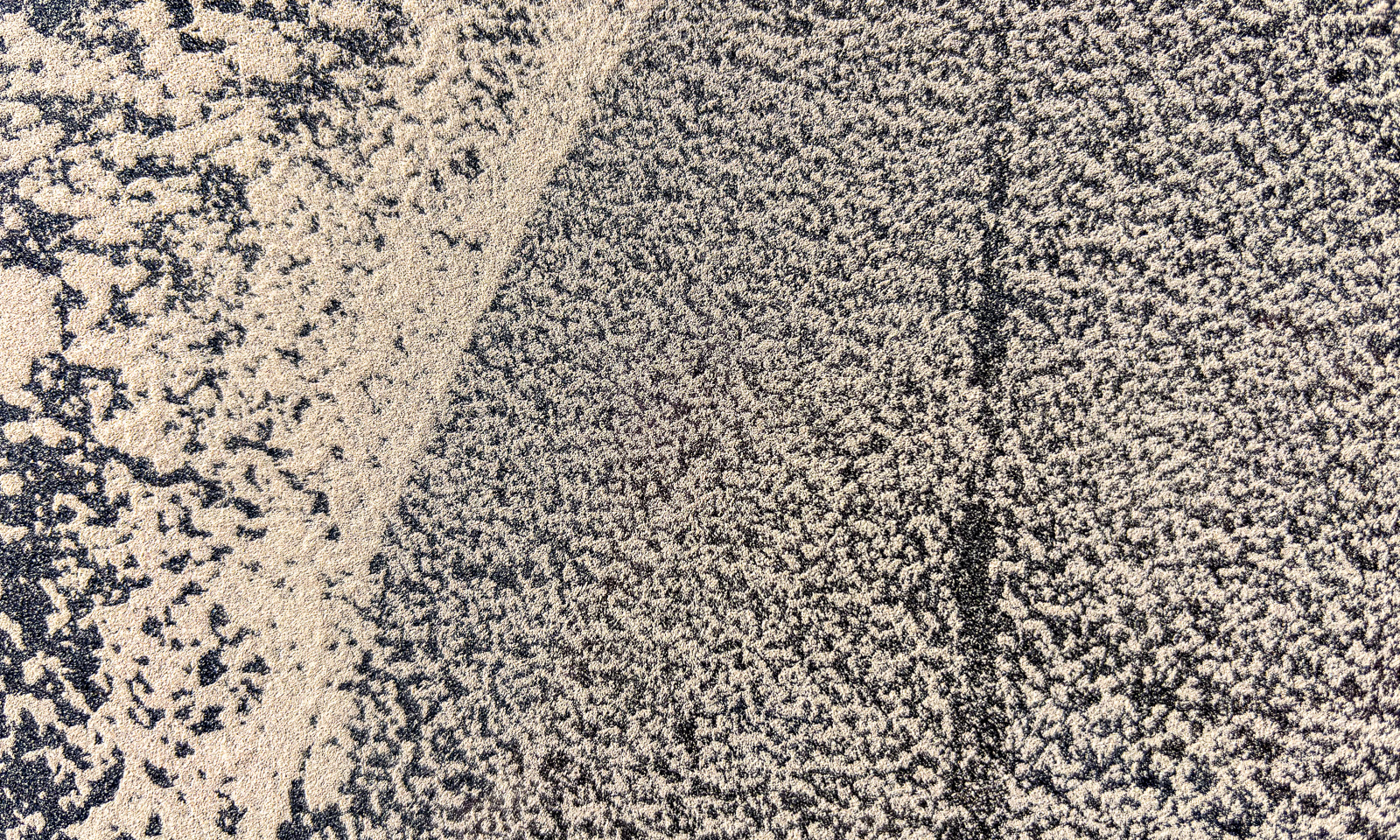
After lunch I leave the ship and stand on land again. I walk into town and go to Svalbardbutikken, the local supermarket. We still live on board and get our meals there, but I want to have chocolate! And I get it.

28 August 2024

We all have stayed on board overnight as well. The cabins are free (and paid) and so there is no need to find some expensive last-minute accommodation in Longyearbyen.

My plane to Tromsø will depart at 14:40. I interrupt my work and leave the ship once more to take some pictures. It is sunny again but Svalbard looks pretty brown and dirty in summer.

Then it was time to say good bye to the crew and the other participants. Car to the airport – checking in the baggage – security. And some hours later I sat in the airplane to Tromsø now leaving also Svalbard and the research ice breaker Kronprins Haakon behind.

When shall we three meet again?
In thunder, lightning, or in rain?
When the data work is done,
When the budget’s lost or won …

Ice station one and polar bears

This article is part of the series “2024-08: Fram Strait cruise KPH”.

For days we wondered, will we ever have an ice station on this Fram Strait cruise in open water? But then at 14° 21′ W, 79° 02′ N we found a large ice floe to work on. Shortly after nine o’clock I finally was on the ice again!

But I wasn’t here to take snapshots but to fly drone and to take a lot of photos from above.

I had issues with the drone from the Polar Institute, so I fetched my private one. First I had to calibrate some sensors, especially the compass and then I put the drone into the air and made some photos to check the image exposure. Ok, looks pretty good.

Now I flew the drone in a rectangular zig-zag pattern. That’s a bit tricky, because the drone is positioned by GPS while the ice flow is drifting. Since I wasn’t sure if I covered every part of the ice station I flew a second round. The single photos look like these:

Before going on board I took a couple of photos on the ice.

On board I uploaded the photos first into my laptop and then into the program OpenDroneMap that would stitch the photos together and add geographical information. And then it was 11:30, lunch time!

After lunch I went up on the bridge on deck 8. Together with two others I was observing my segment checking for polar bears, cracks in the ice and weather. There were several polar bears around but all were further away. I also had a VHF to keep track on the people on the ice. I had two shifts, 12:30–13:15 and 14:00–14:45.

After my second shift I got to know that we had a polar bear in front of the ship. So one of the bears that we had observed for hours had finally decided to pay us a visit. That meant of course that all people had to leave the ice.  On the helicopter deck many people were around to watch the bear.

And there it was – a surprisingly white curious fellow that examined our ship. Did it smell the cake?

In the meanwhile OpenDroneMap finally created a properly rendered orthophoto. I was relieved because I was not sure if my drone photos were sufficient. This is an excerpt:

In the afternoon I had fixed the issue with the other drone. At 19:00 I would have another opportunity to go onto the ice to re-calibrate and test it. Our ice visit was however postponed because another polar bear was paying a visit. It looked much thinner than the other one, but on the other side the fur was wet. So photo shooting again. It surrounded the ship and then stopped, laid down onto its stomach, pushed itself forward with its furry feet and  then rolled in the snow before it continued its walk.

We had to wait some time but then the ice was clear and I had time to test the drone on the ice. It worked. Hopefully I would be able to use it on the second ice station on the next day but the forecast does not look promising. Too much wind.
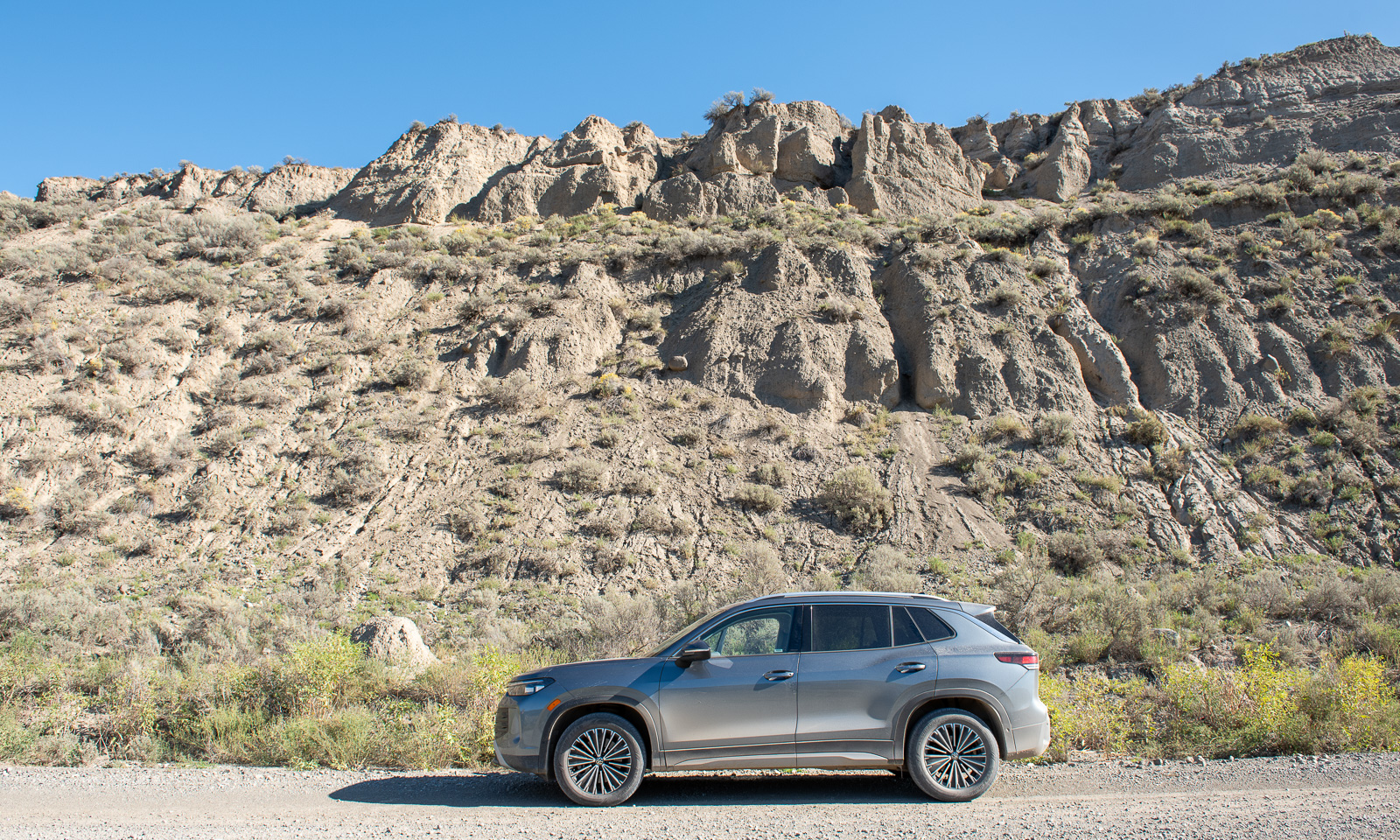
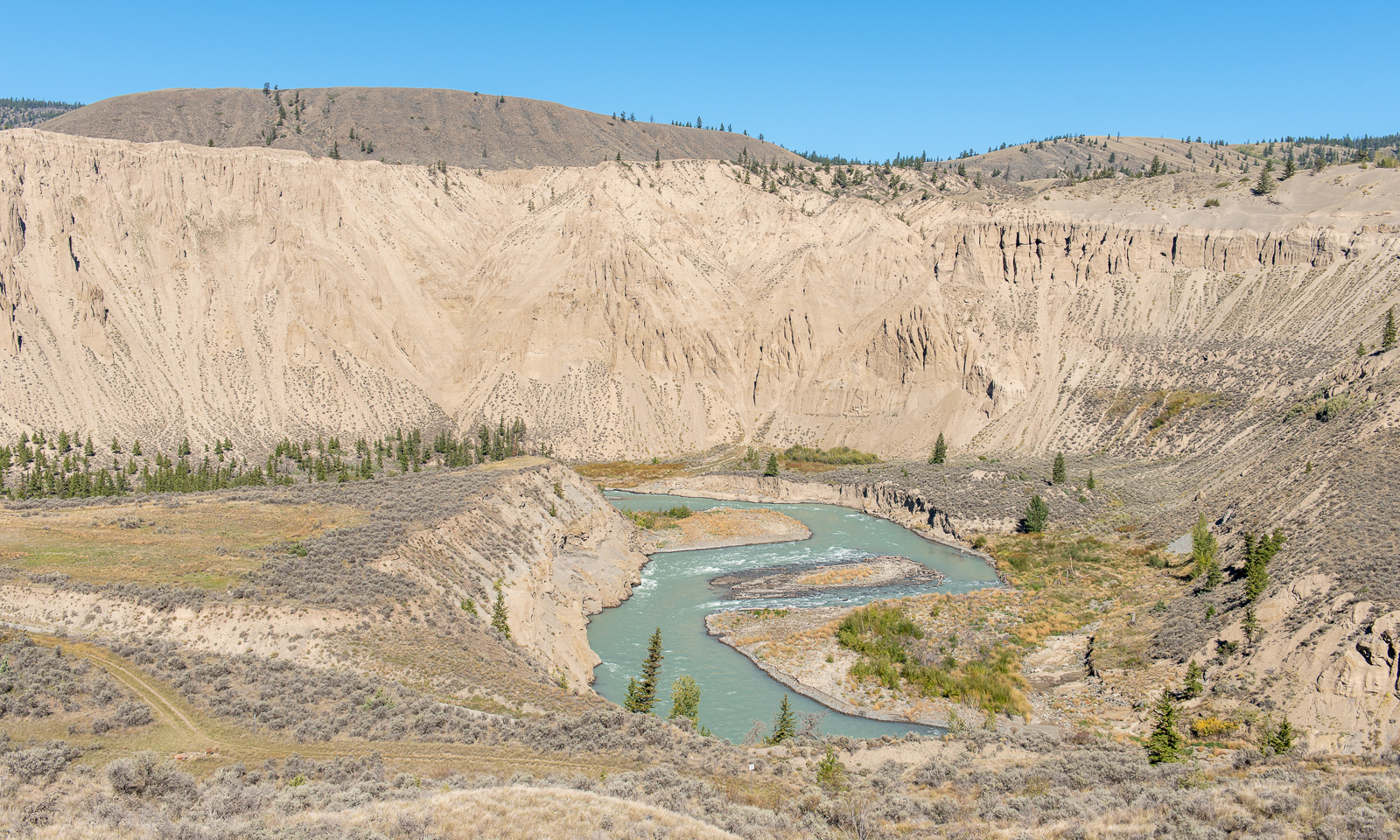
I shot a drone selfie and then I was ready to go on board. I just had to put my hand into one of the polar bear paw prints for size comparison.
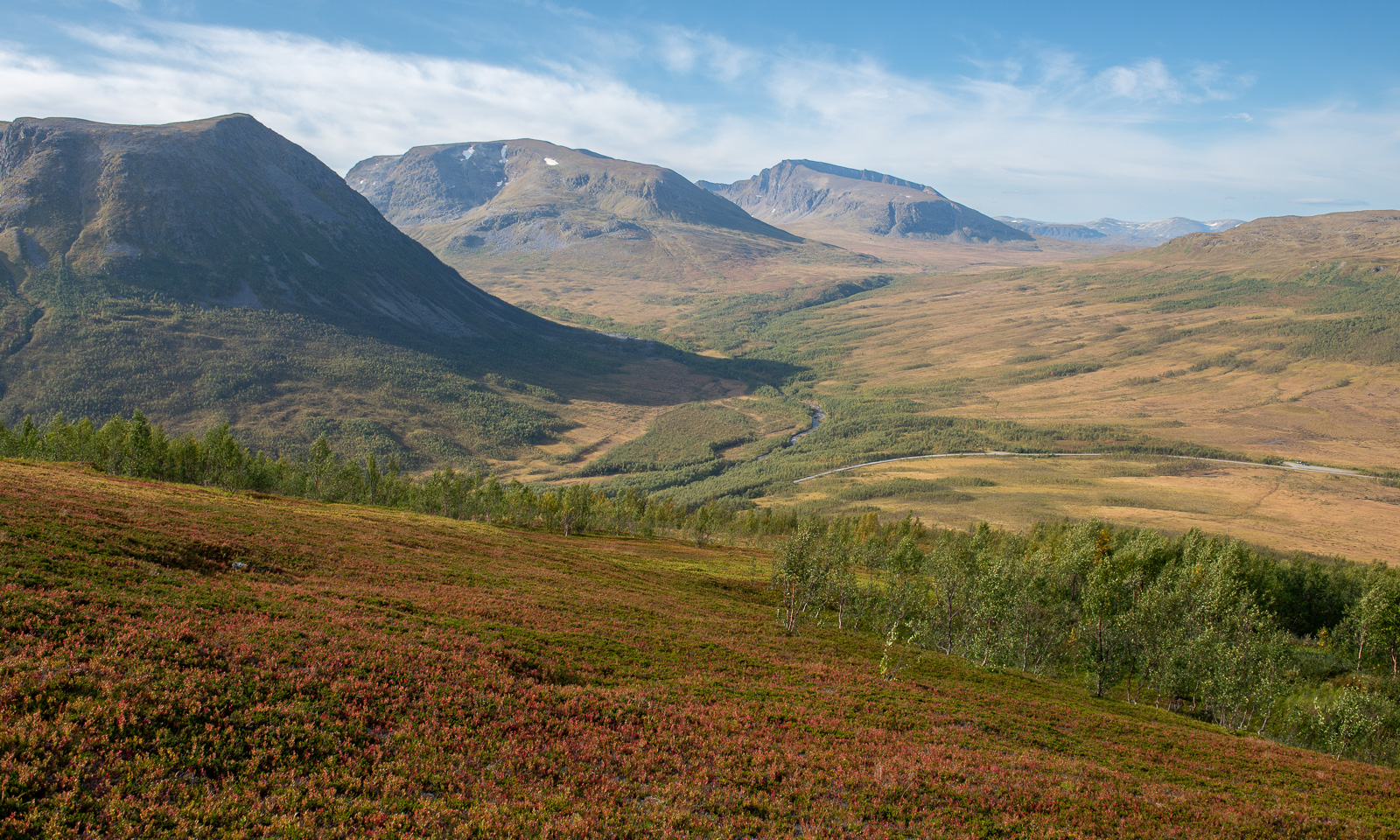
The bear won!