Just a pick-up at the station… – part II

< to part 1

Tuesday, 22 July

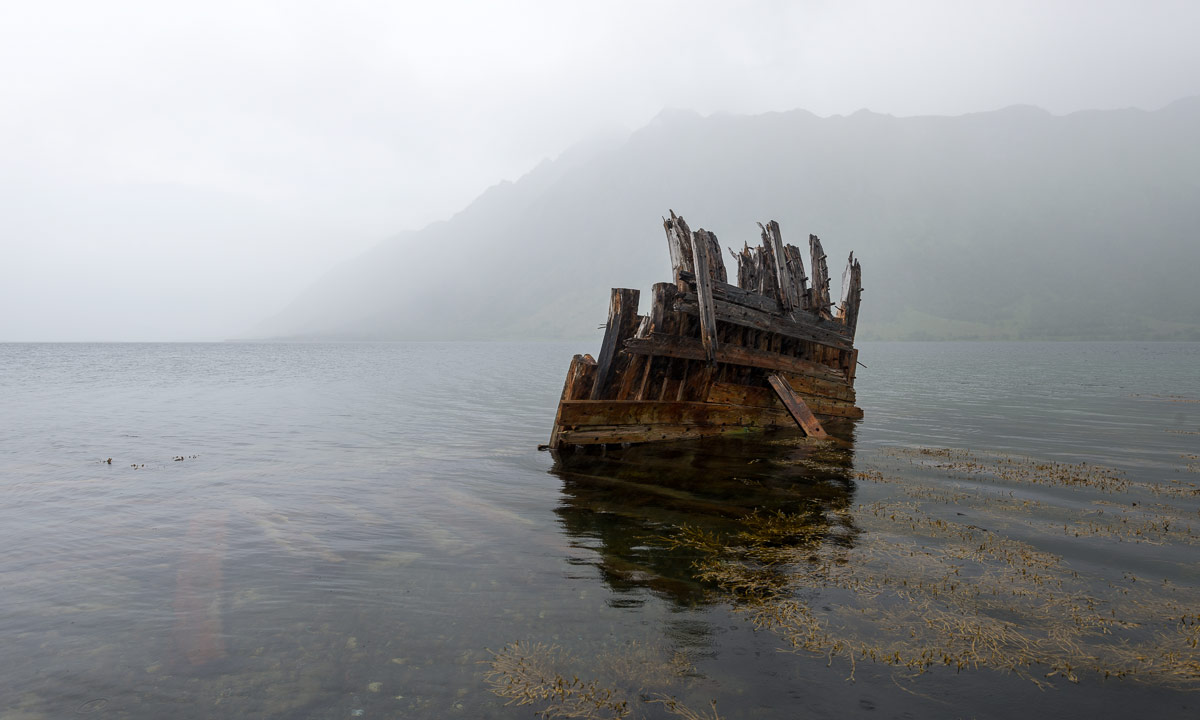
When I wake up early, the mountains and the sea have vanished. Thick fog surrounds our overnight stay Marmelkroken on the island Andøya. I take a walk through the wet grass to the bird observation place but beside of some seagulls and a lonely curlew that flies around there is nothing to see.

One hour later Annika and I sit inside enjoying our gorgeous breakfast. We get a table-side presentation of the dishes. More or less everything has been produced locally and we eat it all.

Then we head of. We want to catch the one o’clock ferry in Andenes that will bring us to the next island Senja, second largest in Norway (again, when we ignore Svalbard). The weather soon gets fair again, but around the mountains still some clouds are hanging.

Yesterday we took the western road, today we cross the boggy island to take the eastern one. On the way there we pass the village Å. There are several Norwegian places called Å, the most famous one is on the Lofoten. The next stop is the octagonal church in Dverberg.

A bit north near Myrset there is a huge area of peat mining. Andøya has large areas of peat bogs and parts of it has been drained to extract the peat. I climb on a hill of peat – it bounces like a water bed – to take some photos of this moonscape. Then I protect my camera lens, because each step emits a cloud of brown dust. But that’s nothing compared to the huge double-wheeled tractors anyhow that produce huge clouds of peat dust while driving. My car is brown now.

We take it easy, we have time – that’s what I thought. When we however arrive at the ferry terminal it becomes quite obvious that we would not join the next ferry. Too many cars are ahead of us waiting. So the one o’clock the ferry departs without us, leaving us behind but in a much better start position. Now we have to wait for four hours. Time to explore Andenes a bit.

As hoped and expected we find place on the next ferry. Now we are on the way north to Senja. Soon we are in open water, accompanied only by some sea birds.

The ferry trip takes one hour and forty minutes. Then we arrive in Gryllefjord on Senja.

Unfortunately we won’t catch the last ferry to Kvaløya today, they are not coordinated. We have to drive via the mainland – a large detour. Although it is another detour we decide to take the coastal route. 289 more kilometres to go which means a five hour drive in Norway. It is evening and we will make less breaks now.

Stop one – Tungeneset, a scenic rest area.
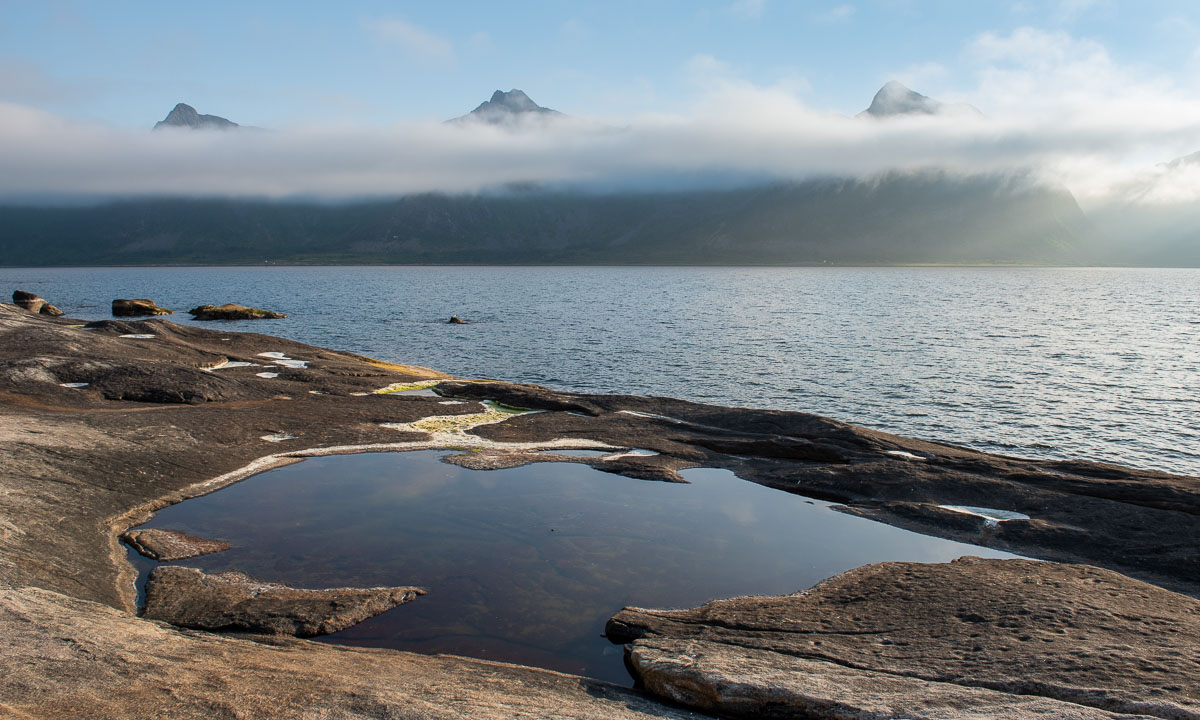
Stop two – another one of the many beautiful views on a fjord and the mountains on the other side. Here we see something special: a cloud waterfall. Clouds fall down a steep mountain range where they vanish in thin air. New clouds come from behind. The cloud waterfall is several kilometres broad and looks like a huge waterfall in slow motion. An impressive view.

(Note to the meteorologists: is this a orographic cloud spillover?)

We take the bridge from Silsand to Finnsnes. After two days we are on the Norwegian mainland again. Although it is still midnight sun season – the sun won’t set, it just moves lower and lower until it is hidden behind the mountain. I took the next photo at eleven o’clock in the evening.

At half past twelve we arrive home in Tromsø, my “work home”. Although it was only one evening and two days of travelling together it felt like real holidays.

We think about doing the same in half a year. I have to check the ferries, but it would be interesting to visit the same places in wintertime.

Just a pick-up at the station…

When Annika travelled to me last weekend, her train from Boden to Narvik was cancelled and the next and last train was heavily delayed. Unfortunately train problems have become common in Northern Sweden over the years. I had to use the airplane several times because trains didn’t run at all for days or it was impossible to buy tickets.

To keep Annika from being stranded, I drive to Narvik to fetch her. From Tromsø it takes me about three and a half hours plus some breaks.

Meanwhile Annika has booked a hostel in Bogen where we stay overnight. Our plan is not to drive back the direct route, but to visit the islands Andøya and Senja.

Monday, 21 July

The next morning starts sunny.

However it soon gets foggy. After crossing the Tjeldsund we are on Hinnøya, the largest Norwegian island (when we ignore Svalbard). We decide against a swim in the sea due to the fog and continue to Refsnes. From here go ferries cross the Gullesfjorden to Flesnes. On my trip to Narvik yesterday it was often 28 °C, now in the fog it is hardly 15 °C.

We have missed the 10 o’clock ferry, but they run hourly and we don’t have to wait for long. The journey itself takes only 20 minutes.

From Flesnes we continue to Risøyhamn. Hurtigruten travellers may know this place not only because it is one of the stops but also because of Risøyrenna – a man-made underwater channel that allows larger vessels to pass between Andøya and Hinnøya. The Hurtigruten ships has to go quite slow there.

We take the bridge over the Risøysundet and drive through Risøyhamn. Twice. Because I didn’t know that it is so small. Only round 200 people live there.

The weather is sunny again and we become more beach focussed. The first beach is for having lunch. We share it with a flock of sheep.

The second beach is for bathing. 16 °C in the water – surprisingly warm for the region.

We continue north. To the west the Norwegian Sea. Next shore westwards is Greenland, more than 1500 kilometres away. Our next stop is much closer: a public toilet at Bukkekjerka. But what a one! It is a designed block of concrete and mirrored glass. From the outside you cannot look in, but from the inside you can switch the huge glass windows between being transparent or opaque.

Around this place – a lighthouse on a peninsula, interesting looking rocks, a baaing sheep and of course the sea.

We follow the coastal road further north to Bleik. Here you can find beaches and turquoise water as well as ridiculously looking rock needles.

After refuelling my car in Andenes we drive south again to Marmelkroken, where we will stay overnight. With an additional photo stop.

To part 2 >

Travelling with the MS Lofoten: Øksfjord – Stamsund

This article is part of the series “2019-02: Northern Norway”.

Disclaimer: Many, many photos, some of them pretty mediocre but all part of the journey.

Still Saturday, 16 February

After we left Øksfjord we continued our journey through the darkness. The people on board were idle, they chatted, read a book, look through the window and of course most of them used their computers, tablets or smartphones.

Three hours later we were in Skervøy, stop #9 of my Hurtigruten journey.

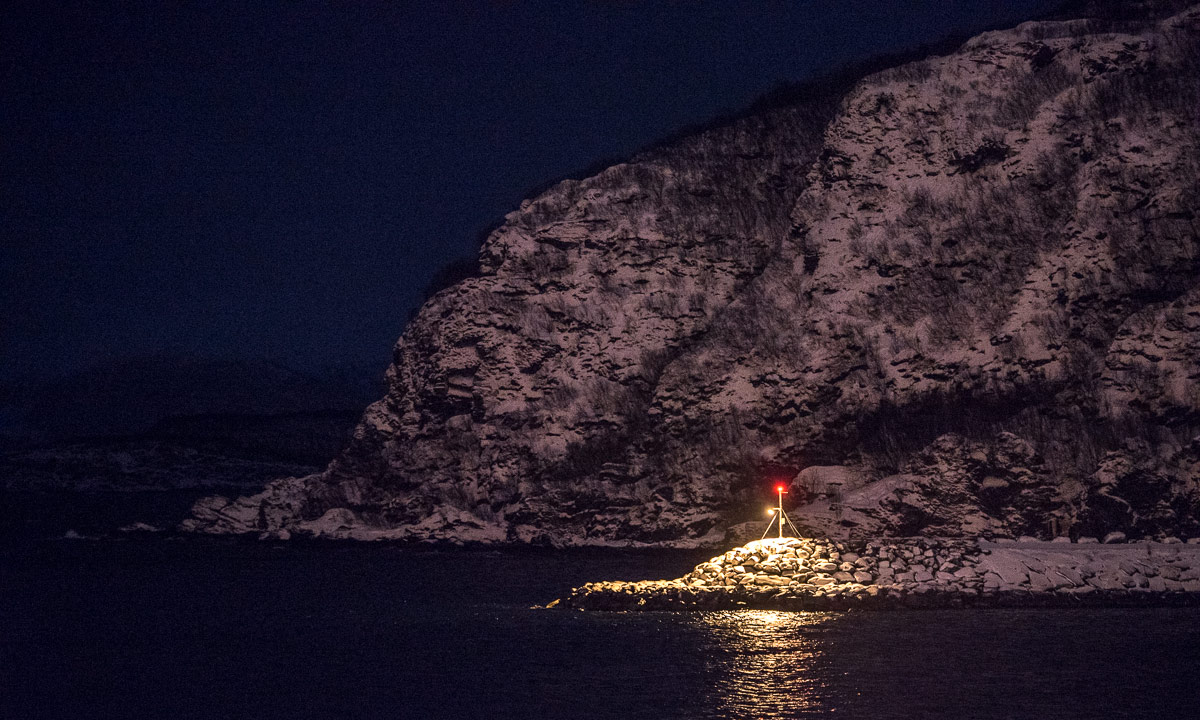
After a short stay we continued to Tromsø, Norway’s largest town north of Trondheim. I took a night image of the passing Hurtigruten ship MS Trollfjord then I went to sleep.

Our stays in Tromsø and Finnsnes I overslept completely.

Sunday, 17 February

At 7 o’clock I woke up, half an hour later I stood outside and took the first pictures in the blue hour. The weather was much better than the other days and the temperatures had dropped below zero in the night. We were on our way to Harstad, with 25000 inhabitants the third largest town in Northern Norway. Stop #12.

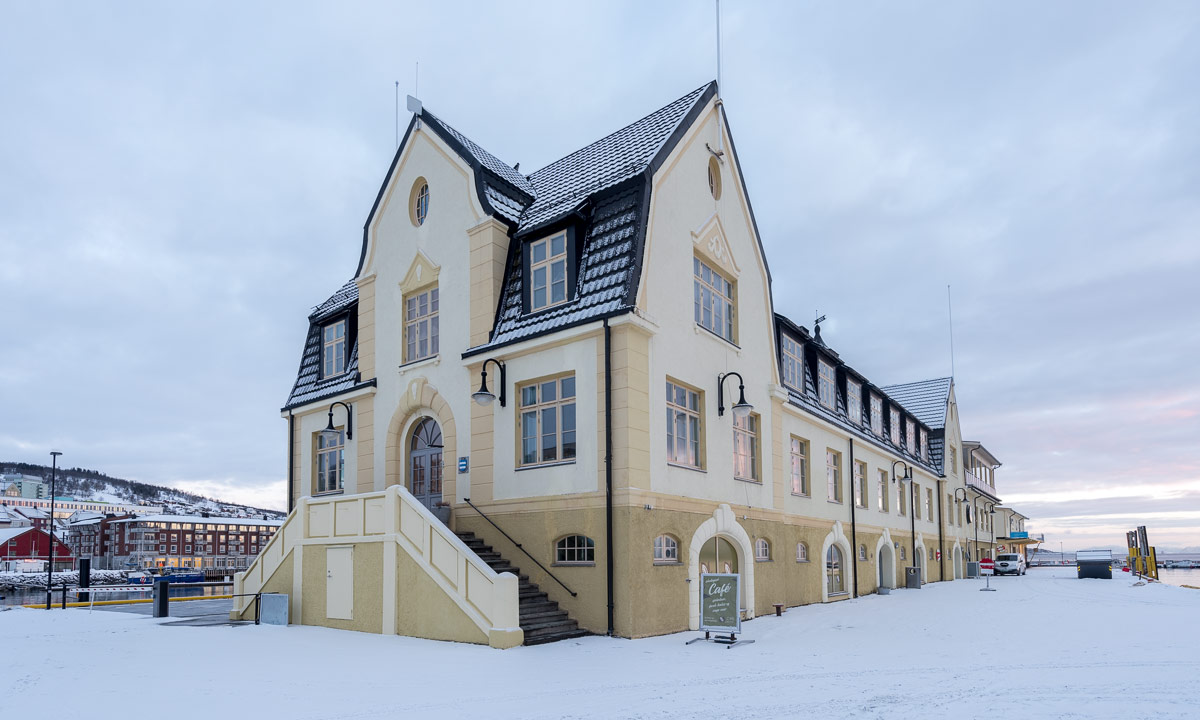
While we were stopped in Harstad the sun was rising and was bathing the landscape in purplish light. Harstad started to glitter. It was the many windows reflecting the warm sunlight.

The sun rose higher and after a while the sky was blue. I stood outside with my large telephoto lens and tried to catch the impressive snowy mountain ranges by the fjords and sea.

Risøyrennan, a deepened part of Risøysundet came into view.

After a short stay in Risøyhamn, part of the Vesterålen and stop #13 of my journey we continued south. The sheltered  was covered with a closed layer of thin pancake ice. You could hear it crack when it met the bow wave of the ship.

Some more images taken between Risøyhamn and Sortland:

I left the MS Lofoten in Sortland, stop #14, but only for a short time. In Norway all shops are closed on Sundays and then the towns may be a bit boring. Partly the ways still covered with a bit of frozen snow, but mostly it was slippery ice and some deep water puddles. Home in Skelleftehamn it had been very warm the last days and I expect the same road conditions when I’ll come home in a couple of days.

After 30 minutes the MS Lofoten continued its tour. At the horizon the steep mountains of the Lofoten islands came into view.

The backlit Lofoten mountain ranges looked amazing as if they were from another world. I’ll show you two photos but I’m not at all happy with them. In reality the landscape looked more aerial or as if made of light.

These mountains were in the far. The nearer mountains to the left or right looked more normal when it comes to light but still unreal because they were so steep and snowy.

The large island Hinnøya on the port side, the island Langøya on starboard side of the ship I stood at the starboard and peeked through my telephoto lens. I have friends near Stokmarknes on the Vesterålen and was I looking for their house. I found it ;-). Unfortunately R. was ill but J. visited be on the ship with the children. They went on board while the ship lay at the port of Stokmarknes, stop #15. Shortly before departure my friends left the ship. Thank you very much for your visit!

Oh, I forgot the photo of the islet (or holm) Gjæva. I already knew it from earlier stays with my friends.

Now we headed for the impressive sound Raftsundet where we would even take a small detour to the entrance of the Trollfjorden. Due to the narrowness of the fjord and the risk of avalanches it’s not possible to drive into it in wintertime.

We left the blue sky behind us, the weather worsened.

First the weather still was quite fair but then it started to snow. The snowfall was so strong and the cloud layer was so thick and low that it was decided not to visit the Trollfjorden. You hardly would have seen anything.

The camera was wet, I was wet, too and it was so dark that it was near to impossible to take any pictures. It was twenty to five and I went into my cabin and took a nap.

Just some photos “for the archives” of the next stays: Svolvær and Stamsund, stops #16 and #17, both on the Lofoten.

Winter on the Vesterålen

This article is part of the series “2017-02: Northern Norway”.

I’m sitting in a small mobile home in Nordnes near Røkland, Saltdalen, Norway. This morning Annika and I left Haukenes on the Vesterålen, where we had visited friends for some days. It had been gorgeous days, not only because it’s always fun to visit friends, but because of the fabulous winter weather we got those days.

Arrival

Last friday we left the Hurtigruten ship in Stokmarknes that we entered in Vardø two days before. My friends told us that there hadn’t been any snow one week before, but since then almost half a meter snow had fallen and snowfall hadn’t stopped yet.

Saturday

It snowed another ten centimetres the night and it continued snowing in the morning.

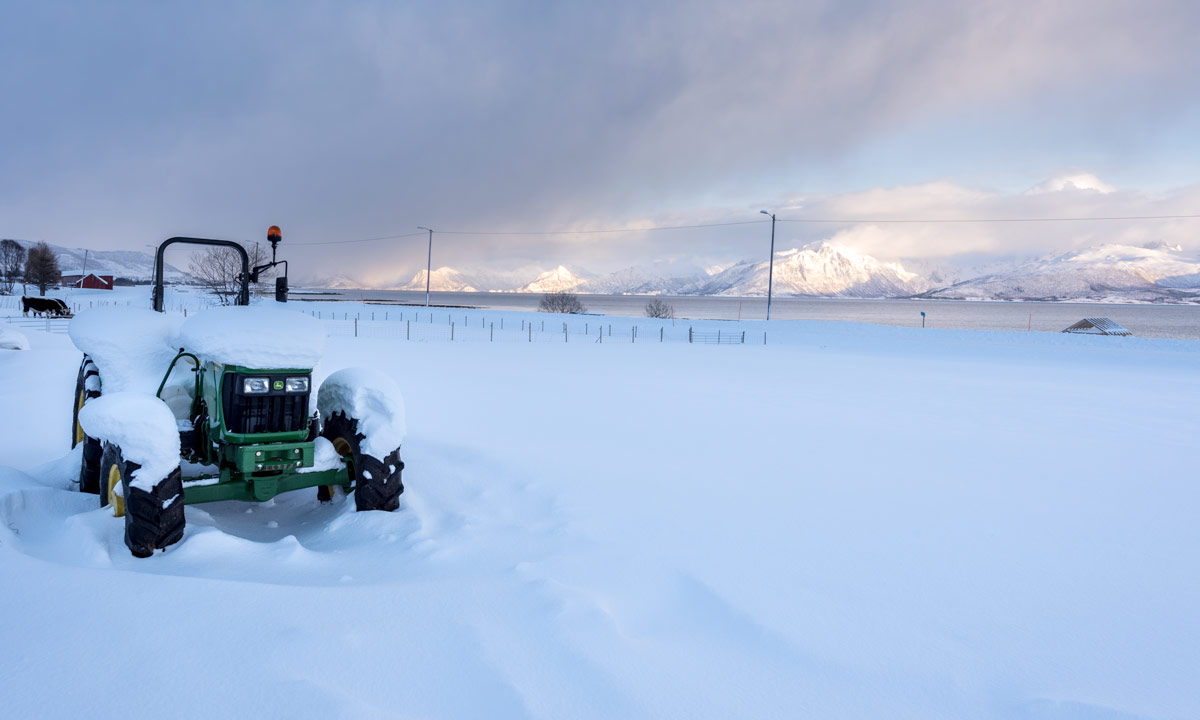
Sometimes the Norwegian weather forecast is right and so it was this day: As predicted it cleared up and promised to be a nice and sunny day later on. Annika and I took our skis and joined J. and B. together with Frits, the dog, on a ski promenade right behind their house . J. and B. returned after a while, we continued through the forest to the boggy valley Dalmyra over which we returned. Two small streams we had to cross with our skis but they were narrow enough to be crossable without problems.

Back again I looked at the snowy mountain range of the Lofoten that you can see from my friends house. The sinking sun changed colours of the snowy peaks every moment, from bright white to pale yellow, to “peach”, to orange, to colour shades I’m not able to name.

Sunday

Another sunny day awaited us. Annika and I planned to ascend the Hovden, a mountain, not high (285 – 323 m) but steep. So we left home our skis and took snowshoes, first to hike on snow covered ways and paths to Marka, were we went up the Hovden. Phew, that was quite exhausting.

Annika went back while I continued a bit, first along the waymarks, then using my GPS.

I just love being above the treeline in Norway, where the view is wide and includes snow covered mountains and solitary trees just as blue coloured open fjords.

I descended the top and came to the small lake, where I took a break with water and „Kvikk Lunsj“ chocolate.

The descend from the lake was far from being optimal, I chose a very steep passage and it took a while and some concentration until I was on sea level again, were I walked back to my friends house, first on a minor road, than across a snow covered bog.

Monday

I might bore you, but even this day the weather was fantastic. Annika and I followed a tip of J., took the car to Sandnes and skied to Årneset, a place by the bay Årnesbukta. Here’s a cosy cabin were you can seek shelter, when weather is bad and a row of beautiful sandy beaches. I never ever skied along sandy beaches and open water and I really enjoyed this ski premiere.

Tuesday

Our last day on the Vesterålen and guess what: Weather was great again! Anyway I was quite lazy, so Annika and I didn’t use skis or snow shoes but the car to drive round the southern part of the island Langøya on which my friends – now our friends – live. Some impressions:

That was our last day on the Vesterålen. Thank you, J. and R. for your hospitality. I hope, you’ll visit us in Sweden someday. You’re more than welcome!

Tomorrow we’ll continue our return journey, first 40 km to the Norwegian—Swedish border, than round 380 km home to Skelleftehamn.


Continuing to the Vesterålen

This article is part of the series “2015-07: Lofoten and Vesterålen”.

Our third day started with a lot of rain. We put the wet tent into the car and continued our tour to Kabelvåg where we visited a friend of mine. We took a small mountain hike but it was cloudy and wet. Only far away in the east you could see some sunny patches on the top of the snowy mountains.

After the hike Delle and I looked for a camp ground. But first I had to take a picture of the beautiful rainbow near Sildpollen.

This time we tented on a bigger campsite in Sandsletta. When I woke up quite early the next day I could see another rainbow over the Vatnfjorden, but later it started to rain and pour down again. And again we put the soaked tent into the car. We continued on the road 888 to Fiskebøl. The clouds were hanging low and you could hardly see any mountain, just some white and light grey schemes.

Soon we arrived in Fiskebøl where we waited for the ferry. Again we were lucky – we waited hardly half an hour until we entered the ferry for the short crossing to Melbu, the southernmost city of the Vesterålen. We visited friends of mine, this time in Haukenes were we tented near the friend’s house. The cocks tried to wake me up ridiculously early, but in vain. I continued sleeping until 8 o’clock.

Alas it was the first morning without rain (and the only one, too) and we could dry the tent. After a long and lazy breakfast with my friends we said farewell and continued our car trip. We got a tip to visit Stø at the northern end of the Vesterålen island Langøya. What a good tip and what a beautiful landscape – especially after the weather was nice and sunny. We made a short photo stop between Strengelvåg and Klo before we continued to Stø.

In Stø we parked our car and took a short hike over the mountains to a beautiful white sanded beach were we made a rest and I took a short bath. There’s a 15 km hiking trail as well; next time I’ll definitely will go it.

After our rest we slowly walked back and continued by car. First we had to head south to Sortland were we crossed the Sortlandsundet and headed north on the other side. The sky became more and more cloudy and we looked for a nice campground. Finally we found one in Bleik, quite near Andenes, a town at the northern end of the Vesterålen. We put up the tent and – guess what – it started to rain.

It had been raining the whole night and it continued raining. Again a soaking wet bunch of a tent lay in the back of the car. After a while of driving through the greyness we decided to head back to Skelleftehamn. It’s more than 900 kilometres and it took the whole day. Rain became less near Abisko and after we passed Jokkmokk the sky cleared up and we could see the full moon slowly rising. The next photo, which is the last of our car trip through the Lofoten and Vesterålen is taken near Storforsen, one of Europe’s biggest rapids. At 23:50 we were in Skelleftehamn again – and I was home.

  • 2296 kilometres in six days
  • a lot of clouds and rain, but two nice and sunny days, too
  • one night in the car, four in the tent (three of them on campgrounds)
  • two bathes and at least four rainbows
  • – a nice trip!


Weather changes

Day ten

Today the clouds came, it became warmer, wind increased and some fresh snow fell. The perfect weather for a quite lazy day with only one shorter walk.

On the other side of the Sortlandsundet mountain range after mountain range vanished in the low clouds leaving only the nearest mountains visible to eye and camera.

I plan another lazy day here in Haukenes, then I’ll continue my journey, probably heading to the island Senja and the town Tromsø. It will take much longer time as in summer because the most ferries are closed in the winter time.

Back to Haukenes

Day nine

Today I drove back from Andenes to my friends in Haukenes where I’ll leave on Sunday or Monday. I didn’t choose the direct way on the eastern side of Andøya (82) but the detour on the western side via Stave and Skogvoll. There where some fantastic views, mostly at places where I couldn’t stop. But anyway, some images of today (and two of yesterday):

Let’s start with some houses in Andenes build on stilts (The greenish colour on the second photo comes from the polar light).

Andenes next morning and Bleik, where I took a long walk on the large sandy beach.

A small graveyard and a real tiny light house.

A man hanging up fish heads for drying (for the african market).

And last not least some landscapes when sun went down again.

That’s today in a nutshell.

Whale watching in Andenes

Day eight

To cut a long story short: It’s been a great day!

After watching the beautiful polar light last night I got less sleep than preferred because I drove to Andenes to participate a whale safari. First I had to drive round two hours. After that I had to wait, time I used to put my cameras in waterproof bags. Finally we where equipped with overalls and live vests and entered the big rubber boat. We left the harbour and headed an area where whales have been seen some hours before. This part was a bit tough since we drove against the wind and some waves where quite huge letting the boat rise and fall some meters into the wave troughs again.

But finally we reached the area and directly saw the first whale fins and the first steam blown out through the whales blowholes.

The next two hours we saw a lot of whales, sometimes we where almost surrounded by them. Mostly we saw orcas (that are called killer whales, too) and humpbacks, but some fin whales as well. The orcas are following the herring and I probably came just to the right time to see so many of them. We even saw orca calves that are yellow or even orange instead of white as long as they are breast-fed.

(Oops, the room where I get internet is closing soon, I have to rush a bit …)

For me the most amazing view were the huge humpbacks diving down showing only there big tail fin. And the orca child swimming near its mother. And now to the photos:

As I said – it’s been a great day!

Links:

Sea Safari – Whale & Bird watching Andenes (under construction)

Photoing whales

It’s hard to take pictures of the whales. Sometimes there where quite near, less than 10 meters, but mostly there are farer away and you need a good system camera, a good tele lens and much practise in focussing. The most of my photos were out of focus, but alas not all.

Some of the photographers that joined the trip had real huge tele lenses and I guess the value of the total camera equipment onboard was the same as my house in Skelleftehamn.

Whale names

Latin English German Swedish
Orcinus orca Orca / Killer whale Orca / Schwertwal Späckhuggare
Megaptera novaeangliae Humpback whale Buckelwal Knölvalen
Balaenoptera physalus Fin whale Finnwal Sillval

The first polar light

If you like your beauty sleep and travel way up north, do not look out of the window too late! I did it and lost 50 minutes sleep standing outside and another 30 minutes writing this blog article.

And that’s why I stood outside: A really bright, moving and colourful polar light covered half of the sky.

It’s still out there but I’m tired and I have plans for tomorrow. Hopefully it’s not the last one on my journey.


A first mountain hike

Day six

Yesterday on Tuesday I stood up quite early to hike into the mountains. I packed my camera equipment, hot tea, nuts and raisins, compass, GPS and a down jacket. I considered first about taking my snowshoes with me but left them home, it didn’t look like much snow on the mountains.

I started the tour and headed to Langbakken, the place where we saw the sun two days before. I was greeted by the flock of sheep, some of them so tame and curious that they came to sniff on my hand. Then I climbed the fence and cut across country until I came to another fence with a gate. I went through the gate and followed the way beside of the fence until I came to a crossing where a way climbed up a forested hill.

The way didn’t continue but I just continued the direction until I came to a snow covered lake, the Dalvatnet.

I started to regret that I left my snowshoes behind, because with every step I sank 10 to 20 cm into the hard snow. It wasn’t the last time …

I knew the direction and had two options: Either crossing the open mountain brook or to just go ahead. I chose the latter. I had to cross a field with huge rocks where I really had to by careful and check every single step. After that I went up the steep slope. And it was much, much steeper than expected. I measured 40° with my compass. I had to be careful not to slip and I took many rests to calm down. Sorry, no photos.

But finally I reached the first hill took and horizontal terrain again. Just some more steps and I took a longer rest with the tea and my nuts. I was glad about my down jacket because the -8 °C felt much colder in the wind.

I could have sat there for hours and just watch the colours change. When the sun disappeared behind a mountain top the snow looked cold and bluish. When it appeared some minutes later in a gap between two mountains the snow was illuminated in yellow, orange and purple pastel shades. I’m no poet, I cannot describe it with words. After a while I continued to another lake called Finnurdvatnet, as frozen and snow covered as the first. I love the landscape above the treeline, especially in winter when it is reduced to snow, ice and rocks and some scattered small trees.

I would have loved to go further but the hard and partly crusty snow – knee deep some times – slowed me down quite much and both my condition as day light where limited. So I started my way back and went to another lake, the Nils-Persavatnet. Starting feeling exhausted I took another rest and continued to the ridge of the Hovden. I was quite glad to hit a snowshoe track that I could follow. It made it both easier to go. But first I had to look again. The sunset in the southwest, the intense purple colour of the sky in the southeast, the Hurtigruten ship on the Sortlandsundet, The huge bridge to Stokmarknes and the white snow-covered mountains everywhere. Just wonderful!

I continued the treeless ridge of the Hovden to the peak. Then I started the descend through the forest. I don’t think I would have found the whole way down without the snowshoe track that I could follow so easy. After a while I saw the same way I took when I started the tour, but from within the forest and the other side of a ditch. No wonder that I didn’t find this path in the morning! I jumped over the ditch and headed to the house of my friends. When I crossed Langbakken the same flock of sheep – as curious as in the morning hours – came again and some sheep (the same?) sniffed on my fingers again. But I longed after taking a hot shower and a nap in my bed and that was exactly what I did when I was back.

Conclusion:

A great first tour with beautiful weather in a fantastic landscape that would have been much easier with snowshoes. I guess that even the blister on my left heel came just from the wet snow in my boots that I could have avoided with snowshoes. Lesson learned, Olaf? Lesson learned!

Some vocabularies for my German readers:

down jacket – Daunenjacke
flock of sheep
– Schafherde
cut across country – querfeldein laufen
mountain brook – Gebirgsbach
treeline – Baumgrenze
crusty – hier: verharscht
ridge – Gebirgskamm, Grat
ditch – Graben

Links:

Map with the lakes and the peak of Hovden