This article is part of the series
“2022-02: Winter cruise KPH”.
Day 7 and 8 · 25 – 26 February 2022
25. Feb 07:00 – testing clothing concepts for extreme cold weather
Another Arctic morning. It has become slightly warmer with temperatures round -24 °C but at the same time a lot of windier. The average wind speeds of 20 m/s and above. So windchill is still -45 °C and I wonder how to dress just in case I will be on the sea ice the first time this night. No, I do not count on being allowed to enter it under such conditions but you never know. Be prepared and wait …
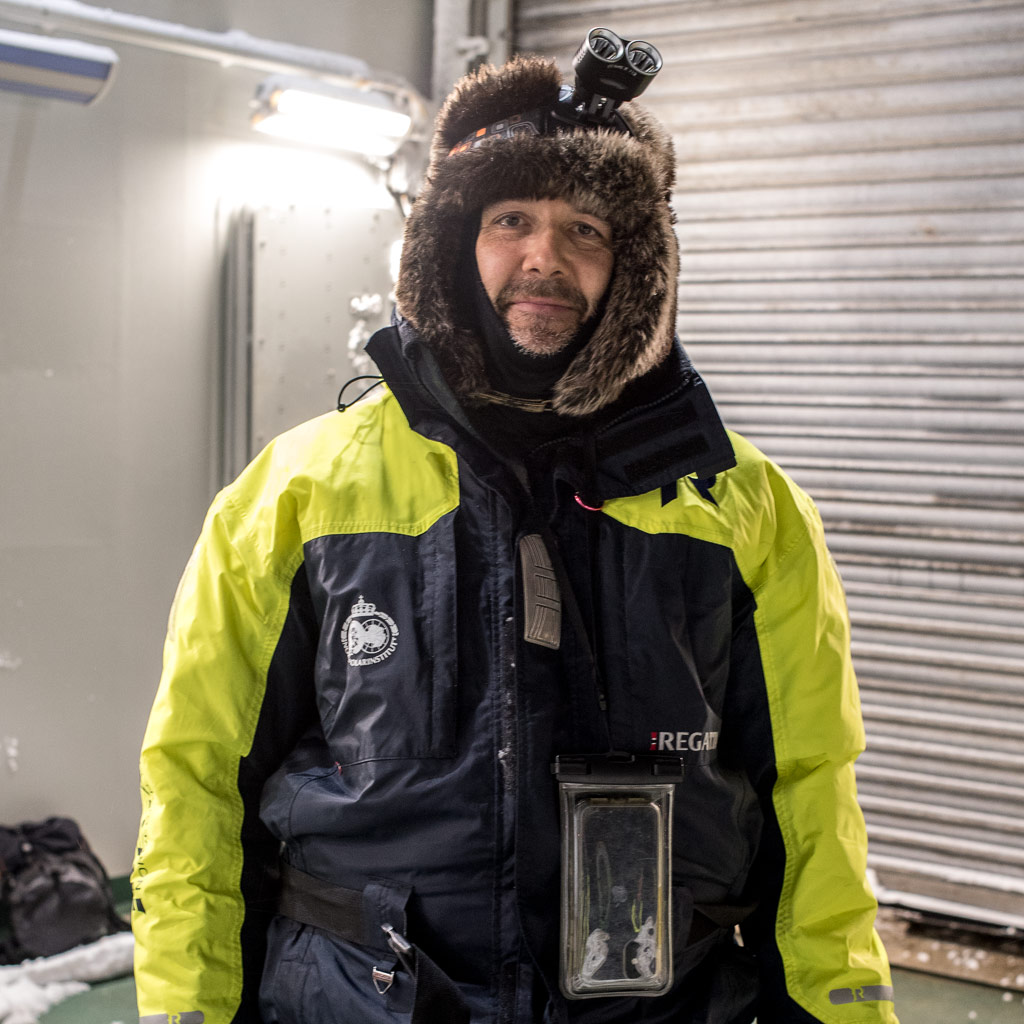
For safety reasons we always have to wear a special suit on the ice in case of someone breaks through. That’s either the Regatta suit, a floatation suit. This acts as a full body life vest giving you buoyancy in the water. However you will get wet instantly. No big issue because we will always be quite near the ship and conditions are ok. If the circumstances are more extreme or the ice is not trusted a survival suit with attached rubber boots is used. It will keep you completely dry as long as the arm and neck cuffs are tight. It is said however that it is uncomfortable to wear and you easily get very cold feet.
So, let’s get dressed. For the first time I put on the Regatta suit. It is as breathable as a rubber dinghy so you should not sweat too much. Over that, more for the fur hood than the warmth the Canada Goose parka. Yes, I can still move ;-)
Dressed like never before I open the thick door to the helicopter deck and stagger outside. Whoa! That’s some rough weather. I instantly feel every single square millimetre of skin that is still exposed to the wind and even that the zipper of the down pants are not completely closed at the bottom although I wear high rubber boots. In my opinion the hood of the Snow Mantra is ingenious but the gusty storm just pushes it aside in all directions and I can hardly see anything. So I do not check if the selfies taken with the Nikon and three pairs of gloves and mittens are in focus. They are not.
Being in again I understand the first time, why the parka hood is not only fur-trimmed but have this thick fleece rim inside. It keeps away the ice dust that the storm blows in.
The combination of Regatta suit is too warm and too bulky. I test another combination with the shell jacket of the Norwegian Polar Institute and ski goggles. Insight 1: if the hood does not fit perfectly it is completely useless in the storm. Insight 2: my old ski goggles freeze over so fast that within a minute I am functionally blind. I have to remove them to find back to the helicopter hangar. While checking this the storm pushes me around on the deck slippery deck. I really doubt if anyone wants to work on the ice in these extreme conditions. On the other side I do not know anything about polar research. Neither about polar researchers. It’s me who is the newbie.
25. Feb 11:00 +2h – planning for the storm
Aside: The day before we changed the ship’s time to take better advantage of the daylight. When I write +2h it means our privately shifted time. Otherwise it means „normal“ CET time zone. If you don’t care, just ignore it.
We have a meeting before lunch. A storm approaches. We will seek shelter between Nordaustlandet, Svalbard’s second-largest island and the island Kvitøya. Conditions are too rough for an ice station. Although all four ship engines are running we hardly make progress. There is no time schedule anymore. We just have to sit it out.
25. Feb 16:20 – the swell wracks the ice
At 15:20 I take a long afternoon nap while Kronprins Haakon struggles through the ice. I have on of the frontmost cabins on deck 3 –the noisiest ones. The icebreaker is rumbling, rattling, grinding, squeaking and doing many more noises that I do not have words for. I lie in my bed and feel the mattress vibrating, shaking, bouncing. And I love it. For me it is like an Arctic lullaby and as mostly I fall fast asleep.
z – z – z – z – z
After an hour I wake up all of a sudden. Something has changed. The ship is slowly and strongly pitching. At the same time noises and vibrations are absent. Are we in open water? What happened!?
I have to compensate the ship’s movements while I walk to the dayroom. I peek through the ice crusted windows. Yes, we are in open water. J. sitting there tells me that 10 minutes ago swell waves. They broke up the ice within minutes and now the ice has disappeared. Impressive and a bit frightening, too.
Now we are amidst the storm with an hourly average of 24.2 m/s, that’s round 87 km/h. The highest wind speed measured in this hour is 32.7 m/s, that’s the exactly beginning of Hurricane force or level 12 on the Beaufort scale.
Although the ship is stabilised it is pitching, rolling, yawing, heaving and a lot of people have started to get seasick. I feel quite ok, but a bit stressed and tired. After a while I decide to lie down for a quarter. Good idea! I feel better again after that.
I’m in the day room again, watching the dark waves through the ice encrusted windows . Sometimes the spray splashes up many metres. No, I won’t enter any outside deck today any longer!
25. Feb 19:24 – crossing the 80th degree of latitude
I wanted to see on the digital nautical chart how we cross the 80th degree of latitude but I miss it by some minutes in time. Soon I go to bed quite curious how the next day may look like.
26. Feb morning – Kvitøya
06:10 – The wind has calmed down and I stand on the helicopter deck (on level 6) again. Open water, a bit of ice and in the distance a pale scheme. The island Kvitøya. It looks like the spray has reached the deck because everything is coated in ice and the ice on the floor is slippery and feels like soap powder.
After the breakfast I try to catch Kvitøya on the Nikon sensor.
The last photos are crap from a technical view (taken at 600 mm ƒ/6.3 in twilight on a moving ship and a travel tripod). Anyhow they show the glacial coast of this Arctic island which I think is very impressive. A pity that the weather was so cloudy.
26. Feb morning – we reach ice again
While I take these photos another thing happens: we reach ice again. First fields of beautifully rounded pancake ice floes, then a few hours later we are in ¹⁰/₁₀ of thick ice again. There Kronprins Haakon can show again that it is an icebreaker.
We have another meeting at 09:00 +2h. We learn that it is more than unsure whether station P4 will have any reliable sea ice to work on. The cruise leader asks: shall we try P5 instead? Yes, all scientists agree. So today we will head to P5 at 80.5 °N 34 °E. That’s only an estimated position. First of all a suitable ice floe has to be found and then this floe will drift on the sea and so change position while ice work is ongoing.
26. Feb 16:00 – checking the ice
Eight hours later. Together with the cruise leader and the captain the ice experts had looked for a suitable ice floe. When they were satisfied the ship stopped and a derrick lowered the ice gangway. Now four people are on the ice. All equipped with survival suits. Two of them carry rifles. We are in the home of the polar bears.
Will I be allowed to enter the sea ice? Perhaps already tomorrow? I doubt it but I’m really longing. I don’t know where this strong relation for the Arctic comes from but it’s definitely there and it grew the last days. And I want to be part of it as much as possible.