Like ice in the springtime …

In the rare cases where the temperature rises above 0 °C something special happens: Ice and snow melt and become a liquid known as „water“. One of these rare occasions is called „spring“ and this is what has started happening right now. In these days many things happen that are related to ice, snow, and water.

8 April: Vattenplasket in Malå

Last Friday Annika and I visited our friends Lasse and Martine in Kusfors and stayed over. Lasse is a journalist and had a job in Malå the next day. There was a very special ski competition named “Vattenplasket” – the water splash. A ski hill and instead of a finish line a large basin with knee deep water. Is it possible to downhill on ski or snowboard and have enough momentum to cross the water? Let’s see:

Most of the competitors failed, two actually managed it. True sportsmanship showed a small boy that did not get enough momentum with his sled and just walked into the water. Kudos!

9 April: almost a kayak tour

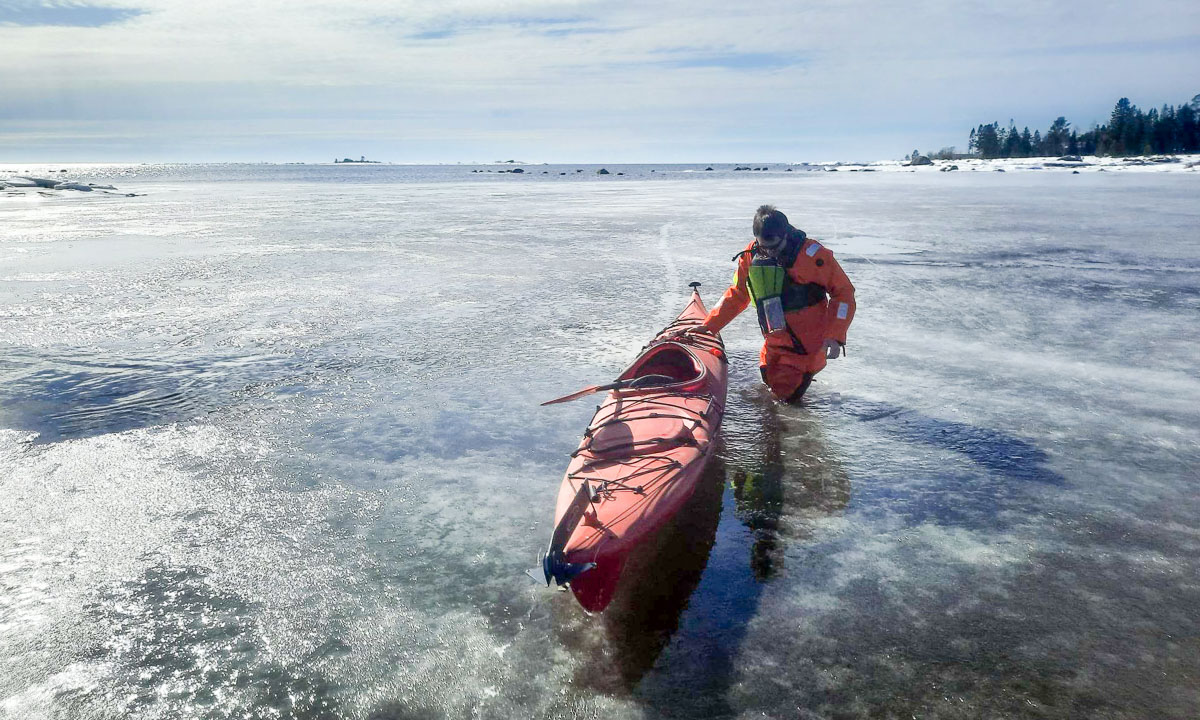
On Sunday Annika and I tried to do another kayak tour. Five days ago the ice was stable, this day it had got holes and was not reliable anymore. While Annika stood on safe ice I tried to cross the old ice to the island but **splash!** broke through several times. No biggie, the water is quite shallow and we have drysuits but it is exhausting. When Annika started breaking through as well, we decided to return. Another time …

10 April: winter bath

Finally. Annika and I. Twice. And then: sitting on the rocks in the wet bathing clothes without freezing because the sun is so warm. Springtime!

12 April: ice work

This is a piece of ice seen from the side. You can see the different horizontal layers that accumulated over time.

This is however no glacier ice nor Arctic sea ice. It is a piece of ice from our way to our house. Annika and I have been chopping the ice bit by bit for many days and today was the day: the way to the car and the road is free of ice and snow.

12 April: another “almost” kayak tour

There are other parts that are free of ice: Most of the weak ice between land and the island Lillskär is gone. After work I tried to paddle around the islet. We had low water (-30 cm) and some of the stable ice was grounded while large parts of the sea were open.

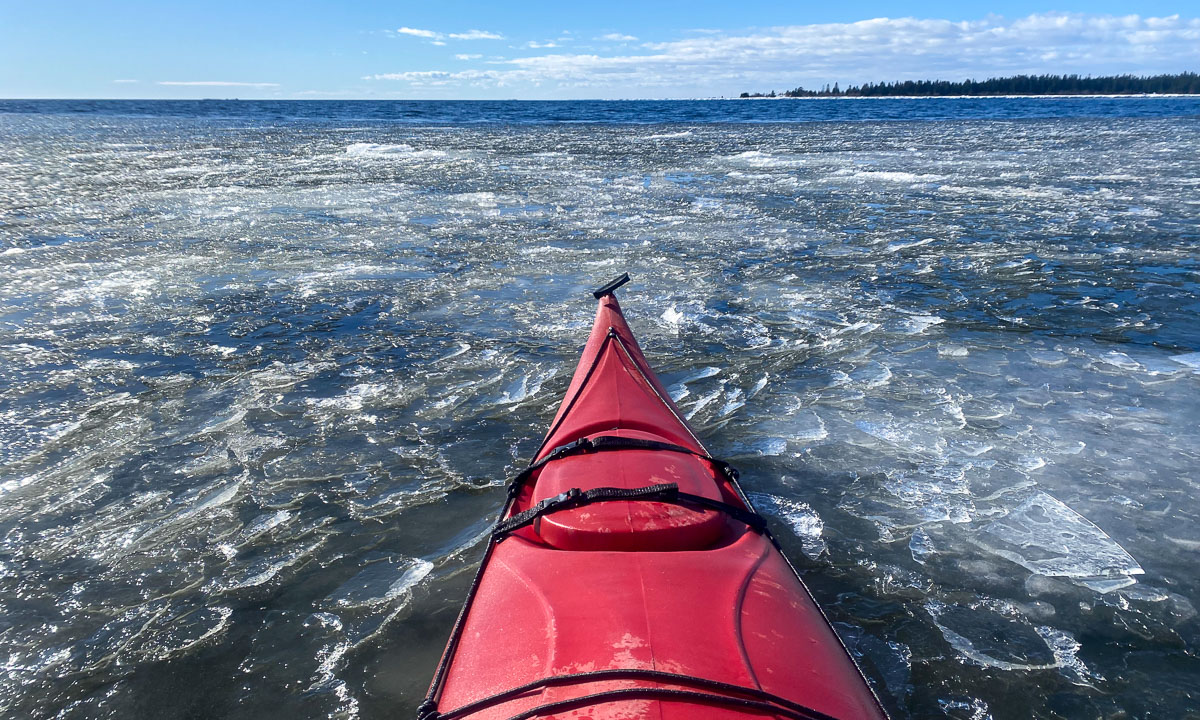
The first part was easy but when I almost rounded the island I came into an ice field. I already had seen it before starting the tour and thought I could paddle through. In theory this was possible, but the wind and the layers of ice made it near to impossible to steer the kayak.

So I got off the boat, jumped into the 60 cm deep water and while standing turned the kayak back to course. Now I could continue my island circumnavigation. Anyhow I consider exiting the kayak on the tour cheating, that’s why I say: I almost circumnavigated Lillskär today.

Even though the ice floes may have been 7–8 cm thick you couldn’t stand on the ice any longer. The ice was “rotten”. Many tiny vertical channels had weakened the ice and made it sensible to vertical stress. You can see it on the next photo. The piece on ice is standing, the bottom part of the ice floe is on the left.

A day cruise to Finland

A day cruise from Sweden to Finland and back.

HolmsundVaasa: 11:15–16:00. VaasaHolmsund: 16:30—19:00. The ferry is not faster on the way back but the Finnish time is one hour ahead.

Just some photos:

What a wonderful vårvinter kayak tour!

Yesterday the weather was calm and sunny. A perfect day for kayaking! Perhaps to Vitskärsudden, our favourite beach?

Chapter one – Bredskär

Kayaking needs a bit of preparation, especially in winter. After we have fixed a problem with Annika’s rudder, dressed ourself and went over the ice to the northern tip of the islet Lillskär we are ready to start our tour.

Annika goes first, I follow. We turn left and paddle along the edge of the ice.

Sometimes we cross fields with crushed ice. Many of the ice slices are thin and in the waves they sound like tuned bells.

We paddle along the island Bredskär. The waves are shallow and there is hardly and wind. I have to make a short stop to take a picture of the “ice monster”, then I follow Annika to the sandy bay in the northeast of the island.

We continue following the coastal line until we come to Bredskärssund, the sound between Bredskär and Obbola. As expected the sound is covered with ice and we have to return.

Time for …

Chapter two – Vitskärsudden

Slowly we paddle back enjoying the exceptionally beautiful weather and the ease of movement. Leaving Bredskär behind we cross the water heading for the rock that marks the entry to Vitskärsudden.

Arriving there more ice fields wait for us. Here are many layers of thin ice and it is not easy to find gaps to put the paddle in. Often it just glides and slides away.

It is not possible to paddle into the bay. It is covered with ice floes, many of them thick and large. But we do not want return home – too beautiful the day – and decide to paddle to the islands Obbolstenarna where we shortly have been two days ago.

Chapter three – Obbolstenarna

The way there is easy. No mentionable wind, just open water. In front of the islands there is another ice field, but it is small and easy to cross.

The next ice field is thicker. We try to break through but decide to go round. We just follow the coastal line.

In the south we go round an ice cap. According to the nautical map there is no island, just a shallow with some rocks.

Again I take a small detour to take a photo. This time to a large ice block.

Then we paddle north. First along the islands …

… then …

Chapter four – Home

we are leaving Obbolstenarna behind and head home. We enjoy the effortlessness of our today’s kayaking but we got a bit hungry. 10–15 minutes later we stand on the ice near our house.

We take a tour selfie then we drag our kayaks back home. First over the ice, then through the snow.

Thanks for the fabulously beautiful tour, Annika!

Annika tracked the tour with her smart watch. Here’s a small map. I added some names.

Back in Obbola – 20 hours

Sunday 10:30

After a breakfast in the sun heated winter garden Annika and I dress for a kayak tour. Special challenge today is not the frozen bay but the deep snow in our garden. I plunge through the snow, Annika is taking snowshoes while dragging the kayak behind. We are walking over the ice to the small skerry island Lillskär and then turn left until we approach open water. There we start the tour. I give Annika a push, then be both are sitting in our kayaks hopping forward until we reach open water.

We paddle to the islands Obbolstenarna. The way there is fast, a clear sign that we have tailwind. And true, the way back takes much longer. Yes, we are cold, but the winter garden is very warm and soon are we.

Sunday 17:00

A friend from Stockholm is visiting us today. Time to dig out our barbecue place. The two benches are covered with 20-30 of snow and it takes a bit of digging, until they are usable again. On the photo you still can see last day’s ski track crossing the bench.

Sunday 19:00

It gets cold and we have moved to the winter garden again. Blue sky, blue sea, blue snow, blue hour.

Sunday 20:23

A bright greenish light crosses the night, much faster than a plane. What was that? Many other sightings in Sweden confirm my thoughts: it was a bolide, an extremely bright meteor. I never saw anything like this. Since it was a matter of seconds, I couldn’t even think of taking a photo.

Monday 5:45

I wake up. Unnecessarily early for having vacation. Anyhow I peek out of the window. A beautiful morning, and with -13 °C a cold one for beginning of April. I pull ski pants and a down jacket over my pyjamas, slip into my boots and go out to take photos and wait for the sun. The icy edge at the horizon is already sunlit and I can see a weak light pillar above the island Bredskär. Fifteen minutes later the sun rises over the forestal island and I enjoy the sun for a short while.

Monday 6:30

When I’m back in the house it is still early. Time to take off the warm overclothes and continue sleeping …


Back in Obbola – the shortest ski tour

Two weeks ago I was in Longyearbyen, one week ago I was in Tromsø, my “work home” and yesterday evening I arrived in Obbola, Annika’s and my “home home”. Annika mentioned already, that we have quite a lot of snow.

Yesterday it was too dark, but this morning I could see our barbecue place. Sort of. While the benches were snowed in completely, the grillage was still visible.

Time for a walk to the tiny coastal promontory, that is round  160 metres from our house. The first steps the snow held, then my legs broke 90 cm deep into the snow. The same happened with the next steps. So I chose an alternative way of transport.

I chose the wooden Tegsnäs skis because the ski binding takes every shoe and I didn’t have to look for my ski boots. It is quite wobbly to ski on them – they are 240 cm long and the binding is very loose – but deep snow is no issue anymore. And so it took perhaps two minutes until I reached the promontory. Perhaps my shortest ski tour ever?

I love our coast in winter. The snowed in islet, the blank ice, the open water on 1 April. It’s beautiful and it’s home. I’m glad, that I’ll be here for the next weeks.

12 more photos of Longyearbyen

This article is part of the series “2023-03: Svalbard”.

3 March

It is the first evening of Annika’s and my stay in Longyearbyen, Spitsbergen, Svalbard. We already strolled through the settlement after arrival. Now it is dark but the full moon illuminates the end of the road of Nybyen, one of Longyearbyen’s districts. What a special feeling to be in one of the world northernmost settlements on Earth. And a slightly tense one. It’s the edge of town, are there any polar bears around?

8 March

When you are in Svalbard you have to keep distance to animals to protect them. The animals do not follow this rule. This is a Svalbard reindeer, an own species of reindeer living here. It is looking for food in the middle of the city.

9 March

I didn’t expect to see ptarmigans on Svalbard but on our guided minibus tour we get to see a whole flock, again in Longyearbyen. Magnus is so kind to stop so that I could take a photo from the road.

10 March

This day is quite warm for Longyearbyen: Only -8 °C. When I took this photo however it was windy. Average wind wind 16 m/s, gusts 21 m/s and snow is blowing in the streets.

12 March

Annika is on her way home, I’ll stay for another week and today I enjoy the beautiful weather by the coast. The mountains on the other side of the fjord Isfjorden look quite near today – especially through the big telephoto lens.

15 March

I take an after work stroll along the coast and through town. It is cold and even with the modest wind of 6 m/s windchill is below -30 °C. It looks arctic, it smells arctic (the nose hairs freeze together immediately) and it feels arctic. No wonder – I am in the Arctic. Even the petrol prices show, that you are not in mainland Norway any longer. Petrol is cheap because Svalbard has reduced taxes.

18 March

Another walk in town. Up the hill to Taubanesentrale (the central of coal mining cableway), down to the center and up again to the elevated way in the east, part of the avalanche protection.

19 March

Sunday. Tomorrow I’ll fly back to Tromsø, today I’m quite lazy but finally I walk to the coast again because of the wonderful weather. Even with my hood on I can hear something above me. I look up and see the first two seagulls since I have arrived here. It is two glaucous gulls that draw large circles above the coastal line.

I try even to take pictures of the incredibly coloured mountains on the other side of the Isfjorden but the turbulences in the air make clear pictures impossible. I’ll keep it in my memory as I’ll do with my whole stay in Longyearbyen.


Colder days in Longyearbyen

This article is part of the series “2023-03: Svalbard”.

Two days ago on 14 March 2023 it started getting colder in Longyearbyen. Yesterday temperatures were around -19 °C, today around -21 °C.

Yesterday I took a walk after work and took some photos with my tiny Sony camera that worked surprisingly good in the cold when being kept warm.

While light was beautiful yesterday, today it was magic. After work I went to my apartment. Round about 15 minutes later I left it with all my camera gear and went to the shore. Due to the interface between the open water and the cold air ice fog covered large parts of the Adventfjorden. While I looked for good places to take photos the setting sun and the altering fog changed the mood every minute. Extraordinary beautiful!

Like the days before the sunset colours on the snow covered mountains became warmer and warmer until they reached a delicate but intense purple shade while the sunlit parts rose higher and higher until only the tops stayed in the sun.

Remember, these photos were not taken in the wilderness, I’m in the settlement Longyearbyen and my apartment lies just 500 metre from the nearest photo spot.

As already mentioned today’s temperatures were round -21 °C. With a moderate breeze of 6 m/s that felt like -32 °C. Pretty cold and the ice fog didn’t make it warmer.


After work snowmobile tour

This article is part of the series “2023-03: Svalbard”.

This week I’m working at UNIS, the university centre in Svalbard together with friend and colleague Luke Mardsen. He is data manager for The Nansen Legacy. This week we collaborate on some of the software he wrote for this research project. Interesting stuff, but maybe not for this blog.

Today Luke invited me to an after work snowmobile trip up the glacier Longyearbreen. I borrowed a helmet, ski goggles and warm mittens from the Norwegian Polar Institute whose colleagues I had coffee break with today. Then I dressed like being in the high Arctic, but hey, I am in the high Arctic. Luke picked me up from the UNIS Guesthouse and then we started the tour. Luke was driving the snowmobile, I was sitting behind him. First through town, under the water pipes – duck! – and past Huset, where Annika and I had food ten days ago. Then we ascended the valley and then the glacier. Today we have had the finest whether thinkable: crisp, clear, blue sky and so we got to see the beauty of the sunset colours on the snowy mountains around as well as on the other side of the Adventdalen.

But beside of marvelling the beauty of nature there were other attractions waiting. Another ice cave, probably larger than that Annika and I visited a week ago and a bit more need of climbing. We got a tip of a colleague of Luke to visit a side room and it was astonishing. A large and high, beautiful room with a roof covered with large feather-like ice plates. I never saw something like this before. Without torches it was pitch black in the cave and so photographing took more time and efforts. I managed to take some snapshots anyhow.

After some exploring we returned and climbed up the ladders to the cave entrance. Now the blue hour had started and the light was less colourful but equally beautiful.

Back we went on Luke’s snowmobile. He in the front, I in the back. It was only two hours later when we arrived at the guesthouse again, but I had completely fallen out of time, especially in the ice cave.

I lack the words to thank you for this wonderful after work trip, Luke. See you tomorrow in the office.

Two-day dogsledding tour in Svalbard – ice cave

This article is part of the series “2023-03: Svalbard”.

There is a hole in the snow. You can crawl in and then you are in another world. Down the rabbit hole …

It is the second day of Annika and my dogsledding tour and we are on our way back to the dog yard. Our tour guide Adelheid however makes a detour to the Scott Turner glacier. Here is the entrance to an impressive cave formed by meltwater in the summer. Now it is winter and we can walk through ice, that at the bottom is roughly 1000 years old.

We have time and can follow the main cave passage through the glacier’s art exhibition.

I try to take many photos, but it’s not easy. Parts of the cave are quite dark and the cave is so humid that my Nikon telephoto lens fogs up. It’s not the first time, that my iPhone rescues me in such situations.

Thanks for the guiding, Adelheid.

A first day in Longyearbyen

This article is part of the series “2023-03: Svalbard”.

Today Annika and I have the first full day in Longyearbyen. There’s a lot to see, even for us, for whom Northern Norway in general is nothing new.

House on mountain slope

We have seen houses, we have seen mountains, we have seen houses by and in mountains. But the mountains in Svalbard are really special and quite recognisable.

Arctic town

It is not only the mountains, that give Longyearbyen a very special character. It is amongst others the traces of the coal mining that is still present although there is no active mining in town any longer.

Avalanche fences

In December 2015 an avalanche buried ten houses in Longyearbyen. Two people died. Today some houses in Longyearbyen are abandoned because they lie in critical areas and the mountain Sukkertoppen (the sugar peak) is covered with avalanche fences.

Snowmobiles

In Northern Sweden snow mobiles are very popular, for work, transportation and for leisure. In Northern Norway there are much more restrictions and you do not see them as often. In Svalbard there are more snow mobiles than people. No wonder in a place with very long winters and hardly any road network.

Chilly temperatures

In Northern Sweden temperatures of -19.7 °C are not seldom in winter, but then it is mostly calm weather. Today in Longyearbyen it was pretty gusty and windy which made the temperature appear significantly lower.

Fjords

Yes, there are fjords in Tromsø. But there are roads and settlements, too. On Svalbard there are not many settlements at all and the fjords do not only look much more icy and arctic, but also untouched. The small dots on the right of the first image however tell another story: There is a lot of snowmobile traffic.

Northernmost church?

There is a church in Longyearbyen lying on a small hill. It looks cosy and if you go in you realise, it is. It is the northernmost Lutheran church in the world, only topped by an Eastern Orthodox church in the Russian Franz Josef Land. (Source: wikipedia)

Mukluks

Of course people in Longyearbyen have warm clothes. When it comes to boots Mukluks are quite popular. The origin of these shoes lies in the Inuit culture of the North American Arctic and there are great for dry and cold weather. You hardly see them in mainland Scandinavia.

Impressive mountains

Did I mention the impressive mountains? I did? Well, anyhow – they are impressive!

Surprises

This solitary house goes by the name Huset – the house. The name is as pragmatic as the architecture. But it contains a surprise. The restaurant Huset does not only have quite high-priced dinner, but also a “Saturday beef” on Saturdays 15-18. By chance we passed the house at 14:45 and it is Saturday today. So we decided to eat there. A good choice because the food was very delicious and costed only 190 crowns – a bargain in Norway!

Polar bears

One of the very special things about Svalbard: there are more polar bears than human beings on this Archipelago. While the town Longyearbyen is protected the surroundings aren’t. If you leave town you have to carry a rifle and a flare gun and must know how to handle incidents with polar bears. Signs warn you when you leave the safe space.

Neither Annika nor I can and may handle a rifle so we stay within town beside of guided tours.

Treacherous weather

When we left the restaurant Huset, weather had changed. It was as windy as before but now it was snowing and the wind gusts blew snow everywhere. Into the face and into the pockets of my parka. It was however less than a kilometre walk until we reached our accommodation Coal Miner’s Cabin.