March snow at the coast

Today I finally had to work with my it job again.

But before that I just had to take my camera and drive to different places by the sea. I was curious how it would look like after the snowfalls of the last days. This morning between 75 cm and 80 cm of snow in my backyard and we are talking about the average, not the snow drifts.

1. Peninsula Näsgrundet

Normally the coastal line is quite visible here. Either you see stones sticking out of the rocky coast or you can spot the raised ice edge. Today you mainly saw a white plain. Only some of the largest rock and some brown tufts of grass were sticking out of the snow. I really had to look for motives to avoid images with a plain-white bottom half.

I would not dare to enter the ice because you cannot see its thickness. Probably there are weak spots that wouldn’t bear my weight.

2. Boat harbour Kurjoviken

On the roofs protecting the two wooden boats there was hardly any snow. Probably it had been too windy. Parts of the outside furniture of the restaurant Sjökrog were buried deepely in the snow. There was also a completely buried table, but that would have given a very boring photo.

3. Nameless boat bridge, Rönnskär

The boat bridge normally shows nice contrasts between the wooden construction and the water, whether covered with ice or not. Even here the snow made it all the same today: snow everywhere reduced the contrasts radically.

Now I was satisfied enough to start working, but first I had to shovel snow. I had already cleared the garage driveway last Sunday, not I had to dig a bay into the snow so that the postman could approach the mailbox by car. Phew, that was work, round about 1.5 m³ of frozen snow had to be moved and thrown in my front yard.

Snow makes everything beautiful, it’s only a matter of the amount.


Old ice, new ice

Just one cold night with calm weather and temperatures round -11 °C was enough to freeze the coastal Baltic Sea after yesterday’s stormy weather. Between the thin and dark new ice are thick old ice floes, most of them grounded on rocks, because most free floating ice floes were blown away yesterday.

If you were there and looked really closely you would see the new ice floes moving up and down a bit. There are still not frozen together.

Last day of February – farewell sea ice

Yesterday I stood on the ice edge of Kågnäshällan. It was warm and felt like the end of April. And so it looked like, too, because large parts of the Bothnian Bay were free of ice. Only protected bays and shallow waters round the islands were still frozen.

It became colder and stormy in the night. It even snowed a millimetre.

When I got up this morning it was -4 °C and still quite gusty and stormy. At 8 o’clock I took the car to have a look at the ice conditions.

I passed the nearest bay Kallholmsfjärden, just 400 metres from my house. Some ice fishers were sitting on the ice, but only some hundred meters from open water. I however wanted to drive to Näsgrundet, one of my favourite places. Yesterday afternoon the sea east of this peninsula had been completely covered with a new ice shield that had been created one week ago. Today it was … well, different …

Gale-force wind gusts tugged at my hood. Waves splashed sea spray and tossed pieces of ice onto the ice walls in front of the coast. Ice floes floated to and fro, cracking, shaking, turning, breaking. Sometimes I could feel the vibration of another wave hitting the ice wall I was standing on. Some of the ice already had been squelched to slush. I cannot remember such an impressive view of the forces of the Baltic Sea in winter time. Farther away a ship was leaving the port, accompanied by a tug boat and the small icebreaker Baus.

I tried to make pictures of the say spray of the waves. Not easy …

Behind the curtains of spray waves came rolling and small and large ice floes pivoted and danced while going up and down.

After 45 minutes the Baus came back heading for the port.

Partly I was taking pictures, partly I was just enjoying the energy of the elements and listened to the different sounds. I tried to make some videos, but all you can hear is the swooshing wind at full volume.

After one and a half hours of photographing I left this scene and drove to the small boat harbour Tjuvkistan nearby. Here the ice uses to be safe to cross to the islands Norrskär and Bredskär until the end of March or even mid-April.

Well, not this year. Even here the ice layer was being destroyed by the waves. The northern wind blew the ice floes away, so they will not freeze together again, or perhaps in Finland.

When I returned home I passed the Kallholmsfjärden a second time. The ice fishers were gone – there was just no ice left to sit on and fish from.

So, the sea-ice-season is over, four to six weeks earlier than usual.

Last day of February – polar light

Just one hour ago: finally a polar light above Skelleftehamn that was more than a pale green arc. It was just a short intermezzo and when I had found a good place for photographing it already weakened. That’s normal. Many of the beautiful auroras do not last long. I got some shots anyway.

You see the open water on the last image? Well, that’s another story to tell.

Kågnäshällan – between land, ice and sea

Kågnäshällan is a small island in the Baltic Sea with a lighthouse. The linear distance is only 7 km, but it’s 18 km by car. Since I cannot fly (and neither skies or kayak would do neither) I took the car this morning to Kågnäsudden, the cape nearby to take some photos on Kågnäshällan.

The sea is almost free of ice, only at the coast and between the islands there’s a thick layer of ice left. That makes the area quite amphibian. I took snowshoes and pulka for walking along the coast and for crossing the wet but safe ice between mainland and Kågnäshällan. Then I wanted to get near the ice edge and chose waterproof equipment. The waterproof Nikon AW-1 for taking photos and my red immersion suit to keep my warm and dry in the ice cold water. I felt like a bright red seal hunting for photos, not for fish.

Farewell winter

Yesterday afternoon: a snapshot of the coast. That’s how I like winter. Either a lot of snow or cold, crisp and sunny days at the coast.

This morning at 7 o’clock the weather was still fine. An almost cloudless blue sky at -19 °C. Would it be another beautiful winter day? Well …

Since days the weather services SMHI, Klart and yr had been predicting much warmer weather from today. Unfortunately they were right. At 8:00 the temperature already had risen to -9 °C, at 9:30 to -4 °C. In the afternoon some snowfall was predicted by SMHI. Instead of snow we got freezing rain for hours and soon black ice covered the roads and made them incredibly slippery. Even the snow-covered surface became extremely icy. The rain created an ice shield everywhere, for example on the southern windows of my winter garden.

Both SMHI, Klart and yr predict warm weather with plus degrees up to 8 °C for the rest of the month. Much too warm for February!

The rubber boots and the matching spikes are already at the door and probably will become standard equipment for days.

Farewell winter. I hope you come back with snow and coldness in March.

No kayaking today

Yesterday the Baltic Sea was open. Some ice floes drifted in the waves, the rest between mainland and the island Gåsören was open water. Just the photo from yesterday afternoon one more time:

When I saw the open see yesterday I thought about kayaking today. Temperatures below -15 °C were expected. What to wear beside of a dry suit? How many layers?

I started to dig out the door and gate of my garage to be able to get my kayak. That was hard work. The upper layer of the frozen snow that had slid from the roof was as hard as concrete. Even the avalanche shovel with the metal blade could be hug into the snow centimetre by centimetre. But finally I made it, my kayak was free.

Today at 7 o’clock the outdoor thermometer showed -18 °C. Again – what to wear on a kayak winter tour? Two layers of underwear? The winter anorak? The earflap cap made of thick polyester fur? Well, first let’s check the situation by the sea.

Oops …

The sea had been frozen overnight. A stripe of at least several hundred metres was covered with soft and thin ice, exactly that type of ice hardest to handle when sitting in a kayak.

Kayaking plans cancelled! Time for another photo.

Meanwhile in Skelleftehamn – snow and sea ice

Arrival home in SkelleftehamnI expected the worst in Skelleftehamn. The worst regarding winter. I wanted to have a real one – it’s mid-February – but had heard about the warm temperatures last week. Three days with temperatures round 7 °C, at least in town. But I was lucky, it hadn’t rained these days. The snow had fallen together but was still there. All minor streets where still white with some fresh snowdrifts from today’s strong and gusty wind and in my backyard lie still round 55 cm of snow.

Of course I had to shovel away the snow before I could use my car. Its a car with all-wheel drive but no snowcat. Although the snow was hard it was easier than expected.

The special thing about a trip with the Hurtigruten ship is that the Norwegian Sea is free of ice the whole year round and most parts of the Barents Sea, too. The Bothnian Bay – the northernmost part of the Baltic Sea – however is covered with a thick solid layer of ice. That’s what I thought until I read a Facebook post today:

Öppet vatten runt Gåsören. – Open water round [the island] Gåsören.

I could hardly believe it and took the car to the coast. And yes – large parts of the sea were free of ice, even the ice floes had gone beside of some remains. I guess there won’t be a ski tour to Gåsören this winter.

Two weeks ago I had made ski tours on the Baltic Sea with Chris. Although there’s solid ice left between the other islands I doubt that we could do the same tours today.

Here’s a comparison of the ice situation today and two weeks ago:

Legend:  fast ice |  very close or compact ice |  open ice | open water
Source: SMHI Sea Ice – Archived charts and reports

Travelling with the MS Lofoten: Stamsund – Trondheim

This article is part of the series “2019-02: Northern Norway”.

I’m writing this blog article from the train. We left Trondheim central station ten minutes ago at 7:50, at 9:22 I’ll be Storlien in Sweden where I’ll have to change train. But back to the day before yesterday evening. The Hurtigruten ship MS Lofoten had just left Stamsund

22:30 – we just had left Stamsund. The next stop would be Bodø at 2:30 in the night.

Monday, 18 February

As expected I overslept Bodø, stop #18 of my Hurtigruten journey to Trondheim. I was awakened by a loud, squeaky noise. It was our ship leaving Ørnes, stop #19. It scraped along the huge truck tires that are fixed to all piers to avoid damages and made an awful noise. One hour later I stood on deck and looked at the MS Spitsbergen, the ship that Chris and I visited eight days ago. It had been in Bergen and now was returning to Kirkenes.

At half past nine we passed Polarsirkelmonumentet, a monument marking the polar circle. It looks a bit alike as the more famous monument at the North Cape.

But – where’s the winter? We were not only going south, we also had unusually warm weather for mid-February. Beside of the higher mountains most snow had melted and the landscape looked more like a rainy September day than the middle of winter.

Later there was a little ceremony for having crossed the polar circle. I have crossed it many times but I participated too. Obediently, I took a spoonful of cod liver oil, because I wanted to have the spoon that you may keep.

I have to admit, that the journey started to become a bit boring. The winter was far up north, the weather was warm and rainy and I’ve been on the ship for three days already. I made some pictures anyway.

Next stop Nesna, stop #20.

Next stop Sandnessjøen, stop #21.

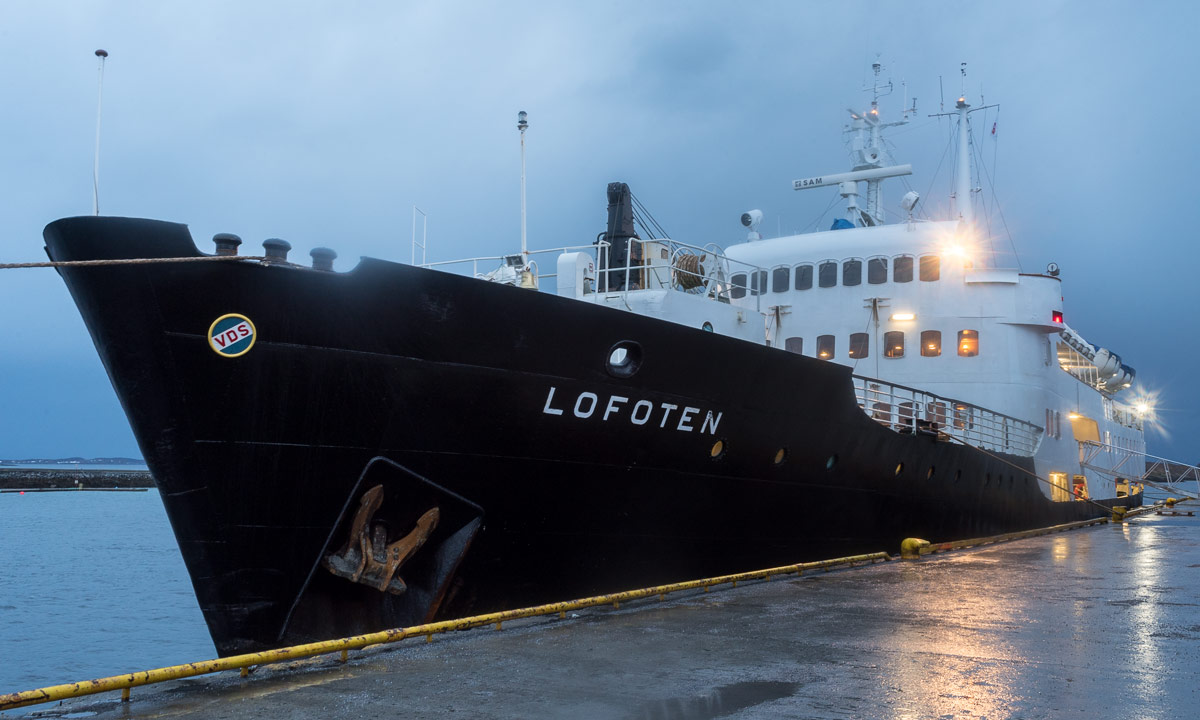
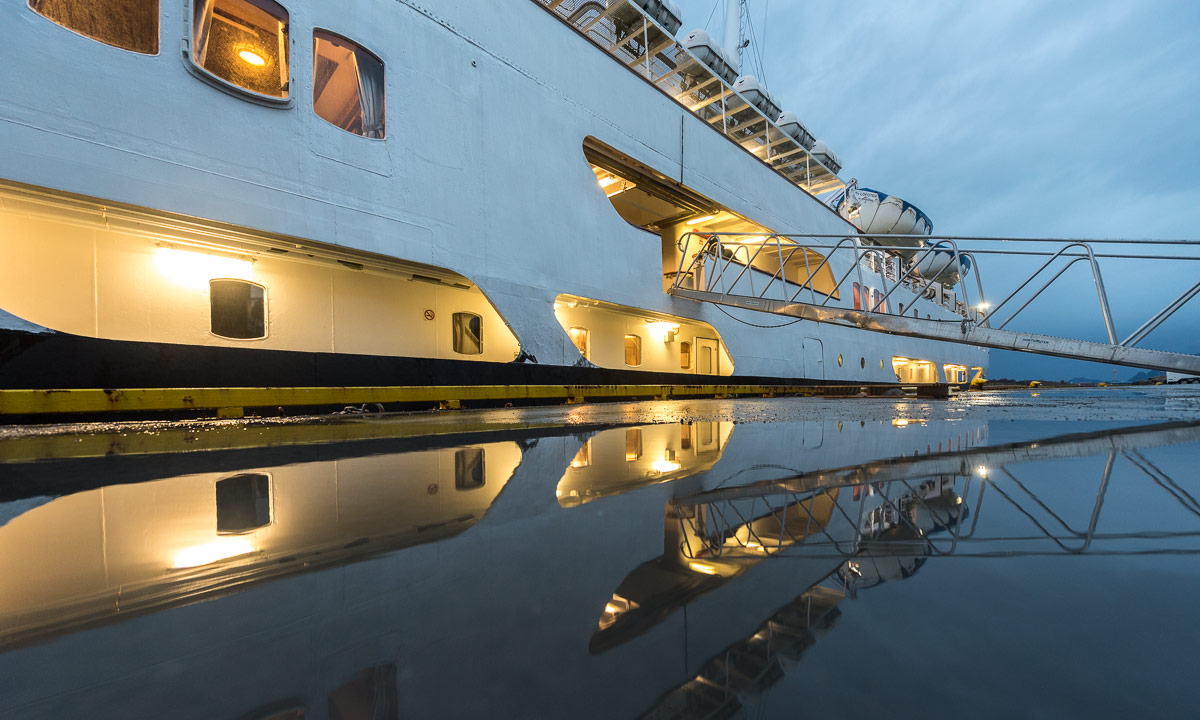
Here I even took some detail photos of the MS Lofoten from the pier.

We travelled along the Helgelandskysten, the coast of Helgeland. It’s a well-known scenic route which Annika and I took some years ago after having visiting friends in Norway. First it showed a funny combination of ancient mountains and modern functional houses.

De syv søstre (the seven sisters) came into view and seemed to follow us for half an hour. This is a quite impressive mountain range with seven summits. Some of the tops were in the clouds that made the view maybe less postcard compatible but in my opinion more impressive. The mountains looked higher with their summits hanging in the clouds.

Next stop Brønnøysund, stop #22. Here we had a stopover of an hour. When I left the ship rain was pouring down and I was glad about my Gore-Tex clothes that I actually didn’t plan to wear before April.

We left Brønnøysund at 17:00 and it was still quite light. Half an hour later it became so dark that you could hardly see anything but the lights of towns, villages, streets, cars and other ships.

Next stop Rørvik, stop #23 and the last stop before Trondheim. The weather was just as bad and Rørvik in a rainy winter evening is probably not the most beautiful place, especially when there’s a huge construction site in the middle of the village. Soon I returned to the ship that lay head-to-head with the Hurtigruten ship Nordlys. Some very last photos of the tour.

At half past nine we left Rørvik. I was already lying in my bed in cabin 121. The alarm clock was set to 6 o’clock in the next morning. The next day we would arrive in Trondheim where I would leave the Hurtigruten, take a taxi to the railway station and then the 7:50 train to Storlien. There I would take another train to Sundsvall and a third one to Umeå. In Umeå I would stay with Annika for a night and travel home by bus the next day.

Our train just stopped in Gudå. 20 more kilometres and I’ll be back in Sweden. Ha det bra, Norge. Takk for turen.