Kayaking around Håkøya

Yesterday I finally had time to join the Thursday paddling in Tromsø again. The weather was calm and the tour leaders suggested to take a tour to the island Håkøya. After the usual preparations I entered the club’s kayak that I’d reserved – a Valley Etain 17,5 – waited for the others to be ready and off we went. Fourteen paddlers we were, including the tour leaders.

First we head west over the sound Sandnessundet. After 3 km we reach the northern tip of the island Håkøya.

First I was a bit disappointed about the gathering clouds after the clear and sunny day. Then I realised again, what wonderful light the combination of clouds and the low sun can produce. The houses and farms on the island look extremely picturesque in this light.

We slow down a bit and go on land to take a break. While sitting, eating, chatting we decide to circumvent Håkøya. Great – a new tour for me!

We enter the kayaks and continue our counterclockwise circumvention. Since I’ve been on Håkøya before I’m looking forward to some of the attractions such as the red sail boat anchoring near the shore and especially the 330-metre-long bridge Håkøybrua, built 1961 with its prominent wooden construction.

What however comes completely unexpected are the three catamarans anchoring on the southern side of the bridge. Huge, modern and probably ridiculously expensive sailing catamarans. What a contrast to the other sailing boats and the wooden bridge.

It is half an hour to sunset. The clear sky in the southeast has turned red and the light on the mountains is spectacular. Alas, My only camera on the water is my iPhone, so no telephoto shots.

When we reach the east side of the island the sea is getting rougher and choppier. The next photo is probably my favourite shot from the tour showing the sea, the evening light and some of my kayaking mates.

With the waves comes the wind and of course it comes right from the front. Together with the waves I have to focus more on paddling than on taking pictures on the last 3½ kilometres. Just two snapshots. On the second one you may see the lights at the kayaks. We’re in navigable waters with commercial traffic and we have to be seen. I have a light on the kayak as well and a second one attached to my life vest. And by the way, the clouds are vanishing.

After 13.5 km we arrive at the boat houses of the Tromsø Sea Kayakers Club at half past nine and it is pretty dark. Soon the kayak season will be limited not by temperature but by available daylight. Until then I’ll hopefully can join some more “Thursday paddlings”.

Here is a map of our route (including some zigzagging when taking photos.

I want to thank my paddling mates for good company and our tour guides for guiding and guarding. Takk for turen!


Just a pick-up at the station… – part II

< to part 1

Tuesday, 22 July

When I wake up early, the mountains and the sea have vanished. Thick fog surrounds our overnight stay Marmelkroken on the island Andøya. I take a walk through the wet grass to the bird observation place but beside of some seagulls and a lonely curlew that flies around there is nothing to see.

One hour later Annika and I sit inside enjoying our gorgeous breakfast. We get a table-side presentation of the dishes. More or less everything has been produced locally and we eat it all.

Then we head of. We want to catch the one o’clock ferry in Andenes that will bring us to the next island Senja, second largest in Norway (again, when we ignore Svalbard). The weather soon gets fair again, but around the mountains still some clouds are hanging.

Yesterday we took the western road, today we cross the boggy island to take the eastern one. On the way there we pass the village Å. There are several Norwegian places called Å, the most famous one is on the Lofoten. The next stop is the octagonal church in Dverberg.

A bit north near Myrset there is a huge area of peat mining. Andøya has large areas of peat bogs and parts of it has been drained to extract the peat. I climb on a hill of peat – it bounces like a water bed – to take some photos of this moonscape. Then I protect my camera lens, because each step emits a cloud of brown dust. But that’s nothing compared to the huge double-wheeled tractors anyhow that produce huge clouds of peat dust while driving. My car is brown now.

We take it easy, we have time – that’s what I thought. When we however arrive at the ferry terminal it becomes quite obvious that we would not join the next ferry. Too many cars are ahead of us waiting. So the one o’clock the ferry departs without us, leaving us behind but in a much better start position. Now we have to wait for four hours. Time to explore Andenes a bit.

As hoped and expected we find place on the next ferry. Now we are on the way north to Senja. Soon we are in open water, accompanied only by some sea birds.

The ferry trip takes one hour and forty minutes. Then we arrive in Gryllefjord on Senja.

Unfortunately we won’t catch the last ferry to Kvaløya today, they are not coordinated. We have to drive via the mainland – a large detour. Although it is another detour we decide to take the coastal route. 289 more kilometres to go which means a five hour drive in Norway. It is evening and we will make less breaks now.

Stop one – Tungeneset, a scenic rest area.

Stop two – another one of the many beautiful views on a fjord and the mountains on the other side. Here we see something special: a cloud waterfall. Clouds fall down a steep mountain range where they vanish in thin air. New clouds come from behind. The cloud waterfall is several kilometres broad and looks like a huge waterfall in slow motion. An impressive view.

(Note to the meteorologists: is this a orographic cloud spillover?)

We take the bridge from Silsand to Finnsnes. After two days we are on the Norwegian mainland again. Although it is still midnight sun season – the sun won’t set, it just moves lower and lower until it is hidden behind the mountain. I took the next photo at eleven o’clock in the evening.

At half past twelve we arrive home in Tromsø, my “work home”. Although it was only one evening and two days of travelling together it felt like real holidays.

We think about doing the same in half a year. I have to check the ferries, but it would be interesting to visit the same places in wintertime.

Just a pick-up at the station…

When Annika travelled to me last weekend, her train from Boden to Narvik was cancelled and the next and last train was heavily delayed. Unfortunately train problems have become common in Northern Sweden over the years. I had to use the airplane several times because trains didn’t run at all for days or it was impossible to buy tickets.

To keep Annika from being stranded, I drive to Narvik to fetch her. From Tromsø it takes me about three and a half hours plus some breaks.

Meanwhile Annika has booked a hostel in Bogen where we stay overnight. Our plan is not to drive back the direct route, but to visit the islands Andøya and Senja.

Monday, 21 July

The next morning starts sunny.

However it soon gets foggy. After crossing the Tjeldsund we are on Hinnøya, the largest Norwegian island (when we ignore Svalbard). We decide against a swim in the sea due to the fog and continue to Refsnes. From here go ferries cross the Gullesfjorden to Flesnes. On my trip to Narvik yesterday it was often 28 °C, now in the fog it is hardly 15 °C.

We have missed the 10 o’clock ferry, but they run hourly and we don’t have to wait for long. The journey itself takes only 20 minutes.

From Flesnes we continue to Risøyhamn. Hurtigruten travellers may know this place not only because it is one of the stops but also because of Risøyrenna – a man-made underwater channel that allows larger vessels to pass between Andøya and Hinnøya. The Hurtigruten ships has to go quite slow there.

We take the bridge over the Risøysundet and drive through Risøyhamn. Twice. Because I didn’t know that it is so small. Only round 200 people live there.

The weather is sunny again and we become more beach focussed. The first beach is for having lunch. We share it with a flock of sheep.

The second beach is for bathing. 16 °C in the water – surprisingly warm for the region.

We continue north. To the west the Norwegian Sea. Next shore westwards is Greenland, more than 1500 kilometres away. Our next stop is much closer: a public toilet at Bukkekjerka. But what a one! It is a designed block of concrete and mirrored glass. From the outside you cannot look in, but from the inside you can switch the huge glass windows between being transparent or opaque.

Around this place – a lighthouse on a peninsula, interesting looking rocks, a baaing sheep and of course the sea.

We follow the coastal road further north to Bleik. Here you can find beaches and turquoise water as well as ridiculously looking rock needles.

After refuelling my car in Andenes we drive south again to Marmelkroken, where we will stay overnight. With an additional photo stop.

To part 2 >

Midnight sun on the Stor-Kjølen – part II

To part I >

I slept better than expected in the shelter on top of the mountain Stor–Kjølen (790 masl) that I hiked up the previous day. At 7 o’clock I get up and enjoy strolling around the plateau under a deep blue sky. Thank you, DNT, for maintaining this shelter.

At half past seven I start my way back. The sun is high in the sky.

The plateau summit resembles a desert of stones with hardly any plant beside of lichens and some tufts of grass. The first plant that catches my eye when descending the summit is a flowering ground cover. If the AI is correct, it is silene acaulis, also known as moss campion or cushion pink.

Again I cross the huge snow field. I see footprints but no ski tracks. Skiing season seams finally to be over.

Navigation is easy. Sometimes I go astray, since there are so many parallel paths – this hike is quite popular. But with the help of the painted red dots it is easy to find back to the main track. The cairns – Scottish  Gaelic for a man-made pile of stones – can be used for navigation as well. Great in fog! However, use them with caution. Tourists love to build these all over the mountains on random places.

While coming down the mountain the landscape slowly changes. The ground is more and more overgrown and to the right there are several lakes.

As the day before I pass a small valley. Now it lies in the sun. It looks very idyllic with its lakes, streams and its birch trees. One day I have to check how to go there.

Another stream to cross, another lake to view …

… and I’m on the home stretch. Soon I can see the gravel car park. One of the grey cars is mine. But still the terrain is hilly and in no time the car park disappears from view again.

By 9:45 I am back at the car. I was incredibly slow — a luxury you can afford when you’re hiking alone and stopping to take photos.

Later that day I stand on my balcony. The view is mostly blocked by large trees. Birches, willows, rowans. Through the gaps I can spot the mountains. And if you look carefully on the next photo, you may spot a tiny white dot on the top of a snowy mountain. That’s the radar station of Stor-Kjølen. I’ve been there last night.

Midnight sun on the Stor-Kjølen

Yes, I was tired Saturday evening after travelling back from Obbola to Tromsø. But the weather was so nice and I already had started thinking about going up the mountain Stor-Kjølen for experiencing the midnight sun up there. Finally I made a decision. Let’s go. I packed water, a camping mat, a sleeping back, but most of all my camera equipment and went off. It is only a twenty minute drive to the lake Finnvikvatnet on the island Kvaløya where I parked my car. From there it is round 5½ km to the top and a good 500 metres of elevation gain.

When I start my tour at around 10 o’clock the sun is low. The sun is low, but it won’t set tonight – and not for the next twenty days either. The landscape glows in warm colours. The ground is dry, but soon I cross the first tiny snowfield.

The path winds its way through grassy terrain scattered with stones and rocks. Stray snowfields lie on both sides of the path and the radar station on top of Stor-Kjølen has come into view.

The first lake flanks the trail. Slowly, the terrain is becoming rockier.

I look back and already now the hiking tour was a success. Lakes, hills – some grassy, some rocky – and at the horizon a mountain range. So beautiful in the warm light of the low sun.

For a while, grassy patches and rocky ground alternate …

… then the altitude takes command. Only snow and rocks are present and the vegetation is reduced mostly to mosses and lichens. I have to cross a large snow field but the ground is not slippery.

But then I arrive on the stone-covered plateau of Stor-Kjølen, where I can see a small cairn in front of me, a tall cairn marking the summit and the radar station. And if you look closely you can see a small cabin in front of the station. It’s a shelter for hikers. I’m alone, so I can use it for the night.

I want to take photos of the midnight sun, so I start experimenting with some sun-facing shots. These photos are much darker than reality. While the light is warm, it is still bright daylight.

The mountains and the sea all glow in hazy orange hues when I look against the sun.

But I have a mission – taking a photo of the midnight sun. Here it is. Unfortunately there is a small, transparent cloud in front of the sun that makes it look like a white splotch instead of a circle. Bad luck!

Bad luck? Not really. We have summer time, so the lowest position of the sun is one hour later – or a bit more accurate 0:48 due to local solar time. So I had some spare time to take more photo from the stone-covered flat top.

Then it was time: The sun as its lowest position. Ok – I was three minutes late, but the solar path is so flat that it doesn’t matter when taking photos. The light is the same. And eventually the little cloud was vanished.

Just a selfie with my mobile phone, then it is time for bed, at last. (A down hoodie? Yes – it is windy and only +5 °C.)

I enter the shelter, roll out my sleeping mat on the floor and lie down, using my sleeping bag as a blanket. Cluck-cluck, cackle-cackle! What’s that? I peek out of the door and see that the hour of the ptarmigans has started. All around, these galliforms dart about, filling the air with their typical clucking. I am too tired to start another photo hunt so I just take some snapshots. (These photos are heavily cropped.)

But then it is finally time to sleep. The shelter is filled with light, the camping mats (I found another one in the shelter) are thin and the ground is hard. But then I doze off and …

… sleep. At least for a couple of hours.

To part II >

A short summer journey in Northern Sweden

Annika and I are on holiday and spent this week to travel around northern Sweden by car, mainly to visit friends. Some stopps: Kusfors, Arvidsjaur, Nattavaara, and Gällivare.

Jar museum Rolig & Rusk

We took a short stop at the jar museum in Burträsk. Not to visit the museum, but the small flea market. If you travel in Sweden and love browsing at flea markets, look for the sign “Loppis”.

Smörgåstårta

In Kusfors we visited friends and got Smörgåstårta for lunch. This dish is very Swedish. While its “architecture” resembles a layered cream cake, the taste is savoury and contains ingredients like ham or cheese.

Summer flowers

When there are meadows or pastures in Northern Sweden there are full of flowers in summer. Here you can see for examples dandelions, butter cups, campions, and cow parsley. This patch is by our friend’s house.

A reindeer in the grocery?

Reindeers are typical for Northern Sweden and you have to watch out for them when driving a car. This fellow however is stuffed and stands in the display window of a grocery in Arvidsjaur.

Zzzzzzzzzzzzz…

There are many lakes in Sweden and in summer these lakes always come with mosquitoes, especially in the evening. Luckily they are late this year and I could take this photo without being eaten alive.

Old log cabin

We are spending the night at Renvallen Camping near Arvidsjaur. The camping ground is an old farm and some buildings such as this log cabin are pretty old.

Gravel roads

If you think, your car is too clean, use a Swedish gravel road in rain. The back of you car will be plastered with brownish-grey mud that even the strongest rain cannot wash away.

Sandviken beach

Yes, I wanted to take a bath at Sandviken in Gällivare, but my motivation went near zero, when I stood there in the steady rain looking at the shallow water with its gravelly ground.

Fat Tony’s

If you like burgers, you should give Fat Tony’s in Gällivare a try. Both atmosphere and food are great. And if you are there, do visit the bathroom.

Dundret

Just around the corner from Gällivare lies Dundret, a solitary mountain. When the rain stopped Annika and I took a hike there together with our friend Sascha and his malamute Roxy.

Tyre dealer

Stuff standing around in car garages has always its own aesthetics. The reason, why we needed a tyre dealer on our trip will be told another time (although you already may guess it).

Summer Café in Nattavaara

On Monday we passed Nattavaara. Alas, the summer café is closed on Mondays. On our way back it was open and we stopped to ate cake. Different volunteers come up for short stays to run the café and bake cakes. Most of them are from Switzerland or Germany which strongly increases the cake variety in the region.

4th June – the snow in the front garden is gone

This is a photo from 28th April:

This a photo from yesterday, 3rd June:

Both photos show the same motive. The house where I have my apartment with its front garden. The bush in the front garden in about five metres high. In winter I could touch the top of the bush with my fingers, today the last remaining snow has melted away while I was working.

No, we didn’t have three metres of snow in Tromsø last winter. The maximum was “only” 120 cm. But my landlord and I use the front garden as a snow tip and so the amount of snow we put there accumulates in the wintertime. In spring it takes some extra weeks to melt.

And so it looks like if you step into the snow in front of the snow shovel and hop up and down several times …

Now I’m longing for summer but secretly I’m already looking forward to the next winter and the first snow ;-)


End of April winter in Tromsø

When I woke up yesterday morning (28. April) and looked outside the window of my living room I was pretty surprised. I didn’t rain in the night, it had been snowing.

Round 15 cm of fresh snow had fallen within the last six hours and everything looked wintry again. In the centre of Tromsø however, 88 metres lower in elevation than my apartment only five cm of snow had fallen and the cars had smashed it to brown slush. What a difference!

Home again I watched a ptarmigan in the back yard. First it picked on a twig of a tree, then it dug itself into the snow and rested there for some hours. Couldn’t it see me behind the window pane or did it just ignore me? In the night it was gone.

Today I took my skis to work so that I could ski back home from the lake Prestvannet. This time the forecast was correct: we got a blue sky, the sun was shining at temperatures round +3 °C. At the harbour in the centre the view was quite spring-like.

Taking the bus from the center up to Prestvannet takes only 5 minutes, but there it is still winter season with snow depths round 90 cm. It’s astonishing what a difference in altitude of less than 100 metres can do.

Time to ski back, preferably not on the tracks but through the forests. After four kilometres on skis and 840 metres by foot I was home.

Two promenades on Tromsøya

Easter Monday – from Sydspissen to home

On Easter Monday we got surprisingly fine weather in Tromsø. The sun was shining and the sky was blue. I took the bus to Sydspissen – the southern tip of Tromsøya – because it has been ages since I’ve been there. A lot of snow has melted away and tussilago was blooming everywhere. I passed the beach at Telegrafbukta and the pier at Folkeparken came into view. I know the this area well, because I lived nearby for quite some time.

I went on, enjoying the sun and ignoring the chilly wind. Don’t let your eyes fool you, the max temperature was about +2 °C. I passed the old boat house Engenesnaustet, saw a lonely winter kayaker and passed the small lighthouse.

I was not alone. A lot of other people took the holiday to take a promenade, sit side by side or do some barbecuing. I took the liberty to remove some people from the photos.

I wondered if the old, abandoned boathouse was still open? It was. A bit away from the shore there was some leftover snow. The tussilago flowers didn’t care, they were blooming anyhow.

Now it was not far away to the boat houses of the two kayak clubs in Tromsø. TSI Trulle and Tromsø Havpadleklubb. Here I start all my kayak tours in Tromsø, because my own kayak is in Obbola in Swede, so I use to hire one here. Season has just started and I want to paddle a lot this year!

At the bus stop Giæverbukta I missed my bus. 28 minutes of waiting or two kilometres of walking? Easy decision: I walked.

It was fascinating that the coast was mostly free of snow, while MET, the meteorological institute inside the island measured a snow depth of about 80 cm that day. At an elevation of 100 metres. And so the walk became snowy in the end. But spring showed up here as well: some willows had started to bloom.

Intermezzo – more snow

Yesterday afternoon it started snowing. Some snow showers were pretty dense. And sometimes I got one of my favourite weathers: snow flurry and sun at the same time. So beautiful. I tried to take pictures but the result became quite ugly, because the snow against the camera looks dark.

This morning ten more centimetres of snow have fallen, even in the lowland areas. All Scilla flowers in the centre were covered in snow and for the photo I had to look to find some flowers not being completely buried.

Friday (today) – from Prestvannet to home

I use to walk home twice a week after work. Then I take the bus to the lake Prestvannet to skip the boring (and steep) parts. Today I do the same. Additional snow showers have increased the snow depth to 92 cm, but it has started clearing up, when I begin my way home at 15:00. The fresh snow gives the lake an untouched appearance and the first lifebuoy is snowed over almost completely. Could it be January? No, the light is different.

I follow the ski trail a bit then I follow the smaller paths. They have hardly been used today, mostly by a single skier or pedestrian.

But then I come to an area where the snowy paths are completely untouched. No one has used them today. Imagine that: You are on a island with 43000 inhabitants. Many of them are enthusiastic skiers and outdoor maniacs. It is Friday afternoon and the sun is shining. And I trudge through 15 cm of untouched fresh snow. This is absolutely brilliant; I’ve never experienced anything like this before!


I can’t ski, but I do

Let’s face it. I am a lousy skier. My technique is mediocre when I ski uphills and reduces to ε > 0 when I ski downhills. With the lack of technique there is empty space for panic that settles in when I’ve got too fast. But I do love skiing so I do it anyhow. And that’s a thing I’m slightly proud of.

Today I wanted to used the beautiful winter day to do something with skiing. I take the car to the neighbouring island Kvaløya with two destinations in mind: Kattfjordvatnet or Finnviksdalen/Krabbelvdalen. On the bridge to Kvaløya I make up my decision: Finnviksdalen/Krabbelvdalen. More possibilities. So I turn right.

At 10 o’clock I start my tour from the car park by the road 863 and head in the usual direction. Well, that didn’t work, the mountain stream is open. So let’s take the bridge by the car park. That works. I have to cross another mountain river but that is easier, since it is covered with ice floes easy to cross.

I realise, that I already have made up my mind: Going up the mountains to Kraknesaksla (335 m) or to the Jerremaš (467 m). It’s the mountains massif behind these trees:

I check the avalanche situation in the Varsom app. Looks good! So I continue the tour although I am surprisingly bad prepared: I have forgotten the sun blocker and something to drink. The sun has come out and I use my anorak hood to protect against the radiation although it is a bit too warm. And water I can drink from the next stream, although I do not get a lot using only one hand for scooping.

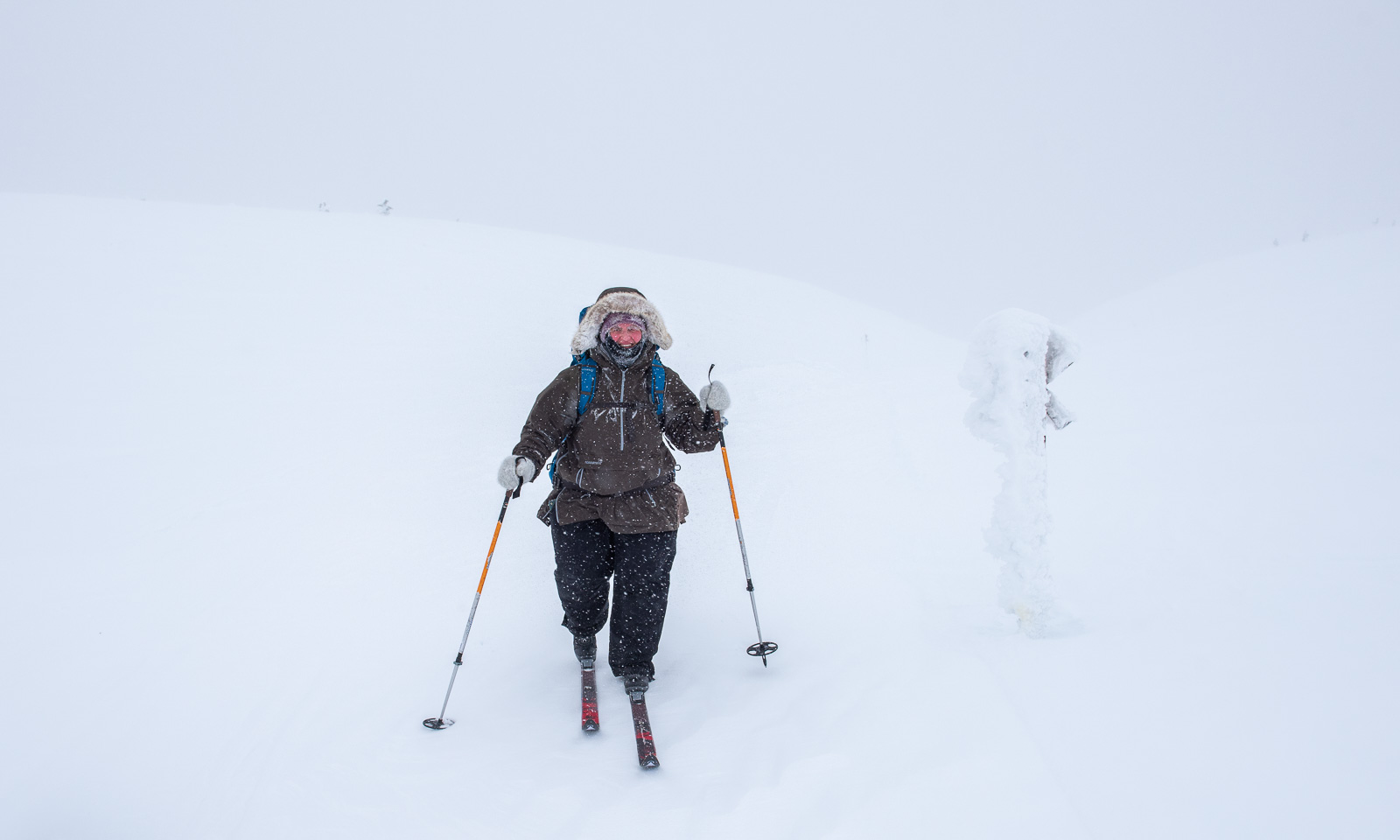
The terrain descends a bit, I cross a ski trail. Then it ascends and I am skiing uphills. Mostly I zigzag because I do not have climbing skins with me either. That is working better than excepted. When I look down behind me I get a bit nervous. Every metre I climb up I’ll have to ski downhills later. Did I mention, that I am a lousy skier? I think so.

But I feel always so rewarded when I am above the timberline leaving all trees below.

I pass the small cabins by the two small lakes whose name I do not know …

… and head to the mountain top Kraknesaksla. Since I have been above the timberline I have beautiful views on the sounds east of Kvaløya. First Sandnessundet, then Kvalsundet. That’s so fascinating, this together of sea and mountains. Down there – the island Tromsøya where I have my “work home”.

At the cairn on the summit of Kraknesaksla I have to put of my skis. Too icy and too many rocks. But what a view!

I continue my tour. For a while I can see the Kvalsundet,

… then I leave the eastern slope behind and head to the next mountain. While I have been alone for a while I now can see some other skiers in the distance. The weather is constantly changing and so the light. Sometimes it is cloudy that the snow is without any contrast at all. That makes it impossible to tell if the ground slopes up or down. And then, minutes later, the sun comes out, the sky is blue and I can “read” the snow again.
I reach the top of the Jerremaš (also called Austeråsfjellet) but here I’m not alone. Three skiers are sitting by the cairn enjoying the sun. So – no photo here. Anyhow I’ve got quite thirsty again and decide now to take a break. Now comes the part where I have to ski down and it wouldn’t have been so hard because the slope is not so steep and there is plenty of space. However more clouds have been gathering and it even started snowing a bit. Visual terrain information: not available. Colours neither.
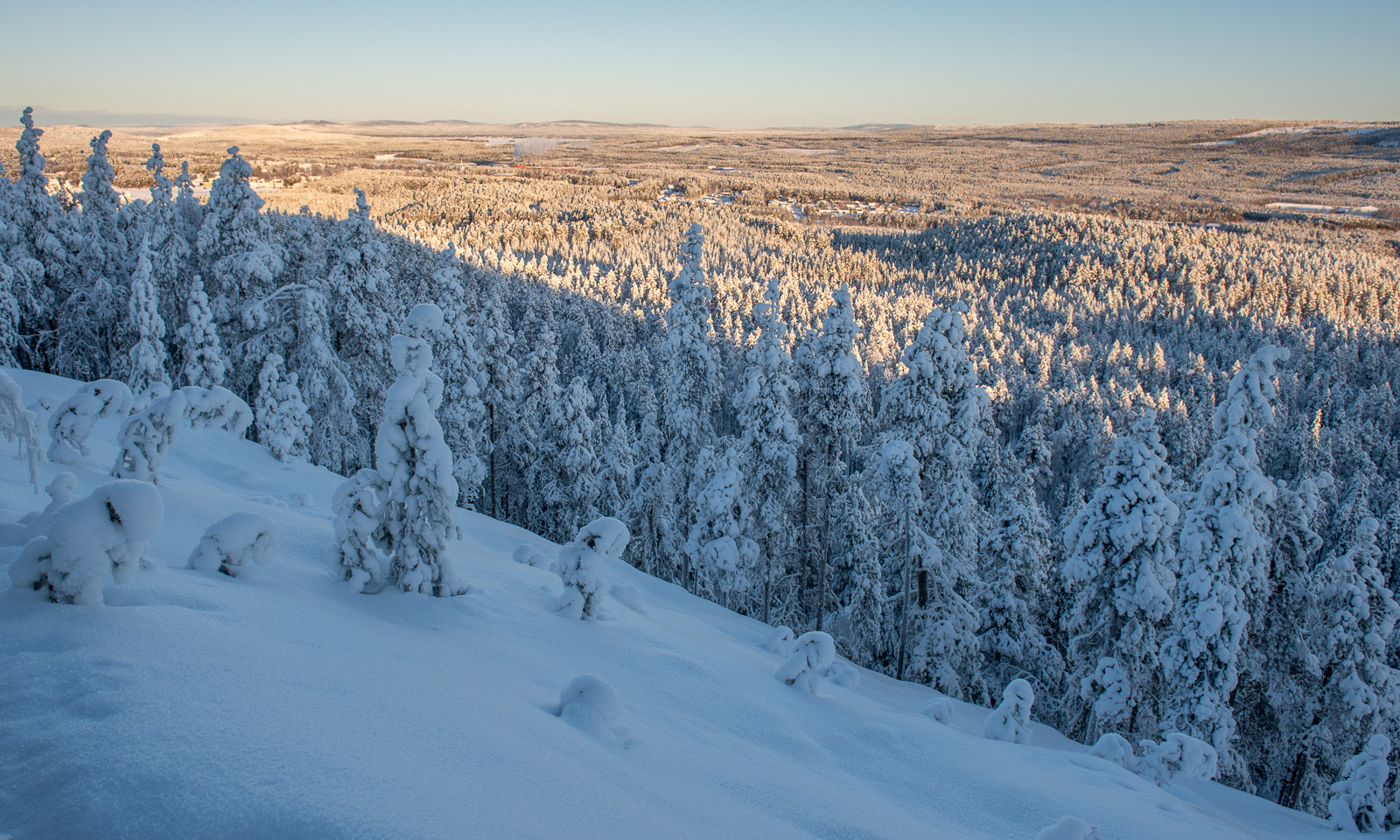
Hmm, I don’t like skiing downhills in these weather conditions. When I finally reach the first sparse birch forests I am relieved, because now I can estimate how steep the slope is. Slowly I continue skiing down, passing another stream that is mostly snowed over.

After more zigzagging down I reach Finnviksdalen, the other valley. This looks pretty different from Krabbelvdalen because of the prepared cross-country ski trails. There are also more people around. From now on it is a bit more about skiing and less about taking photos. The last ones I make show the trail and the hexagonal cabin where skiers use to take breaks.

I however am very thirsty and quite exhausted and so I continue to the car park where a bottle of water awaits me. 17.5 km skiing and – according to the Runners app – 603 metres in altitude later todays skiing has ended. As always: I’ve never regretted being outside and this was another example of having a great day.

The following events: buying sushi and a coke · driving home · eating · taking a hot shower · taking a nap · being pretty lazy · talking to Annika on the phone · editing today’s photos · writing this blog article.