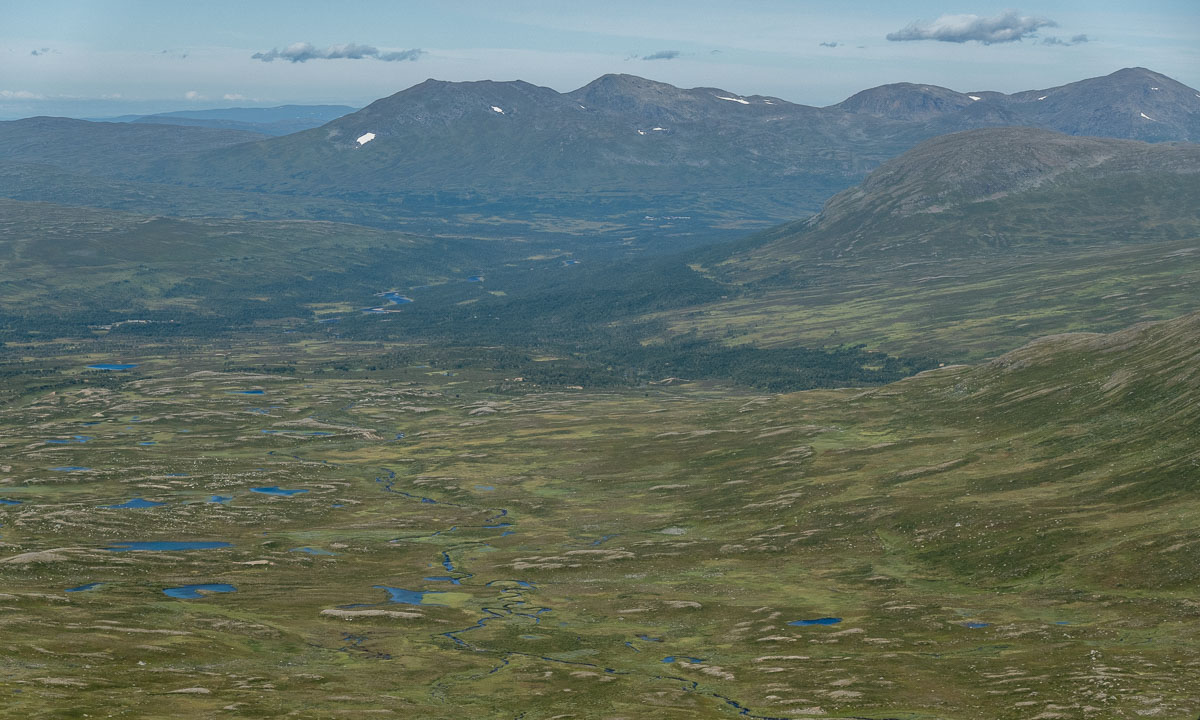
A cloudy hike up the Stor-Kjølen

The weather forecast promised sun for most of the day today. Nice conditions for hiking up the Stor-Kjølen. I’ve been there once almost exactly one year ago, today I chose the other route coming from the Northeast.

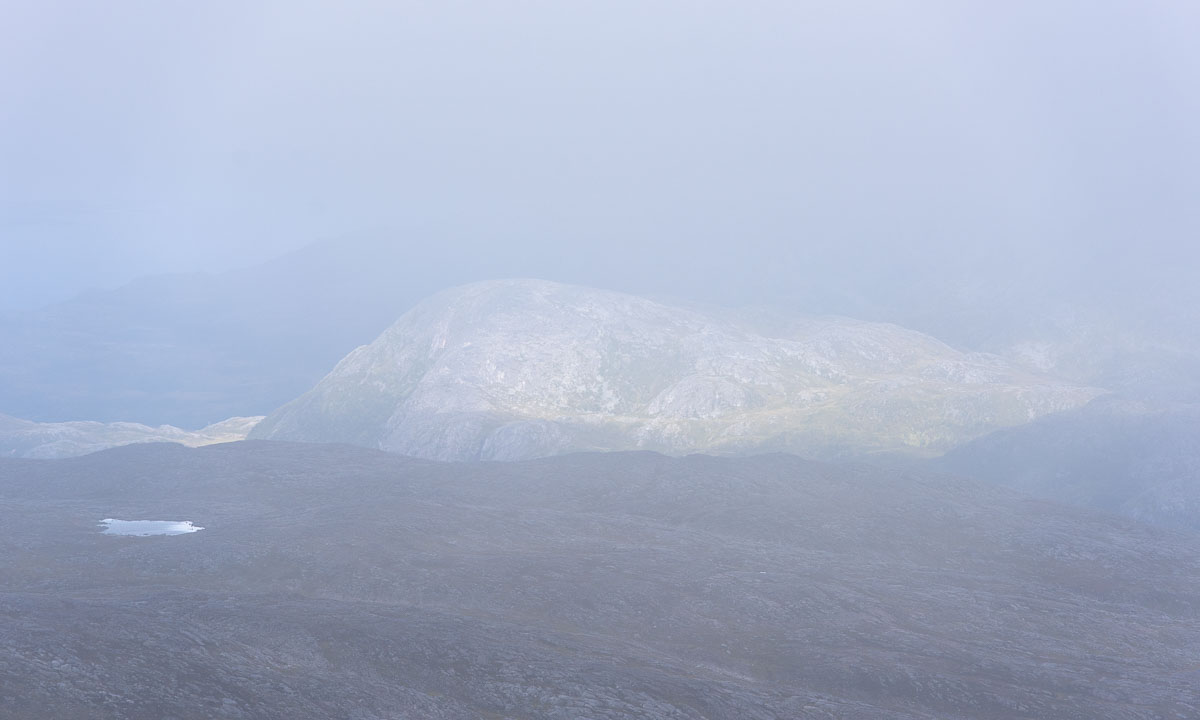
I was there, my camera was there, however the sun wasn’t. Thick and low clouds hung over the whole mountainscape.

1 – The trail

5-5½ km long, leading up 560 metres in altitude. It is well marked and a visible trail most of the time. One boulder field has to be crossed and the last part is mainly pathless, but not steep.

2 – The reindeer

Much less shy than the Jämtland reindeer. They let me get quite close and one of them came within 3 metres. It seemed to be very curious and I expected it to touch me with its soft nose asking for goodies, but it went away. Another reindeer with huge antlers was much more careful and stayed with its small herd.

3 – The summit

Visible from a lot of places in and round Tromsø because of its prominent, mushroom shaped flight radar station at the top. Beneath the station – a small hut. It’s the varmebua, a heated hut driven by Troms Turlag. Very welcoming today, when it was foggy and round 4 °C.

4 – The weather

According to yr.no 4 °C and sunny. While the temperature might have been correct the rest wasn’t. It was cloudy and foggy and partially also drizzly. But then the sea started to shine and glare. While the sun itself was still hidden by clouds the reflection of the water surface sent sunlight upwards to the Stor-Kjølen. Amazing light, nearly unphotographable.

I waited in the hut for the weather to change, but in vain. On my way back to the car the cloud layer lifted and I could see a bit more of the fantastic surrounding scenery. But if took some more hours until the sun came out today and then I was long home.

A nice tour anyway. Or as the Norwegians say: ut på tur aldri sur – Out on a trip, never sour.

Jämtland tour 22 – the cabins, part 1

This article is part of the series “2022-08: Jämtland and Trøndelag”.

On our hiking tour in the Swedish Jämtland and a bit of Norway we hiked from cabin to cabin. These cabins are quite different, both in concept and in standard.

Ok, the photo above does not show a mountain cabin, it shows the Ringve Musikkmuseum in Trondheim that we visited the day before. Sorry folks, I couldn’t resist.

½ – the first emergency hut

Since the weather in the Swedish mountains can be quite rough, there are emergency huts on the trail. The first one lies between Storvollen and Blåhammaren, our first destination. You may rest inside the hut, but do not touch the fire wood or the emergency box – they are meant to save life.

1 – Blåhammaren

With an altitude of 1086 metres it is the highest STF mountain cabin. Famous for its fire beacon and its three-course dinner. We however use the self-catering kitchen to cook pasta with tomato sauce. A great first stay on our tour.

1½ – Endalen raststuga

Another emergency hut. The sun comes out and invites us to take a break. From here it’s only a kilometre to the Norwegian border.

2 – Storerikvollen

Two signs, that we are not in Sweden anymore: All roofs are grass-covered and the inside is full of carpets, wall pictures and other things to make the cabin individual and hyggelig – cozy.

A thing that makes Storerikvollen special: free-roaming sheep and Icelandic horses.

3 – Nedalshytta

After the longest distance of ca. 23 km we gladly arrive at Nedalshytta. As in Storerikvollen this cabin does not provide a self-catering kitchen in the season. We have pre-booked half board and now order dinner. What we do not know yet: the cook is very gifted and the dinners are awesome! A good place for a rest day.

This is by the way the only cabin with road access on our tour.

3½ – Ekkordörren

We are back in Sweden again. Time to take a short rest in the hut Ekkordörren before we follow the trail over the pass.

4 – Sylarna

Without loosing too many words: this is the worst cabin I know! A tiny shop with ridiculous prices, a dysfunctional self-catering kitchen with five soup plates in total, insufficient drying space and so on, and so on. The personal is friendly and pretty uninterested.

We will meet other people on our trip – cabin hosts as well as guests. No one likes Sylarna. But it’s only a single night and now it gets better. Much better!

Stay tuned for part 2 of the cabin article. Coming soon …


Back from a hiking tour

This article is part of the series “2022-08: Jämtland and Trøndelag”.

Hello, my dear blog readers. Three weeks of holiday have come to an end today. Mostly I was aborad. The main attraction: an eleven day hiking tour with my wife, my sister, my brother-in-law and my younger nephew.

We mostly hiked in the Swedish Jämtland but visited two Norwegian cabins as well. Our route: StorlienBlåhammarenStorerikvollen (Norway) – Nedalshytta (Norway) – SylarnaGåsenHelagsFältjägarenRamundberget. That’s a total of about 135 km.

Today I scrolled through the photos I made on the tour – it’s more than 1500. So it will take some time to go though, edit them and write some blog articles.

Anyhow, here is a sneak preview. 9 photos of the tour.

Mountains, sea and midnight sun

Yesterday at 18:00 I took the car to Elvenes on Kvaløya to start a small mountain tour. Well, mountain or hill – the summit of Grønnlibruna is only 401 metres above sea level. I chose this destination in the hope that it was not completely snowed over as the higher mountains still are.

I parked the car, walked the gravel path and stood before the first obstacle, the stream Finnelva. I did the same tour last November, where it was easy to cross. Now in the thawing period the water was at least 50 cm deep and quite fast . Too deep to cross here, even with rubber boots. Luckily I found a better place to ford a bit upstream. Soon I was in the forest. A very wet and muddy forest where I was not always sure whether I followed the way, crossed a swamp or waded in a brook. But this stopped when I gained a bit of altitude where old snow covered the forest floor.

As soon as was above the tree line the landscape changed again. There were some large snow fields but most of the ground was bare of snow and easy to walk on.

After 4 km of hike and some hundred metres in altitude I stood on the summit enjoying the circular view while the weather cleared up more and more.

I did not take a break but hiked down again. I enjoyed the weather and the fact that the birch trees start to turn green, at least in the lowlands. I crossed Finnelva a second time, now with a sturdy stick that I had found on my way. It’s much easier to keep balance with such a “third leg”. From there it was not far to my parked car that I reached round 21:30.

When I left the supermarket in Eidkjosen it was 22:00 and the sky was blue. It won’t get dark because the last sunset in Tromsø was more than a week ago. Since then we have polar days with 24 hours of daylight. I could drive home or …

I turned left. Left to the road 862 that leads to Sommarøya. Maybe I catch the midnight sun. Sometimes I had to drive slow because of the reindeers, sometimes I had to stop to take a photo …

… but round 23:00 I had crossed the bridge to the island Sommarøya and shortly after I parked at the sandy beach Steinsvika. I was not alone. People stood at the beaches, some lit a fire, some paddled kayak, some camped in the hills.

I checked an app when sun would be lowest. What? 0:45!? I forgot, that we had daylight saving time, so clocks were one hour ahead. I took my camera bag, some water and an old jacket, that I use to have in the car and walked to the northern tip of Kvalneset. Now I had a lot of time to just observe the sun hardly going down. After one and a half hour it was time: 0:45 – the sun was at its lowest position: 1.55°. The photo is completely unspectacular because it only shows a low sun, not the fact that the sun would not get lower than that this night.

I was glad about my jacket because it got a bit colder, I was tired and I sat there for almost two hours in total. At least I had chocolate! I waited for the sun to disappear behind the prominent silhouette of the island Håja.

Then I went back to the car and had about an hour drive back home. I wasn’t in bed before 3:30 but it was completely worth it. For a very good reason: I never ever saw the midnight sun in my life before! Although I have lived in Northern Scandinavia for more than 12 years I hardly was above the arctic circle in summer and then it was cloudy.

But it was more than just checking another item of my bucket list. It was just gorgeous to sit there and enjoy nature. I should do that more often and put the old sleeping bag back into my car. Just in case …

Polar expedition AeN JC3 – day 17 and 18: An incredibly beautiful day on the ice

This article is part of the series “2022-02: Winter cruise KPH”.

Day 17 and a bit of 18 · 7 and 8 March 2022

7 March

We have arrived at a place somewhere between Svalbard’s second largest island Nordaustlandet (14.443 km²) and the easternmost island Kvitøya (682 km²). No one lives permanently on these islands.

The ice experts have found an ice flow and examined it. The ice near the ship has some holes so the dress code is survival suits for the first time. In opposite to the formerly used Regatta suits they have attached boots and neoprene arm and neck cuffs. They shall keep you warm and dry in case you fall into cold water – or in our case break through the ice.

I am very interested to join and observe ice coring, a missing link on this expedition. I wasamhowever quite doubtful whether I will be allowed to enter the unreliable ice on this station. But I am lucky again, I may follow M. and L. onto the ice.

Earlier I was told that I may join the scientists taking ice cores but won’t get the opportunity to take ice cores by myself. That’s understandable. To my huge surprise – and delight! – plans were changed: L. shows me how to do it once and then it’s up to me to take five more ice cores. Give me snow or ice and something to play with and I’m happy ;-).

No, I’m no experiences ice corer after five cores. But at least I get an idea and a bit of a routine. In measuring snow depths, ice depths, the freeboard and writing down the values with a pencil. In mounting the large ice core attachment onto the electric drill and removing it after coring. In putting the ice core onto the gutter-shaped cutting board without flooding the electric drill or touching the snow (happened once – sorry!). While M. is cutting the core into slices and putting them into wide-necked plastic bottles I continue with my work. And I have to continue, because I’m still slow and M. shall not wait too long. I think, I could do that for weeks. Standing on the ice and drill cores out of the sea ice.

I have asked Pernille to take some photos from me while coring. These are probably the only photos that prove that I actually did something on the expedition beside of taking photos.

Photo credit: Pernille Amdahl, Nansen Legacy –tusen takk!

And the afternoon? I am allowed just to go onto the ice once more as long as I find some team lead to join. I find one and so get my 7th opportunity on this cruise. Two and a half more hours on the ice. I overhear a radio message. No polar bear warning but the information that our ice flow drifts with more than 2 km/h and the water depth is decreasing. This could damage instruments when they are too deep in the water.

Just some more photos:

And later, when we are on the ship again another polar bear approaches. This time it is a curious one that is very interested in the scientist’s equipment. And since it could harm the bear when it eats cables or plastic it is shooed away with a flare gun. **BANG**. It gallops some metres and then walks away. No polar bears were harmed and as far as I know no cables.

By the way – it was a good decision to use the survival suits. One of the scientists went through the ice today. All of a sudden and quite near the ship. It did not take long to pull the scientist out of the water but without the survival suit this would have been a very wet, cold and unpleasant experience.

8 March

The next day some additional measurements are done on the ice and then we leave last ice station of Arven etter Nansen JC3.

Ha det bra, Arctic sea ice. Farewell! It was a great pleasure to meet you and I definitely will miss you!

Polar expedition AeN JC3 – day 13 and 14: Polar bear ahead!

This article is part of the series “2022-02: Winter cruise KPH”.

Day 13 and 14 · 3 and 4 March 2022

3. March 2022, the second ice day at P7. I have polar bear watch on the bridge at 9:30 +2h so there is some time to relax after breakfast. While I am writing my diary there is a loudspeaker announcement, the first one on this journey:

Polar bear at the front of the ship.

I grab my camera equipment including the large telephoto lens and slip into my Canada Goose clothes. The best deck at the front of the ship is the helicopter deck and there I go.

I am not alone. Ice station was about to begin so some scientists were already clad in Regatta suits. Now they stand at the rail watching. But where’s the polar bear? I cannot see it. Until I go to the rail as well and look straight down. Whoa!

It is hard to believe, but this is my very first photo of a polar bear taken in the wild. Not some blurry spot far in the distance but a polar bear less than 10 metres away – vertically. It is quite interested in the icebreaker with all these funny colourful beings that has appeared in his world.

We are only guests in the Arctic world of the Polar Bears. We are not allowed to chase them off just to do our work. We are not allowed to chase them off to prevent them from destroying scientific equipments. We humans do not matter. Only the polar bears do. But we are allowed to chase them off for two reasons:

  • The polar bear should not eat plastic, rubber or other materials that could harm it.
  • The polar bear should not learn, that it is a nice experience to visit humans and teach this to its cubs. This could result into dangerous encounters in the future.

The polar bear realises that the ship’s bow is boring and continues to Z’s tent, sniffing and licking around ther…

**BANG** – a loud noise alarms me. **BANG** again. K. has used a flare gun to shoo the polar bear away before it starts eating the equipment. The flare gun is not used to hit a target but to make a loud noise. The noise however does not frighten the bear at all and K. gives some more shots. The bear decides that this sucks and slowly continues its way over the sea ice. Even when I have started my polar bear watch on the bridge I can see it in the far distance.

When I am on the sea ice again the afternoon to help K. with the Blueye ROV I see the armed polar bear guards with other eyes. It comforts me even more, that a whole team protects us – three watches on the bridge and several guards on the ice. Polar research works only in a team.

By the way: I am allowed to steer and control the underwater vehicle. It is not easy because the ROV lags a lot and the tension in the cable doesn’t make things easier. But in the end I manage to navigate it back to the ice hole again and we get it out of the water. It has some technical issues, probably because of the cold.

In the evening I stand on the deck and look over the ice.  It was become slightly colder, -26 °C and the air is crisp. Snow and ice look as if carved from marble in the sharp spotlights of the ship.

Later this night a female polar bear with a cub is spotted. And another single bear. I miss them, exactly as I missed the walrus encounters and that of the rare bowhead whale. What this ship misses is some kind of messaging system that informs you in these cases. You cannot be everywhere and you have to sleep sometimes.

The next day I help A. and B. in the benthos lab again. When I go to the locker room to get rid of my boots for lunch I meet E., who is putting on the Regatta suit. Why that? E. tells my another polar bear has been spotted, a kilometre away.

Shortly later we stand on the helicopter deck again and watch the other polar bear approaching. This time I see it when it is still pretty far away, but it discovers our ship and comes nearer and nearer and nearer.

This bear however is less interested in us and just passes by. Good for him and less noisy for us, no flare gun involved this time.

Whale watching – second try

Yesterday Same meeting point, same tour, same boat as 6 days before. But completely different weather! No stormy wind from the north and clouds everywhere, but a clear and starry sky.

And off we went.

It was just incredible how much brighter everything was although it was less daylight than last Sunday. After two hours the island Nordfugløya came into view. A cloud parked itself over the island.

Slowly the colours of the sky intensified and remained colourful the whole short day, because now it was the first day of polar night¹.

It took us round 3½ hours to reach our destination, the sea round Skjervøy. So we had only limited time before we headed back. Already at one, half past one o’clock it started getting darker again.

Eight hours after our departure we had returned to Tromsø.

I have been outside for round seven hours. I didn’t freeze because I was wearing my warmest winter parka. I was inside once to eat a bowl of soup and once when I stood at the ship’s bow and the sea spray soaked the whole foredeck (including me). So I was eager to take a shower not because of being cold but I wanted to get rid of the salt hands and face were covered with.

Resumé: It was a great boat tour and I enjoyed the air, the colours, the light.

And the whales? Oh yes, the whales! Almost forgot them ;-) Well, we saw some of them, mostly orcas and the first fin whale of the season. There were not many whales around and they were quite in a distance, so for photographing whales this tour was not ideal. Too little time and too high the boat decks above the water. I would love to paddle kayak there but I’m pretty sure that I never ever will dare to do that.

____

¹ Where I live in Tromsø we technically had 14 minutes of daylight yesterday but already 1.3 km north it was the first day of polar night.


A hike round the peninsula Klubben

This article is part of the series “2021-07: Back in Tromsø”.

#onceaweek tour 5

Today I didn’t choose a mountain top but a small coastal promenade as my #onceaweek tour. I took the car to the village Lyfjorden on Kvaløxya and went round the peninsula Klubben. I love hiking up mountains to get the view but at the coast you get views for free ;-).

One of the things that still impresses me is how tiny some houses look standing in front of huuuge mountain faces that often look like vertical walls.

Klubben lies in the Kaldfjorden (the cold fjord). On the other side lies the mountain Store Blåmannen (1044 m) – always an imposing view.

The birches on Klubben had only some yellow leaves left. Since it was quite windy (15 m/s on the bridge to Kvaløya) they will be bare soon. Soon the autumnal colours will be history for this year.

Although this tour was marked as green (easy, for beginners) you still had to watch where to go. Sometimes the path was boggy but mostly stony and I had to watch my steps.

A quite loud noise, like someone inhaling loudly through the teeth interrupted me. I looked for the sound source and spotted a whale quite nearby. Although I had the camera with telephoto lens in my hands it took me a second before I managed to make a photo of the dorsal fin just before the small whale submerged again. I saw it two more times but in quite a distance. The photo is poor but the experience to spot a whale just by chance from your Sunday afternoon walk was extraordinary.

I continued my walk but now the path had vanished and the ground was only rocks. Did I miss the path? Possibly. I checked with the map app of Norgeskart and realised that the way was a bit higher up. I went and climbed up the steep slope but did not find any path. Higher and higher I ascended until it was clear that the map wasn’t as accurate as assumed. Probably the rocks were the path.

I didn’t want to descend that slope again and so continued to ascend it until I met a small gravel road that led to some houses – the first modern and cuboid, the second traditional with a grass roof.

Soon the area had become less steep and I could cut short to the coast again.

On the way back I took an extra stop in Finnes, Kvaløya . The small reindeer herd that I’ve seen there several times was still grazing. Probably they live there.

Today’s tour was only 4 km (elevation gain and loss round 250 m) but I cannot say that it was less fun or less exciting. I have however to admit that it was much less exhausting than the mountain tours. Training effect: ±0.

Fylkesvei 8100

This article is part of the series “2021-08: Northern Norway”.

There are places that are so fascinating, that you want to return there for a longer time. For me the road to Hamningberg is one of these places.

Originally Annika and I didn’t have the plan to visit Hamningberg. It’s a detour of 2×40 km just to see a former fishing village whose houses are now used as summer cottages. On the other side the road 8100 that leads there is closed in wintertime and we never had the chance before to drive there.

So right before Vardø we spontaneously decided to turn left into the road Fylkesvei 8100. We could turn if it was boring. Well, it wasn’t. We were both extremely fascinated by the roughness of the landscape and the many light moods because of the constantly changing weather

The photos are just some snapshots I made on our tour. Maybe I have time to return there some other time with more time for making photos.

Norwegian summer journey II

This article is part of the series “2021-08: Northern Norway”.

Annika and I continue our tour through Northern Norway. Four days ago we left Hammerfest behind, now we are in Bjørnevatn 10 km south of Kirkenes. We have seen many places before, but only in winter. The differences between the seasons are huge and we discover a lot: Oh, here is a lake! Oh, here are fields of flowers …

Ten more images looking back:

10 – We just have arrived at our final destination Bjørnevatn where we visit friends for a few days. I have to climb up the hill (55 m) by our friends house to get a summery view. (Here are some winter photos.)

9 + 8 – the “Sjøsamiske samlinger” (Sea Sami Collections) in Byluft is always worth a stop. We have coffee and a chat with Helmer Losoa, the owner and collector of this exceptional museum who recognises us from former visits. (More about the museum.)

7 – this bird observation place near Vardø is very welcome as a shelter against the cold wind, when Annika and I have a lunch break. We do not see any special birds but a rainbow.

6 – after an overnight stay in Kiberg I climb up a hill to make a photo of the wideness and extent of the Varanger Peninsula in the sun. Well, the sun has mostly gone when I stand on the top, but I take some photos anyway.

5 – Annika and I just take a small evening promenade in Kiberg. It starts on a gravel road by the sea and ends in us walking cross-country and looking for dry patches between the small bogs. The sun colours the clouds which are reflected in the many water pools.

4 – Silfar Canyon? Never heard about it before. We were lucky that we decided to stop and have a look. Bad light for taking pictures but we got impressing views on the deeply carved canyon.

3 + 2 – We visit a small beach near Hammerfest together with a friend that just moved back there some months ago. We could take a bath but there is so much to talk about. The reindeer are everywhere. Here they graze, in town they stroll around and eat the front garden flowers.

1 – Before we meet our friend we take a small trip up the mountains. Here we get views in all directions, amongst others on the different parts of the town Hammerfest.