Polar expedition AeN JC3 – day 17 and 18: An incredibly beautiful day on the ice

This article is part of the series “2022-02: Winter cruise KPH”.

Day 17 and a bit of 18 · 7 and 8 March 2022

7 March

We have arrived at a place somewhere between Svalbard’s second largest island Nordaustlandet (14.443 km²) and the easternmost island Kvitøya (682 km²). No one lives permanently on these islands.

The ice experts have found an ice flow and examined it. The ice near the ship has some holes so the dress code is survival suits for the first time. In opposite to the formerly used Regatta suits they have attached boots and neoprene arm and neck cuffs. They shall keep you warm and dry in case you fall into cold water – or in our case break through the ice.

I am very interested to join and observe ice coring, a missing link on this expedition. I wasamhowever quite doubtful whether I will be allowed to enter the unreliable ice on this station. But I am lucky again, I may follow M. and L. onto the ice.

Earlier I was told that I may join the scientists taking ice cores but won’t get the opportunity to take ice cores by myself. That’s understandable. To my huge surprise – and delight! – plans were changed: L. shows me how to do it once and then it’s up to me to take five more ice cores. Give me snow or ice and something to play with and I’m happy ;-).

No, I’m no experiences ice corer after five cores. But at least I get an idea and a bit of a routine. In measuring snow depths, ice depths, the freeboard and writing down the values with a pencil. In mounting the large ice core attachment onto the electric drill and removing it after coring. In putting the ice core onto the gutter-shaped cutting board without flooding the electric drill or touching the snow (happened once – sorry!). While M. is cutting the core into slices and putting them into wide-necked plastic bottles I continue with my work. And I have to continue, because I’m still slow and M. shall not wait too long. I think, I could do that for weeks. Standing on the ice and drill cores out of the sea ice.

I have asked Pernille to take some photos from me while coring. These are probably the only photos that prove that I actually did something on the expedition beside of taking photos.

Photo credit: Pernille Amdahl, Nansen Legacy –tusen takk!

And the afternoon? I am allowed just to go onto the ice once more as long as I find some team lead to join. I find one and so get my 7th opportunity on this cruise. Two and a half more hours on the ice. I overhear a radio message. No polar bear warning but the information that our ice flow drifts with more than 2 km/h and the water depth is decreasing. This could damage instruments when they are too deep in the water.

Just some more photos:

And later, when we are on the ship again another polar bear approaches. This time it is a curious one that is very interested in the scientist’s equipment. And since it could harm the bear when it eats cables or plastic it is shooed away with a flare gun. **BANG**. It gallops some metres and then walks away. No polar bears were harmed and as far as I know no cables.

By the way – it was a good decision to use the survival suits. One of the scientists went through the ice today. All of a sudden and quite near the ship. It did not take long to pull the scientist out of the water but without the survival suit this would have been a very wet, cold and unpleasant experience.

8 March

The next day some additional measurements are done on the ice and then we leave last ice station of Arven etter Nansen JC3.

Ha det bra, Arctic sea ice. Farewell! It was a great pleasure to meet you and I definitely will miss you!

Polar expedition AeN JC3 – day 13 and 14: Polar bear ahead!

This article is part of the series “2022-02: Winter cruise KPH”.

Day 13 and 14 · 3 and 4 March 2022

3. March 2022, the second ice day at P7. I have polar bear watch on the bridge at 9:30 +2h so there is some time to relax after breakfast. While I am writing my diary there is a loudspeaker announcement, the first one on this journey:

Polar bear at the front of the ship.

I grab my camera equipment including the large telephoto lens and slip into my Canada Goose clothes. The best deck at the front of the ship is the helicopter deck and there I go.

I am not alone. Ice station was about to begin so some scientists were already clad in Regatta suits. Now they stand at the rail watching. But where’s the polar bear? I cannot see it. Until I go to the rail as well and look straight down. Whoa!

It is hard to believe, but this is my very first photo of a polar bear taken in the wild. Not some blurry spot far in the distance but a polar bear less than 10 metres away – vertically. It is quite interested in the icebreaker with all these funny colourful beings that has appeared in his world.

We are only guests in the Arctic world of the Polar Bears. We are not allowed to chase them off just to do our work. We are not allowed to chase them off to prevent them from destroying scientific equipments. We humans do not matter. Only the polar bears do. But we are allowed to chase them off for two reasons:

  • The polar bear should not eat plastic, rubber or other materials that could harm it.
  • The polar bear should not learn, that it is a nice experience to visit humans and teach this to its cubs. This could result into dangerous encounters in the future.

The polar bear realises that the ship’s bow is boring and continues to Z’s tent, sniffing and licking around ther…

**BANG** – a loud noise alarms me. **BANG** again. K. has used a flare gun to shoo the polar bear away before it starts eating the equipment. The flare gun is not used to hit a target but to make a loud noise. The noise however does not frighten the bear at all and K. gives some more shots. The bear decides that this sucks and slowly continues its way over the sea ice. Even when I have started my polar bear watch on the bridge I can see it in the far distance.

When I am on the sea ice again the afternoon to help K. with the Blueye ROV I see the armed polar bear guards with other eyes. It comforts me even more, that a whole team protects us – three watches on the bridge and several guards on the ice. Polar research works only in a team.

By the way: I am allowed to steer and control the underwater vehicle. It is not easy because the ROV lags a lot and the tension in the cable doesn’t make things easier. But in the end I manage to navigate it back to the ice hole again and we get it out of the water. It has some technical issues, probably because of the cold.

In the evening I stand on the deck and look over the ice.  It was become slightly colder, -26 °C and the air is crisp. Snow and ice look as if carved from marble in the sharp spotlights of the ship.

Later this night a female polar bear with a cub is spotted. And another single bear. I miss them, exactly as I missed the walrus encounters and that of the rare bowhead whale. What this ship misses is some kind of messaging system that informs you in these cases. You cannot be everywhere and you have to sleep sometimes.

The next day I help A. and B. in the benthos lab again. When I go to the locker room to get rid of my boots for lunch I meet E., who is putting on the Regatta suit. Why that? E. tells my another polar bear has been spotted, a kilometre away.

Shortly later we stand on the helicopter deck again and watch the other polar bear approaching. This time I see it when it is still pretty far away, but it discovers our ship and comes nearer and nearer and nearer.

This bear however is less interested in us and just passes by. Good for him and less noisy for us, no flare gun involved this time.

Whale watching – second try

Yesterday Same meeting point, same tour, same boat as 6 days before. But completely different weather! No stormy wind from the north and clouds everywhere, but a clear and starry sky.

And off we went.

It was just incredible how much brighter everything was although it was less daylight than last Sunday. After two hours the island Nordfugløya came into view. A cloud parked itself over the island.

Slowly the colours of the sky intensified and remained colourful the whole short day, because now it was the first day of polar night¹.

It took us round 3½ hours to reach our destination, the sea round Skjervøy. So we had only limited time before we headed back. Already at one, half past one o’clock it started getting darker again.

Eight hours after our departure we had returned to Tromsø.

I have been outside for round seven hours. I didn’t freeze because I was wearing my warmest winter parka. I was inside once to eat a bowl of soup and once when I stood at the ship’s bow and the sea spray soaked the whole foredeck (including me). So I was eager to take a shower not because of being cold but I wanted to get rid of the salt hands and face were covered with.

Resumé: It was a great boat tour and I enjoyed the air, the colours, the light.

And the whales? Oh yes, the whales! Almost forgot them ;-) Well, we saw some of them, mostly orcas and the first fin whale of the season. There were not many whales around and they were quite in a distance, so for photographing whales this tour was not ideal. Too little time and too high the boat decks above the water. I would love to paddle kayak there but I’m pretty sure that I never ever will dare to do that.

____

¹ Where I live in Tromsø we technically had 14 minutes of daylight yesterday but already 1.3 km north it was the first day of polar night.


A hike round the peninsula Klubben

This article is part of the series “2021-07: Back in Tromsø”.

#onceaweek tour 5

Today I didn’t choose a mountain top but a small coastal promenade as my #onceaweek tour. I took the car to the village Lyfjorden on Kvaløxya and went round the peninsula Klubben. I love hiking up mountains to get the view but at the coast you get views for free ;-).

One of the things that still impresses me is how tiny some houses look standing in front of huuuge mountain faces that often look like vertical walls.

Klubben lies in the Kaldfjorden (the cold fjord). On the other side lies the mountain Store Blåmannen (1044 m) – always an imposing view.

The birches on Klubben had only some yellow leaves left. Since it was quite windy (15 m/s on the bridge to Kvaløya) they will be bare soon. Soon the autumnal colours will be history for this year.

Although this tour was marked as green (easy, for beginners) you still had to watch where to go. Sometimes the path was boggy but mostly stony and I had to watch my steps.

A quite loud noise, like someone inhaling loudly through the teeth interrupted me. I looked for the sound source and spotted a whale quite nearby. Although I had the camera with telephoto lens in my hands it took me a second before I managed to make a photo of the dorsal fin just before the small whale submerged again. I saw it two more times but in quite a distance. The photo is poor but the experience to spot a whale just by chance from your Sunday afternoon walk was extraordinary.

I continued my walk but now the path had vanished and the ground was only rocks. Did I miss the path? Possibly. I checked with the map app of Norgeskart and realised that the way was a bit higher up. I went and climbed up the steep slope but did not find any path. Higher and higher I ascended until it was clear that the map wasn’t as accurate as assumed. Probably the rocks were the path.

I didn’t want to descend that slope again and so continued to ascend it until I met a small gravel road that led to some houses – the first modern and cuboid, the second traditional with a grass roof.

Soon the area had become less steep and I could cut short to the coast again.

On the way back I took an extra stop in Finnes, Kvaløya . The small reindeer herd that I’ve seen there several times was still grazing. Probably they live there.

Today’s tour was only 4 km (elevation gain and loss round 250 m) but I cannot say that it was less fun or less exciting. I have however to admit that it was much less exhausting than the mountain tours. Training effect: ±0.

Fylkesvei 8100

This article is part of the series “2021-08: Northern Norway”.

There are places that are so fascinating, that you want to return there for a longer time. For me the road to Hamningberg is one of these places.

Originally Annika and I didn’t have the plan to visit Hamningberg. It’s a detour of 2×40 km just to see a former fishing village whose houses are now used as summer cottages. On the other side the road 8100 that leads there is closed in wintertime and we never had the chance before to drive there.

So right before Vardø we spontaneously decided to turn left into the road Fylkesvei 8100. We could turn if it was boring. Well, it wasn’t. We were both extremely fascinated by the roughness of the landscape and the many light moods because of the constantly changing weather

The photos are just some snapshots I made on our tour. Maybe I have time to return there some other time with more time for making photos.

Norwegian summer journey II

This article is part of the series “2021-08: Northern Norway”.

Annika and I continue our tour through Northern Norway. Four days ago we left Hammerfest behind, now we are in Bjørnevatn 10 km south of Kirkenes. We have seen many places before, but only in winter. The differences between the seasons are huge and we discover a lot: Oh, here is a lake! Oh, here are fields of flowers …

Ten more images looking back:

10 – We just have arrived at our final destination Bjørnevatn where we visit friends for a few days. I have to climb up the hill (55 m) by our friends house to get a summery view. (Here are some winter photos.)

9 + 8 – the “Sjøsamiske samlinger” (Sea Sami Collections) in Byluft is always worth a stop. We have coffee and a chat with Helmer Losoa, the owner and collector of this exceptional museum who recognises us from former visits. (More about the museum.)

7 – this bird observation place near Vardø is very welcome as a shelter against the cold wind, when Annika and I have a lunch break. We do not see any special birds but a rainbow.

6 – after an overnight stay in Kiberg I climb up a hill to make a photo of the wideness and extent of the Varanger Peninsula in the sun. Well, the sun has mostly gone when I stand on the top, but I take some photos anyway.

5 – Annika and I just take a small evening promenade in Kiberg. It starts on a gravel road by the sea and ends in us walking cross-country and looking for dry patches between the small bogs. The sun colours the clouds which are reflected in the many water pools.

4 – Silfar Canyon? Never heard about it before. We were lucky that we decided to stop and have a look. Bad light for taking pictures but we got impressing views on the deeply carved canyon.

3 + 2 – We visit a small beach near Hammerfest together with a friend that just moved back there some months ago. We could take a bath but there is so much to talk about. The reindeer are everywhere. Here they graze, in town they stroll around and eat the front garden flowers.

1 – Before we meet our friend we take a small trip up the mountains. Here we get views in all directions, amongst others on the different parts of the town Hammerfest.

Back in Tromsø

This article is part of the series “2021-07: Back in Tromsø”.

After eight months of home office home I travelled back to Tromsø last Saturday to continue working at the Norwegian Polar Institute. My wife Annika has joined me for a week and I took some days off. Yesterday she travelled back to our home to Obbola. Tomorrow my Tromsø everyday life starts –at least for three weeks, then Annika and I will meet again for a two week vacation.

Sunday, 25 July

A grey day, a foggy day. Good for relaxing after a long journey from Sweden with train car and bus, that took eighteen hours.

Monday, 26 July

My first working day onsite since 20 November 2020. My boss has bought suksessterte (success cake) to celebrate my return. The seagulls have occupied my windowsill.

Tuesday, 27 July

Annika and I planned to hire a car for a trip, but none of the car rentals have free cars. Instead we are looking for a 2nd hand car for me. We find an old Subaru XV and may test drive it for 24 hours! Road trip to Sommarøya. Lunch at the hotel, watching private kayak lessons at one of the many beaches. Realising that the car fits onto my small parking place.

Thursday, 29 July

After work (well, after lunch) Annika and I take the bus to Tromsdalen on the other side of the sound Tromsøysundet. Here we use Sherpatrappa to hike up the mountain Storsteinen. Sherpatrappa is a stone staircase with 1203 steps built by Nepalese mountain road workers and finished in 2019. Then we hike to the summit of the mountain Fløya (671 m a.s.l.). After a break we return to the mountain station and enjoy our dinner in the sun. Then we walk down the stairs again. My knees are sulky, but that’s worth it.

Friday, 30 July

After lunch we fetch my car that I bought on Wednesday. Not the Subaru XV, but a three year old Suzuki S-Cross. After that we take a road trip to Tromvik and Rekvik on the island Kvaløya. And – oh – it’s so beautiful at many places here! Personal highlight: the two relaxed reindeer at the beach.

Saturday, 31 July

Farewell Annika! Now we are separated by at least 930 kilometres but fortunately for only three weeks. After I farewell Annika at the airport I drive to a parking place on the island Kvaløya and take two promenades. One at the beach, one over the bogs. The variety of landscapes is so impressive.

Sunday, 1 August

After a more or less lazy a short trip by bus to the center of Tromsø. The Indian restaurant is fully booked, but the sushi restaurant has place. 12 bits 189 NOK. Regular Norwegian prices. On the way there I find this narrow shortcut. Old dustbins, but a photo exhibition.

Kayak – crisp morning – roe deer – crushed ice

The week in five chapters – including photographers comments

Tuesday, 16. March, 7:45 – a short kayak tour

The blue sky invited to interrupt work and take a short kayak tour. It hardly needs preparation: Putting on the waterproof coverall, put the iPhone in a waterproof bag and drag the kayak over the ice to the islet Lillskär. Then it gets a bit harder to find a good place to set the kayak into the water. I found a place and some minutes later I paddled to the island Bredskär. The tour however turned out to be shorter than planned because between the islands Bredskär and Bredskärsten the Baltic Sea had frozen over in the night. I wasn’t eager to hack myself through the ice, so I turned and realised, that – as so often – the wind came from land and was fresher than expected. At time I do not have a real drysuit for paddling and moving in the thick neoprene survival suit is exhausting. But it’s great to be outdoors, even when the tour is only a tiny one.

Photographers comment:

It’s always like spinning a wheel of fortune, when you try to photo with an iPhone in a waterproof bag and your fingers are in rubber gloves. Sometimes nothing happens, sometimes you have waterdrops on the bag, sometimes the camera triggers too late and sometimes you’re taking pictures of your own gloves as in image #3.

Photoing like this is about visual storytelling, not about high quality photos you want to put on the wall of your living room. But on the other side, why actually not?

Yesterday, 6:30 –a crisp morning

-10 °C, could be the last cold morning before the warm air will arrive. I walked to the coast quite early and took some photos. One from the packed ice, that has frozen together, one of a funny ice sculpture that I discovered a bit further out.

Photographers comment:

Alas – a DSLR camera. Not waterproof and much heavier but much more fun to handle. The quality of the photos is of course superior but something is missing a bit: The beautiful warm light of the sunrise. The sun rises however already at 5:43, so I was almost an hour too late.

You have to decide: Do you want to sleep or to take better photos? It’s up to you.

Today, 8:30 – cautious visitors

When I went to the living room this morning I saw a movement outside. Right under the kitchen window two roe deer were eating leftovers of the bird food that was lying in the snow. Annika and I hold distance to the window and even though they were extremely cautious they didn’t seem to be able to see us through the glass. They continued eating for a short while and then went on. I slowly opened the kitchen window to give them carrots, but as expected they didn’t dare to come back. Now the carrots stuck in the snow and we’re curious if they’ll find them there the next days.

Photographers comment:

Luckily the roe deer stood on a metre of solid snow, so they could peek in and we could peek out and see them. The first photo gives a good impression of how near they were, even though it is taken with a focal length of 200mm.

Today, 12:00 – no winter bath

The whole day it has been above zero and at 11 o’clock it started to rain. In the need of fresh air Annika and I walked to Vitskärsudden. We weren’t prepared for a winter bath and it would have been quite useless since the whole bay was filled with ice floes and crushed ice and slush that lazily followed the slow waves of the sea.

Photographers comment:

Well, while the motive is quite ok, the grey overcast weather made the light so dull and poor in contrast, that the photo looks pale and boring. Should you photograph under such conditions? Well, of course! But don’t expect the best results.

Today, 15:45 – crushed ice

Where I started my Tuesday morning paddle tour now a large area of the sea was covered with the very same mixture of ice floes, smaller pieces of ice and slush. I went to Lillskär again – equally prepared as for paddling – and watched the ice floes. It’s mostly the trees of the neighbouring islands that prevent the scenery looking completely arctic, but it’s still impressive.

Finally I took my ice bath but since I didn’t get wet in my coverall it probably doesn’t count.

Photographers comment:

The conditions: bad. Again iPhone in a bag and rubber gloves plus the grey sky. Taking the selfie however was fun.

That makes me realise that I’m quite result-orientated when I make photos. Sometimes I just forget, that the process of photographing itself can be fun, last not least because it gives you reasons to do silly thinks like standing outside the whole night, wade through a mud bog or like today – just jump into the ice pool.

What was your last “crazy” photo action?

Reindeer on the island Obbolaö

Annika and I live on an island called Obbolaö. If you want to leave it by car you can take the road E12 either to the west in direction Holmsund or to the north directly to Umeå. When you take the latter you hardly realise, that Obbolaö is an island, because the channel that separates it from the mainland is less than 40 metres wide and you can easily miss it.

Anyhow you have to use one of these roads if you don’t want to take the boat (or swim) in summer or cross the ice in winter.

I wonder, how the reindeer have come to the island. Probably they crossed the ice somewhere. They have been around for some days as Annika told me. She passed some of them when she cycled to or from the bus station and they have been quite near to where we live.

Today I took the car to Holmsund but was I stopped on the road Södra Obbolavägen, little more than one kilometre from home. A large herd of at least 100 reindeer blocked the road. They hardly moved, a sign that there might have been another car on the other side. I stopped the car and waited.

Soon I could hear some glee shouts from the other side and a man on a snowmobile appeared. He was the owner of the reindeer and used the snowmobile and his voice to lead and guide them.

After some minutes all reindeer had left the road. I greeted the man, he waved back and I continued my driving.

It’s not the first time that I experienced reindeer blocking a road, but I never experienced this so near from home. Lovely!

Three kind moose

Sometimes I have to interrupt my work for the Norwegian Polar Institute that I’ve been doing from home in Obbola/Sweden since late November. It’s my home office window to blame. Sometimes it’s a beautiful sunrise that I can witness and sometimes it’s animals.

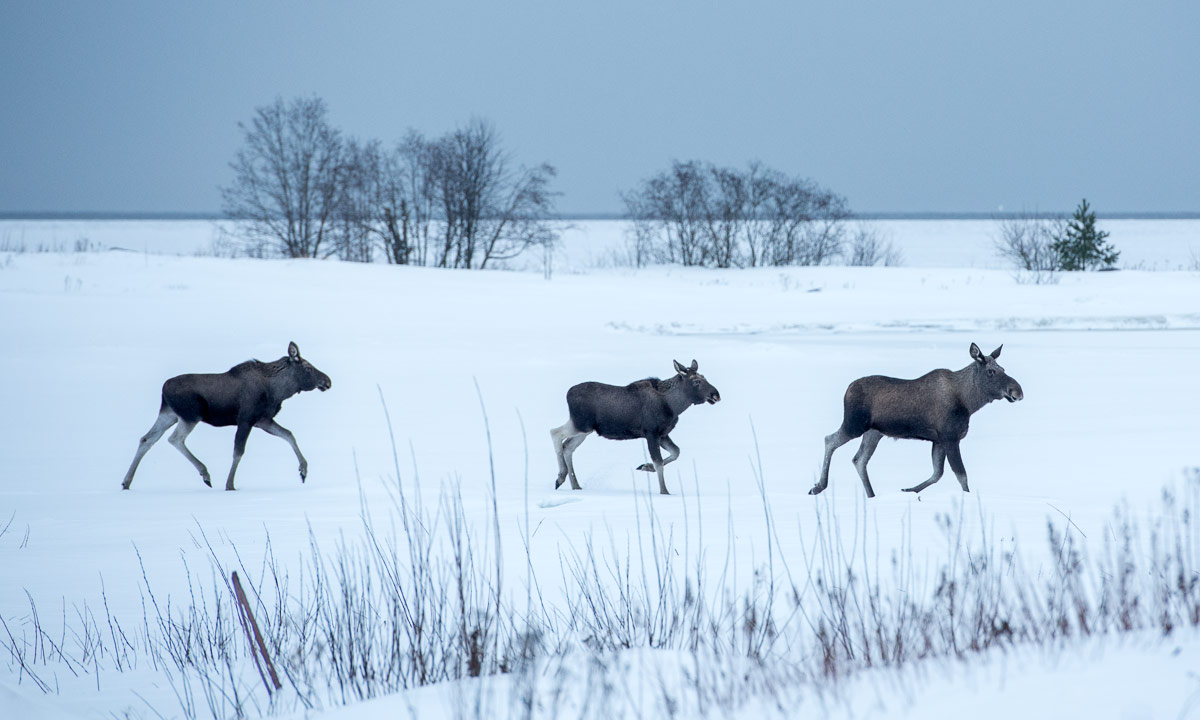
Today it was three moose, mother and two kids. First they stood on the other side of our bay Grundviken and gnawed a bush. I put on boots and winter parka, got out and went into hiding behind a fence. The mother looked skeptically in my direction but the moose stayed. After taking some photos I went in again. Just when I started continuing my work, they came nearer crossing Grundviken. I jumped into boots and parka again and managed to make a nice photo before they vanished behind our neighbours house.

Thank you for your visit. You’re welcome to drop by again.