Along the Vildmarksvägen
Saxnäs – the Wilderness Road (vildmarksvägen). Some shorter hiking tours. No text – just the photos.


Saxnäs – the Wilderness Road (vildmarksvägen). Some shorter hiking tours. No text – just the photos.


Just fifteen minutes ago.
At 16:00 I’m at the southern entrance of the University Hospital of Umeå to fetch Annika from work. We go for a weekend tour that we’ve planned for months. We want to drive the vildmarksvägen on the day of it’s opening. Most of this tourist route is open the whole year, but a part is closed more than half the year due to heavy snow.
Today’s destination: the small town Gäddede, where we have hired a tiny cabin on the campsite. The weather is grey but all birch leaves glow intensely. The Swedish weather forecast issued a level 2 warning for high flow but to our astonishment there is very little water in many lakes we pass. We pass even some reindeers, three moose and some black grouses.


After breakfast we drive along the lakes Kycklingsvattnet, Stor-Jorm and Lill-Jorm. The lakes are open and everything is green. In the distance there are snow covered mountains.

Ten minutes later it looks like this:

What happened? Time travel? No, we are just 200 metres higher than before and although its only 600 metres above sea level the conditions are still wintry here. From now on we travel between the seasons. Sometimes still winter, sometimes already spring. The small brooks and streams carry a lot of water, but most of the lakes are quite empty.


We leave the vildmarksvägen and turn left to pay the Norwegian border a short visit. Of course we are not allowed to cross it due to corona. So we turn our car back to the vildmarksvägen. We travel along some lakes, first partly frozen, then still ice covered until we come to a sudden stop.


A long line of cars, motor cycles and camper vans waits in front of us. They all wait for the opening of the closed passage. We leave our car and walk to the barrier, that will be opened at 12 o’clock.


After half an hour of waiting the barrier opens and the long line of cars starts to move. The next hours there’s a lot of stop-and-go, because people are just stopping and parking anywhere to take pictures making the vildmarksvägen a single file road. But nobody seems to be impatient or even angry, they all have come to see the large snow walls beside the road that tell a lot about last winters snow falls.


Annika and I climb up one of the walls to have a look to an old concrete hut marked with a red cross. We peek inside where we find first aid equipment. Is it still in use? Well, perhaps not, the dressing bandages were fabricated 1957.


And outside: winter landscapes with metre-high snow. We really regret that we have forgot to take our skis with us. Some others are smarter than we and ski through the white. Well,maybe next time …

After driving a bit back and forth we finally take the obligatory snow wall photos.


After an overnight stay in the rainy Saxnäs we head back home. While there is some old snow left in Saxnäs the Swedish inland is free of snow. As on the trip there some of the lakes have very low water levels. I could stroll there for hours but we want to arrive early home in Obbola und so I only take two shorter strolls to take some pictures.


After some hours of driving, a lunch break in Lycksele and another two hours of driving we arrive home in Obbola in the afternoon. Thank you Annika for a fantastic weekend trip.

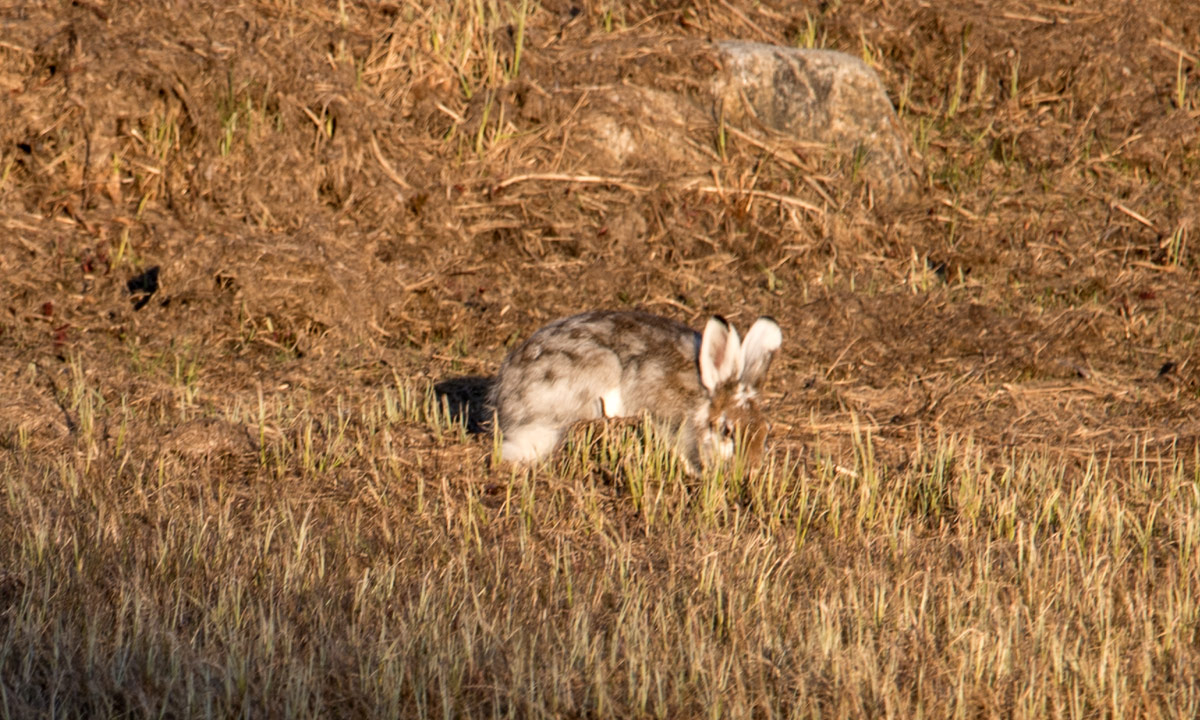


Yesterday evening behind the tiny bay: two deer, a mountain hare, two Canada geese and some red breasted mergansers (probably). A nice neighbourhood.
Some photos are a bit blurred. A focal length of 600mm is not made for handheld snapshots. I guess I will have many opportunities to make better photos in the future.
This article is part of the series “2020-03: Ski tour Jämtland II”.
The weather forecast was right. After a calm and sunny day yesterday it looks very different outside. It is grey and the wind has become stormy and gusty.

All people consider their plans. Among others a group of four decides to remain. They wanted to continue to Helags, round 22 km in the southwest. They would have got the stormy wind straight from the front.
Other skiers plan to return to Vålådalen. It’s Sunday, their last holiday. They ask each other to team up and they exchange phone numbers with Olle, one of the wardens. I do not envy them being out in rough weather with increasing wind speeds with squalls up to 27 m/s in the afternoon. While they equip themselves with balaclavas and ski goggles Annika and I keep inside, peeking through the window that starts to be covered with wet snow.

After all skiers have left Vålåstugan it’s very quiet inside with 10 people remaining. Most of them are on their rooms, only one man seems to love cooking. Until noon he has baked fresh bread, made popcorn and fried pancakes. We are invited to popcorn and get part of the pancake powder so that we can make our own ones. If I’m inside the whole day my interest in eating dramatically increases.
While we spend most of our time reading and being lazy the benches on the sun terrace start to snow in. That’s however nothing compared to the other side of the cabin. A metre high snowdrift has started covering the marked way to the outdoor toilet until Olle relocates the waymarks to a less snowed area. At the same time it has became quite warm, slightly above zero.


In the afternoon the other skiers start to ring. At the end of the day it is clear: All of them reached Vålådalen without any harm. We are quite relieved because we read and heard stories about serious (and even deadly) incidents in the mountains in winter time.
We are equipped with a metal shovel, with warm down bags and bivy bags, but even good equipment is only of limited help when the weather is too severe or there is no snow to dig in.
Tomorrow we want to ski to the mountain cabin Lunndörren. According to the forecast it will be slightly colder, sunny and less windy. Good to know, then we dare to continue our tour.
The next day the skis in front of the house are wrapped in wet snow, now frozen again. I’m glad that my skis are inside. Yesterday evening I glued the long climbing skins under them because we may have to climb many snow drifts today. The weather is fine and it promises to be a sunny day.


At 8 o’clock we say hejdå to the stugvärdarna – the wardens – Olle and Amie. We shall greet the stugvärdarna at Lunndörren. We put on our backpacks, mount the skis, I put on the belt that is connected with the pulka and then we depart.
The first part is easy to ski and extremely beautiful. At every branch tip of the birch trees small pieces of ice are hanging and sparkling in the sun.

We spot a reindeer. When you see one, there are probably others around, too. And so it is. Five reindeers that carefully look at us. They gather in a small group until we come nearer and they walk away.

The first 4 km the snow is perfect. There’s grip for the skis and even with the climbing skins we can glide effortlessly other the snow.

Then it gets more difficult. The plains are so exposed to the wind that they are almost snow-free. Sometimes there’s a visible path, sometimes we have to ski around.
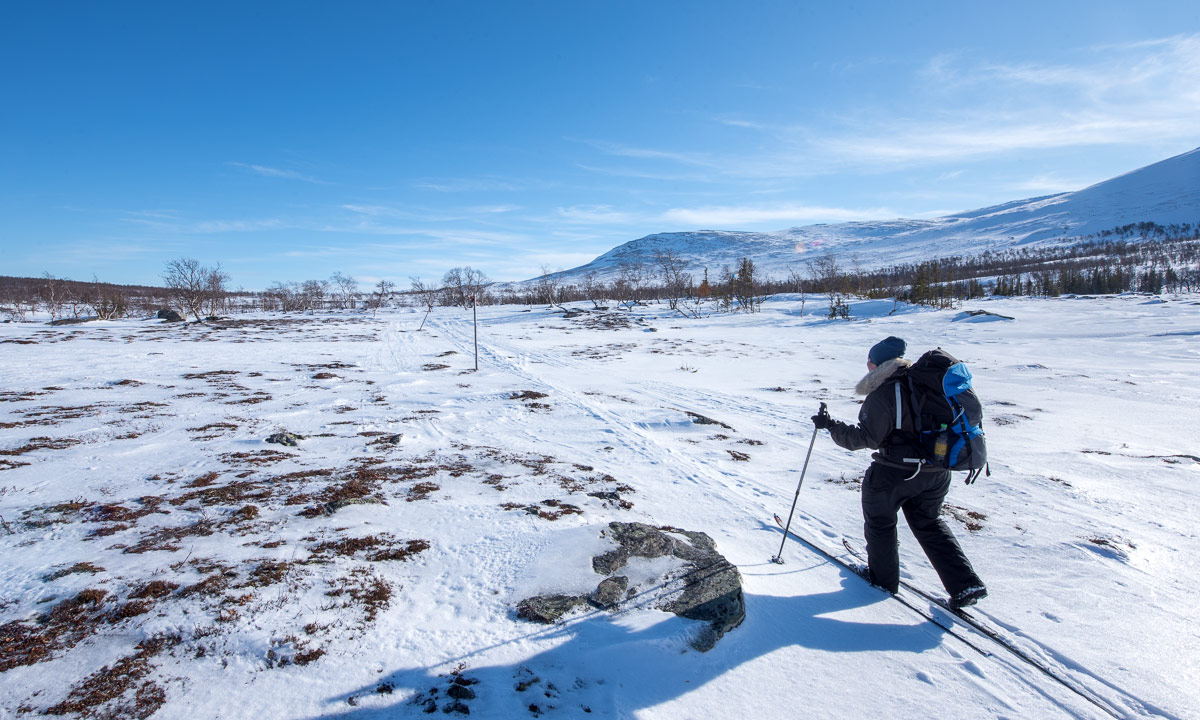


Then the snow gets so hard and slippery that everything starts to slide and it’s near impossible to break. Yesterday’s warm weather and today’s frost have created an icy crust on top of the snow. Sometimes the pulka runs more beside than behind me. When it goes downhills I take large detours to flatten the slope avoiding becoming too fast. Beside of my problems skiing this snow can look very beautiful, especially against the sun.

Later the snow at the surface is as icy as before but the underlying snow doesn’t bare the weight any longer so that we break through. Several times I am run over by my pulka while my skis are stuck. My left wrist still hurts a bit from one fall, one of the less nice memories of this fantastic ski tour.
At last it was snowmobiles that have improved the situation for us. The tracks they have left have broken the icy crust and here we can ski quite well even though I have to unmount the skis for some of the steeper parts. We want to arrive anyway. It’s Annika, who spots the flag of the STF, the Swedish Tourist Association. And there it is: The mountain cabin Lunndörren!
Here Jonas, Arne and I seeked shelter from the storm 17 days ago. Now we are first welcomed by the friendly cabins in the sunshine and then the friendly wardens.

Lunndörren has a highlight we have been looking to for days: A sauna! Already at 17:00 Annika and will sit there enjoying the heat. But before taking a sauna we take another opportunity. Former guests asked for permission to cut a hole into the ice of the small lake by the sauna some days before. Therefore Lunndörren has an ice hole this season. Of course we have to take an ice bath before the sauna. (Taking it after sauna is considered cheating by winter bathers.)


If you ever want to take pictures of a person making faces: Throw her or him into icy water. Four examples (Photos: Annika Kramer):


After 95 °C in the sauna we took a shower. No, not a normal shower with shower head and and chrome valve, just a bucket full of hot water. But it’s enough to wash your hair and yourself. We feel so fresh again afterwards!
Later that evening I stroll around in the full moon. This will be the last night of the ski tour. Tomorrow we will ski back to Vålådalen, where I parked my car only seven days ago.

It’s always a bit strange, the last tour day. Car keys get more important than the pocket knife and mobile internet becomes normal again. Fortunately it’s much easier to ski today than the day before and comfortably we follow the red crosses marking the winter path. After a while we see the first cross country ski-runs and more people around. At the end we have to navigate, because there are so many possible ways. I decide to take the bridge over the river Vålån, the very same bridge I used on the other ski tour three and a half weeks ago. And almost suddenly we are standing on the parking place next to my car. We unmount the skis, load the skis and pulka into the roof box and fill the car with leftover food, sleeping bags, snow shovel and other equipment. And since we were quite fast today we even make it to lunch.


Tack för turen, Annika. Thanks for the tour. Where do we ski next winter?
Have I told you, that the weather in Norway is constantly changing? So it was as well when I continued my road trip the day before yesterday.
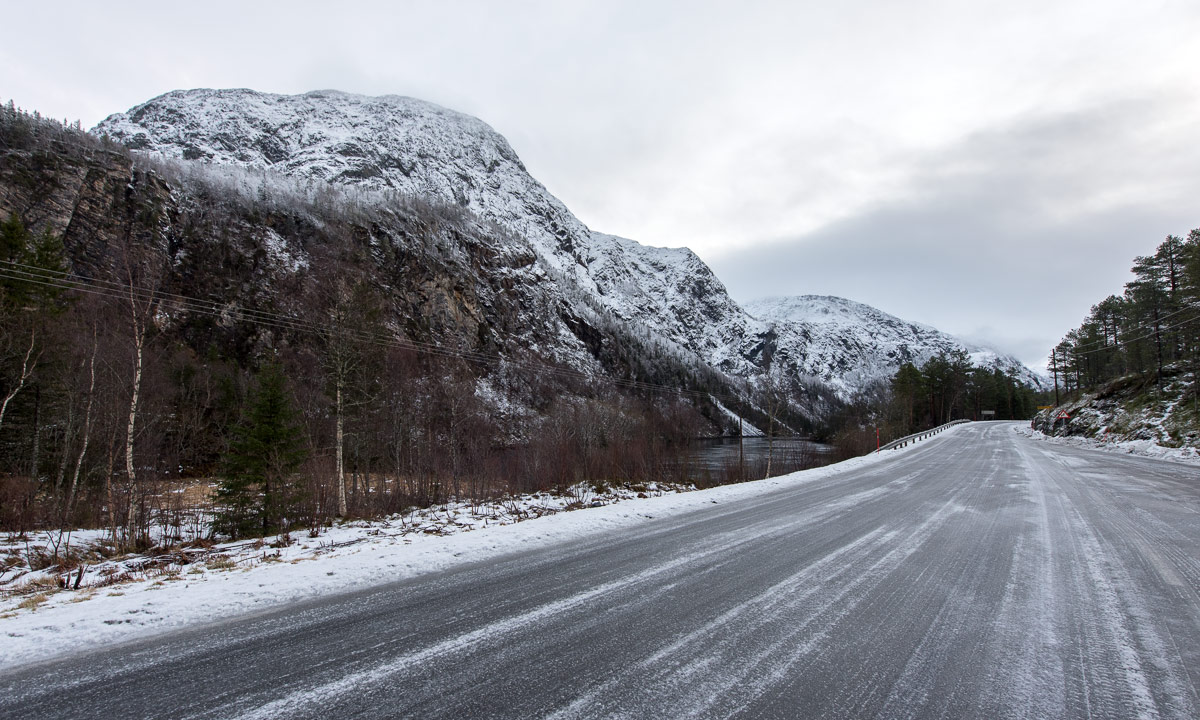

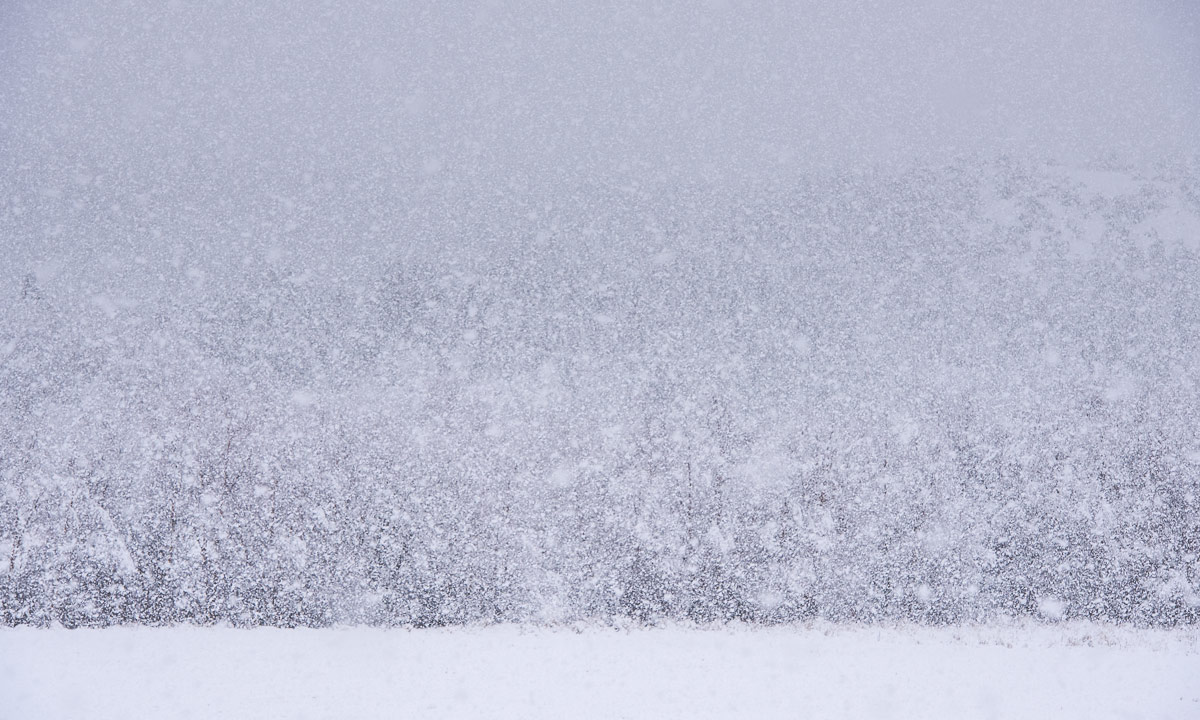
It wasn’t cold, but most of the precitipation came as snow and even by the sea everything was white.
In Hofles I waited for the ferry to Lund which takes 25 minutes. I love standing onboard and watch the snow covered hills and mountains pass.


On the other side there was first less snow, …

… but as soon as the road climbed up a bit everything was white again. Here are two photos from a barbecue hut by the road 74 to Sweden. The first one from now, the other made in August 2016.


This time I have booked a cabin in advance. It is in Rötviken, 20 km behind the Norwegian-Swedish border. Although the campsite is by the road it is really quiet. Hardly any car uses this road.
I was tired from all the driving of the last days and fell fast asleep. The next day I would take it easy.
What a beautiful morning! The sun came out the first time since I left Solberget four days ago. Two dogs were barking. Did they bark at me? Now, it was the two moose that were about to cross the road but then turned too the the lake Hotagen.


This day I didn’t have to go far, just 140 km along broad roads through the Swedish forest. Easy to drive but a bit boring to look at.

I made a short stopover in Östersund, the largest town in the county Jämtland.

Then I continued to Orrviken.
Today I will spend my day here and repack my things for a ski tour that I will start with two friends tomorrow. Then I’ll be offline for about two weeks.
Vi hörs – see ya.
After spending some days in Solberget I continue my journey. Next Friday I have to be in Östersund so I have time to take a detour over Norway.
The road is quite empty. A car comes towards from time to time or a reindeer blocks the road. Nothing special for a car ride through Lapland. Again I’m on my way to Jokkmokk. After an hour I cross the river Stora Lule älv on the Messaure dam.


At 12 o’clock I arrive in Jokkmokk. Time to buy some provisions and get some lunch. I visit “Lilla Paradiset” where I tasted a little piece of the “Lapland Pizza” three days ago. It was very tasty and I commended the cook. Today I was welcomed with a broad smile and the question “Lapland”? Yes – that pizza was my choice today and I can warmly recommend it.


After that pizza the weather got dull and I got tired. Still some hours to go since I wanted to reach Arjeplog at least. I tried to find an accommodation but in vain. Either the rooms where fully booked or closed for winter or much too expencive. So I continued driving. Next station Jäckvik – 75 km from the Norwegian border. I was already prepared to sleep in the car when I spotted a sign “Kyrkans fjällgård“ with a tent and a cabin icon. I was lucky – I got a whole cabin for only 300 kr which is less than a quarter of the price of a cabin in Arjepog I asked for. Maybe it’s because of the zillions of German test drivers that test cars in Arjeplog in wintertime.
Now I’m sitting in “Tjidtjak”, my cosy cabin for this night. It got warm outside (-1 °C) and it snows a bit. Soon I will go to bed, reading and sleeping.


Plans for tomorrow? We’ll see.
Nighty nite!
Last Saturday in Gagsmark, a village one hour away, where Annika and I visited our friends T. and J. . First past the curious cows, then through the spruce forest and there it is: A lake with a beautiful sandy beach and blue water that invites you to take a bath.


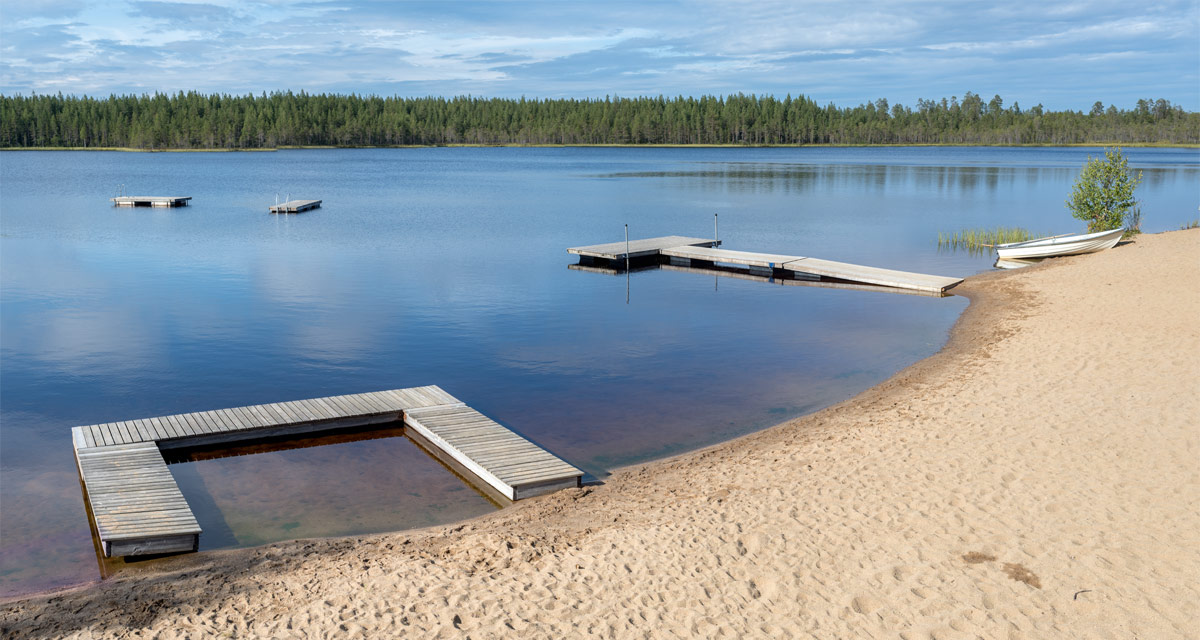
There’s a playground, an open hut for changing clothes, two anchored rafts you can swim to and much more, but hardly other people. Mostly we were alone although it was a sunny Saturday afternoon. We spend a nice time there together, taking a bath or two (17 °C) and enjoying the sun. Then we walked back another way. No curious cows, but beautiful wooden buildings painted in the typical dark falun-red.


Soon the temperatures will drop and the water in the lake Ytterträsket will cool down. If the water is colder than 10 °C it is called “winter swimming”. And one day in autumn – hardly more than two months away – the lake will start to freeze over and you have to saw a hole into the ice to do some ice swimming.
This article is part of the series “2019-07: Southern Sweden”.
July 31 – August 1 – Grövelsjön, Röros, Flatruet, Ljungdalen, Stugun, Åsele
After a tent night in Grövelsjön (temperature minimum 5.7 °C) I take a morning stroll with several purposes: enjoying the fresh air, taking pictures and buying fresh bread for breakfast. My promenade starts at the “troll workshop” where guests are welcome to build their own wooden troll and place it beside the “troll trail”. From there I can spot some “wintry things”: a prohibition sign for scooters and red crosses marking the winter trail. I follow the red signs over a bog until I come to a road from where it isn’t far to Grövelsjön’s mountain bakery.


Annika and I have breakfast in the mountain lodge. Hm, the Brötchen are extremely delicious!

Actually I have planned to take a bath in the lake Guevteljaevrie nearby. The water was very clear but the car tires and metal scrap at the ground discouraged us.


You may realise that the name of the lake doesn’t look Swedish. You’re right. We are not only in Sweden but also in Laponia – the area of the Sámi people. Therefore towns, rivers, lakes and mountains have two names, a Sámi and a Swedish one. The Swedish name of Guevteljaevrie is Grövelsjön, as the village.
A small part of the lake is on Norwegian territory and Norway is our next destination, hardly 10 km away. Soon we are at the border.


We already met reindeers on the Swedish side, in Norway however they seem to be more numerous and they love to block roads.


In the lake Femund – Norways third largest lake – we catch up with the bathing. 13 °C in the water, much warmer in the sun. A nice place to relax.


Two and a half hours later we are in Røros. In this old mining town one could stay for days and write long articles. We however stay only for two hours. Just some snapshots:


After filling up the car we follow a small gravel road that leads us to a Norwegian mountain hut – a possible accommodation for the night. 2.5 km before the hut the road stops – at least for cars. Our luggage is chosen for travelling by car, not for hiking. So this hut that even may be fully booked is out of bounds. Will we find a shelter for the night?

#cliffhanger
Next morning we wake up in a bunk bed in our hostel in Funäsdalen. Of course we found an accommodation, not in Norway but in Sweden. After breakfast we pack our things – a daily routine – and start the next daily stage.
In Mittådalen we take a spontaneous stop. We have just crossed the river Mittån and spot a Sámi resort with souvenir shop. Beside the river there’s a kåta, a traditional Sámi hut. The word kåta is Swedish. The Sámi have several related languages and so their names for this type of dwelling vary: goahti, goahte, gábma, gåhte, gåhtie or gåetie.


We buy some souvenirs and continue. Soon we reach Flatruet, a place I’ve been especially looking forward to. Flatruet is a plateau above the tree line with a gorgeous view to all directions.


The last photo above shows the Helags massif with the Helags summit (1797metres above sea level).
I’ve been there in winter 2006 on a ski tour with J. and T. . It had been very stormy for two days and one of the huskies was so scared that she hid under the bed. We decided to abandon our ski tour. We skied to Ljungdalen where T. waited for a lift to Fjällnäs where he parked the car. Hours later he came back and we took the car over Flatruet. I had never experienced anything that looked as arctic as this snowy road leading through an infinite white void. Here’s a photo that I took from the car 12½ years ago:

That’s the reason why you should visit all Scandinavian places at least twice. In winter they are completely different than in summer.
Back to present: I hardly can tear my eyes away from Flatruet but we have to leave. It’s at least 400 km to Åsele, our today’s destination. Some more stops on the way – some of them caused by reindeers again.


In the evening we arrive in Åsele. Here we will visit M. and F. and stay overnight. Before dinner there’s time to cuddle some sheep.

Now we’re almost home. To Annika’s flat in Umeå it’s only 164 km and another 130 km to my house in Skelleftehamn. “Peanuts” compared with the long distance the last days.
Next day Annika will be home again and the day after me, too. What a wonderful journey!
This article is part of the series “2019-07: Southern Sweden”.
22–25 July – Sparsör, Öresjö and Borås
It’s already Friday, Annika and I have been in Sparsör near Borås since Sunday afternoon and I have been extraordinary lazy. Today it’s going to be the hottest day yet with temperatures round 30 °C or above, so my laziness will definitely continue and the most exhausting action will be going to the bath place nearby.
The weather is still cloudy and not so warm. Perfect hiking weather. When we have to climb the hill Örekullen we sweet anyway. The way is steep. We meet sheep in a forest by the lake and a sow with her two piglets. When we are at the south tip, we have some lunch and take a bath in the bay of Almenäs.
Later this day we drive to the city Borås and eat extremely delicious tapas and dessert in the fantastic restaurant La Copita.


-40 ° C I seek, +40 °C i flee. Luckily it’s not as hot as in Germany¹, but even temperatures round 30 °C are too warm for me to feel comfortable. Fortunately there are many bathing places around, one of them in walking distance. I am bathing and snorkelling. I see schools of fish and hundreds of river mussels underwater, but also a half meter long pike. Anyway the pike is much too fast to be photographed.


Later the evening we drive to Borås another time. A vivid town, especially when there’s a live concert on the town square and a dance band (far away from playing live …) playing in the city park. The air is cooler, but still round 25 °C and even the statues seem to seek refreshment in the water of the river Viskan.


¹ 42.6 °C were measured in Lingen yesterday, the hottest temperature in Germany ever measured. Even though a single hot day is no proof for the ongoing climate shift it is one of the many, many signs.