A short tour onto the hill Solberget
Day 3 of the winter journey 2018
Just two images from a wonderful ski tour up the hill Solberget.


Day 3 of the winter journey 2018
Just two images from a wonderful ski tour up the hill Solberget.
Another photo from the trip to Hampstärnsstugan. It’s a colour photo, by the way.


There’s a hiking trail from Umeå to the lake Tavelsjö, the so-called Tavelsjöleden. The first stop after 5 km is the mountain hut Hampstärnsstugan. Today it opened for the first time this season and served waffles and some other snacks.
While Annika and I had used our new cross-country skis the last days (lightweight, slim and fast) we decided to use our sturdy back-country skis today since we didn’t know anything about the trail conditions.
The trail however was almost perfect, we just had to follow the railway-like ski tracks. We would have been much faster with the other skis, but we just enjoyed being outside and of course the warm chocolate and waffles in the stuga.
While we skied round 10 km, most of the families probably came by car. It was fun to watch the small children on their sledges and toboggans dashing down the slopes, even though we had to jump away several times to avoid collision.
I love being outdoors far, far away from civilisation, but it’s great as well to be able to make such short holiday trips just out of town.

This image was taken with my iPhone SE, not with my Nikon camera that I usually take with me. I just forgot it home today. I don’t think, that the iPhone SE has or is a great camera because I’m quite picky when it comes to image quality. But it’s a great backup if you manage to keep it warm in the winter and some of the photos look quite nice.
It’s probably not the first time, that I use the word lagom in this blog. You could translate it with “just right”. Not too hot, not too cold – not too much, not too little. That’s lagom.
Just now the winter behaves lagom, too. Om Friday evening 5 cm of snow covered my garden, tonight it’s round 20 cm. Not 76 cm as last year, not 2 mm as the year before, just 20 cm. That’s lagom! Even the temperatures are quite moderate, lying round -5 °C.
I didn’t have much time to enjoy this winter, because I’ve worked quite much the last time. Today evening however I managed at least an evening promenade through the near forest, first along some ways and paths, then across country. It was snowing a bit and everything was quite. I could hear neither bird nor car, only the scrunching of the snow under my feet. Today I went afoot but I got my back-country skis from the garage hoping for more snow to come.


C. and O., my best friends from Munich have been visiting me for some days. Today we made a car trip to Vindeln via Burträsk.
Contrary to the weather forecast the sun was shining, when we started. Right after Örviken, hardly 7 km from home I had to stop the car to look at the bay Ytterviksfjärden. Larger parts had frozen over under the last two days and were covered with a thin layer of fresh snow. The first sunny “winter photo” of the season!

The road between Falmark and Hjoggböle – hometown of Per Olov Enquist – was snow covered and hardly any other car appeared. Mist lay on the snowy ground, illuminated by the sun in warm yellow and orange. The whole scenery looked extremely beautiful and a bit fantastical. I was really glad to share this special mood with my friends instead of a cold November rain.


When we approached Burträsk clouds had started to cover the sky and the sun was hidden. It was so foggy, that the lake Burträsket hardly could be seen. We continued without stopping and arrived in Vindeln round 11 o’clock. While O. vas visiting a business acquaintance, C. and I made a long promenade along the river Vindelälven. It was grey in Vindeln and sometimes it snowed a bit. So the scenery was wintry as well but completely different from the colourful hazy atmosphere some hours ago.


Autumnal colours, blue sky and afternoon sun – this is the golden aspect of autumn. Time to wade into the shallow waters of the river Skellefteälven and make some autumn pictures.

One week after autumnal equinox the sun sets at 18:18 but days get shorter soon. In my dreams the first snow had already fallen. This may turn into reality in some weeks.
Today I planned to make some autumnal pictures in the early evening. I took the car to the small boat harbour tjuvkistan in Skelleftehamn. It felt like ages ago that I had been there. On the way there I saw a ship anchored in the commercial port. I stopped and to my surprise it was a ship from my hometown: The “Seabass” from Bremen. Of course I had to take a picture:

I went on to tjuvkistan and took some photos with trees (and boat navigation lights) reflecting in the sea. Still many boats lay in the small harbour or were on the way from or to the islands, but soon most boat people will set their boats on land before the weather gets too cold.

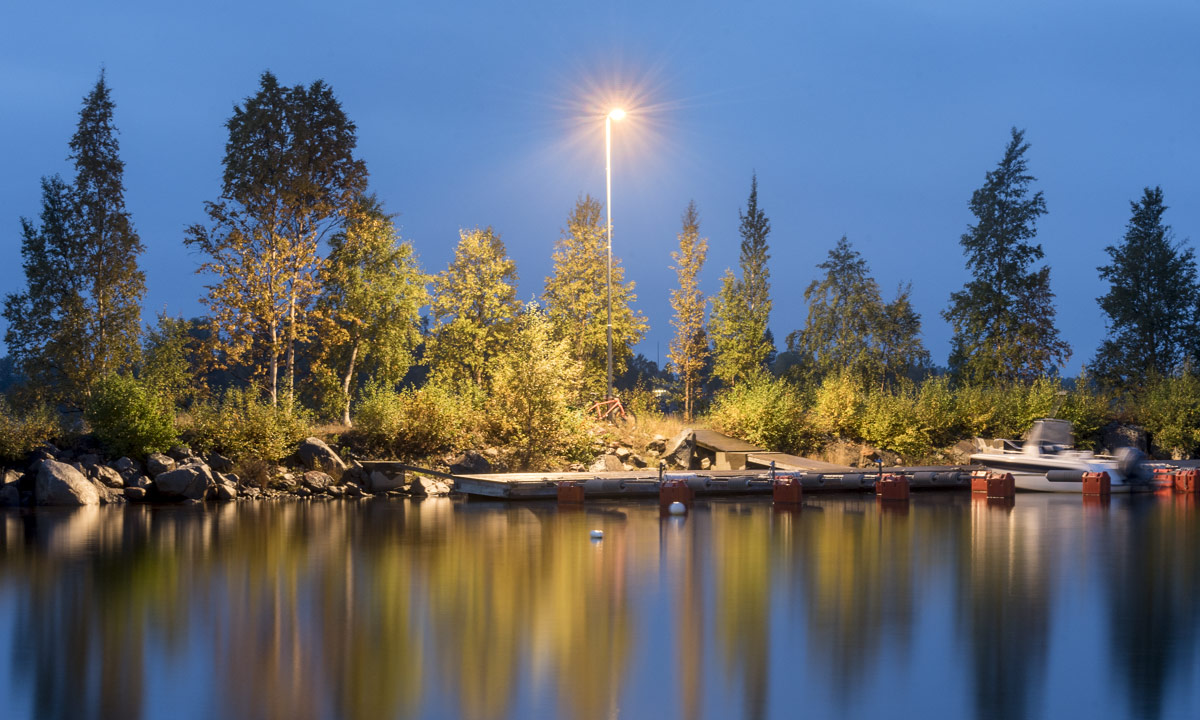
Hopefully I will have some other opportunities to make more pictures as long the leaves have not fallen down.
This article is part of the series “2017-08: Kungsleden hike”.
Today Katrin, Annika, Andi and I would continue to Alesjaure, the longest distance to walk so far.
The morning was frosty with -2 °C and the petals of the flowers called rallarros (rosebay willowherb or fireweed) were covered with ice.


The sky was blue, the sun was shining, we had picture-book weather. As a photographer I would have preferred to hike two weeks later when leaf coloration would be in progress, but you can’t have everything. Anyway, the photo of the bridge over the Visttasjohka right at the Vistasstugan looks like a postcard motif:

This spot looked quite Canadian or Alaskan to me. I almost expected to spot some huge grizzly bears catching salmon in the river. But we’re still in Sweden where bears are brown bears and (luckily) very shy.
The first kilometres of the trail to Alesjaure lead through dense birch forest. Then gradually the forest got less and less dense and the snow covered mountains that frame the valley Visttasvággi were revealed.


The first kilometres were said to be muddy and they were, but not more than many other passages that we walked the days before. Unfortunately the trail continued to be both rocky and muddy and therefore wasn’t easy to walk.
After we left the birch forest the landscape became more rocky again. We found the resting place I remembered from two years ago. Someone had used a plank and some stones to build a bench in front of a huge block of stone. Still the sun was shining but gradually the sky become cloudy. Will we manage to arrive before the rain comes? We still hadn’t walked half of the distance.


We continued our tour until we reached the bridge over the stream Moarhmmájohka. Andi and I went down to refill out water bottles, then we took only a short rest since we were eager to arrive not too late.

After having crossed the bridge we had to go uphills quite steeply and we all slowed down more or less. Then we arrived at the plateau and looked back a last time into the beautiful valley Visttasvággi.


The clouds became denser, the wind increased but still it was dry. We passed the lakes Vuolip Čazajávri and Bajip Čazajávri. We went on and the sami village Alisjávri, located by the lake of the same name came into view. Now it was only 1.5 km left to the Alesjaurestugorna, our destination. As the day before we spotted the sauna first.


At 4 o’clock we arrived at Alesjaure and we stayed dry. Alesjaure is the largest mountain hut that we would stay at. It has as much as 86 regular beds (and more place if needed.)
I already found out, that stugvärd J. would be here, he whom Annika and I met in Nallo two years before and I again on my winter tour in Singi for some days. And really, he indeed was there and I was very glad to meet him again.
To meet J. means also to meet Simba, his kingsize dog. Simba dosed in the outside, stoically ignoring the mosquitoes in her eyes and on her nose. I said hello and started to pet her, which she apparently liked: she sighed and slumped onto her side. The photos I made before and afterwards:


Alesjaure has several houses, which appear more like a youth hostel than a mountain hut. That may look less cozy but we all enjoyed our big beds in our own four-bed-room. Katrin and Annika went to the sauna and after that we cooked one kilo (!) of pasta with goulash soup as a sauce. No, we didn’t manage to eat it all, the rest would follow us to Abiskojaure the next day.
Alesjaure would the last place in the kalfjäll above the treeline on this tour. Tomorrow we would continue to Abiskojaure, which is round 22 km away. This could be the longest day’s march, but we took a shortcut …
This article is part of the series “2017-08: Kungsleden hike”.
Going to bed early, getting up early – the second morning in Nallo we beat a record. We woke up at six and started our tour already at half past seven. The snow has melted away the day before but the night had been cold and some smaller puddles were covered with ice needles.

This year it was easy to cross the watercourse behind the hut Nallostugan. Later on we would have to cross a bigger stream where Annika had to put on her sandals to cross that stream two years ago while I barely managed to cross it in rubber boots.
The first part of the way was still quite arctic and alpine with many rocks and frozen ponds …


… but with each meter in height we descended to Vistas, our next destination, the variety of plants grew. Soon Salix lapponum (downy willow), Empetrum nigrum (crowberry) and Betula nana (dwarf birch) were found again and finally birch trees as well, the first ones for days.


Downy willows like wet places. If you see a long line of them you can be sure that they grow along an alpine brook and if they cover a whole area it certainly will be very wet. Apropos wet – we all managed to cross the river by stepping from stone to stone. Wading was unnecessary. Even if many parts of the trail have been quite muddy this year the water level had been generally low.
This tour was the shortest and easiest of the whole Kungsleden and we used the sunny weather to make a longer rest with lots of chocolate. We would buy new chocolate in Vistas.
The first building we could see was the new Sauna, which is sponsored of a gentlemen’s club called “Fjällrävarna”. Shortly after that the other buildings of Vistasstugan came into sight. We already arrived at 12 o’clock and would have been there even earlier, if we hadn’t been hold up by blueberries …

When we arrived we were alone. D., the German stugvärd left a note that he was hiking and would come back round 4 o’clock. Guests should just choose a bed. So did we. Then we took some items from the self-service shop, put ourselves on the outside stairs of the hut and enjoyed sun. After that we made pancakes with bluebe …
Oh well, the blueberries! I almost forgot them. We hadn’t found many eatable blueberries yet. Many of them were still small and green, probably due to the cold winter, and most blue ones we found turned out to be tasteless or sour. Until today, when we found another field of blueberries on our way to Vistas. This time they were ripe and aromatic. First we ate one or two, then some more. Then we dropped our backpacks and ate some more. Then we dropped ourselves on the ground to collect these tasty berries (and eat some more). It didn’t take long to fill a whole box and some hours later we got a delicious dinner:
Pancakes with fresh blueberries, sugar and cinnamon. They tasted extremely well and it was hardly imaginable, that the pancake dough had been just a powder in Annika’s backpack. Did I mention, that the blueberry garnished pancakes were delicious? I did? Well, you think a lot about food when hiking …


Our dinner was less special: Swedish meatballs in cream with mashed potatoes. It was tasty anyway but not very photogenic. I prefer to show the cans instead of the meal:

Stugvärd D. asked us if he should wake us for polar lights and we accepted gladly. He woke us round 22:30, when it was still dusky. Indeed there were polar lights on the sky, but they were quite weak and hardly spottable. I stayed up another two hours, glad to have a down vest with me, since the temperature already had reached freezing point. The aurora however continued to be weak most of the time. Anyway it was a pleasure to watch. And the stars, the many stars! It was months ago, that it was dark enough to experience such a starry night. At one o’clock I fell into my bed. Another great tour day and the sunniest one yet.
