Scotland: the west coast of Isle of Lewis

This article is part of the series “2022-10: Autumn in Scotland”.

It is 10 October.

Yesterday evening we arrived on the Isle of Lewis, took the reserved rental car (Annika driving) and stayed in the Ravenspoint Community Hostel. Today we want to go by car to explore the west coast of the island.

We do not meet a single person while taking breakfast. We succeed in not raising fire alarm while frying eggs, we pack our backpacks, revert our personal rearrangement of the beds in our twin room and get in our small car – a Kia Picanto. While Annika has been in Scotland much more often than me it is our joint premiere in exploring this country by car.

After taking a detour to a small beach at Tobson we continue to Callanish Stones, one of several arrangements of menhirs. Although yesterdays gale has subsided it is still very windy with some showers of rain. My challenge as a photographer is not only to keep my small Sony dry (first photo is an iPhone photo) but also to take pictures while a large family uses the standing stones for playing hide and seek.

We make a stopover at Doune Braes Hotel for lunch. There we spot the standing stones again – as a colourful leaded window, animals included.

Next stop: the Gearrannan Blackhouses, a village of thatched cottages that was inhabited until 1974. Now it is not only a museum but one of the cottage is a hostel, where we check in and reserve a bunk bed. We have a look at the museum, where a local shows his expert knowledge regarding weaving looms. The view of the coast from the village is quite impressive. The waves are high and smash surf and spray against the rocky cliff.

Now we continue the road north to the headland with the catchy name Butt of Lewis. When we arrive there I’m really flabbergasted. Neither Annika nor I have ever seen waves breaking so high as here at the northern tip of the Isle of Lewis. Extremely impressive, a bit daunting and also a bit wet because sea spray seems to be everywhere. Keep in mind, that the rocks in the next photos are round 10 metres high. Thanks, Google Earth for your elevation data.

It takes some time until I can tear myself away. Next we head for Port of Ness, a harbour village nearby. The sandy beach is broad and shallow. Huge waves roll ashore. While they are breaking the wind gusts blow the spray away – a fascinating view. I decide that today is just not the day to take a relaxing bath in the Atlantic ocean.

We return to our parked car and drive back to our hostel – part of the Gearrannan Blackhouses. The museum is closed and it looks like we are completely alone in our cottage, that can host 13 guests. While we boil water to cook pasta we still can hear the waves splashing ashore at the rocky coast round 100 metres away. After dinner we fall fast asleep . Stormy weather is exhausting, and so is left-hand driving. So, thank you, Annika, my luv, for driving us.


Jämtland tour 22 – signposts and waymarks

This article is part of the series “2022-08: Jämtland and Trøndelag”.

If you want to hike you need either a good map and a compass, or a GPS, or you have an area with designated hiking trails. Then you in most cases have only two issues: find the right trail and follow it.

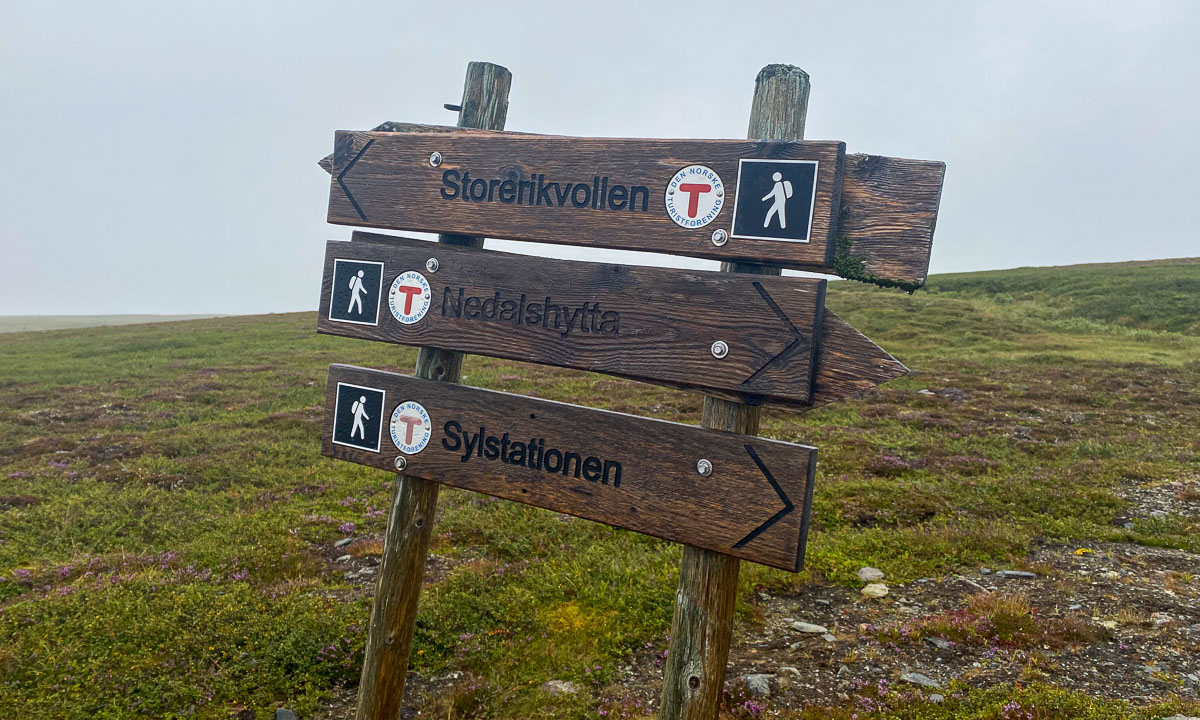
Easy, isn’t it? Yes, but wait – what’s that?:

Why are there two trails to Storerikvollen? Check the symbols. One shows a skier, the other a hiker. That’s the first think you have to know: There are summer and winter trails in the Swedish mountains. The latter ones are often a bit less hilly but can lead over bogs and lakes. So choose the right track. Quite often they go together for a while and then split up again. That’s where you have either to check a map (take an up-to-date one) or follow the right waymarks.

The waymarks for summer trails use stones and red paint. In Norway it is a red T, in Sweden it is mostly a red dot. Mostly they are painted on large stones, rocks or on cairns – heaps of stones. The advantage of cairns: they are easier to spot when it is foggy.

In wintertime most summer waymarks are hidden under a deep snow cover. Then it is the time of the winter waymarks: Red diagonal crosses.

The poles can be several metres long because of the snow, the depth of which can vary greatly. When you have snowstorm conditions in winter you sometimes just can spot the next cross. When you’re lucky. I took the following photo on 20 February 2020 on a ski tour. Two hours later we experienced average wind speeds of 25 m/s. Then you start to love the waymarks that guide you through the storm.

Back to our August Jämtland tour this week. We could watch some people replacing the old winter waymarks by new ones. An important job, probably done on a voluntary base. Voluntary work is so important in Norway that it has its own word: dugnad.

I guess the best sign posts we found in Nedalshytta in Norway. One “summer signpost”, one “winter signpost” and even ratings for the trails from green to black.

It’s always nice to meet some signposts on your way, but not all of them show the distances. I like the last one. The letters are holes in the metal sign, so it won’t snow over so easily in winter time.

But not all signs are about following the trail. They can show you the Swedish-Norwegian border. Or the way to the toilet. Or the toilet – often a “privy” – itself. Or where to park your dog in case you have any.

And some of the signs or marks are quite creative. I almost missed this “in-tree” waymark in Norway. Perhaps more funny than helpful.

But the clearest sign we directly spotted on our first hiking day in Storlien:

The words say henan, dittan and hittn which are apparently words in Jamska, a group of Jämtland dialects. They mean something like here, →there and →here. I cannot express it better. Anyhow this is an article about signposts and waymarks, not about linguistics.

Jämtland tour 22 – the cabins, part 1

This article is part of the series “2022-08: Jämtland and Trøndelag”.

On our hiking tour in the Swedish Jämtland and a bit of Norway we hiked from cabin to cabin. These cabins are quite different, both in concept and in standard.

Ok, the photo above does not show a mountain cabin, it shows the Ringve Musikkmuseum in Trondheim that we visited the day before. Sorry folks, I couldn’t resist.

½ – the first emergency hut

Since the weather in the Swedish mountains can be quite rough, there are emergency huts on the trail. The first one lies between Storvollen and Blåhammaren, our first destination. You may rest inside the hut, but do not touch the fire wood or the emergency box – they are meant to save life.

1 – Blåhammaren

With an altitude of 1086 metres it is the highest STF mountain cabin. Famous for its fire beacon and its three-course dinner. We however use the self-catering kitchen to cook pasta with tomato sauce. A great first stay on our tour.

1½ – Endalen raststuga

Another emergency hut. The sun comes out and invites us to take a break. From here it’s only a kilometre to the Norwegian border.

2 – Storerikvollen

Two signs, that we are not in Sweden anymore: All roofs are grass-covered and the inside is full of carpets, wall pictures and other things to make the cabin individual and hyggelig – cozy.

A thing that makes Storerikvollen special: free-roaming sheep and Icelandic horses.

3 – Nedalshytta

After the longest distance of ca. 23 km we gladly arrive at Nedalshytta. As in Storerikvollen this cabin does not provide a self-catering kitchen in the season. We have pre-booked half board and now order dinner. What we do not know yet: the cook is very gifted and the dinners are awesome! A good place for a rest day.

This is by the way the only cabin with road access on our tour.

3½ – Ekkordörren

We are back in Sweden again. Time to take a short rest in the hut Ekkordörren before we follow the trail over the pass.

4 – Sylarna

Without loosing too many words: this is the worst cabin I know! A tiny shop with ridiculous prices, a dysfunctional self-catering kitchen with five soup plates in total, insufficient drying space and so on, and so on. The personal is friendly and pretty uninterested.

We will meet other people on our trip – cabin hosts as well as guests. No one likes Sylarna. But it’s only a single night and now it gets better. Much better!

Stay tuned for part 2 of the cabin article. Coming soon …


An intangible longing

This blog article is a bit special. It’s not about the places I visit but about a special place of longing. The article is more personal than the others and probably I write it mostly for myself. I decided to publish it anyhow. You are welcome to read it and share your thoughts in the comment section. That would be nice!

I’m feeling sad and wistful. This map shows the reason for my melancholy and the place of my longing:

The image above is a clip of the map North Circumpolar Region. A large version of the map hangs in my work room home in Sweden. In the middle of the cropped image there it is: The North Pole! Unreachable. But …

Let’s first go back in history. 20 years ago. I lived in Essen, Germany and I just had stopped working as a professional jazz musician and made my first work experiences in web programming. Everything was new. And I started to develop a new passion: The Scandinavian winter.

That winter I had been in Lapland for the first time and I loved it! With the exception of the following year I have been north of the Arctic Circle every single year since then. In 2004 I first moved to the opposite direction – Munich – but in 2010 I moved to Sweden. 2020 was a very special year. Annika and I bought a house and moved in together in May. And in August we have married ! At the same time I got a job at the Norwegian Polar Institute in Tromsø. As a matter of fact that is too far away from home but this job is just a once-in-a-lifetime opportunity. That’s why I have had two places to live since then. Right now I’m in Tromsø.

Since I not only like maps but also graphics, I photoshopped a bit today. A graph about “way-up-north” the last 20 years. The x-axis shows the time and y-axis shows the latitude. The bars show were I lived and the dots my northernmost latitude per year.

You see the green dot this year? 82 °N – that’s quite out of my normal Northern Scandinavian boundary box. How I came there? As part of my job I got the opportunity to join a polar expedition with the ice breaker Kronprins Haakon. The three week journey took us to the Polar Ocean north of Svalbard. I was really touched and overwhelmed by the beauty of the sea ice and I fell in love with the high Arctic.

Last week Kronprins Haakon started another polar expedition for five weeks. Oh, I was longing for being in the high Arctic again and I wished to join that cruise so much!

It doesn’t make it easier that I know 9 of the 27 participants. And it doesn’t make it easier either, that the ship is probably not fully booked. There might have been a place (although no budget)! But today it became even harder when I read that yesterday Kronprins Haakon has reached the North Pole for the first time. The North Pole! Imagine – the NORTH POLE! Being there is one of my two strongest dreams in life! The other I’ll keep secret ;-). But of course it is not my main field of work travelling around. Unfortunately.

So that’s why I have been feeling sad and wistful the last two weeks.

But there are things that help.

Annika is coming to Tromsø next Friday and then we have three weeks of holiday together! Since we do not see each other regularly, each day together is something special. I’m so looking forward to see her!

Other thing that help? Hiking in the mountains (last Sunday and tomorrow), paddling kayak (yesterday), taking a bath in the sea (this afternoon).

But still visiting the North Pole will be one of my big dreams!

Tromsøya crossing in winter

An almost true story to be read out loud with a deep and rough voice.

I survived one of mankind’s largest expeditions of our times – the crossing of the arctic island Tromsøya from south to north! Probably I’m the first one, who dared to face this extraordinary challenge.

The arctic ice breaker could not approach the harsh coastal line of Tromsøya’s southern tip. Too mighty the storm, too sharp the rocky cliffs, too high the enormous waves! I was forced to row the last mile in a wooden dinghy. When I approached land I realised that despite of months of planning I was without food! Would I survive? Well, the tour must start, with or without provisions. One has to go on in live.

The land was wild and it was hard to find the entry point of my expedition. Where is Sydspissen, the Southern tipp? With my extraordinary orientation skills I finally managed to find this unexplored promontory which would be the starting point for my crossing.

I followed the coastal line through a field of invincible rocks. The storm howled and the surge of waves covered everything in spray. I decided to leave the exposed coast and seek shelter in the inland. To my surprise I found some ancient dwellings.

It seemed that this hostile island had been inhabited earlier. What a discovery! I continued my way and realised that I was not alone. People still seemed to live here. While most of the indigenes hid inside some dared to be outside, guarded by their dogs. The houses were shocking. While the people seemed to have some basic skills in woodcraft, they still lacked the knowledge of constructing right angles.

I continued my way through the forbidding terrain. After a while it opened and gave view to an extent of ice. Could it be a lake? Probably it had been frozen for centuries. Here I spotted more locals. As the others before they ignored me. Didn’t they dare to seek contact? I do not know. First I though they would hunt seal or walrus but they just seemed to wander around without any goal.

Soon I was alone again in the rough mountain scape of this arctic island. Orientation was extremely difficult. Without my compass and sextant I probably would have been lost forever in this pathless country. I was completely on my own.

The terrain descended and gave view to a strange installation. Scaffoldings pointing up to the sky were erected randomly on that slope. Was is temples or other places of worship? Who build them? When? And why? Probably one never will find out.

Since I lost my food I was forced to continue my expedition. Time was precious. The land was bleak and barren. No trees, no bushes, nothing. Maybe some moss seeking shelter between the stone could survive under the eternal snow. For other plants this place is too hostile. 

The mountains became even higher and I got view on a small coastal village, probably abandoned ages ago. One wooden house lay nearby but it lacked a door and most of the walls.

I looked for walkable paths that would lead me further north. The more north I came the more glaciers covered the land.

It started to get dark but without food I did not dare to seek shelter. I was forced to go on and on without any rest. Amidst the mountains I spotted two indigenes. They sat on some kind of toboggan well clad in furs to keep them warm in the harsh sub-zero climate. I did not dare to disturb them and only managed to get a blurred photo as a proof of my observations.

According to my positional measurements the northern tipp of Tromsøya could not be far. I had survived until now. Would I make it to Nordspissen, the northern tip?

Alas – after more efforts and privations I managed to reach Nordspissen. I was grateful that fate allowed me to be the first human who reached this remote spot on foot. To my big surprise the legend was true: There is a mystic monument at Tromsøya’s northern tip and I can prove it:

But my efforts were in vain. I was too late! The last ship of the season just had passed by. Now I was forced to live here on this remote and solitary polar island for another year. But that’s daily routine for tough explorers like me.


It gets dark – it gets bright

This weekend the mørketid started in Tromsø. That’s the time when the sun does not rise above the horizon any longer. Literally translated it means “darkness time” but usually it is called polar night.

What do you do if it gets darker? You illuminate the town!

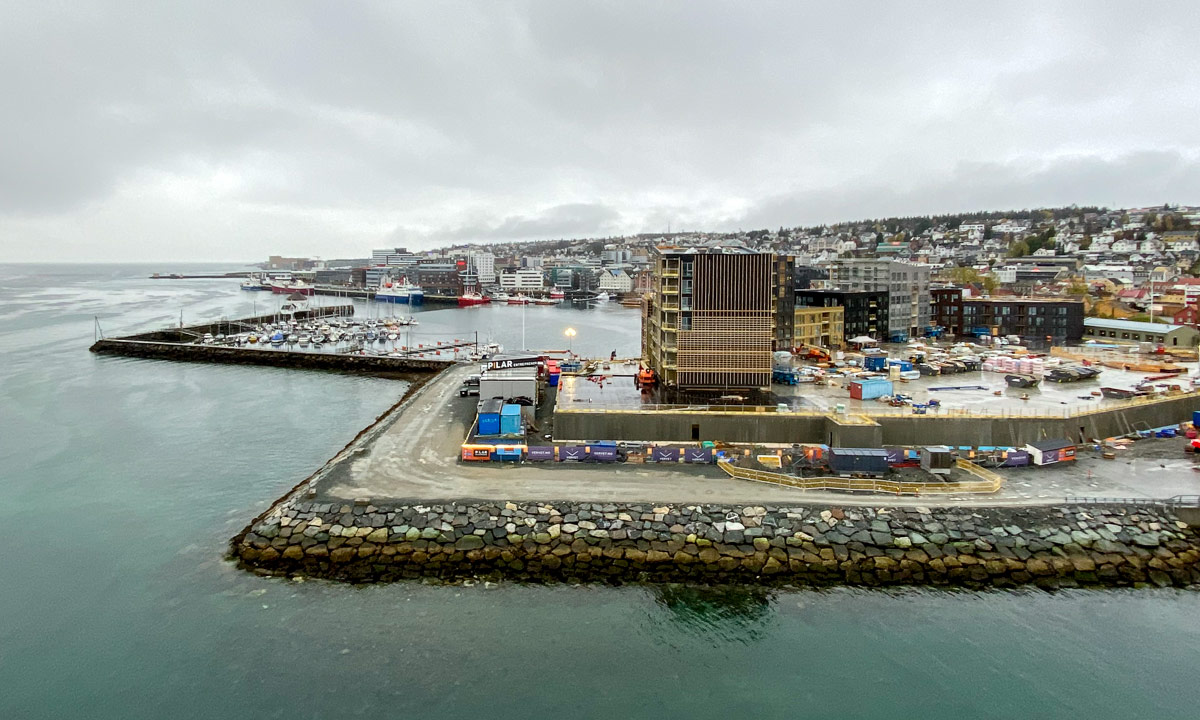
Have a look at the photo with the two deer. You see the red-white logo with the H to the left? That’s the Hurtigruten ship MS Nordlys. You see the lights above amidst the darkness? That’s the mountain station of the Fjellheisen cable car on the other side of the Tromsø sound.

Why I was in town and not on tour? Because today was the Christmas tree lighting in the center of Tromsø and I was singing there as part of the chamber choir Ultima Thule. The place was crowded with people that wanted to experience this annual tradition. Here’s a snapshot that I took from stage during the soundcheck:

Unfortunately there were many people that did not wear a mask. Please cross your fingers, that this event does not lead to another increase of Corona here in Tromsø.

No whales today

To the left the Brim Explorer, a boat located in Tromsø for amongst other whale watching. To the right the tourists waiting to be boarded. The boat is fully booked, I am not alone.

Before leaving an announcement: The crew will try its best but it’s not granted that we reach the waters where the whales are. Anyone is free to leave and given a full refund. Most people stay and so do I. First of all I’m not surprised, as another tour operator already cancelled today’s tour. And then I just want to be a day on the water. Whales of course would be a nice extra.

To the left Tromsøbrua, the bridge that connects Tromsø with the mainland. To the right the safety on board drill, that everyone had to join.

And then we’re off.

To make it short: What we didn’t get today was whale sightings. What we got today was rough weather in the open parts. The boat was rolling and pitching like a cork in the waves. More than one passenger got sea sick. The unpredictable movements of the boat and the dim light under the grey sky made photographing a bit adventurous. Several times I was forced in and one passage even the doors were locked. The rest I was outside, partly taking photos, partly just looking around and letting the wind blow around my nose.

Conclusion: an awesome tour even without whales. If you want to participate as well: take your warmest clothes with you. And those of you that just want to stay home and look at some whale photos may read my article about Whale watching in Andenes. Enjoy.

Note to myself: TromsøyaRingvassøya/ReinøyaVannøyaNordfugløyaArnøya/LaukøyaSkervøya/KågenLyngenReinøyaTromsøya

New friends Tromsø

This article is part of the series “2021-07: Back in Tromsø”.

New friends Tromsø is a Facebook group where people new to Tromsø meet. Some may be here only for  couple of days while others may have moved here and look for tips and other people.

Finally I had time to join an event that one of the group members organised, a hike to Gutta på skauen in Tromsdalen. Since I didn’t know this place I’ll can add the hike to my project #onceaweek.

As the day before the weather was quite warm but cloudy and rainy. I just took some photos with my iPhone since the focus was on get to know other people not on taking pictures. As usual I was quite early at the meeting point in town and waited in the rain for other people to come.

Eight people we were in total – from five, six different countries. We went to Tromsøbrua and used this large bridge the cross the Tromsøysund strait and reach the mainland.

On the mainland we had four more km to hike – first through the urban neighbourhood Tromsdalen, then on smaller roads through the forestry valley of the same name. And then we reached Gutta på skauen which means “guys in the wood”. These guys – all older than me – provided coffee and cinnamon buns. You do not pay per coffee or bun but donate an amount of money that you consider suitable.

There we sat for an hour or such while rainfall outside increased. Then we hiked back another parallel path (the nicer way), crossed the bridge again, asked a bypassed to take a picture of us and then started to split up. After another stop in the café Koselig I walked home. There are not many busses on Sundays.

There were a lot of water puddles on my way back, some of them quite deep. The last photo however is not rainwater but the sea. When the tide is quite high it covers one of the footpaths on the seashore. I managed with rubber boots this time but it was close.

No, this tour was not demanding but anyhow it was 14–15 km in total. So – motion: check! Meeting nice people: check! Having a good day: check!

Thank you, E. for organising.

Hejdå home office

Hejdå home office – hejdå Obbola – hejdå Sweden.

This picture is from yesterday, my last day in home-home office. One “home” is for not being in the office, another “home” for working from home in Obbola, not in Tromsø.

This room was my home office for eight months.

In normal times you meet colleagues in real life and have landscape photos on your computer monitor as a desktop background. The last eight months it was the opposite: I met my colleagues digitally but the view of the Baltic Sea was real. And so were the sail boats, the screeching sea birds and the roe deer passing by.

While I write this Annika and I sit in the train to Riksgränsen that departed in Umeå at 2:08(!). In Riksgränsen we’ll get a private lift to Narvik crossing the Norwegian border and then take the bus to Tromsø. If everything works well we’ll arrive there this evening. After a week Annika will return home while I’ll stay in Tromsø to continue my work for the Norwegian Polar Institute on-site.

Eight months Annika and I had together in Obbola. I appreciated every single day of this unexpected gift caused by the COVID-19 restrictions and I’ll keep this time in my heart.

What the future brings? Too early to say.

Tramporgel

Harmonium or tramporgel are the Swedish words for a pump organ, an organ where you use your feet to pump air to the pipes. Yesterday such a tramporgel moved into the unheated uterum of our house.

I found the instrument on Facebook Marketplace some weeks ago. It was being given away. It took some weeks to organise a transport but good friends of us offered their help (including a large car with trailer). I was a bit afraid, that transporting the instrument uphills could be hard, but transportation was easier (and less heavy) than expected.

Some hour later the tramporgel had found its new place.

My thanks to S. for giving away this fine instrument and help with organisation and transportation.

My thanks to J. and M. for the transportation (and a real nice lazy day including bathing and lunching).

Now I’ll have six days to play and practise. Then I’ll travel to Tromsø to continue working there – probably for the rest of the year – and home will be many miles away. But that’s another story …