The Sea Sami Collections in Byluft

This article is part of the series “2018-03: Varanger peninsula”.

Day 37 of my winter journey 2018

When we left Kirkenes last year we got the tip to visit the Sjøsamiske samlinger – the Sea Sami Collections in Byluft. We went there and were amazed at the huge collection of showpieces. This year we visited the museum again, this time with more time and a warmer winter jacket, since the exhibition rooms are not heated.

Helmer Losoa, who runs the museum gave us a warm welcome and asked us in to coffee, where he talked about the museum’s and his personal history.

Helmer was born and grew up in Byluft. Aged 15 he went to sea on the training ship M/S Gann. That was in the ’50s. He travelled for many years and lived in Oslo a long time. When he moved back to Byluft in 1990 much had changed. Everything was motorised and many things were made of plastic. Helmer wondered what had happened to the old things of the Sea Sami in this region and started to collect many items, mostly from the years 1830 – 1950. He got support for building the museum but not for running it. A part of the items were donated to the collections, but most things Helmer bought himself from his own money.

After drinking coffee and listening to Helmer we went to the museum and Helmer showed us around.

There are many facets that make the Sea Sami Collections especially interesting:

  • While many other museums focus on the Mountain Sami who herded reindeers, this museum focuses on the more unknown Sea Sami who lived by the Norwegian coast of fishing, farming and hunting.
  • The exhibition is huge! I guess you could build at least ten new museums all over Northern Norway from all the exhibits that Helmer collected under the last 28 years.
  • Helmer can tell many stories about the showpieces in his collection. Some of them belonged to his relatives and he knows a lot about the history behind.
  • There are no glass boxes. You can have a close look at everything and with Helmer’s permission you are allowed to touch some of the items.
  • The museum reflects the everyday life of the Sea Sami in older times. Beside of wooden boats or fishing equipment you will find old coffeepots or radios, too.

We stayed in the museum quite a long time. It probably would take weeks to look at all the showpieces in detail. We looked around, asked questions to Helmer and listened to his stories. After some time we left the museum and said goodbye to Helmer.

Thank you so very much, Helmer! It was a pleasure to meet you again and to be guided through your Sea Sami Collections. Hopefully we’ll meet again sometime.

The Sea Sami Collections are located in Byluft, 29 km east from Varangerbotn.
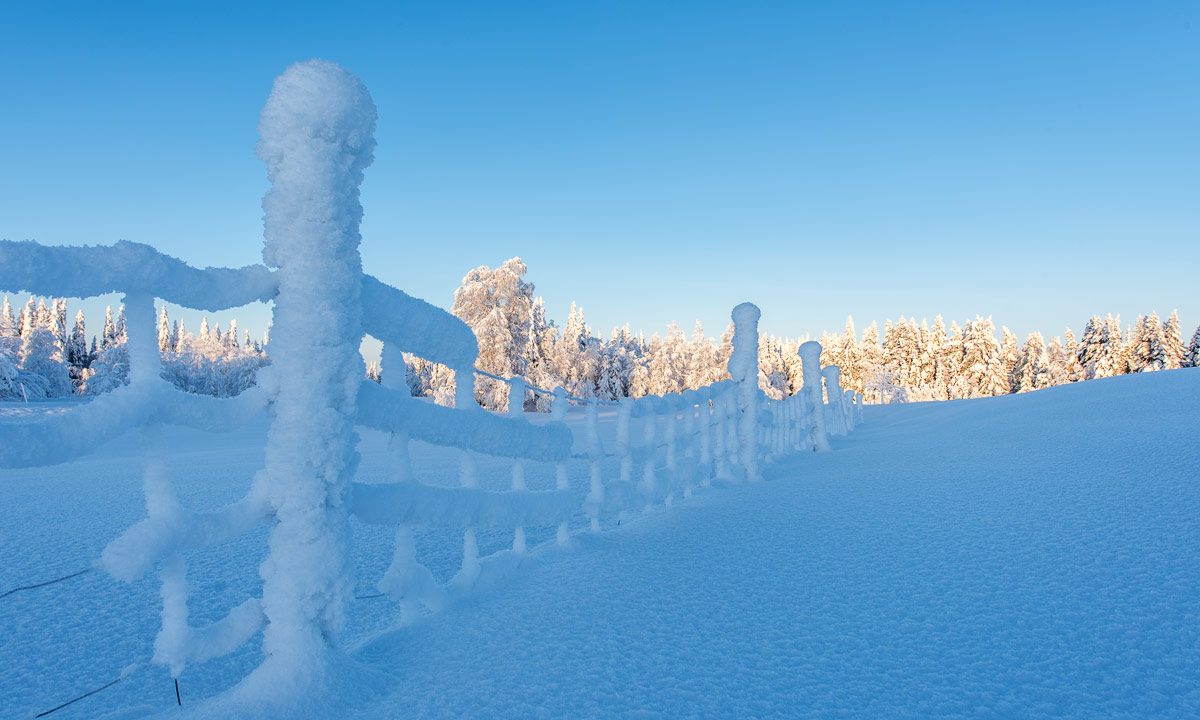
A cold and crisp winter day

Day 4 of the winter journey 2018

This morning was cold, clear and crisp with temperatures round -25 °C. The snow glittered and the sun slowly started to illuminate the snow covered trees. Today Annika would travel back to Umeå and our main plan for that day was to not have any plans at all.

Dirk, the owner of Solberget asked me however if I could have a short photo session to make pictures of his reindeer sledges in action – one of the attraction of the wilderness retreat. And I gladly accepted. Here’s a first selection of the photos i made.

When I later took Annika to the nearest train station Nattavaara the temperature dropped to temperatures round -30 °C. Good to know, that the small station in Nattavaara has a small heated waiting room where you can wait for the train.

Her train was several hours late (I’ll come back to that topic later …) but thanks to internet and mobile app we already were informed about that delay and hadn’t wait too long until the train arrived in Nattavaara.

Annika will be away for two weeks until we’ll meet again and start our main winter journey. Meanwhile I’ll do a ski tour with Jonas, a good friend from Germany who should already have arrived the day before. Which he didn’t. Well, the train delays – I promised you to come back to that topic.

Due to a snowstorm in Gävleborgs län all trains to Northern Sweden had been cancelled. Jonas had been stuck in Stockholm. He couldn’t take the train the next day neither since it was fully booked. Therefore he was forced to wait another day and then take the night train with a scheduled arrival on Monday, 7:38. This train however was stuck in Vännäs for many hours due to technical problems. Instead of arriving on Saturday, 12:40 as originally planned he arrived on Monday, 17:00. That’s more than 52 hours delay!

But finally he arrived and tomorrow we can plan our ski tour which we’ll probably start on the day after tomorrow, 7 February.


Impressions of the Jokkmokk Winter Market

Day 1 and 2 of the winter journey 2018

The first time I’ve been on the Jokkmokksmarknad – the Jokkmokk Winter Market – was 2005. As many other tourists I strolled over the market looking at the many products, everything between fox furs, Sami handicraft and plastic tools for the everyday life.

Since then I’ve been on the market several times, last time in 2015. And I still enjoy the market. Some random impressions:

But my focus has started to change. More and more I want to talk to all the people on the market. With the old guy from Finland trading with fur products, with the American artist building objects from weaving looms, with the Sami women selling grammar books about “lulesamiska”, with the people selling double-walled sauna tents. So many interesting people, all with their own story.

Another way of storytelling I witnessed at 4 o’clock. Sofia Jannok, a famous Sami singer and songwriter presented her current program, which is very political from a Sami perspective. As a musician however I had a strong focus on the music, which I enjoyed very much even though it wasn’t the music I use to listen to. I asked Sofia after the concert if I may publish a photo and I may:

I could tell more but the laptop battery is almost empty and dinner is served in 15 minutes. Two strong arguments for closing the article. We’ll hear soon …


A starry night at Solberget

Day 1 of the winter journey 2018

After a first day on the winter market in Jokkmokk Annika and I enjoyed the cozy sauna at Solberget, my very favourite of all saunas I know. I was really tired after the sauna but just had to make some photos of the beautiful surroundings in the moonlight.

And while I made photos of the window of the sauna hut even the polar light increased a bit.

Today Annika and I will head to the Jokkmokksmarknad again. Yesterday we got a lift, today we’ll take my car.

Travelling to Tromsø

This article is part of the series “2017-07: Tromsø”.

Sometimes I’m just too lazy to blog and so was I the last weeks. Today however I finally want to write about a great trip to Tromsø, that Annika and I started on 7 July, almost three weeks ago.

Tromsø is in located in the North. Very far north. It lies 344 km north of the polar circle and is the northernmost town of the world with more than 50,000 inhabitants. It has the northernmost university, both the northernmost cathedral and mosque, the northernmost brewery and probably some more northernmost things of the world.

The shortest route by car from Skelleftehamn to Tromsø leads over Luleå, Pajala, Kilpisjärvi (Finland) and Nordkjosbotn (Norway) and that’s the route Annika and I took.  We had a lot of time and planned to stay overnight twice, but didn’t plan where.

The first part of the route, the E4 leading north, is kind of boring. At least you’re allowed to drive 110 km/h – the maximum allowed speed of the whole journey. In Töre we left the E4, took a break and ate in the Restaurang Roady – the first KRAV-certified sidewalk restaurant.

After lunch we continued northwards. After 50 km we reached Holgers Traktor Museum in Svartbyn, which is always worth a visit. Since it was late – we started our trip in the afternoon – we just made a short stop to take a picture and then continued our trip.

Where to stay? Perhaps we could stay with Katharina whom I met last winter. She lives in Miekojärvi between Överkalix and Övertorneå. We tried to ring her, but she didn’t answer the call. Anyway it’s just a detour of 30 kilometres so we just gave it a try. Katharina has round 20 huskies and someone has to feed them. When we arrived at her house, a man left the shed, looked at us and we were quite surprised to meet Sascha whom we met before in Solberget several times. What a lucky coincidence! So we found not only our first overnight stay but great company, too! Thank you, Katharina (abroad) and Sascha for your hospitality!

The next day we continued our tour after a nice and rich breakfast. We crossed the arctic circle and watched the reindeers.

First stop: Pajala, where a big market took place. Here you could buy a lot of things between tradition and modern age.

After two hours we left the hurly-burly and entered the car again. We crossed the Swedish–Finnish border and followed the E8 which was more construction site than main road. We passed Karesuvanto, where I was sure to meet a food store. All stores however are on the Swedish side, in Karesuando. Not a problem, if you have bread with you and then are given butter, cheese and salami as a present on the super-nice camping ground Lätäsenon Majat near Enontekiö, where we stayed overnight.

Next day we passed Kilpisjärvi near the border triangle, where Sweden, Finland, and Norway meet and soon we were in Norway. Norway is my favourite country in summer because the landscape is so varying and beautiful that even I make photos from within the car:

In Skibotn we saw the first fjord – the Lnygen – and made a break. Annika used it for jogging and I for looking around and taking pictures. I love to stand at the shore, the feet in the water, the view either on the shells or on the fjord and the still snow covered mountains. But the seagulls didn’t like me standing there and they flew some feint attacks, luckily in vain. They don’t dare to come really close.

In Nordkjosbotn we ate hamburgers for lunch. It’s not easy to get anything other than burgers and pizza in Northern Norway outside the cities, but sometimes I like fast food, especially when travelling. From Nordkjosbotn it’s only another hour to Tromsø, where we arrived in the afternoon.

Here we would stay for four whole days with … but that’s another story for another blog article. Stay tuned!


Visiting the “Vindelälvsdraget”

Yesterday Annika and I went to Vännäsby , 25 km away from Umeå, to view the 30th Vindelälvsdraget which is the world biggest draught dog relay according to the organisers. It started in Ammarnäs in the Swedish mountains on Thursday and ended just in Vännasby on Sunday. That’s a distance of 381 km in three and a half days.

Some of the competitors used a sledge pulled by four to six dogs, but most of them skated on skis and had one or two dogs dragging (more or less). They came along on the frozen river Vindelälven, turned into the river Umeåälven, which they had to leave right after the bridge. Some of the teams managed it perfectly while others had to shout höger! (right) to the dogs several times until they obeyed. The river bank is quite steep and was a real challenge for the discipline of the dogs. One of them just rolled in the snow while the skier tried not to slip and fall, while some others were shortly distracted by the smell of the grilled sausage by the trail. However all teams managed to come up where there were only some 100 metres left to the finishing line.

The speaker at the finishing line was great. His talk was so “adagio”, laid back and completely free of any stress. I really enjoyed his almost zen-like moderation which was the total opposite of the normal sport presenters stressful reporting attitude. My kudos!

Some photos:

Links: Website / Information pdf (both in Swedish)

Two days on the Hurtigruten

This article is part of the series “2017-02: Northern Norway”.

On Wednesday we left Kirkenes and started our journey to the next destination: Stokmarknes on the Vesterålen where we planned to visit good friends of mine.

Kirkenes—Stokmarknes would be 1000 km by car and take at least 14 hours, if you take the faster way through Finland and Sweden. Anyway there’s an alternative: The Hurtigruten express route, which connects many coastal towns, among others Kirkenes and Stokmarknes. That’s why we took the Hurtigruten ship instead of driving for at least two days. In Vardø we entered the vessel Trollfjord and 16:45 we started our two day long tour.

The first night we went to bed quite early and I only took some pictures in Berlevåg. Since the ship already was moving again I decided to make a longer exposure with the camera on a tripod. That’s Berlevåg by night seen from the Hurtigruten:

We missed Mehamn, Kjøllefjord, Honningsvåg. The first place with a landing stage I saw was Havøysund, were we anchored from 7:45 to 8:00. Shortly after we met the Lofoten, the oldest and smallest ship of the Hurtigruten fleet today. It was tiny compared to the much bigger Trollfjord (which is tiny compared to modern cruise ships).

I tried to be as much outside as possible. It was cold and quite windy, not only because of the airflow, but the gusty wind, too. First I thought, that I would be extremely overdressed in my Canada Goose expedition parka, but soon I found it quite comfortable to wear it in the chilly weather.

In Hammerfest we left the Hurtigruten, looked round in town and bought food. In Øksfjord it started to get dark and the black-white mountain ranges became blue.

… and blurred if you wanted to …

… and it got darker …

Then it started to snow. Sometimes the snowfall was quite heavy especially with the wind and I was even more glad about my warm parka.

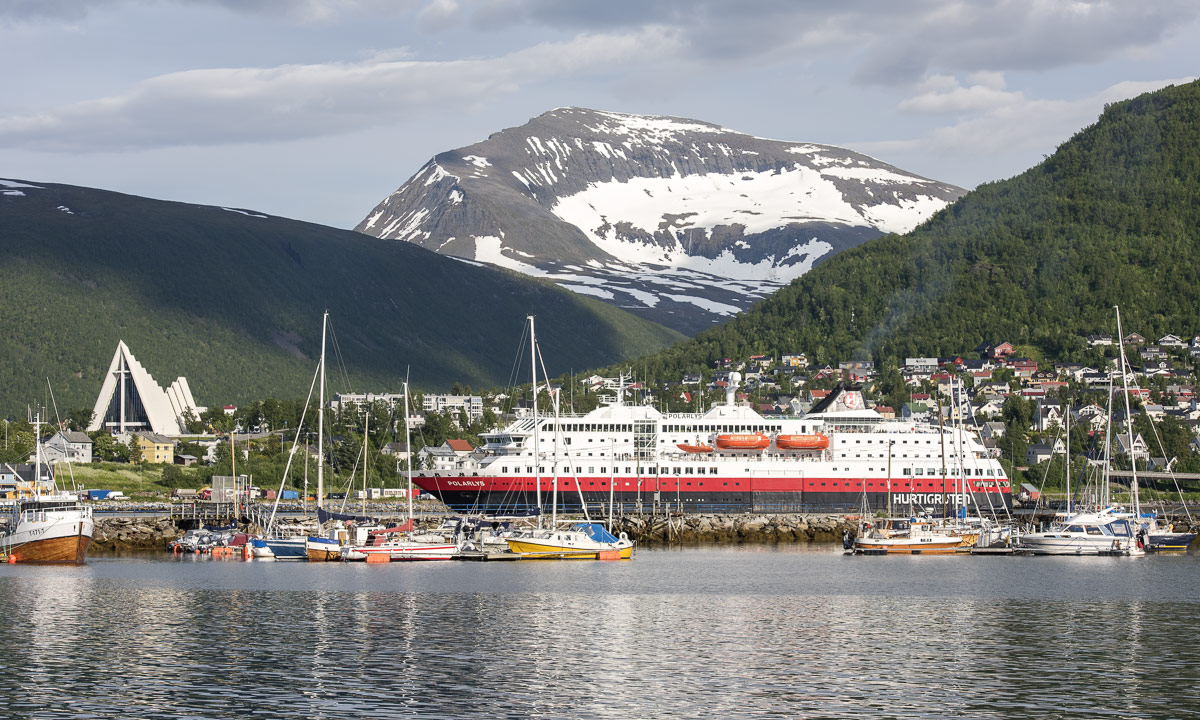
In Tromsø we arrived at 23:35 and I made some night shots of this favourite town of me.

We could have left the ship for a visit of Tromsø but we preferred sleeping. We’ll probably visit Tromsø this summer.

The next morning came and the last day aboard began. Good for me, because even if I was glad to slip the car ride it’s not my world to be on a large ship looking at the landscape rolling by. Last night snow fall has brought much snow on the top deck. I never waded through snow drifts on a ship before.

At the same time the Trollfjord anchored in Harstad, a town on the island Hinnøya.

On our way to the next destination Risøyhamn it got extremely windy, the stabilised ship started to roll and to pitch and heavy snow showers appeared, reducing the view to some hundred metres.

Suddenly the wind calmed down, the snow showers were left behind and for the first time of the whole cruise patches of blue sky and finally the sun came out. We approached Sortland, the last stop before our destination Stokmarknes where I gazed at the beautiful mountains of the Lofoten archipelago in the south.

I generally dislike the last 30 minutes of transportation, if it’s by train or by plane. I just want to arrive, and so it was on the Hurtigruten. Impatiently I waited in the inside of the Trollfjorden for its arrival in Stokmarknes, then another fifteen minutes for the allowance to enter the car deck and another ten until I was allowed to drive the car onto the very same car elevator which I used to enter the ship almost 46 hours ago.

I could write a lot more about the Hurtigruten and its passengers, but that’s another story. Short résumé: I love those ships for transportation, but cruising is not my cup of tea. (Anyway, the outside jacuzzi on the top deck is really great!)

Sjøsamisk Museum

This article is part of the series “2017-02: Northern Norway”.

Today Annika and I left Kirkenes and headed north to the Varanger Peninsula and the towns Vadsø and Vardø. Well, heading north it would be without the fjords. We took the E6 and followed it in almost all directions to drive round Neidenfjorden, Munkefjorden, Bugøyfjorden and the large Varangerfjorden.

Ørjan had advised us to visit the Sjøsamisk Museum – the museum of the sea sami. It is located in Byluft 30 km before Varangerbotn when you come from Kirkenes. We rang at the door bell of the private looking house and Helmer Losoa, the creator and owner opened the museum for us. We entered the large wooden building and looked stunned. We didn’t expect such a huge collection related to the history of the sea sami and the region. Almost uncountable items hung on the walls, the ceiling, stood on large tables or in cupboards. From old sami costumes to wooden fishing boats, buoys made of glass and ancient radios – I guess there’s hardly a thing you cannot find in this collection. And Helmer, who has both built the museum and has been collecting all these items for 27 years, know them all and can tell stories about them.

So that’s my tipp for today: If you ever should be near Kirkenes or Vadsø – visit this collection. If you come in wintertime, keep in mind that the rooms are not heated. Inside temperature = outside temperature minus the stormy wind.


4×4 winter impressions of Kirkenes

This article is part of the series “2017-02: Northern Norway”.

Kirkenes – the harbour

While Annika and our friends in Kirkenes enjoyed their breakfast in the Hotel Thon I took a short promenade along the Johan Knudtzens gata to take some pictures. Already the view from the hotel terrace over the fjord is quite impressive and shows the beauties of the arctic nature while the harbour shows the more practical sides of living here: fishing, both commercially and just for fun.

A hike onto the top of the Lyngberget

After the breakfast we took the car to Jakobsnes and a bit further to take a promenade up the mountain Lyngberget, which lies on the other side of the Bøkfjorden. Here you can have a wide view over the whole town of Kirkenes – at least as long it doesn’t snow, as it did on our way back. I just love these wintry landscapes where you have views over fjell and fjord, but the wind was quite chilly and soon we looked like the participants of an arctic expedition.

The Huskies of the Kirkenes Snowhotel

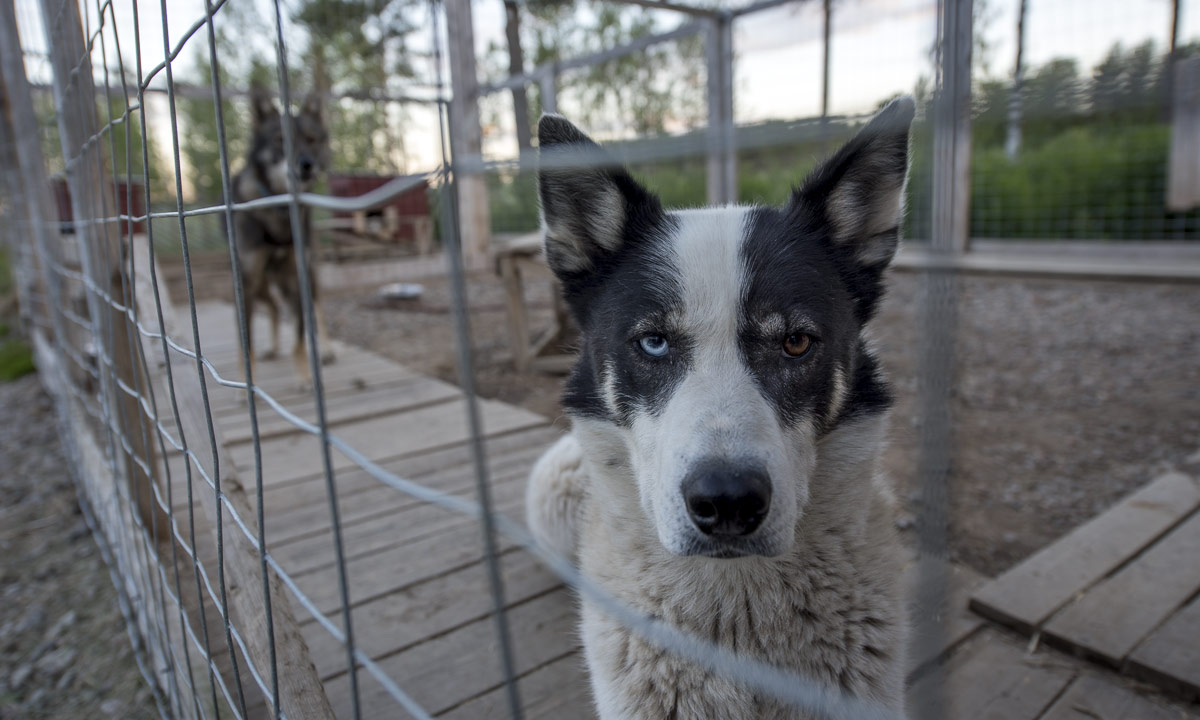
Today we played tourists and visited the Kirkenes Snowhotel, which is just some hundred metres away. The Snowhotel has 180 Huskies including the seniors plus 30 puppies. The huskies are like we humans – some are working, some are resting, some are curious and some are shy. But they are all very kind and friendly.

Inside the Kirkenes Snowhotel

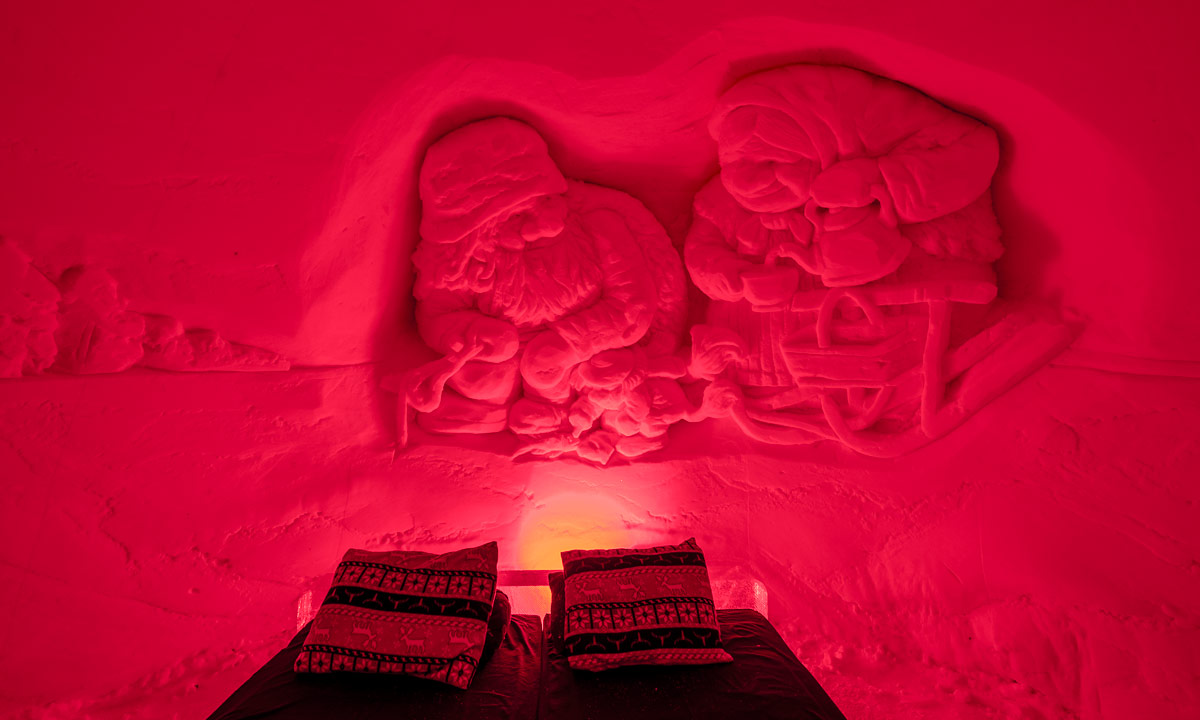
I slept in tents, in igloos and outside in wintertime. I even slept in the Kirkenes Snowhotel two years ago. This time Annika and I enjoy sleeping in the inside of our friends house (Thank you for your great hospitality, Christine and Ørjan) but gave the Snowhotel a visit. And it was worth it – especially the lounge with it carved ice blocks is very impressive.

Tomorrow we’ll leave this fine place, take the car to Vardø in the North (yes, that’s still possible!) and take the Hurtigruten from there to our next destination.