A winter journey from home to work

Last Saturday I travelled to work. Obbola—Tromsø, that’s round 1000 km – the reason why I do not commute weekly.  This time it is a bit suspenseful, because there are two obstacles on my way.

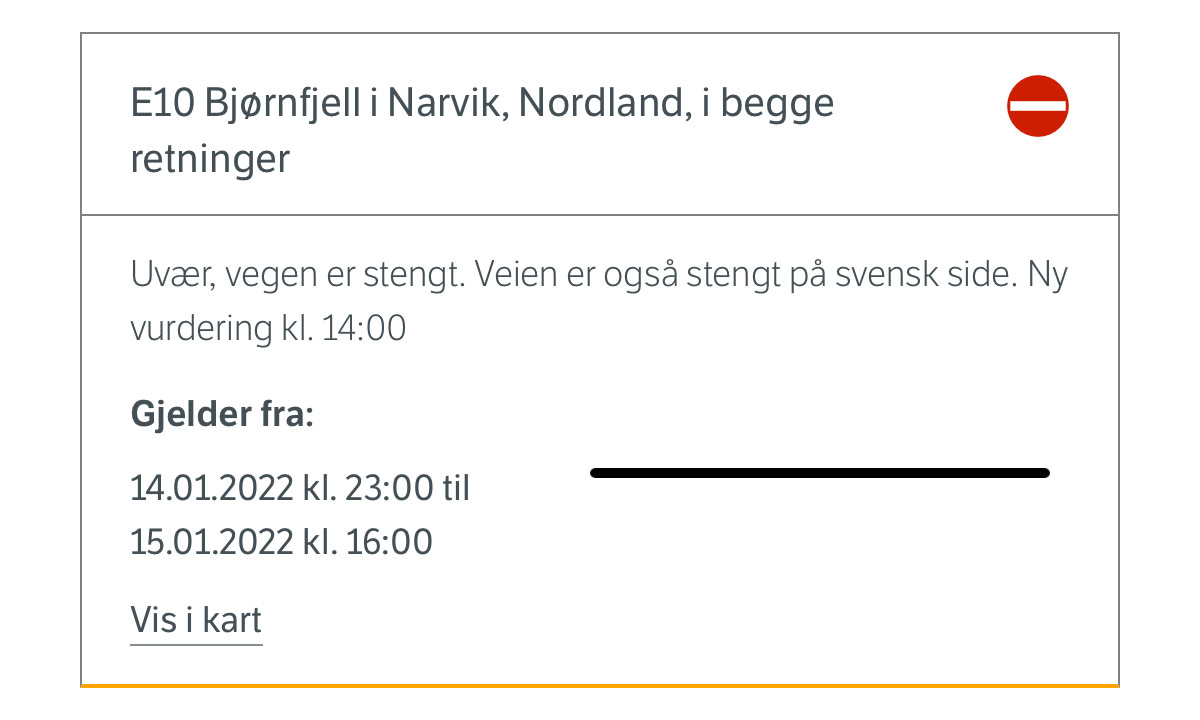
One obstacle is easy: taking a covid test at the test center. The other is much bigger: The road over the Bjørnfjell – the only road – has been closed for many hours due to stow storm conditions. Well, I start my journey anyhow. We’ll see.

At 5:30 in the morning Annika takes me to the train station in Umeå. The first 9½ hours were just a “normal” train journey beside of the train being mostly ahead of time. One change in Boden – nothing special, just long and a bit boring.

I leave the train in Abisko Turiststation where I parked my car. My car – will I find it or is it submerged under a pile of snow? To my relief hardly any snow covers my car. I already hoped so, because Abisko is known for its low precipitation because mountains in the west protect it from bad weather. Much more snow and rain fall on the other side of the mountain range and that’s exactly where I have to go through. Some minutes after leaving Abisko behind it starts snowing. Snowfall increased more and more but isn’t severe and the Swedish mountain road is open. Soon I cross the Norwegian border and …

… have to stop because of a lowered tollgate with a red blinking light. Beside of two trucks I am alone. I am relaxed because I know that the road has been opened for driving in convoy one hour ago (thanks internet!). I just have to wait for the large snowplough to fetch us.

After twenty minutes the tollgate went up and the red light goes out. That’s all that happens. I hesitate. And now? Do I have to wait? Or may I drive? I don’t dare and ask one of the Norwegian truck drivers. He answers I should just go ahead and so I do. The drive is snowy but not bad and soon I arrive at Bjørnfjell brøytestasjonen where the snowploughs are located and now also the Covid19 registration. I register myself, get a covid test and start taking photos while waiting for the result.

I take an image of a snowed in car. The snow plough driver goes to me and asks for what purposes I take photos. “Just for my blog.” “Ah ok, just curious.” Good to talk to him, because so I learn that beside of the mountain passage behind Bjerkvik road conditions are good. Here they got a lot of snow the last 24 hours and one of the cars looks like this:

After round 20 minutes I get a ping ♪. It’s an SMS with a link to my test result. Negative :-). 260 km to go, that’s four hours when conditions were good.

The first 100 km the road conditions are good and weather is ok. The next photo shows how driving looks like.

The next hour it snows a lot. Sight is still good. To my left and right everything is covered with snow, from the largest church to the smallest branch of a tree. Winter wonderland.

Then it starts to get nasty. Snowfall intensifies more and more and the snow has the consistence of superglue. My windscreen wipers hardly manage to push away the gluey snow and finally I have to turn into a side road and de-ice the wipers. Scratch, scratch … . I’m not alone. In front of me a car with a driver doing the same. Behind me another car stops. Am I in the way? No, just another scratch, scratch. On the other side of the side road another one.

I still have some holes to peek through but it is extremely tiring to drive car through the night like that. Alas, after two hours I drive over the large concrete bridge Tromsøbrua and am on the island Tromsøya. Apparently Tromsø’s snow removal has given up. The minor roads are covered with 20 cm of snow with deep tyre tracks. I understand more and more why most Norwegians have cars with all-wheel drive (and so have I).

22:45. I make a last stop at the supermarket nearby that is open until 23:00. I’m lucky because Norwegian supermarkets close on Sundays. By the way: the supermarket’s parking place is in much better condition than the roads.

One other minute driving and I arrive at my flat in Tromsø after 17½ hours travelling. I’m tired but it takes another hour until I’m relaxed enough to sleep. Next week I’ll walk …

When a boat take photos

One month ago I joined two whale watching boat tours to the sea round Skjervøy, one on 21 November, one on 27 November. Most of the time I was outside on deck to take photos.

Days were short and it became darker and darker soon. There are some options what you can do on a moving boat if you want to take photos but light is low. One of them is to use high ISO values. Depending on your camera this can result in a photo with a lot of noise.

Another one is to take your tripod with you and integrate the boats movements while taking photos with a long exposure. That’s what I did on the return passage of these boat trips. The exposure times of these photos lie between 10 and 13 seconds.

Two movements are caught in these photos. The large ones are created by the rolling and pitching of the boat. The small ones are caused by the vibrations of the motor.

While I mostly focussed on taking pictures to the side I almost skipped an interesting motive: the stern wave of the boat.

Some tips:

  • Use a telephoto lens. It will magnify the movements of the lights.
  • In wintertime take your warmest clothes with you. It can be colder on the boat than you might expect.
  • Avoid the bow of the ship when waves get higher to avoid your camera equipment and yourself being soaked by breaking waves.

Here is a set of images I made on two Hurtigruten journeys some years before. You see less vibration, since the Hurtigruten ships are much larger.

To the photo series “bevegelse” >

Tønsnesvarden

On Tuesday we got some snow in Tromsø. On Wednesday it already has melted away. But last night a bit of snow arrived.

Today I chose a shorter tour from my book “På tur in Tromsø” (On tour in Tromsø) because I just wanted an easy hike, not a full-grown mountain tour. The weather agreed with me.

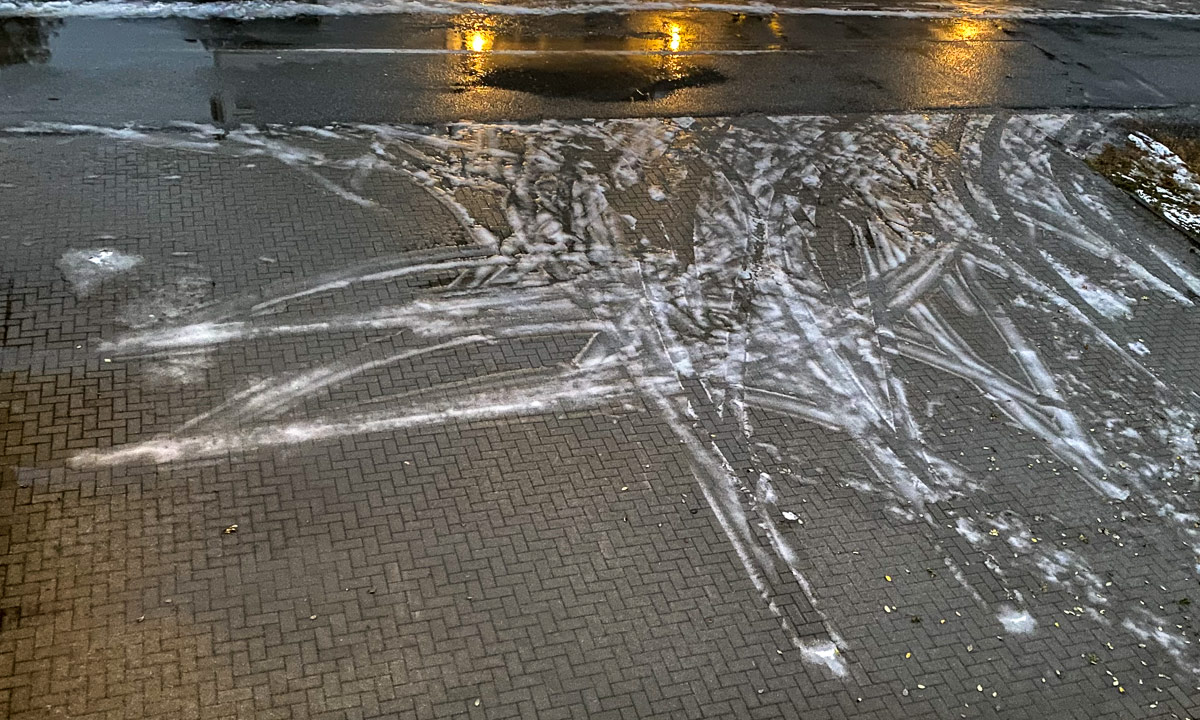
By the sea only a bit of wet snow and sleet covered the ground but already 50 meter higher the gravel path was covered with 10 cm of snow. Deep tyre tracks were carved in the snow. This part of the tour was very easy. Just follow the road up until you reach the radio unit on the Tønsnesvarden (281 m) and try not to slip, because under the snow there are some icy patches.

This summit has a big radio station on its top. Even in the increasing snow fall is was quite visible. Now I walked through 20 cm of snow. After an hour I arrived at the radio station, where I met the creator of the deep tyre tracks: A six-wheeled ATV.

It wasn’t cold but a windy. It snowed more and more and the wet snow glued itself to my jacket. On my way back I left the main road and followed a small path on my digital map on my iPhone. I stopped in a forest of birches with thin and long stems. I loved the motive, but my Nikon camera gave up in this wet weather. The lens was fogged up in the inside and in the dense and wet snowfall I didn’t dare to change lens. One photo worked out ok anyhow:

Soon I realised that some of the paths drawn on the map did not exist in reality (at least not in winter) while others that exist were not part of the map. So I went cross-county through pathless terrain, partly dens forest, partly wetlands with many small streams to cross. It took only 15 minutes until I reached the other gravel road leading down again. Now the iPhone was in charge for making pictures.

I followed the path down. With each metre altitude I lost there was less snow on the ground and the snow fall became more and more sleet. When I arrived at my car my anorak was soaking wet. Having seat warmers in a car is a great feature after such a tour.

For the records: 6.5 km, round 300 metres in altitude. Temperature round 0°C.

Appendix 1:

When I show pictures of mountain tours and hilly hikes it is easy to forgot, that Norway has not only mountains but the sea, too. This is an iPhone snapshot I took from some metres from my parked car. What you cannot see is the mountains of the island Kvaløya, 3.8 km away. They are hidden in the snow clouds.

Appendix 2:

What do you do with photos taken with a fogged up lens? You start to experiment. I mean, the photo is spoiled anyhow. But the result of today’s experimentation turned out nice in my opinion.

Saskarö in the fog

From Monday and Thursday Annika and I made a trip that I had in mind for a longer while. Travelling round the Bothnian Bay which is the northernmost part of the Baltic Sea. The first days we travelled by car along the sea. The last hours we travelled by ship from Vaasa in Finland to Holmsund in Sweden. From there it’s only a 12½ additional km to our house in Obbola where we live.

On our way to Haparanda we made a detour to Seskarö, an island that is connected to the mainland by several bridges. As the whole day (and half our journey) it was quite foggy.

Especially by the shores there was not much to see. A near island, a bit of ice, some rocks and and a white sea merging seamlessly into the white sky.

Aurora hunting – failing and cheating

It’s always the same: when you wake up in the night and see the polar lights illuminating the sky it doesn’t mean, that you can take good pictures of them. In the time you need to dress, take camera and tripod and walk outside to a nice place it’s likely that they disappear again. Polar lights are shy fellows.

Last night it was the same: I saw a nice aurora from my sleeping room. But when I arrived at the bay Telegrafbukta no distinct aurora was visible anymore.

Anyhow the sky looked a bit pale. Clouds or polar lights? Let’s take a handheld photo with a long exposure. Cl… …ick.

Yes. The sky is definitely green. I set up the tripod, configure the camera and wait.

…

Nothing happens.

So I start taking a long expose shot of the sea, the mountains and the lights of Kvaløysletta.

And you can see the polar lights, at least a bit. No surprise because I exposed the photo for 30 seconds with ISO 560 and an exposure of ƒ/3.2. That puts enough light onto the sensor to catch even faint polar lights that are hardly visible to the naked eye. So this is not really an aurora photo, it’s more cheating.

Before I went back to my bed I wanted to take at least one photo with some kind of a motive. It became a shed nearby, illuminated by the moon and again with a faint polar light in the background.

Today I have to go to bed early, I have to catch up on sleep.

A short tour to Sørtinden

I have to admit that my motivation to go out was low this Saturday where it was grey weather with a slight drizzle that made everything damp. So this time I chose a shorter tour for my project #onceaweek.

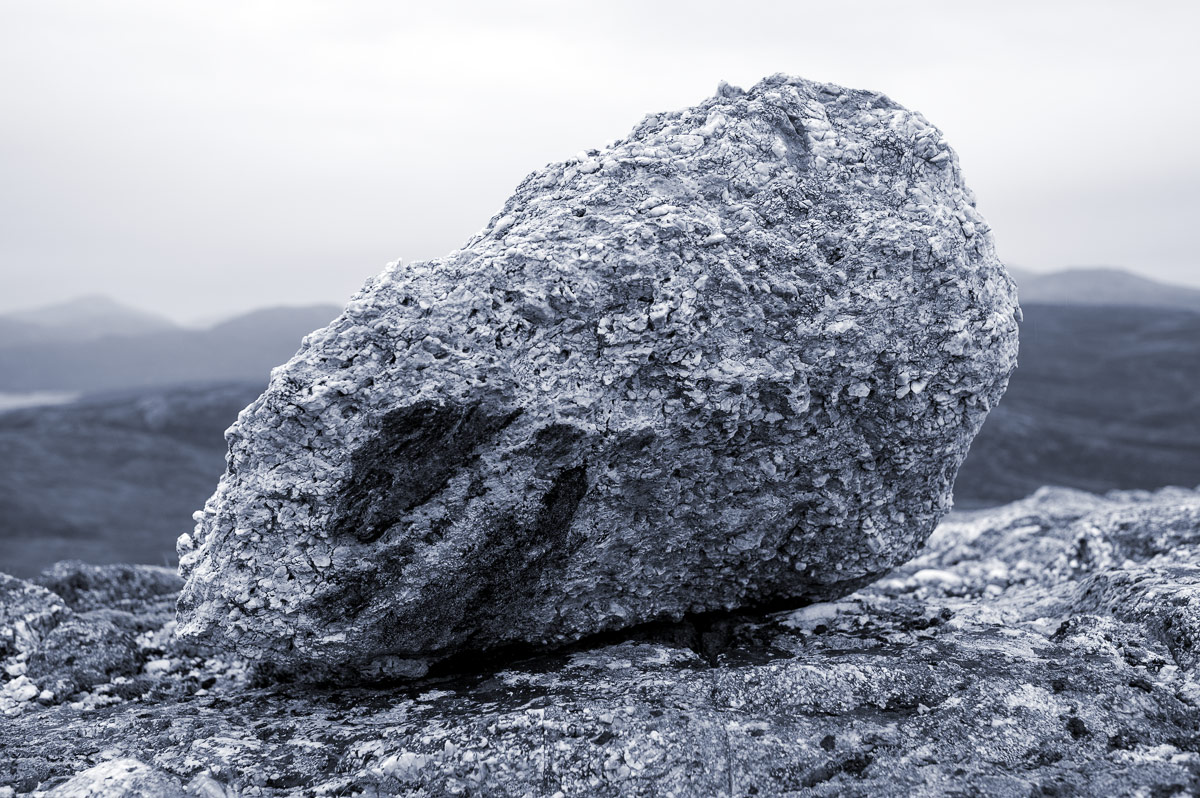
And since the light was so dull that the autumnal colours looked pale and grey it was simple to choose a photo project: Only black and white and only rocks.

The first polar light of the season

This article is part of the series “2021-07: Back in Tromsø”.

Is the polar light shy? It was quite bright, when I peeked out of the window of my tiny room in Tromsø. It got pale when I took pictures at the bay Telegrafbukta. And it got really bright after that while I was returning home because clouds had been gathering.

Anyhow, it’s the first polar light of the season 2021/22 and therefore worth photographing.

There was another light at least as fascinating as the polar light. Plankton that was washed ashore. This plankton was bioluminescent and glowed blue-turquoise. I have a real ugly photo for the records. When this a common phenomenon I’ll try to take better photos some other time.

Two photos from a mountain tour

This article is part of the series “2021-07: Back in Tromsø”.

Two quite different photos from a mountain tour in the Tverrfjellet on Kvaløya. In opposite to the forecast the weather was very cloudy.

Photo 1 – telephoto lens, 125 mm · developed in black and white with a light shade of blue.

Photo 2 – fish eye · developed with increased color saturation.

… and when I was halfway down the sun came out and half an hour later the whole sky was blue. My knees however disagreed in the idea of hiking 500 metres up again.


Gratulerer med dagen from abroad

Today is syttende mai (17th of May), the Norwegian national day. On 17 May 1814 the The Constitution of Norway that declared Norway to be an independent kingdom was signed. That’s why Norway turns 207 years today. Gratulerer med dagen – Happy birthday!

The first time that I was in Norway was the turn of the year 2003/04 together with a friend. Although the weather was really miserable – storm and rain – I was so fascinated by that country, that I travelled there one month later again to find a job as a developer.

Well, I didn’t find a job. I couldn’t speak Norwegian, didn’t have much programming experience and the dot-com bubble was still present.

2005, one and a half year later I visited Tromsø for the first time of my life after a week of hiking on the Hardangervidda. I had less than two days to discover this town but since then it has been my favourite town in Scandinavia.

Anyhow I didn’t think about moving there. The same year I had been in Northern Sweden twice and preferred the colder winters there. In addition to that I was a bit scared of mørketiden – the seven weeks in winter, where the sun stays below the horizon. Five years later I moved to Sweden.

This year however I was sure that I will be in Norway for syttende mai, since I’ve been working in Tromsø since last October.

Well, at least on the papers. Due to Covid 19 we were strongly advised to work from home, which I can better in our house in Obbola/Sweden than in my tiny room in Tromsø. On 22 November 2020 I took the plane to Oslo, another one to Stockholm and a third to Umeå. Since then I’ve been working and living home in Obbola. In five days I’ll have been here for half a year.

It feels a bit like a dream. Did I really work in the office of the Norsk Polarinstitutt in Tromsø? Together with others? Walked the 1.7 km from my shared flat? Enjoyed the first snow in the mountains? Took a kayak course?

Only when I miss my down sleeping bag (in Tromsø), my macro lens (in Tromsø), my rain parka (in Tromsø) I realise that I still have my flat there. And of course when I have to pay the monthly rent. And that’s a lot because it is ridiculously expensive to live there.

At time I’m forbidden to travel to Norway even though I have a job and a shared flat there. It’s unclear when I’ll be allowed there again. Until then I have the blog articles as memory of my two months in Tromsø to remember, the knowledge that I’ll be there again but most of all a wonderful time home.