A starry night

Today evening I met with my colleague Marika. We took the car to a road on the mainland looking for a dark place to spot the comet C/2022 E3. And we did, although it was only a weak, soft spot high up in the sky. I was much too impatient to take photos. I know that my equipment is not made for astrophotography.

But I was glad to be outside under the stars, watching the moonlit snowy mountains and the frost covered trees that glittered brightly when a car passed. With -15 °C it was surprisingly cold, almost ten degree colder than in town.

Of course I did take some other photos, just from the surroundings.

Now I hope for more starry nights.

Aurora Lightshow in Tromsø

Hooray – finally the polar light and I were awake the same time!

It’s not the first polar light this season. But either there were clouds or it vanished when I was at the bay Telegrafbukta for taking pictures or I just slept. Today however I was lucky and was at the right place at the right time.


Kayaking into the dark

It seems, that summer is over. It’s less a matter of temperature but light. Next night will be autumnal equinox and today’s sunset was already at 18:47. Tromsø has almost the same longitude as Budapest.

Anyhow the Thursday paddling of Tromsø Havpadelklubb – the Tromsø sea kayak association – still hold place today. Next week will be the last time for this season. Today we had perfect conditions: No waves, no wind and 10 °C. We had many a summer day worse than that here in Tromsø

May I present, that is D5. It’s one of the many rental kayaks of the association and my standard choice. My own kayak is in Sweden.

Today we were 15 people heading to the island Grindøya on the other side of the sound between Tromsøya and Kvaløya. OK, let’s start …

First we paddled along the coast, then we started crossing the sound. From the boat houses to Grindøya it is round about 4 km.

This time we did not paddle round the island like in June or two weeks ago. Instead we headed for a beach at the northern tip and made a break there. I had a piece of soft chocolate cake with cashew nuts, a welcome leftover of the three day data management workshop that I joined this week. And while we stood or sat there it started getting dark.

Some of my fellow paddlers already had switched on their lights on the way to Grindøya, now we all illuminated our kayaks and ourself. It’s less about seeing but about being seen. There is commercial shipping on the sound. We prepared our kayaks and departed.

While we paddled back it got darker and darker. It’s really a special experience to paddle through the dark in a group. You hear the drone of the city, occasionally interrupted by an airplane or a motorcycle. But that’s far away. Our own sounds are near: soft conversation and the little noises of the paddle entering and leaving the surface of the sea. And since you see less and less, hearing becomes more and more present. And anyhow I tried to paddle as silent as possible not to disturb the quietness.

When we arrived at the boat houses of Tromsø Havpadelklubb it had become dark. The tour lasted only an hour and a half plus a half hour break. But the peaceful sound of kayaking calmly through the darkness lingers still in my ears.


Jämtland tour 22 – the glacier of Helagsfjället

This article is part of the series “2022-08: Jämtland and Trøndelag”.

It is 23 August, day 9 of our hiking tour through the mountains of Jämtland. Today we take another day off and I decide to try to reach the glacier of the mountain Helagsfjället. I don’t know how near I can get but I’ll see.

This glacier is the Sweden’s southernmost and parts of it are visible from the Helags fjällstation. You can even see the mark of the top (1797 m) which is round 750 metres higher than the cabins.

On my way up I meet three men heading for the top. I hear that it is easy to climb, even for children. Other hikers will confirm that later. Well, perhaps I’ll do that another time but today I want to touch the glacier.

I walk first up on across county, reach the main trail and follow it for a while. Then I turn right to follow a smaller path heading to the glacier. I reach a field with large rocks and boulders. Carefully I follow the cairns that mark a path until I stand in front of the first glacier tongue.

Time for a selfie!

I spot another glacier tongue. For coming there I have to climb over a rock outcrop. Mountaineers will laugh that I call it climbing but I’m more a hiker than a climber and as soon as I have to use both hands I call it climbing. The effort was rewarded. What an impressive view on the glacier!

I stand still for a while. First of all it is beautiful weather and then it is fascinating just to see the colours of the glacier changing while shady clouds pass by. And then I move again to take more pictures. And I drink some water and eat a bit of chocolate.

How long I stand there? I cannot say. I start my way back. My first view is on the radio station on the mountain Jalkedsåajja. This is where my sister and brother-in-law are today. But it is too far to spot if they are there right now.

While walking back I come to the small glacial lake that I already passed on my way up. Some people had written their names using stones. Wait – some people!? Only now I do realise that the whole area is covered with messages arranged by stones. An ancient social media stream – though without cat videos.

The whole tour took only three hours, with a lot of photographing and taking rests. If you plan to visit Helags you definitely should consider to give the glacier a visit. I keep my fingers crossed that you get nice weather, too.

Polar expedition AeN JC3 – day 9: P5, the first ice station

This article is part of the series “2022-02: Winter cruise KPH”.

Day 9 · 27 February 2022

Yesterday we have arrived at P5, our first ice station. In the night the ship left the ice for some plankton nets and trawl. Today morning it carefully moves back to the chosen ice floe. After breakfast the activities on the ice will start. A station with a tent quite near the ship, another one some hundred metres away and A. and B. who do transects of ice and snow depths will wander around somewhere. (A transect is a path along which a series of measurements of the same type is performed.)

A lot of people will be on the ice but not me. The meeting of the previous evening revealed that I will not the enter it today and my status for the next day (tomorrow) is “additional”. Although I understood that the cruise leader did not want to send all people directly onto the ice – especially since it is not very thick – I was disappointed.

After the meeting I tried to ask the cruise leader for the reasons but I communicated quite demanding and stressed her unnecessarily. Today I apologised to her. Even while I write this article I am ashamed for my behaviour. That was not my best hour.

Today I will be involved in the ice station anyhow, but from the ship.

Polar bear watch

Here in the northern part of the Barents Sea we are in the habitat of ursus maritimus – the polar bear. These animal are threatened and need our protection. At the same time they are dangerous and we have to protect ourselves. So the most important thing – both for humans and polar bears – is to avoid encounters on the ice.

That’s where the polar bear watches come in.

Before anyone may enter the ice already three polar bear watches stand on the bridge on deck 8. Each watch has a segment of ca. 150° to watch so that the segments overlap. Than the polar bear watch will have a single task for one hour: constantly watching the segment – with and without binoculars. As soon as a polar bear watch discovers a polar bear on the ice he/she uses the handheld VHF, a two way radio to make a radio call, for example “Polar bear at 10 o’clock, 1000 metres, moving to the ship”. All team leaders and ice bear guards and the cruise leader have a VHF as well and can discuss plans that mostly will result in leaving the ice.

Today I will have three polar watches. 9:30, 12:30, 14:30 +2h. Since I know that this task is very important I am quite nervous while I walk up the staircase to the bridge.

At least the windows that still were salt-encrusted from the storm two nights ago are cleaned. Good for the visibility.

The VHFs are also used to sign in and out people on the ice. As soon as someone enters it a call is emitted: “Bridge, bridge, this is A. B and C on the ice”. The same procedure when people are back on the ship. The person in charge is also on the bridge and will move magnets on a chart to keep track. A bit like a non-magic version of the Weasley Clock in Harry Potter. (Thanks Annika for this metaphor!)

At 9:30 I start my first watch at the port side of the ship. It is a good beginner place because it is farthest away from the ice stations. For one hour I constantly scan the ice from the open water at the stern to the ice at the bow. Sometimes I use the binocular and scan the horizon, sometimes I use my naked eyes to get a better overview. Sometimes I look down to the ship. Some of the ice floes look like polar bears but first they do not move (and soon I know them by heart) and then polar bears are not of this cold blueish white but more a yellowish, creamy colour.

These photos I made after my watch. My job is to watch the ice, not to take selfies for this blog or mobile photos through my binoculars. Yes, I use my own, because I love them more than those on the bridge. I realise that I own these binoculars for almost 40 years. The oldest piece of equipment I brought on this polar cruise.

The biggest challenge: Do not think! Don’t follow your thoughts. Because then you may still look through the binoculars but without paying attention. The 59th minute you do the same as in the 1st minute. Watch the ice. Watch the ice. And again, watch the ice!

So that’s my day. Watch the ice. Take a nap. Eat lunch. Watch the ice. Relax. Watch the ice. Fight tiredness. Eat dinner. Until …

MSS casts on the sea ice

… the cruise leader comes to my chair while I am eating fish, potato gratin and beetroot. She asks me if I was ready to go on the ice at seven. Tomorrow? No, today. What? I mean, of course! I shall follow Z. who will do three MSS casts to measure CTD (conductivity, temperature, depth) and turbulence in an ice hole. I shall dress very warmly. The first opportunity to be on the ice and see how this measuring works. Wow!

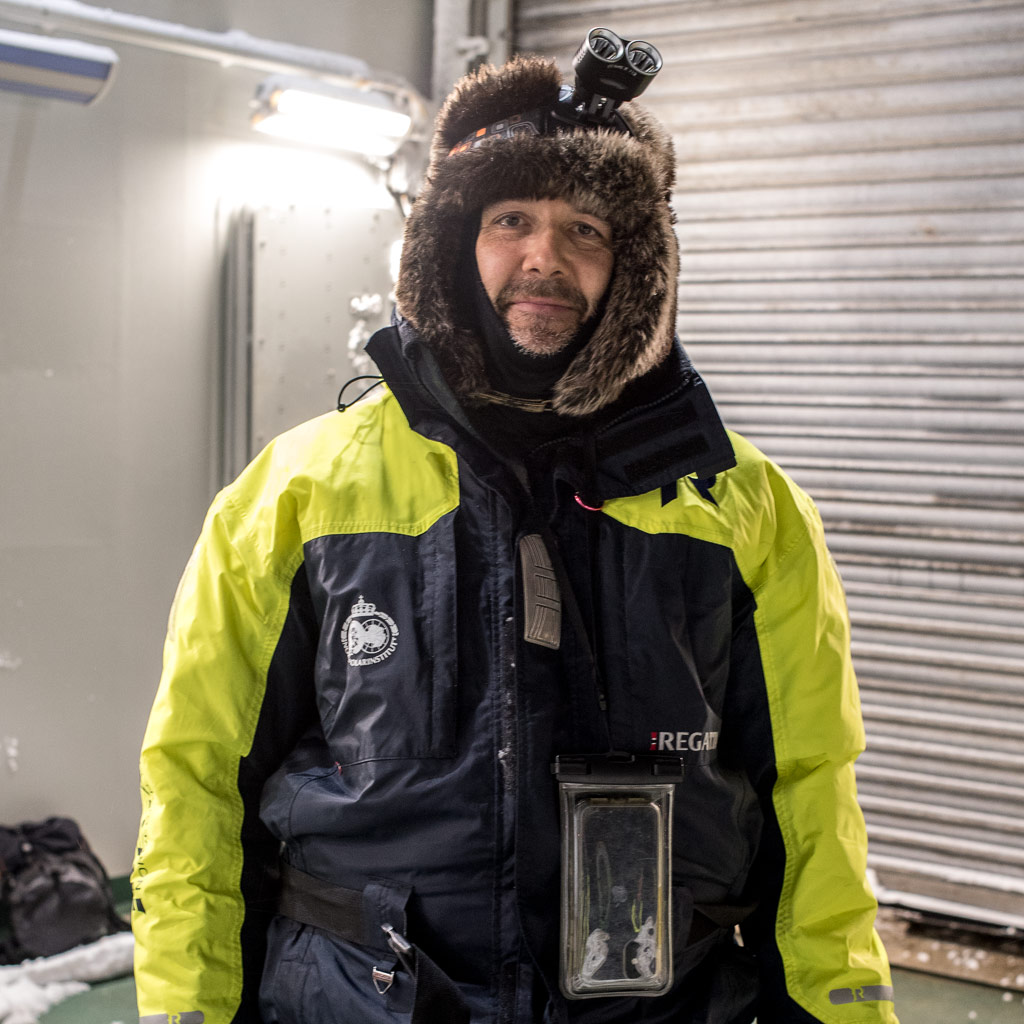
At 19:00 I stand outside on the deck waiting for the others. I have to stand outside because I’m dressed in two layers of wool and this non-breathing Regatta suit and I already started sweating while changing clothes.

Half an hour later the snowmobile has left me at the green tent. Officially I only got 30 seconds for taking photos – every extra minute will extend the observation time of the three polar watches – but since Z. has to do some preparations I have some minutes to take snapshots in the dark. And to feel very happy.

Then it’s my turn to help. While letting down the MSS needs some experience pulling up is just some mechanical work. Z. did the first one, I do the two others. Z. observes the computer display and signals me when I shall slow down. All I have to do is winding up. Easy work and time for a chat.

After the three measurements Z. is content and calls K. to fetch us with the snowmobile.

This activity from ship to sea ice and back to ship took less than an hour but I will never forget it. Standing in the dark on the ice of the Barents Sea on a place nearer to the North Pole than to my work town Tromsø is just impressive and I feel that I have a strong relation to it.

Next time however I will dress less warmly. It was only -15 °C outside and I had too much clothes on. Alone the Regatta suit is warm and the tent was heated to protect the sensitive electronics.

And you? If you had such an opportunity would you take it or do you prefer warmer locations?

And to those of you who have such an opportunity for me: contact me asap.

Internet is back!

This article is part of the series “2022-02: Winter cruise KPH”.

Hello, dear blog readers!

After twelve days without the internet came back today though slow. So I’m kind of online again.

I do not even try to summarise all the extraordinary experiences I was able to make the last two weeks. I just say it was a lot! And it was awesome!

So today I just say hei and that I feel excellent! More from this scientific polar cruise with Arven etter Nansen I will tell when I’m back in Tromsø in some days.

For the stats: 3319 photos taken, 3473 lines of diary written. It will take a bit of time to sort and recap.

Stay tuned.

I couldn’t sleep

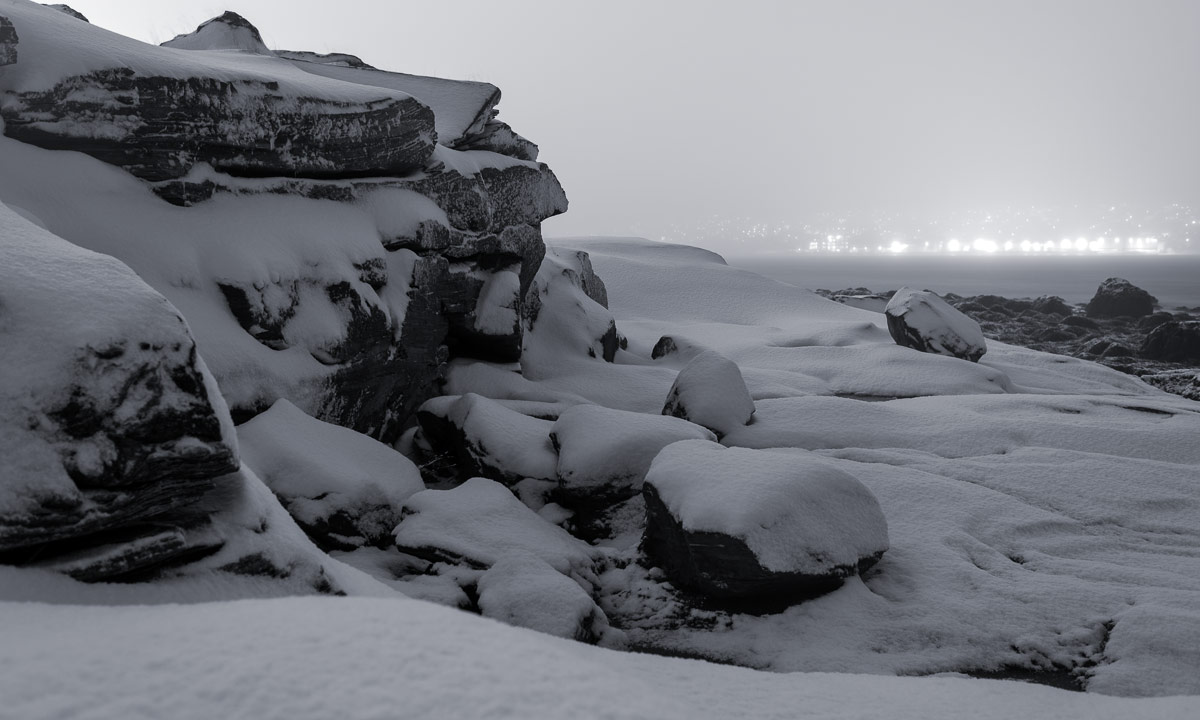
I couldn’t sleep. Not at all! At 1:30 I gave up and went out for a walk. And took some photos. Black and white. By the coast. Snow showers.

Now I try to catch some sleep. Good night!

____

Not I see, that the 2nd JPEG has quite strong colour artefacts. I may correct that. Later.

A winter journey from home to work

Last Saturday I travelled to work. ObbolaTromsø, that’s round 1000 km – the reason why I do not commute weekly.  This time it is a bit suspenseful, because there are two obstacles on my way.

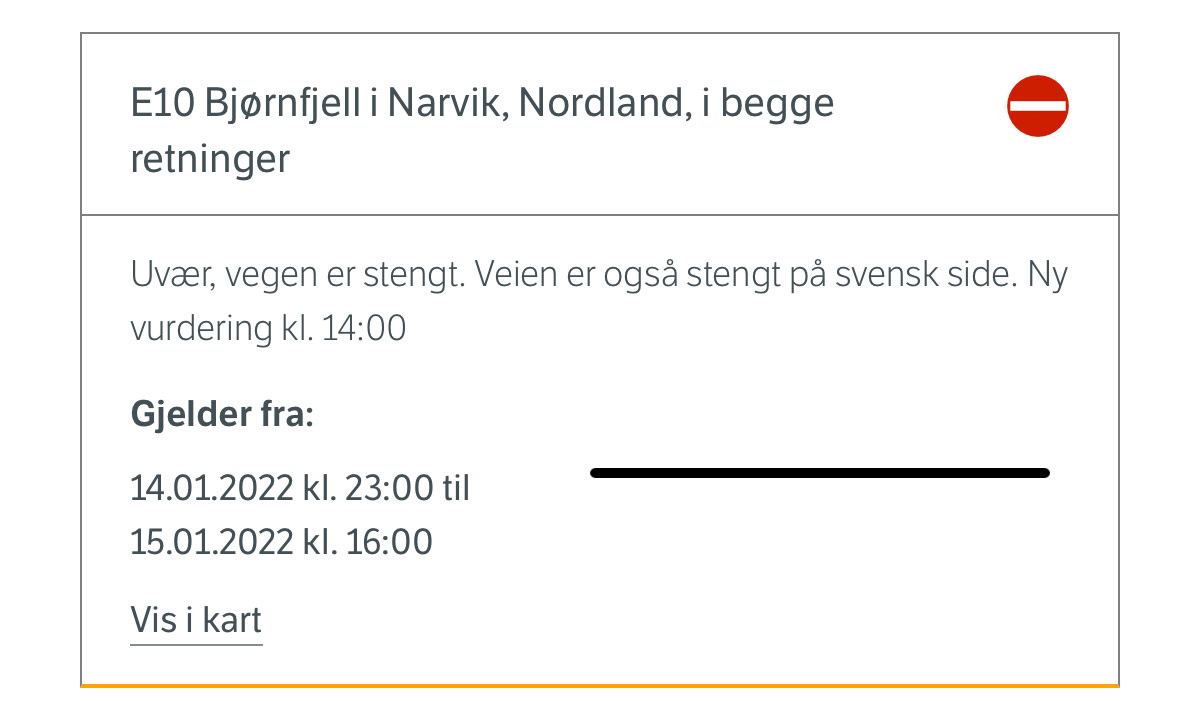
One obstacle is easy: taking a covid test at the test center. The other is much bigger: The road over the Bjørnfjell – the only road – has been closed for many hours due to stow storm conditions. Well, I start my journey anyhow. We’ll see.

At 5:30 in the morning Annika takes me to the train station in Umeå. The first 9½ hours were just a “normal” train journey beside of the train being mostly ahead of time. One change in Boden – nothing special, just long and a bit boring.

I leave the train in Abisko Turiststation where I parked my car. My car – will I find it or is it submerged under a pile of snow? To my relief hardly any snow covers my car. I already hoped so, because Abisko is known for its low precipitation because mountains in the west protect it from bad weather. Much more snow and rain fall on the other side of the mountain range and that’s exactly where I have to go through. Some minutes after leaving Abisko behind it starts snowing. Snowfall increased more and more but isn’t severe and the Swedish mountain road is open. Soon I cross the Norwegian border and …

… have to stop because of a lowered tollgate with a red blinking light. Beside of two trucks I am alone. I am relaxed because I know that the road has been opened for driving in convoy one hour ago (thanks internet!). I just have to wait for the large snowplough to fetch us.

After twenty minutes the tollgate went up and the red light goes out. That’s all that happens. I hesitate. And now? Do I have to wait? Or may I drive? I don’t dare and ask one of the Norwegian truck drivers. He answers I should just go ahead and so I do. The drive is snowy but not bad and soon I arrive at Bjørnfjell brøytestasjonen where the snowploughs are located and now also the Covid19 registration. I register myself, get a covid test and start taking photos while waiting for the result.

I take an image of a snowed in car. The snow plough driver goes to me and asks for what purposes I take photos. “Just for my blog.” “Ah ok, just curious.” Good to talk to him, because so I learn that beside of the mountain passage behind Bjerkvik road conditions are good. Here they got a lot of snow the last 24 hours and one of the cars looks like this:

After round 20 minutes I get a ping ♪. It’s an SMS with a link to my test result. Negative :-). 260 km to go, that’s four hours when conditions were good.

The first 100 km the road conditions are good and weather is ok. The next photo shows how driving looks like.

The next hour it snows a lot. Sight is still good. To my left and right everything is covered with snow, from the largest church to the smallest branch of a tree. Winter wonderland.

Then it starts to get nasty. Snowfall intensifies more and more and the snow has the consistence of superglue. My windscreen wipers hardly manage to push away the gluey snow and finally I have to turn into a side road and de-ice the wipers. Scratch, scratch … . I’m not alone. In front of me a car with a driver doing the same. Behind me another car stops. Am I in the way? No, just another scratch, scratch. On the other side of the side road another one.

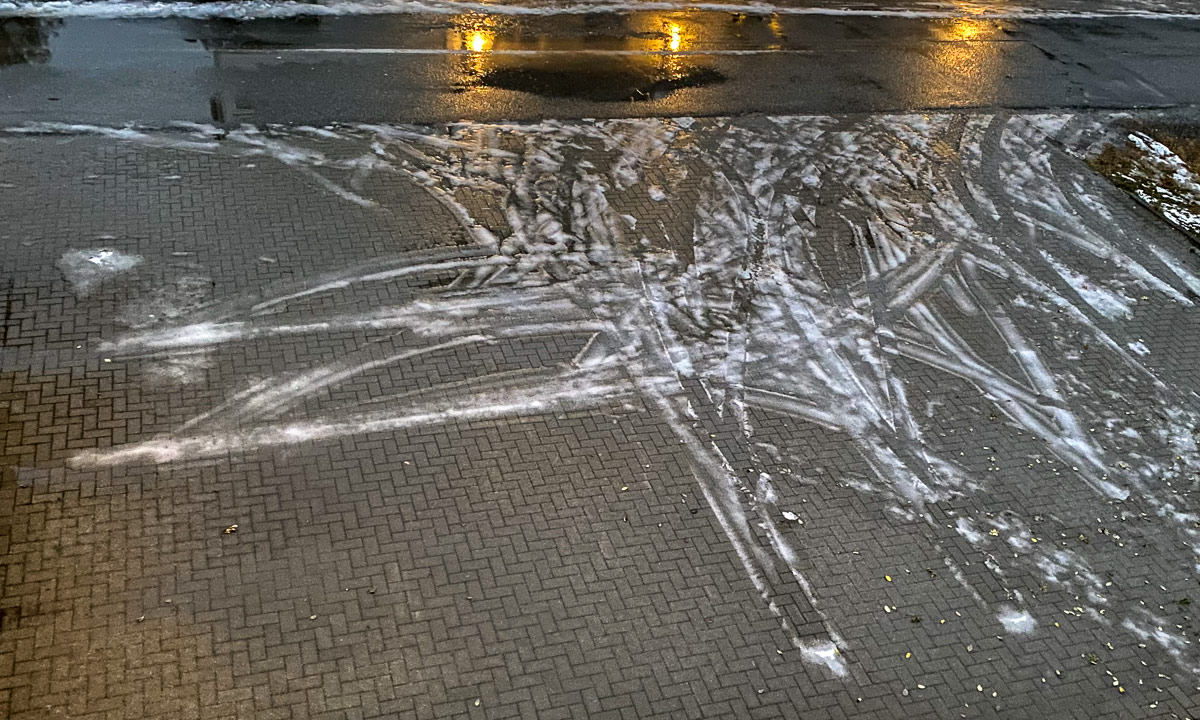
I still have some holes to peek through but it is extremely tiring to drive car through the night like that. Alas, after two hours I drive over the large concrete bridge Tromsøbrua and am on the island Tromsøya. Apparently Tromsø’s snow removal has given up. The minor roads are covered with 20 cm of snow with deep tyre tracks. I understand more and more why most Norwegians have cars with all-wheel drive (and so have I).

22:45. I make a last stop at the supermarket nearby that is open until 23:00. I’m lucky because Norwegian supermarkets close on Sundays. By the way: the supermarket’s parking place is in much better condition than the roads.

One other minute driving and I arrive at my flat in Tromsø after 17½ hours travelling. I’m tired but it takes another hour until I’m relaxed enough to sleep. Next week I’ll walk …

When a boat take photos

One month ago I joined two whale watching boat tours to the sea round Skjervøy, one on 21 November, one on 27 November. Most of the time I was outside on deck to take photos.

Days were short and it became darker and darker soon. There are some options what you can do on a moving boat if you want to take photos but light is low. One of them is to use high ISO values. Depending on your camera this can result in a photo with a lot of noise.

Another one is to take your tripod with you and integrate the boats movements while taking photos with a long exposure. That’s what I did on the return passage of these boat trips. The exposure times of these photos lie between 10 and 13 seconds.

Two movements are caught in these photos. The large ones are created by the rolling and pitching of the boat. The small ones are caused by the vibrations of the motor.

While I mostly focussed on taking pictures to the side I almost skipped an interesting motive: the stern wave of the boat.

Some tips:

  • Use a telephoto lens. It will magnify the movements of the lights.
  • In wintertime take your warmest clothes with you. It can be colder on the boat than you might expect.
  • Avoid the bow of the ship when waves get higher to avoid your camera equipment and yourself being soaked by breaking waves.

Here is a set of images I made on two Hurtigruten journeys some years before. You see less vibration, since the Hurtigruten ships are much larger.

To the photo series “bevegelse” >

Tønsnesvarden

On Tuesday we got some snow in Tromsø. On Wednesday it already has melted away. But last night a bit of snow arrived.

Today I chose a shorter tour from my book “På tur in Tromsø” (On tour in Tromsø) because I just wanted an easy hike, not a full-grown mountain tour. The weather agreed with me.

By the sea only a bit of wet snow and sleet covered the ground but already 50 meter higher the gravel path was covered with 10 cm of snow. Deep tyre tracks were carved in the snow. This part of the tour was very easy. Just follow the road up until you reach the radio unit on the Tønsnesvarden (281 m) and try not to slip, because under the snow there are some icy patches.

This summit has a big radio station on its top. Even in the increasing snow fall is was quite visible. Now I walked through 20 cm of snow. After an hour I arrived at the radio station, where I met the creator of the deep tyre tracks: A six-wheeled ATV.

It wasn’t cold but a windy. It snowed more and more and the wet snow glued itself to my jacket. On my way back I left the main road and followed a small path on my digital map on my iPhone. I stopped in a forest of birches with thin and long stems. I loved the motive, but my Nikon camera gave up in this wet weather. The lens was fogged up in the inside and in the dense and wet snowfall I didn’t dare to change lens. One photo worked out ok anyhow:

Soon I realised that some of the paths drawn on the map did not exist in reality (at least not in winter) while others that exist were not part of the map. So I went cross-county through pathless terrain, partly dens forest, partly wetlands with many small streams to cross. It took only 15 minutes until I reached the other gravel road leading down again. Now the iPhone was in charge for making pictures.

I followed the path down. With each metre altitude I lost there was less snow on the ground and the snow fall became more and more sleet. When I arrived at my car my anorak was soaking wet. Having seat warmers in a car is a great feature after such a tour.

For the records: 6.5 km, round 300 metres in altitude. Temperature round 0°C.

Appendix 1:

When I show pictures of mountain tours and hilly hikes it is easy to forgot, that Norway has not only mountains but the sea, too. This is an iPhone snapshot I took from some metres from my parked car. What you cannot see is the mountains of the island Kvaløya, 3.8 km away. They are hidden in the snow clouds.

Appendix 2:

What do you do with photos taken with a fogged up lens? You start to experiment. I mean, the photo is spoiled anyhow. But the result of today’s experimentation turned out nice in my opinion.