Break at work I – island hopping

The Baltic Sea at Obbola has hardly a tidal range. When we get high water or low water it’s mostly due to the wind. Today we had gusty wind from north that let the air temperature of -12 °C feel much colder and to a sea water level of 70 cm below normal, that’s really rare.

Today I took a break at work to enjoy my beloved winter weather. Today’s plan: island hopping to Lillskär, a skerry less than 250 metres away.

Along the small bay I walked to the sea. A lot of rocks that normally are underwater were visible now, some of them wore rings of ice.

The skerry was even nearer than usual when I took this photo because I already stood on the ice. You see parts of the skerry in the right.

I had a decision to make: Shall I try to cross the ice or just wade through the icy water? I decided to wade, because you can get bruises when you go through the ice, even in my thick neoprene survival overall.

So I waded through the water which was less than hip deep. On the islet I had to wade through some thigh deep snow drifts, then I arrived at the outer shore of the islet.

Oh, I love winter when it’s a bit rough and I enjoyed being out. But not for long. Soon I went more or less the same way back …

… and home. After I had changed clothes I had five more minutes until the 10 o’clock meeting. Good timing.


And suddenly it’s winter

Last Tuesday it got sunny and I paddled kayak.  On Wednesday it got cold and the small sound between island Lillskär and mainland was covered with ice.

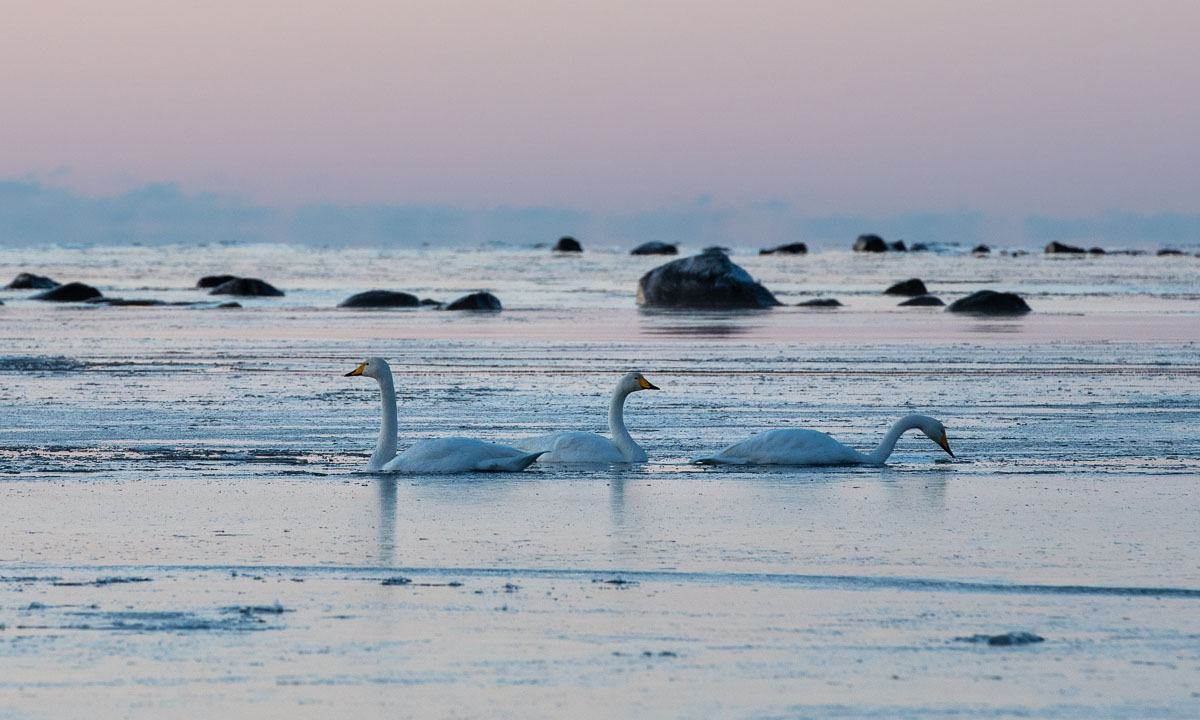
Although it’s mid-December and despite temperatures between -10 °C and -14 °C there were still whooper swans around. Don’t they migrate south? In the morning they managed to paddle through last night’s fresh and thin sea ice. In the afternoon the swans had left. Perhaps they finally decided to fly south.

On Thursday it snowed. In the afternoon 10 cm of fresh snow had fallen and everything was white and bright, even in the night.

On Friday Annika and I had a day off and visited friends in for a long weekend. They live in Kusfors in the inland, round 180 km north. On the way there and there we found more winter. It was not very cold but it snowed quite a lot. I took some images from the car while Annika was driving.

Yesterday on Sunday we came back to our house in Obbola round 20:00. Our property was covered with 45 of fresh snow. Since it had been sub-zero all the days the snow was pretty fluffy. We had to do quite a bit of snow shovelling – but after taking a photo.

Today it’s Monday and a new working week has begun. I had a lot of meetings today and therefore no time to paddle kayak. Oh yes, the kayaks … where are they? I know they lie beside the wooden terrace. Here they are, well hidden under a thick blanket of snow, right beside the window of the winter garden.

But there are other things to do as well. For example opening the afterwork ski season in Olles Spår near Umeå together with Annika. The snow is still soft and the cross-country skiing trail still slow but the first time of skiing is always special and we are happy and grateful that we live in a place where winter is around us.

Now it’s half past nine in the evening and I’m blogging. Snow is falling and the thermometer shows -9.5 °C, the same temperature as the last hours.

And you? What kind of winter do you like? Or do you prefer other seasons?

Finally it’s sunny again home in Sweden!

After a period of dull and cloudy weather that felt like ages the sun finally came out yesterday. Since I was flexible with working hours in the  morning I could make a small kayak tour.

The first part was easy. Since our house in Obbola is on the coast I only had to change my clothes and drag the kayak from the house to the bay. The bay was covered with ice. As usual I just sat in my kayak and started pushing myself ahead using ice claws. This works surprisingly well until you have a lot of water on the ice as I had yesterday. Although I wore neoprene gloves I got cold fingers. As usual this took some time but finally I reached open water.

It was then that I realised that I had forgot my paddle. Fortunately the bay is shallow and I could leave the kayak, step on the ice and carefully walk back to land to fetch the paddle. Some minutes later I sat in my kayak again ready to circle the island Bredskär. I watched the hooting whooper swans and even four flying goldeneyes, a species of ducks. At the northwestern tip of the island there was a small, slushy ice field, the rest was open water. The big freezing hadn’t started yet. When I reached the eastern side of the island I could watch the sunrise some minutes after 9 o’clock.

The last part of the otherwise calm tour was surprisingly wavy. When one breaking wave came out of nothing and of course directly from the side I was afraid that I could capsize but the wave just lifted me gently up half a metre and down again. I was lucky. Sometimes it’s nice to own a less agile but super stable boat.

Even it was only some degrees minus the kayak was covered with a layer of frost that glittered in the warm light of the sun. I just had to take another photo when I was back on land.

And then? After taking a hot shower I made it to the 10 o’clock meeting. In time!

From Tromsø to Obbola

Friday, 18 November – walking back from work

It’s weekend. Today I stopped working already at 14:15. Sunset was 40 minutes ago and the light is beautiful while I’m walking home.

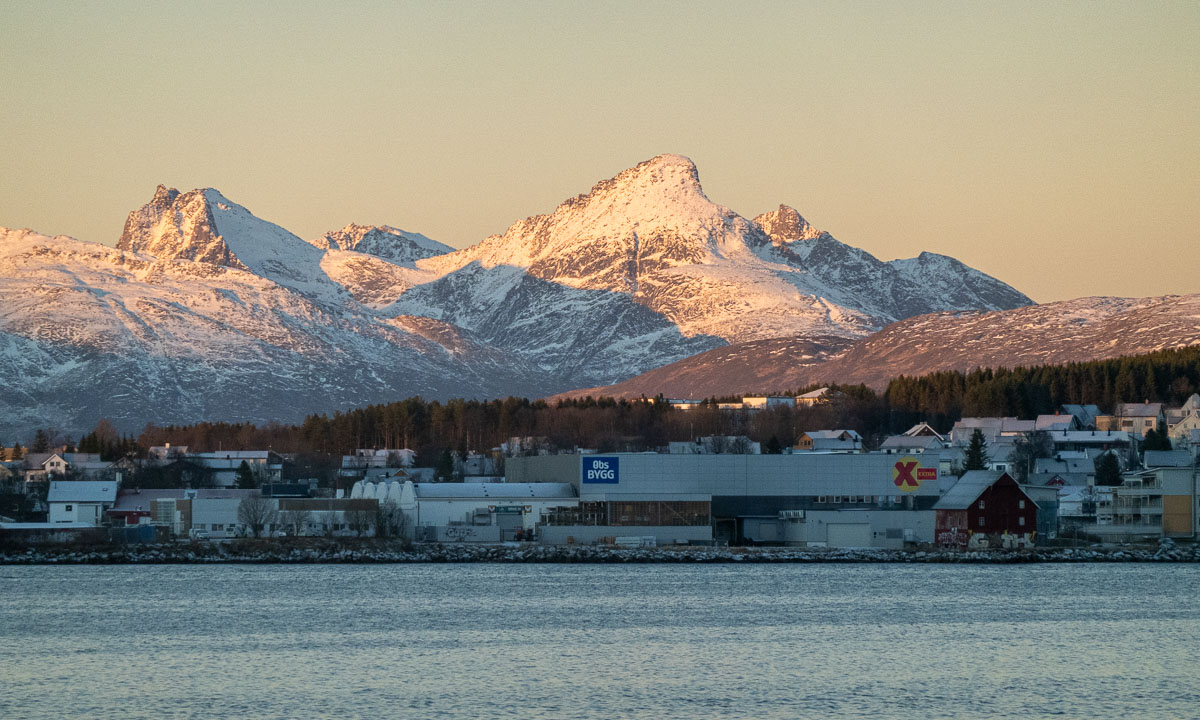
In Tromsø there’s hardly any snow, but a lot of rime. In the evening there’s polar light, but I only take a smartphone snapshot – tomorrow is a long day.

Saturday, 19 November – taking the bus to Narvik

Today is travel day. Round 16–17 hours it will take me from home to home.

Yes, I have two homes. One “work home” in Tromsø where I work and one “Home home” in Obbola where my wife Annika and I have a house by the Baltic Sea.

The weather is gorgeous and I take many photos through the window of the bus. Therefore some of the motives are blurred. The last one – the large bridge Hålogalandsbron is jittery because it has become dusky.

Saturday, 19 November – taking the train to Umeå

It’s a long ride from Narvik to Umeå. Departure 15:10, arrival 1:40 in the night. But it is a though train. I don’t have anything more to do but being awake on the arrival in Umeå. While I eat my take-away sushi outside of the train station it gets dark and so there is not much to see from the landscape in the train unless it stops.

In the frosty inland where it is quite cold I witness a special phenomenon. The whole forest we are passing is lit in green light. Another aurora? No, it’s cloudy. There are passages where the power lines for the train are coated with rime ice. The layer is so thick, that the current collector of the train looses contact and the electricity jumps over emitting bright green light that illuminates the dark forest.

The train arrives in Umeå in time and Annika already waits at the station. Another half an hour and I’m home home. Bed is waiting!

Sunday, 20 November – winter feelings

Oh, what a blessing it is to be home home. Normally we are supposed to work at the offices of the Norwegian Polar Institute but my boss knows about our long-distance relationship (or is it called long-distance marriage?) and allowed me to do home office until Christmas. Tusen takk! And it is even wintry and a bit sunny and a bit snowy.

From now on I can enjoy the view from my home office.

Monday, 21 November – the first home office day

Enjoying the view from my home office is a pleasure but when all of the sudden the morning sun peeks through the clouds I just have to go outside and make some photos!

And what do I do at lunchtime? This:


Jämtland tour 22 – the landscapes

This article is part of the series “2022-08: Jämtland and Trøndelag”.

I’m sitting in the train to Umeå. We have a longer stop in Kiruna where the train changes direction. The other trains standing here are cargo trains that transport iron ore from the mines around. Temperature is -10 °C or lower and there are some centimetres of snow covering the ground. Winter finally has arrived in the Swedish fjäll.

I’m so glad to arrive home in Obbola tonight. I haven’t been there since July. Now I’ll stay until Christmas working from home for the Norwegian Polar Institute.

I’ve been however in Sweden in August, too. Not home but for a hiking tour with my sister and family together with my wife Annika.

This reminds me that I almost forgot to publish the last blog article about our hiking trip in the Jämtland. It will take more than seven more hours until I arrive in Umeå, so there’s plenty of time to start blogging now, as long as the mobile net allows. Earlier I’ve written about the cabins, some day trips, the trail and way marks. Today I want to show some photos of the landscape. Let’s go back three months in time. It is late summer in Sweden.

What I love about the Swedish mountains – the fjäll – is its variety. Not only in weather but also in landscapes. In the lowlands there are forests – mostly birch forests – but all Swedish cabins we visited lie above the tree line and here you have a wide view of the mountains, small and large lakes, rivers and streams, bogs and stone deserts. Let’s have a look.

15 August, our first day. The landscape is rising and we have left the forest behind. The trail between Storlien and Blåhammaren leads over many swamps and bogs and is wet and muddy.

16 August. We leave Jämtland and cross the border to Norway. The cabin Storerikvollen lies quite low and we descend through forests of crooked birches.

18 August. Still in Norway we take a resting day at Nedalshytta. I talk a walk along the lake Nesjøen. The water level is extremely low and so I can cross some mud fields that normally are under water. This landscape looks a bit hostile and is not typical for this region.

19 August. Again the terrain is wet and has many small lakes and water puddles. The mountains are hidden behind low hanging clouds.

We start hiking up the Ekorrpasset. Looking back we witness one of the most unphotographable landscapes I know. In reality it is an impressive view of a hilly terrain with uncountable lakes, ponds, streams and puddles. The photos however always look pale, blurred and boring.

Let’s not look back but ahead. The peak of the pass is more than 1300 metres high. That may not be much in the alps, but in these latitudes only few plant can survive these altitudes and so we walk through a desert of stones and rocks. Hidden in between some moss and the flower Ranunculus glacialis.

And let’s look aside. We pass the mighty Sylarna massif (1574 m) with its glaciers and rugged rocks. Impressive.

The Sylarna cabins lie lower. Grass and heather cover the ground presenting the landscape much more mellow, especially in the soft colours of dusk.

20 August. We leave Sylarna and continue to Gåsen. For that we have to hike through the valley of the river Handölan. Here we meet birch forests again. And some quite impressive rapids.

22 August. After a resting day in Gåsen we continue to Helags. The landscape is wide and broad. And where it is not too wet there are surely some reindeer around.

24 August. We are on our way to Fältjägaren, the last cabin of our tour. The weather is sunny and we are accompanied by the mountain Predikstolen (the pulpit) which shows itself from some of its many beautiful sides.

In the evening we stand outside watching the sunset and the incoming night. Soon the lakes are the only part of the landscapes visible. The rest is almost black.

25 August. Our last hiking day. On the other side of the valley we can see the gaps in the forests covering the mountain slopes. These are the ski slopes of Ramundberget where we’ll take the bus to Östersund. Back to civilisation.

And back to the present. I’m still sitting in the train. Where am I? Ah – half an hour left to Gällivare. Now I’m longing for a cold and snowy winter. But then I want to change ski boots with rubber boots and go for a hike again.

Jämtland tour 22 – signposts and waymarks

This article is part of the series “2022-08: Jämtland and Trøndelag”.

If you want to hike you need either a good map and a compass, or a GPS, or you have an area with designated hiking trails. Then you in most cases have only two issues: find the right trail and follow it.

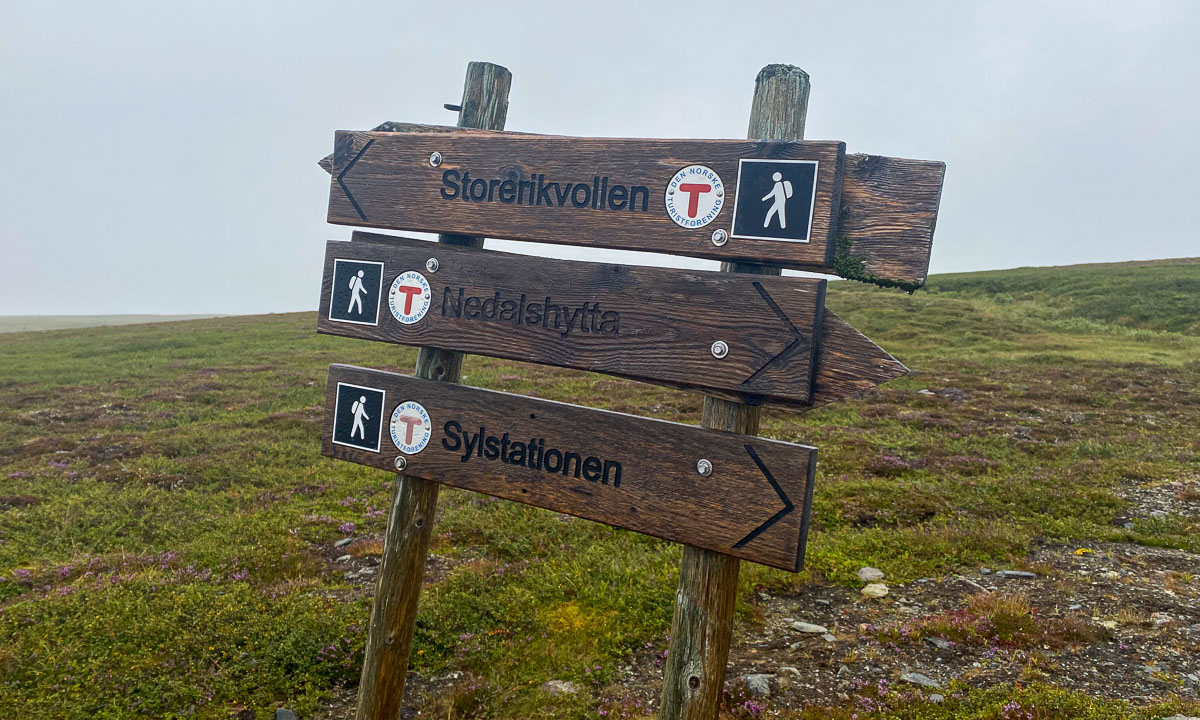
Easy, isn’t it? Yes, but wait – what’s that?:

Why are there two trails to Storerikvollen? Check the symbols. One shows a skier, the other a hiker. That’s the first think you have to know: There are summer and winter trails in the Swedish mountains. The latter ones are often a bit less hilly but can lead over bogs and lakes. So choose the right track. Quite often they go together for a while and then split up again. That’s where you have either to check a map (take an up-to-date one) or follow the right waymarks.

The waymarks for summer trails use stones and red paint. In Norway it is a red T, in Sweden it is mostly a red dot. Mostly they are painted on large stones, rocks or on cairns – heaps of stones. The advantage of cairns: they are easier to spot when it is foggy.

In wintertime most summer waymarks are hidden under a deep snow cover. Then it is the time of the winter waymarks: Red diagonal crosses.

The poles can be several metres long because of the snow, the depth of which can vary greatly. When you have snowstorm conditions in winter you sometimes just can spot the next cross. When you’re lucky. I took the following photo on 20 February 2020 on a ski tour. Two hours later we experienced average wind speeds of 25 m/s. Then you start to love the waymarks that guide you through the storm.

Back to our August Jämtland tour this week. We could watch some people replacing the old winter waymarks by new ones. An important job, probably done on a voluntary base. Voluntary work is so important in Norway that it has its own word: dugnad.

I guess the best sign posts we found in Nedalshytta in Norway. One “summer signpost”, one “winter signpost” and even ratings for the trails from green to black.

It’s always nice to meet some signposts on your way, but not all of them show the distances. I like the last one. The letters are holes in the metal sign, so it won’t snow over so easily in winter time.

But not all signs are about following the trail. They can show you the Swedish-Norwegian border. Or the way to the toilet. Or the toilet – often a “privy” – itself. Or where to park your dog in case you have any.

And some of the signs or marks are quite creative. I almost missed this “in-tree” waymark in Norway. Perhaps more funny than helpful.

But the clearest sign we directly spotted on our first hiking day in Storlien:

The words say henan, dittan and hittn which are apparently words in Jamska, a group of Jämtland dialects. They mean something like here, →there and →here. I cannot express it better. Anyhow this is an article about signposts and waymarks, not about linguistics.

Jämtland tour 22 – the glacier of Helagsfjället

This article is part of the series “2022-08: Jämtland and Trøndelag”.

It is 23 August, day 9 of our hiking tour through the mountains of Jämtland. Today we take another day off and I decide to try to reach the glacier of the mountain Helagsfjället. I don’t know how near I can get but I’ll see.

This glacier is the Sweden’s southernmost and parts of it are visible from the Helags fjällstation. You can even see the mark of the top (1797 m) which is round 750 metres higher than the cabins.

On my way up I meet three men heading for the top. I hear that it is easy to climb, even for children. Other hikers will confirm that later. Well, perhaps I’ll do that another time but today I want to touch the glacier.

I walk first up on across county, reach the main trail and follow it for a while. Then I turn right to follow a smaller path heading to the glacier. I reach a field with large rocks and boulders. Carefully I follow the cairns that mark a path until I stand in front of the first glacier tongue.

Time for a selfie!

I spot another glacier tongue. For coming there I have to climb over a rock outcrop. Mountaineers will laugh that I call it climbing but I’m more a hiker than a climber and as soon as I have to use both hands I call it climbing. The effort was rewarded. What an impressive view on the glacier!

I stand still for a while. First of all it is beautiful weather and then it is fascinating just to see the colours of the glacier changing while shady clouds pass by. And then I move again to take more pictures. And I drink some water and eat a bit of chocolate.

How long I stand there? I cannot say. I start my way back. My first view is on the radio station on the mountain Jalkedsåajja. This is where my sister and brother-in-law are today. But it is too far to spot if they are there right now.

While walking back I come to the small glacial lake that I already passed on my way up. Some people had written their names using stones. Wait – some people!? Only now I do realise that the whole area is covered with messages arranged by stones. An ancient social media stream – though without cat videos.

The whole tour took only three hours, with a lot of photographing and taking rests. If you plan to visit Helags you definitely should consider to give the glacier a visit. I keep my fingers crossed that you get nice weather, too.

Jämtland tour 22 – the trail

This article is part of the series “2022-08: Jämtland and Trøndelag”.

On the photo above you can see the trail from Blåhammaren to Storulvån. It is in fact two trails together: the winter trail that is marked with red crosses and the summer trail that mostly is marked with stones with a large dot of red paint on it. We didn’t follow this trail I only took the photo because of the beautiful evening colours.

Many parts of the trail are just like this. They lead through heather, grass, crowberries, and dwarf birches. Other parts of the trail lead over hills, across rock fields, through forests and sometimes over a reindeer fence.

This is when the trail is dry. But often it isn’t. The trail can just be very wet of last nights rain as we had it on our third day.

The trail can be boardwalks that lead over swampy area or bogs. Some of them may be under the water which makes them rather slippery.

And then there are rivers, streams and brooks. Some of them are crossed by a bridge. Some bridges are big, some are – well – small, simple, and pragmatic.

And then there are rivers that you have to ford. I ’m used to hiking in rubber boots and so I could splash through while my fellow hikers had to switch to sandals and wade through the ice cold water. Already Douglas Adams said: You have to know where your towel is.

And then there is mud. It can be slippery and sometimes quite deep, especially right before or after a plank. When you have a plank.

Especially the first day trail section StorvallenBlåhammaren was in an extremely poor shape. The others went around all these muddy patches while I – hey, I have rubber boots! – just continued straight ahead. But then at one point it happened. I made a step ahead and my right leg sank thigh deep into the mud. On the trail! Luckily Blåhammaren had a dry room.

But don’t be afraid, that’s not typical. Many sections of the trail look more like this:

How long the trail was? I don’t have the exact numbers but I think we hiked round about 135 km on 8 days, so round 17 km a day.

Jämtland tour 22 – hiking up the Gåsen

This article is part of the series “2022-08: Jämtland and Trøndelag”.

In Gåsen, one of my favourite cabins in the Swedish mountains we took a day off from our hiking tour. My brother-in-law and I took this as an opportunity to hike up to the summit of the mountain Gåsen, name giver of the cabin.

Gåsen is 1427 metres high. That’s however not a huge ascent, because the cabins lie on 1100 metres.

As everywhere in on our hiking trip there were reindeer around. What do they do on the snow fields? Eating snow? Fleeing the mosquitoes, while there were no around? I don’t know.

We approached the mountain from the south where it is less steep, although Gåsen is quite flat everywhere. While we went up my brother-in-law discovered a snow hare (a.k.a. mountain hare) that ducked to the ground but then sprang away when it realised that we spotted it.

Looking back: the cabins of Gåsen. Looking ahead: the way to the top. And more reindeer.

And there it is – the summit of Gåsen. While the top of the mountain is just a large gravel plateau the 360° panoramic view is quite impressive. It’s not only the mountainscapes that surround Gåsen but the large valleys that made this landscape so huge and seemingly endless.

After a rest – being thankfully for our jackets because it was quite windy – we ascended again, this time more direct to the cabins we stayed over. This time our hike led us over two snow fields. We were not alone, the reindeer seemed to liked the snow fields, too.

At the end we had to go a bit zigzag because the ground was quite wet but after 2½ hours we were back at our cozy cabin. That was fun!

Bonus photo: A cloud. For me it looks like a singing turtle floating effortless though the sky. And you?


Jämtland tour 22 – the cabins, part 2

This article is part of the series “2022-08: Jämtland and Trøndelag”.

Let’s continue with part 2 of the cabins on our Jämtland hiking tour. You can read the first part here.

4½ – Gamla Sylen

Another emergency hut on our way. We do not rest here, because it is just 2 km behind Sylarna.

5 – Gåsen

In Gåsen we choose the older cabin. It is a “Fjällstuga 65”, also known as Abrahamssonstugan after Tore Abrahamsson, who planned this cabin type in 1965. A room to the left, a room to the right. A large kitchen and two curtain-separated alcoves with five beds each. Propane gas stove, wood stove, no running water, no electricity. It is simple, genuine and it just works! Especially if you have a whole room for yourself as we did.

The other guests prefer the newer cabin, build in the eighties which is great, too – an even larger kitchen and eight four-bed rooms.

Here we take a day off. Time for idling, reading or taking small tours.

And taking an outdoor shower. The water is cold, but not icy. I leave the bath untouched, it is only knee deep.

Gåsen is one of my favourite cabins and places. I’ve been here several times – once in 2013, twice in 2020, but always in winter. It’s always windy but I just love it, even though you have to shovel a lot of snow and going to the toilet can be an effort.

Some photos from winter 2020. The first photo shows the newer cabin. Do you recognise it?

6 – Helags

Two days later we approach Helags fjällstation. Fjällstation means, that there is a restaurant. There are several cabins with self-catering kitchens and sleeping rooms, a house with reception, shop and restaurant, there is a large sauna building and there is Gamla Östan – the oldest cabin, built in 1916.

And that’s where we sleep: The right room in Gamla Östan. It is tiny, has a table, a wood fired stove, a double and a triple bunk bed. To enter the uppermost bed some mountaineering skills are required. The room is really cosy but does not have any kitchen. So we use the one in the cabin called Nordan.

The second evening I made a fire because the cabin was a bit chilly the night before. It takes some time, because the wood stove had its own ideas about getting oxygen or not. But finally it is burning.

It’s a nice combination of living in a museum, having a sauna and hot showers and be able to chose to cook or to go to the restaurant. (We take one breakfast and one dinner. Tasty!) And that all in a gorgeous place amidst the mountains. Me like!

7 – Fältjägaren

The first and only cabin I’ve never been before, neither in summer or in winter. It lies on the top of a hill, has a Fjällstuga 65, a toilet and a tiny cabin for the stugvärd. A really nice place, especially when it’s warm and you can bath in this fantastic mountain lake just some minutes down the hill.

And that was all the cabins we slept over on our hiking tour. Plus some of the resting places.

What I like most is the diversity of the cabins – from Norwegian hygge (cosiness) to Swedish funkis (functional design). From 1916 to 20-something. Variety rules!