Telegrafbukta in the storm

It’s Friday! Just a 25 minutes walk through the snow, then I’m home.


Have a nice weekend!
Back in Tromsø I decided to walk to work this week. 2½ km to the Norwegian Polar Institute in the Framsenteret and 2½ km back home. So I get at least a bit of motion each day. And a bit of outdoor feeling, too.
It has snowed quite a bit the night and is still snowing. It’s -4 °C and the wind is calm. It’s fun to trudge through the powder snow.


Lunch time. We get the table by the panoramic window. Some boat owners clear the landing of the marina from snow.

-3 °C and snow fall again but now the wind is stronger and squally. Luckily I have it in the back.


It gets warmer the whole day and it starts to rain. Wet ice and deep puddles on my way back.

+2 °C, a bit of rain. Rubber boots, slush, ice, water puddles.

-1 °C and fresh snow.

I don’t trust the snow. I know that ice and slush lurk beneath the surface. Therefore I wear rubber boots again with attached spikes to avoid slipping on the wet ice. The gloves protect against the wind, the reflective wristbands with the blinking LEDs and the high visibility vest against not being seen by car drivers. No cyclists the last days.


-6 °C, almost like winter. The canteen invites to “sun buns” and cacao because it is “soldagen”, the day where the sun is finally visible in Tromsø again after 8 weeks. Unfortunately clouds block the low hanging sun.


This weekend I won’t see the sun neither. We got warm weather and storm and unfortunately a lot of rain. So I’ll probably keep myself mostly inside.
Last Saturday I travelled to work. Obbola—Tromsø, that’s round 1000 km – the reason why I do not commute weekly. This time it is a bit suspenseful, because there are two obstacles on my way.

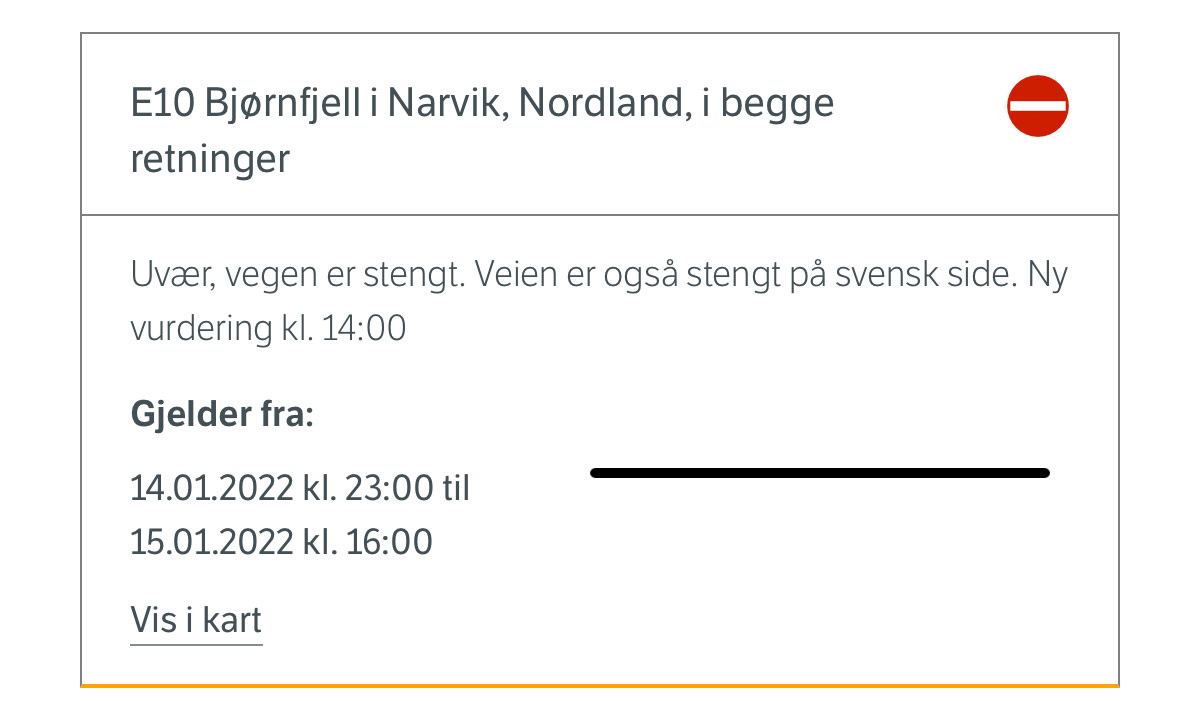
One obstacle is easy: taking a covid test at the test center. The other is much bigger: The road over the Bjørnfjell – the only road – has been closed for many hours due to stow storm conditions. Well, I start my journey anyhow. We’ll see.
At 5:30 in the morning Annika takes me to the train station in Umeå. The first 9½ hours were just a “normal” train journey beside of the train being mostly ahead of time. One change in Boden – nothing special, just long and a bit boring.


I leave the train in Abisko Turiststation where I parked my car. My car – will I find it or is it submerged under a pile of snow? To my relief hardly any snow covers my car. I already hoped so, because Abisko is known for its low precipitation because mountains in the west protect it from bad weather. Much more snow and rain fall on the other side of the mountain range and that’s exactly where I have to go through. Some minutes after leaving Abisko behind it starts snowing. Snowfall increased more and more but isn’t severe and the Swedish mountain road is open. Soon I cross the Norwegian border and …

… have to stop because of a lowered tollgate with a red blinking light. Beside of two trucks I am alone. I am relaxed because I know that the road has been opened for driving in convoy one hour ago (thanks internet!). I just have to wait for the large snowplough to fetch us.
After twenty minutes the tollgate went up and the red light goes out. That’s all that happens. I hesitate. And now? Do I have to wait? Or may I drive? I don’t dare and ask one of the Norwegian truck drivers. He answers I should just go ahead and so I do. The drive is snowy but not bad and soon I arrive at Bjørnfjell brøytestasjonen where the snowploughs are located and now also the Covid19 registration. I register myself, get a covid test and start taking photos while waiting for the result.


I take an image of a snowed in car. The snow plough driver goes to me and asks for what purposes I take photos. “Just for my blog.” “Ah ok, just curious.” Good to talk to him, because so I learn that beside of the mountain passage behind Bjerkvik road conditions are good. Here they got a lot of snow the last 24 hours and one of the cars looks like this:

After round 20 minutes I get a ping ♪. It’s an SMS with a link to my test result. Negative :-). 260 km to go, that’s four hours when conditions were good.
The first 100 km the road conditions are good and weather is ok. The next photo shows how driving looks like.

The next hour it snows a lot. Sight is still good. To my left and right everything is covered with snow, from the largest church to the smallest branch of a tree. Winter wonderland.
Then it starts to get nasty. Snowfall intensifies more and more and the snow has the consistence of superglue. My windscreen wipers hardly manage to push away the gluey snow and finally I have to turn into a side road and de-ice the wipers. Scratch, scratch … . I’m not alone. In front of me a car with a driver doing the same. Behind me another car stops. Am I in the way? No, just another scratch, scratch. On the other side of the side road another one.
I still have some holes to peek through but it is extremely tiring to drive car through the night like that. Alas, after two hours I drive over the large concrete bridge Tromsøbrua and am on the island Tromsøya. Apparently Tromsø’s snow removal has given up. The minor roads are covered with 20 cm of snow with deep tyre tracks. I understand more and more why most Norwegians have cars with all-wheel drive (and so have I).
22:45. I make a last stop at the supermarket nearby that is open until 23:00. I’m lucky because Norwegian supermarkets close on Sundays. By the way: the supermarket’s parking place is in much better condition than the roads.


One other minute driving and I arrive at my flat in Tromsø after 17½ hours travelling. I’m tired but it takes another hour until I’m relaxed enough to sleep. Next week I’ll walk …
Since yesterday evening I am back in my “work town” Tromsø. How I got here after 17 hours of travelling is another story. I only mention that it among others had to do with snow.
And snow we got in Tromsø as well. Round 30 cm of fresh, clean snow cover the ground, the houses, the trees and build fields of slush in the shallow parts of the sea.
These photos are from a short promenade from Telegrafbukta and Sydspissen.


The morning of 10 January is my the coldest this winter: -20.5 °C. A longer period of frost has frozen over the Baltic Sea earlier than usual. I stand at the shore by our house. Ice as long as I can see.
I follow the coastal line to take photos. Ice fog draws in.


When I return from my pre-work photo trip the temperature has risen to -15 °C and it gets warmer hour by hour. In the evening it’s only -3 °C and it has become stormy.
Two days later I’m out again. It thaws. The effects of the storm are visible: The wind pushed the ice shield ashore where the ice broke into countless pieces.
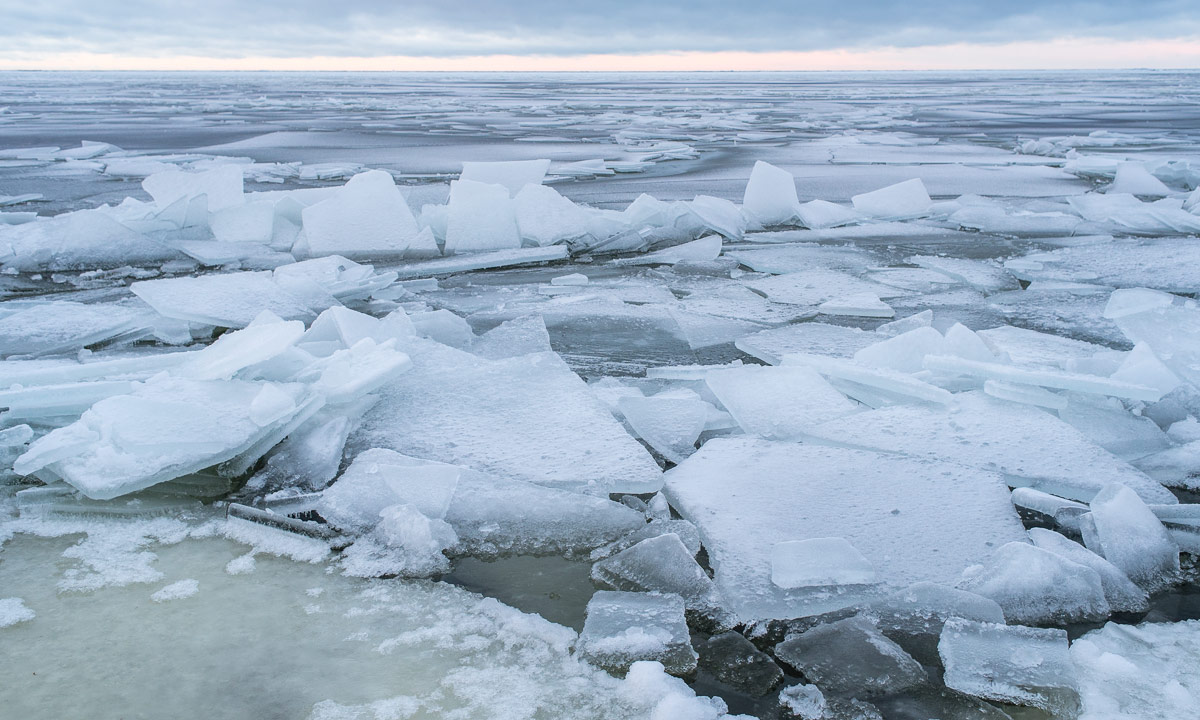
Movements at the horizon. Large waves roll along the sea and build an ice wall by the rocks south from the island Bredskärssten, 1300 metres from our house. I would love to take photos there but there’s no way for me to get there. It’s too windy for a hovercraft and I don’t own one. So I take mobile phone photos through my spotting scope.


The next day. Similar situation but now with the sun illuminating the splash that the waves throw at the ice walls. The thaw has melted the snow on the ice and made it wet. It twinkles and glistens in the sun. Beautiful to watch.

In the night it is stormy und gusty again.
14 January – the next day. As every day it is too dark in the morning to spot the sea. A small line of red at the horizon signalises the approaching sun. And there it is: 09:03 – sunrise.


Now I can see that beside of some leftovers by the shore all the sea ice has gone. Crushed by the waves and the storm and floated away. Now there’s open water from shore to horizon. Probably it will take some time until the Baltic Sea freezes over again.
And what can you do in open water? Correct – you can kayak!


It was just a very small tour round Lillskär. First it was just a lunch break again and then it was still very windy. Wind came from west and I didn’t want to drift to Finland ;-)
Kayaking however wasn’t dangerous. It’s easy to paddle against the wind – easier than side winds – if the distance is not too big. Probably more dangerous is the large, wet patch of blank ice in front of our house. Slippery as hell! Hopefully it gets colder and snowier soon.
Link to a Swedish article of the SMHI: Bottenviken snabbt avtäckt igen.
OK guys, it’s Sunday afternoon and I’m too lazy to write long texts. I just show some photos of the last days where our German friend Medi joined Annika and me on various excursions with some notes.
+++ Västermarks naturreservat, 50 km north from Umeå +++ a non-commercial forest made us climb over and under fallen trees that lay across the marked loop trail +++ by the trail a wooden cabin +++ time was too short to fire the oven but lighting candles is cozy, too +++


+++ right next to our postbox (500 metres from our house) starts Spåret, a 3600 metre long forest trail +++ we use back-country skis to ski Spåret in my prolonged lunch break +++ we, that’s Dirk – guest for two nights – Medi and I +++ -12 °C, but my Anorak is too warm +++ I tie it round my hip +++ on the photo it looks like a skirt +++

Photo: Dirk Thomas
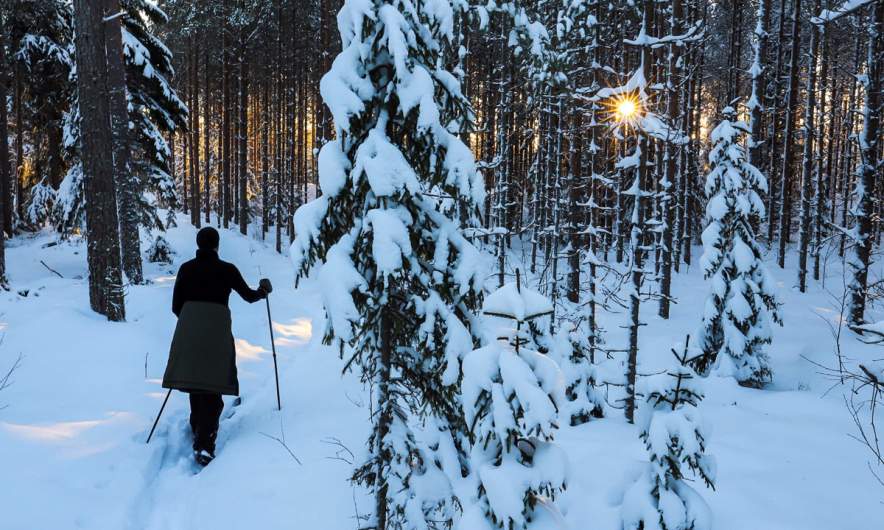
+++ grey weather, -14 °C +++ the trees are covered with snow +++ black-and-white imagery +++ after some days of back-country skiing it’s nice to use cross-country skis on a real trail +++


+++ 1 o’clock in the night +++ I check for Northern lights +++ we are lucky +++ Medi and Annika watch the aurora beside of the garage +++ I take some photos from our garden +++

+++ 8:20 in the morning +++ the Baltic Sea freezes over more and more +++ sunrise colours by the sea +++ and then in our garden +++ watching sunrise while taking breakfast +++


+++ just a short walk at one of Annika’s and my favourite places: Strömbäck-Kont +++ looking at the ice ridge by the sea +++


+++ after lunch we are taking Medi to the airport +++ strong and colourful parhelion or sun dogs halos +++ the photo is taken at the airport +++ I am questioned by the security and show the taken photos to prove I’m not a spy +++

Yesterday it snowed the whole day. This morning round about 20 cm of fresh snow covered everything, among others my kayak.


Anyhow more and more of the Baltic Sea freezes over and reaching open water can be quite time consuming and exhausting. When the wind does not turn the kayaking season may be over for a while.
Let me take you to my favorite place
Just a five hour drive from the city
Just follow the road until it stops
And then keep walking for another forty minutes
Then – out of nowhere – there it is
My cabin!
I was lucky to get the my employer’s cabin for the Christmas week this year. The cabin of the Norwegian Polar Institute lies on a mountain slope by the fjord Kattfjorden. Two days ago Annika and I packed my car with a a lot of food and winter equipment and drove to the cabin, which is 40 km away from where I live in Tromsø. It lies by the road to Sommarøya (the summer island) which is a funny name when you drive through intense snow fall.
We did not have an address, but a small map and a description and so we found the parking place where the cabin supposed to be. And there it was, up on the hill in seemingly pathless terrain.

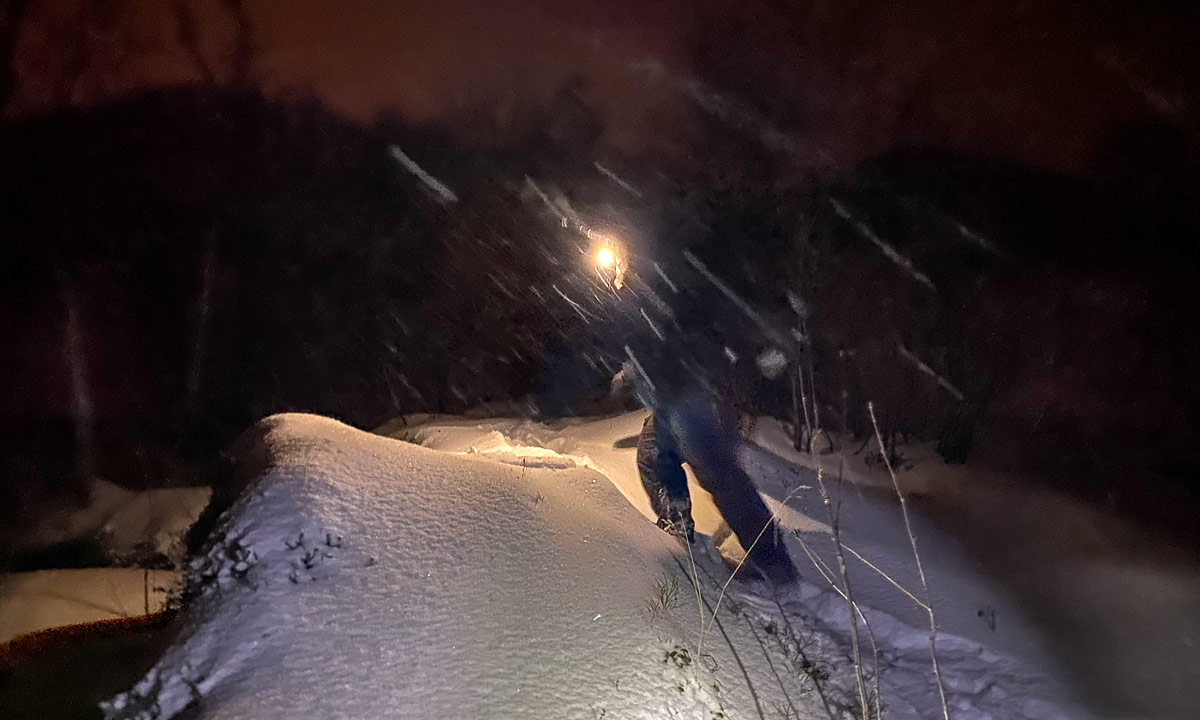

But under the snow there was a path up the hill and we found it. It took some efforts to bear everything up.
A Norwegian cabin can be everything from a wooden box to a luxury retreat. Our cabin has running water (cold and hot), electricity, underfloor heating, a kitchen, a bathroom with shower, a wood-burning stove, a sauna, internet and more.
We followed the manual and turned the underfloor heating to the maximum, but even after some hours the cabin was as chilly as before. We failed to fire the wood-burning stove because there were only large logs of wood and no axe.
At one o’clock in the night we woke up. Whether it was because of the gusty and stormy wind or of the cold I cannot say. 8 °C in the cabin, the same as hours before.
I put on clothes and went down the hill to look for an axe in the woodshed by the road. I didn’t find one but I found bags with smaller pieces of wood. I hefted one up (exhausting!) and finally was able to make a fire. We were awake for an hour, sitting by the oven, gladly watching the thermometer showing the rising temperature.
Right now it’s icy cold
But in sixteen hours, it’s gonna be hot!

The next day I slept until 10 o’clock. It was still dark and Annika and I took breakfast. One hour later it was bright enough to see the falling snow. We put on our clothes and went to the fjord Kattfjorden, which is less than 100 metres away from the cabin – and 20 metres in altitude.


We looked at the rocky coast and the seaweed covered stones and decided not to winter bath here today. Soon we trudged uphills through the snow back to the cabin and took it easy for the rest of the day. I can say, that the short days in the time of the polar night can be really relaxing.

At 13:00 the sky started to clear up and the snowy mountain ranges glowed colourfully. Polar night does not mean that it is pitch black 24 hours a day.


How lucky we are, we who may be here and stay for Christmas. In the cabin named Fredly (peaceful shelter).
Why, oh why was the forecast of Yr right? Already a week ago it forecasted a period of thaw and heavy rainfall. And Wednesday it started to rain. Just now I’m listening to another cloudburst bucketing down on the roof.
The snow is gone and the ways and small streets are very icy. When it continues raining like this even the ice may have thawed and washed away soon.


It looks almost like autumn but with a huge difference: It’s dark. The photos above I made at lunch break on my last working day this year.
It’s a pity! Just today my wife Annika will arrive so that we can spend Christmas time together. It would have been lovely with a lot of snow but even though it shall be colder again soon it does not look like we get some.
