Skiing and tenting in Jämtland – part 1

This article is part of the series “2020-02: Ski tour Jämtland I”.

This year I’m lucky. I did two ski tours in a row, that’s spending more than three weeks in the beautiful mountains of Jämtland. Let’s start with the ski tour number one.

We are three people: Jonas, with whom I already did three ski tours before, Arne, who is doing his first ski tour and me.

Saturday, 15 February – shelter from the storm

Jonas and Arne live in Northern Germany. They arrive in Östersund by train at 6:37 in the morning. 23 minutes later we enter the large shop ICA Maxi to buy food for eleven days. It takes an hour to decide what to choose and find these items in the large shop. After we have managed to stuff the shopping bags into the packed car we drive to Vålådalen. There’s a parking place that we use as the starting point for our tour in the fjäll. It takes some time until we have packed our pulka sleds with all our stuff and they are quite heavy loaded.

At 13:15 we leave the parking behind and start our ski tour. It starts with a challenge. Although we have a tent we need to reach Lunndörren, the first mountain cabin tonight. Just now the weather is calm but according to the Swedish weather service a storm will approach tonight with gusts of wind up to 30 m/s. That’s more than 100 km/h or wind force 11 (violent storm)! Definitely not the night to spend in a tent, if you have the choice. Although it’s only 14 km to the cabin, it takes us more than 5 hours. There’s the heavy pulka sleds, some short but steep slopes to climb, pinching boots and much more that slows us down. Exhausting or not – it’s great to be outside in the winter again.

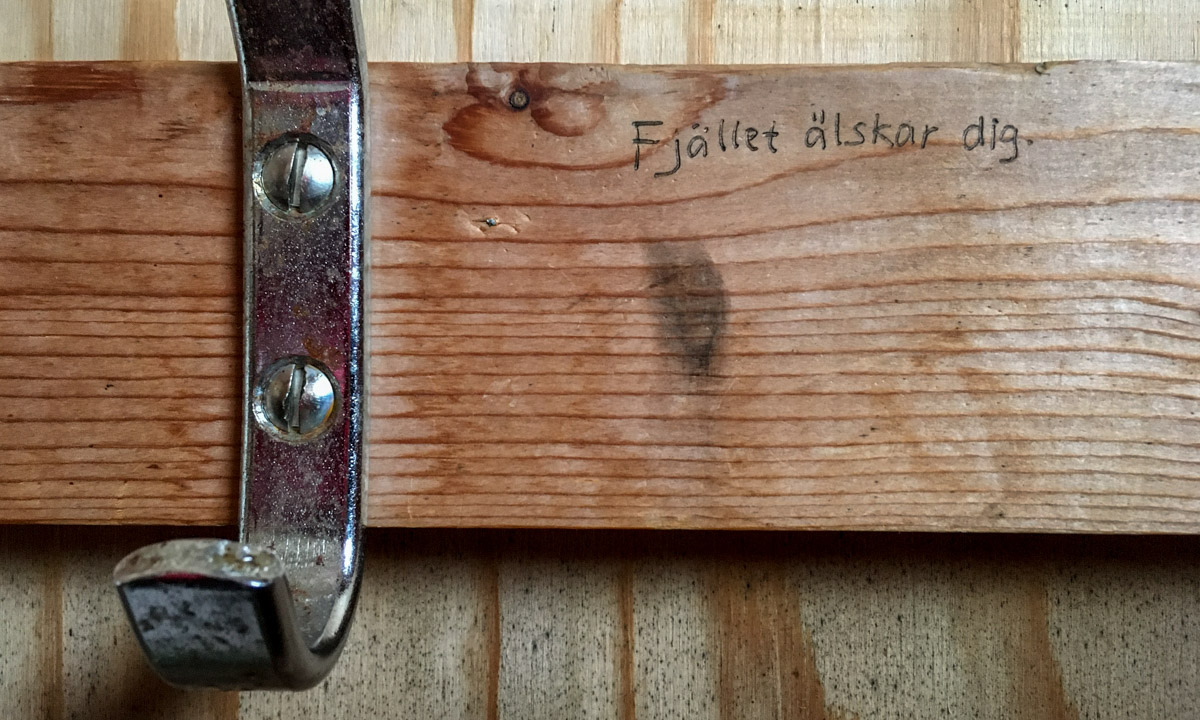
Sun down is round 17:00. For the last part we use our head lamps. In darkness we arrive at Lunndörren at 18:30. As usual, one cabin is opened for out-of-season hikers as us. Here you have all you need. There’s a table and stools, bunk beds and most important: a wood stove. Firewood is found in the vedbod, the woodshed. The water? Probably there’s a place to get water from the lake. We however go outside with a bucket and fetch snow to melt on the wood stove.

The sky is still clear and the night is starry but it already has started to blow more and more.

Sunday, 16 February – camping by the river

It’s 5:30 in the morning. Storm gusts howl around the house. Violently they blow snow from here to there and I have to pee. Not my favourite combination. I manage to open the door but have to crawl over the icy patch to prevent being blown away. Every mountain hut has it’s outhouse but I prefer the nearest tree. That spares me 20 meters to brace myself against the storm. I have to hold tight on the tree to avoid being blown over. Back in the cabin I can hear the storm but a mountain cabin is a great shelter and soon I fall asleep again.

Fortunately the storm has weakened, when we get up.

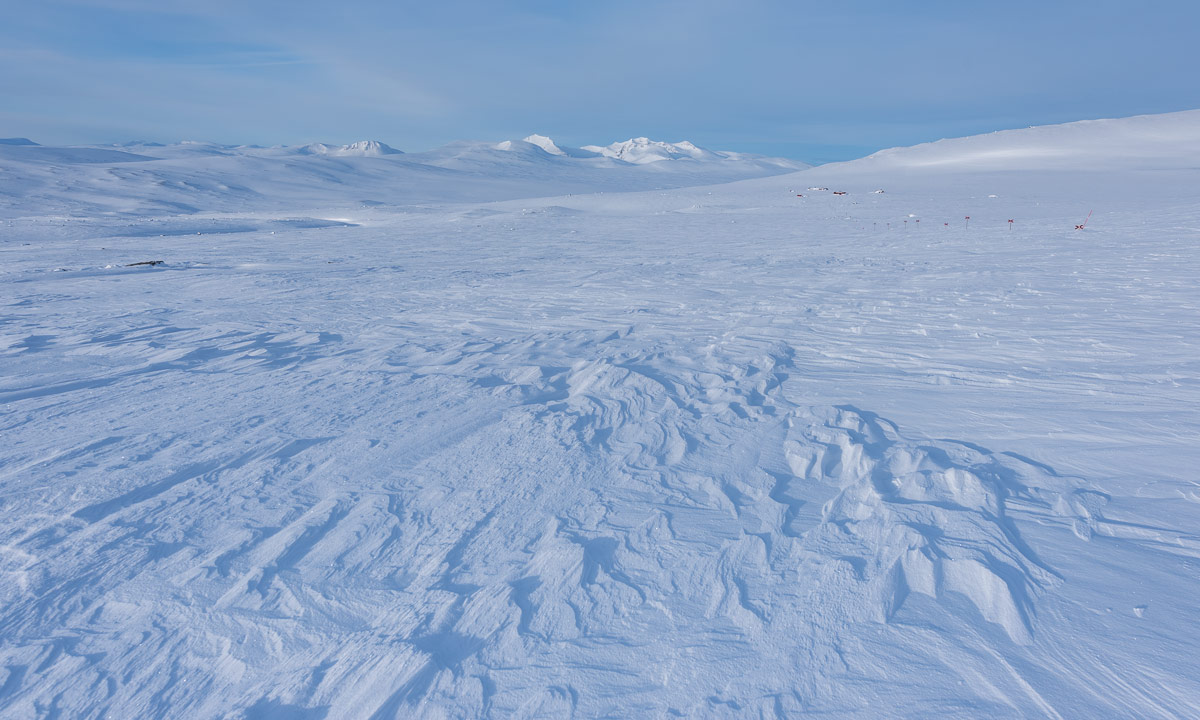
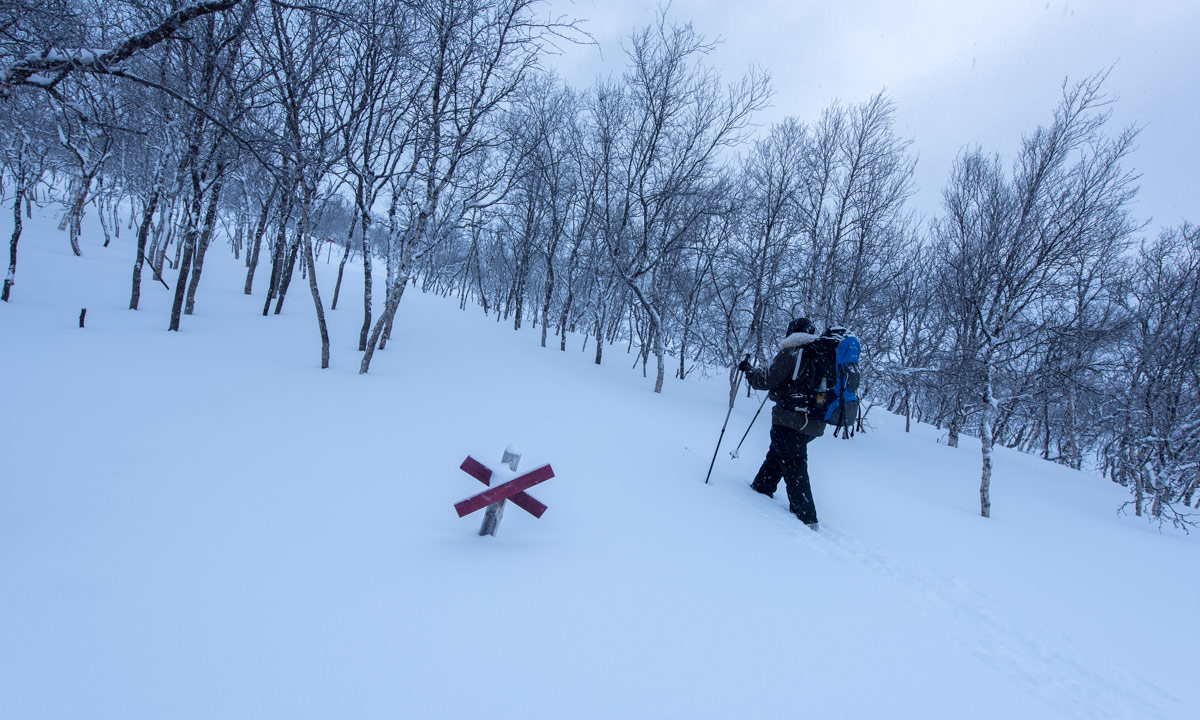
Today we don’t want to go far and look for a nice place to tent. So we take it really easy in the morning and it’s already 11:45 when we start our second tour day. Slowly we gain height and there are less and less trees.

Hardly three hours later we have found a nice tenting place. It’s in the forest to be protected against storm and wind and by the small river Lunndörrsån. Jonas tests crossing the river to fetch water – it works. Fresh water is a luxury in winter. It takes less energy to warm up than snow and it tastes much better!

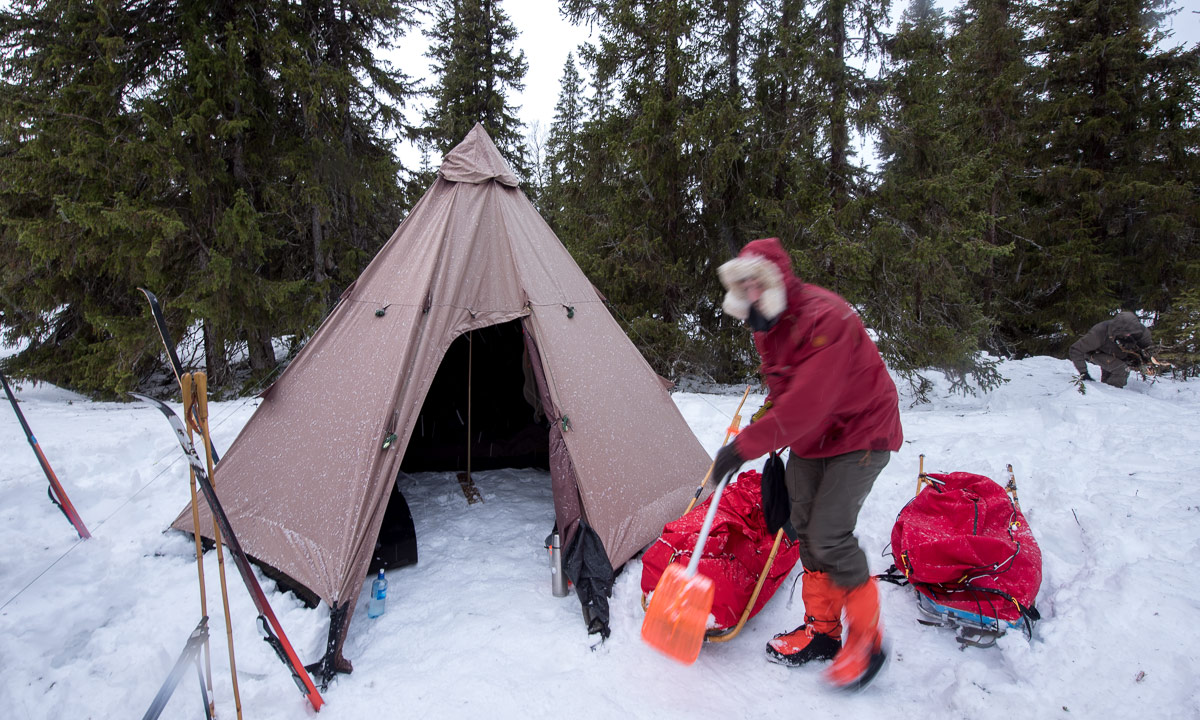
You see the orange shovel? We have two snow shovels with us and we use them both to dig a large hole for a camp fire. The dead wood that we find is soaking wet and it takes Arne some time until it burns.

Where there is a fire there is no boredom.

Later Jonas, how is the tour cook is preparing food. Today it’s köttbullar with mashed potatoes and chanterelle sauce. Tasty! Already a quarter to eight we lie in our warm sleeping bags and soon we fall asleep.

Monday, 17 February – warm weather in the forest

Of course I did not sleep well. I always need two or three days until I got used to sleeping in a sleeping bag in winter time. One of the reasons is the reduced freedom of movement, one other the VBL.

A vapour barrier liner (VBL) is used to prevent moisture getting into the down filling of the sleeping bag. There the moisture would freeze and so reduce the isolating effect of the down feathers. So far so good. In practise it has the same comfort as sleeping in a huge plastic trash bag and although there are good reasons to use a VBL I dislike them.

But I shouldn’t complain. I had it warm and I got enough sleep. Some storm gusts have shaken the tent but all in all it was a quite night. And so is the morning by the river. Even the sun tries to peek through the clouds.

At 10:40 we move on. First we have to cross a small plateau called Finnångelflätet. It is quite exposed to the wind and hardly covered by snow.

One hour later the view is completely different. The ground is white again. The wind has intensified and gets stormy. At the same time it’s warm – slightly above zero – which makes the snow very sticky. Sometimes it feels like half the hill sticks under my skis.

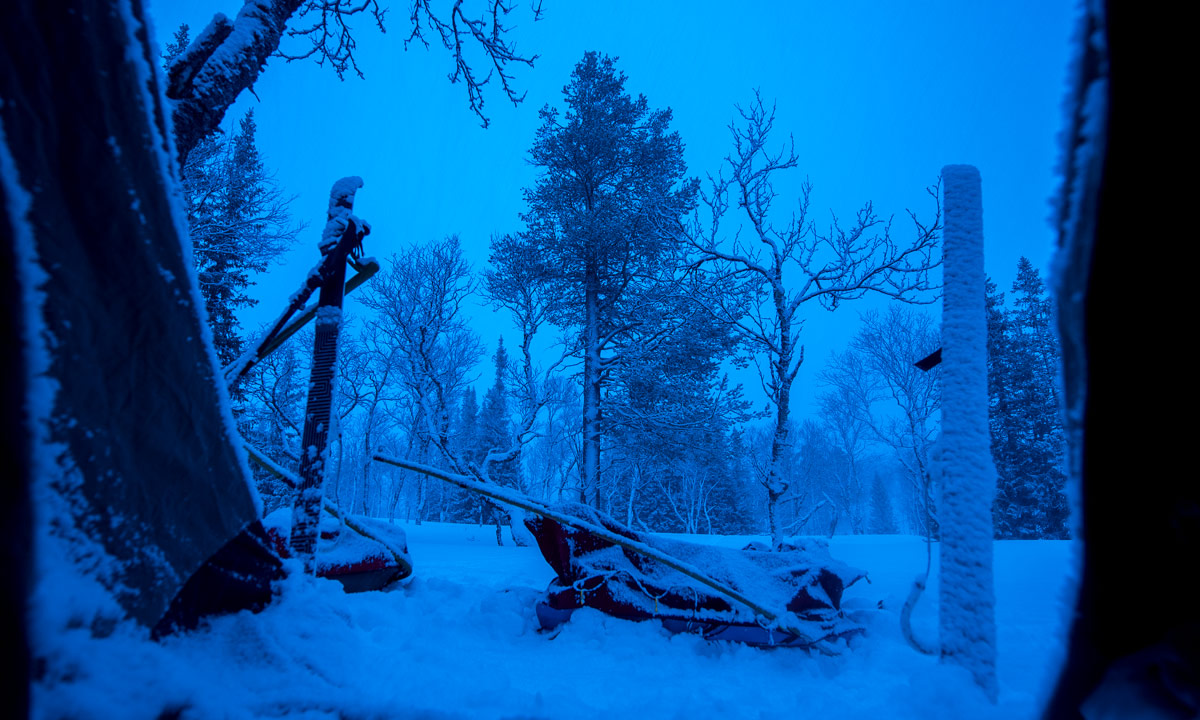
The good thing with tenting is that you are flexible. We do not have to get to a cabin or hut, we just need a sufficient campsite. Right after crossing the river Tronnan (we ignore the bridge and cross the ice) Arne and Jonas start looking for a good place to camp. And find it. The snow is loose and we trample on the snow to harden it. At some places we sink knee deep in the snow. It has started snowing and when we look out of the tent we see the snow covering the skis used as huge tent pegs and the pulkas.

Tuesday, 18 February – arrival at the Vålåstugan

Phew – my sleeping has been much too warm. It is made for -25 °C, not for 0 °C. My wool underwear is wet but still does it’s job anyway: keeping me warm.

As the day before we move on at 10:40. The tent has become quite heavy due to the wet snow and the warm temperatures. Now it’s both wet and frozen. We have decided to reach the mountain cabin Vålåstugan today. I find it exhausting to ski. I have to take tiny breaks to catch my breath on every slope. Perhaps it’s because it’s the third tour day but I may be wrong.

Luckily Vålåstugan is not far away and we arrive already at 13:30. There are several buildings. The main cabin, surrounded by huge snow drifts won’t be opened before 21 February but the other cabin is open. Again we are alone, we haven’t seen a single person the last days.

This cabin is of a well known type. It’s a Fjällstuga 65, also known as Abrahamssonstugan. A corridor, one room to the left, one to the right with ten beds each. It works quite well with up to eight people, then it starts to get a bit crowed. We use the whole space to dry our sleeping bags, jackets, boots, gloves and other clothes. As I mentioned we are alone.

Wrrrr—wroooom—wrooooom! Not anymore. Snowmobiles are approaching with people dressed in bright colours. They park in front of our house. Who are they? It’s an official party of the mountain rescue (probably training), the police (checking the emergency phones), way markers and later two snowmobiles with people from the Swedish Tourist Association STF. They pull trailers in which people sit. It turns out that they are the wardens of Vålåstugan and Gåsen Fjällstuga, that will open these cabins in three days. The wardens of Vålåstugan directly start to dig out the main house (that will take some time), the others leave a bit later.

I haven’t had internet access for two days. So I’m glad to ask the police for a weather update: wind this night, sunny round -10 °C the next day, then wind in the night again. Looks like this tour is a stormy one.

It’s cloudy but the sun manages to peek though from time to time. The birch branches are bent by the wind.

And later that evening we even get a bit of polar lights. The only ones I’ll see the next weeks.

Continue with part 2 >

Ferries to the island Norderö

Beautiful weather in Jämtland. Here it was round -5 °C and a clear blue sky. I made a small car trip to the island Norderö and to mainland again. Norderö is one of the islands in the big lake Storsjön, which is Swedish for „The big lake“.

There are two car ferries to Norderö. These car ferries are part of the Swedish road network and they are free. I took both of them and looked at the crushed ice beside the fairway.

In other years there are winter roads over the lake, but this winter they are closed, probably due to the extraordinary warm weather.

And far in the distance you could see the white, treeless tops of the Jämtland mountains. Somewhere over there I’ll start a ski tour tomorrow.

On the road IV and V

Back to Sweden · Sneringsvika—Rötviken – 315 km

Have I told you, that the weather in Norway is constantly changing? So it was as well when I continued my road trip the day before yesterday.

It wasn’t cold, but most of the precitipation came as snow and even by the sea everything was white.

In Hofles I waited for the ferry to Lund which takes 25 minutes. I love standing onboard and watch the snow covered hills and mountains pass.

On the other side there was first less snow, …

… but as soon as the road climbed up a bit everything was white again. Here are two photos from a barbecue hut by the road 74 to Sweden. The first one from now, the other made in August 2016.

This time I have booked a cabin in advance. It is in Rötviken, 20 km behind the Norwegian-Swedish border. Although the campsite is by the road it is really quiet. Hardly any car uses this road.

I was tired from all the driving of the last days and fell fast asleep. The next day I would take it easy.

Arrival · Rötviken—Orrviken – 139 km

What a beautiful morning! The sun came out the first time since I left Solberget four days ago. Two dogs were barking. Did they bark at me? Now, it was the two moose that were about to cross the road but then turned too the the lake Hotagen.

This day I didn’t have to go far, just 140 km along broad roads through the Swedish forest. Easy to drive but a bit boring to look at.

I made a short stopover in Östersund, the largest town in the county Jämtland.

Then I continued to Orrviken.

Today I will spend my day here and repack my things for a ski tour that I will start with two friends tomorrow. Then I’ll be offline for about two weeks.

Vi hörs – see ya.

On the road III – Hemavan—Sneringsvika – 296 km

From the wintry fjäll to the rainy coast

It’s only one day of travelling, hardly 300 km, but today was filled with a lot of varying great experiences and feels like a complete holiday.

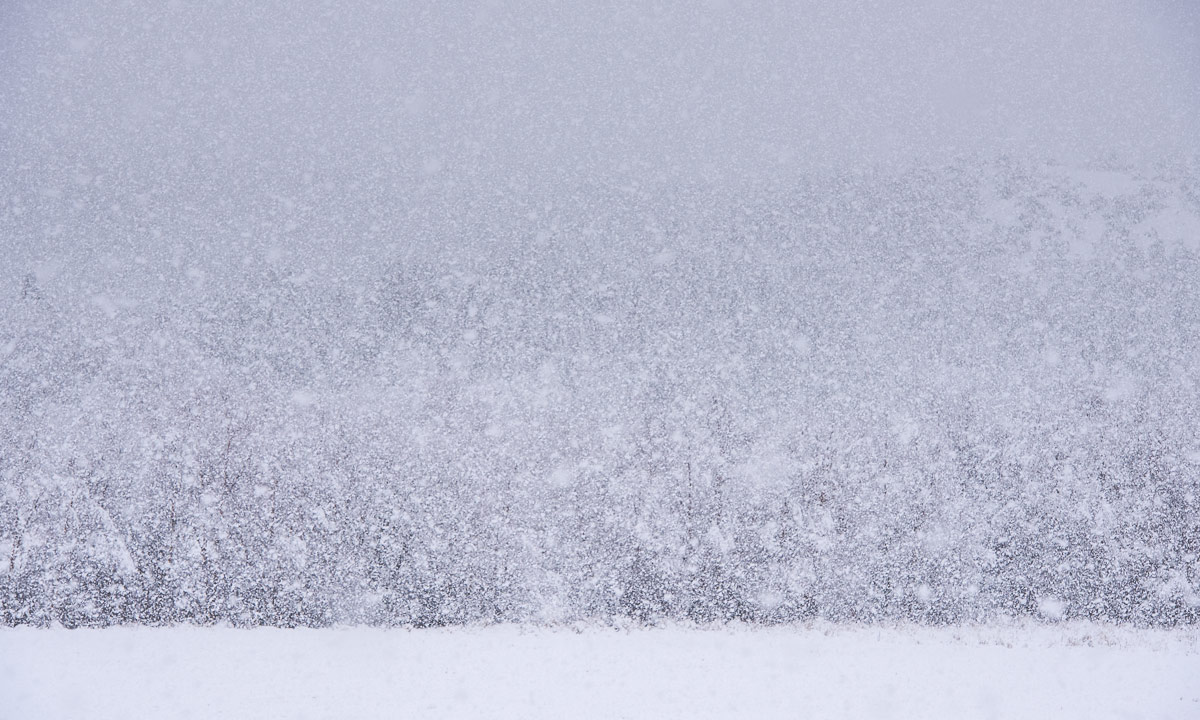
After breakfast I leave Hemavan behind and again I travel to Norway, this time taking the road 73 via Joesjö. It’s just below zero and it’s snowing. I cross Norway and now the snowfall intenes. It’s snowing handkerchiefs and the visibilty is poor. Within minutes the road is covered with a fresh layer of snow.

The heavy snowfall lasts only short and soon visibility is much better. Twice I pass an open barrier. This route section can be closed when the weather is severe. If this should happen to me I’d choose to wait on the western side. What a cozy shelter the Norwegians have built there.

Now I’m really in Norway. It’s just impossible to describe the zillions of different impressions. It’s the endless combinations of different landscapes, different moods and different weather that makes travelling through Norway so interesting and inspiring.

An example image, from bottom to top: a river rushing through a canyon. Above that a hill with a green coniferous forest. Above that a mountain with a forest covered with fresh snow. Above that a high mountain over the timber line, completely encased with white snow. Above that clouds bringing snow or rain (depending on the altitude) and the sun trying to peek through a cloud gap. And that’s one of a thousand images.

I do not even try to photo all the different scenic moods because it would take ages. And by the way: there are hardly any parking opportunities by the roads.

So I publish just some travelogue photos, mostly taken through the windscreen.

At 14:25 I arrive in Vennesund. Here I have to take a ferry to continue my trip south. An hour later my car is in the belly of the ship and I am on deck. It’s windy, but warm with +4 °C. I’m the only one on deck. The journey takes only 20 minutes.

After leaving the ferry I continue my road trip and the landscape is as gorgeous as before.

Anyway I got quite tired and I’m longing for a cosy place to stay. I plan to take the first opportunity. At the branch, where the 802 leaves to Bogen I see some kind of camping kiosk. I leave the car and meet an elderly man, who gives me his cabin for a night. It costs 800 NOK, but first it’s Norway and then this cabin by the fjord is a welcome luxury after travelling by car for three days.

Now I have to check the weather forecast for tomorrow. I’m in a winter mood and long for snow!


A wintry weekend in Saxnäs

If the mountain won’t come to Muhammad, Muhammad must go to the mountain.

While the coastal weather has still much too warm (last night it rained again onto the icy roads) you can still seek winter in the Swedish mountains. Annika and I used the long weekend to visit Saxnäs (and my piano tuner who owns a house there). Some days ago it had rained even there but fortunately it snowed afterwards and everything was white when we arrived there Friday evening.

Seven impressions of Saxnäs

1 – wind and snow

The night and the first day in Saadteskenjuana/Saxnäs was very windy with squalls round 20 m/s. That’s why we chose the car to look around, not the skies. The bay Faepmienloekte/Fatmomakkeviken, part of the large lake Gåaltoe/Kultsjön was partly open. Maybe because of the current of the stream Jeanoe/Ransarån, maybe because of the stormy wind and the warm weather. In the back the wind blew the new snow over the ice and highly into the air. It was not cold, but windproof clothes were necessary to feel comfortable.

A comment on the naming of the locations: The first part is the Sámi name, the second the Swedish name. The headlines and repetitions have only the Swedish names to keep it short.

2 – Fatmomakke

Faepmie/Fatmomakke is an old Sámi meeting point. In 1781 the Swedes erected a first chapel. Both Sámi and Swedish people lived here. Since 2014 it is a “kulturreservat” – an area to protect the culture of that place. I loved the old wooden houses by the lake Gåaltoe/Kultsjön.

3 – lake and mountains

When we drove back we still could see snow blowing over the lake. Above the whirling snow dust the risen sun had started to illuminate the mountains of the Marsfjäll.

Step by step we drove back to Saxnäs and I used every parking place to take pictures.

4 – polar stratospheric clouds

A rare phenomenon had been observed the last days: polar stratospheric clouds. I already could see some the days before on my way from Skelleftehamn to Umeå. Now in Saxnäs they were spread over half the afternoon sky. If they are near the sun the light is diffracted and the clouds are very colourful. I have seen such clouds before but never as intense and colourful as that day.

5 – skiing through the dark

In 2005 I bought my first fjällskidor – backcountry skis with steel edges. I had used them on many tours – from short half-day trips to multi-day winter tours with pulka and tent. They had become quite worn and battered, therefore I bought a new pair some weeks ago, including new boots. Now it was time to test them.

The test went very well, but the ski track around the lake we didn’t find. So we went cross-country and returned after a while. The way back was much faster because we could follow our own tracks and didn’t have to navigate.

6 – cross country skiing

The next day was grey but quite calm. We took the car to the Bagarstugan, starting point of the ski tracks in Saxnäs. The ski tracks weren’t prepared yet but some minutes later we met a man that was about to start the preparation. The classical tracks are prepared by snow mobile, the broader skating tracks by snowcat. So finally we were lucky to have our cross country ski premiere on a freshly cut track. Great!

7 – Saxnäs by night

Annika invited me to dinner and we decided to walk the 2 km from my piano tuner’s house to the hotel. Good to have some motion before and after dinner. We passed the closed village shop and soon approached the hotel. Urgently recommended: reflex vests to be seen by the cars.

Beside of the employees we were completely alone in the large hotel restaurant. It’s still pre-season.

Now I’m back in Skelleftehamn. The road is icy and wet from last night’s rain. The average of the max temperature forecast for the next 9 days: +1.3 °C. Come on, winter, where are you!?

Translation:

EnglishGerman
polar stratospheric cloudPerlmuttwolke

Day 24–26 – a detour to Norway and travelling home

This article is part of the series “2019-07: Southern Sweden”.

July 31 – August 1 – Grövelsjön, Röros, Flatruet, Ljungdalen, Stugun, Åsele

July 31

After a tent night in Grövelsjön (temperature minimum 5.7 °C) I take a morning stroll with several purposes: enjoying the fresh air, taking pictures and buying fresh bread for breakfast. My promenade starts at the “troll workshop” where guests are welcome to build their own wooden troll and place it beside the “troll trail”. From there I can spot some “wintry things”: a prohibition sign for scooters and red crosses marking the winter trail. I follow the red signs over a bog until I come to a road from where it isn’t far to Grövelsjön’s mountain bakery.

Annika and I have breakfast in the mountain lodge. Hm, the Brötchen are extremely delicious!

Actually I have planned to take a bath in the lake Guevteljaevrie nearby. The water was very clear but the car tires and metal scrap at the ground discouraged us.

You may realise that the name of the lake doesn’t look Swedish. You’re right. We are not only in Sweden but also in Laponia – the area of the Sámi people. Therefore towns, rivers, lakes and mountains have two names, a Sámi and a Swedish one. The Swedish name of Guevteljaevrie is Grövelsjön, as the village.

A small part of the lake is on Norwegian territory and Norway is our next destination, hardly 10 km away. Soon we are at the border.

We already met reindeers on the Swedish side, in Norway however they seem to be more numerous and they love to block roads.

In the lake Femund – Norways third largest lake – we catch up with the bathing. 13 °C in the water, much warmer in the sun. A nice place to relax.

Two and a half hours later we are in Røros. In this old mining town one could stay for days and write long articles. We however stay only for two hours. Just some snapshots:

After filling up the car we follow a small gravel road that leads us to a Norwegian mountain hut – a possible accommodation for the night. 2.5 km before the hut the road stops – at least for cars. Our luggage is chosen for travelling by car, not for hiking. So this hut that even may be fully booked is out of bounds. Will we find a shelter for the night?

#cliffhanger

August 1

Next morning we wake up in a bunk bed in our hostel in Funäsdalen. Of course we found an accommodation, not in Norway but in Sweden. After breakfast we pack our things – a daily routine – and start the next daily stage.

In Mittådalen we take a spontaneous stop. We have just crossed the river Mittån and spot a Sámi resort with souvenir shop. Beside the river there’s a kåta, a traditional Sámi hut. The word kåta is Swedish. The Sámi have several related languages and so their names for this type of dwelling vary: goahti, goahte, gábma, gåhte, gåhtie or gåetie.

We buy some souvenirs and continue. Soon we reach Flatruet, a place I’ve been especially looking forward to. Flatruet is a plateau above the tree line with a gorgeous view to all directions.

The last photo above shows the Helags massif with the Helags summit (1797metres above sea level).

I’ve been there in winter 2006 on a ski tour with J. and T. . It had been very stormy for two days and one of the huskies was so scared that she hid under the bed. We decided to abandon our ski tour. We skied to Ljungdalen where T. waited for a lift to Fjällnäs where he parked the car. Hours later he came back and we took the car over Flatruet. I had never experienced anything that looked as arctic as this snowy road leading through an infinite white void. Here’s a photo that I took from the car 12½ years ago:

That’s the reason why you should visit all Scandinavian places at least twice. In winter they are completely different than in summer.

Back to present: I hardly can tear my eyes away from Flatruet but we have to leave. It’s at least 400 km to Åsele, our today’s destination. Some more stops on the way – some of them caused by reindeers again.

In the evening we arrive in Åsele. Here we will visit M. and F. and stay overnight. Before dinner there’s time to cuddle some sheep.

Now we’re almost home. To Annika’s flat in Umeå it’s only 164 km and another 130 km to my house in Skelleftehamn. “Peanuts” compared with the long distance the last days.

Next day Annika will be home again and the day after me, too. What a wonderful journey!

Day 23 – travelling north again

This article is part of the series “2019-07: Southern Sweden”.

July 30 – Falun—Grövelsjön

Yesterday morning a guest room in Vetlanda in the forestal Småland – today evening a tenting place in Grövelsjön in Dalarna’s fells. We are travelling north again.

Yesterday we travelled from Vetlanda to Hosjö/Falun where we met Alex in real life the first time. It was just an overnight stay because we wanted to take a detour on our journey home that would take a bit of time.

Tuesday, seven o’clock. We say goodbye to Alex who has to leave for work. I take a bath in the lake Hösjön nearby. After breakfast Annika and I pack our things together and leave Alex’ cosy house behind.

As Alex recommended we follow tiny roads through Dalarna County – a county I’ve never visited before. As parts of Småland the scenery is extremely charming and looks a bit like “Sweden in a nutshell”.

In Leksand we reach the Siljan, Sweden’s seventh largest lake. We take the southern road to Mora via Sollerön, an island in the Siljan. Although the road is near to the lake it leads mostly through forest so that we can see the lake only from time to time. That’s quite typical for Swedish roads.

In Åsen we take a short stop to take pictures of the wooden chapel.

We follow the road 70 to Idre and turn right in the road to Grövelsjön. The trees become smaller and the mountains on the horizon higher. I’m glad to approach the fjäll, my favourite Swedish landscape. We make a last stopover at the church …

… then we arrive at our destination for today: Grövelsjön Fjällstation. This mountain station is operated by the STF – the Swedish Tourist Association. As we already have expected there are no rooms left, but we have a tent with us, that we set up in a sparse birch forest in the middle of other colourful tents. After dinner – pasta with pesto cooked in the common kitchen – Annika goes into the sauna while I take a short hike up the mountain. I do not reach the top of the Jakobshöjden, but at least the kalfjäll above the treeline.

There are no mountains home in Skelleftehamn, but after the sandy beaches of Österlen in Skåne and the mixed woodlands of Småland I feel home again when I see these landscapes. It’s still more than 630 km to Umeå and 750 to Skelleftehamn. But we do not plan to drive home yet – au contraire! Tomorrow we will travel to Norway.


Winterly Tromsø in May

I’m sitting in the bus somewhere in Northern Finland. We just passed the sign “Tornio 410 km”. Are we there, it’s only some more minutes to Haparanda from where a car ride of another 270 km awaits us. Then I’m home.

Home from the incredible interesting and inspiring but also exhausting Barents Press International Media Conference that took place in Tromsø for two days. Great speakers, great talks! Here are some of the topics:

  • EU and the struggle against fake news
  • How to make your climate change story into a click-blockbuster
  • #Barents #Beingyounghere: Official book release
  • Norwegian spy scandal in Russia: A close friend’s story

At the same time winter had come back to Northern Scandinavia and so to Tromsø. I used the mornings and evenings to walk round or just visit the roof terrace of our hotel to make some pictures of Tromsø.

Thursday 2 May – the weather is quite nice. I’m glad to walk around after the long bus trip there.

Friday 3 May – the morning is windy. First it’s dry but then snow showers rack over Tromsø for the rest of the day. Some of them are quite intense.

Saturday 4 May – Tromsø is covered with fresh snow. The air is cold but the ground is warm and so the snow is partly melting again. In the evening some very intense snow showers cover Tromsø with more snow.

Sunday 5 May – partly cloudy, partly blue sky that reflects in the sea water. And so do the ships.

Although I enjoyed the conference it was a bit of a pity that I didn’t have more time to take pictures and explore the city. On the other side I’ve been in Tromsø several time and probably will be there again.

I would love to work there for some months but the tax rules of the non-EU-member Norway would make that quite complicated because then I had to declare taxes both in Sweden and in Norway.


All articles about Tromsø >
From Haparanda to Tromsø through the bus window

Four pairs of looking-through-the-window photos and a bonus proof photo

I’m sitting on my bed of room 223 in the Clarion Hotel “The Edge” in Tromsø. I’m here to join the Barents Press International Media Conference that will take place tomorrow and the day after. We from Skellefteå took a car to Haparanda at the Swedish-Finnish border already yesterday. Today we took the bus to Tromsø.

I took photos through the bus window, all with my Nikon D750 and an old 70-210mm/ƒ4.0 lens.

Pair 1 – along the river Torneälven

The Torneälven is the border river between Sweden and Finland. We drive on the Finnish side of the river. Almost all snow has melted and the river is ice free now. Sometimes large walls of ice floes lie along the riverbank.

Pair 2 – moorlands

We already have crossed the Arctic Circle. The coniferous forests are behind us and large moorland frame the road. It’s windy and temperatures are hardly above zero. From time to time it snows.

Pair 3 – winterland

The more up north we travel the snowier and more wintry the landscape becomes. We pass Kilpisjärvi and are in Norway now.

Pair 4 – fjords and mountains

Fjords and mountains – both are typical for Norway. And both can be seen from the bus. A lot of other participants have never been here before and the Oh-s and Ah-s do not stop. And they are right, the landscape is both beautiful and impressive. (… and quite unphotographable from a driving bus.)

Bonus photo

At 7 o’clock we departed in Haparanda, at 17 o’clock we arrive in Tromsø. Later I make some pictures from the roof terrace of our hotel. A Hurtigruten ship with the ishavskatedralen in the background. Take it as a proof, that I’m really in Tromsø.

Skiing from Syter Fjällstuga to Umasjö

This article is part of the series “2019-03: Ski tour Vindelfjällen”.

Wednesday, 6 March

Today we will have the longest distance of our ski tour: round 22 km from the Syter Mountain Cabin to Umasjö. We get up at 5:45 and start our tour at 7:30 to have enough time before sunset.

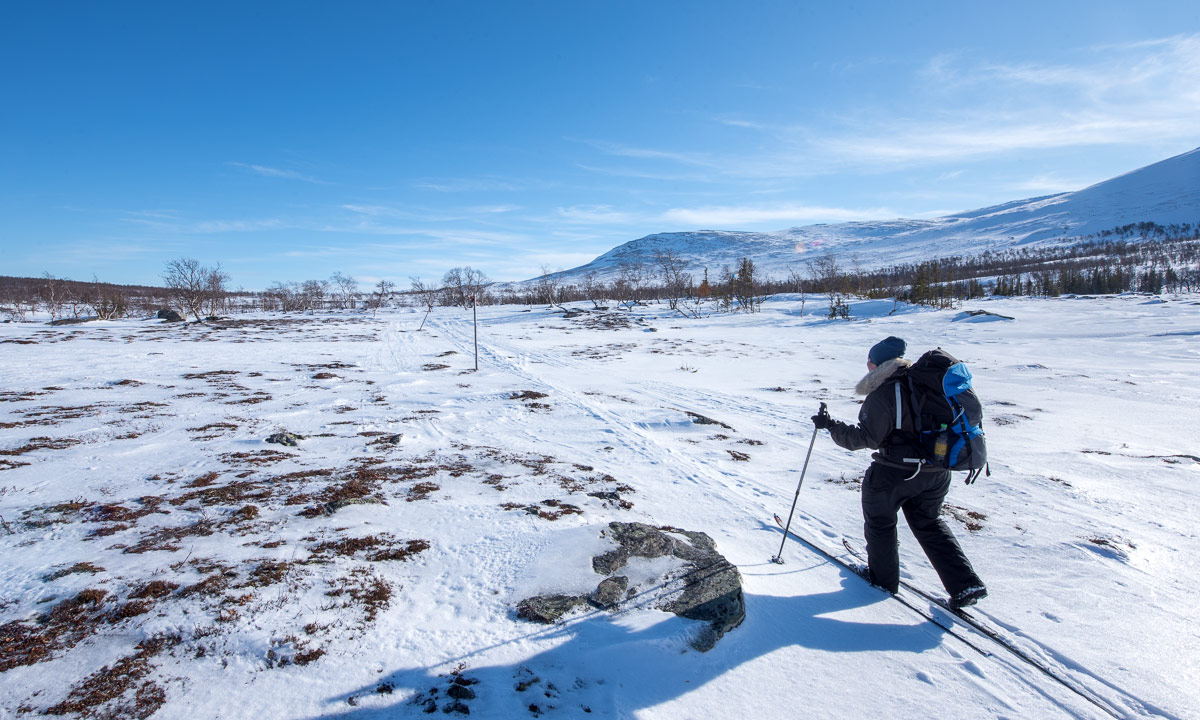
G., the stugvärd recommended to go on the small river Voehpejoeke or Svärfarbäcken, it would be easier to ski. We however do not dare and follow the marked winter trail. That turns out to be a quite bad idea. The trail seems to connect all existing hilltops around. The hilltops are exposed to the wind so that they are free of snow. There is vegetation, rocks and a lot of bare ice where neither the skis nor the poles get any hold. We barely make any progress and our frustration grows. After a while we decide to follow G.’s advice and ski down to the winding river.

You have to know, that there is ice and water under your feet for all we can see is snow, a bit of vegetation and some rocks. We feel safe and we are at least three times faster than before. After some time we come to a wide plain where I make the first tour photo of the day.

The morning had been cold again with temperatures below -20 °C, but it quickly became warmer and clouds have approached, covering the mountain peaks. Despite to the forecasts it is windy and the drifting snow makes the view hazy.

After 5 km we pass a Sámi dwelling, marked in the map as a black triangle.

Then we approach a narrow passage and the frontal wind increases. First I think it is snowing but it’s just the snow driven by the wind. We avoid making smaller breaks because there is no shelter in the valley and we would have to put on down jackets to avoid hypothermia.

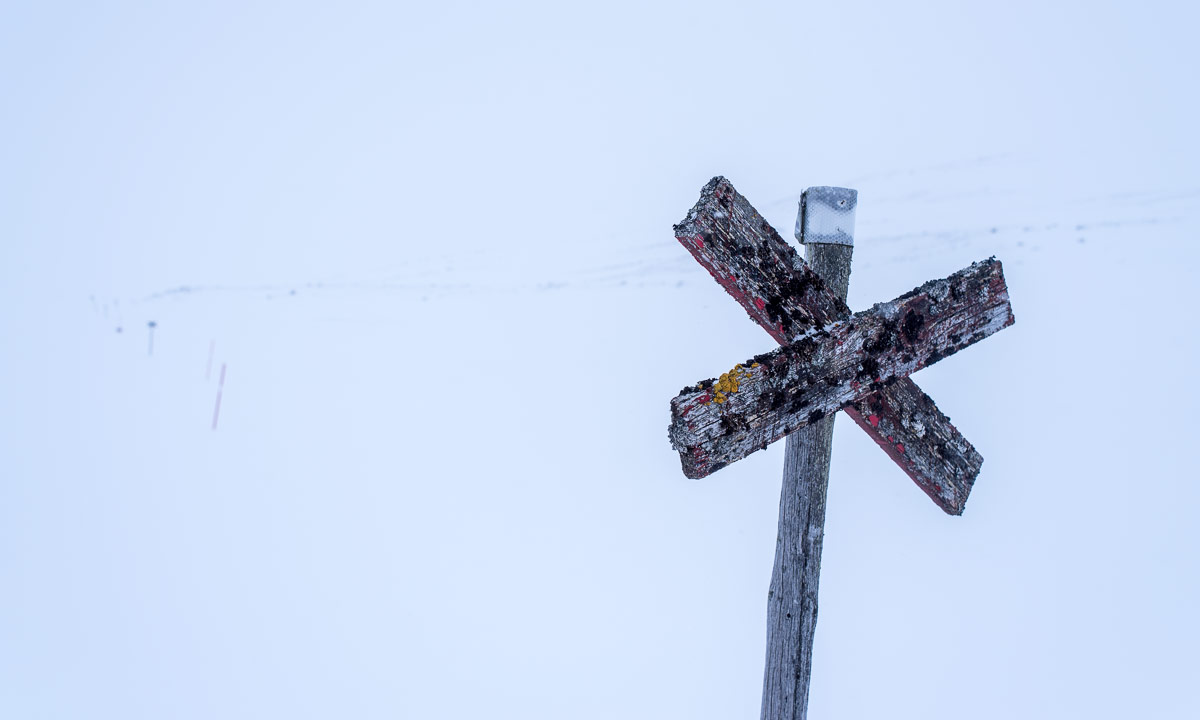
The way is long but navigation is easy. We just have to follow the red crosses. Visibility is not the best but still we can see at least the next three or four crosses. After the valley we have to ascent a pass but the ascent is so slow that we hardly realise, that it’s already the pass. I check our position with the GPS but take the wrong number. I know that it has to be wrong but we continue anyway. What shall happen: we are on the trail and it feels like we are in time. It was only the first stage that slowed us down.

Even though the way is long it is a great tour. Snowmobiles are prohibited and we ski through the untouched snow landscape, completely alone. I do not take many pictures because I don’t want to loose too much time.

It’s still windy. When Annika goes ahead parts of her ski tracks are snow covered after already half a minute. At least it’s not cold, probably between -5 °C and -10 °C.

I check the GPS again, this time more properly. We have come further than expected and are faster than thought. Sometimes we stop to drink a bit and eat chocolate (mostly me) but we try to minimise the breaks.

We are on a plateau now, where the wind is calmer and it’s easy to ski. But we know that we have to descend 300 – 400 metres. And soon we have to ski downhills which is not our most outstanding skill. At least the slopes are wide and there are no trees around.

The trees appear a bit later but still it’s easy to ski. And then we finally meet the first snowmobile trail. It is descending through the forest but it’s so wide that it’s easy to ski down, either directly on the tracks or on the sides through untouched snow. Then we come to the “snowmobile main road”. The signpost says, that 17 km lie behind us and 5 other km to go.

This part is both boring and tiring. The track goes up and down which doesn’t matter for snowmobile drivers but for us. We curse every hill we have to ski up.

But finally we reach our final destination of today’s ski tour. The road E12 in Umasjö.

Our four-day ski tour is over but neither the journey nor the day.

Annika’s colleague F. is staying on her mountain cottage in Umasjö. It is she who comes shortly after our arrival and gives us a lift to Hemavan, where I parked my car three days ago. We buy some food and drink (rich in calories!) and drive back to Umasjö where we meet F. again in her cottage together with her family. We sit in the living room and report from our ski tour. After that we continue our journey to Norway, where we visit friends of Annika in Mo I Rana. The road conditions are not the best and I’m tired but luckily it’s only a one-hour drive from Umasjö.

That has been a long day and an exhausting one as well, but – more important – a great one. Now I’m looking forward to the next ski tour together with Annika.