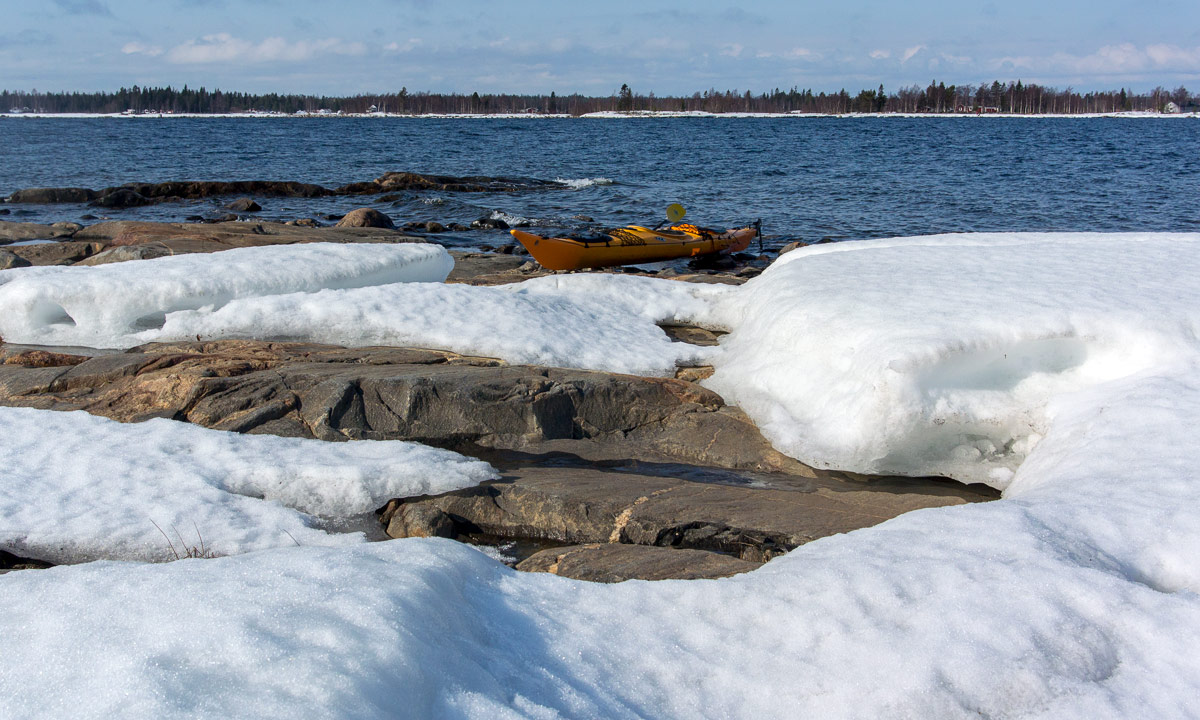
Opening the kayak season

“4:45” showed the clock when I woke up this sunday. Seventy minutes later I stood at the shore – just on time to see the sunrise. My kayak still was fixed on its cart with paddle, camera and dry suit inside.

I put on the dry suit, pushed the kayak into the water and started the tour. When I left home it was -6 °C and parts of the sea where covered with thin new ice. Thin enough to melt under the day but thick enough to give me a hard time to break through with the kayak.

I’m always a bit nervous when I stick my paddle into the ice. Will it break one day? But until now it went well. Sometimes it was easier to take the hand and pull the kayak ahead. And sometimes, when the ice got really thick I used the paddle to hack small holes into the ice that I used as handles for pulling me forward.

But after a time I reached open water and paddled along some old ice floes that were much, much thicker.

And a bit later I came to the huge icy surface, that lays between the mainland and the islands Norrskär and Bredskär. I got out and stepped onto the ice. I think, this is the first time that I stepped onto the sea ice from my kayak. I wasn’t nervous, first of all is this old ice really thick, I should guess at least 30 centimetres, probably more. Then I always wear my completely waterproof immersion suit when I make a kayak trip in winter.

After a short break I continued the tour and headed to the island Gåsören. On the outer shore there were some impressive ice floes left.

It took a while until I could go ashore, because I had to cross another field of new ice. I took a longer rest and took of the dry suit. Ugh! Like always I sweated in the thick neoprene suit and now I smelled like a dead Puma. I took on some other clothes and first it was quite chilly. The spring sun however had enough power to warm me up and soon I took of my gloves and cap.

Most snow has melted and beside of the ice covered rocks at the eastern bank Gåsören almost looked like spring was here.

After a while I dressed for paddling again, entered the kayak and returned to the starting place. With the last ice behind I had a beautiful view of the islands Klubben, Flottgrundet, Gråsidan and Nygrundet. With the blue sky and the blue sea I had the feeling of leaving the winter behind me and paddle into the spring.

When I was home again the thermometer showed +7.3 °C. Almost spring!


Home in Skelleftehamn

I’ve been home again for some days. The weather in Skelleftehamn is between winter and spring. The sky is clear and the nights are cool (last night for example -7 °C) but as sun the sun comes out the temperatures rise soon to degrees above zero.

Parts of the ground are covered with hard snow – in my backyard i measured 45 cm – but other parts are completely free of snow and I’m waiting for the first flowers to come out and blossom.

The Baltic sea is mostly free of ice, but near the shore and in some sheltered harbours there is still a thick layer of ice covering the water. And since the night was quite cold, parts of the near harbour that was completely open yesterday was covered with thin new ice this morning.

Two photos that I made near the small boat harbour Tjuvkistan this morning:

I could walk over the ice to some islands that still are connected to the mainland or I could take the kayak and paddle to some islands, too. But to be honest – I’m quite lazy after the long journey and I guess I stay home today and take it easy.

Through the Finnmark to Alta

Day 47

After a nice stay in Palojärvi i continued my trip. Just 10 km later I crossed the Finnish-Norwegian border and entered the Finnmark, the northernmost part of Norway. It was still very grey, very windy and quite warm with temperatures round zero. And that’s how the road looked like in the open, where the wind covered parts of the roads with snow drifts.

Soon I arrived in Kautokeino, where the Sami culture is quite big. Most signs have the Sami language first, in some of the front yards are fenced reindeers, women wear traditional Sami dresses and on the outside of many houses are reindeer skins hanging for drying.

I made a short break to make some photos of the church and the graveyard.

After a short rest I continued northwards. The landscape was first as flat as a pancake but gradually started to become hilly. Almost all I could see was grey birches and white snow, almost like a black-white painting. The yellow central dividing strip of the road and here and there a traffic sign were the only visible colours.

After an hour the hills got larger and finally a found a parking place, that wasn’t in the middle of a birch wood. Even if the thermometer showed 0 °C it was extremely chilly due to the strong winds that even shook my parked car and I had to protect face and hands against the coldness. Just one picture into the valley showing a small village.

The hills got steeper and sheer rocks appeared, some of them covered with turquoise blue ice that seemed to glow from its inside. The landscape started to get a bit colourful.

Now the most interesting part of the road began. I was a bit disappointed that I couldn’t make any photos, but the road had so many curves and bends and not a single parking bay, that I didn’t dare to stop. Suddenly the road was bordered by steep black-brown rock walls, it was almost like driving into a canyon. Then the road went down, the landscape opened again and suddenly I was surrounded by a green pine forest. After some hours of seeing only black-white it was amazing and felt like driving into another country with another climate. Minutes later the cloud layer broke and the sun lingered through the gap illuminating a snowy mountain at the horizon making all finally colourful again.

This looked so nice, that I decided to stay to nights in Alta. Now I only needed a cheap room. The employees at the  tourist information had some difficulties in understanding that their job is to help tourists, but that’s another story … . Finally I could convince one of them to find a room for me. I drove back to the camping place in Øvre Alta, where I stay in a nice, small cabin without water but with internet (that’s more important!) for two nights. But before it went dark I returned into town and took two images near a partly frozen bay.

Abisko: White snow, white sky

Day 18

Another ski tour today, not up the hills but down to the lake Torneträsk, which ist the seventh biggest lake in Sweden and 168 metres deep. But on the lake there’s a layer of at least 50 cm ice and a bit snow. This snow was so low in contrast that you could see just a uniform white without any structure at all. When I came to the first small island I could hardly see where the slope began. White snow, white sky.

I went half around the first nameless island and half across. Then it was only some hundred metres to the island Ábeskosuolu which is bigger and higher. I didn’t dare to climb the top with my skis but went around here and there. After taking a rest I continued to Abisko Turiststation, the big tourist station in Abisko. I went over the ice straight ahead.

Even on land I tried to continue quite directly, which was both quite stupid and quite funny, because the labyrinth of steep small hills was full with a thicket of birches. A snow hare looked at me from a safe distance. I guess he thought, I’m mad and perhaps the hare is right. I continued plunging through the deep snow taking many detours to come uphills until I reached the station. Arrival 13:45 – just in time to get a late lunch. I enjoyed especially the salad bar. After a rest and eating a bit too fast and too much I went back to the village Abisko, but this time on the direct way near the road and the railway line. That’s only two kilometres and I was soon home again.

Meanwhile home: A snow storm has covered Skellefteå and around with huge amounts of snow. Some people wrote on Facebook, they’d been snowed in. I looked at the photos and – yes – I, as a snow fan would love to could have shared this experience. But on the other side we had much snow in Skelleftehamn the last years, especially because the nearness to the coast. For example:

Here in Abisko wind starts to increase and snow shall come tonight, but just some centimetres.

Abisko: A first small ski tour

Day 17

Finally – my first time on skis! I didn’t dare to use them in the Tromsø mountains, they are too steep for my mediocre skiing abilities. The mountains – the fjäll – in Abisko however is not so hard.

EquipmentWhat do I need for a (short) day trip? Let’s see …

  • windproof clothes
  • a down jacket for resting
  • warm woolen mittens
  • hot tea
  • goodies
  • a compass
  • a good map
  • my GPS with spare batteries
  • first aid kit
  • headlamp
  • camera equipment
  • bivy bag
  • some money (just in case)

I love it when I can start a ski tour just from the doorstep. Weather was fine, partly blue sky, partly clouds, -15 °C and no wind at all. The first time in this winter I put on my ski shoes, attached the skis, unattached them again to get the other mitten that still was in the house, attached the skis again, took the backpack and ski poles and started the tour. First the tunnel under the railway (Stockholm–Narvik) then up the street and into the open woodland. First I followed the snowmobile tracks. That’s easy because the snow is solid and it’s easy to go. But it’s a bit boring, too. So I left the trail after a while and went cross-country. The snow is new – it snowed 30-40 cm the last days and quite soft. Soon the skis were more under than on the snow, mostly calf deep, later sometimes more than knee deep.

In average the snow was 70 cm deep – that’s not so much for the fjäll, but I was quite glad that I could continue cross-country even if it was a bit exhausting. Again and again the snow around me slumped down under my weight sometimes snapping like a whip, sometimes growling like thunder. This is what avalanches are build of. It was clear that I had to avoid all steeper terrain today.

Soon the valley Lapporten, that you can see from Abisko as well, came into view again.

I hit another snowmobile tracks and followed them. An a slope ahead a snowmobile approached and I stepped aside to make place – sinking into snow almost knee deep again. The snowmobile was followed by eleven tourists that booked a dog sledding tour. I laid down into the snow to make pictures and since the dogs came to a stop I could make a photo of the husky with its snow-covered nose.

The dogs continued and so did I. But now I had a minor challenge. The track on the slope was quite steep and so narrow, that I couldn’t make V-steps big enough to go up on skis without sliding back. So I left the track and tried to go up zigzag beside the track. But after ten steps I was bogged down into the snow more then knee deep. I tried to go up, but impossible, at least for me. I returned to the hard snowmobile track, unmounted the skis and went up afoot.

Up on a bleak plateau I left the snowmobile trail and continued cross-country again in direction Lapporten. On the treeless plateaus it has been much windier and the snow was pressed and beared my weight. I continued a bit further and enjoyed the beautiful views and impressions.

But soon I headed back and skied down again through the untouched terrain. Downhill skiing was a bit thrilling: Some patches where hard and the skis ran fast but soon a patch filled with deep soft snow waited for you. It was pure luck that I didn’t fell. Four hours later I was in front of the house – right before the doorstep. A nice tour.

Car trip to Tromsø – partly nightmare, partly relaxation

Day twelve

Today I said goodbye to my friends that I stayed with the last week and headed to Tromsø in the north which is round 400 km away. I thought about driving as long as I like, making a over-night stop and continuing the next day.

The weather was quite bad. The temperature has increased to +5 °C, it rained and it was quite windy. But travelling was relatively easy until I came to the first mountain passage. And this part turned out to be the most terrible car ride I had in my whole life!

The nightmare part

The rain – sometime mixed with wet snow – became more and more intense, until rain was just bucketing down on the frozen roads. Sometimes I drove through deep puddles, pushing a bow wave like a boat, sometimes deep slush covered the narrow roads that oncoming cars tossed onto my windscreen temporarily reducing sight to zero.

But mostly the roadway was covered with a thick layer of wet new ice that was slippery as hell. So slippery that I hardly could accelerate or break or steer or do anything without starting to slide. Thanks god for the traction control of my Saab. I wouldn’t have managed without it.

Do not forget, I’m not talking about broad Swedish streets, I’m talking about narrow Norwegian streets, that only consists of tiny bends and sharp hairpin curves, roads that constantly go left and right, up and down. And that’s the main road I’m talking about!

And I’m talking about other car drivers. Car drivers that don’t mind the weather but drive as usual: Too fast! And I was way too slow for them. If they were behind me, they glued their car to my rear bumper and I used every parking place or bus stop to let them pass.

I was stressed, I was frightened and I was frustrated! Was it a smart idea to make this winter journey or was it just stupid? Should I skip Norway and head back to Sweden, where roads are broad and straight? I started to understand why many Norwegian roads are closed when weather is bad. I decided not to continue to Tromsø, but to drive back to Abisko, where the streets are better and in addition to that weather is cold enough to avoid these awful wet and icy roads.

The relaxed part

But first I had to continue the same road, regardless whether of staying in Norway or driving to Abisko. But alas, the weather became better and better and so became the streets. Now it was not only easy to drive, it was fun! It felt like I could continue for hours and hours without any effort. And so did I. 19:45, eleven hours after the start in Haukenes, Vesterålen I arrived in Tromsø.

Wait a moment, eleven hours of driving? For 400 km? No, not really. First of all I stopped at two different bays and walked at the sandy, muddy and ice covered shore lines. I love these walks and consider them extremely relaxing.

In addition to that I made a detour. OK, I’ll be honest: I missed the road to Tromsø and had to head back 19 kilometres to Breivik.

And I made a stop and ate a big burger with fries and drank a coke. Driver’s junk food!

Now I’m sitting in my tiny cabin on Tromsø camping and I’m writing this blog article. The radiator tries to heat the cold cabin but it will take some time until it is warm. But I’m wearing my down suit and even my sleeping bag, both are extremely warm and cozy. A cheer for good equipment and overdressing!

Back to Haukenes

Day nine

Today I drove back from Andenes to my friends in Haukenes where I’ll leave on Sunday or Monday. I didn’t choose the direct way on the eastern side of Andøya (82) but the detour on the western side via Stave and Skogvoll. There where some fantastic views, mostly at places where I couldn’t stop. But anyway, some images of today (and two of yesterday):

Let’s start with some houses in Andenes build on stilts (The greenish colour on the second photo comes from the polar light).

Andenes next morning and Bleik, where I took a long walk on the large sandy beach.

A small graveyard and a real tiny light house.

A man hanging up fish heads for drying (for the african market).

And last not least some landscapes when sun went down again.

That’s today in a nutshell.

T minus 35 hours

Now I’ve made up my decision: I’ll start my journey on Thursday round 11 o’clock. That’s only 35 hours left! I’ll have to work all day tomorrow to manage my departure in time. Mostly it’s packing the zillion things I’ll want to take with me, but I have to continue and finish the installation of my travelling computer (my old MacBook Pro) and we all know: Working with computers always takes more time than planned and excepted.

Anyway, I managed to take a photo of the cement carrier Sunnanvik that regularly goes ashore in the bay nearby. Look how ice-covered the foredeck is! I would have preferred a wide angle lens shot from a lesser distance, but the whole bay was clear of ice some days ago and the new ice is much too weak to bear me.

That’s probably my last photo made in Skelleftehamn for long. When I’ll write the next blog post, I’m probably in the midst of Swedish Lapland already.

The magic ice world

Today I was in another universe. At least it looked a bit like it.

After my adventure on the “ice shelf” last night I longed to see the place by daylight. Breakfast was late but so was sunrise and right after I’ve eaten I drove to Näsgrundet again. We had -17 °C (more or less the whole day by the way) and some snow crystal fluttered out of the grey stratus clouds. I put on my grödels – simple crampons – to be able to go on the ice slope. Soon I stood at the rim and looked down into the calmed down sea. The view was quite impressive …

… but …

it would be great to see the ice walls with its icicles from the seaside. It’s not, that I didn’t think about it before, that’s why I had both my waterproof camera and my waterproof survival suit with me. I undressed a bit (not the funniest thing when it’s -17 °C outside) and slipped into the red suit. Then I took the camera and glided into the water. And that’s where I entered another universe. But enough words, the photos! Here they are:

I really loved to paddle in the ice water and to look at the ice walls that where decorated so beautifully wich icicles. Since the attached rubber gloves are waterproof, but not warm at all, my right hand index finger didn’t like the adventure as much as I did and got a bit of frostbite (it still hurts a bit but nothing serious, fortunately). And that’s how I looked like today when I took all these photos:

Winter intensifies

Did I write about the “just normal” winter two days before? Well that changed a bit. Right after I wrote the last article the snowfall intensified and brought 10 cm new snow within 16 hours. It got both windier and colder and still snowed a lot.

Today¹ I took a walk round the small lake Rudtjärnen. Snow fell in thick, heavy flakes and made it impossible to look farther than 100 meters. The squalls whirled up the snow morphing the view into a grey-white nothing. And it was even windier on the slope by the lake. The trees on the 2nd photo were hardly 50 metres away!

That was a nice and not so long walk (which was intended since I don’t want to overstrain myself right after the infection), but it wasn’t enough. I wanted to go out again. And so I did. This time with food and drink, (of course) my camera, my new flashlight and my new down clothes for some testing. I already guessed that I couldn’t drive to the small boat harbour because the way wasn’t ploughed and snow was too deep for my car. So I decided to continue to the peninsula Näsgrundet. What a piece of luck!

I dressed up for cold weather, lit my new strong flashlight and went to the rocky beach. Normally the shore descends to the open sea but not tonight where – I couldn’t believe my eyes – the shore was an ice shelf rising up at least one meter before dropping into a black nothing. I could hear the sea behind but I couldn’t see it. Where am I? What happened? Then I heard a rolling wave and – SPLAT! – I could see water and foam rising high up behind the brink and clashing onto the ice shelf! It took a moment or two until I realised what happened: The brisk northern wind presses the waves ashore where they rocket up into the air several meters. I guess that the water and foam first landed on the rocks where it probably froze almost instantly – remember, it’s -15 °C  out there. The rocks became more and more ice covered until they vanished under a growing layer of ice. When I came to this place this evening some parts of the ice were already two meters above sea level! And still some of the waves managed to toss a lot of water onto the ice where it froze and enlarged the ice shelf. What a fantastic experience!

I was both happy to be out there and a bit disappointed that I couldn’t share this moment. If I at least could take a photo, but how to take pictures of waves when it’s so dark. Wait a moment – dark? – My new flashlight was described as extremely bright – Let’s test. I switched the flashlight to the brightest mode, laid it onto my backpack and adjusted the beam to the waves. Then I took tripod and camera and started to experiment. And that’s the result:

I’m impressed. The new Flashlight is really bright. So bright that I can take such pictures at night time. (For the photo freaks: 1/20 sec at f / 4.5, ISO 1600. 35mm)

OK. The flashlight succeeded the test. But what’s with the rest? I was curious how warm the new bought down parka and down pant would be. I just wore a single layer of woollen underwear and my thin but windproof Norrøna-jacket, mostly to test the fur under the down clothes, that was all. (Not mentioning boots and gloves, of course). I’ve been out more than an hour, first taking pictures, then measuring wind and temperature, than taking my frugal evening meal. And yes – the Marmot down combination is as warm, snugly and cozy as it looks like. Almost too warm when sitting although we had an average wind speed of 10 m/s resulting in a wind chill of  -27 C. That’s good to know.

Now I’m longing to sunrise. I want to visit the spot again and take some daylight pictures. That’s perhaps evan a reason to postpone my journey another day. I’m not in a hurry. But tomorrow, when I’ll visit the place again I’ll wear something less water-sensitive than down, because tonight I always expected a huge monster wave would flood half the shelf and soak me completely.

Finally just two selfies from today, one when I walked round the lake, the other when I sat outside after the evening meal.

Foot note:

¹ As a matter of fact: Yesterday. It will already be Monday when I publish this article.

Some vocabularies for my German readers:

squall – Windböe
down – (hier) Daune
foam – (hier) Gischt
flashlight – Taschenlampe
fur – Pelz

For equipment nerds:

Flashlight: Nitecore EA41 Pioneer
Down clothes: Marmot 8000M Parka, Marmot 8000M Pant. Older (or simpler) models.

Just for the archives:

Friday 2015-01-09 21:45 ca. 30 cm -4.6 °C
Saturday 2015-01-10 13:40 ca. 40 cm -7.1 °C
Sunday 2015-01-09 09:15 ca. 45 cm -8.6 °C
Sunday 2015-01-09 16:55 ca. 52 cm (47 cm backyard, 57 cm front yard) -15.0 °C