Kungsleden: returning to civilisation

This article is part of the series “2016-02: Ski tour on the Kungsleden”.

From the Tjäktjastuagn to Alesjaurestugorna

27 February · 13 km · Link to map

This day I continued to the Alesjaurestugorna, the last mountain hut in the kalfjäll –  the treeless mountain landscape in Lapland. Perhaps that’s why I was a bit sad, because I love the bare mountains and I felt that I had to say farewell to this outstanding landscape soon. I said farewell to quietness a bit, too, since I knew, that Alesjaure would be quite crowded:

But first of all I had a nice trip of thirteen kilometres to go. Weather was good and the way was short and easy, even if there were some patches with hardly any snow that I had to bypass. So I arrived in Alesjaure already at a quarter past one, being the first guest.

Other guests came, from Austria, from Germany, from France and from Denmark – many interesting people. And in between five scooters arrived – all with a trailer loaded with figures dressed in huge black down parkas and ski goggles – the Englishwomen. Their plan was to go back to Abisko on skis in two days with some detours to make it a full marathon distance.

The rest of the day was relaxed and easy-going. First I sat the sauna, then I made dinner (an outdoor meal called “Rice with basil” – quite boring). After that I sat together with all those kind and interesting people. At half past nine one of the Danes started to make pancakes – and I was invited! The Danes told me, that each of them has a surprise for the others on their tour and the pancakes were the first surprise. What a great idea (especially, since I benefitted from this surprise). I went to bed at half past ten – much later than the last days.

From Alesjaure to Abiskojaure

28 February · 20 km · Link to map

The next day I wanted to continue to Abiskojaure, that’s the longest part of my journey. The last tour days had quite short distances between 12 and 14 km and I was rather slow. As a photographer I have a good excuse: It’s making photos, that takes time, not my slow speed! Anyway, today I planned to start very early and decided to go a bit faster to avoid arriving in darkness. But first I had to get water, there was hardly any left.

If you tent in the winter, you’ll have to melt snow in most cases – this takes a lot of time and doesn’t taste well. The mountain huts on Kungsleden have ice holes to get fresh water, either in lakes or rivers. The ice hole of Alesjaure lies exactly below the summer bridge. It is covered with a wooden look to reduce freezing over, but I had to break the fresh ice anyway. It’s almost impossible to fill a 25 litre container with water (lowering the bucket into the small hole – pull it up again – pour water through the funnel – de-ice the funnel – pour water through it again) without getting wet hands. Oh, what I longed for waterproof gloves. My fleece gloves were completely soaked and my fingers got so cold that they itched when I “defrosted” them above the gas oven.

That’s why I started a bit later than planned and at the same time as the marathon skiers. They followed the official winter way, I took the short cut over the frozen lake Alisjávri. Although I took pictures I was faster than the skiers – some of them probably stood on skis the first time – and when I left the lake to join the winter way they already lagged behind.

I tried to go a bit faster, but stopped for some photos:

After I went more than half the way I took a break. It’s quite warm: -5 °C and even the cloud-covered sun warms a bit. For me it was a bit like saying good-bye. Good-bye to the treeless kalfjäll. Soon I will enter the narrow valley Gárddenvággi where terrain declines. And soon after I finished my break and continued the tour I saw the first small birch woods. The sun has disappeared behind a cloud layer and the landscape got monochrome. Dark birches, white snow, only interrupted by some red waymarks.

The last descend to the woodlands is quite steep. I decided to unmount my skis and go on foot. Even so the pulka tried to push me down towards the valley and I had to lean back to avoid being knocked over. After some minutes I was almost level with the Abiskojaurestugorna and went the rest of the tour through denser birch forests on skis again. I have to admit that I found this part a bit boring – we have snow and trees in Skelleftehamn, too, but soon I arrived at the mountain huts, where I spent the rest of the day.

In the evening I met C. who wanted to go to Abisko the next day and we planned to do this last part together.

From Abiskojaure to Abisko Östra and home

29 February · 15 km · Link to map

Let’s make it short: This day was travel day. C. and I woke up at 6 o’clock. Not by our own will but because we had the loudest snorer ever in our room. Jet engine level! We took a short breakfast, packed our pulkas and started our tour. Not to Abisko Turiststation, the classical start and end of the Kungsleden, but to Abisko Östra, the station of the village Abisko. I went on skis, C. just with normal boots, since the snow on the snow mobile tracks was packed and easy to walk on. C. was much faster than I use to be, but we headed for the 12-o’clock-train and I was keen to get it, too. We took two breaks: One for elevenses (or some kind of pre-lunch), one for the reindeer posing in front of the kåta.

We mad it, we even had an hour time until the train arrived. 14 km in 3 hours, 8 minutes (including the two breaks) – that was the fastest part of my tour. Thank you, C. for helping me leaving my comfort zone a bit.

The rest of the tour: Train from Abisko Östra to Luleå. Bus from Luleå to Skellefteå. Bus from Skellefteå to Skelleftehamn. I was home at 21:30 – 13½ hours after starting on skis in Abiskojaure.

Now it’s midnight. I’m sitting in the living room of my house in Skelleftehamn. I really like this place, but I’m already longing to the Swedish Mountains again. Perhaps another ski tour later in April?

Well, we’ll see …

Kungsleden ski tour: From Nikkaluokta to Singi

This article is part of the series “2016-02: Ski tour on the Kungsleden”.

It was 2005 when I was asked by C. from Switzerland, if I wanted to join him on a ski tour on the Kungsleden – the King’s trail. That’s how I came to my first ski tour in the mountains of Swedish Lapland. More tours followed, but sometimes it was hard to find a tour mate. Same thing this year; that’s why I decided to do my first ski tour on my own.

Kungsleden would be ideal for that, since there’s infrastructure as mountain huts and I won’t be alone. Good to know, since even twisting an ankle could be a serious problem in winter if no one’s around. I wanted to start 19 February, the day, when the huts open.

After a long trip I reached Nikkaluokta (many thanks to A. for the lift from Kiruna!) on the evening of the 17th I had one spare day in one of the cosy cabins of family Sarri. This place can be very cold and I had a look at the digital thermometer in the cabin: -44.8 °C minimum since the last reset – brr, that had been a cold day!

I climbed the small church hill and looked west. That’s were I’ll go the next day.

From Nikkaluokta to Kebnekaise Fjällstation

19 February · 19 km · Link to map

Time: 7:40, temperature -17 °C, weather: cloudy. Time to start the tour. I mount my skis, put the belt of the pulka (a sled for transportation) round my hips and after some gliding steps I see the first mark of the winter way to Kebnekaise.

It’s the only mark for a long time, the winter way to the Kebnekaise Fjällstation is not marked, neither on the map nor in real. But it’s easy to find the way, since many snowmobiles take this way and you only have to follow their tracks. Soon I’m at the place where the trail crosses the stream Čievrragorsa. In summer I used the chain bridge, In winter the snowmobile goes right over the frozen and snow covered stream. I can hear the sound of water running underneath the ice – a strange feeling.

After some kilometers I come to the lake Láddjujávri. Here you can eat waffles with cloudberries or burgers at “Lap Dånalds” and even take the boat over the lake to shorten your trip a bit. Well – in summer …

Hardly imaginable that I took a bath here six month ago on a hot summer day, when I was here with Annika. Not it’s winter, all is closed down, the boats lie on land and are covered with snow and I’m completely alone. Anyway it’s not too cold and I take a first rest on my tour. Without waffles, without a refreshing bath, but with the same beautiful view as in summer, since the sky starts to clear up and one mountain top after the other starts to get free from clouds, fogs and haze.

When I continue my tour over the ice of the frozen lake I soon can see the same mountain range as I did in summer. And it’s as beautiful as in summer, too.

After some kilometres the trail leaves the lake and continues through scattered birch forests and over frozen swamps, some of them covered with ice. The weather is fine and sky is of a clear blue with some clouds.

Another rest, this time on top of a rock, with hot tea, chocolate, and a bit of salami. What a beautiful day! I could sit here for hours, but I shouldn’t. I have to reach the huts of the Kebnekaise Fjällstation. I do reach them, but before that I have to work. The trail ascends and I have to make wide V-steps with my skis to be able to pull the pulka uphills. Finally I arrive. This mountain resort is quite huge, since Kebnekaise is the highest mountain in Sweden and very popular among hikers, skiers, and climbers. Anyway it is not opened yet beside of the cabin Jägarn (“the hunter”). Here I’ll stay overnight before I’ll continue to the Singistugorna the next day. Twice I climb on the small hill with the radio mast, first after sundown, then at half past six – where I see the first polar light of the tour.

From Kebnekaise Fjällstation to the Singistugorna

20 February · 14 km · Link to map

When I wake up sky is blue again and -17 °C. I take a short breakfast with muesli and prepare for leaving. That means: packing all things – doing the dishes – cleaning the kitchen and my bed room – checking that I have everything with me – putting on skis and pulka belt. Meanwhile the sky is overcast and it has started snowing. Weather can change quickly in the mountains.

After I have walked some kilometres it clears up a bit, just so much, that you can see some mountain tops shining through the hazy fog.

When I enter the narrow passage of the valley the mountain tops hide again, which is a pity. The mountains here are so beautiful.

There is not much snow in the mountains this winter. Parts of the marked winter way lead over stony passages with no snow at all. I have to go round these passages to avoid ruining my skis and pulka. Mostly I follow the snowmobile tracks, hoping that the locals know the best way.

This way leads over the frozen river, but sometimes it’s hard to see, since the snow under the overcast whitish-grey sky don’t show any contours. Wind increases, snow falls as well and the snow starts to drift in the increasing wind. In the narrow valley between the mountains Siŋŋičohhka and Liddubákti more snow lies on the ground which makes it easier to ski but worse to see.

That’s when you are really glad about the winter way marks: Red crosses set on long poles. Sadly plastic crosses are used nowadays. They are ugly, in my opinion harder to see and many of them are broken. But I’m glad to have them anyway. They do not only show you the way, they help you even in guessing whether it’s going up or down, which you cannot see, if visibility and sight are poor.

I always have compass and a good map with me on such tours. Anyway, if you cannot see any landmark these tools are of limited help if you do not count steps or know how fast you are on your skis. That’s when a GPS can be very handy. When I make another rest, longing for the mountain huts Singistugorna, the GPS revealed, that it’s only 970 meter to go. Easy!

Well, not really. The valley opens, wind increases and there are many rocks and snow-free parts on my way. I decide to circumnavigate a steeper passage and ski a bit to the right. To my big amazement I don’t go down but keep on level. Suddenly I feel part of the ground collapsing a bit and realise that I stand on the rim of a soft snow drift, about two meter high. It was absolutely impossible to see it. I’m lucky, that I didn’t fell down! I go back and circumnavigate my circumnavigation until I’m on the marked trail again. There I can see the cabins shining through the drifting and blowing snow. It takes some time to find a good way down to Singi but finally I arrive. Here the wind seems to be even stronger and the snow falls even more intense.

Stugvärd J. shows me my room, light fires in the ovens of the kitchen and my bed room and allows me to take my pulka inside since I’m the only guest. After doing some work he leaves and heads to his own cabin against hard wind and snow.

According to the forecast wind will increase even more and snow fall round 20 cm are expected. I’m glad, that I have time and plan to stay at least one other day in the Singistugorna, perhaps two.

The next article: Singi – from blizzard to clear sky >>

A short trip to Arvidsjaur – Dessert

This article is part of the series “2015-12: Short trip to Arvidsjaur”.

Monday afternoon at our cabin near Arvidsjaur: -22 °C. How cold will it get the night. Well, not so cold, since the sky overclouded and it got gradually warmer. The next morning the thermometer showed mere -11 °C. The sky was overcast and the diffuse light seemed hardly able to light up the scenery.

Annika and I took a small snowshoe walk on the lake Arvidsjaursjön. Last night’s fog has covered all trees with a thin white layer of hoarfrost and the nature looked more like an old black-white painting than real.

What a contrast to yesterdays mountain hike in full sunlight!

Two other pictures of the same day:

These images were taken on a minor side road. It felt like being hundred miles away from civilisation, but the main road was just 500 meters ahead.

When it darkened the sky cleared up again, but now we were ready for our way back to Skelleftehamn where it was quite warm compared to Arvidsjaur: -1 °C.

A short trip to Arvidsjaur – Starter

This article is part of the series “2015-12: Short trip to Arvidsjaur”.

On the day after Christmas Annika and I thought about making a short trip to the “inland” where weather is colder and snow depth is bigger. What about Arvidsjaur for example where I’ve been six weeks before. It’s only two hours away. We looked for a room to stay overnight but we weren’t lucky in finding a room that was (a) affordable, (b) nice and (c) free.

Therefore I asked on Facebook if someone would have a tip or even better a stuga – a cottage. Ten minutes later Pär, a friend in Skellefteå, answered and offered us his private stuga for as long as we want to stay. What a great offer!

The next day we packed the car with warm cloths, food, snow shoes, camera equipment, bed clothes and a lot of water (which the stuga lacks) and drove to Arvidsjaur. Round 9:30 we arrived and were glad that neighbours already started the main heating, since it was -12 °C outside. After unpacking the car and switching on the others electric radiators we made a short trip by foot. Days are still short – 3 hours, 12 minutes this day – and as short was our trip. Mostly we walked in the shadow of the pine trees, first on the small road, than on a snowmobile track, but sometimes the low sun shimmered through a gap in the trees.

When we stood at the lake we could see Arvidsjaurs local tree-covered mountain with some ski slopes cut into the wood. Left of it was another mountain, that was completely treeless and snow covered. It looked quite high. How far it might be? Round the corner or many miles away? We planned to check this the next day.

Evening was calm – inside as outside. Stars twinkled above the frozen and snow covered lake right behind the house. The next photo is taken from the terrace. The photo reveals to types of light that were invisible in real life: The pink gleam of Arvidsjaur and a the greenish glow of a very faint polar light.

Areas of water

There’s a lot of water round Skelleftehamn. North and east lies the Baltic Sea, in the west and south runs the river Skellefteälven and in the forests around there are some lakes such as the one kilometre long Snesviken.

As several times before, winter came when I left the country for a visit in Germany. That figures! But it didn’t last long. In my absence Skelleftehamn got 20 – 30 cm snow and one cold day with a minimum of -12.9 °C. Then it got warmer again and rain melted away most of the snow. Since I came back on sunday it snowed a bit with temperatures round 0 °C.

Today I was curious, how much ice would lay on the waters. First I checked the Baltic Sea round the peninsula Näsgrundet. The water still was completely open. The same at the small boat harbour Tjuvkistan.

Next stop: Sundgrundsbron, a bridge crossing the Skellefteälven which is round 700 meters wide at that place. The eastern part – the mouth of the river – was almost completely open too, with some thin ice at the riversides, while larger areas of the river itself in the west were covered with ice.

Next stop: Rudtjärnen, a smaller lake in the forest nearby. It might look like waves, but the lake is completely iced, as well as the larger Snesviken.

Next stop: Storgrundet, which is both an elongated island and a small sandy beach. The Baltic Sea between island and main land is sheltered from wind and freezes over quite early. Round three-quarters of the water were iced too.

I would love to paddle at least one more time before the ice becomes too thick, but I’m afraid that I have to look for another starting point as my favourite Storgrundet.

And then I’m longing for cold weather that freezes over the Baltic Sea so that it’s possible to go or to ski to the islands.


Winter journey in a nutshell

It snowed in Skelleftehamn tonight. It’s hardly a secret, that I love winter, snow and coldness. In Skelleftehamn however it would be too warm, because the Baltic Sea is near.

Therefore I decided yesterday to take a day off today, take camera and car and travel towards winter. In the inland the climate is colder and hopefully there would be more snow. I started at 6:45 in darkness. The first part was no fun to drive. Road salt is used on the big road to Skellefteå and the road further west. With temperatures slightly below zero you always have a film of muddy saltwater on your windscreen while the wipers still are partly frozen and will not work properly. That in combination with approaching cars with bright lights makes it hard to see and much concentration is needed.

That instantly got better when I left the big road 95 (that would bring me to Bodø in Norway) right after Jörn. The smaller roads are covered with ice and hard snow – much easier to drive and the windscreen stays clear. And it looks much more like winter than a wet road. And while in Skelleftehamn even the duck pond is open, here the lakes and some small streams are ice and snow covered.

I continued the road and drove to Storklinten, a small ski hill. Well, it wasn’t so interesting yet with only round about 10 cm snow, but the lake nearby – Lill-Klintträsket – was really nice. It started snowing and the tree covered hills farther away seemed to vanish into a white nothing.

The way to Storklinten is a dead-end road and I had to return. I continued the larger road to Myrheden looking for motives. And I found one. The small river Ålsån:

I was glad I had my chest waders with me, so I could come quite near to the motive. And there were a lot of motives this day. For example reindeers. The first small flock was extremely shy and cautious. It didn’t dare to pass my car and left the road starring at me suspiciously from behind the small trees. You can see that they digged for food in the snow, the noses are snow covered and one of the reindeers even had a twig hanging in its antlers.

Further on the road: Town signs with funny looking names (there was even a village called Hej, which is Swedish for hello), more snow covered roads and trees and two extremely well educated reindeers going beside the road in single file.

I’m looking for motive especially, where there are crash barriers beside of the road – there the street will probably cross a river or a creek. Some of them are open, many broader ones with less current are already covered with ice. And on one of them – far away – I could see a reddish animal and some dark spots. A fox? Birds? I looked for the next parking opportunity – sometimes a real challenge – and walked back.

I was right: There was a fox. And some kind of skeleton, perhaps a roe deer or a reindeer. And some crows. And an eagle! It doesn’t happen often, that I see eagles nearby where I live. I made some photos with my tele lens. Zooming in I could even see some magpies hopping around hoping for a snack. The scene was much too far away to get good pictures, but anyway, I want to show you this one:

After a while I started to get hungry. My car too; the red R-lamp has been glowing for a while. Anyway, the town Arvidsjaur, todays destination, was not so far away anymore. As people in former days first fed their horses before eating themselves I first tanked my car with E95, then myself with beef, mashed potato, mushroom sauce and salad. Then I looked around in the city which I think is really nice. Especially in winter with snow – round 20 cm today.

Even if the “real winter” is not here yet the days are already quite short: Sunset in Arvidsjaur was a quarter past two! At three o’clock I started to use the car’s full beam, half an hour later it was quite dark. Time to head home. I couldn’t see any motives any longer and I navigated to the main road. Now driving became exhausting again for a while since it started to snow quite heavily. And if you use full beam while snowing you just see a tunnel of snow flakes swooshing towards you. It’s a big like old televisions science fiction series, when the spaceships activated their warp-drives. And as in space there is no up or down. The second photo may give you a faint idea.

Luckily the snow shower ended soon and the rest of the trip was just about coming home.

400 km and 500 meters – 11 hours 30 minutes – a straining but great one day trip winterwards.

Back again in Skelleftehamn: Snow is gone, it’s pitch black and it’s raining cats and dogs.

Freezing over – day two

Another chilly morning, with -7 °C it was the coldest in Skelleftehamn this season. Again I woke up quite early and took a tour to Storgrundet. There lay more ice on the sea than yesterday and you could see that it was partly ice floes that froze together the night before. However, the beautiful ice rim that I photographed yesterday was gone.

I made a short stop at the lake Snesviken, that is round about one kilometer long. Since we had only two frosty nights after a longer warm period with day temperatures above 10 °C, I was sure that the lake was completely open with perhaps a bit of ice at the shore.

I couldn’t believe my eyes when I realised that almost the whole lake was covered with ice – after only two frosty nights. Incredible how fast it goes!

This evening I had a meeting in Ursviken at the Kanotudden – the canoe bay, where the canoe club has its location. This bay is part of the Skellefte River and it starts to freeze over, too. I really like the clubhouse. It’s a pity that it’s hardly used in winter time – it would be the perfect location for a public winter bath site!

Another frosty morning

-5.6 °C showed the thermometer when I woke up at 6:15. I don’t need to look through the window to know that it’ll be a nice morning with mostly blue sky when it’s so cold in early October. And so it was.

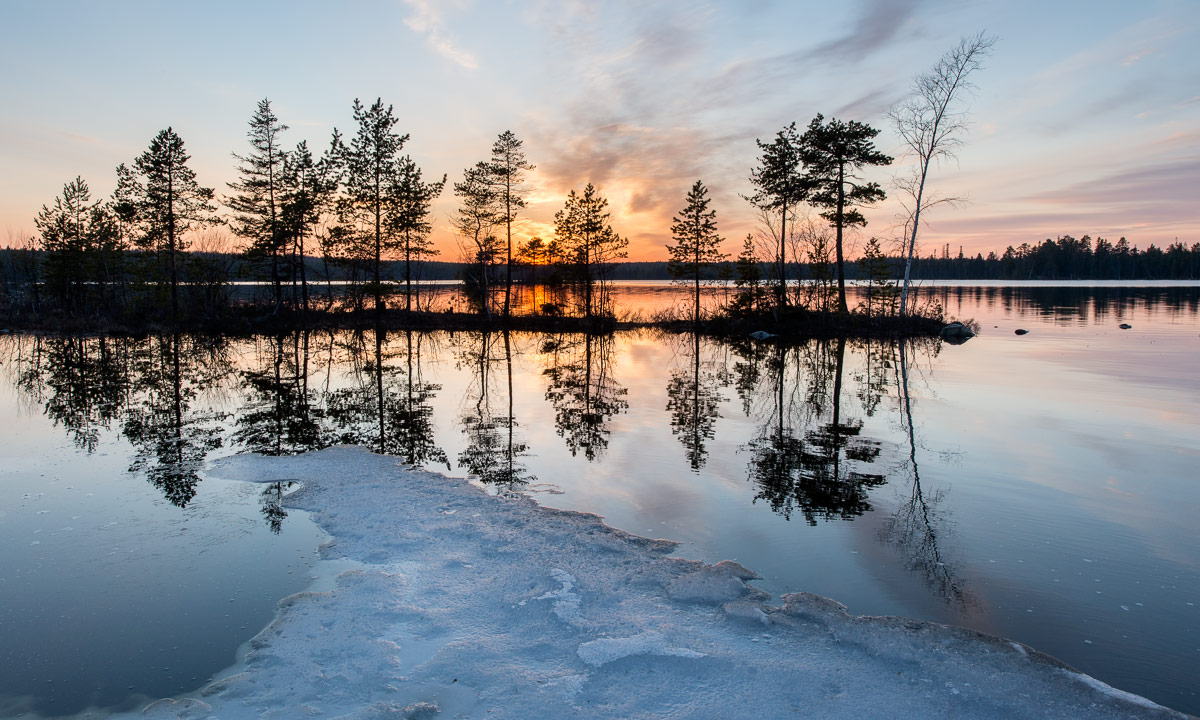
The photo above is taken almost at the same place as the 1st photo three days ago. I prefer the older motive but like the intense colour of the sunlit clouds in the background. To other shots:

Have a look at the second photo, the one with the grass in the foreground. Why isn’t the horizon straight? That’s because I stood knee deep in the water myself, breaking the ice. When this happens, water from the hole will start to cover the ice. I just could take my camera, look through the finder and – click! – take a picture. One second later parts of the ice were covered by a thin layer of water.

That was the main problem: There is no save ground round these swamp ponds, where you could take your time for making pictures or even use a tripod. No, you stand knee deep in water on unstable ground, knowing that another step could bring you in much deeper water. I’m always afraid I could fall into the water and drown my expensive camera. It will me much easier when the ice is thick enough to stand on.

After a while the sun started to rise. Time for some more experimental images:

I realised the frozen bug on the second photo first, when I looked through the images at home. It’s hardly 2 mm big but looks quite huge on this macro photo. Learning: look at the motive even more precisely.

Two sides of an autumnal morning

A cold side and a warm side. The difference? 19 Minutes and 500 meters.

It’s really fascinating that even larger water areas than mud puddles start to freeze over after just three mornings with temperatures below freezing; today round about -5 °C.