A short trip to Umeå

I have to admit, that it felt a bit strange to travel to Umeå. For one thing it’s a big town and for another thing it’s south from Skellefteå and that’s not my usual travel direction.

You may laugh at me calling Umeå a big town. Umeå has 80000 inhabitants and that may not sound very much, but the whole city with its many big buildings and streets feels much bigger, especially if you compare it to Skellefteå – the next town nearby – which is less than half as big and appears only a tenth as busy as Umeå.

I stayed over night in a hotel in the 12th floor with a nice view over the town and the river Umeälven. What a pity that it rained almost the whole time.

Today it still rained a lot and I didn’t have any interest in city sightseeing. So I fled the town and took a long walk in nature. That’s much more my cup of tea.

Deforestation in Skelleftehamn

When I moved to Skelleftehamn in July 2010 I directly fell in love with the nature around. The Baltic sea with the stony shores, the islands and the pine and birch forests. One place I really love is Storgrundet, which is name of both an island and the tiny sandy beach at the mainland. It’s my favourite starting point for kayaking, because you’re into nature directly, but I guess I have to wait some more days until I’ll be able to start there, since the sea is still partly ice covered. Two images of yesterday:

Storgrundet – a beautiful place. The way that leads to it however has changed. Last autumn it was framed of dense forest, now many of the trees are cut down and the way is framed by piles of tree logs. It brings to my mind that almost all forests in Sweden are no wild untouched primeval forests but commercial forests. There’re not only used for collecting berries and hunting moose, but for hugging down trees, too.

Now I’m sitting a bit on the fence – on the one hand I like wooden houses and furniture made of wood and I love to fire a cabin or a sauna with birch logs. On the other hand I really loved the forest around and when I walked cross-country today, I felt a bit sad seeing the clear-felled areas. I’m glad that the terrain is not too easy to enter with forestry machines. There are some really big rocks and many shallow ponds and swamps. I guess that’s why there’re a lot of single trees left. But it’s not the same anymore.

Now, that many trees are gone, you can look much farther and I realised, how many swampy areas were hidden in the woods. Now they are quite visible and they look fascinating and desolate at the same time.

I do not have anything against using the forest and cutting down trees, but anyhow I felt sad, when I walked through the destroyed landscape today.

Yes, we can waves

Strange weather we had today. Sky was blue and the warm sun warmed up the air, but it was really stormy. Even if the wind came from west, we had a lot of waves on the Baltic Sea, that sprayed sea foam high up into the air, where storm gusts blew it ashore.

selfie-at-the-shoreThe last photo was shot against the sun, which was against the wind as well, so that a lot of foam landed on the lens of my camera. Not so ideal for photos, because each drop of water blurs parts of the image. I have to think about a method how I can avoid this. The camera itself is waterproof and so were my clothes and boots, that I used today, when I sat in the midst of the waves.

Why I called the article “Yes, we can waves”? Well, many people – sometimes including me – smile at the Baltic Sea and say, that it’s more like a big lake and no real sea at all. That it is shallow and never has big waves. Partly they may be right, because the Baltic sea is hardly affected by tides and the northern part – the Bothnian Bay – where I live, has a very low salinity. But at least we got some waves and sea foam today.


A short kajaktour to the island Norrskär

What a contrast – two days ago I skied through the snowy winter forest in Äkäslompolo in Finland, today I paddled on the Baltic sea under a blue sky with two friends and it almost felt like spring.

Hans, Stefan and I met at the pilot house, where the Baltic sea is completely free of ice. We paddled to the island Klubben and started to round it, but a thick layer of old ice still lay between Klubben and Bredskär.

So we turned left, and paddled along Bredskär and Norrskär.

On the outer side of Norrskär we went ashore and took a fika, a break with drink and food.

On the outer side the waves were a bit higher and sea spray splashed ashore.

The old ice has a fascinating structure, it’s like a mosaic of thin vertical sticks. If you smash it, it splinters into many pieces, but the sticks are quite stable.

After the break we continued our tour and paddled along the southeast peaks of the islands Storgrundet, Brambärsgrundet and Vorrgrundet. Here we had a bit more waves. More than twenty whooper swans rose when we came closer – a spring sign. But on the ice between Storgrundet and Brambärsgrundet people still stood on the ice, perhaps there were ice fishing.

Now we were on the way back and the waves got smaller again. The ice edge is quite fascinating. The ice itself is still quite thick but at the edge the underwater ice got a lot of holes and looks like a frozen sponge.

Three weeks ago I stood on the thick ice between the mainland and the island Bredskär and it was possible to go to the islands by snowmobile. Today we paddled through the open water, but on the remaining ice in the small boat harbour Tjuvkistan you could still see some snowmobile tracks and they were quite fresh.

Soon we arrived again at our starting point, a short but very pleasant tour. Thank you, Stefan and Hans!

They packed their car and I put the boat onto the small cart and started to go home, dragging the kayak behind. (Foto: Stefan)

The air was still cold – round +3 °C – but the sun already got a lot of power and it feels much warmer. On my way home I discovered another spring sign: The first blooming flower, a tussilago. Spring is here!


Sun rise 5:16

If you love to witness the sun rise you have to rise up early. Today I managed to stand up round 4:15 and half an hour later I stood at the sandy beach of Harrbäckssand to see the sun coming up. Well, sandy beach it is in summer, now the shore is covered with snow and ice. And today it was even quite cold with temperatures round -12 °C. This may be the last “real” winter day this season, but you never know, last year it snowed in May.

5:16 the first bright orange beams of the sun appeared behind the island Medgrundet.

Minutes later the sun illuminated ice, snow and pine trees with warm colours between orange and pink.

I loved the swirly ice patterns on the half frozen water of the shallow beach.

After a while I drove home again and took an additional nap. 4:15 is too early, even for me.


Watching the solar eclipse

The solar eclipse 2015Today I would have loved to be either in Longyearbyen on Svalbard or on the Føroyar, the Faroe Islands. Then I could have seen the first total solar eclipse in my life. But at least we had fantastic weather with clear blue sky and I could watch the partial solar eclipse.

OK, the eclipse photo first. As a matter of fact it’s a composition of two images. The sun itself, that I photoed with a so called “big stopper” that takes away 99.9% of the visible light. Also a good eye protection, even through the tele lens. But the sky is pitch black on this filtered photo, that’s why I made a shot of the blue sky and merged both images in Photoshop.

Even if it’s quite fascinating to watch the solar eclipse I want to mention the surrounding as well: I stood on the thick ice at the rocky shore of the Baltic sea. Water is open, most ice floes are away, but the shore is still covered with thick ice that is underpinned by large rocks. Therefore the ice is hovering above the sea water and the tiny waves created funny-looking icicles underneath the ice.

Back to the solar eclipse. I never saw a total solar eclipse in my whole life and I’m really longing to see one. I had checked the next total solar eclipses, to check where I can see one.

  • March 9, 2016 – Indonesia, Micronesia, Marshall Islands – nope, I want to have it way up north
  • August 21, 2017 – USA. Come on, what did I say?
  • July 2, 2019 – Argentina and Chile …  – That’s not north at all, but at least it’s winter in South America
  • December 14, 2020 – Southern Chile and Argentina … – Again? What about Europe or Canada or Siberia?
  • December 4, 2021 – Antarctica – I know, it’s hard to find a place on earth that’s even still less way up north, but for Antarctica I’m willing to make an exception. It would be great to see a total solar eclipse in Antarctica.

I have to check if there’re any opportunities to travel to Antarctica to see this eclipse. But I guess, it’s coming to be expensive! Are there any rich people out there? Who is willing to sponsor me a trip to Antarctica in December 2021? Or parts of it? Please contact me, I have a warm jacket.

Opening the kayak season

“4:45” showed the clock when I woke up this sunday. Seventy minutes later I stood at the shore – just on time to see the sunrise. My kayak still was fixed on its cart with paddle, camera and dry suit inside.

I put on the dry suit, pushed the kayak into the water and started the tour. When I left home it was -6 °C and parts of the sea where covered with thin new ice. Thin enough to melt under the day but thick enough to give me a hard time to break through with the kayak.

I’m always a bit nervous when I stick my paddle into the ice. Will it break one day? But until now it went well. Sometimes it was easier to take the hand and pull the kayak ahead. And sometimes, when the ice got really thick I used the paddle to hack small holes into the ice that I used as handles for pulling me forward.

But after a time I reached open water and paddled along some old ice floes that were much, much thicker.

And a bit later I came to the huge icy surface, that lays between the mainland and the islands Norrskär and Bredskär. I got out and stepped onto the ice. I think, this is the first time that I stepped onto the sea ice from my kayak. I wasn’t nervous, first of all is this old ice really thick, I should guess at least 30 centimetres, probably more. Then I always wear my completely waterproof immersion suit when I make a kayak trip in winter.

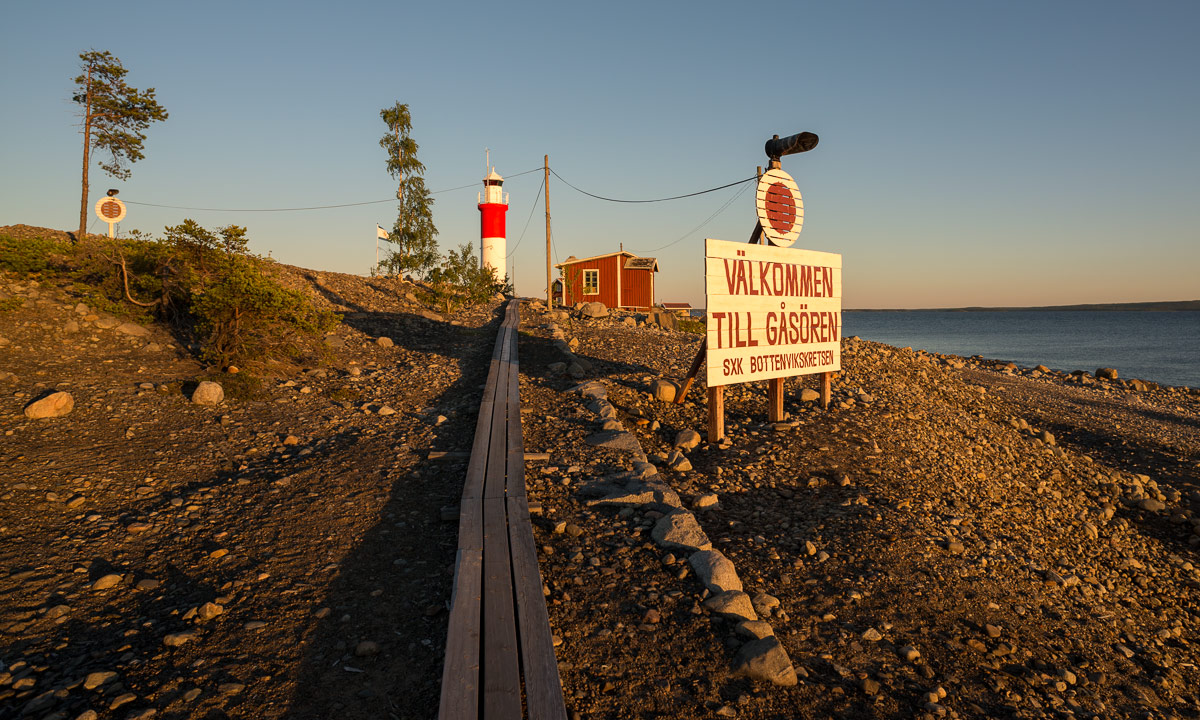
After a short break I continued the tour and headed to the island Gåsören. On the outer shore there were some impressive ice floes left.

It took a while until I could go ashore, because I had to cross another field of new ice. I took a longer rest and took of the dry suit. Ugh! Like always I sweated in the thick neoprene suit and now I smelled like a dead Puma. I took on some other clothes and first it was quite chilly. The spring sun however had enough power to warm me up and soon I took of my gloves and cap.

Most snow has melted and beside of the ice covered rocks at the eastern bank Gåsören almost looked like spring was here.

After a while I dressed for paddling again, entered the kayak and returned to the starting place. With the last ice behind I had a beautiful view of the islands Klubben, Flottgrundet, Gråsidan and Nygrundet. With the blue sky and the blue sea I had the feeling of leaving the winter behind me and paddle into the spring.

When I was home again the thermometer showed +7.3 °C. Almost spring!


Home in Skelleftehamn

I’ve been home again for some days. The weather in Skelleftehamn is between winter and spring. The sky is clear and the nights are cool (last night for example -7 °C) but as sun the sun comes out the temperatures rise soon to degrees above zero.

Parts of the ground are covered with hard snow – in my backyard i measured 45 cm – but other parts are completely free of snow and I’m waiting for the first flowers to come out and blossom.

The Baltic sea is mostly free of ice, but near the shore and in some sheltered harbours there is still a thick layer of ice covering the water. And since the night was quite cold, parts of the near harbour that was completely open yesterday was covered with thin new ice this morning.

Two photos that I made near the small boat harbour Tjuvkistan this morning:

I could walk over the ice to some islands that still are connected to the mainland or I could take the kayak and paddle to some islands, too. But to be honest – I’m quite lazy after the long journey and I guess I stay home today and take it easy.

Finally: The North Cape

Day 50

To be honest: I never planned to visit the Nordkapp (The North Cape), but when I was in Alta I continued to Hammerfest and after that I travelled to Honningsvåg and from that place it’s only 29 kilometres. So I visited the North Cape yesterday.

The first part is a normal road showing some beautiful views. I also completed 5000 km on this road.

If you go to the North Cape in winter by bus or your own car, you have to drive the last part in convoy. Convoys are starting at 11 and 12 o’clock.

When I came to the convoy place I was an hour too early. Time to try to make a rest on a wooden bench (it was degrees above zero again), but the wood was too wet to stay.

11 o’clock we started. The snow plough came first, then two minibusses, then me and two other cars. The street seemed to be alike as the first part: Snow and mud, partly frozen and some steep passages. The weather changed every single minute and I looked into a rainbow while following the other cars.

When we arrived I parked my car, almost jumped into the building to get an entrance ticket and ran to the famous landmark to make a photo with the rainbow without any other tourists. Even although the rainbow started to vanish I was lucky and I got my pictures. Only my own shadow was unavoidable.

But more than of the landmark I was fascinated by the weather. You could see single rain showers wandering over the sea like extraterrestrial animals and I never saw the weather change so fast and so often than yesterday at the North Cape.

I wandered round and made some photos, both inside and outside. I saw fog and approaching and I saw the many tourists, that came in big busses with the second convoy. I had a look into the tiny chapel in the basement and I ate a waffle with Norwegian cheese, jam and whipped cream.

And of course I made a selfie.

I took the convoy back at 1 o’clock (the earlier one) and I was alone. But so I had time to take the car on another road and drive to Gjesvær, a little fishing village in the northwest part of the island Magerøya. I had to stop again, the light on the far mountains was just breathtaking and the photo is just a poor copy of reality.

There’s apparently no tourism in Gjesvær under the winter but I could see several fishing boats going out and coming in.

After a short strolling I returned back over the fjell until I was at my hostel in Honningsvåg again.

The North Cape – is it worth a visit?

Even if I’m usually not attract by touristic attractions I do like the place somehow.

Yes, it’s neither the northernmost point of mainland Europe (that’s Cape Nordkinn near Mehamn), nor even the northernmost point of the island Magerøya (that’s Knivskjellodden), but it’s a symbol! A symbol for being at the north peak of Europe and as long as you travel by car it is the northermost place you will reach.

I wouldn’t travel far just to reach the North Cape but when you are nearby I think it is worth both the travel and the entrance fee of NOK 255. If you have your own car, take the first convoy and you will get a chance of taking pictures without a zillion other tourists, at least as long it’s not too foggy.

For me this is kind of a peak of my journey Nordkalotten 2015 and now I’ll travel southward again. Probably Karasjok today and Kirkenes tomorrow. What I will do after this depends on the weather. If winter still is much too warm as most of the time I might return to my house in Skelleftehamn and take it easy for two weeks before I drive to Finnland again the last free week. But we’ll see. No plans yet …