The magic ice world

Today I was in another universe. At least it looked a bit like it.

After my adventure on the “ice shelf” last night I longed to see the place by daylight. Breakfast was late but so was sunrise and right after I’ve eaten I drove to Näsgrundet again. We had -17 °C (more or less the whole day by the way) and some snow crystal fluttered out of the grey stratus clouds. I put on my grödels – simple crampons – to be able to go on the ice slope. Soon I stood at the rim and looked down into the calmed down sea. The view was quite impressive …

… but …

it would be great to see the ice walls with its icicles from the seaside. It’s not, that I didn’t think about it before, that’s why I had both my waterproof camera and my waterproof survival suit with me. I undressed a bit (not the funniest thing when it’s -17 °C outside) and slipped into the red suit. Then I took the camera and glided into the water. And that’s where I entered another universe. But enough words, the photos! Here they are:

I really loved to paddle in the ice water and to look at the ice walls that where decorated so beautifully wich icicles. Since the attached rubber gloves are waterproof, but not warm at all, my right hand index finger didn’t like the adventure as much as I did and got a bit of frostbite (it still hurts a bit but nothing serious, fortunately). And that’s how I looked like today when I took all these photos:

Winter intensifies

Did I write about the “just normal” winter two days before? Well that changed a bit. Right after I wrote the last article the snowfall intensified and brought 10 cm new snow within 16 hours. It got both windier and colder and still snowed a lot.

Today¹ I took a walk round the small lake Rudtjärnen. Snow fell in thick, heavy flakes and made it impossible to look farther than 100 meters. The squalls whirled up the snow morphing the view into a grey-white nothing. And it was even windier on the slope by the lake. The trees on the 2nd photo were hardly 50 metres away!

That was a nice and not so long walk (which was intended since I don’t want to overstrain myself right after the infection), but it wasn’t enough. I wanted to go out again. And so I did. This time with food and drink, (of course) my camera, my new flashlight and my new down clothes for some testing. I already guessed that I couldn’t drive to the small boat harbour because the way wasn’t ploughed and snow was too deep for my car. So I decided to continue to the peninsula Näsgrundet. What a piece of luck!

I dressed up for cold weather, lit my new strong flashlight and went to the rocky beach. Normally the shore descends to the open sea but not tonight where – I couldn’t believe my eyes – the shore was an ice shelf rising up at least one meter before dropping into a black nothing. I could hear the sea behind but I couldn’t see it. Where am I? What happened? Then I heard a rolling wave and – SPLAT! – I could see water and foam rising high up behind the brink and clashing onto the ice shelf! It took a moment or two until I realised what happened: The brisk northern wind presses the waves ashore where they rocket up into the air several meters. I guess that the water and foam first landed on the rocks where it probably froze almost instantly – remember, it’s -15 °C  out there. The rocks became more and more ice covered until they vanished under a growing layer of ice. When I came to this place this evening some parts of the ice were already two meters above sea level! And still some of the waves managed to toss a lot of water onto the ice where it froze and enlarged the ice shelf. What a fantastic experience!

I was both happy to be out there and a bit disappointed that I couldn’t share this moment. If I at least could take a photo, but how to take pictures of waves when it’s so dark. Wait a moment – dark? – My new flashlight was described as extremely bright – Let’s test. I switched the flashlight to the brightest mode, laid it onto my backpack and adjusted the beam to the waves. Then I took tripod and camera and started to experiment. And that’s the result:

I’m impressed. The new Flashlight is really bright. So bright that I can take such pictures at night time. (For the photo freaks: 1/20 sec at f / 4.5, ISO 1600. 35mm)

OK. The flashlight succeeded the test. But what’s with the rest? I was curious how warm the new bought down parka and down pant would be. I just wore a single layer of woollen underwear and my thin but windproof Norrøna-jacket, mostly to test the fur under the down clothes, that was all. (Not mentioning boots and gloves, of course). I’ve been out more than an hour, first taking pictures, then measuring wind and temperature, than taking my frugal evening meal. And yes – the Marmot down combination is as warm, snugly and cozy as it looks like. Almost too warm when sitting although we had an average wind speed of 10 m/s resulting in a wind chill of  -27 C. That’s good to know.

Now I’m longing to sunrise. I want to visit the spot again and take some daylight pictures. That’s perhaps evan a reason to postpone my journey another day. I’m not in a hurry. But tomorrow, when I’ll visit the place again I’ll wear something less water-sensitive than down, because tonight I always expected a huge monster wave would flood half the shelf and soak me completely.

Finally just two selfies from today, one when I walked round the lake, the other when I sat outside after the evening meal.

Foot note:

¹ As a matter of fact: Yesterday. It will already be Monday when I publish this article.

Some vocabularies for my German readers:

squall – Windböe
down – (hier) Daune
foam – (hier) Gischt
flashlight – Taschenlampe
fur – Pelz

For equipment nerds:

Flashlight: Nitecore EA41 Pioneer
Down clothes: Marmot 8000M Parka, Marmot 8000M Pant. Older (or simpler) models.

Just for the archives:

Friday 2015-01-09 21:45 ca. 30 cm -4.6 °C
Saturday 2015-01-10 13:40 ca. 40 cm -7.1 °C
Sunday 2015-01-09 09:15 ca. 45 cm -8.6 °C
Sunday 2015-01-09 16:55 ca. 52 cm (47 cm backyard, 57 cm front yard) -15.0 °C

At high watermark

Today we had a really high watermark in the Baltic Sea: Up to one meter above sea level. You may laugh if you live nearby the Northern Sea or the Atlantic Ocean, but that’s a lot for the Bottenviken, the northern part of the Baltic Sea and hasn’t happened for several years. Despite of my cold I took the car and drove to several places to make pictures of the flooded shores. But I realised, that most motives were extremely boring. What differs a shore with high water of a shore with sea level? Almost nothing!

But the beach at Storgrundet was a bit different. The ice was covered with 60 cm water and slush and the whole sand beach was flooded and many of the small pines that grow beside the beach where partly or completely under water. What a pity, that I didn’t have my waterproof camera with me.


108 free days

Yesterday I worked the last day for a long time. Now I have holidays. Long holidays! The first day I’ll work again will be the day after Easter Monday and that means that I have (just a moment, I’ll have to check it again to believe it: 12 + 31 + 28 + 31 + 6), that I have a 108 day holiday starting today!

108 days – isn’t it great? Um – err – I don’t know! The last months were quite tough with much work (both privately and on the job) and I’ve been in “survival mode” for many weeks – and still I am. I don’t realise yet, that today my longest period of free time since pre-kindergarden times started. Probably it will take some more days until I really understand.

Yesterday it was sleeting – a bit of snow, quite much rain. But in the afternoon it got colder and rain changed into snow. Today it’s round -5 °C and we have ca. 8 cm fresh snow. In contrast to the last weeks the snow will probably survive, since the weather forecast promises temperatures below zero for the rest of the month.

My friends know my passion for winter and snow and of course I went out and took a walk round the lake Rudtjärnen. The whole lake is covered both with ice and fresh snow and I saw the first two skiers today. They tried to cross a part of the lake but they had to stop to scrape the freezing slush from the bottoms of their skis. The ice under the snow is still wet. No surprise after yesterdays rain.

Later this morning I took the car to the peninsula Näsgrundet where you can see the island Gåsören with its red-white lighthouse in two kilometers distance. It still snowed and long waves rolled on the beach, broke on the shallow shore and flushed away the snow of the nearest rocks. And in the background lay Gåsören covered with the first noteworthy amount of snow.

It took more than 60 shots of this motiv, until I found the right place and – much harder – the right time with surf in the air and the red spotlight of the lighthouse on. I’m still not content, but it’s the best shot today.

The rest of the day: Celebrated laziness – it’s my first day off!

In round about three weeks I will start my long trip through Northern Sweden and Northern Norway – the reason why I took such a long period off duty, and by the way the reason why I started this blog.

Roller coaster weather

This December the weather is like a roller coaster, going up and down, bringing frost, rain, hail, sleet and storm. It’s not at all the winter you imagine when you think on Northern Sweden.

Monday started with sunny weather and temperatures round 1 °C – cold enough to cover the windscreen with a thick layer of window frost. (I prefer the German name “Eisblumen” which means ice flowers.) Then it got colder.

Tuesday it was quite clear and cold with temperatures round -7 °C with a minimum of -9 °C at 22:00. In the next three hours temperatures rose by 10 °C and the next morning we had +3 °C and heavy winds. I left my car at the car service station to get it checked before my winter journey and took some photos on the way back home. I attached spikes to my boots because the wet icy roads where extremely slippery. When I went back some hours later to get the car I was surprised at the high water level. This day the water level climbed 70 cm, that’s a lot for the Baltic Sea and only happened because of the storm pressing the sea water ashore.

The next two days were cloudy, temperatures round + 2 °C with some drizzle that instantly froze on the cold ground. Saturday evening – which was yesterday – it started to get colder and rain started to mix with snow and some soft hail. In the evening it finally started to clear up a bit und got colder.

Today it was quite clear, temperatures round -8 °C and I took a tour to the peninsula Örviken. Örviken has an area of 1 km², 400 people are living here. Even if it is quite near I hardly has being there, which is a pity since it’s a nice place, especially if it’s clear and you’re waiting for the sun rise.

And that’s what I did today. A good activity if you caught a cold and want to take it easy.

On the photos you can see the impacts of the weather: The storm destroyed the ice cover leaving a lot of floating ice floes, but in the cold night the surface started to freeze over again. Do you see the stacked ice in front of the trees? Its laying on land and I guess it was left there after the high water some days before.

After that I drove to another place I already knew and took some photos of the last motif today:

Now it’s half past five and -7.4 °C outside. The weather tomorrow? +2 °C and rain! Probably the whole day! Onto the frozen ground! Sounds familiar?

Some vocabularies for my German readers:

roller coaster – Achterbahn
drizzle – Sprühregen
soft hail – Graupel
peninsula – Halbinsel
Ice floe – Eisscholle

Ice und sun from two weekends

Yes, I’ve been partly busy, partly lazy and in addition to that a bit unhappy with my photos the last days. Winter still hasn’t come to Skelleftehamn: Sometimes it’s below zero, sometimes above, sometimes it snows a bit, sometimes it rains (preferably on frozen ground making the streets quite slippery) und quite often it’s cloudy.

For me it’s still a mystery, how lakes, river and even parts of the sea could freeze over if it’s not constantly below zero for a longer period.

When I made the photo Sunrise colours two days ago, I had to wade through hip deep water and swamp to come to my desired place since the ice didn’t bear me. Two days later I saw a photo of the same spot – with a small child ice skating on the frozen surface. But I guess that the locals know the places where it’s save to enter and leave the ice.

A day later I stood at a small rocky beach of the peninsula Kallholmen looking on the bay Sörfjärden. Here you couldn’t sea any ice at all, beside on some stones that are extremely slippery when ice-covered. That’s where I made this photo:

The next saturday – exactly a week later – I was out again to take photos of the sunset. Same bay, different place – this time more upstream. The Sörfjärden is not only a bay but the mouth of the river Skellefteälven, too. The sea is still open but on the sides of the more wind protected river large parts are covered with several layers of ice. The upmost layer was so thin that the ice looked like flakes or feathers.

Today I drove to Kågehamn to take a sauna with two friends. Kågehamn lies beside of the Kågefjärden which seems to be well protected against wind, since the whole sea is ice covered. The ice is thick enough that people skated to the island Bastuholmen, which is one kilometre away from the shore.

Note to myself: Buy ice skates and learn how to skate – next winter.

While my friends did I skating tour, I was on the ice as well and – surprise, surprise – took some photos. This time mostly of ice cracks and embedded bubbles.

By the way: The first sunset photo was made 13:32, the second was made 13:08. Sun goes down quite early in this time of the year. But sun goes down quite slow as well which is nice if you like taking pictures because you don’t have to hurry too much.

Northern lights and truthfulness

What a nice surprise: After 10 days of dull, cloudy and overcast weather sky cleared up this afternoon. You don’t have to go outside, just have a look at the thermometer: A temperature drop almost guarantees a cloudless sky. But you have to go outside if you want to check for the faint Northern Lights. And this evening I was lucky: a large pale bow of  the aurora borealis was visible in the sky.

Some minutes later I stood beside the small haven tjuvkistan and made the first photo. Click: 15,0 sec at f/2.5, ISO 800 35mm.

Whoa! The whole sky is green, it’s like diving into Fluorescein! Just too much green color! A great deal too much!

I made another photo, knowing beforehand it wouldn’t work. Click: 1,0 sec at ƒ/2.8, ISO 400 35mm, which means only 2.7 % of the light compared to the first photo.

Yes … um … interesting … . Is it art or may I trash it? Too dark! A great deal too dark! This image is just a dumb proof to the platitude I already knew: Cameras need enough light to make good pictures, even a Nikon D800.

Let’s take the 1st photo: I’ll show it again. And again – and again! I cropped it to the same 5:3-format, but processed it in three different kinds.

Version 1: The kitsch-version: I kept the extreme colours and increased contrast, especially in the center. Bang – that’s the photos you show on Facebook!

Version 2: The almost-real-version: I tried to adjust the photo to my memories of the real moment, which means for example that I reduces exposure more than 3 stops and removed saturation of the polar lights by 50%. Well, that’s the photos you won’t show anybody. They are more realistic but a bit prosaic.

Version 3: The in-between-version: I tried to find a version between kitsch and almost real. I’m not sure if it’s a good or a bad compromise between the other versions.

What do you think? Which photo do you prefer? I’m looking forward to your comments.

What a Diff’rence a Day Makes

Today (6th of November) was probably the coldest day this season by now. When I left the house the thermometer showed -11 °C. I was a bit in a hurry to get the sunrise photo in time. After that I had a bit more time and drove to the lake Snesviken where I made the boat photos yesterday and last night. When I looked at the lake I was stunned! Yesterday only a minor bay was covered with thin ice, today – just 24 hours later – the whole lake.

And we’re not talking about a tiny duck pond, but about a lake one kilometre long and up to 500 meter broad. Amazing, how a single frost day can change the surface from small gurgling waves into a solid ice cover.

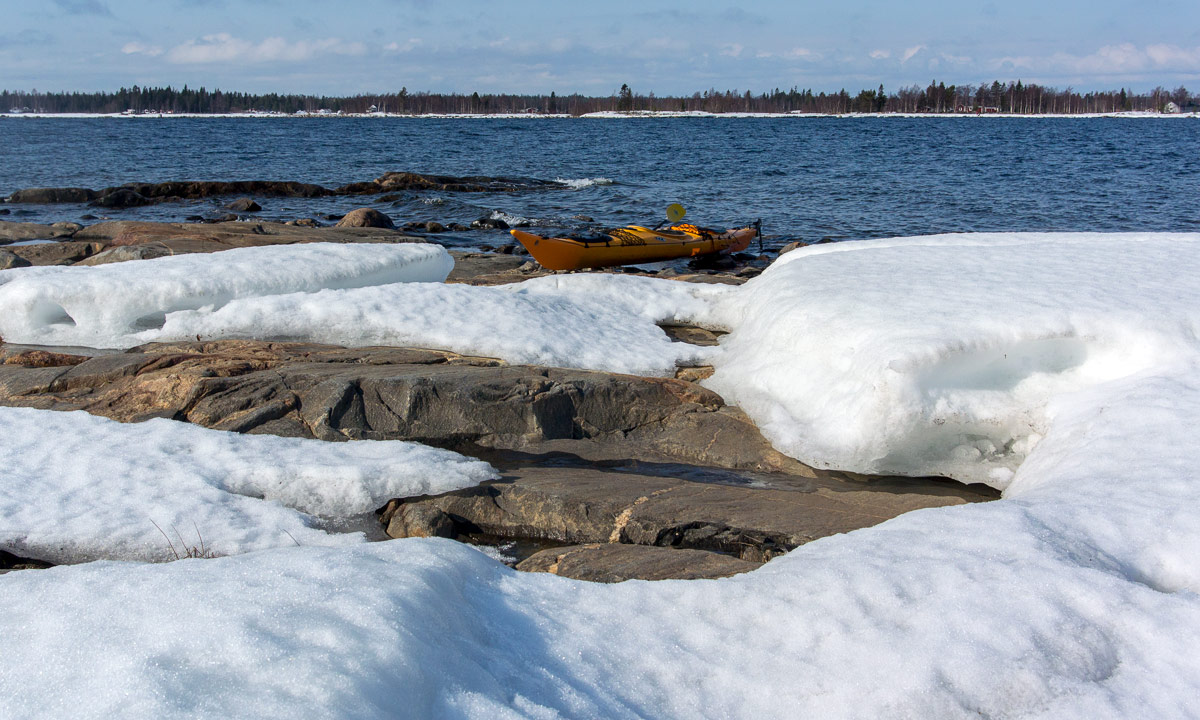
The evening before I was a bit angry with myself that I already dragged the kayak home again some days before, but when I came to the little beach Storgrundet I realized, that even this sheltered part of the Baltic Sea was completely covered with ice. Ice you almost could stand on and therefore much too thick to break it with the plastic blades of the paddle without ruining them.

It will get warmer the next days with even some rain, but I guess that kayak season is over, at least as long as I want to set in the kayak at the beach Storgrundet or at the boat harbour Killingören.

From bed to sun rise in 11 minutes?

Today I woke up 7:26, sun rise should be 7:37. That’s eleven minutes to get into warm clothes (-11 °C!), get the camera, change the lens, change camera mode, get the tripod, put all stuff into the car and drive to the peninsula Näsgrundet. This should be one of the last days where I can make a photo of the sun going up behind the light tower of the island Gåsören. Eleven minutes were slightly too short and I arrived two minutes late. So I was a bit in a haste but at least could capture the motif just in time, even if the light tower is not perfectly in the center of the rising sun. But anyway, it was really nice to be outside and I continued being outdoors.