Polar expedition AeN JC3 – day 7 and 8: a stormy intermezzo

This article is part of the series “2022-02: Winter cruise KPH”.

Day 7 and 8 · 25 – 26 February 2022

25. Feb 07:00 – testing clothing concepts for extreme cold weather

Another Arctic morning. It has become slightly warmer with temperatures round -24 °C but at the same time a lot of windier. The average wind speeds of 20 m/s and above. So windchill is still -45 °C and I wonder how to dress just in case I will be on the sea ice the first time this night. No, I do not count on being allowed to enter it under such conditions but you never know. Be prepared and wait …

For safety reasons we always have to wear a special suit on the ice in case of someone breaks through. That’s either the Regatta suit, a floatation suit. This acts as a full body life vest giving you buoyancy in the water. However you will get wet instantly. No big issue because we will always be quite near the ship and conditions are ok. If the circumstances are more extreme or the ice is not trusted a survival suit with attached rubber boots is used. It will keep you completely dry as long as the arm and neck cuffs are tight. It is said however that it is uncomfortable to wear and you easily get very cold feet.

So, let’s get dressed. For the first time I put on the Regatta suit. It is as breathable as a rubber dinghy so you should not sweat too much. Over that, more for the fur hood than the warmth the Canada Goose parka. Yes, I can still move ;-)

Dressed like never before I open the thick door to the helicopter deck and stagger outside. Whoa! That’s some rough weather. I instantly feel every single square millimetre of skin that is still exposed to the wind and even that the zipper of the down pants are not completely closed at the bottom although I wear high rubber boots. In my opinion the hood of the Snow Mantra is ingenious but the gusty storm just pushes it aside in all directions and I can hardly see anything. So I do not check if the selfies taken with the Nikon and three pairs of gloves and mittens are in focus. They are not.

Being in again I understand the first time, why the parka hood is not only fur-trimmed but have this thick fleece rim inside. It keeps away the ice dust that the storm blows in.

The combination of Regatta suit is too warm and too bulky. I test another combination with the shell jacket of the Norwegian Polar Institute and ski goggles. Insight 1: if the hood does not fit perfectly it is completely useless in the storm. Insight 2: my old ski goggles freeze over so fast that within a minute I am functionally blind. I have to remove them to find back to the helicopter hangar. While checking this the storm pushes me around on the deck slippery deck. I really doubt if anyone wants to work on the ice in these extreme conditions. On the other side I do not know anything about polar research. Neither about polar researchers. It’s me who is the newbie.

25. Feb 11:00 +2h – planning for the storm

Aside: The day before we changed the ship’s time to take better advantage of the daylight. When I write +2h it means our privately shifted time. Otherwise it means „normal“ CET time zone.  If you don’t care, just ignore it.

We have a meeting before lunch. A storm approaches. We will seek shelter between Nordaustlandet, Svalbard’s second-largest island and the island Kvitøya. Conditions are too rough for an ice station. Although all four ship engines are running we hardly make progress. There is no time schedule anymore. We just have to sit it out.

25. Feb 16:20 – the swell wracks the ice

At 15:20 I take a long afternoon nap while Kronprins Haakon struggles through the ice. I have on of the frontmost cabins on deck 3 –the noisiest ones. The icebreaker is rumbling, rattling, grinding, squeaking and doing many more noises that I do not have words for. I lie in my bed and feel the mattress vibrating, shaking, bouncing. And I love it. For me it is like an Arctic lullaby and as mostly I fall fast asleep.

z – z – z – z – z

After an hour I wake up all of a sudden. Something has changed. The ship is slowly and strongly pitching. At the same time noises and vibrations are absent. Are we in open water? What happened!?

I have to compensate the ship’s movements while I walk to the dayroom. I peek through the ice crusted windows. Yes, we are in open water. J. sitting there tells me that 10 minutes ago swell waves. They broke up the ice within minutes and now the ice has disappeared. Impressive and a bit frightening, too.

Now we are amidst the storm with an hourly average of 24.2 m/s, that’s round 87 km/h. The highest wind speed measured in this hour is 32.7 m/s, that’s the exactly beginning of Hurricane force or level 12 on the Beaufort scale.

Although the ship is stabilised it is pitching, rolling, yawing, heaving and a lot of people have started to get seasick. I feel quite ok, but a bit stressed and tired. After a while I decide to lie down for a quarter. Good idea! I feel better again after that.

I’m in the day room again, watching the dark waves through the ice encrusted windows . Sometimes the spray splashes up many metres. No, I won’t enter any outside deck today any longer!

25. Feb 19:24 – crossing the 80th degree of latitude

I wanted to see on the digital nautical chart how we cross the 80th degree of latitude but I miss it by some minutes in time. Soon I go to bed quite curious how the next day may look like.

26. Feb morning – Kvitøya

06:10 – The wind has calmed down and I stand on the helicopter deck (on level 6) again. Open water, a bit of ice and in the distance a pale scheme. The island Kvitøya. It looks like the spray has reached the deck because everything is coated in ice and the ice on the floor is slippery and feels like soap powder.

After the breakfast I try to catch Kvitøya on the Nikon sensor.

The last photos are crap from a technical view (taken at 600 mm ƒ/6.3 in twilight on a moving ship and a travel tripod). Anyhow they show the glacial coast of this Arctic island which I think is very impressive. A pity that the weather was so cloudy.

26. Feb morning – we reach ice again

While I take these photos another thing happens: we reach ice again. First fields of beautifully rounded pancake ice floes, then a few hours later we are in ¹⁰/₁₀ of thick ice again. There Kronprins Haakon can show again that it is an icebreaker.

We have another meeting at 09:00 +2h. We learn that it is more than unsure whether station P4 will have any reliable sea ice to work on. The cruise leader asks: shall we try P5 instead? Yes, all scientists agree. So today we will head to P5 at 80.5 °N 34 °E. That’s only an estimated position. First of all a suitable ice floe has to be found and then this floe will drift on the sea and so change position while ice work is ongoing.

26. Feb 16:00 – checking the ice

Eight hours later. Together with the cruise leader and the captain the ice experts had looked for a suitable ice floe. When they were satisfied the ship stopped and a derrick lowered the ice gangway. Now four people are on the ice. All equipped with survival suits. Two of them carry rifles. We are in the home of the polar bears.

Will I be allowed to enter the sea ice? Perhaps already tomorrow? I doubt it but I’m really longing. I don’t know where this strong relation for the Arctic comes from but it’s definitely there and it grew the last days. And I want to be part of it as much as possible.

Polar expedition AeN JC3 – day 6: sailing through the ice

This article is part of the series “2022-02: Winter cruise KPH”.

Day 6 · 24 February 2022

We are on our way to P4, our first ice station. P4 lies at 79.75 °N 34.00 °N, round 50 km southeast of the island Kvitøya (white island) that belongs to the Svalbard archipelago. This station is more north than Ny-Ålesund on Svalbard. The estimated time of arrival is tomorrow round lunch time.

However it is not granted that the ice will be safe enough to work on. In addition to that it will become stormy tonight and maybe the whole next day according to windy.com . So even when the ice is safe the weather conditions could be too harsh. So there are several uncertainties. We plan for the station but more we cannot do yet.

Today is a cold day with temperatures maximum of -25.0 °C and minimum of -30.5 °C. I’ve experienced colder temperatures many times in my live in different parts of Lapland, but then the wind was always calm. With the ongoing wind the resulting windchill lies between -36 °C and -49 °C. And windy is right: it starts getting windier in the evening.

temperate in °C | wind speed relative to the ship in m/s | resulting windchill in °C.

I take photos of marine animals, I learn the basics of ice observation but I stand outside quite often today. Watching the icebreaking polar research vessel Kronprins Haakon breaking through the ice. It is a great experience and I’m happy that I may participate.

But now, let the photos speak. The first I made at 3:50 in the night, the last ones at 19:10.


Polar expedition AeN JC3 – day 5: marine fauna · entering the ice · temperature drop

This article is part of the series “2022-02: Winter cruise KPH”.

Day 5 · 23 February 2022

12:30 – it gets colder

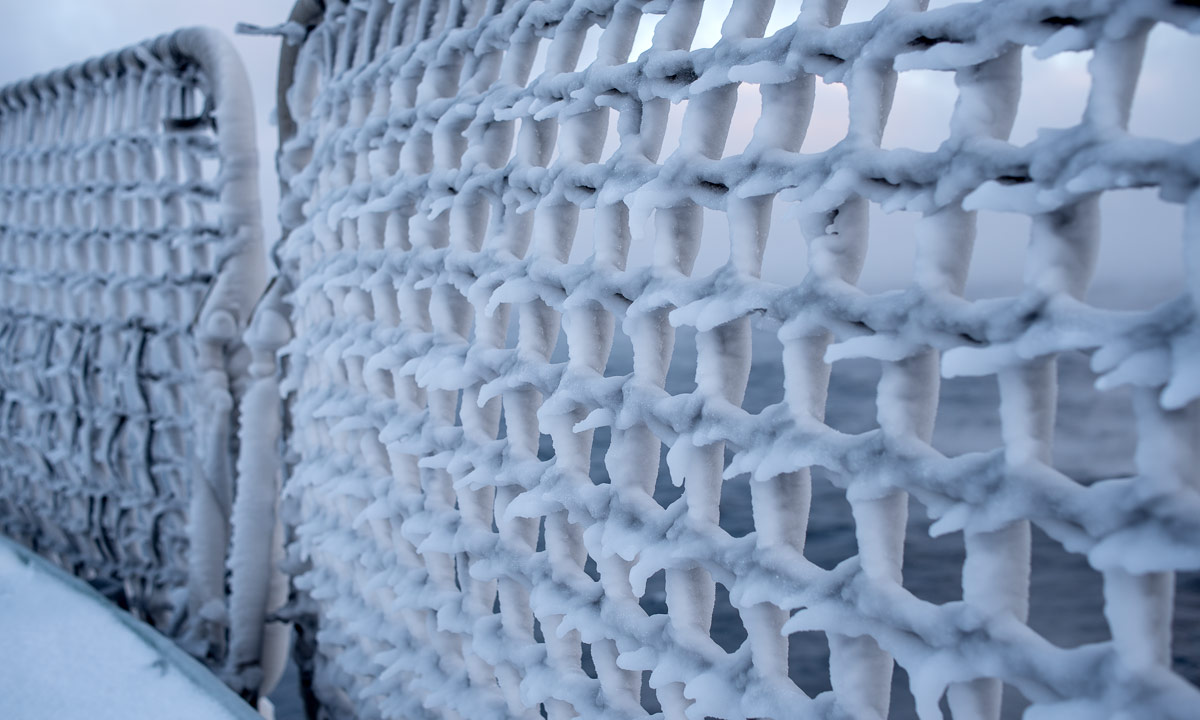
Over night it has become much colder and windier. Temperature has dropped to -17 °C and the relative wind speed has increased to 17 m/s (ca. 60 km/h). According to the wind chill formula that feels like -33 °C. The taut nets around the deck are covered with ice structures and ice fog hovers over the still open sea.

14:00 – marine fauna

A large trawl net is being pulled up. Scientist are waiting on deck, they look eager. What will the trawl reveal?

The net is up and the haul is emptied onto the deck.

At once the marine biologists gather round the catch and start browsing, identifying, sorting. I know some of the animals, but neither taxonomy nor latin name. It’s a childhood’s memory – me walking along the shore, my eyes glued to the soil to search for shells, jellyfish, worms, starfish. As a child I wanted to become a researcher but live has changed many times. Anyhow it finally brought me here on this polar expedition on Kronprins Haakon. But I digress, back to some photos of marine fauna and scientists:

I would love to know a bit more about the taxonomy of all these species but this will take some time and efforts, nothing you will get for free.

14:37 – the first sea ice

And there it is. The first sea ice is ahead.

The photo is awful. Noisy, underexposed two levels but I want it here in the blog. Not only for you but also for me because it’s the very first photo of sea ice on this cruise.

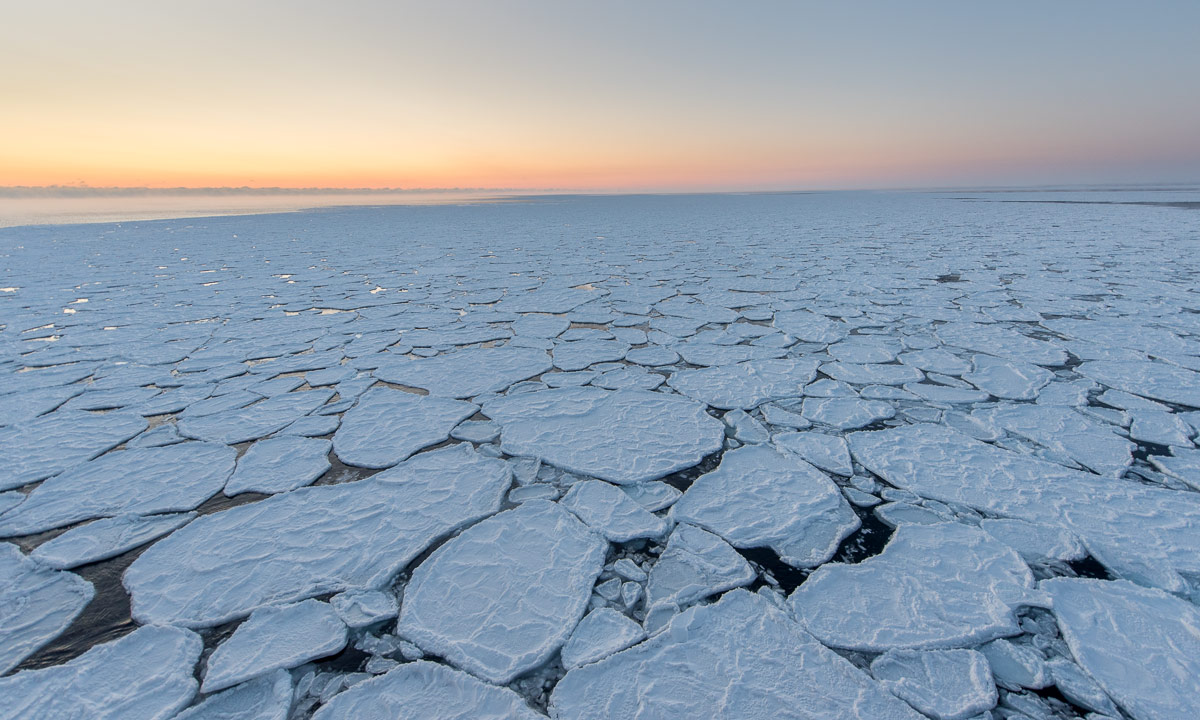
But there is more. While we continue north, soon the Barents Sea gets covered with pancake ice – called because of the rounded shapes of the ice floes – that soon make place for larger ice floes. That takes only 20 minutes.

(The images are not in chronological order for layout reasons)

For more than an hour I stand at the bow of the heli deck and watch the changes of the ice coverage. I love ice, I love the sea, I love cold winter and here I can get it all together. I feel happy! And cold it has become. Temperature -22 °C, relative wind speed 16 m/s resulting in a wind chill of -39 °C. The Canada Goose Snow Mantra parka starts to make sense. It shows what it can: keeping me warm under these conditions.

I use a pair of gloves and two pairs of mittens to keep hands and fingers warm. With one exception: Smartphone selfies. These I take bare-handed. While doing that the pinky of my right hand gets really cold and I will feel this for many hours. I’m lucky, the fingertip has no frostbite but I decide to stop making selfies in such harsh conditions. I love the arctic, but I play piano, too. I need my fingers. All of them.

15:59 – dinner pleasures

The haul caught a lot of animals, amongst others a lot of shrimps. Only some of them are needed for research. I help cleaning them, plucking away starfish and other species while a huge pot with salt water starts boiling. And at dinner we all get shrimps. Freshly caught in the Arctic. Delicious!

19:00 – photo shooting

A. a marine taxonomy expert asks me if he can borrow a tripod, he wants to take photos of some of the animals. Oops – I forgot the mount for attaching other cameras. I make another proposal: I’ll drop by and take pictures by myself. From this day I’m the “official court photographer” of non-microscopic animals. That’s work I really like. The first results are not the best, but I’ll share them anyhow:

Species identification taken from the cruise report of Andreas Altenburger. Thanks a lot!

21:30 – Sailing through the night

It’s dark. Ice has become thicker and you can hear the cracking and feel the vibrations from Kronprins Haakon breaking the ice. Again I stand on the heli deck looking ahead. Two strong spotlights illuminate the ice.

And for some minutes there is even a Northern light palely glowing in the sky.

While I stand there, happily watching the ice and the sky, muffled up warmly in my down parka and pants, temperature has dropped even more. -28 °C, windchill -44 °C.

temperate in °C | wind speed relative to the ship in m/s | resulting windchill in °C.


Arrival in Longyearbyen

This article is part of the series “2022-02: Winter cruise KPH”.

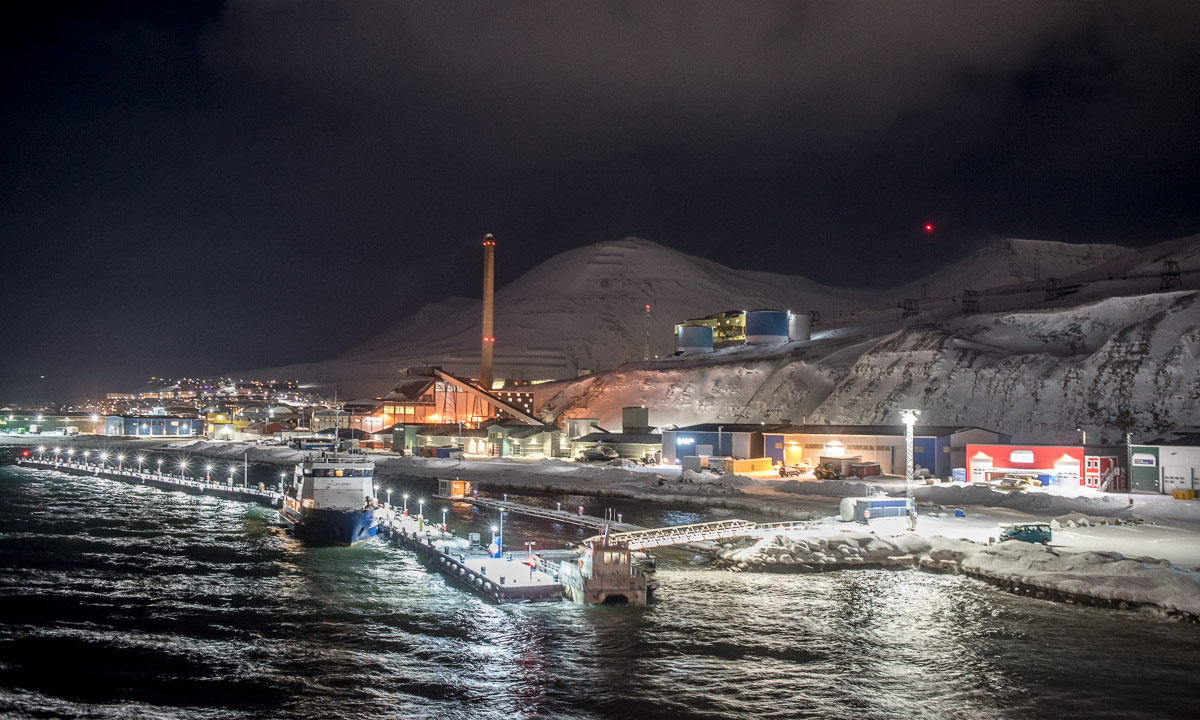
It is half past two in the night between Thursday and Friday. For almost two hours I had stood on the helicopter deck of the icebreaker Kronprins Haakon to witness our arrival in Longyearbyen on Svalbard.

When I went outside two hours ago clouds had just started to gather and the moon was hidden. I could see dark and pale schemes on both sides of the ship and straight ahead another shade of a mountain, decorated with lights.

Slowly the lights came nearer. And since it was the first time I had mobile Internet for many days I could follow our route on the map of the iPhone. Only occasionally because a cold wind on the bow made the quite mild temperatures of -5 °C feel much colder.

There – the airport! And then, after we started to turn into the Adventfjorden, the city LongyearbyenSvalbard’s largest settlement.

The ship slowed down at the harbour and slowly and carefully started to move sideways. Do we still move? I peek down to the pier. There, the first thick rope connects the vessel with land – the first land after we bunkered fuel round 19 days ago!

We have arrived in Longyearbyen. Almost three weeks I worked, learned, photographed, relaxed, ate and slept on Kronprins Haakon. Tomorrow I’ll disembark and in the early afternoon take an airplane back to Tromsø. Yes, I am sad that this incredible journey has now come to its end. But I am also happy and content and full of stories, experiences and memories.

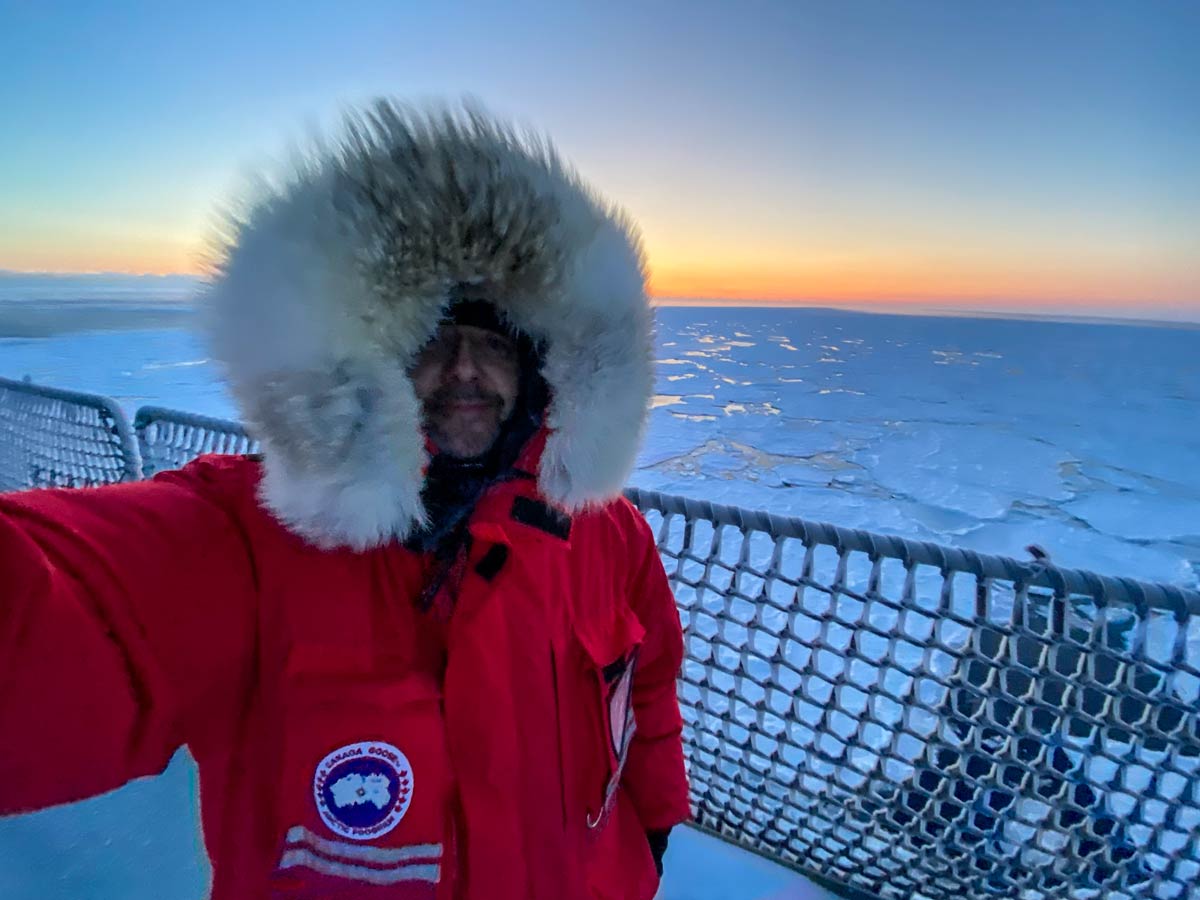
Do I smile on the photo or am I sad? Most of all I am tired and then a bit tense because it is hard to hold the iPhone as still as possible for some seconds with an outstretched arm.

The scientific winter cruise Arven etter Nansen JC3 took almost three weeks. Three very extraordinary weeks. And it will take at least three other weeks to tell some of the stories and show some of the photos here in the blog. So, please be patient – more to come, but step by step.

Short sign of life

This article is part of the series “2022-02: Winter cruise KPH”.

We are at 76°45′ N, 31°08′ E and still have internet. Today we entered the sea ice and the ship is jerking when it cuts through.

After days with open sea and moderate temperatures between -5 °C and -8 °C it got significantly colder today. At time we have -24.9 °C (falling) with a relative wind speed of 8.2 m/s. That makes a wind chill of round about -39° C.

So, why am I alone out at the helicopter deck?

Otherwise: too much interesting stuff going on. This arctic research cruise is definitely one of the most gorgeous things I’ve ever experienced in my life!

I hardly manage to be up to date with my notes and I don’t have time to write more. And it’s dinner time, too. See you …

Sea ice field work training on the Sørbotn

Peacefully I wake up this morning. It is already light outside. WHAT? LIGHT? WHY? AND WHEN?

I check my mobile phone – the clock shows 8:01. SH**!!! At 7:45 we were supposed to meet at the Norwegian Polar Institute, at 8:00 we were supposed to leave there for a field work training on the sea ice. But not me. I have overslept!

We – that’s 5 instructors and round 20 participants of the Sea ice field work training arranged by the Norwegian Polar Institute and the Arctic University of Norway in Tromsø. I realise that my colleague M. already tried to reach me and ring back. I tell her that I will take my own car and hopefully make it to our destination with only a small delay.

Our destination – that’s Sørbotn, the southern tipp of the fjord Ramfjorden where the training will take place on the sea ice of the frozen fjord.

I manage to dress, make tea and pack in 20 minutes thanks to previous day’s preparation and a fondness for packing lists. Although I take it easy while driving (safety first!) I arrive less than 10 minutes late while the preparations are still in progress.

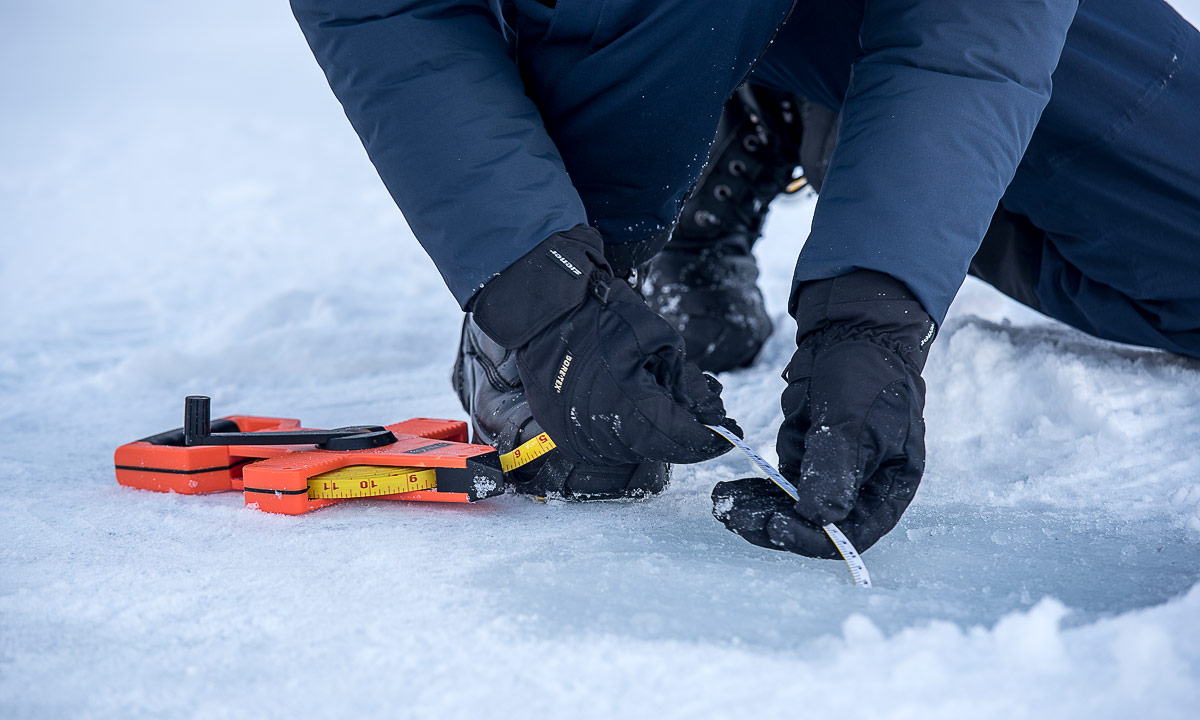
We are split in two groups. Our group will do measurements of ice and snow depths first and take ice core samples after lunch break. I won’t go here into details too much, because I’m a newbie to all this and I do not want to write half-understood nonsense. I’ll have to look up some details of today’s stuff later.

Although I drill holes in the ice, help calibrating the GEM2 device, measure temperatures in a freshly taken ice core and use a MagnaProbe to measure a transect of snow depths I have a lot of time to take photos, too. So, let’s just start with this.

Being on the ice with a bunch of nice people is not only a lot of fun but it will help me in doing my job at the polar institute. Part of it is to manage scientific data. The deeper my understanding on collecting data the better I can do my work. The most interesting thing today was observing the coexistence of advanced sensor technology paired with GPS tracking and the usage of rulers, pencils and paper as in the early days of polar research.


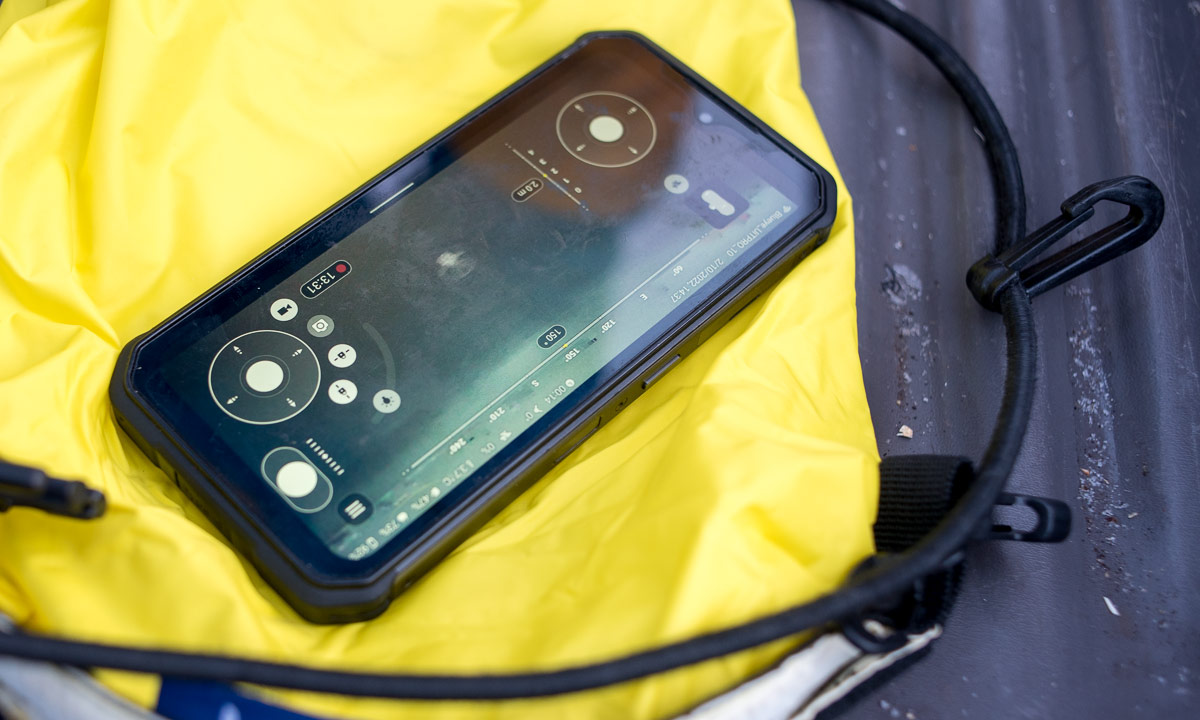
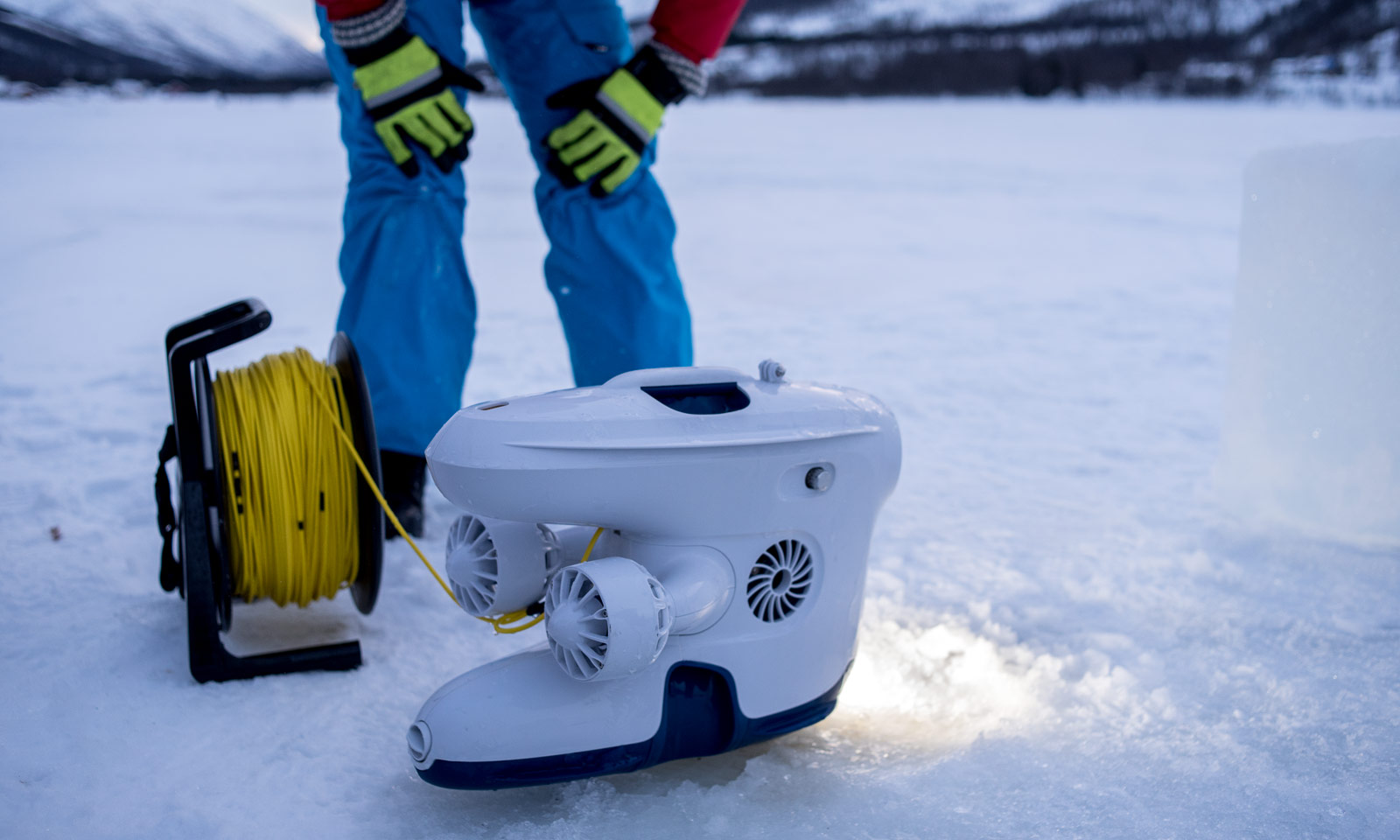
There was one thing I wasn’t involved in: The usage of a remote-controlled underwater drone. We clearly could see some fishes and jellyfish (do you spot it on the 1st image below?) on the live display. I know that it’s used for research, but I would love to have it just as a toy.

Hopefully this was not the last time that I was involved in field work this year. And perhaps we’ll be lucky with the weather again next time. For while we had calm conditions and even sunshine, wind drove heavy snow squalls over Tromsø just some hours after we called it a day.

Sea ice field work training – preparations

My job at the Norwegian Polar Institute is both to write applications and to manage scientific data. Since I’m not a scientist it’s hard to understand sometimes, how data is collected and digitalised.

To learn more about this I’ll participate a sea ice field work training tomorrow. It is organised by the polar institute and UiT, the Arctic University of Norway. We’ll be on the sea ice of Sørbotn – part of the fjord Ramfjorden the whole day and learn different measurement methods as coring and magna probe. (Don’t ask me any questions today. I hope I’ll know a bit more tomorrow.)

The instructors measured the ice depth yesterday. It is round 50 cm and absolutely safe to walk and work on. We had two preparative meetings where we discussed possible risks and how to dress properly. Although it is forecasted to be only -5 °C and hardly any wind it’s always good to have enough stuff to stay warm when being outside on the ice. I started packing today.

Some of the items I’ll take with me:

  • Thick Kamik rubber boots with inner shoe – really warm!
  • Red hard shell jacket and matching bibs. Not warm, but absolutely wind proof.
  • Grey down parka. For resting and having lunch outside.
  • The brown fur hat. 100% polyester, H&M, EUR 9.90. I used it once in -37 °C and although cheap it’s warm and works well.
  • Ski goggles – just in case.

The hard shell jacket and bibs are not mine. Yet. They belong to the polar institute and I got them recently. After five work years they are mine. The attached fur is my private one.

Maybe some of us will get a Regatta floatation suit, a warm, water- and windproof coverall, but I’m not sure yet so I’ll take all the private stuff with me. I love winter. I do not love freezing.

More to come after the training …

I walk to work

Back in Tromsø I decided to walk to work this week. 2½ km to the Norwegian Polar Institute in the Framsenteret and 2½ km back home. So I get at least a bit of motion each day. And a bit of outdoor feeling, too.

Monday, 17 January

It has snowed quite a bit the night and is still snowing. It’s -4 °C and the wind is calm. It’s fun to trudge through the powder snow.

Lunch time. We get the table by the panoramic window. Some boat owners clear the landing of the marina from snow.

Tuesday, 18 January

-3 °C and snow fall again but now the wind is stronger and squally. Luckily I have it in the back.

It gets warmer the whole day and it starts to rain. Wet ice and deep puddles on my way back.

Wednesday, 19 January

+2 °C, a bit of rain. Rubber boots, slush, ice, water puddles.

Thursday, 20 January

-1 °C and fresh snow.

I don’t trust the snow. I know that ice and slush lurk beneath the surface. Therefore I wear rubber boots again with attached spikes to avoid slipping on the wet ice. The gloves protect against the wind, the reflective wristbands with the blinking LEDs and the high visibility vest against not being seen by car drivers. No cyclists the last days.

Friday, 21 January

-6 °C, almost like winter. The canteen invites to “sun buns” and cacao because it is “soldagen”, the day where the sun is finally visible in Tromsø again after 8 weeks. Unfortunately clouds block the low hanging sun.

This weekend I won’t see the sun neither. We got warm weather and storm and unfortunately a lot of rain. So I’ll probably keep myself mostly inside.


A winter journey from home to work

Last Saturday I travelled to work. ObbolaTromsø, that’s round 1000 km – the reason why I do not commute weekly.  This time it is a bit suspenseful, because there are two obstacles on my way.

One obstacle is easy: taking a covid test at the test center. The other is much bigger: The road over the Bjørnfjell – the only road – has been closed for many hours due to stow storm conditions. Well, I start my journey anyhow. We’ll see.

At 5:30 in the morning Annika takes me to the train station in Umeå. The first 9½ hours were just a “normal” train journey beside of the train being mostly ahead of time. One change in Boden – nothing special, just long and a bit boring.

I leave the train in Abisko Turiststation where I parked my car. My car – will I find it or is it submerged under a pile of snow? To my relief hardly any snow covers my car. I already hoped so, because Abisko is known for its low precipitation because mountains in the west protect it from bad weather. Much more snow and rain fall on the other side of the mountain range and that’s exactly where I have to go through. Some minutes after leaving Abisko behind it starts snowing. Snowfall increased more and more but isn’t severe and the Swedish mountain road is open. Soon I cross the Norwegian border and …

… have to stop because of a lowered tollgate with a red blinking light. Beside of two trucks I am alone. I am relaxed because I know that the road has been opened for driving in convoy one hour ago (thanks internet!). I just have to wait for the large snowplough to fetch us.

After twenty minutes the tollgate went up and the red light goes out. That’s all that happens. I hesitate. And now? Do I have to wait? Or may I drive? I don’t dare and ask one of the Norwegian truck drivers. He answers I should just go ahead and so I do. The drive is snowy but not bad and soon I arrive at Bjørnfjell brøytestasjonen where the snowploughs are located and now also the Covid19 registration. I register myself, get a covid test and start taking photos while waiting for the result.

I take an image of a snowed in car. The snow plough driver goes to me and asks for what purposes I take photos. “Just for my blog.” “Ah ok, just curious.” Good to talk to him, because so I learn that beside of the mountain passage behind Bjerkvik road conditions are good. Here they got a lot of snow the last 24 hours and one of the cars looks like this:

After round 20 minutes I get a ping ♪. It’s an SMS with a link to my test result. Negative :-). 260 km to go, that’s four hours when conditions were good.

The first 100 km the road conditions are good and weather is ok. The next photo shows how driving looks like.

The next hour it snows a lot. Sight is still good. To my left and right everything is covered with snow, from the largest church to the smallest branch of a tree. Winter wonderland.

Then it starts to get nasty. Snowfall intensifies more and more and the snow has the consistence of superglue. My windscreen wipers hardly manage to push away the gluey snow and finally I have to turn into a side road and de-ice the wipers. Scratch, scratch … . I’m not alone. In front of me a car with a driver doing the same. Behind me another car stops. Am I in the way? No, just another scratch, scratch. On the other side of the side road another one.

I still have some holes to peek through but it is extremely tiring to drive car through the night like that. Alas, after two hours I drive over the large concrete bridge Tromsøbrua and am on the island Tromsøya. Apparently Tromsø’s snow removal has given up. The minor roads are covered with 20 cm of snow with deep tyre tracks. I understand more and more why most Norwegians have cars with all-wheel drive (and so have I).

22:45. I make a last stop at the supermarket nearby that is open until 23:00. I’m lucky because Norwegian supermarkets close on Sundays. By the way: the supermarket’s parking place is in much better condition than the roads.

One other minute driving and I arrive at my flat in Tromsø after 17½ hours travelling. I’m tired but it takes another hour until I’m relaxed enough to sleep. Next week I’ll walk …

Interval training in Vasstrand

Today I tried a tour on the mountain Stappen on the island Kvaløya, where I did most of my hiking tours the last months. In my book “På tur i Tromsø” it is marked as quite easy and that it would take 1½ hours up. Well, perhaps in summer …

Although sun does not rise anymore it’s already quite bright at 9 o’clock. I stop my car ride of 45 minutes to take this photo at 9:20 on the mountain passage.

At 9:50 I start my tour. No snow shoes, but spikes in case of icy patches. And a warm down jacket. And a tripod for making photos in twilight. Backpack is heavy.

First I walk along the road and then uphill through the snow. I use to manage to hike up mountains although it can take some efforts. I love to trudge through snow. The combination however is extremely exhausting since the snow today is often knee deep and especially the first part has some steep bits.

I have to rest many times and my heart is beating like a hummingbird’s. There are ski tracks but I’m wondering how to ski here where the forest is so dense. Well, while most Norwegians are excellent skiers, I’m not.

I arrive at the bog Vasstrandmyra which is described as being wet in the tour book. Now it is frozen and snowed over. It still goes up though more gently and I look for a route with as less snow as possible. Today’s destination has come into view, the mountain Stappen (570 m). It looks like having been painted by a toddler. A line up, a peak, a line down. I want to go up there but have the impression that I’ll probably not make it.

A second steeper passage through another wood lies ahead of me. I’m panting. Snow is mostly knee deep until I make a step that sends both legs completely into the white. The snow is hardly deeper but I found a mud hole well hidden under the snow. Thanks to the rubber boots I wear my feet stay dry.

With some more breaks I manage to hike up to a second plateau and start ascending the mountain.

On the photo it looks quite flat, but in reality it is steeper. That is not a problem. The problem is that there is no visible way and it is impossible to see, where there are holes between all the snowed over rocks. Quite cautious I hike up a bit but after 60 metres I realise that this kind of testing each step takes too much time.

I rest sitting in the snow with hood on, because it has become quite windy which makes the frost temperatures feel much colder. I even witness a larger snow devil – a mini-tornado sucking up snow –  just some ten metres from me and can feel the snow dust in my face.

Although I do not have a 360° panoramic view I cannot complain. The mountainous landscape in the warm colours of polar night’s noon is just beautiful!

I do not rest long, then I start my descend. As soon as I reach the plateau hiking becomes easy. Trudging through snow downhills is much faster and even on the not-so-steep bog my step length is 50% larger than on the way up. A snow grouse flees, it does not want to be photographed. It’s windy and snowy and wintry and an exhausting but an awesome tour.

Round one o’clock I arrive at the car glad about the car’s heating and a warm sweater.

On my way back I stop at the supermarket and delicacy shop Eidehandel where I eat some warm lunch. At 14:30 I’m almost home but I have to stop for another photo because now it has become dark. Not pitch black, but dark enough to see the stars.