A winter journey from home to work

Last Saturday I travelled to work. ObbolaTromsø, that’s round 1000 km – the reason why I do not commute weekly.  This time it is a bit suspenseful, because there are two obstacles on my way.

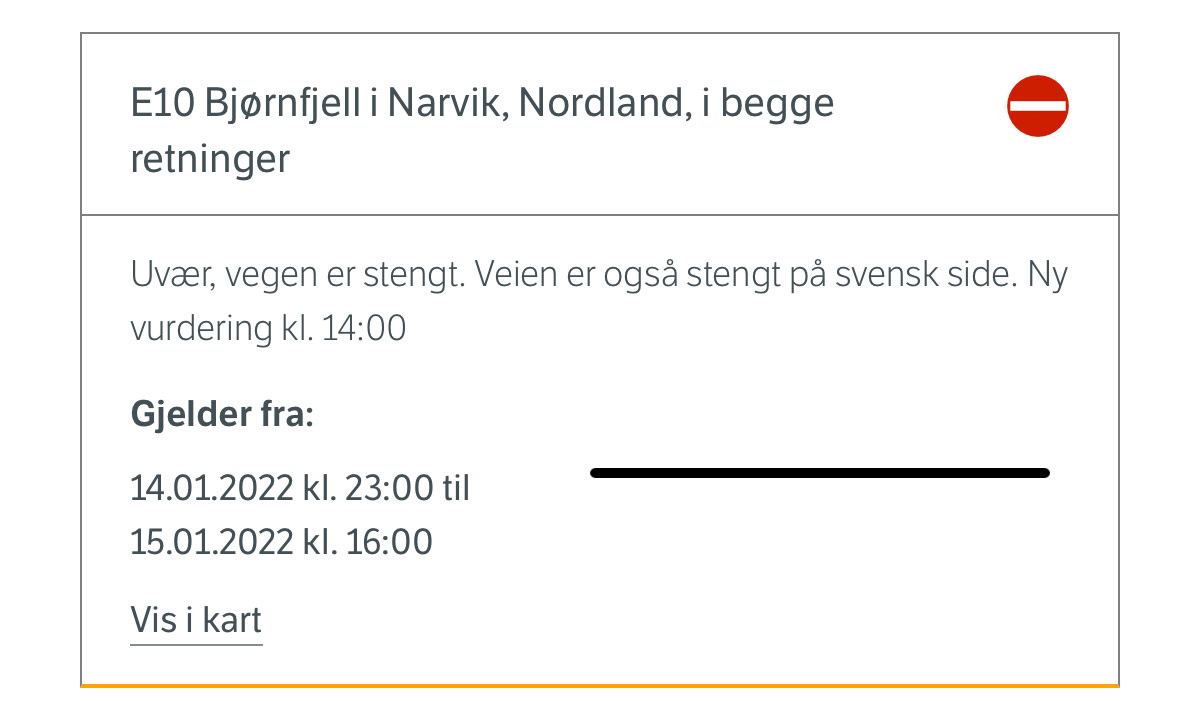
One obstacle is easy: taking a covid test at the test center. The other is much bigger: The road over the Bjørnfjell – the only road – has been closed for many hours due to stow storm conditions. Well, I start my journey anyhow. We’ll see.

At 5:30 in the morning Annika takes me to the train station in Umeå. The first 9½ hours were just a “normal” train journey beside of the train being mostly ahead of time. One change in Boden – nothing special, just long and a bit boring.

I leave the train in Abisko Turiststation where I parked my car. My car – will I find it or is it submerged under a pile of snow? To my relief hardly any snow covers my car. I already hoped so, because Abisko is known for its low precipitation because mountains in the west protect it from bad weather. Much more snow and rain fall on the other side of the mountain range and that’s exactly where I have to go through. Some minutes after leaving Abisko behind it starts snowing. Snowfall increased more and more but isn’t severe and the Swedish mountain road is open. Soon I cross the Norwegian border and …

… have to stop because of a lowered tollgate with a red blinking light. Beside of two trucks I am alone. I am relaxed because I know that the road has been opened for driving in convoy one hour ago (thanks internet!). I just have to wait for the large snowplough to fetch us.

After twenty minutes the tollgate went up and the red light goes out. That’s all that happens. I hesitate. And now? Do I have to wait? Or may I drive? I don’t dare and ask one of the Norwegian truck drivers. He answers I should just go ahead and so I do. The drive is snowy but not bad and soon I arrive at Bjørnfjell brøytestasjonen where the snowploughs are located and now also the Covid19 registration. I register myself, get a covid test and start taking photos while waiting for the result.

I take an image of a snowed in car. The snow plough driver goes to me and asks for what purposes I take photos. “Just for my blog.” “Ah ok, just curious.” Good to talk to him, because so I learn that beside of the mountain passage behind Bjerkvik road conditions are good. Here they got a lot of snow the last 24 hours and one of the cars looks like this:

After round 20 minutes I get a ping ♪. It’s an SMS with a link to my test result. Negative :-). 260 km to go, that’s four hours when conditions were good.

The first 100 km the road conditions are good and weather is ok. The next photo shows how driving looks like.

The next hour it snows a lot. Sight is still good. To my left and right everything is covered with snow, from the largest church to the smallest branch of a tree. Winter wonderland.

Then it starts to get nasty. Snowfall intensifies more and more and the snow has the consistence of superglue. My windscreen wipers hardly manage to push away the gluey snow and finally I have to turn into a side road and de-ice the wipers. Scratch, scratch … . I’m not alone. In front of me a car with a driver doing the same. Behind me another car stops. Am I in the way? No, just another scratch, scratch. On the other side of the side road another one.

I still have some holes to peek through but it is extremely tiring to drive car through the night like that. Alas, after two hours I drive over the large concrete bridge Tromsøbrua and am on the island Tromsøya. Apparently Tromsø’s snow removal has given up. The minor roads are covered with 20 cm of snow with deep tyre tracks. I understand more and more why most Norwegians have cars with all-wheel drive (and so have I).

22:45. I make a last stop at the supermarket nearby that is open until 23:00. I’m lucky because Norwegian supermarkets close on Sundays. By the way: the supermarket’s parking place is in much better condition than the roads.

One other minute driving and I arrive at my flat in Tromsø after 17½ hours travelling. I’m tired but it takes another hour until I’m relaxed enough to sleep. Next week I’ll walk …

Interval training in Vasstrand

Today I tried a tour on the mountain Stappen on the island Kvaløya, where I did most of my hiking tours the last months. In my book “På tur i Tromsø” it is marked as quite easy and that it would take 1½ hours up. Well, perhaps in summer …

Although sun does not rise anymore it’s already quite bright at 9 o’clock. I stop my car ride of 45 minutes to take this photo at 9:20 on the mountain passage.

At 9:50 I start my tour. No snow shoes, but spikes in case of icy patches. And a warm down jacket. And a tripod for making photos in twilight. Backpack is heavy.

First I walk along the road and then uphill through the snow. I use to manage to hike up mountains although it can take some efforts. I love to trudge through snow. The combination however is extremely exhausting since the snow today is often knee deep and especially the first part has some steep bits.

I have to rest many times and my heart is beating like a hummingbird’s. There are ski tracks but I’m wondering how to ski here where the forest is so dense. Well, while most Norwegians are excellent skiers, I’m not.

I arrive at the bog Vasstrandmyra which is described as being wet in the tour book. Now it is frozen and snowed over. It still goes up though more gently and I look for a route with as less snow as possible. Today’s destination has come into view, the mountain Stappen (570 m). It looks like having been painted by a toddler. A line up, a peak, a line down. I want to go up there but have the impression that I’ll probably not make it.

A second steeper passage through another wood lies ahead of me. I’m panting. Snow is mostly knee deep until I make a step that sends both legs completely into the white. The snow is hardly deeper but I found a mud hole well hidden under the snow. Thanks to the rubber boots I wear my feet stay dry.

With some more breaks I manage to hike up to a second plateau and start ascending the mountain.

On the photo it looks quite flat, but in reality it is steeper. That is not a problem. The problem is that there is no visible way and it is impossible to see, where there are holes between all the snowed over rocks. Quite cautious I hike up a bit but after 60 metres I realise that this kind of testing each step takes too much time.

I rest sitting in the snow with hood on, because it has become quite windy which makes the frost temperatures feel much colder. I even witness a larger snow devil – a mini-tornado sucking up snow –  just some ten metres from me and can feel the snow dust in my face.

Although I do not have a 360° panoramic view I cannot complain. The mountainous landscape in the warm colours of polar night’s noon is just beautiful!

I do not rest long, then I start my descend. As soon as I reach the plateau hiking becomes easy. Trudging through snow downhills is much faster and even on the not-so-steep bog my step length is 50% larger than on the way up. A snow grouse flees, it does not want to be photographed. It’s windy and snowy and wintry and an exhausting but an awesome tour.

Round one o’clock I arrive at the car glad about the car’s heating and a warm sweater.

On my way back I stop at the supermarket and delicacy shop Eidehandel where I eat some warm lunch. At 14:30 I’m almost home but I have to stop for another photo because now it has become dark. Not pitch black, but dark enough to see the stars.

From autumn to winter – a tour to the Litjeblåmannen

This article is part of the series “2021-07: Back in Tromsø”.

My first concert with the chamber choir Ultima Thule was supposed to be today but due to the increasing COVID-19 cases in Tromsø the board decided to cancel the concert. That’s a pity but gave me a free day and the opportunity to continue with my #onceaweek project. I decided for a tour to the Litjeblåmannen (860 metres above sea level).

At 8:40 I have parked my car and start the tour. Temperature is -5 °C. Brr! I regret that I left my long johns home. That changes quickly when I take the first steep climb up the forest path and start to sweat. All trees have shed their leaves and are bare.

At 8:40 is sunrise. Half an hour later I can see the sun rise above the mountains. Ten minutes later I have left the birches behind and the landscape opens. I am gaining altitude and soon the path starts to cross the first snow fields.

Ten other minutes later snow and rocks start to dominate the landscape. It looks like winter. The autumn is left behind in the valley. I see a radio mast, part of the radio station on the Rundfjellet (472 m). Well, that was easy.

I decide to continue the tour. But where? The tour description mentions that I have to go down 50 metres. I hardly see any waymarks or a track but soon some foot steps that I follow. According to map and compass it’s the right direction. The terrain gets rockier, steeper and is partly icy but at least I spot some waymarks again. I stop to strap my spikes under the boots. Safety first! Less than an hour later I pass another radio station. I do not look closer because the terrain behind the building is very steep.

The terrain continues being steep and rocky but after a while I reach a plateau. Now it’s winter. Beside of some tufts of grass covered with frost there’s only snow and rocks.

From now on it’s much simpler to walk on this snow covered plateau and soon I reach the mountain summit Botnfjellet (844 m).

That’s however not my destination. Well, the summit of Litjeblåmannen looks far away but it takes only 20 more minutes to go there.

Break! Summit selfie!

The fur hood is not only for looking wintry on the selfie. It was colder than expected and after the selfies I put on my down pullover. Checking the temperature at Tromsø airport and subtracting 0.6 °C per 100 metres altitude I guess that the temperature is round -7 °C. The wind makes my mind change about wearing long johns a second time.

I eat a bit of chocolate and drink some Sprite before the frost transformed it into slush. I’m completely alone and I haven’t met anyone yet. It’s just beautiful up here with views on snowy mountain chains everywhere but on the snowless lowlands and the fjords as well.

After 20 minutes break I start my way down. First I follow my own tracks until I met the first mountain hiker today. Now I follow her steps. Does she know a better way?

Some impressions from the way down:

While I descend more and more the sun starts to set. I hike cross-country. Less and less snow covers the ground until I reach a terrain consisting of terraces of wetlands and dense birch thickets. The wetlands are easy to cross, since the ground is mostly frozen and I have rubber boots. The birch thickets however take some time to squeeze through. Looking back I can see purple clouds indicating that the sun already has set.

At 14:40 I arrive at the car. -4 °C. According to my app I walked 15 km and 1120 metres in altitude. I started before sunrise and arrived after sunset. This gives me the right to be very lazy the rest of the day. The blog article I want to write anyhow.

I met three persons in total:

  • A woman in my age in clothes that probably have been used on countless tours for many years,
  • A young woman in a grey woollen sweater hiking up quite fast while talking loudly on her cell phone.
  • A packed sleeping bag on a stone in the wetlands. A sleeping bag with a book. Wait! No, it’s a hood with a book. Wait! No, it’s a person leaning against a large rock reading. In the middle of some wet slope on the island Kvaløya. People here really like being outdoors.

So much for today. And now I have to stretch!

Appendix:

I just went to the kitchen and felt, that the outside light had changed. It had! It had snowed some centimetres and is still snowing. Everything is white. Beautiful!

April weather – kayaking through the snow

Yesterday the whole day was sunny. The sun was warm enough that we could take breakfast on the terrace. At lunch time we took a bath at Vitskärtsudden. Of course the water temperature is hardly above zero, but it felt springlike to go barefoot over the sand of the beach. Yes – sand, no more ice or snow!

Today however:

In the morning it has started snowing and since then it has been constantly snowing at temperatures round 0.3 °C. A good opportunity for …

… kayaking! Although wind had become stronger the Baltic Sea still was calm. Maybe it was the snow, that created a wet blanket of slush and made parts of the surface slow and doughy, but that I don’t know.

I just took a tour round Lillskär, but took some photos with my Nikon. That took time, because each time I took photos the wind blew me back 50 to 100 metres again. But as I said, the water was calm and it didn’t took long to round the island, cross a field of floating slush, disturb some geese and return home.

Short experiences can be great and memorable experiences!

A photo from the afternoon – still snowing. The original photo looked almost black-and-white and so I made this composition completely black-and-white with a slide blueish tone.

The background: a line of trees, dimmed by the intense snow fall. The middle layer: A line of rocks in the sea, covered with snow. The foreground: The sea, covered with a layer of slush.

Black and white weather

+1 °C, grey and hazy with some rainy showers. I ignore the weather and go out for a longer walk. Time to put a black and white film in the iPhone.

The last cold morning?

A clear blue sky, -20 °C – this may be the last cold morning here in Obbola. I was up early and went to the coast to catch the sunrise. The sea, where I paddled yesterday afternoon was completely frozen over again. Patches of ice fog drifted by – a clear sign that other parts of the sea are open (and that it’s cold). The fog partly hid the island Bredskärssten.

When did you watch your last sunrise? Do it again! It’s always fascinating to see the sky and the clouds change colours– from soft pink to deep purple, from crimson red to bright orange. The sunrise position has moved more and more westwards. Now it’s behind the larger island Bredskär. The sun illuminated the drifting fog in spots of orange.

Now in mid-March the sun rises much faster than in midwinter and soon the colours went pale. Time to go back and to warm up. The parka and mittens kept me warm, but the ski pants were a bit too thin when sitting on the ice.

I’ll be home for Christmas ♫

This article is part of the series “2020-10: New in Tromsø”.

Like last Saturday I had a handover meeting at the Norwegian Polar Institute yesterday. And like last Saturday I walked there, taking a longer detour. In contrary to last time 15–20 cm of fresh, fluffy snow had fallen making the landscape look quite different than one week ago. Some photos:

This meeting was a bit special. We should actually have been working from home the last two weeks due to the new corona regulations. I however have just a tiny room with shaky internet in Tromsø and therefore was allowed to work in the office. The handover meeting was in the office, too. And that by the way was the last time for me being there this year.

No, I didn’t quit my job. I will just work from “home home” and that’s Obbola/Umeå. With the approval of my manager I’ll work from Obbola for the rest of the year.

Today is travel day. Since there are no trains from Narvik in Norway to Umeå (guess, why) I was forced to take the airplane. Right now I’m already at Oslo Airport, the first stopover.

Flight 1: Tromsø airport, Langnes – Oslo Airport, Gardermoen

At half past eight I stood at the bus station Sydspissen (southern tip) waiting for the bus. I felt quite warm, because I wore a huge down parka for my six-week stay home. Today I definitely won’t need it – it’s 0 °C in Tromsø – but you never know how winter is like at home.

I don’t write anything about airports. Most of them are equally boring and it’s a lot about waiting, buying high-priced snacks and such. You know that. The only airport photo I show is of the departure schedule in Tromsø. Two flights to Oslo, one to Bodø (via Andenes) and the next to Longyearbyen, the largest settlement of Svalbard. Oh, I have to fly there one time! And from Tromsø it’s nearer to Longyearbyen (960 km) than to Oslo Gardermoen (1110 km).

We got into the air late, because we had to wait for the de-icing of our plane. I sat in row 30 in the back. It was quite cold and I was freezing. That reminded me on my down parka, that I definitely wouldn’t need today. Well …

But soon we were in the air and there was an incredible view about the blue fjords and snow covers mountains surrounding Tromsø. When we were above the clouds I took a nap. The parka made a good sleeping bag, too. Shortly before Oslo the landscape was still white and most of the minor lakes were frozen. Some of the lower lands however were brown and free of snow.

This part I wrote in Gardermoen, where I’ve had a four hour stopover.

Flight 2: Oslo Airport, Gardermoen – Stockholm Arlanda Airport

When I went to the gate I spotted it: a grand piano. May I play it? I first saw the tape that taped the piano shut, then the paper: “Do not play the piano!”. Of course – corona. But I have to keep it in mind that if I’ll be really bored in Gardermoen in the future I maybe can play piano. Would be nice.

I went to the international departure. Here all restaurants and a lot of stores were closed as well as the waiting room for our gate.

But finally I sat in the airplane that connected Norway and Sweden. The crew talked Swedish, the pilot one of the zillion Norwegian dialects. The airplane was almost empty with round about 20–25 passengers.

Annika messaged me: “… kp 5”, which means a faint chance of polar lights even in Oslo or Stockholm. I saw the lights of the airport, when we started. I saw the colours of the sundown. I saw the illuminated towns, villages and streets below and some stars above. Finally even the half moon. But I didn’t see any polar lights.

But maybe my iPhone camera did. You see this cloud-like thing above the horizon on the last photo? It is slightly greenish. Of course it could be a reflection or a malfunction of the iPhone that is not made for available light photography. But maybe it was really a northern light. Well. I hope for more in the next weeks.

This part in I wrote in Arlanda where I’ve had another three and a half hour stopover. Two more hours to wait, one hour to fly, then I’m finally home.

Flight 3: Stockholm Arlanda Airport – Umeå Airport

Now it’s Monday and I sit home in my computer room. Two laptops are placed on the table and it smells burned dust, because I switched on the radiator. I have a look at the bay – sea level is 50 cm above normal and it’s 30 minutes before sunrise (which is two hours earlier than in Tromsø).

The last flight to Umeå was as eventless as the other flights. Anything went well and according to plan.

The only thing to mention: this time we definitely had polar lights. I could see them from my window. I tried to take pictures with my camera which was a bit tricky because I had to use anything I had to cover the rest of the window to avoid reflections. Here is the result where it worked best:

It’s an awful photo, but part of my journey. Now I’m home. Over and out.

The day before tomorrow

Don't take it too seriously …

Like yesterday, it rained a lot today. It was also very windy with squalls between 20 and 25 m/s.

Tomorrow the weather looks quite alike. There maybe a bit less wind and probably less rain, since it will mix with wet snow due to falling temperatures during the day.

What a lovely day to go kayaking the whole day.

This weekend I’m participating the Teknikkurs Hav (Technique sea kayaking course). I’m a bit scared that the level could be too advanced, especially in this rough weather. Tim, the course leader who gave me some private lessons last week promised however that we would mostly paddle in sheltered areas. I hope so.

Anyhow, come rain or come snow – I’m prepared ;-)

upper left: the webcam some hours ago – lower left: wind stats of today – right: dressing proposal, when the weather becomes too bad …

I try to make some photos tomorrow but probably I won’t have too many opportunities for that while being on the water.

Links:


Winter sneak preview – the first snow hike

This article is part of the series “2020-10: New in Tromsø”.

This weekend I planned to take the Fjellheisen. Fjell is Norwegian for mountain(s) and heis for lift or elevator. Fjellheisen however is not a vertical lift but a cable car up to the mountain Storsteinen (421 m above sea level) where you can have an incredible view on Tromsø, visit the café and most of all can start countless hiking tours.

Today morning I took the bus and changed to another bus near the polar museum. The second bus crossed the large bridge Tromsøbrua over the strait Tromsøysundet and ascended to the bus stop Fjellheisen. I planned to buy a multiple ticket (much cheaper) but the payment failed three times. To my delight I got a free return ticket. Soon the cable car arrived, two other guests and I entered it and Fjellheisen started its way up while I was looking down to the autumnal town Tromsø.

I got of the cable car, walked up some stairs, went through the door and then there it was: Winter ❄︎!

First I just strolled around. The snow was 10–20 cm deep and it was quite easy to walk. Few others people were around although the weather was quite fine – even though not as sunny as I expected. I decided to start my hiking tour by hiking up the nearest summit Fløya (671 m). Sometimes I had to cross knee deep snow, but mostly it was less. I followed some footprints – I wasn’t first this day – and soon arrived at the landmark – whatever it is – on a small pre-summit of Fløya and then on the near summit.

That didn’t take much time. So I continued in direction of the summit Romssavákkivárri (Sami) or Bønntuva (Norwegian) (776 m). Parts of the slopes looked steep but still it was relatively easy to ascend beside of the fact that the snow was deeper here. In the lee it was mostly knee deep and wind-pressed. This type of snow it quite easy to sink in and then you have to take the leg up the very same way it went down, since the snow is way too hard to plunge through. Sometimes I felt like a stork with balance problems.

On the way there were many heaps of stones which are used as waymarks. But you should be very cautious to follow these waymarks strictly in this part of the mountains because there are many tourists how just love to build heaps of stones everywhere. Anyhow, they are nice photo motives.

And so are the mountain ranges in the southeast. It could be the famous Lyngen Alps, but I’m not sure.

On the summit of the Romssavákkivárri I took a selfie. It was sub-zero (my Cola froze) and windy and I was glad about my winter anorak. Next time I’ll take warmer pants with me as well as woollen mittens.

What you may forget when you see these photos is the surroundings. All the snowy mountains are surrounded by straits and fjords of the Norwegian Sea. Here’s a panorama photo taken from the summit.

If you take the telephoto lens (most photos were made with it) you also see the snow line, which is quite low but not low enough to cover the lowlands with snow, too. That have to wait probably some more weeks.

After a while of photographing, eating cookies, drinking, watching, resting and enjoying I started my way back. Some other hikers had passed by and left tracks in the snow that made it easier to walk most of the time. I looked down at Tromsø and watched the weather worsen. From the north clouds with dense snow showers approached.

Several times I stopped. Once to talk to a skier – the only one I met today. He was British, lived in the Netherlands and was in Scandinavia quite often. Later I would meet him again at the cable car and he would give me a lift back to Tromsø. Thanks a lot!

Mostly however I stopped to take more photos.

Up here it was quite sunny and when finally the first snow flakes fell down I already was near the summit station of the Fjellheisen, where I had vegetarian lasagne for a late lunch in the café. It was a quite small portion and of course expensive as almost everything in Norway, but it was tasty. After that I went out again. The sun has started to set and the western sky was orange.

When I looked east I looked into a void. A huge shower cloud had approached and it started to snow. Seven minutes the same motive looked like this:

At 17:00 I took the cable car down, got the mentioned lift of the British man and was back in central Tromsø where I hardly could believe, that I just made my first winter hiking tour. Down in the city everything was just wet and just a bit slippery.

Conclusion: That was a great day with hiking through a winter’s sneak preview. I’m lucky since the snow will probably last for half a year, at least in the mountains.

As usual I made most of the photos with my Nikon D750 DLSR and different lenses. Today however I had another “camera” with me, my new iPhone 11 that I got from my employer, the Norwegian Polar Institute. It’s a huge improvement to my old iPhone SE. First of all the camera is much better and it has a real wide angle lens. Then the phone works in the cold! My iPhone SE would hardly have survived this day while the iPhone 11 was still ⅔ loaded when I ended my tour. Having these advantages I can live with the fact, that the iPhone 11 is bigger and feels twice as heavy than the SE. No ad, just my two cents.

iPhone photos today (all edited with Adobe Lightroom): The 1st one, the panorama and the last one.

A kayak course by the Umeå Kanotklubb

It’s the second week of Annika’s (and my) holiday and we are registered for a three-day paddle course which is carried out by the local association Umeå Kanotklubb. Two days we’ll be on the lake Nydalasjön in Umeå to learn the basic technique, the last day we’ll do a tour on the Baltic Sea starting in Holmsund. I’ve been paddling for almost ten years now but never learned any technique, so I was eager to join the course. Annika has paddled only a few times before and was interested in testing paddling before buying a kayak herself.

The first day. While the others sit in very short and agile whitewater kayaks, Annika and I have chosen sea kayaks, which are longer but much less agile. The others have it easier to make turns and bents, we have it easier to paddle straight ahead and are faster, too. In the beginning we learn the basic paddle strokes forward and backward. Part two is to capsize intentionally just to learn the feeling. Do we get wet? No – we are already completely soaked by the heavy rain, that is chattering down from black clouds above us.

The second day – same location as the first one. It’s not about learning something new but more about repeating and deepening the first day’s learnings. We do a short tour to the bridge Kinabron – hardly more than 700 metres away and then we train capsizing again.

Annika and I try kamraträddning – a rescue technique. We test on our own because the instructors are more into whitewater kayaking where you use completely different rescue techniques. While Annika succeeds in rescuing me I do a mistake and her kayak is flooded almost up to the rim within seconds. We do not have a pump with us but luckily we are only ten metres away from shore and can walk the kayak ashore.

Day three – for us the highlight because we want to make kayak tours on the sea and that’s what we do today. Using sea kayaks is quite different from using whitewater kayaks and so we have an additional instructor that tells us everything we need to join today’s tour. After the instruction we carry the boats into the water and start a tour to the island Lill-Haddingen which is 3–4 km away. There we make of course a fika – a break for eating, drinking, resting. The conditions are good. Hardly any waves, hardly any wind. It would have been a really easy tour for Annika and me if we hadn’t chosen a tandem kayak. It is quite challenging to steer together and to always paddle synchronously to avoid our paddle blades colliding. It is fun to test the tandem kayak but we prefer the single ones. After paddling back almost the whole way we are shown kamraträddning – the rescue technique Annika and I tried the day before but we do not train it by ourselves. It has become later than expected when we finish our tour but especially the third day was a fantastic experience. Thank you, Umeå Kanotklubb for the course! We come again when you offer a rescue course.