Midnight sun on the Stor-Kjølen

Yes, I was tired Saturday evening after travelling back from Obbola to Tromsø. But the weather was so nice and I already had started thinking about going up the mountain Stor-Kjølen for experiencing the midnight sun up there. Finally I made a decision. Let’s go. I packed water, a camping mat, a sleeping back, but most of all my camera equipment and went off. It is only a twenty minute drive to the lake Finnvikvatnet on the island Kvaløya where I parked my car. From there it is round 5½ km to the top and a good 500 metres of elevation gain.

When I start my tour at around 10 o’clock the sun is low. The sun is low, but it won’t set tonight – and not for the next twenty days either. The landscape glows in warm colours. The ground is dry, but soon I cross the first tiny snowfield.

The path winds its way through grassy terrain scattered with stones and rocks. Stray snowfields lie on both sides of the path and the radar station on top of Stor-Kjølen has come into view.

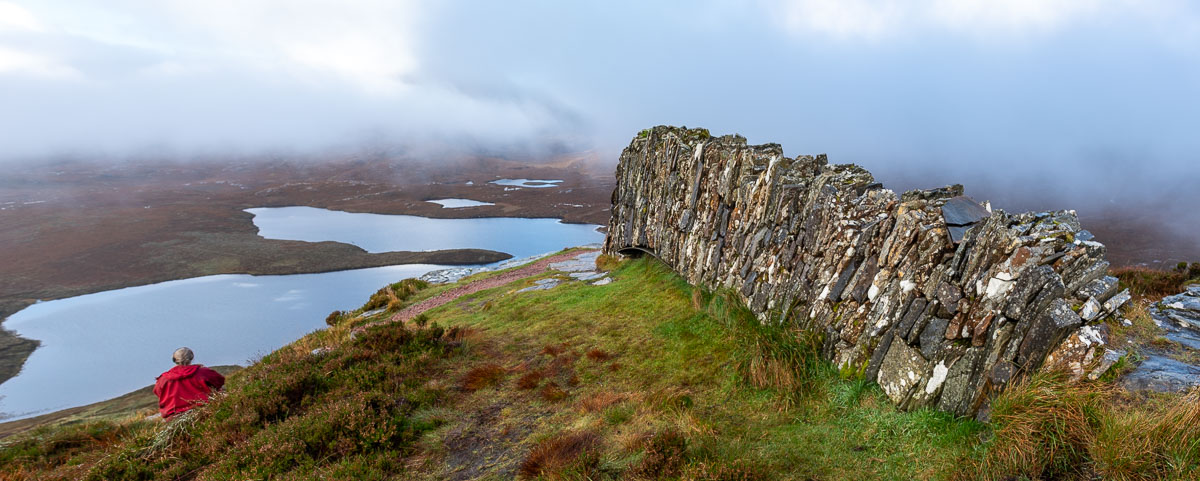
The first lake flanks the trail. Slowly, the terrain is becoming rockier.

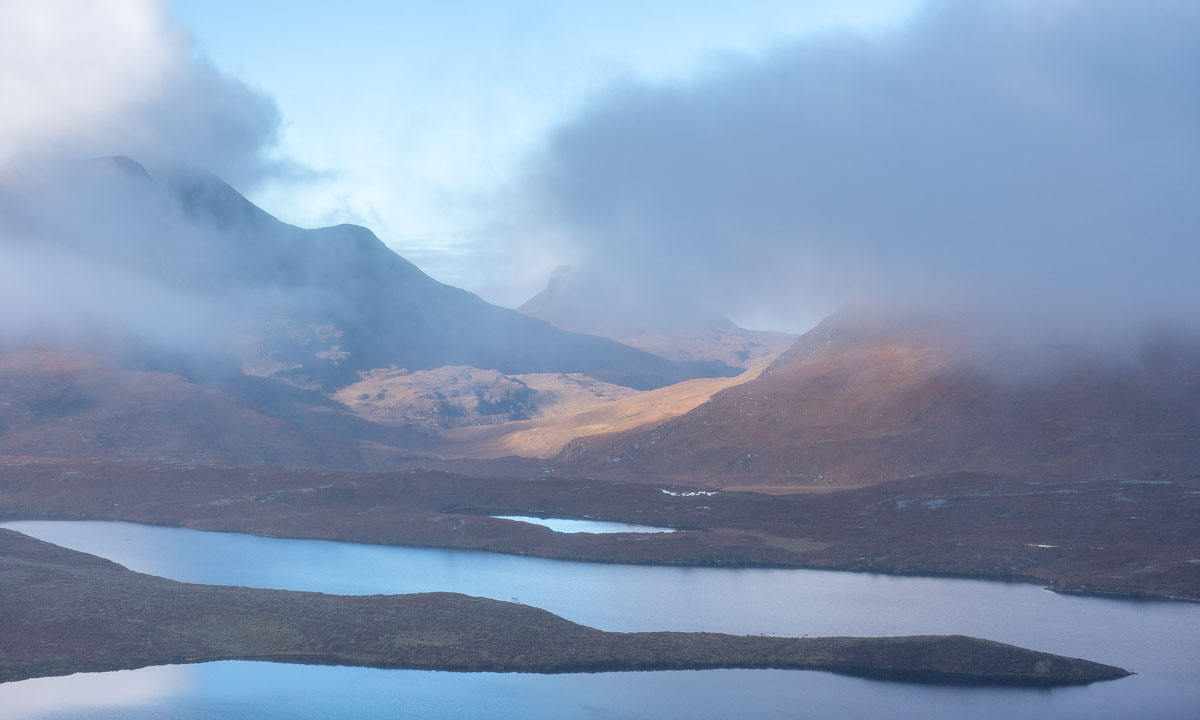
I look back and already now the hiking tour was a success. Lakes, hills – some grassy, some rocky – and at the horizon a mountain range. So beautiful in the warm light of the low sun.

For a while, grassy patches and rocky ground alternate …

… then the altitude takes command. Only snow and rocks are present and the vegetation is reduced mostly to mosses and lichens. I have to cross a large snow field but the ground is not slippery.

But then I arrive on the stone-covered plateau of Stor-Kjølen, where I can see a small cairn in front of me, a tall cairn marking the summit and the radar station. And if you look closely you can see a small cabin in front of the station. It’s a shelter for hikers. I’m alone, so I can use it for the night.

I want to take photos of the midnight sun, so I start experimenting with some sun-facing shots. These photos are much darker than reality. While the light is warm, it is still bright daylight.

The mountains and the sea all glow in hazy orange hues when I look against the sun.

But I have a mission – taking a photo of the midnight sun. Here it is. Unfortunately there is a small, transparent cloud in front of the sun that makes it look like a white splotch instead of a circle. Bad luck!

Bad luck? Not really. We have summer time, so the lowest position of the sun is one hour later – or a bit more accurate 0:48 due to local solar time. So I had some spare time to take more photo from the stone-covered flat top.

Then it was time: The sun as its lowest position. Ok – I was three minutes late, but the solar path is so flat that it doesn’t matter when taking photos. The light is the same. And eventually the little cloud was vanished.

Just a selfie with my mobile phone, then it is time for bed, at last. (A down hoodie? Yes – it is windy and only +5 °C.)

I enter the shelter, roll out my sleeping mat on the floor and lie down, using my sleeping bag as a blanket. Cluck-cluck, cackle-cackle! What’s that? I peek out of the door and see that the hour of the ptarmigans has started. All around, these galliforms dart about, filling the air with their typical clucking. I am too tired to start another photo hunt so I just take some snapshots. (These photos are heavily cropped.)

But then it is finally time to sleep. The shelter is filled with light, the camping mats (I found another one in the shelter) are thin and the ground is hard. But then I doze off and …

… sleep. At least for a couple of hours.

To part II >

Dundret

It rained a lot in Gällivare when Annika and I were there some days ago. On Wednesday however the weather forecast said there’d be a bit of sun in the afternoon, so we planned to hike on the Dundret. Dundret is just around the corner and a solitary mountain, a so-called inselberg. I skied up there in Winter 2012. In summer you can take your car and drive up almost all the way.

Indeed it had stopped raining and we had some sun and blue sky when we started our hike.

As in many Scandinavian hiking areas there are summer and winter trails. The winter trails are marked with red crosses that lead over the “kalfjäll”.

Kalfjäll is the Swedish word for the alpine tundra above the tree line. The dwarf  birch growing here is technically a tree, but you wouldn’t think so at first glance. It has no visible trunk, and its branches sprawl low across the ground.

We splotted some flowers in bloom such as the mountain-Heath, the alpine azalea or the lapland lousewort.

It got cloudy on our hike, but at least it didn’t rain.

After some hours of hiking (and some mosquito contacts) we arrived at the car and drove down again. On some of the slopes there was still a bit of snow.

For me Dundret is a mountain for hiking and back-country skiing, but it is also a ski resort.

Near the station at the bottom we were sitting for a while enjoying our waffle with jam and cream before we drove back to the Gällivare camping ground. When we arrived there it started to rain heavily. Good timing I would say.

And here two winter photos from Dundret when I was there in February 2012. Seems like ages ago.

A short summer journey in Northern Sweden

Annika and I are on holiday and spent this week to travel around northern Sweden by car, mainly to visit friends. Some stopps: Kusfors, Arvidsjaur, Nattavaara, and Gällivare.

Jar museum Rolig & Rusk

We took a short stop at the jar museum in Burträsk. Not to visit the museum, but the small flea market. If you travel in Sweden and love browsing at flea markets, look for the sign “Loppis”.
Smörgåstårta

In Kusfors we visited friends and got Smörgåstårta for lunch. This dish is very Swedish. While its “architecture” resembles a layered cream cake, the taste is savoury and contains ingredients like ham or cheese.

Summer flowers

When there are meadows or pastures in Northern Sweden there are full of flowers in summer. Here you can see for examples dandelions, butter cups, campions, and cow parsley. This patch is by our friend’s house.

A reindeer in the grocery?

Reindeers are typical for Northern Sweden and you have to watch out for them when driving a car. This fellow however is stuffed and stands in the display window of a grocery in Arvidsjaur.

Zzzzzzzzzzzzz…

There are many lakes in Sweden and in summer these lakes always come with mosquitoes, especially in the evening. Luckily they are late this year and I could take this photo without being eaten alive.

Old log cabin

We are spending the night at Renvallen Camping near Arvidsjaur. The camping ground is an old farm and some buildings such as this log cabin are pretty old.

Gravel roads

If you think, your car is too clean, use a Swedish gravel road in rain. The back of you car will be plastered with brownish-grey mud that even the strongest rain cannot wash away.

Sandviken beach

Yes, I wanted to take a bath at Sandviken in Gällivare, but my motivation went near zero, when I stood there in the steady rain looking at the shallow water with its gravelly ground.

Fat Tony’s

If you like burgers, you should give Fat Tony’s in Gällivare a try. Both atmosphere and food are great. And if you are there, do visit the bathroom.

Dundret

Just around the corner from Gällivare lies Dundret, a solitary mountain. When the rain stopped Annika and I took a hike there together with our friend Sascha and his malamute Roxy.

Tyre dealer

Stuff standing around in car garages has always its own aesthetics. The reason, why we needed a tyre dealer on our trip will be told another time (although you already may guess it).

Summer Café in Nattavaara

On Monday we passed Nattavaara. Alas, the summer café is closed on Mondays. On our way back it was open and we stopped to ate cake. Different volunteers come up for short stays to run the café and bake cakes. Most of them are from Switzerland or Germany which strongly increases the cake variety in the region.

4th June – the snow in the front garden is gone

This is a photo from 28th April:

This a photo from yesterday, 3rd June:

Both photos show the same motive. The house where I have my apartment with its front garden. The bush in the front garden in about five metres high. In winter I could touch the top of the bush with my fingers, today the last remaining snow has melted away while I was working.

No, we didn’t have three metres of snow in Tromsø last winter. The maximum was “only” 120 cm. But my landlord and I use the front garden as a snow tip and so the amount of snow we put there accumulates in the wintertime. In spring it takes some extra weeks to melt.

And so it looks like if you step into the snow in front of the snow shovel and hop up and down several times …

Now I’m longing for summer but secretly I’m already looking forward to the next winter and the first snow ;-)


It’s June in Tromsø

After a week in my hometown Bremen in Germany I returned to Tromsø yesterday. This morning I took a tour through the nature of the northern island. The landscape is mostly wooded hills, with a few bogs and lakes dotted around. I was curious about two things: how much snow is left and have the birch trees got their leaves?

More and more snow is gone. However some of the forest floor is still covered with dirty snow, sometimes up to half a metre and more.

You can still see last winter’s cross-country ski trails. The pressure of many thousand skiers has squeezed the snow making it more compact. Like white ribbons, these paths wind their way through the forest.

Other paths give no hint that winter ever touched that place.

The moorland with its spongy ground is completely clear of snow. And so are the lakes.

However, although it is already 1st of June the colours look more like late October. But if you look a bit closer you see the signs of springs such as the blooming marsh-marigold and the birch leaves that finally start to grow and unfold on some of the trees.

Fremdriftstak

Monday 19 May

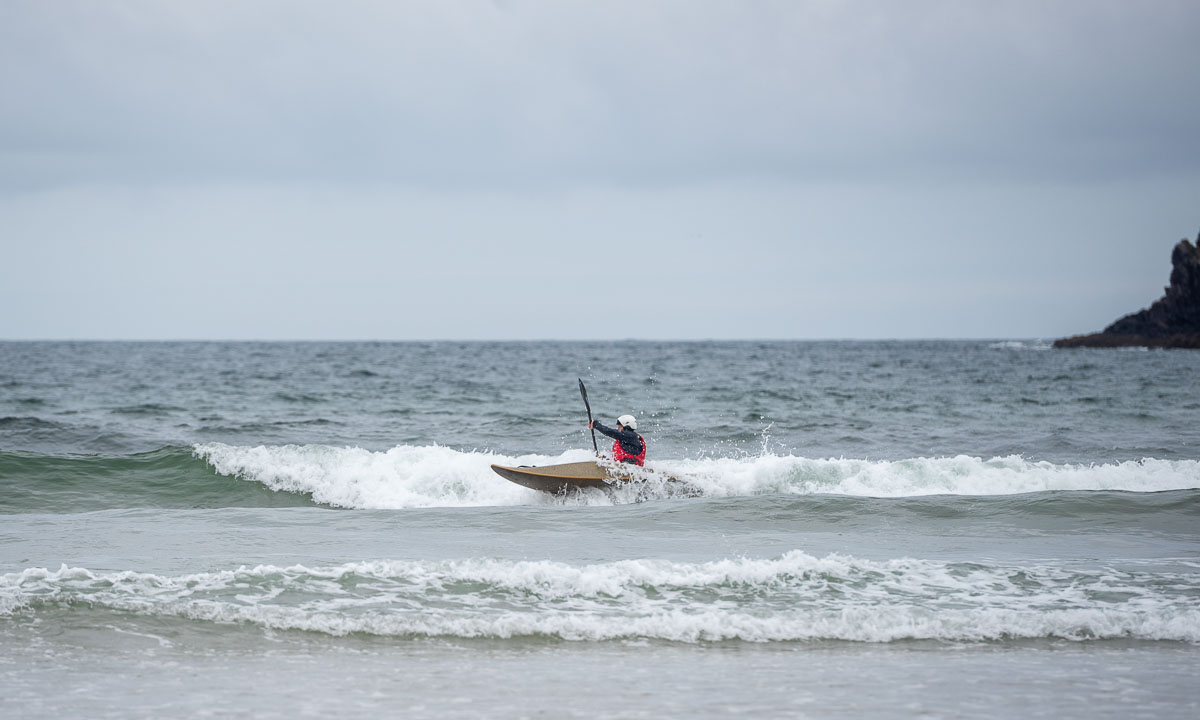
On Monday I joined a kayak training on fremdriftstak. That’s Norwegian for forward stroke, the most basic kayak stroke. We had two experienced trainers, one for the euro paddle, one for the Greenland paddle. I joined the euro paddle group and learned some new details that hopefully will help me kayaking a bit more effortlessly in the future. The weather was a mixture of sun and clouds and the last hour it rained. Doesn’t matter, we are fully waterproofed when on the sea anyhow.
Thursday 22 May

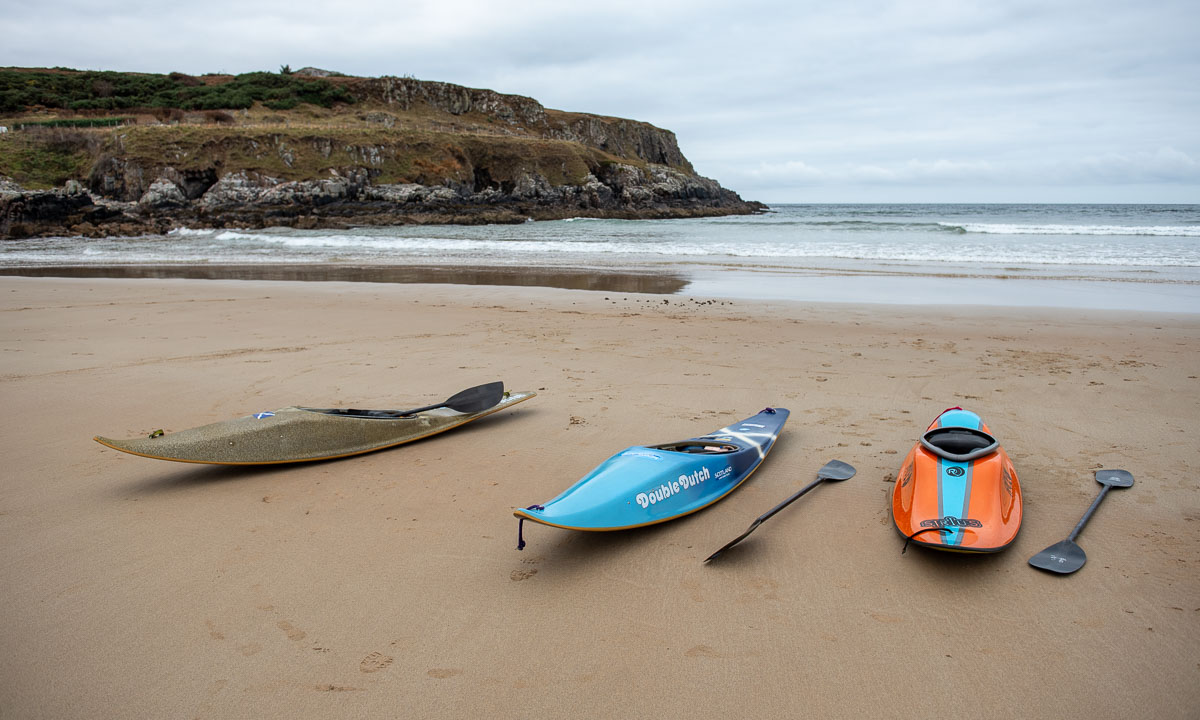
Yesterday was the regular Thursday paddling with eighteen eager kayakers and fantastic spring weather. I joined the group kayaking to the island Grindøya as the week before. While the tour leaders told us about their plans and checked, that we all know the basic communication signs, the colourful kayaks had already been brought to the shore.

My own kayak is in Sweden so I always rent a kayak from the kayak club. A good opportunity to finally test another model. I had used the same on Monday, now I checked it a bit again while waiting for the others to join.

We paddled to “Monsterbygget” – a large cuboid building that is one of the favourite orientation marks for kayakers. There we split and our group of eleven headed west to the island Grindøya.

It is round 2.5 kilometres to the southern tip of the island. A good opportunity to recap my learning from the Monday training. It went well but it will take time until it is in the muscle memory. At the small bay with the sandy beach we parked our kayaks. This is one of the two locations where you may enter the island during the bird breeding season. Time for a break, enjoying the sun, drinking water and eating chocolate.

On our way back we paddled along the western shore of the island. We saw a lot of eider ducks and other sea birds that I cannot name. After two kilometres we had passed the northern tip and were heading back to Tromsøya crossing the strait Sandnessundet.

This is a great season for paddling, especially on such a sunny day. The coast is green, the sea is blue (and very cold) and the mountains are still covered with snow.

In the south we could spot a ship. Where will it go? We decided to wait. The ship was sailing along the strait and since ships are not only much bigger than us but also much faster we decided to paddle back a bit and then to a sea mark north to wait for the ship to pass.

First the ship’s movements were hardly visible but when it approached it seemed to become faster and faster. While it was passing we spotted another ship in the distance, this time in the south and decided to cross the strait instantly. I took two photos, then I had to keep up and since we wanted to cross the strait quickly I didn’t make any further photos.

At half past nine we were back at the boat houses. Takk for turen – thanks for the tour!

Today

I’m proud. I paddled 11.3 km yesterday and I don’t have any pain in my right arm as occasionally after other tours. Just for that the training on fremdriftstak this Monday was a full success. Thanks, B. for your tipps and advice.

These are the two recorded tracks from kayaking to Grindøya. The first one from last week, the second one from yesterday.

The snow is melting

Fifteen days ago: 98 cm of snow in Tromsø, measured at an elevation of 100 metres. Yesterday – two weeks later – 31 cm of snow are left. And so my walk home also looked like. Somewhere between the winter still hesitating but spring approaching anyhow.

Tomorrow the summer working hours start and till September I’ll have to work only seven hours a day. Yay!

The following day my car will get summer tyres.

And on Sunday – four days from now – the time of the polar days start where the sun won’t set before 26 July.

End of April winter in Tromsø

When I woke up yesterday morning (28. April) and looked outside the window of my living room I was pretty surprised. I didn’t rain in the night, it had been snowing.

Round 15 cm of fresh snow had fallen within the last six hours and everything looked wintry again. In the centre of Tromsø however, 88 metres lower in elevation than my apartment only five cm of snow had fallen and the cars had smashed it to brown slush. What a difference!

Home again I watched a ptarmigan in the back yard. First it picked on a twig of a tree, then it dug itself into the snow and rested there for some hours. Couldn’t it see me behind the window pane or did it just ignore me? In the night it was gone.

Today I took my skis to work so that I could ski back home from the lake Prestvannet. This time the forecast was correct: we got a blue sky, the sun was shining at temperatures round +3 °C. At the harbour in the centre the view was quite spring-like.

Taking the bus from the center up to Prestvannet takes only 5 minutes, but there it is still winter season with snow depths round 90 cm. It’s astonishing what a difference in altitude of less than 100 metres can do.

Time to ski back, preferably not on the tracks but through the forests. After four kilometres on skis and 840 metres by foot I was home.

Two promenades on Tromsøya

Easter Monday – from Sydspissen to home

On Easter Monday we got surprisingly fine weather in Tromsø. The sun was shining and the sky was blue. I took the bus to Sydspissen – the southern tip of Tromsøya – because it has been ages since I’ve been there. A lot of snow has melted away and tussilago was blooming everywhere. I passed the beach at Telegrafbukta and the pier at Folkeparken came into view. I know the this area well, because I lived nearby for quite some time.

I went on, enjoying the sun and ignoring the chilly wind. Don’t let your eyes fool you, the max temperature was about +2 °C. I passed the old boat house Engenesnaustet, saw a lonely winter kayaker and passed the small lighthouse.

I was not alone. A lot of other people took the holiday to take a promenade, sit side by side or do some barbecuing. I took the liberty to remove some people from the photos.

I wondered if the old, abandoned boathouse was still open? It was. A bit away from the shore there was some leftover snow. The tussilago flowers didn’t care, they were blooming anyhow.

Now it was not far away to the boat houses of the two kayak clubs in Tromsø. TSI Trulle and Tromsø Havpadleklubb. Here I start all my kayak tours in Tromsø, because my own kayak is in Obbola in Swede, so I use to hire one here. Season has just started and I want to paddle a lot this year!

At the bus stop Giæverbukta I missed my bus. 28 minutes of waiting or two kilometres of walking? Easy decision: I walked.

It was fascinating that the coast was mostly free of snow, while MET, the meteorological institute inside the island measured a snow depth of about 80 cm that day. At an elevation of 100 metres. And so the walk became snowy in the end. But spring showed up here as well: some willows had started to bloom.

Intermezzo – more snow

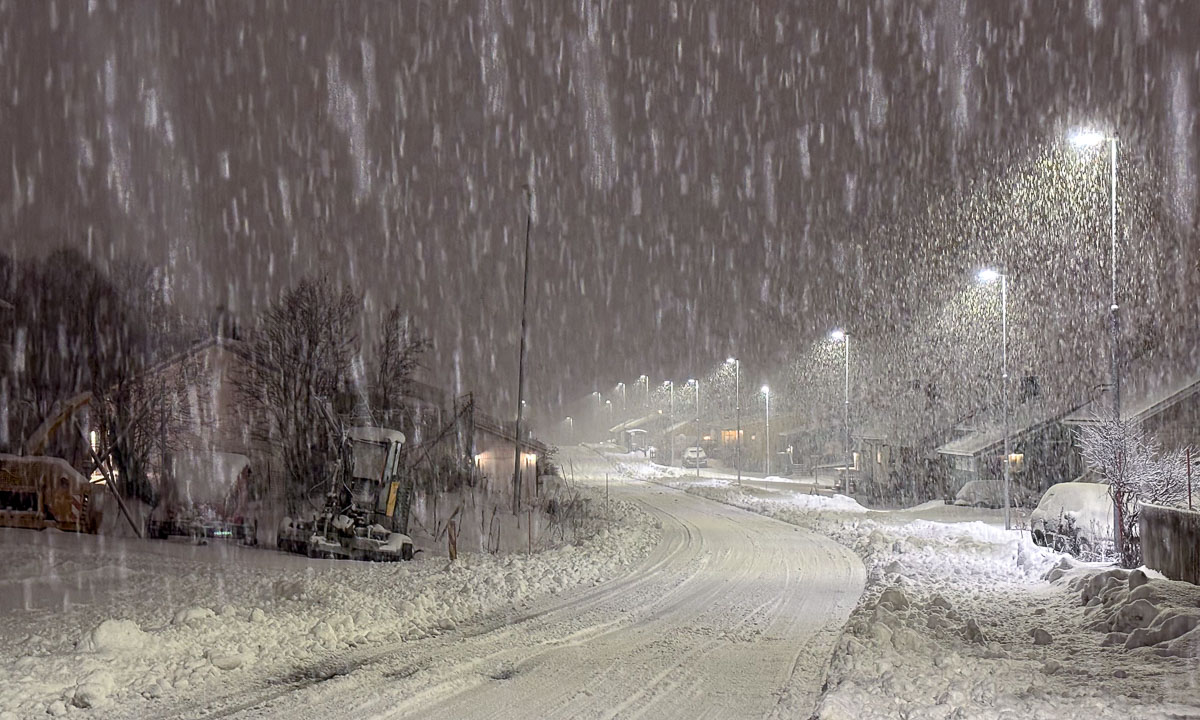
Yesterday afternoon it started snowing. Some snow showers were pretty dense. And sometimes I got one of my favourite weathers: snow flurry and sun at the same time. So beautiful. I tried to take pictures but the result became quite ugly, because the snow against the camera looks dark.

This morning ten more centimetres of snow have fallen, even in the lowland areas. All Scilla flowers in the centre were covered in snow and for the photo I had to look to find some flowers not being completely buried.

Friday (today) – from Prestvannet to home

I use to walk home twice a week after work. Then I take the bus to the lake Prestvannet to skip the boring (and steep) parts. Today I do the same. Additional snow showers have increased the snow depth to 92 cm, but it has started clearing up, when I begin my way home at 15:00. The fresh snow gives the lake an untouched appearance and the first lifebuoy is snowed over almost completely. Could it be January? No, the light is different.

I follow the ski trail a bit then I follow the smaller paths. They have hardly been used today, mostly by a single skier or pedestrian.

But then I come to an area where the snowy paths are completely untouched. No one has used them today. Imagine that: You are on a island with 43000 inhabitants. Many of them are enthusiastic skiers and outdoor maniacs. It is Friday afternoon and the sun is shining. And I trudge through 15 cm of untouched fresh snow. This is absolutely brilliant; I’ve never experienced anything like this before!