Ekkerøy and Nesseby

This article is part of the series “2018-03: Varanger peninsula”.

Day 34 and 35 of my winter journey 2018

After some days in Ytre Kiberg Annika and I travelled to the next place: Ekkerøy. This village, 50 km southwest from Kiberg lies on the peninsula Ekkerøya that is connected to land by a natural dam with sandy beaches on each side. We already had taken a short walk at one of the beaches last week, where we had met H., one of the locals.

We arrived in Ekkerøy three days ago. The day before yesterday I took a morning promenade with my camera. I made some photos, but the light was a bit dull.

After breakfast Annika and I started a tour round the island, partly with snowshoes, partly on foot. There’s a cliff at the southern shore that looks quite impressive. At the eastern tip there’s an old wooden sea mark. The northern shore is quite flat and was more snowy. Outgoing tide already had started so we walked the last meters on the beach until we came to our wonderful house, that we’ve rented for four days.

As you might have noticed almost all photos shown in this blog have a landscape format. I have a project however that might involve having portrait format photos as well. Therefore I walked to the beach yesterday morning to find a motif fitting portrait format, not too easy in a landscape that’s extensive and mainly quite flat. It was almost high tide and it was quite cold – -12 °C and very windy. The water at the beach was almost of a slushy consistency and each wave flushed new liquid slush to the beach where it froze to a wavy line of ice. That motif went quite well in portrait format, I just have to practise my view.

(I have to think over the design of my blog, these portrait format images are way too large.)

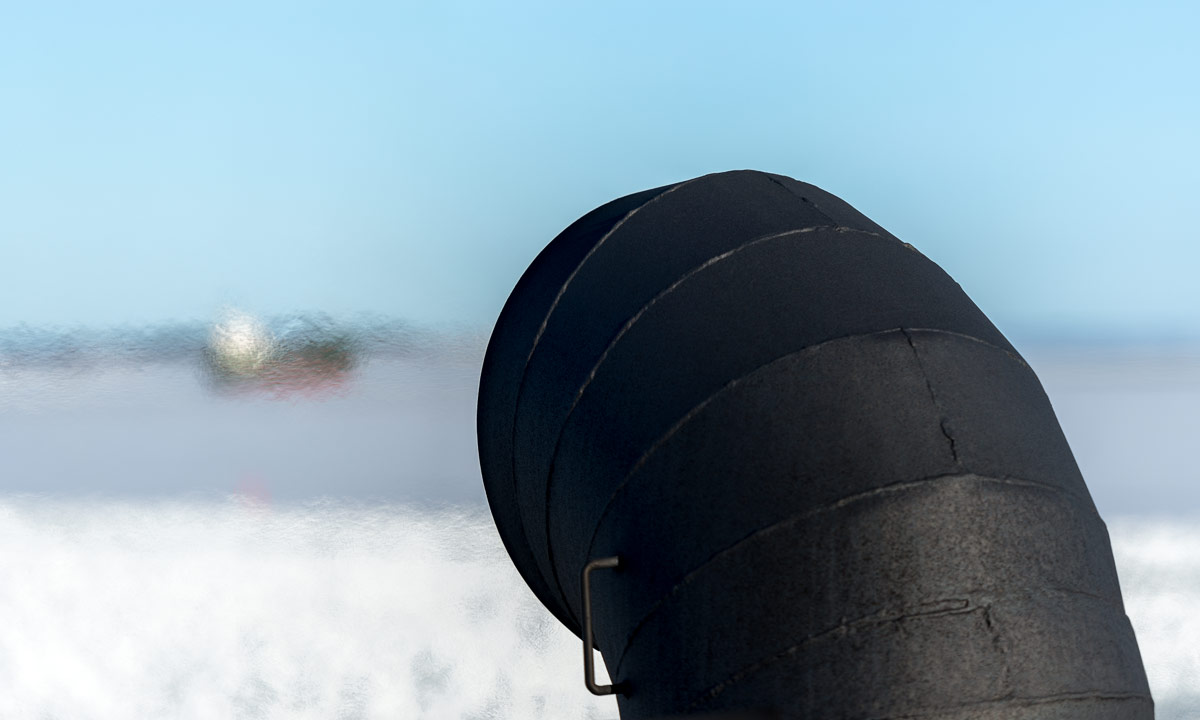
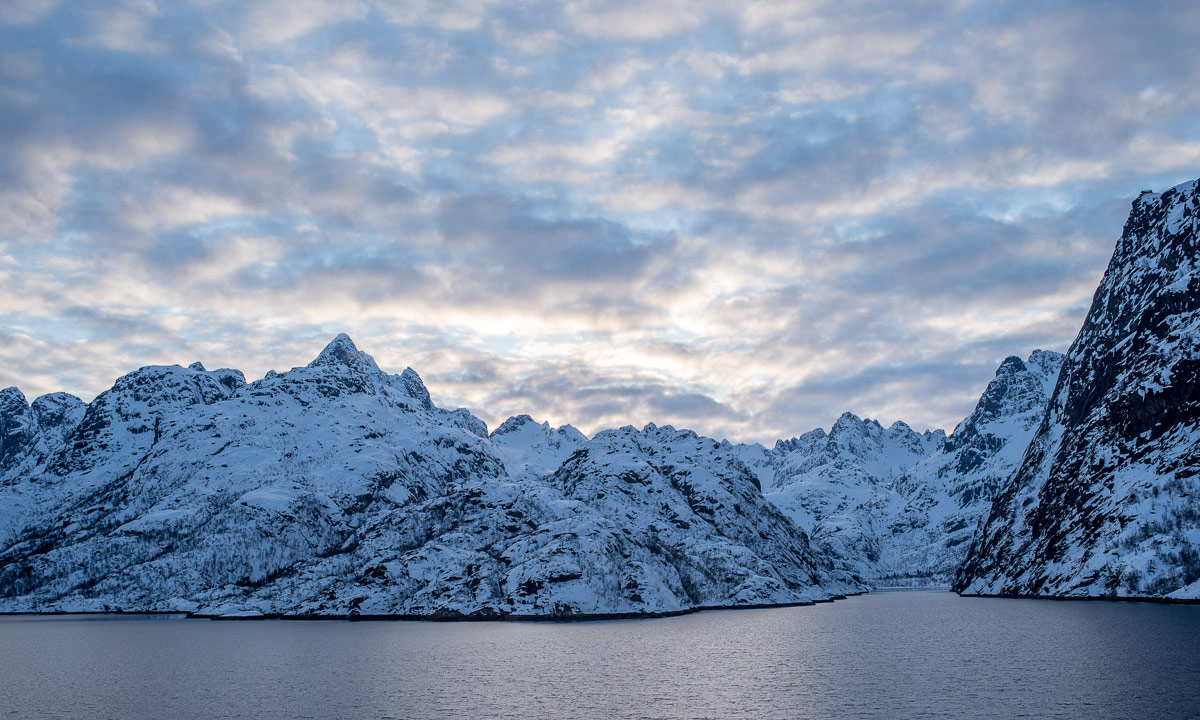
It cleared up more and more and the sun shone from a blue sky. We took the car to Nesseby, 50 km away, where I planned to make some photos of the Nesseby Church. The more we came to the more sheltered parts of the fjord, the colder it got and the open water of the Barents Sea smoked. This phenomenon is called sea smoke and happens, when cold air lies over the open sea.

From the harbour Nesseby Church could be seen through the foggy sea smoke. It is located quite exposed at the thinnest part of a peninsula and can be spotted from long, when weather is good. After looking from the harbour we continued to the church and had a closer look.

We took a short detour to Varangerbotn. There it was even colder with -19 °C but fair weather and hardly any wind.

It’s fascinating to have a look at the fjord of the same name. At the end it’s completely frozen with many icy humps, but on the way back (and north again) it opened and sea smoke appeared again.

In Vadsø I took a promenade on the island Vadsøya to have a look at the airship mast. Since I’ve been a child I’m a huge fan of balloons and airships and it was interesting to see this mast, built in 1926 and only used twice: by Umberto Nobile and Roald Amundsen for their expedition over the North Pole with the airship Norge in the same year and on Nobile’s flight with the airship Italia two years later.

Home again we remembered that H. who we’d met the week before had asked us in for coffee some day. At 4 o’clock we knocked at the door of her house and met her husband T. who directly invited us to come in. H. was visiting a friend and would join us later. We talked and talked, about languages, life in Northern Norway in general and Ekkerøy in special and we had a good time (and got coffee, cakes, cheese, grapes and red wine). When we left H. and T. – two of the round twenty permanent residents in Ekkerøy – it was already 9 pm and sky was dark … beside of a beautiful aurora dancing above the northern shore.

It took some minutes to walk home, put on warmer clothes, get camera and tripod and the aurora already had weakened a lot when I took the photo below. So it is with northern lights: intensity can change very fast, often within seconds.

Today we have another day in Ekkerøy. Our plans so far: not any. That’s nice, too!


Eight times Ytre Kiberg and around

This article is part of the series “2018-03: Varanger peninsula”.

Day 31 and 32 of my winter journey 2018

1. Yesterday, Ytre Kiberg – the morning

Two days ago two other guests arrived at Cape East Arctic Adventure, our cozy stay in Ytre Kiberg. They came from Utrecht in the Netherlands and were on a three week car trip from Utrecht to the North Cape and back – 8500 kilometres in total!

Trond, our fantastic host made a special breakfast for them: King crabs, locally caught in the Barents Sea. Annika and I got our share, too. King crabs are probably my favourite seafood but it was the first time I got such for breakfast.

After breakfast Trond had some work to do: clearing the snow with his rotary snow plough. Last days had been very windy with some short but intense snow showers. The snowploughs had to work a lot to keep the roads clear of snow and Trond had to clear the snow on his property several times a day. This morning the snow drifts were especially high and Trond had to work hard to get through with his snowblower.

2. Yesterday, Vardø – a private guide tour by Trond

After the driveway was cleared, Trond invited the Dutch guests and us to a short private guided tour in Vardø. We entered his all-wheel drive car and he drove us the short way to Vardø – a town with 2100 inhabitants located on an island – where he showed us some of his favourite places. There is a lot of street art in Vardø and next time I have to take a closer look to all the graffiti and more conceptual artworks. But you cannot do all in a single journey.

There’s a mountain pass between Vardø and Ytre Kiberg called Domen. It’s quite exposed to the elements and when we crossed it waves of driving slow covered the road.

3. Yesterday, Skallelv – a short visit

Soon after we arrived in Kiberg, the Dutch guests left and Annika and I made a car ride to Skallelv, 30 km south of Ytre Kiberg. The weather was really nice: sunny and hardly any wind. We went round a bit and I made some photos. I had however problems with some lenses, they got moisture inside that tends to freeze when being outside. Hopefully they will dry within the next days.

4. Yesterday, Vardø – the Vardøhus Fortress

After a rest we took a tour to Vardø again, this time we wanted to focus on two local attractions: The fortress and the witch memorial.

The Vardøhus Fortress (Vardøhus festning) was built round 1300 and is the northernmost fortress of the world. Beside of being a museum it is used today as a school for the Norwegian marine. Shortly after we arrived there, the Trollfjord, a Hurtigruten ship landed in Vardø and shortly after many tourist rushed through the fortress. In contrary to us they only had litte time.

5. Yesterday, Vardø – Steilneset Memorial

After visiting the fortress we went on to visit the witch memorial. It’s not easy to reach. First of all you have to know that it is called Steilneset Memorial (or find it visually), then you have to plunge through deep snow, because there are no cleared ways to the memorial.

In 1621 91 people, mostly women and Sami people had been executed for witchcraft. This memorial, created in 2011, shows the history of all 91 people and lists the confessions made. It is a shocking and touching place about the cruelty of mankind and worth to visit, if you are in Vardø and have the time.

After this long and eventful day we were quite exhausted and decided to take it a bit more easy the next day.

6. Today, Ytre Kiberg – a promenade in Ytre Kiberg

Today morning it was quite warm (-4 °C) and almost windless. 10 cm of new snow had been fallen over night. After breakfast we took a medium short promenade along the beach and into the village and back. The weather was changeable as it uses to be here. It could change from sun to snow within less than a minute.

Snow fall intensified and it became a bit windier, too.

7. Today, Ytre Kiberg – a private tour though the partisan museum

At 15:30 we had an appointment: we were invited to visit the Partisanmuseet – the partisan museum in Ytre Kiberg. We would get a personal guided tour from Steinar Borch Jensen – expert for the history of Kiberg and around – who would open the museum for us.

Trond took a huge spade, we entered the car, drove the short way to the museum, plunged through the snow to the entrance, where Steinar already had started to clear the outer stairs. Trond joined him shovelling.

The museum is not the biggest and the showpieces maybe not the most special, it’s the stories behind the showpieces that matter. Steinar had a lot to tell about the partisans in Northern Norway that fought on the Soviets side against the National Socialists in World War II. Beside of Steinar’s huge knowledge about that time there was another facet, that made our visit in the museum very special. Both Trond and Steinar have personal relations to the partisans. They know their relatives and they know the places where they lived. For many Norwegians the history of WWII is not just an academic interest but personal history. Soon the last witnesses of the past will be gone.

I felt very touched by the visit and was glad that we got the opportunity to get involved into the local history, but it made me thoughtful, too and reinforced my personal pacifistic worldview.

8 .Today, Ytre Kiberg – the first Varanger polar lights

Actually I planned only seven stories in this long blog article, but well …

I was out after a great two course dinner: reindeer (provided by Trond), pancakes (provided by Annika) and me doing the dishes. I wanted to make a photo of Cape East Arctic Adventure, Trond’s house, where Annika and I had such a good time. Then I spotted faint polar lights. I wore only a t-shirt and got in to fetch my Canada Goose parka. I was outside quite a while since the polar lights gradually became stronger. They constantly changed place making it hard to take any good pictures. It was -10 °C, quite windy and more and more I closed the zipper of the parka to prevent freezing. After a while the aurora weakened and I went in to look at the photos. I’m not content with the image above, but it’s a nice remembrance of our fantastic stay at Cape East Arctic Adventure in Ytre Kiberg.

Tomorrow we will leave and stay in Ekkerøy for some days.

Tusen takk, Trond, for your kindness and your great hospitality!

A trip to Murmansk – day two

This article is part of the series “2018-02: A trip to Murmansk”.

Day 23 of my winter journey 2018

When we came home from our dinner last night it started to get quite foggy und it became colder. The fog intensified and the city started to smell smoggy.

This morning however was clear and some millimetres of snow dust had fallen over night making everything looking white and fresh. It was much colder than the day before (Murmansk airport reported -29 °C) but the hotel doesn’t have a thermometer so I don’t know how cold it was in town.

After breakfast we went through the Park Zhertv Interventsii (Парк Жертв Интервенции), a small park directly at the hotel.

Then we continued through the streets and across the railway to the port.

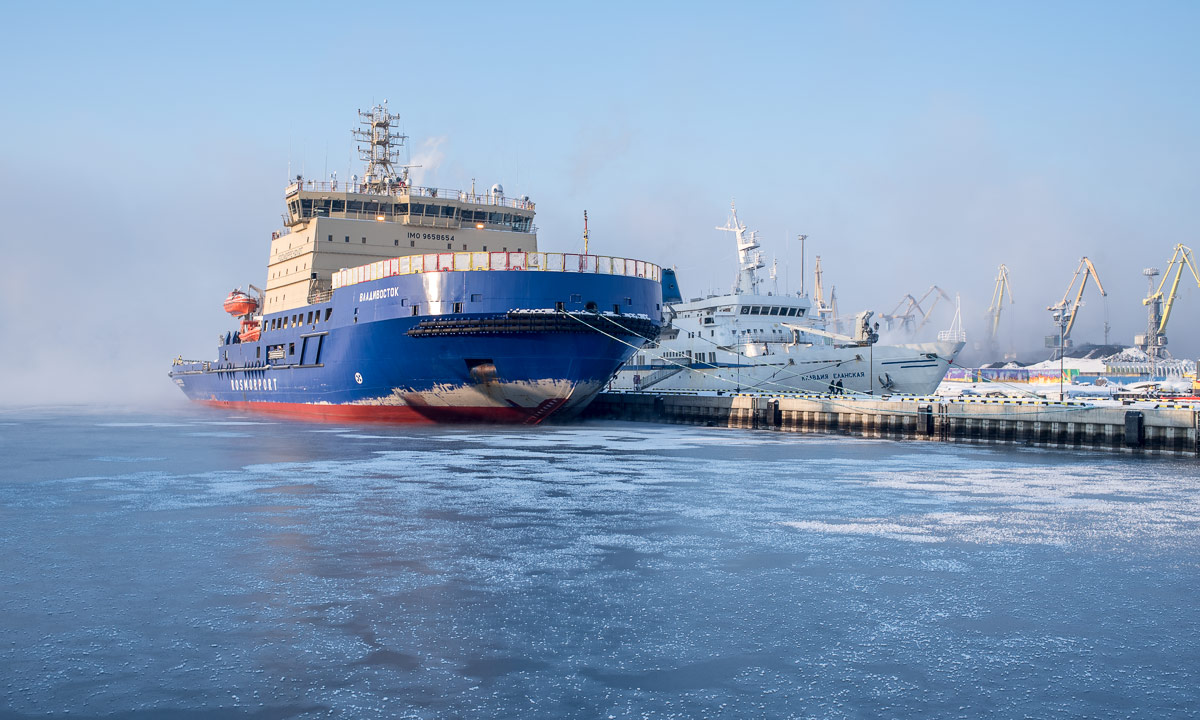
We wanted to visit the atomic icebreaker Lenin (Ленин) and check if we already could buy tickets. Lenin was the world’s first nuclear-powered surface ship and launched in 1957. She was decommissioned 1989 and subsequently converted into a museum.

Two big ships lay at the pier: Lenin and Vladivostok (Владивосток). Parts of the water surface were covered with ice but most of the water was open and steaming in the cold. The other side of the Kola Bay was hardly visible in the fog although only one kilometre away. The small ice particles in the air made the air feel quite cold.

A man left the icebreaker to meet a french couple at the pier, that had booked a tour. Unfortunately we couldn’t follow with them since this tour was privately booked. The man could speak a bit of German and we learned that the outside temperature was round -22 °C and that we had to wait for the first public tour at 12 o’clock.

So we went back to town, this time crossing the railway by a pedestrian bridge. Large chains of good wagons, some empty, some filled with charcoal were seen on almost all tracks.

While Chris and Ørjan went their own ways Annika and I went to the center to find a book shop. We knew that we had to follow the Lenin Alley (Проспект Ленина) and we found several book stores where I among others bought a pictured children dictionary English—Russian.

We continued the alley and finally came to Murmansk Mall (Мурманск Молл), a large shopping mall. Here both local stores and many international shops as e.g. H&M were found. The mall was extremely tidy and a huge contrast to the many rundown concrete buildings.

We’ve been in another mall the day before where you mostly could find Russian fashion for women. And that means mostly fur coats, partly in very fancy colours, high heeled boots and a lot of accessories in pink, silver and glitter. Some of them looked like plastic toys made for four-year-old girls, but in adult sizes. A fashion quite different from the informal one in Germany or Sweden.

I was really irritated when I entered some shops. People in Murmansk don’t smile or even laugh in public unless they know each other quite well. When you enter a shop the salesperson will stand up and observe you and even follow you through the shop. They won’t take contact with you, they won’t smile but will instead look stonily at you. I felt treated completely unwelcome and more like a thief than a customer. Strange and irritating!

Annika and I went back to the hotel and passed a Lenin figure and a house painted in bright turquoise, a colour that seems to be quite popular in Murmansk, as some other houses were painted the same.

We met Chris and Ørjan at the hotel and continued to the port together. Although it had become warmer it was still quite cold and some of the water that was open in the morning had frozen over in the last hours.

We arrived at the port at half past eleven and were the first one’s for the guided tour through the icebreaker Lenin. Shortly before twelve Annika and I could go aboard but most other tourist pushed to the front so that Chris and Ørjan were left behind. Later we realised that they attended another tour just some minutes later.

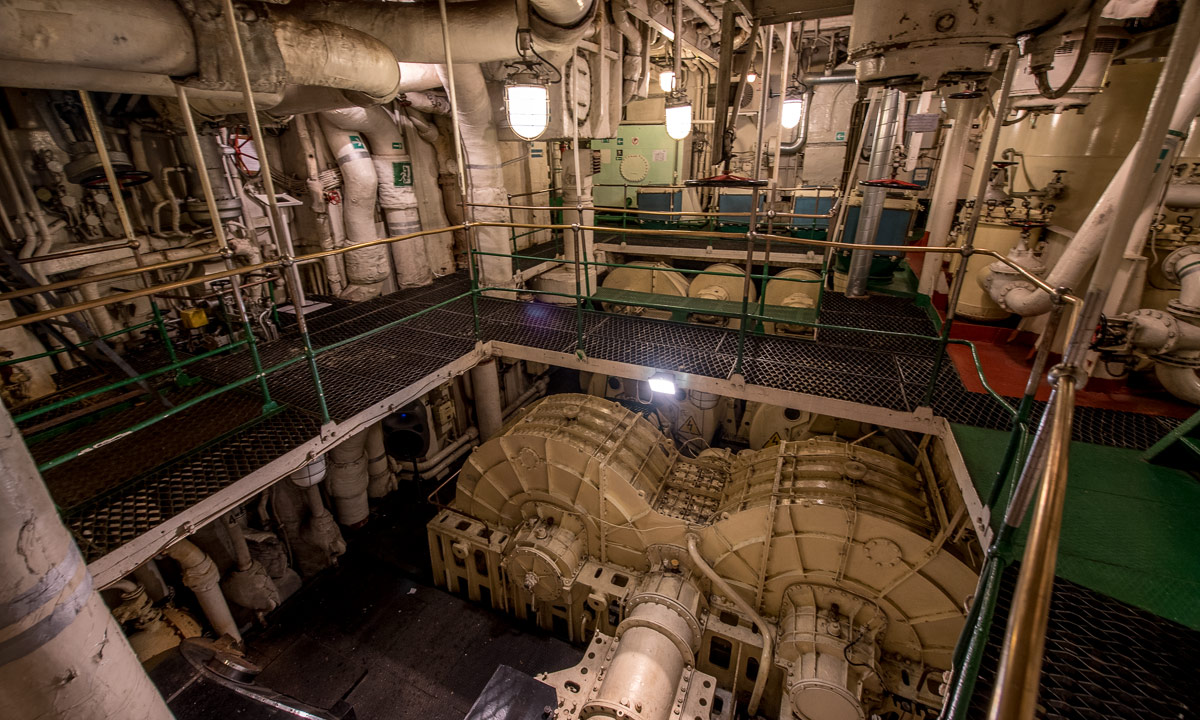
The following hour was one of the most boring experiences for long and made me remember some of the dullest school lessons. We were guided in a crowd of people by a Russian guide that loved to speak in a monotonic language without a split second of resting. Since he was so eager to talk another group behind us fenced us in so that we could hardly move and we were really glad to be able to sneak from the icebreaker before the guided tour was over. I guess, that most tourists are Russians too and so are able to understand the guide but even then I consider this kind of guiding as extremely boring and almost narcotic. My personal advise: Look at the boat from the pier but avoid the tour.

Some pictures from the inside anyway.

After this experience we needed fresh air and a café. We went to the Café Yunost (Кафе Юность), took some sweet cakes and after that we returned to the hotel to rest for a while.

In the evening we went to Terrasa (Терраса), another restaurant, though not to the White Rabbit (Белый кролик), our preferred choice. First it was Friday and then it was a holiday: Defence of the Fatherland Day. Therefore many restaurants had been fully booked. We enjoyed the food, went home to the hotel to take a short drink. Then we went to bed early. Next morning the alarm clock would ring at 6:15 local time, that’s 4:15 Swedish time.

When being in the hotel I took pictures from above. Here you could spot almost all places and attractions we visited the last two days, among others Alyosha, the Church of the Savior on Waters and the icebreaker Lenin. A good summary of the last two days.

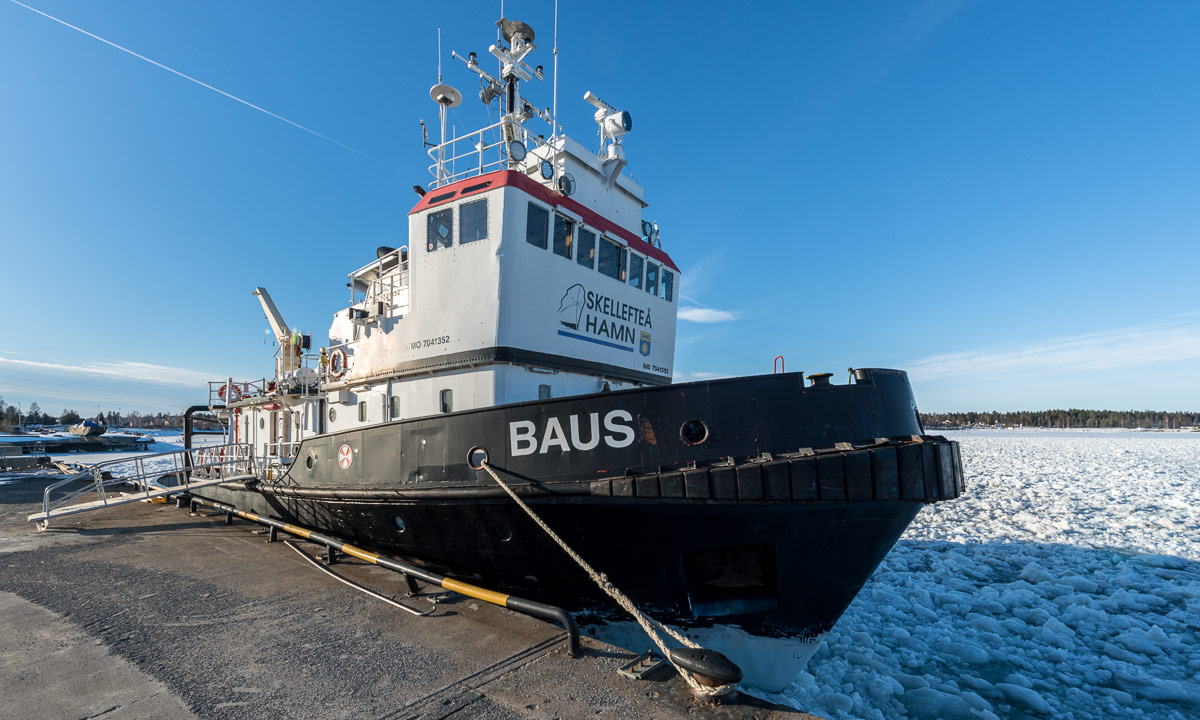
Ships and boats in Skelleftehamn

Today I planned to make some autumnal pictures in the early evening. I took the car to the small boat harbour tjuvkistan in Skelleftehamn. It felt like ages ago that I had been there. On the way there I saw a ship anchored in the commercial port. I stopped and to my surprise it was a ship from my hometown: The “Seabass” from Bremen. Of course I had to take a picture:

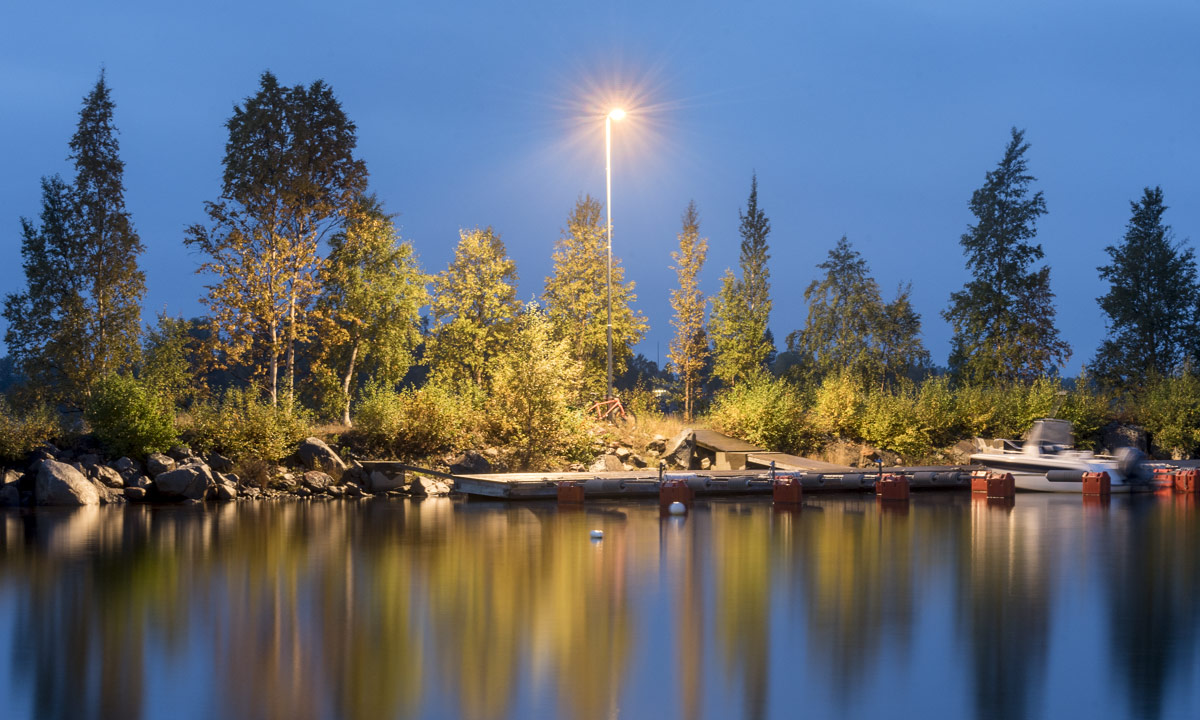
I went on to tjuvkistan and took some photos with trees (and boat navigation lights) reflecting in the sea. Still many boats lay in the small harbour or were on the way from or to the islands, but soon most boat people will set their boats on land before the weather gets too cold.

Hopefully I will have some other opportunities to make more pictures as long the leaves have not fallen down.


21 August: Kungsleden day 2 – Teusajaure—Kaitumjaure (9 km)

This article is part of the series “2017-08: Kungsleden hike”.

One of the less adorable things when you’re hiking from hut to hut is going to the toilet. You have to go to the utedass, the outdoor earth toilet, which is always a bit away. You need to slip in your boots or sandals, put on a jacket to stay warm and dry and in the night you even need a flashlight to find the right way. At least the toilet seats are made of styrofoam which isolates quite well. And there’re always some nice outdoor photos pinned to the wooden walls.

After I already took the camera to my early morning loo visit I stayed outside and took some more photos. It was chilly and cloudy but at least yesterday’s rain had stopped.

After a breakfast (Wasa bread with cheese and muesli with milk made from milk powder) we started our day’s march. It was much easier than the day before since it’s only 9 km to the next hut. We had to climb up round about 250 meters through forest until we reached the kalfjäll above the tree line. And finally the sun managed to find some holes in the clouds and illuminated parts of the alpine landscape.

It didn’t take very long until we crossed the river Kaitumjåkka (sami: Gáidumjohka) using the large chain bridge.

Leaving the river behind us we descended again through green birch forests …

… and arrived at the Kaitumjaure huts at 14:45. I cut up some logs and chipped wood for the sauna but it happened to be so crowded, that Annika and I left it soon. Katrin and Andi didn’t even managed to enter the sauna and the water for cleaning was still cold.

But even without a hot water “shower” day two felt much better than the day before. Now we looked forward to the next day that finally would lead us to the treeless kalfjäll for several days.

Back to the toilets: If you think that using the utedass is quite uncomfortable to use in summer, you won’t like it in winter either. Then you sometimes have to dress like for an arctic expedition just to reach it without hypothermia. Check the second photo in the article Kungsleden ski tour: Singi – from blizzard to clear sky to get an impression.


Three trips round Tromsø

This article is part of the series “2017-07: Tromsø”.

It’s me who is thrilled by the North, who loves to travel to places like Tromsø or Kirkenes. It’s my mother however who has been much northerly than I was. She was in Spitsbergen/Svalbard with a cruise ship many years ago. But on the way back the route had to be changed due to fields of drifting ice and therefore the travellers couldn’t leave the ship in Tromsø. So my mother missed Tromsø on that cruise.

This year we managed to close this gap: three weeks ago my mother took a plane to Munich, another plane to Oslo and a third plane to Tromsø, where Annika and I picked her up from the airport. That’s why we’d travelled to Tromsø by car two days before.

We had four days in Tromsø, I will write mostly about the first two:

Monday, 10 July

Weather was better than forecasted and so the first thing we did after breakfast was taking the car, crossing the Tromsøysundet on the Tromsø Bridge and taking the Fjellheisen on the other side of the town. Fjellheisen is a cable car up the mountain Storsteinen (approx. 420 m), where you have an incredible view over the town Tromsø, the island Tromsøya and the mountain ranges on the neighbouring islands.

We stayed there the whole morning, enjoying the view, walking around, eating ice cream and looking at the arctic flowers that grew everywhere.

Finally we went down with the cable car again driving back to Tromsø and since the weather was sunny and nice we just continued driving, leaving Tromsøya again, this time using the Sandnessund Bridge. We continued our trip on the island Kvaløya (Whale island), Norway’s fifth largest island. At the western end there’s a bridge leading to the island Sommarøya which sometimes looks like like a caribbean island with it’s turquoise blue bays.

Annika and I were very keen to take a bath, but we all were hungry too, so we took a lunch first. While we were eating our fried fish, clouds approached and soon it started to rain. So much to our summer bath plans …

After looking around on Hillesøya (another bridge, another island) we drove back, this time taking the coastal way in the south of Kvaløya. Finally even the sun came back and illuminated the bright yellow blossoms of Lotus corniculatus, or common bird’s-foot trefoil that covered the sides of the narrow road.

Have a look at the beach photo above. It’s not sand, it’s corals covering this beach, which makes them looking even more caribbean – at least as long it’s sunny.

Late in the afternoon we arrived at our hotel after our first day together.

Tuesday, 11 July

After the rainfalls of the night sun came out again. Time for another trip to the surroundings – this time the island Senja, Norway’s second largest island (beside of Svalbard).

The first part of the tour was the same as the trip to Sommarøya the day before, but instead of turning right the last T-junction we turned left to Brensholmen and waited for the ferry to Botnhamn/Senja. Annika downloaded an app to pay the passage, since it was much cheaper than paying cash. As in Sweden it has become quite unusual to pay cash. The idea to start early was a good one, we were one of the last cars to fit on the ferry. Some others were unlucky – they had to wait for many hours or change plans.

Hour plan was to take a round trip on Senja using the roads 862, 86 and 861. In addition to that we planned to take some side trips.

The first side trip was special, since it led through a dark tunnel cut into the rock, that much too narrow for two cars to pass. In addition to that it was curved and bent so that you couldn’t see other approaching cars in advance. There were lay-bys were you could try to squeeze in and let others pass and I was really glad that the regular bus had left the tunnel minutes ago.

But when we left the tunnel we got “Norway in a nutshell”: Wide bogs, birch and pine forests, clear blue lakes, green meadows and fields and most impressive: big snow covered mountains, some of them looking unreachable by foot, so steep and harsh they were.

But it wouldn’t be Norway without the fjords. Sometimes the coast is as rocky as the mountains, sometimes it provides sandy beaches in beautiful bays. And finally we came to our bath, all three of us. Of course the water was cold, but the air was warm and we stayed in the water quite a long time.

We continued our round trip, again some clouds approached and again some rain drops fell. I thought we’d have to wait an hour for the ferry back, the ferry arrived simultaneously. I realised that I looked wrong when I checked the timetable, but we were lucky and found a place on the ship anyway.

On the way back we didn’t stop for taking pictures any longer. First of all the weather had become grey and dull and then we were tired and hungry. So we stopped only at the supermarket to buy some food for the dinner.

The other days

We did it right, making the larger trips in the beginning, because the other two days it was cloudy and rainy. Time for some sight seeing and indoor activities in the city that we hardly touched the last two days.

We visited the Polarmuseet – we went shopping (kind of) – we tried to visit the Tromsø Cathedral (in vain, it was closed).  We visited a photo exhibition in the Universitetsmuseet – we were on board of the seal hunting ship Polstjerna (another museum) – we strolled around in the beautiful botanical garden (hard to find!). We ate lunch or dinner at the harbour – we visited the park Prestvannet – we visited the Hurtigruten ship Trollfjord, the very same ship Annika and I travelled with last winter. Did I forgot something? Certainly!

On friday we started our road trip back to Skelleftehamn were I live, but that’s another story.

Rainy Tromsø impressions

This article is part of the series “2017-07: Tromsø”.

Two weeks ago: I’m in Tromsø, it’s quite early in the morning and I cannot sleep any longer. Time to ignore the grey rainy weather, take the camera with the 35mm lens and go out for an hour to make some photos of Tromsø when the weather isn’t so nice, but neither bad.

Summer experience – a bicycle tour in 7+1 chapters

The advantage of a short workday

How much should I work for a German customer today? It’s Corpus Christi, a holiday in Germany but not in Sweden. Well, what about a half day? I finished work at 11:30 and shortly after I started a bicycle tour. The first one this year. Today’s destination: Budsba, a Thai restaurant at Skellefteå Solbacken.

Soon I was in the forest where I expected to be alone. But after some hundred metres there was a huge herd of children, who were too busy with themselves to let me though. Anyway I managed to squeeze through and soon I left the group behind – no children were harmed.

I took the forest path along the lake with the most boring name. It’s called Sjön – “The Lake”.

Some weeks ago parts of the way were quite wet, but now it’s much drier. After some bends I saw a car. Then two people with a table. Camping? Picknick? I came nearer and saw the table packed with plastic cups filled with water and juice. The people invited me to drink and I accepted thankfully. They were teachers and told me that it’s skolavslutning tomorrow – the last school day before nine weeks of summer holidays. Today the pupils of the Örjansskolan had a hiking day.

Thanks for the drink, teachers.

The ways are for the cottages

I continued the small way, which got sandy – not so nice for cycling – but soon I came to a larger way. I turned right and left again and cycled along a gravel road to Södra Skatan, one of the many cottage colonies by the sea.

Some of the cottages are huge and sometimes they surpass their owner’s regular houses. Most roads near the shore are only made for one reason: reaching those cottages. That’s why most ways come from the inland, lead to some summer cottages and end at the last house. They are hardly connected to each other beside of some narrow paths through the forest, if at all. The way after this last cottage was quite broad but stony and muddy so I had to walk the bike for some metres.

In remembrance of winter

Since there are many cottages along Västerbottens Baltic Sea most of these connection paths are short and soon I was on another road, this time an asphalt street. Beside the street there were many log piles. Almost all Swedish forests are planted for getting timber and piles of logs are a common view in Sweden.

Do you see the white thingy on the left side of the log pile? I stopped the bicycle and looked. I looked again and my first consumption was right: It’s old snow which had transformed to ice. I never saw such nearby so late in the year!

Intermezzo: Best food at the ugliest place

I continued the street until I left it to take the gravel road to Solbacken. It ran through forests and sometimes it was quite stony and hard to bike. Clouds approached, but it was still warm with temperatures between 20 °C and 25 °C. Anyway I passed by another winter souvenir: A snowmobile trail. Some more kilometres and I met civilisation again. On the other side of the European Route E4 I arrived at today’s destination: Budsba.

What do you choose – beauty or truth?

I took it easy after the lunch, because I ate too much. That’s the problem with huge lunch buffets of tasty food. And spicy – phew, one of the chilly peppers was quite hot. After lunch I crossed the E4 again looking for the short cut to Fällbacken. I found it and after a short rocky passage the gravel path was quite beautiful and not as steep as expected. Here’s a photo of the way:

It wasn’t so steep, because it was the wrong way! It ended after a hundred metres. I returned and found the right way. This way was quite stony. Then it was quite stony and quite steep. Then it was quite stony, quite steep and quite wet.Here’s a photo of the right way:

First I tried to ride my bicycle but soon my hands started to hurt due to the permanent breaking. Therefore I descended and walked my bicycle until I reached the road that would lead me to Boviksbadet, a sandy beach. There I would clean my muddy feet.

Beach time

An asphalt road again – it was nice and relaxing to just pedal along without looking for stones or glueing my fingers to the handbrakes. I arrived at the beach of Boviksbadet,  the bathing beach of Boviken.

I took a rest but I didn’t bath. It was warm and I would have loved to swim. The sea at Buviksbadet however is extremely shallow. You could walk for ages and still would remain in only knee deep water. I waded in a bit, so at least my feet were clean again.

Come on, it’s just a quick shortcut

After the rest I continued the road and turned left into the Bergviksvägen. This way leads along the Storberget (100 m) and ascends to 90 metres within a kilometre. First I tried to climb the ascend on my bike, using the lowest available gear, but soon I had to rest while my heart beat like a colibri heart. While resting it started to buzz. Some hundred mosquitoes tried to suck my blood. They had a buffet by their own: Hands, neck, eyes, ankles, arms, legs …

Since I ate too much at the Thai restaurant I didn’t want the litte fellows to make the same mistake and so I decided to move on and walk my bike uphills. Walking is less exhausting and so I was on the “top” quite soon. After cycling one kilometre downhills I had to make up my mind.

  • Should I follow all small paths along the coast, which would give me more bathing opportunities but would make the tour longer? Well, no – the sun was almost gone and I was a bit tired, too.
  • Should I continue the way, meat the asphalt road I took on the way there and return the same way? Well, no – I don’t like taking the same way twice the same day.

But there seemed to be another possibility: I could follow the road for three other kilometres and take the small shortcut southwards, where I would meet a road to Ursviken, which is quite near Skelleftehamn.

And so I did. You should know however that it can be quite uncomfortable following me on shortcuts  …

The gravel road descended and was quite broad, but since it was so much gravel on it and potholes in it I didn’t dare to let the bike go and braked from time to time. I approached the shortcut, which didn’t look very promising, but I gave it a try.

I cycled fifty metres away from the main road and looked down to that something that was marked on my map with a black dotted line:

I could return to the main road and just return home the same way, but I still didn’t like the idea. The shortcut would be just some hundred metres and only the first twenty of them seemed to be muddy.

I took my first steps and – splash! – I sank into the mud up to my knees. I freed one foot but unfortunately not the sandal that was still submerged deeply into the mud. It took some time until I could locate it and managed to dig it out. I clamped the sandals on the pannier rack and continued the way barefooted. It was short indeed, hardly 30 metres but my bike was muddy up to the axes and I – well, have a look:

So much to shortcuts …

The “way” became better with some other but less deep mud holes, then it became a grassy path that probably didn’t have been used for a long time (I guess, I know why!)

Now I longed for a bath. My bicycle as well. Anywhere …

Cooling down

… and I was lucky.

The path broadened and soon was covered with gravel again. Marvellous! I knew, that there would be some ponds along the way and I directly stopped at the first one. First I dunked my clothes, then my bike, then myself. After the bath I almost looked civilisation-compatible again. Well, almost!

I continued cycling. The gravel path became a gravel road, became an asphalt street and soon I was on the Skelleftehamnsleden, the road leading to Skelleftehamn, where I arrived round about five hours after my departure.

The daily stage: 42 km biking · ± 800 m walking the bike · ± 100 m bog walking. Not much in distance but in experience.

Two days on the Hurtigruten

This article is part of the series “2017-02: Northern Norway”.

On Wednesday we left Kirkenes and started our journey to the next destination: Stokmarknes on the Vesterålen where we planned to visit good friends of mine.

KirkenesStokmarknes would be 1000 km by car and take at least 14 hours, if you take the faster way through Finland and Sweden. Anyway there’s an alternative: The Hurtigruten express route, which connects many coastal towns, among others Kirkenes and Stokmarknes. That’s why we took the Hurtigruten ship instead of driving for at least two days. In Vardø we entered the vessel Trollfjord and 16:45 we started our two day long tour.

The first night we went to bed quite early and I only took some pictures in Berlevåg. Since the ship already was moving again I decided to make a longer exposure with the camera on a tripod. That’s Berlevåg by night seen from the Hurtigruten:

We missed Mehamn, Kjøllefjord, Honningsvåg. The first place with a landing stage I saw was Havøysund, were we anchored from 7:45 to 8:00. Shortly after we met the Lofoten, the oldest and smallest ship of the Hurtigruten fleet today. It was tiny compared to the much bigger Trollfjord (which is tiny compared to modern cruise ships).

I tried to be as much outside as possible. It was cold and quite windy, not only because of the airflow, but the gusty wind, too. First I thought, that I would be extremely overdressed in my Canada Goose expedition parka, but soon I found it quite comfortable to wear it in the chilly weather.

In Hammerfest we left the Hurtigruten, looked round in town and bought food. In Øksfjord it started to get dark and the black-white mountain ranges became blue.

… and blurred if you wanted to …

… and it got darker …

Then it started to snow. Sometimes the snowfall was quite heavy especially with the wind and I was even more glad about my warm parka.

In Tromsø we arrived at 23:35 and I made some night shots of this favourite town of me.

We could have left the ship for a visit of Tromsø but we preferred sleeping. We’ll probably visit Tromsø this summer.

The next morning came and the last day aboard began. Good for me, because even if I was glad to slip the car ride it’s not my world to be on a large ship looking at the landscape rolling by. Last night snow fall has brought much snow on the top deck. I never waded through snow drifts on a ship before.

At the same time the Trollfjord anchored in Harstad, a town on the island Hinnøya.

On our way to the next destination Risøyhamn it got extremely windy, the stabilised ship started to roll and to pitch and heavy snow showers appeared, reducing the view to some hundred metres.

Suddenly the wind calmed down, the snow showers were left behind and for the first time of the whole cruise patches of blue sky and finally the sun came out. We approached Sortland, the last stop before our destination Stokmarknes where I gazed at the beautiful mountains of the Lofoten archipelago in the south.

I generally dislike the last 30 minutes of transportation, if it’s by train or by plane. I just want to arrive, and so it was on the Hurtigruten. Impatiently I waited in the inside of the Trollfjorden for its arrival in Stokmarknes, then another fifteen minutes for the allowance to enter the car deck and another ten until I was allowed to drive the car onto the very same car elevator which I used to enter the ship almost 46 hours ago.

I could write a lot more about the Hurtigruten and its passengers, but that’s another story. Short résumé: I love those ships for transportation, but cruising is not my cup of tea. (Anyway, the outside jacuzzi on the top deck is really great!)

Crossing and not crossing borders

This article is part of the series “2017-02: Northern Norway”.

Hardly believable that Annika and I started our holiday trip just three days ago when we looked at the arctic landscape today.

On Tuesday we started in Skelleftehamn, Sweden and crossed the first border to Köngäs, Finland. 481 km.

On Friday we continued in Köngäs, Finland and crossed the second border to Kirkenes, Norge, where we’re visiting Christine and Ørjan. Another 387 km.

Yesterday on Saturday we took it easy and relaxed after the two day road trip.

Last night I got sick. (That’s another story but the reason, why we cancelled our ski tour today.) Instead of that we took a short road trip to the Russian border, a border that we cannot cross without a valid visa.

The only border checkpoint between Norway and Russia is at the E105, the road to Murmansk. This checkpoint is only 10 km away from Kirkenes. I’ve been there two years ago.

In Elvenes there’s another small road to Skafferhullet. This place lies at the Russian border, too. There’s no checkpoint, the small road just ends and a fence with some signs marks the border to Russia and warns of crossing it. Here I really had the impression, that the world – as known to me – had come to its end and another kind of secret part of our planet begins right after that wire mesh fence.

Only wild animals can cross borders without any harm. They don’t share my memories of the inner German border, they don’t know anything about the cold war, they don’t have to care borders at all. Lucky them!

Perhaps I’ll witness the day, when the border to Russia is as open as many inner European borders today. Who knows …?

Just before the border checkpoint on the E105 there’s the road 886 to Grense Jakobselv – another place located at the Russian border. Most of the road is closed in winter time, but the first part is open. And this way is quite beautiful. We followed it until the barrier, where only snowmobiles are able to continue. There we took the minor road to Lanabukt located at the Jarfjorden.

Some photos:

What a great day with fantastic winter weather and temperatures round -17 °C. On the way back we stopped at the petrol station to buy me salted sticks and a Coke because unlike in Sweden super markets are closed in Norway on Sundays.