A wet walk west from Ersmark

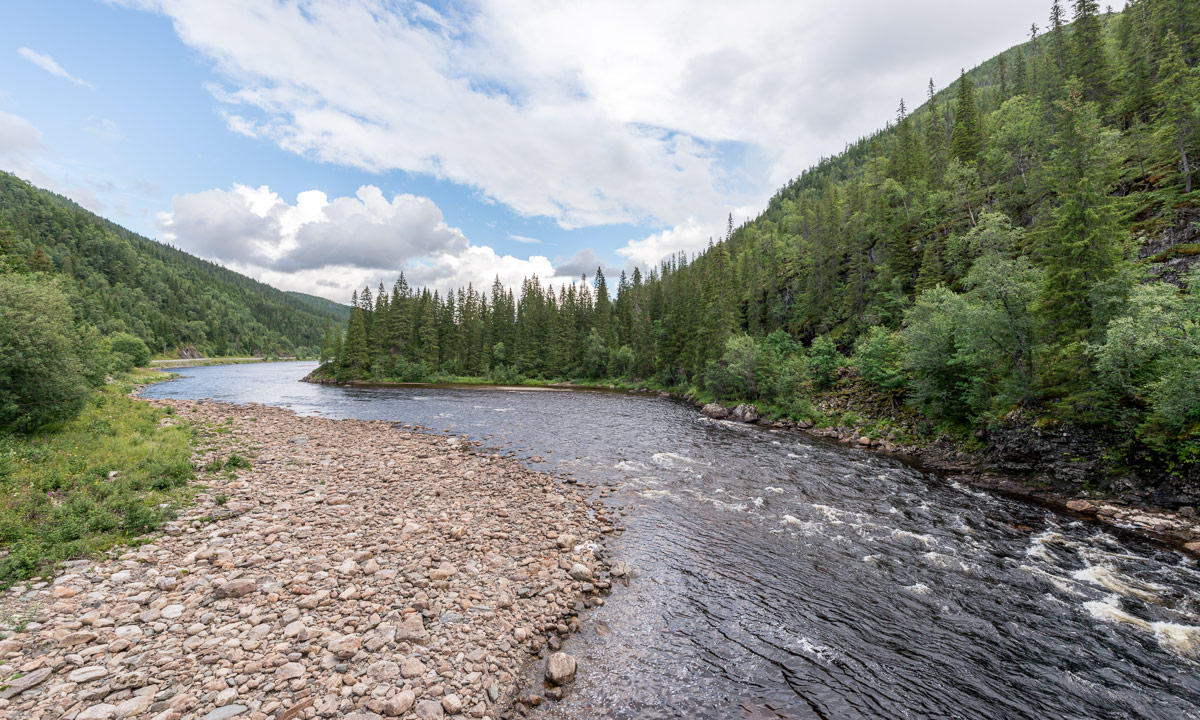
At this time of the year it can be quite interesting to go for a walk through the woods. A lot of snow melted in the warmth of the last week and every river, stream or brook is in flood. The heavy rain some days before provided an additional amount of water.

Annika and I started our walk west from Ersmark, seven kilometres north from Umeå. The whole area is a shooting range for the military, but a sign clearly shows, when shooting exercises take place and when it’s safe to hike. Today we were lucky – no military exercises this weekend.

We went along the gravel road. The road was clear of snow, but due to the night frost all mud puddles were covered with a thin layer of ice. We went ahead until we came to a minor path. This path was completely covered with snow. We continued this snowy path until we approached the brook Tavelån. This part of the path was covered with a splintered crust of ice that clearly showed, that this part of the path was flooded a short time ago. More and more water flooded our path and we had to wade to reach the wooden bridge, that crosses the water. The brook was so flooded that the water partly flowed over the planks of the bridge.

After the bridge there was much more water on the way. Parts of the flooded brook flowed over our hiking path, too. I tested the depth, but soon had to give up. The water was too deep for us to continue, although we both wore high rubber boots.

We turned and took the same way back, until we reached the car. Annika, who took care of navigation today, realised, that we could take the car to another starting point to experience the other side of the brook.

A short time later I parked the car on a muddy ground near a small nature reserve with the witty name “Natur 2000” – still the same military shooting range. Larger parts of our new hiking path were covered with ice, but at least the way wasn’t muddy. After a while we headed north trying to cross the Tavelån again, this time at another place. When we came to that place were we expected the bridge, all I could see was some kind of old concrete base – the bridge was gone. I laughed out aloud – another blind end again!?

But we were lucky: Ten metres away some railway sleepers lay across the Tavelån. After some wading again we could safely cross the flooded brook. Anyway, the continuation of the path was a bit challenging again. The snowy path was partly flooded and we had to wade several times, carefully balancing on the wet ground ice. But we succeeded: None of us slipped and we continued our tour – dry and warm, since the spring sun had a lot of power and warmed us gently.

The path ascended and soon we walked on a dry gravel way. The rest of our hiking tour was a bit boring: Broad and straight gravel roads through forest and heather. After a while we reached the car.

We tried to take the minor gravel roads to head back to Umeå but when we almost reached the big road, the last part of our way was prohibited for cars and we had to return.

When we arrived home at Annika’s flat, the thermometer of the car showed +10 °C. Another day in spring with remains of winter.

Farewell, winter

Yesterday it started to rain.

Today it rained, rained and it rained. It poured down the whole time and didn’t stop for a single second.

Probably it’s time to say farewell to winter.

I’m looking forward to spring, but I’ve started to miss winter already.

Kungsleden ski tour: Tjäktja

This article is part of the series “2016-02: Ski tour on the Kungsleden”.

From the Sälkastugorna to Tjäktjastugan

25 February · 12 km · Link to map

This day could be a more demanding day. It’s only 12 km to Tjäktja, but first of all i goes up 300 meters and then there’s Tjäktjapasset – the mountain pass, which I remember as being quite steep. In 2005 I skied down the slope, now I have to go up, dragging the pulka behind.

That’s why I started quite early this day. In my pulka: a parcel with food from the shop that stugvärd Z. gave me for stugvärd P. – one kilo more or less doesn’t count so much if you doesn’t have to carry it on your back.

When I started the tour the sky was still cloudy, but soon the clouds disappeared, sun was shining and the sky was blue. I was happy, since according to the weather forecast I expected the whole week being grey and cloudy. Far away in the early sun I could see a chain of mountain – there’s the Tjäktjapass, still far away, and it looked high and steep.

This was the first time that I had skins under my skis that help going up, especially if you carry a pulka that always wants to slide down. The trail led through a hilly landscape and I had to climb many small hills just to go down on the other side of the hill. I asked myself how I should gain altitude going just up and down. Anyway, the landscape was gorgeous, just as the weather, and when I looked back after some time I could see, that I gained more height than I thought. First I could see small brown boxes laying behind – the Sälkastugorna – but after some time they disappeared behind the hilly landscape.

I continued my tour and saw a black bird ahead. It cawed and landed on a dark spot beside another bird. Crows. I remembered, that one of the skiers that I met in Sälka, told me, that he saw a dead reindeer on his way from Tjäktja. This reindeer was killed by a wolverine, one of the biggest carnivores in Scandinavia. I approached the dark spot, the craws cawed again and flew away. There was a heap of something and beside of some patches of reindeer skin it was hardly recognisable. The sight of a frozen hump of meat is neither nice nor beautiful, but it is part of a country, where predators as wolves, bears, lynxes or wolverines still exist.

After taking some photos for this blog I continued my tour. Two other skiers approached from the other side – they just slided down in long, relaxed steps. I however had to climb up. Now, where the pass was near, it was visible that it was neither as steep nor as high as expected. After a bit of effort (I’m not well trained …) I stood on a plateau just below the highest point of the pass. And the view back into the huge valley Tjäktjajåkka (sami: Čeakčajohka) was incredible. The sun shone from a bright blue sky, a rainbow coloured sundog nearby. Ice dust fell from the blue sky that glittered and sparkled against the sun. The broad valley seemed to be endless, the further away mountains looked hazy and I had the impression, that you could walk through this valley forever.

It’s not the first time, that I stood here and gazed in amazement. I’ve been here on my first ski tour in april 2005, too, when I went from Abisko to Kvikkjokk. And now I was just as amazed as at the first time.

I could have stayed for ages, but after I while I broke away from this special place and ascended the last meters of the pass until the small hut Tjäktjatjattja came into sight. I took a break, but instead of seeking shelter in the hut I sat outside in the sun with chocolate and hot tea. It started to snow a bit – always a bit strange if you cannot see a single cloud.

After this sunny break I continued the trail to Tjäktja. The skiers I met left a nice track and the only think I had to do was sliding downwards effortlessly until I arrived in Tjäktja, the smallest mountain hut on my journey. Stugvärd P. got my parcel with food and goodies and I got a room in the stuga.

The sky was clear the whole day and it started to become a bit colder. -15 °C, when I arrived, -19 °C short time later. Time to fire the oven and to eat something warm. But later I went outside again to look at the starlit sky that arched above the Lappish mountainscape.

A day in Tjäktja

The next morning the weather was perfect for skiing: -22 °C, hardly any wind and again an almost cloudless, blue sky.

I stayed a day in Tjäktja and went up the mountain Tjäktjatjåkka, but only half the way. First of all I’m not the most experience skier, and then I was afraid of avalanches. But even going up halfway in this outstanding weather was great.

Going downhill was much faster than uphills. When I arrived in Tjäktja, the thermometer show -18.5 °C, exactly the same temperature as when I started my short day trip and the sun shone from a cloudless sky over the ravine of the stream Čeavččanjira. The next day I will continue to the next mountain hut: Alesjaure.

The next article: returning to civilisation >>

Translation:

EnglishGermanSwedish
wolverineVielfraßjärv

Kungsleden ski tour: From Nikkaluokta to Singi

This article is part of the series “2016-02: Ski tour on the Kungsleden”.

It was 2005 when I was asked by C. from Switzerland, if I wanted to join him on a ski tour on the Kungsleden – the King’s trail. That’s how I came to my first ski tour in the mountains of Swedish Lapland. More tours followed, but sometimes it was hard to find a tour mate. Same thing this year; that’s why I decided to do my first ski tour on my own.

Kungsleden would be ideal for that, since there’s infrastructure as mountain huts and I won’t be alone. Good to know, since even twisting an ankle could be a serious problem in winter if no one’s around. I wanted to start 19 February, the day, when the huts open.

After a long trip I reached Nikkaluokta (many thanks to A. for the lift from Kiruna!) on the evening of the 17th I had one spare day in one of the cosy cabins of family Sarri. This place can be very cold and I had a look at the digital thermometer in the cabin: -44.8 °C minimum since the last reset – brr, that had been a cold day!

I climbed the small church hill and looked west. That’s were I’ll go the next day.

From Nikkaluokta to Kebnekaise Fjällstation

19 February · 19 km · Link to map

Time: 7:40, temperature -17 °C, weather: cloudy. Time to start the tour. I mount my skis, put the belt of the pulka (a sled for transportation) round my hips and after some gliding steps I see the first mark of the winter way to Kebnekaise.

It’s the only mark for a long time, the winter way to the Kebnekaise Fjällstation is not marked, neither on the map nor in real. But it’s easy to find the way, since many snowmobiles take this way and you only have to follow their tracks. Soon I’m at the place where the trail crosses the stream Čievrragorsa. In summer I used the chain bridge, In winter the snowmobile goes right over the frozen and snow covered stream. I can hear the sound of water running underneath the ice – a strange feeling.

After some kilometers I come to the lake Láddjujávri. Here you can eat waffles with cloudberries or burgers at “Lap Dånalds” and even take the boat over the lake to shorten your trip a bit. Well – in summer …

Hardly imaginable that I took a bath here six month ago on a hot summer day, when I was here with Annika. Not it’s winter, all is closed down, the boats lie on land and are covered with snow and I’m completely alone. Anyway it’s not too cold and I take a first rest on my tour. Without waffles, without a refreshing bath, but with the same beautiful view as in summer, since the sky starts to clear up and one mountain top after the other starts to get free from clouds, fogs and haze.

When I continue my tour over the ice of the frozen lake I soon can see the same mountain range as I did in summer. And it’s as beautiful as in summer, too.

After some kilometres the trail leaves the lake and continues through scattered birch forests and over frozen swamps, some of them covered with ice. The weather is fine and sky is of a clear blue with some clouds.

Another rest, this time on top of a rock, with hot tea, chocolate, and a bit of salami. What a beautiful day! I could sit here for hours, but I shouldn’t. I have to reach the huts of the Kebnekaise Fjällstation. I do reach them, but before that I have to work. The trail ascends and I have to make wide V-steps with my skis to be able to pull the pulka uphills. Finally I arrive. This mountain resort is quite huge, since Kebnekaise is the highest mountain in Sweden and very popular among hikers, skiers, and climbers. Anyway it is not opened yet beside of the cabin Jägarn (“the hunter”). Here I’ll stay overnight before I’ll continue to the Singistugorna the next day. Twice I climb on the small hill with the radio mast, first after sundown, then at half past six – where I see the first polar light of the tour.

From Kebnekaise Fjällstation to the Singistugorna

20 February · 14 km · Link to map

When I wake up sky is blue again and -17 °C. I take a short breakfast with muesli and prepare for leaving. That means: packing all things – doing the dishes – cleaning the kitchen and my bed room – checking that I have everything with me – putting on skis and pulka belt. Meanwhile the sky is overcast and it has started snowing. Weather can change quickly in the mountains.

After I have walked some kilometres it clears up a bit, just so much, that you can see some mountain tops shining through the hazy fog.

When I enter the narrow passage of the valley the mountain tops hide again, which is a pity. The mountains here are so beautiful.

There is not much snow in the mountains this winter. Parts of the marked winter way lead over stony passages with no snow at all. I have to go round these passages to avoid ruining my skis and pulka. Mostly I follow the snowmobile tracks, hoping that the locals know the best way.

This way leads over the frozen river, but sometimes it’s hard to see, since the snow under the overcast whitish-grey sky don’t show any contours. Wind increases, snow falls as well and the snow starts to drift in the increasing wind. In the narrow valley between the mountains Siŋŋičohhka and Liddubákti more snow lies on the ground which makes it easier to ski but worse to see.

That’s when you are really glad about the winter way marks: Red crosses set on long poles. Sadly plastic crosses are used nowadays. They are ugly, in my opinion harder to see and many of them are broken. But I’m glad to have them anyway. They do not only show you the way, they help you even in guessing whether it’s going up or down, which you cannot see, if visibility and sight are poor.

I always have compass and a good map with me on such tours. Anyway, if you cannot see any landmark these tools are of limited help if you do not count steps or know how fast you are on your skis. That’s when a GPS can be very handy. When I make another rest, longing for the mountain huts Singistugorna, the GPS revealed, that it’s only 970 meter to go. Easy!

Well, not really. The valley opens, wind increases and there are many rocks and snow-free parts on my way. I decide to circumnavigate a steeper passage and ski a bit to the right. To my big amazement I don’t go down but keep on level. Suddenly I feel part of the ground collapsing a bit and realise that I stand on the rim of a soft snow drift, about two meter high. It was absolutely impossible to see it. I’m lucky, that I didn’t fell down! I go back and circumnavigate my circumnavigation until I’m on the marked trail again. There I can see the cabins shining through the drifting and blowing snow. It takes some time to find a good way down to Singi but finally I arrive. Here the wind seems to be even stronger and the snow falls even more intense.

Stugvärd J. shows me my room, light fires in the ovens of the kitchen and my bed room and allows me to take my pulka inside since I’m the only guest. After doing some work he leaves and heads to his own cabin against hard wind and snow.

According to the forecast wind will increase even more and snow fall round 20 cm are expected. I’m glad, that I have time and plan to stay at least one other day in the Singistugorna, perhaps two.

The next article: Singi – from blizzard to clear sky >>

Short trip to Bjuröklubb

Yesterday I went to Umeå by car, but I took a detour. In Övre Bäck, where I made the photo from the “Winter tree” I left the E4 to drive to Bjuröklubb, a salient that reaches wide into the Baltic Sea.

In summer, you can walk up from the parking place, eat in the Café Fyren or follow the wooden walkway up to the light house. In winter time this place is abandoned. I took my snow shoes and went first along the shore and then up to the light house.

Temperatures were between -25 °C and -30°C and the sky was totally clear. Another wonderful winter day.

Långhällan – some kind of another world

Today it was even a bit colder as yesterday. When I left the house to make some photos, the thermometer showed -10 °C and it hardly became warmer today.

This time I drove to one of my favourite places nearby, Långhällan, where the coast is quite rocky. When I left the car to walk the remaining 250 meters I could already hear the waves breaking ashore. The first view of the rocky coast was like from another world. The higher parts of the rocks were covered with a bit of snow, while the lower rocks were crusted with a layer of ice. This layer will grow with every wave rolling ashore.

The next hour(s) I spend sitting and crawling on the ice covered rocks and tried to make pictures of the incoming waves. I took more than a hundred pictures but I’m not completely content yet. Anyway, it was just fun being outside and experiencing this fine weather.

Finally the sun came out and started to fill nature with light – first of soft pink, then of intense yellow and orange colours.

I made another “photo session” and took even more pictures of the waves, this time illuminated by the low sun, but time was short and the waves were less impressive.

Soon the sun vanished behind some trees and I walked along the coast were I spotted the next motives: Last day high water has surrounded the lower parts of the small bushes with a solid layer of ice, that gleamed and sparkled in the sun.

After a while I had enough of taking pictures and slowly returned to the car. Two photos from the way back through the forest. It got colder – down to -15 °C and the soft-edged snowy landscape made me feel, that I left the world Långhällan and I was back in my home world again. The only thing that lacks for a real winter: A bit more snow.

Appendix 1 – Things that I was glad to have today

  • Warm cloths: insulated jacket and warm thermal pants, as well as warm gloves. I love winter but I don’t like to freeze.
  • Warm and waterproof “Muck Boots” rubber boots that kept my feet warm and dry.
  • A good camera, a good tripod and my favourite lenses.
  • Spare batteries – a must-have when it’s cold.
  • Most of all: My crampon-like spikes from Snowline – without them I wouldn’t have any chance to climb on the ice covered rocks.

Appendix 2 – making of

Flood along the Skellefteälven

The river Skellefteälven had much water today. Water level was 87 cm above normal according to a hiker I met at the river today. The hiker had to turn because parts of the way were still under water just as the ground besides.

It was funny walking on this “way” – the ground was frozen, 15 cm water above, slightly frozen over, too. I even saw a fish fleeing my rubber boots under the thin ice cover. And I was so glad about my crampon-like spikes, that I had with me, since the ground was almost frictionless.

After a grey morning the weather was nice with blue sky and sun, but still much too warm for the season. I really wonder how the river succeeds in freezing over when it’s hardly frosty. I also wonder why the river ice can rise almost 90 centimetres without getting any visible cracks. Probably it’s quite soft.

Ten, fifteen centimeters above water level you could see ice round the branches and twigs of the smaller trees and bushes, marking the high water peak of last night. I had to crouch and lie down to make the next picture.

It was easier to make pictures of the beautiful frost patterns that covered the ground. By the way: These are colour photographs.

Räven raskar över isen

“Räven raskar över isen”, which means “The fox rushes over the ice”  is a popular Swedish folksong which is performed as a singing game at midsummer.

Today I was out quite early, because the weather was still nice: -6 °C and not completely cloudy. And while I took some more images of the ice outside of Storgrundet, wondering when the ice will bear my weight I saw a fox crossing the ice and rushing from one island to the other. I immediately remembered the song.

(The photo itself is a cropped image, the fox was too far away for my 70-200 mm telephoto lens. By the way: the clouds were of an incredibly intense red – even more than the photos)

Soon more clouds came in and it started to get warmer. In the afternoon it started to rain transforming the cold roads into slippery, wet ice tracks. I would deeply recommend to wear broddar – spikes for your shoes when weather is like this.

Winter journey in a nutshell

It snowed in Skelleftehamn tonight. It’s hardly a secret, that I love winter, snow and coldness. In Skelleftehamn however it would be too warm, because the Baltic Sea is near.

Therefore I decided yesterday to take a day off today, take camera and car and travel towards winter. In the inland the climate is colder and hopefully there would be more snow. I started at 6:45 in darkness. The first part was no fun to drive. Road salt is used on the big road to Skellefteå and the road further west. With temperatures slightly below zero you always have a film of muddy saltwater on your windscreen while the wipers still are partly frozen and will not work properly. That in combination with approaching cars with bright lights makes it hard to see and much concentration is needed.

That instantly got better when I left the big road 95 (that would bring me to Bodø in Norway) right after Jörn. The smaller roads are covered with ice and hard snow – much easier to drive and the windscreen stays clear. And it looks much more like winter than a wet road. And while in Skelleftehamn even the duck pond is open, here the lakes and some small streams are ice and snow covered.

I continued the road and drove to Storklinten, a small ski hill. Well, it wasn’t so interesting yet with only round about 10 cm snow, but the lake nearby – Lill-Klintträsket – was really nice. It started snowing and the tree covered hills farther away seemed to vanish into a white nothing.

The way to Storklinten is a dead-end road and I had to return. I continued the larger road to Myrheden looking for motives. And I found one. The small river Ålsån:

I was glad I had my chest waders with me, so I could come quite near to the motive. And there were a lot of motives this day. For example reindeers. The first small flock was extremely shy and cautious. It didn’t dare to pass my car and left the road starring at me suspiciously from behind the small trees. You can see that they digged for food in the snow, the noses are snow covered and one of the reindeers even had a twig hanging in its antlers.

Further on the road: Town signs with funny looking names (there was even a village called Hej, which is Swedish for hello), more snow covered roads and trees and two extremely well educated reindeers going beside the road in single file.

I’m looking for motive especially, where there are crash barriers beside of the road – there the street will probably cross a river or a creek. Some of them are open, many broader ones with less current are already covered with ice. And on one of them – far away – I could see a reddish animal and some dark spots. A fox? Birds? I looked for the next parking opportunity – sometimes a real challenge – and walked back.

I was right: There was a fox. And some kind of skeleton, perhaps a roe deer or a reindeer. And some crows. And an eagle! It doesn’t happen often, that I see eagles nearby where I live. I made some photos with my tele lens. Zooming in I could even see some magpies hopping around hoping for a snack. The scene was much too far away to get good pictures, but anyway, I want to show you this one:

After a while I started to get hungry. My car too; the red R-lamp has been glowing for a while. Anyway, the town Arvidsjaur, todays destination, was not so far away anymore. As people in former days first fed their horses before eating themselves I first tanked my car with E95, then myself with beef, mashed potato, mushroom sauce and salad. Then I looked around in the city which I think is really nice. Especially in winter with snow – round 20 cm today.

Even if the “real winter” is not here yet the days are already quite short: Sunset in Arvidsjaur was a quarter past two! At three o’clock I started to use the car’s full beam, half an hour later it was quite dark. Time to head home. I couldn’t see any motives any longer and I navigated to the main road. Now driving became exhausting again for a while since it started to snow quite heavily. And if you use full beam while snowing you just see a tunnel of snow flakes swooshing towards you. It’s a big like old televisions science fiction series, when the spaceships activated their warp-drives. And as in space there is no up or down. The second photo may give you a faint idea.

Luckily the snow shower ended soon and the rest of the trip was just about coming home.

400 km and 500 meters – 11 hours 30 minutes – a straining but great one day trip winterwards.

Back again in Skelleftehamn: Snow is gone, it’s pitch black and it’s raining cats and dogs.

From Nallo to Vistas, Alesjaure, Abiskojaure and back to civilization

This article is part of the series “2015-08: Kungsleden hike”.

August 30 – September 2: Day eight to eleven of the summer hike through the mountains of Swedish Lapland

Nallo – Vistas

After two days in Nallo Annika and I were eager and keen to move on. After our breakfast we said goodbye to stugvärd Janne and started to ford the stream behind of the hut. Fortunately the water level dropped to normal again and quite easily we could cross the stream.

Then we went along the Nallú, a fantastic mountain that changed its appearance every other second because of the moving clouds and the changing light situations. We never tired of looking at this big mountain that seemed to accompany us a long way.

After a while another stream that we had to cross, came down from the lake Nállujávrrit. While I managed to splash through with my high rubber boots, Annika decided to take of her shoes and wade through it in her sandals – brr, the water was really ice cold!

We continued the hike through the fast-changing scenery. Quite soon we saw the first trees and realised that the big mountain ahead was the Vássačorru, that lies behind the valley Visttasvággi, where our next destination, the Vistasstuga is located.

Soon we crossed the Visttasjohka on the chain bridge and arrived at the cabin to meet the stugvärd – the warden.

Oh look: Coke and beer are priced down! That’s because the season only lasts three other weeks. After that the huts are closed down until their reopening for the skiers in February or March. But because none of the cans would survive the frost, all liquids has to be drunk in the next three weeks or poured away. We decided to save some cokes from this cruel destiny.

We were placed in the outhouse – the main building was in the act of being renovated. There we sat on the front stairs, ate, drank and looked on the river Visttasjohka. And we took a bath in this cold river. Chilling but refreshing! Finally the sun came out. I crossed the bridge to make a photo of our cabin.

Later – it started getting dark – we got a visitor: A big moose stood beside the river. I went out, where I could observe this huge animal, how it ate leaves and grass, less than 10 meters away. It looked at me but wasn’t disturbed by me at all, it even passed quite near until it vanished between some trees. This was one of the moments were I was glad and touched as a “normal person”, but a bit grumpy with myself, that I was too lazy to carry my big tele lens for better and sharper pictures. I never experienced a moose so near and so fearless.

Vistas – Alesjaure

The trip the day before was short: only 9 kilometres, this day it would be twice as much: 18 km. The first kilometres were a bit boring since they went through birch forests and quite muddy passages. But after a while the landscape opened and we could see the mountain Siehtagas with its glacier Siehtagasglaciären. In front of the mountain there were alpine meadows and small birch forests. In front of that the turquoise water of the Visttasjohka glimmered in the sunlight.

We went up again until we again were over the treeline. This part of the valley Visttasvaggi is beautiful and very varying. The first rest we made in the lee side of a huge cuboid rock. We weren’t the first – someone built a bench by laying a plank over two stones. The second rest we made at the Tjatjajaurekåtan (there’s not much left of it).

After a while I saw some reindeers grassing. There were shy and quickly went away when I came nearer. We saw (probably) them again when we had a view at the sami village Alisjávri that lies at the lake with the the same name. From that it’s not far to the mountain huts of Alesjaure – the Swedish version of Alisjávri. The Alesjaurestugorna are the biggest mountain huts of the STF – the Swedish tourist association. I prefer the smaller ones as e.g. Nallo, but it’s fine to have a shop, a drying room and especially a sauna. And we used it all! It’s nice to go to sleep after being in the sauna and having a wash in the river Aliseatnu.

Alesjaure – Abiskojaure

I didn’t make many pictures of this part of our tour. I was a bit bored of this part of the trail and found nothing special in the landscape. Just some photos of human evidence: Tent poles for a lavvu and a crossing over a long reindeer fence.

It was the first time, that I was really impatient and just wanted to arrive. Some kilometres before Abiskojaure we came below the treeline. Most of the birch trees still were green but you could see, that autumn is near. No wonder, it was the 1st of September, beginning of autumn for the meteorologists.

Finally we reached another chain bridge and shortly after it arrived in Abiskojaure. The sun came out and even though it was much colder than one week ago we could sit and lie on the short-cut lawn in front of the hut. I took the last bath of the journey and strolled around making some photos. After crossing a small swamp I came to a quite huge sandy beach beside the lake Ábeskojávri. A beautiful place!

The evening it started to become chilly, hardly 3 °C. I was curious if we would get the first frost of the season next morning …
Abiskojaure – Abisko Östra

… and yes, we got frost. -2.5 °C showed the scientific thermometer of the swedish weather service, when I had my first look. On the water surface of the buckets lay a layer of ice and round the leaves of lower plants I could see the first autumnal hoarfrost.

I was up very early that morning and I went to the beach at the lake again. First it looked quite normal but then it started to get foggy and misty while the sun rose behind the mountain Giron. What a beautiful sight! I stood there for at least an hour and only walked back to get another full battery for my camera. Later I met Annika, showed her the place and was glad that I could share this awesome experience.

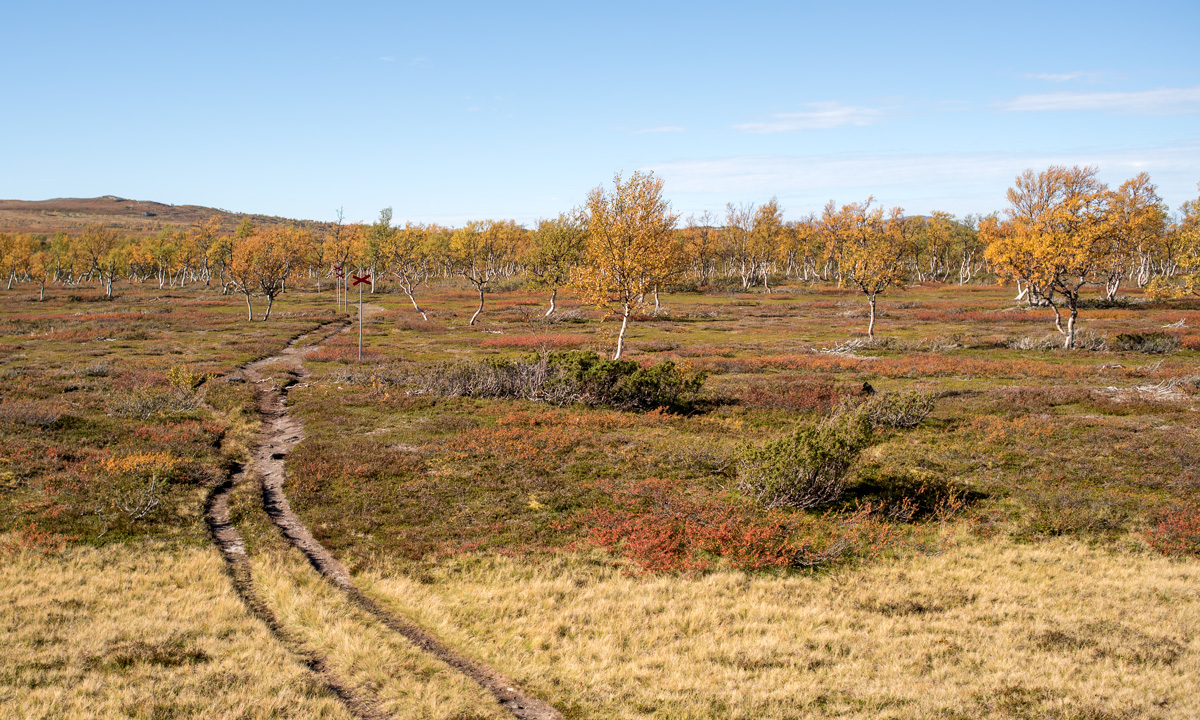
I was a bit sad – this would be the last day of hiking through the wonderful mountain landscape of Swedish Lapland. But each journey has some kind of end and so had ours. We started our tour through the birth forests along the lake Ábeskojávri, than along the river Abiskojåkka.

After a while a famous landmark came into sight: Lapporten – “The Lapponian Gate”, a U-shaped valley framed of two mountains that give this valley its specific and recognizable shape. However, since this photo is taken from the backside, it hardly shows this special shape.

Since Alesjaure we followed the Kungsleden – the King’s Trail, but right after the bridge over the stream Nissonjohka we left the main trail that leads to the Abisko Mountain Station and turned right to Abisko Östra, the village, were we planned to stay for two other days. The way, however, was not much fun to go. A lot of all-terrain vehicles has turned the way into mud. Since I lost my lens cap and I was afraid that mud would splatter my lens, I packed the camera into its waterproof bag long before the worst mud patches. And that’s why this is the last photo of our hiking tour:

Thank you Annika, för trevligt sällskap – for nice company. Where should we hike next?

Any suggestions?