Flood along the Skellefteälven

The river Skellefteälven had much water today. Water level was 87 cm above normal according to a hiker I met at the river today. The hiker had to turn because parts of the way were still under water just as the ground besides.

It was funny walking on this “way” – the ground was frozen, 15 cm water above, slightly frozen over, too. I even saw a fish fleeing my rubber boots under the thin ice cover. And I was so glad about my crampon-like spikes, that I had with me, since the ground was almost frictionless.

After a grey morning the weather was nice with blue sky and sun, but still much too warm for the season. I really wonder how the river succeeds in freezing over when it’s hardly frosty. I also wonder why the river ice can rise almost 90 centimetres without getting any visible cracks. Probably it’s quite soft.

Ten, fifteen centimeters above water level you could see ice round the branches and twigs of the smaller trees and bushes, marking the high water peak of last night. I had to crouch and lie down to make the next picture.

It was easier to make pictures of the beautiful frost patterns that covered the ground. By the way: These are colour photographs.

Räven raskar över isen

“Räven raskar över isen”, which means “The fox rushes over the ice”  is a popular Swedish folksong which is performed as a singing game at midsummer.

Today I was out quite early, because the weather was still nice: -6 °C and not completely cloudy. And while I took some more images of the ice outside of Storgrundet, wondering when the ice will bear my weight I saw a fox crossing the ice and rushing from one island to the other. I immediately remembered the song.

(The photo itself is a cropped image, the fox was too far away for my 70-200 mm telephoto lens. By the way: the clouds were of an incredibly intense red – even more than the photos)

Soon more clouds came in and it started to get warmer. In the afternoon it started to rain transforming the cold roads into slippery, wet ice tracks. I would deeply recommend to wear broddar – spikes for your shoes when weather is like this.

Winter journey in a nutshell

It snowed in Skelleftehamn tonight. It’s hardly a secret, that I love winter, snow and coldness. In Skelleftehamn however it would be too warm, because the Baltic Sea is near.

Therefore I decided yesterday to take a day off today, take camera and car and travel towards winter. In the inland the climate is colder and hopefully there would be more snow. I started at 6:45 in darkness. The first part was no fun to drive. Road salt is used on the big road to Skellefteå and the road further west. With temperatures slightly below zero you always have a film of muddy saltwater on your windscreen while the wipers still are partly frozen and will not work properly. That in combination with approaching cars with bright lights makes it hard to see and much concentration is needed.

That instantly got better when I left the big road 95 (that would bring me to Bodø in Norway) right after Jörn. The smaller roads are covered with ice and hard snow – much easier to drive and the windscreen stays clear. And it looks much more like winter than a wet road. And while in Skelleftehamn even the duck pond is open, here the lakes and some small streams are ice and snow covered.

I continued the road and drove to Storklinten, a small ski hill. Well, it wasn’t so interesting yet with only round about 10 cm snow, but the lake nearby – Lill-Klintträsket – was really nice. It started snowing and the tree covered hills farther away seemed to vanish into a white nothing.

The way to Storklinten is a dead-end road and I had to return. I continued the larger road to Myrheden looking for motives. And I found one. The small river Ålsån:

I was glad I had my chest waders with me, so I could come quite near to the motive. And there were a lot of motives this day. For example reindeers. The first small flock was extremely shy and cautious. It didn’t dare to pass my car and left the road starring at me suspiciously from behind the small trees. You can see that they digged for food in the snow, the noses are snow covered and one of the reindeers even had a twig hanging in its antlers.

Further on the road: Town signs with funny looking names (there was even a village called Hej, which is Swedish for hello), more snow covered roads and trees and two extremely well educated reindeers going beside the road in single file.

I’m looking for motive especially, where there are crash barriers beside of the road – there the street will probably cross a river or a creek. Some of them are open, many broader ones with less current are already covered with ice. And on one of them – far away – I could see a reddish animal and some dark spots. A fox? Birds? I looked for the next parking opportunity – sometimes a real challenge – and walked back.

I was right: There was a fox. And some kind of skeleton, perhaps a roe deer or a reindeer. And some crows. And an eagle! It doesn’t happen often, that I see eagles nearby where I live. I made some photos with my tele lens. Zooming in I could even see some magpies hopping around hoping for a snack. The scene was much too far away to get good pictures, but anyway, I want to show you this one:

After a while I started to get hungry. My car too; the red R-lamp has been glowing for a while. Anyway, the town Arvidsjaur, todays destination, was not so far away anymore. As people in former days first fed their horses before eating themselves I first tanked my car with E95, then myself with beef, mashed potato, mushroom sauce and salad. Then I looked around in the city which I think is really nice. Especially in winter with snow – round 20 cm today.

Even if the “real winter” is not here yet the days are already quite short: Sunset in Arvidsjaur was a quarter past two! At three o’clock I started to use the car’s full beam, half an hour later it was quite dark. Time to head home. I couldn’t see any motives any longer and I navigated to the main road. Now driving became exhausting again for a while since it started to snow quite heavily. And if you use full beam while snowing you just see a tunnel of snow flakes swooshing towards you. It’s a big like old televisions science fiction series, when the spaceships activated their warp-drives. And as in space there is no up or down. The second photo may give you a faint idea.

Luckily the snow shower ended soon and the rest of the trip was just about coming home.

400 km and 500 meters – 11 hours 30 minutes – a straining but great one day trip winterwards.

Back again in Skelleftehamn: Snow is gone, it’s pitch black and it’s raining cats and dogs.

From Nallo to Vistas, Alesjaure, Abiskojaure and back to civilization

This article is part of the series “2015-08: Kungsleden hike”.

August 30 – September 2: Day eight to eleven of the summer hike through the mountains of Swedish Lapland

Nallo – Vistas

After two days in Nallo Annika and I were eager and keen to move on. After our breakfast we said goodbye to stugvärd Janne and started to ford the stream behind of the hut. Fortunately the water level dropped to normal again and quite easily we could cross the stream.

Then we went along the Nallú, a fantastic mountain that changed its appearance every other second because of the moving clouds and the changing light situations. We never tired of looking at this big mountain that seemed to accompany us a long way.

After a while another stream that we had to cross, came down from the lake Nállujávrrit. While I managed to splash through with my high rubber boots, Annika decided to take of her shoes and wade through it in her sandals – brr, the water was really ice cold!

We continued the hike through the fast-changing scenery. Quite soon we saw the first trees and realised that the big mountain ahead was the Vássačorru, that lies behind the valley Visttasvággi, where our next destination, the Vistasstuga is located.

Soon we crossed the Visttasjohka on the chain bridge and arrived at the cabin to meet the stugvärd – the warden.

Oh look: Coke and beer are priced down! That’s because the season only lasts three other weeks. After that the huts are closed down until their reopening for the skiers in February or March. But because none of the cans would survive the frost, all liquids has to be drunk in the next three weeks or poured away. We decided to save some cokes from this cruel destiny.

We were placed in the outhouse – the main building was in the act of being renovated. There we sat on the front stairs, ate, drank and looked on the river Visttasjohka. And we took a bath in this cold river. Chilling but refreshing! Finally the sun came out. I crossed the bridge to make a photo of our cabin.

Later – it started getting dark – we got a visitor: A big moose stood beside the river. I went out, where I could observe this huge animal, how it ate leaves and grass, less than 10 meters away. It looked at me but wasn’t disturbed by me at all, it even passed quite near until it vanished between some trees. This was one of the moments were I was glad and touched as a “normal person”, but a bit grumpy with myself, that I was too lazy to carry my big tele lens for better and sharper pictures. I never experienced a moose so near and so fearless.

Vistas – Alesjaure

The trip the day before was short: only 9 kilometres, this day it would be twice as much: 18 km. The first kilometres were a bit boring since they went through birch forests and quite muddy passages. But after a while the landscape opened and we could see the mountain Siehtagas with its glacier Siehtagasglaciären. In front of the mountain there were alpine meadows and small birch forests. In front of that the turquoise water of the Visttasjohka glimmered in the sunlight.

We went up again until we again were over the treeline. This part of the valley Visttasvaggi is beautiful and very varying. The first rest we made in the lee side of a huge cuboid rock. We weren’t the first – someone built a bench by laying a plank over two stones. The second rest we made at the Tjatjajaurekåtan (there’s not much left of it).

After a while I saw some reindeers grassing. There were shy and quickly went away when I came nearer. We saw (probably) them again when we had a view at the sami village Alisjávri that lies at the lake with the the same name. From that it’s not far to the mountain huts of Alesjaure – the Swedish version of Alisjávri. The Alesjaurestugorna are the biggest mountain huts of the STF – the Swedish tourist association. I prefer the smaller ones as e.g. Nallo, but it’s fine to have a shop, a drying room and especially a sauna. And we used it all! It’s nice to go to sleep after being in the sauna and having a wash in the river Aliseatnu.

Alesjaure – Abiskojaure

I didn’t make many pictures of this part of our tour. I was a bit bored of this part of the trail and found nothing special in the landscape. Just some photos of human evidence: Tent poles for a lavvu and a crossing over a long reindeer fence.

It was the first time, that I was really impatient and just wanted to arrive. Some kilometres before Abiskojaure we came below the treeline. Most of the birch trees still were green but you could see, that autumn is near. No wonder, it was the 1st of September, beginning of autumn for the meteorologists.

Finally we reached another chain bridge and shortly after it arrived in Abiskojaure. The sun came out and even though it was much colder than one week ago we could sit and lie on the short-cut lawn in front of the hut. I took the last bath of the journey and strolled around making some photos. After crossing a small swamp I came to a quite huge sandy beach beside the lake Ábeskojávri. A beautiful place!

The evening it started to become chilly, hardly 3 °C. I was curious if we would get the first frost of the season next morning …

Abiskojaure – Abisko Östra

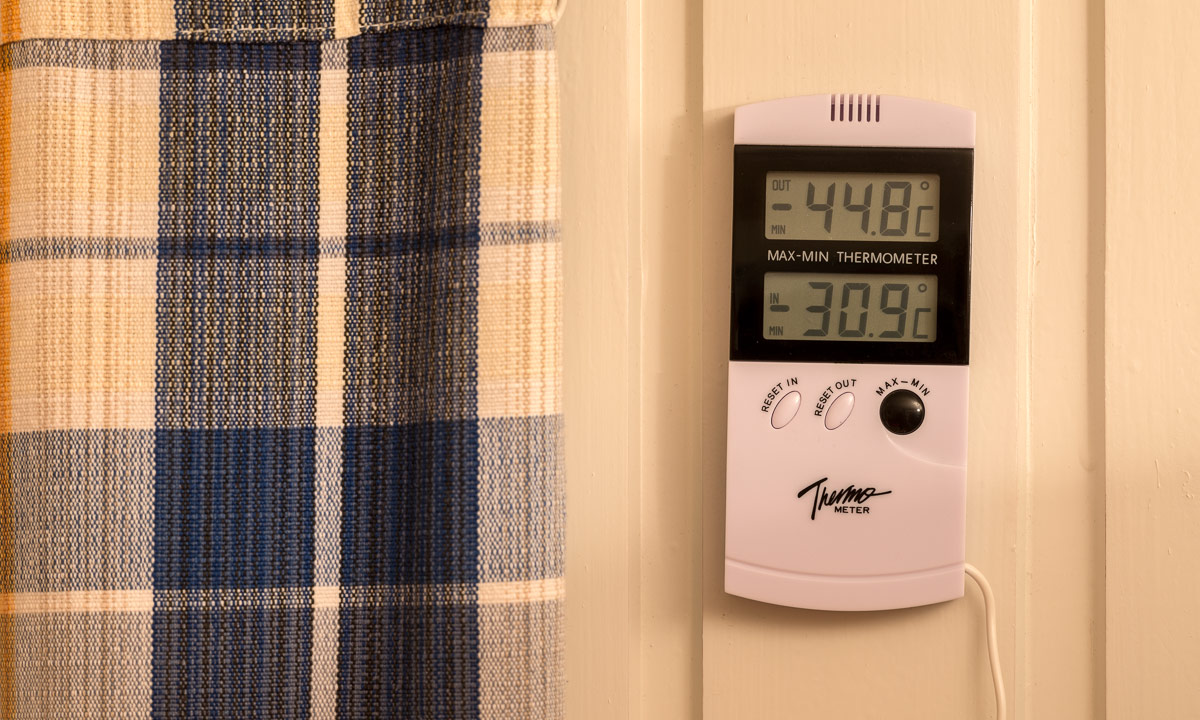
… and yes, we got frost. -2.5 °C showed the scientific thermometer of the swedish weather service, when I had my first look. On the water surface of the buckets lay a layer of ice and round the leaves of lower plants I could see the first autumnal hoarfrost.

I was up very early that morning and I went to the beach at the lake again. First it looked quite normal but then it started to get foggy and misty while the sun rose behind the mountain Giron. What a beautiful sight! I stood there for at least an hour and only walked back to get another full battery for my camera. Later I met Annika, showed her the place and was glad that I could share this awesome experience.

I was a bit sad – this would be the last day of hiking through the wonderful mountain landscape of Swedish Lapland. But each journey has some kind of end and so had ours. We started our tour through the birth forests along the lake Ábeskojávri, than along the river Abiskojåkka.

After a while a famous landmark came into sight: Lapporten – “The Lapponian Gate”, a U-shaped valley framed of two mountains that give this valley its specific and recognizable shape. However, since this photo is taken from the backside, it hardly shows this special shape.

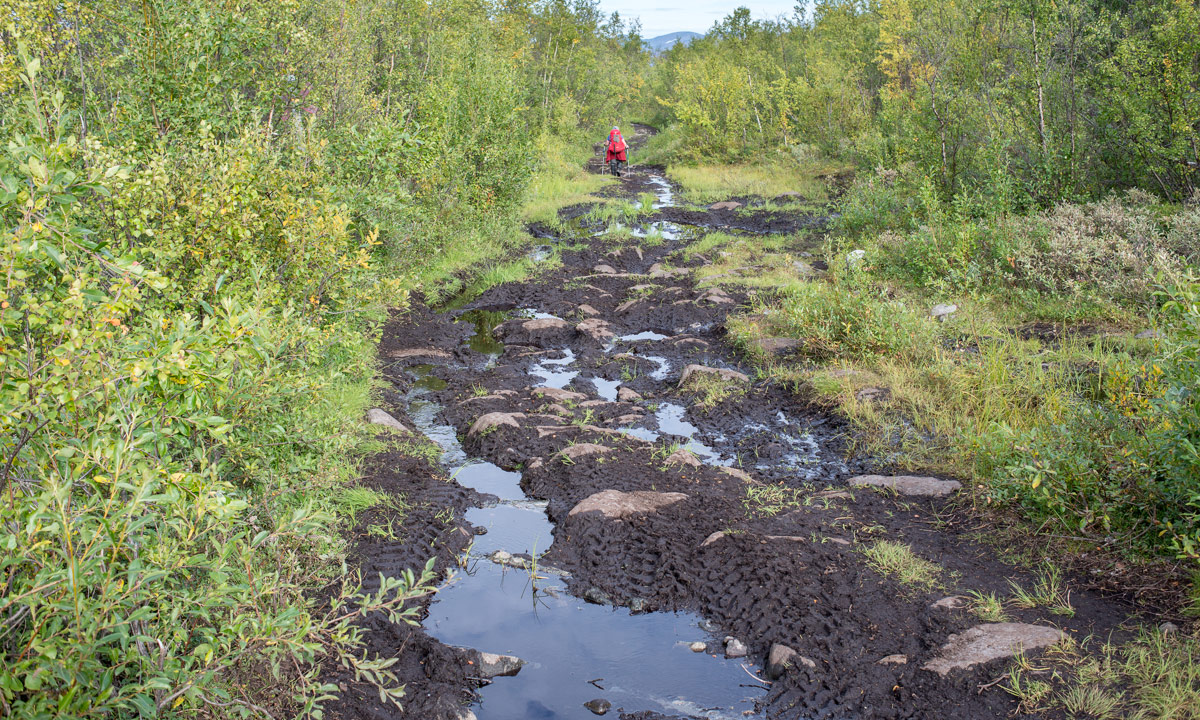
Since Alesjaure we followed the Kungsleden – the King’s Trail, but right after the bridge over the stream Nissonjohka we left the main trail that leads to the Abisko Mountain Station and turned right to Abisko Östra, the village, were we planned to stay for two other days. The way, however, was not much fun to go. A lot of all-terrain vehicles has turned the way into mud. Since I lost my lens cap and I was afraid that mud would splatter my lens, I packed the camera into its waterproof bag long before the worst mud patches. And that’s why this is the last photo of our hiking tour:

Thank you Annika, för trevligt sällskap – for nice company. Where should we hike next?

Any suggestions?

From Singi to Sälka and Nallo

This article is part of the series “2015-08: Kungsleden hike”.

August 26 – 29: Day four to seven of the summer hike through the mountains of Swedish Lapland

Singi – Sälka

After three very warm and sunny days clouds came in over night and the sky was quite overcast that morning. Only at the northern sky a larger patch of blue was visible. That fits, we’re going north! The first two kilometres were very well known to us, we went them there and back the day before. The day’s walk was short – just 12 kilometres.

Soon the huts of Sälka came into view. It was funny to see the ads for the shop and the bastu – the sauna – amidst the extend mountain landscape. Only 300 meters left and we entered the reception to check in.

It’s a nice look from Sälka but we had another interest that afternoon: Overall on the ground the ptarmigans were running and there were even sitting on the huge pile of birch wood, so that me, the photographer and them, the models, were on eye level. They let me advance quite near – in fact so near that the tele lens couldn’t focus anymore. The first two images are younger ptarmigans, the last is a grown up – look at these fantastic white feathered feet.

Sälka – Nallo

The next morning there were so many ptarmigans around that you really had to watch yourself not stepping on one of them. I never saw so many and never saw them so near. Our plan was not to continue the King’s Trail but to go northeast to Nallo, a smaller cabin a bit higher up in the mountains. After the common breakfast (muesli with some milkish liquid made from dry milk – yuck!) we started our tour. Even shorter than yesterday: only 9 km but perhaps a bit more demanding since there’re streams to ford, while the whole King’s trail is equipped with Bridges.

We had to look for planks to cross the small rivers behind the cabins but soon we were on our trail.

One hour later we were on the moon …

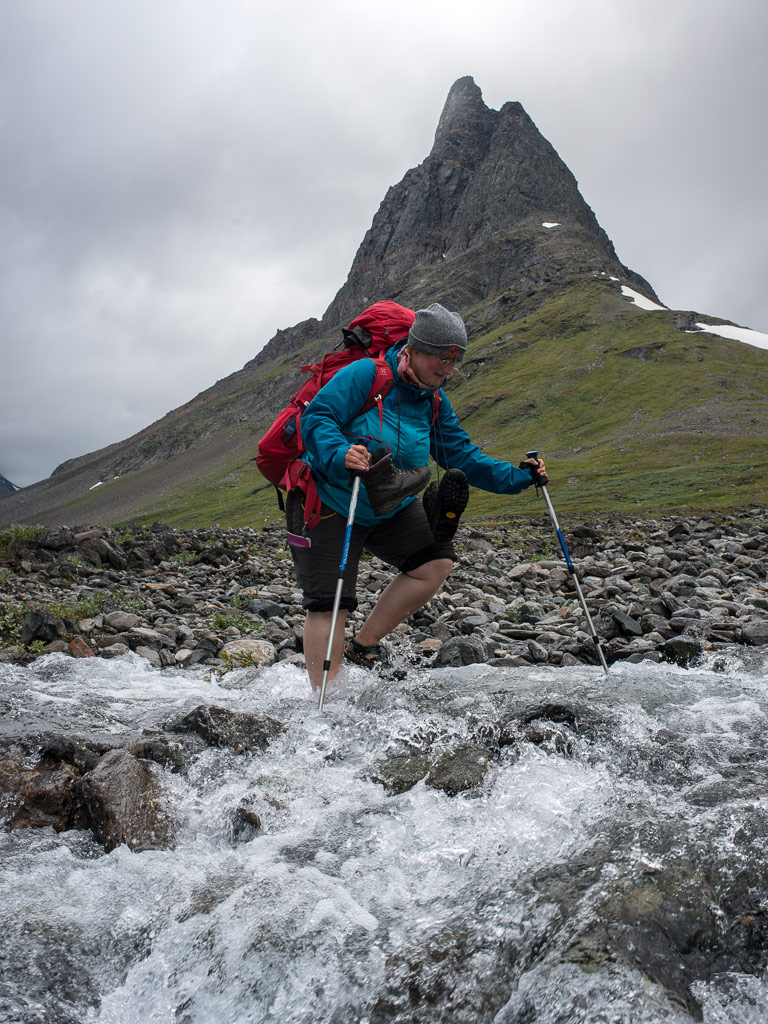
… well, not exactly, but it was such a sharp contrast to the sweet and lovely landscape of the last days. We could hardly see any vegetation. Only moss, grass and some scattered flowers were left. And some reindeers on some of the tabular slopes. There were many small streams and brooks to cross and it was the first day where I was glad, that I walked in rubber boots.

After a while the lake Reaiddájávri that lies on 1056 meter came into view and we went along it. More and more clouds came towards us and swirled around as if they wanted to surround us.

We had to cross the stream that enters the lake at the northern shore. Annika had to switch to sandals and ford the stream, for the water was to high for her hiking boots. It started to drizzle, than to rain and it got windy. Navigation was less easy now since it started to get foggy, there were less marks and some streams and snow patches to cross. Mostly I navigated with the compass, but twice I took the GPS to ensure my navigation. Since wind and rain increased more and more and I was busy with the navigation I packed the camera into the waterproof bag and didn’t make any photo on the last two kilometres. In the end the small Nallostuga came into view and even the huge mountain Nállu in the back lingered through the floating clouds. We got a warm welcome of the stugvärd – the warden of the Nallostuga. And warm was the wood fired oven, too. A good opportunity to dry our wet clothes.

I only went out later that day to take a photo of the wooden signpost and the hut itself. The rest of the day was just gemütlich – the pouring rain outside and we ourselves warm and cozy inside.

Two days of at Nallo

One

We planned to stay a day in Nallo already two days ago. It looked like a good idea since the rain just poured down the whole day and it was very windy. All people out there looked very wet, whether they just crossed the stream – now twice as large and probably twice as deep – or if they just fetched a bucket full of water.

Time to make some photos within the house. Two typical views in Swedish mountain huts: Many of them have two rooms, each has a kitchen and two flanking bedrooms, only separated by a curtain. That make 20 beds in total. Plus one for the stugvärd who has his own little room. The Primus 2388 is a gas cooker, easy to handle and is found in almost each Swedish mountain hut.

Two solo hikers planned to continue their tour that day but after a while they decided to stay. Perhaps not the worst idea when you looked at the young hikers, that came in. They were completely soaked. They poured the water out of their hiking shoes and hang up the dripping-wet sleeping bags for drying. All was just soaking wet! We we’re quite glad to be inside. But finally I took my camera and went out for some photos. Brr, it was really cold (7 °C) and so windy that the spray of the brooks was blown upwards again. Some photos:

I was glad, when I came into the inside of our cozy hut again. Only Simba, the warden’s dog endured the weather stoically.

Later that day: The sleeping bag already has dried, but other clothes were still hanging on the clothes line.

Two

Next day we wanted to continue our trip but I changed plans. Unintentionally. I got ill. I got fever that night and problems with my stomach and intestines, that I definitely don’t want to describe in detail. Otherwise there’s nothing much to report. I didn’t make a single photo (a certain proof that I was really ill) and slept almost the whole day.

Later in the evening, when I felt a bit better I was able to communicate again. I heard about others that went Singi–Sälka, the very same way we went three days before. The trail has been so flooded that the water poured over the wooden planks of the minor bridges making them very slippery and it was so windy that the hikers were really frightened to be blown from the bridge right into one of the swollen rivers. Illness never fits, bit I guess I chose a quite good day for being sick.

I slept the night before, I slept almost the whole day and I slept the next night. That sums up to round about 30 hours of sleep without any larger interruption. That probably was the best medicine and the next day I felt sound and healthy again. The plan for the coming day: Hiking to Vistas.

From Nikkaluokta to Kebnekaise Fjällstation

This article is part of the series “2015-08: Kungsleden hike”.

August 23: Day one of the summer hike through the mountains of Swedish Lapland

It’s hardly imaginable that it was only two weeks ago, that Annika and me started our tour through the mountains of Swedish Lapland.

On Saturday, August 22 I shouldered my packed backpack and travelled from Skelleftehamn to Nikkaluokta, this time not by car but by bus and train: The bus to Skellefteå, the bus to Luleå, the train to Kiruna, the bus to Nikkaluokta. The journey took the whole day – hardly surprising, it’s more than 550 kilometres and travelling in Northern Sweden takes time.

The most popular way through the Swedish mountains is the kungsleden, the “King’s trail”. It’s not only possible to sleep in cabins, you even can buy food in some of them to keep your package small. We however preferred another route on the Norwegian side. There’re cabins, too, but you cannot buy food. That’s why we started with quite heavy backpacks that included food for more than a week. (It included my camera, three lenses and a tripod as well, but that’s another story …)

Sunday morning was a sunny morning and already very warm. Our destination today: The Kebnekaise Fjällstation, 19 km away. We started our trip right behind the cabins of Nikkaluokta and soon we left “civilisation” and were out in the beautiful Lappish nature.

But we were not alone. Some other hikers were on their way but most of all there were a lot of helicopters flying there and back. Soon we gave up counting them, they were too many. We were glad that the aerial traffic calmed down after a while.

Our first stop was the beginning of the lake Láddjujávri, quite popular for two reasons: Here you can take a boat over the lake to shorten your trip to the Kebnekaise Fjällstation and you can eat a reindeer burger at “Lap Dånalds”. We neither took the boat (too lazy) or a burger (too early), but we ate waffles with cloudberry jam. Tasty!

The day was really warm: 24 °C. You even may call it hot when you carry 20 kilos on your back. Beads of sweat ran down and before we ordered our waffles, I took a bath in the fresh and cool water of the lake.

After a quite long and relaxed rest we continued our tour. The path is extremely well marked and changes between rocky and wet parts. Almost all wet and muddy passages are bridged with spångar – wooden walkways – but there are exceptions …

After 6 km walk we came to the other pier. Time for a rest, some water and food and another bath. This part of the lake was much colder and the bath was merely a dip into the icy water.

What a nice resting place: Warm, quite and not too many mosquitoes. It was hard to get up and to continue, both because of the great weather and our heavy backpacks that felt quite uncomfortable on the very first day of our hiking trip. But finally we managed to pick ourselves up and continued.

After a while the first chain bridge came into view: The bridge over the Darfáljohka. That meant, it was less than two kilometres to the Kebnekaise Fjällstation where we would stay over night. But before that I saw the first patch of snow. As a snow lover I just had to take a picture of it even though I knew it wouldn’t be the last snow on our journey.

Finally we arrived at the mountain lodge which is quite huge. The Kebnekaise is the highest Swedish mountain and so the lodge is used by many people: Hikers, climbers, mountaineers, and fly-in tourists – remember the helicopters?

Annika invited me to dinner – thank you, Annika! – but sadly it was a bit disappointing. The restaurant changed the menu without letting us know in advance and the cod was so soaked in butter that it hardly had any own taste left. Anyway the starters were great!

But anyway – a really nice first day of our tour.

A hike and three tests

Do you remember Nokia? Cell phones and rubber boots? Today I tested a quite similar combination: Rubber boots and a Nikon lens. Plus a hiking trail.

A few weeks ago I discovered a big information board at a forest edge in Skelleftehamn. It describes the “kraftleden”The force trail or The energy trail. Perhaps the trail is named after Skellefteå Kraft, one of the sponsors I thought when I read the information.

Today I decided to try to hike the 18km long trail. I had two new things with me: My new rubber boots Tretorn Sarek which are made for hiking and my new lens Nikon 100mm f/2.8 (Series E), that I bought secondhand some days ago.

After a one kilometer walk I was at the starting point.

At the first junction I was lost, since I couldn’t see a sign. But after checking my photos of the information board I learned that the way marks where orange coloured blazes round the trees. That’s easy. The trail itself however wasn’t easy at all. It looked more like an area where you cut down trees and bushes. Like a stork I stalked through the cut down branches and twigs that lay criss-cross on this so-called trail hoping for a better path.

And the trail got better. But I still was slow. This time not because of the trail but of my new lens. It’s my first lens ever without an autofocus. This means that I have to focus manually at the lens itself. It took some time until I got used to it, but I still had to control every single shot on the display and I had to make some photos five times until I was satisfied.

I continued the trail – now a nice stony path until I came to the Örberget – altitude 40 meters, 30 meters higher than the starting point. It doesn’t take much to be called a mountain here. I made a photo of a “gravröse”, a tomb from the Bronze Age. Probably it was build at the shore some thousand years ago but the land has been rising round a centimeter a year since then.

I continued the walk. The ground became wet and muddy and after a while I stood in front of a bog. In the middle of the bog I saw a wooden post with an orange blaze. OK, let’s go …

… now I knew, that the new rubber boots were not only comfortable but really waterproof. I didn’t get soaked, but it was quite close.

I always had to look down carefully to avoid the deep water and mud puddles, and I had to look forward to find my way. When I looked up I started to suspect why the trail was called kraftleden. Almost the whole trail followed the transmission lines and the Swedish word for transmission lines is kraftledning. That’s a really pragmatic approach to make a trail since some kind of path was made already to mount the power poles. But it’s not very inspiring just following the lines and not beautiful neither.

After round 11 kilometers I made a rest on a high seat normally used for hunting moose.

I continued the tour but I started to lose interest a bit. Parts of the way were hard to walk, harder than many mountain trails but without the reward of a beautiful landscape or great views. In addition of that I started the tour round half past two and I didn’t want to come to town too late. So I left the kraftleden and walked southwards through the forest. At the beginning I found some nice flowers and I changed the lens to a macro. First two additional test images of the new 100mm lens, then two flowers – a dactylorhiza maculata and a linnaea borealis:

OK, I have to admit: I tested four different things, not only three. Number four was a mosquito protection jacket, that came in quiet handy when I shot the macros of the flowers. Flocks of mosquitos darted for my blood, but they didn’t had a chance beside of biting into my unprotected hands.

After taking the flower images I had to walk some other kilometers until I came to the main road and another one to come to the bus station where I had to wait half an hour for the next bus. Happily I slipped of my rubber boots to try my socks, sat down and waited. Finally the bus came and half an hour later I was home. The GPS displayed:

19.0 kilometers · average when moving: 4.3 km/h · total average: 3.3 km/h

And here come todays test candidates:

Rubber boots Tretorn Sarek: Really nice and comfortable boots, perhaps a nuance too tight for me. They are made of natural rubber and it’s easy to turn the upper upside down. They could be a bit higher.

For me: 8 points out of 10.

Nikon 100mm f/2.8 (Series E): A small, lightweight lens with manual focus. I have to practise focussing. I prefer my huge Nikon 70-200mm VR II, but there’s a reason why I bought the former one: At the end of August I’ll start a two week hiking tour in the Scandinavian mountains and I want to save weight. The 70-200 weights more than 1500 gram, the new 100mm only 215 gram. Got the point? And it was cheap, too – only 53 Euros.

For me: 7 points out of 10.

The trail kraftleden: The only advantage of the trail is that you avoid navigation. Beside of that it’s an awkward combination of a trail a bit too hard to be nice and a bit too boring to be beautiful. I wouldn’t recommend it. If you want to give it a try, take high rubber boots and plenty of time with you. Take care and follow the way marks if you don’t want to end in almost knee deep mud as it happened to me today.

For me: 3 points out of 10.

The nameless mosquito jacket: Perhaps it’s not fun to walk within some kind of mosquito net but it was great, when I took the macro photos of the flowers. The hood is too big. Since it’s very light – only 214 gram – I will take it with me on all summer photo tours and perhaps even on the planned mountain hike. And with costing only 18 Euros it was a bargain, too.

For me: 6 points out of 10.

Translations:

EnglishGermanSwedish
Dactylorhiza maculata / heath spotted-orchid / moorland spotted orchidGeflecktes KnabenkrautFläcknycklar
linnaea borealisMoosglöckchenLinnea
upperSchaft (am Schuh)skaft

Travelling back in time

Believe it or not, it is possible to travel back in time, at least some weeks.

Here in Skelleftehamn near the coast the ice on the Baltic Sea, the river Skellefteälven and all lakes is gone and all birch trees are bedecked with green leaves.

Yesterday I had a gig in the Skidstugan Stenabäck – a small ski hut between Norsjö and Lycksele. On the way there I could see the birch trees being less and less green until they were leafless again. As I said – like travelling back in time. But I was even more fascinated by the fact, that parts of the lake Stor kvammarn were still covered with ice.

Just at the driveway to the ski hut some reindeers were hanging around. I saw them again several times this weekend. The group was easy to recognise because of the white reindeer with the pale pink horns.

I stayed over night and so I got the opportunity to make a picture of the incredible evening sky. It looked like clouds burning in slow motion.

Today I took a short tour by car with R. who drove along some forest roads nearby. We saw a young moose standing in the forest and just beside the road a Western capercaillie probably looking for a hen.

Then I took my own car and drove home, not the fast and boring main roads but the smaller ones. I saw four more moose on three different  places. Five moose total – a new record, but there all were quite camera-shy, trotted away and hid in the dense forest – one even crossed a small river and even if I couldn’t see her anymore I could still hear her feet splashing through the water.

One photo through the windscreen – just for the records.

Translation:

EnglishGermanSwedish
western capercaillie, wood grouse, heather cockAuerhuhn/Auerhahntjäder

Cross-country skiing in Äkäslompolo – part two

Last Friday I travelled to Kittilä in Finland, to make a one week holiday with Annika and and Medi, a friend of hers. I wrote already about the first days in “Cross-country skiing in Äkäslompolo – part one”.

Wednesday. We took the ski bus to Äkäsmylly and we were not the only ones. Some busses arrived at the parking place and spit out round hundred cross-country skiers, most of them dressed in skin-tight racing suits. And if the children were too small to stand on their own skis, they were pulled behind in a pulka sledge. That looked really snugly.

We didn’t like to start within a crowd and so we waited, until the most skiers had started. But we didn’t go very far. The Äkäsmylly Café is just round the corner and it’s really extremely cozy. An old man played traditional Finnish songs on his accordion and yes – they all were in moll. We peeked into the text books to sing along, but even if we knew the melody the Finnish language with its long and unfamiliar words gave us a hard time. But it was fun anyway!

Finally we broke away from the warm Café and started the tour. As the days before it snowed most of the day. I made less and less photos each day but today I had to make a break and leave the ski trail for this lonely tree in the snow fall. It took some time, because the snow didn’t bear the thin cross-country skis and I was up to my knees in snow.

I didn’t have to leave the comfortable ski trail for the next photo, a bridge over a completely snowed in brook.

We made our last stop in the Karilan Navettagalleria, the beautiful café and gallery that I already visited the day before.

Thursday. With 25 km our longest tour from Totovaara via Tammitupa, Karhunkota Hanguskurun and again Karilan Navettagalleria back to Äkäslompolo, and by the way my birthday tour.

I think, this is the first day where we neither used the private sauna in our lodge nor lit the fireplace after the ski tour. Instead we went to a bar nearby and listened again to the karaoke. It was just wonderful, listening to the singers – some men had really nice voices. People browsed the set lists to see what they could sing next and at least one pair was dancing to the karaoke songs all the time. Unfortunately some of the people got extremely drunk quite quickly. One of them was so intrusive and pushy that we left the bar soon. I guess that’s also part of the Finnish culture, just as karaoke.

Friday. A short but more demanding tour in the south-west with some nasty descents. I was glad that the trails were in good shape and hardly icy, although it was so warm. I didn’t make a single photo, because I started to get bored of the cloudy sky and the forest, that looked more or less alike everywhere. I enjoyed the week, but since I’m more in nature for the landscape than for the sports, a week was long enough for me and I started to long home a bit. And again I had back luck with the weather; the two weeks before were cold and sunny.

Saturday. Phew, that was early! We stood up at 4:45 local time (that’s 3:45 Central European Summer Time) and 5:35 I said good-bye to Annika and Medi that took the early bus to the airport. Then I drove home. After 425 km and six hours (some ways were in quite bad shape) I was home in Skelleftehamn again.

Addendum:

I hardly saw any animals when I was on the ski trails. That changed on my way back to Skelleftehamn: I saw a fox, a mountain hare, two reindeers, two squirrels and some black grouses, all from my car. I guess, animals are seen best when driving ;-)

Winter wonderland

Day 21 – Deep, deep snow

Today I left Kurrovaara. The narrow street back to the main road is quite steep and covered with new snow. My friend and a teammate took the ATV to plough the snow away for me. After that I started the road up. First it went well but then came a steep passage with a bent. And there I stood and didn’t come any further. My friend had to help me. He, who is both much more experienced with car driving and knows the way by heart drove my car up to the main road. I was so grateful, without him I guess I would have been forced to wait until summer to climb this road. Yes – another argument for having a car with a four wheel drive …

The rest of the journey was quite relaxing: Kiruna – Gällivare – then not the Nattavaaravägen as usual, but via Purnu. I was curious how deep the snow was and stopped beside plain terrain – I guess a meadow or a field. I took some steps through real deep snow and stopped. I just moved my legs a bit and down I went. I was standing shoulder deep in snow until I hit firm ground. Unbelievable! I tried some other places to make sure that I didn’t hit a hole in the ground, but more or less it was all the same: Breast to shoulder deep and that means 140 cm snow in average!

So it wasn’t only the coast, that got a lot of snow (Luleå got 113 cm and broke the old snow record from 1966), but the inland as well, Many places in Northern Sweden have more than one metre snow now.

I continued the journey and made a short stop in the Wilderness Lodge Solberget, where I’ll stay a whole week later this month. Since last Thursday they have got huge amounts of snow  – a neighbour talked about 60 cm on a single day – and the wind created snowdrifts up to three metres height. So they had a lot of work to dig out doors, windows, cars and much more. Just some impressions from today (much snow is shovelled away already):

After having a fika (the Swedish coffee break) and making these photos I continued to the village Murjek where I’ll stay for some days, mostly for visiting the famous winter market in Jokkmokk but perhaps a ski tour as well if it works with so much snow.