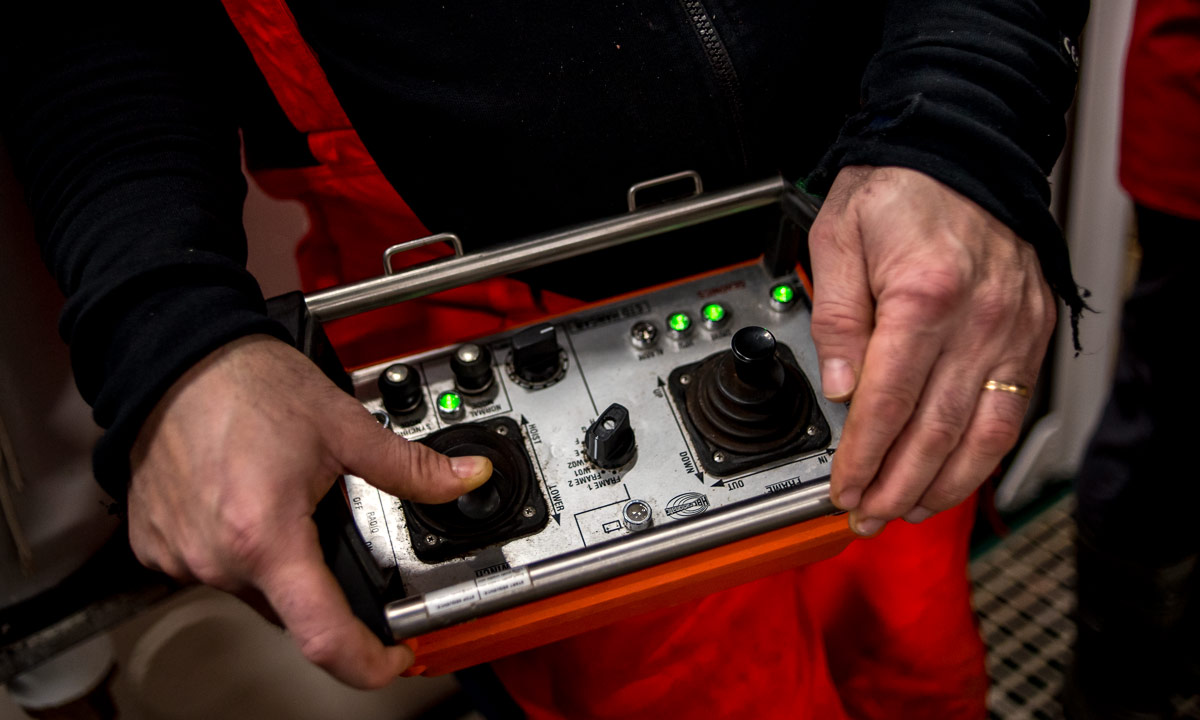
Polar expedition AeN JC3 – day 6: sailing through the ice

This article is part of the series “2022-02: Winter cruise KPH”.

Day 6 · 24 February 2022

We are on our way to P4, our first ice station. P4 lies at 79.75 °N 34.00 °N, round 50 km southeast of the island Kvitøya (white island) that belongs to the Svalbard archipelago. This station is more north than Ny-Ålesund on Svalbard. The estimated time of arrival is tomorrow round lunch time.

However it is not granted that the ice will be safe enough to work on. In addition to that it will become stormy tonight and maybe the whole next day according to windy.com . So even when the ice is safe the weather conditions could be too harsh. So there are several uncertainties. We plan for the station but more we cannot do yet.

Today is a cold day with temperatures maximum of -25.0 °C and minimum of -30.5 °C. I’ve experienced colder temperatures many times in my live in different parts of Lapland, but then the wind was always calm. With the ongoing wind the resulting windchill lies between -36 °C and -49 °C. And windy is right: it starts getting windier in the evening.

temperate in °C | wind speed relative to the ship in m/s | resulting windchill in °C.

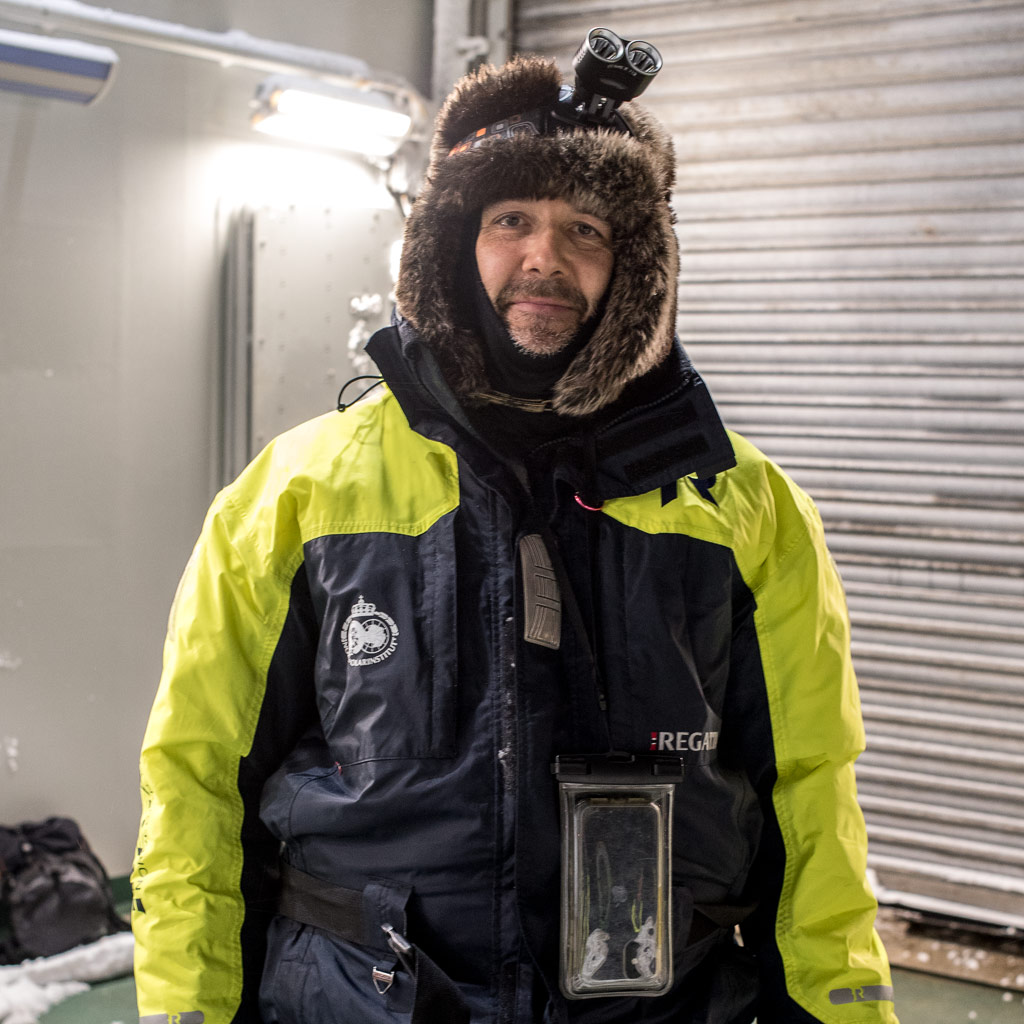
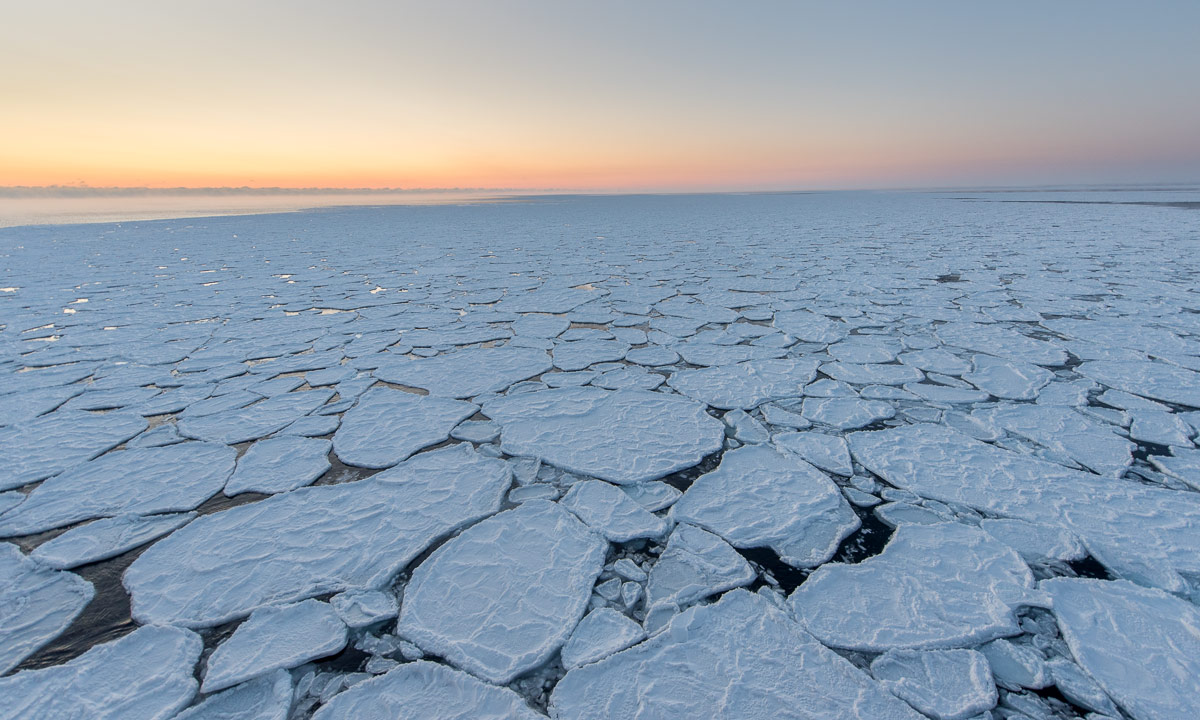
I take photos of marine animals, I learn the basics of ice observation but I stand outside quite often today. Watching the icebreaking polar research vessel Kronprins Haakon breaking through the ice. It is a great experience and I’m happy that I may participate.

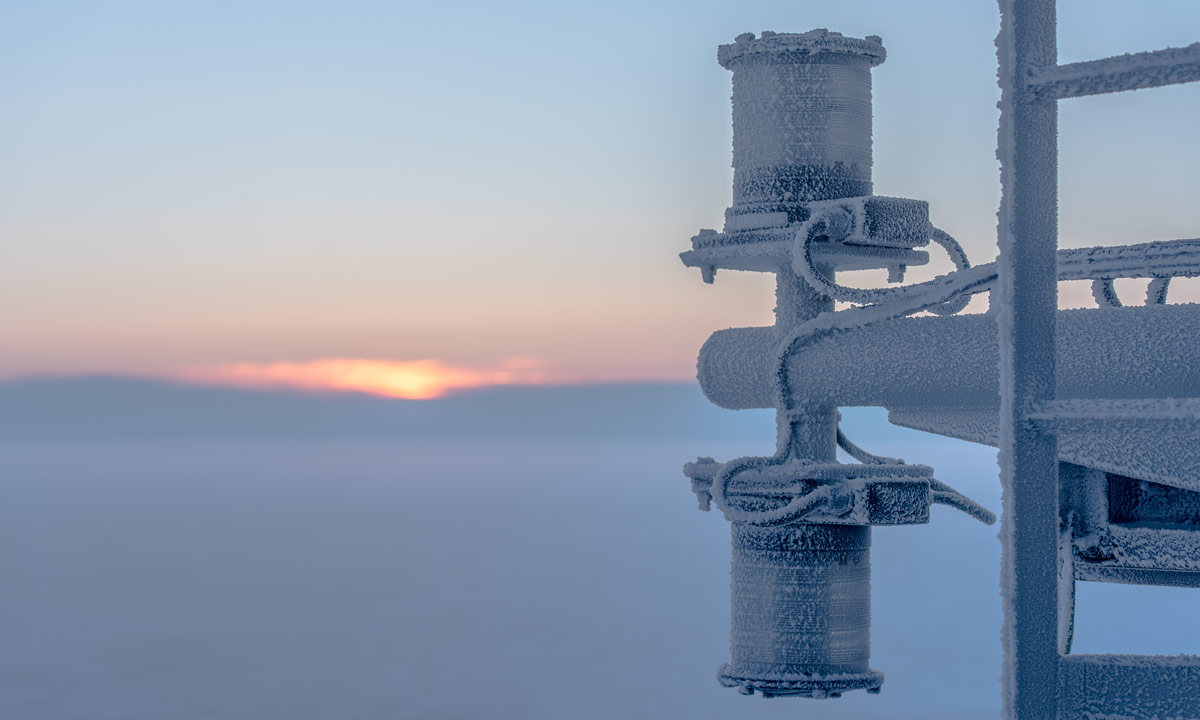
But now, let the photos speak. The first I made at 3:50 in the night, the last ones at 19:10.


Polar expedition AeN JC3 – day 5: marine fauna · entering the ice · temperature drop

This article is part of the series “2022-02: Winter cruise KPH”.

Day 5 · 23 February 2022

12:30 – it gets colder

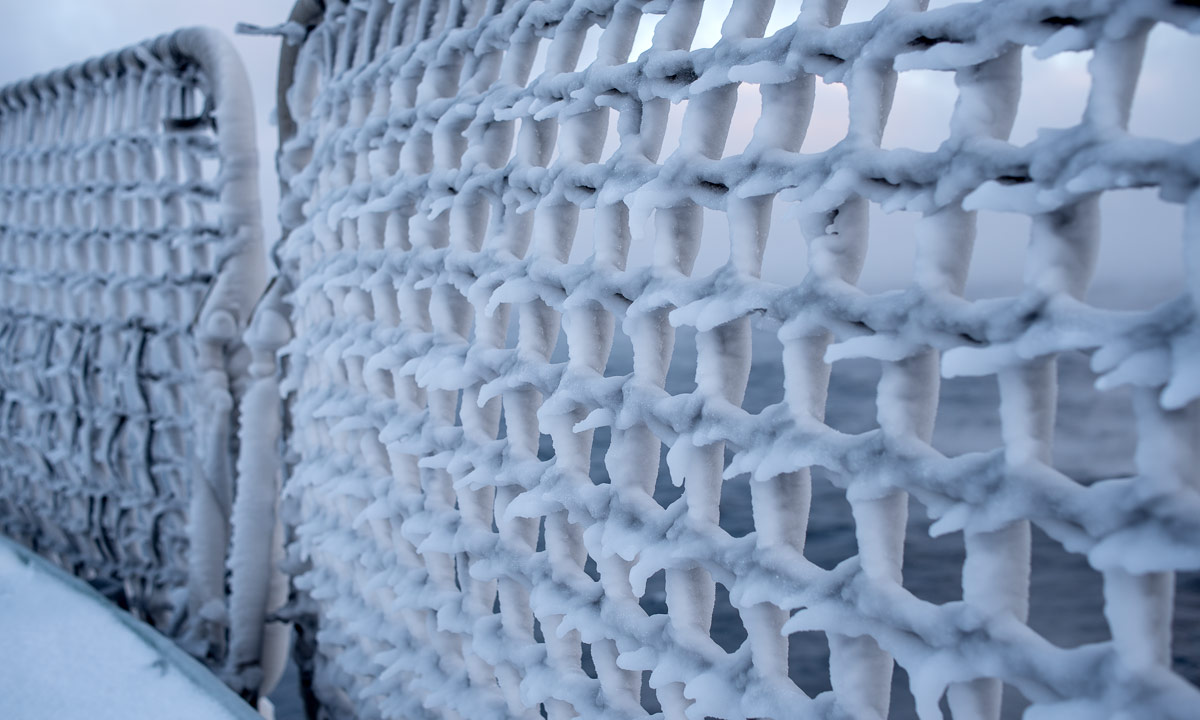
Over night it has become much colder and windier. Temperature has dropped to -17 °C and the relative wind speed has increased to 17 m/s (ca. 60 km/h). According to the wind chill formula that feels like -33 °C. The taut nets around the deck are covered with ice structures and ice fog hovers over the still open sea.

14:00 – marine fauna

A large trawl net is being pulled up. Scientist are waiting on deck, they look eager. What will the trawl reveal?

The net is up and the haul is emptied onto the deck.

At once the marine biologists gather round the catch and start browsing, identifying, sorting. I know some of the animals, but neither taxonomy nor latin name. It’s a childhood’s memory – me walking along the shore, my eyes glued to the soil to search for shells, jellyfish, worms, starfish. As a child I wanted to become a researcher but live has changed many times. Anyhow it finally brought me here on this polar expedition on Kronprins Haakon. But I digress, back to some photos of marine fauna and scientists:

I would love to know a bit more about the taxonomy of all these species but this will take some time and efforts, nothing you will get for free.

14:37 – the first sea ice

And there it is. The first sea ice is ahead.

The photo is awful. Noisy, underexposed two levels but I want it here in the blog. Not only for you but also for me because it’s the very first photo of sea ice on this cruise.

But there is more. While we continue north, soon the Barents Sea gets covered with pancake ice – called because of the rounded shapes of the ice floes – that soon make place for larger ice floes. That takes only 20 minutes.

(The images are not in chronological order for layout reasons)

For more than an hour I stand at the bow of the heli deck and watch the changes of the ice coverage. I love ice, I love the sea, I love cold winter and here I can get it all together. I feel happy! And cold it has become. Temperature -22 °C, relative wind speed 16 m/s resulting in a wind chill of -39 °C. The Canada Goose Snow Mantra parka starts to make sense. It shows what it can: keeping me warm under these conditions.

I use a pair of gloves and two pairs of mittens to keep hands and fingers warm. With one exception: Smartphone selfies. These I take bare-handed. While doing that the pinky of my right hand gets really cold and I will feel this for many hours. I’m lucky, the fingertip has no frostbite but I decide to stop making selfies in such harsh conditions. I love the arctic, but I play piano, too. I need my fingers. All of them.

15:59 – dinner pleasures

The haul caught a lot of animals, amongst others a lot of shrimps. Only some of them are needed for research. I help cleaning them, plucking away starfish and other species while a huge pot with salt water starts boiling. And at dinner we all get shrimps. Freshly caught in the Arctic. Delicious!

19:00 – photo shooting

A. a marine taxonomy expert asks me if he can borrow a tripod, he wants to take photos of some of the animals. Oops – I forgot the mount for attaching other cameras. I make another proposal: I’ll drop by and take pictures by myself. From this day I’m the “official court photographer” of non-microscopic animals. That’s work I really like. The first results are not the best, but I’ll share them anyhow:

Species identification taken from the cruise report of Andreas Altenburger. Thanks a lot!

21:30 – Sailing through the night

It’s dark. Ice has become thicker and you can hear the cracking and feel the vibrations from Kronprins Haakon breaking the ice. Again I stand on the heli deck looking ahead. Two strong spotlights illuminate the ice.

And for some minutes there is even a Northern light palely glowing in the sky.

While I stand there, happily watching the ice and the sky, muffled up warmly in my down parka and pants, temperature has dropped even more. -28 °C, windchill -44 °C.

temperate in °C | wind speed relative to the ship in m/s | resulting windchill in °C.


Polar expedition AeN JC3 – day 4: let the science begin!

This article is part of the series “2022-02: Winter cruise KPH”.

Day 4 · 22 February 2022 (part II)

18:14 on the bridge on deck 8. Some metres south of the 76th degree of latitude. People stand by the window, they are staring outside. Outside it’s dark. What are they looking for? What’s happening?

The activities for which we are doing this expedition have finally started. What activities do you realise on a scientific cruise? Collecting samples and data. For yourself and for others.

1 – Seaglider recovery

The very first activity is the recovery of a seaglider, an Autonomous Underwater Vehicle (AUV). It sends its position but still you have to locate it with your own eyes so that the icebreaker Kronprins Haakon can approach it. The recovery is much faster than excepted, already 15 minutes later the glider is on board. Anyhow it takes much more time to deactivate it, clean it thoroughly and most of all to dismantle it so that it fits into its huge plastic boxing that looks like an alien coffin.

To be honest, I don’t know for how long the glider drifted through the Barents Sea until we pulled it up. I don’t know neither what it measured and who will process this data. There is so much happening on this cruise that I do not manage to keep track of everything.

2 – CTD and water samples

There are a lot of abbreviations used on this cruise. One of them you hear frequently is “CTD”, which stands for conductivity, temperature, depth. A CTD is an electronic device that measures these three parameters constantly while it is winched down and up again. The conductivity is used to calculate the salinity, the relative amount of dissolved salt in the water. I will not go into details in this article because I’m not a scientist and I don’t want to write nonsense.

We have to talk about two more terms: “Moon pool” and “Niskin bottles”.

A moon pool is an opening in the floor of a ship deck to have access to water from inside the ship. Where this name comes from no one could explain.

When the moonpool is opened and the winch is ready the CTD is lowered into the water of the moon pool. And then it’s time for waiting – a quite common activity on the cruise. Time for discussions or just watching.

You see this “rosette” of dark, numbered cylinders? That’s Niskin bottles, used for sampling water. They can be opened and closed remotely so that it is possible to fetch water samples from different depths. These samples are used by chemists and marine biologists for different purposes. Since the chemists do the most delicate analysis they come first. The CTD rosette of Kronprins Haakon has 24 bottles. Today 22 of this bottles are filled, each one with water from a particular depth.

3 – plankton nets

It’s half past eight, when parts of the ship’s starboard hull is moved aside. Now it’s time for the first plankton nets. Marine biologists will work till long after midnight to bring down different nets for collecting zooplankton and phytoplankton. And there are many net types with different net sizes for different purposes. I have already worked with marine biological data so I know the names as bongonet or multinet. But now I see them first time in real life and learn about the different purposes and methods. Each net has not only its own construction but needs a distinct speed for being lowered and another one for being pulled up again.

Not all plankton nets are taken from the starboard. Some are so heavy, they need the more powerful winch at the stern of the ship. One of these is the multinet, a combination of five nets for collecting plankton from different depth intervals.

The activities continued the whole night. According to the data the last one was finished at 6:31, one hour before breakfast. I however decided to go to sleep at half past twelve. It was not relevant for my work to watch every activity and I was really tired. I’m a morning lark, not a night owl.

And since this blog article is already quite long I make it optically even longer by finishing it with another photo featuring the multinet.

Polar expedition AeN JC3 – day 3 and 4: transit to P1

This article is part of the series “2022-02: Winter cruise KPH”.

Day 3 and 4 · 21 – 22 February 2022

Monday, 21 February

Yesterday afternoon we left Tromsø behind for the transit to P1. The program Arven etter Nansen has seven so called process study stations called P1 to P7. P1 is the southernmost station with the approx. coordinates 76° N 31°13′ E. That’s almost five degree more north then I’ve ever been in my live. And it is planned to reach P7 at 82° N later on this cruise. Will we make it?

ETA (estimated time of arrival) is set to tomorrow 8:00. So today is travel day.

After I woke up I take a short lookout on the helicopter deck before breakfast. This starts to be a personal tradition on this cruise. With -11 °C it is colder than the days before but wind is calm and the temperature feels still very moderate.

I expected that we had left the mainland far behind and would cruise through open sea. To my surprise I can see mountains and lights. Where are we!?

Internet reveals that we are just passing the island Melkøya near Hammerfest. Melkøya is illuminated by the lights of the processing plant Hammerfest LNG. Interesting!

After a rich breakfast I stand on the same deck again. Today I feel more like a cruise tourist then a data manager on a work trip. Even the photos look like beautiful but quite random pictures taken from a Hurtigruten ship.

And indeed the icebreaker Kronprins Haakon follows the very same route as the Hurtigruten ships. Aside from that we do not call any ports. (Spoiler: next port is Longyearbyen on Svalbard 18 days from now.)

What do you do on a transit day on sea? Participating the mandatory sea ice training for example. It’s from 9:00 to 14:00 with a lunch break and we are told a lot about the different risks we might be confronted with on this cruise.

What I know is cold weather. Hypothermia, frost bite. I tented at -35 °C, I skied in blizzard-like conditions. I guess I have a bit of experience.

What I hardly know is arctic sea ice. I’ve been on the ice of the northern Baltic Sea countless times, but that water has only the tenth of the salinity compared to the water of the Barents Sea. The sea ice is softer and the conditions are quite different.

I  definitely know nothing about polar bears and a lot of the training is learning the procedures to avoid contacts.  I’ll talk more about this in another blog article.

At 13:30 we meet at the quarterdeck and train the handling of throw bags. Inside the bag there is a rope attached to a hip belt. When someone breaks through the ice the rescuer can throw this bag. The person to be rescued catches the rope and can be pulled back to safety. By having a long rope it is possible to keep distance. This minimises the risk that the rescuer breaks through as well. I know this from kayak courses but I’m glad to give it some tries again. Yes, it’s me on the next photo.

Photo: Adam Steer, Norwegian Polar Institute

At 16:00 I go on deck 3 again. It has got dark and started snowing.

Later that day the arrival time for P1 has been postponed to 19:00, eleven hours later than the ETA before. So much to the letter E in ETA ;-) It is almost impossible to plan with conditions as unsure as in the Arctic.

Tuesday, 22 February

My sis has birthday today. Hooray! Will we still have internet that I can wish her a Happy Birthday? Don’t ask me why, but we have internet in this remote place and I can send her a message.

Again I am on the helicopter deck before breakfast. Three differences to the day before: The deck is covered with snow, it is slightly warmer and no land is in sight. Finally we have left mainland Norway behind. And more and more I’m able to realise that I am really on a scientific polar expedition!

Still it will take another 11½ hours until we reach P1. I use the time to finally start working. My goal on this cruise is to understand the flow of scientific data. Where do the unique IDs come from? Where location and time? How are physical samples tied to the digital data? And can I improve these processes? I ask many stupid question to scientists to get a basic understanding.

And since I cannot ask questions for 11½ hours – I don’t want to be thrown overboard by my “victims” – I use more time to stand outside and take pictures.

Dinner 17:30. I forgot what I ate but it was delicious! For sure, because every single meal has been delicious on Kronprins Haakon.

But after dinner it is time to recover a glider. This is the first scientific activity on this cruise. Finally!


Arrival in Longyearbyen

This article is part of the series “2022-02: Winter cruise KPH”.

It is half past two in the night between Thursday and Friday. For almost two hours I had stood on the helicopter deck of the icebreaker Kronprins Haakon to witness our arrival in Longyearbyen on Svalbard.

When I went outside two hours ago clouds had just started to gather and the moon was hidden. I could see dark and pale schemes on both sides of the ship and straight ahead another shade of a mountain, decorated with lights.

Slowly the lights came nearer. And since it was the first time I had mobile Internet for many days I could follow our route on the map of the iPhone. Only occasionally because a cold wind on the bow made the quite mild temperatures of -5 °C feel much colder.

There – the airport! And then, after we started to turn into the Adventfjorden, the city LongyearbyenSvalbard’s largest settlement.

The ship slowed down at the harbour and slowly and carefully started to move sideways. Do we still move? I peek down to the pier. There, the first thick rope connects the vessel with land – the first land after we bunkered fuel round 19 days ago!

We have arrived in Longyearbyen. Almost three weeks I worked, learned, photographed, relaxed, ate and slept on Kronprins Haakon. Tomorrow I’ll disembark and in the early afternoon take an airplane back to Tromsø. Yes, I am sad that this incredible journey has now come to its end. But I am also happy and content and full of stories, experiences and memories.

Do I smile on the photo or am I sad? Most of all I am tired and then a bit tense because it is hard to hold the iPhone as still as possible for some seconds with an outstretched arm.

The scientific winter cruise Arven etter Nansen JC3 took almost three weeks. Three very extraordinary weeks. And it will take at least three other weeks to tell some of the stories and show some of the photos here in the blog. So, please be patient – more to come, but step by step.

Arctic research expedition with the Norwegian Polar Institute

This article is part of the series “2022-02: Winter cruise KPH”.

Kronprins Haakon is a Norwegian icebreaking polar research vessel. It was build 2018, can cut through one metre of solid ice, has 15 different laboratories on board and place for 35 scientists or other staff in addition to the crew.

Four days ago Kronprins Haakon had arrived in Tromsø. It was travelling 26 days since it left Cape Town, the only stopover on its return trip from Antarctica.

This morning I went on board of Kronsprins Haakon. Not as a visitor to look around but with a suitcase, an enormous bag full of warm clothes, a heavy camera backpack and my Canada Goose down parka. I will stay on board for three weeks to participate the winter cruise “Arven etter Nansen JC3” that will lead us to the Barents Sea east of Svalbard and a bit beyond.

What happened?

Some of you may know that I’ve been working as a data engineer at the Norwegian Polar Institute in Tromsø since autumn 2020. In this position I’m not only a software developer but a data manager of polar research data.

Three and a half weeks ago my colleague M. told me she would join the winter cruise and mentioned that there might still be an available place.

Of course I was very eager to participate. Beside of my private passion for the Arctic I wanted to get a deeper and hands-on understanding of the research data. Where does it come from? How is it measured? And how is it transferred to the digital world? And nothing would teach me better than joining this very winter cruise, where conditions could be quite rough.

I mentioned it to M., another colleague and he introduced me to the expedition leader. There I was told that there was indeed a vacancy on board and that I was welcome to join if my boss would agree.

Since then it had been crazy times with some organisation, a lot of worries and little sleep.

  • 1 Feb: My boss had to check the budget for my participation.
  • 4 Feb: A seafarer’s doctor examined me and gave me my helseerklæring – a medical certificate that proves me “seaworthy”.
  • 16 Feb: I had to take a PCR test and wait for the result for two days. Then I had to take another PCR test, but that’s a whole story in itself.
  • 18 Feb: I had to do a survival suit training in the Tromsøsundet.
  • 18 Feb: I had to pack clothes and equipment I will need on the cruise. Everything beside of two pairs of boots, a helmet, a floating suit and a survival suit. These are provided by the Norwegian Polar Institute.
  • 19 Feb (today): I took a taxi to the port of Tromsø. I was driven directly to Kai 25, took some photos and then went on board.
  • Still today: passport control through the police, a security briefing, lunch and dinner, carrying boxes to the labs, entering the rescue boat and some more …

The next weeks

When Kronprins Haakon will leave Tromsø tomorrow morning we will sail north. First destination is a point referred as P1. It is approx. 500 km east of Svalbard’s southern tip. From there we will continue heading north to the other stations, if weather and sea ice conditions allow it.

The northernmost position is planned to be approx. 82° N, somewhere in the Arctic Ocean. That’s more than 10 degrees of altitude further north than I’ve ever been and less than 900 km to the North Pole.

I’m so excited, that’s really way up north!

We will work both on the sea ice and on the ship using various measurement and sampling methods. Some of them I learned a bit last week but most of them I do not know yet. I’m a newbie. I’m here to learn. And hopefully I’ll learn a lot on this cruise.

After three weeks of tokt (Norwegian for “cruise”) we are supposed to arrive in Longyearbyen on 11 Mars. There I’ll take a flight back to Tromsø the same day.

I will not blog on this cruise because there will be a lot of work and hardly any reliable internet connection. But I’ll definitely take photos, both for the Norwegian Polar Institute and in private for this blog.

So, my dear readers, cross your fingers that I do not get seasick, we can reach our planned destinations and most of all that no one has Covid on board.

You can check the live position of the Kronprins Haakon on the map below. And you are welcome to leave a comment. See you again in mid-March when I’ll answer your comments and start posting articles.

23. Feb, 13:03: Just a short note: This map does not seem to work in polar regions. At time we have internet. Outside temperature -17.4 °C. Position round about 76°29′ N 31°11′ E.


Sea ice field work training on the Sørbotn

Peacefully I wake up this morning. It is already light outside. WHAT? LIGHT? WHY? AND WHEN?

I check my mobile phone – the clock shows 8:01. SH**!!! At 7:45 we were supposed to meet at the Norwegian Polar Institute, at 8:00 we were supposed to leave there for a field work training on the sea ice. But not me. I have overslept!

We – that’s 5 instructors and round 20 participants of the Sea ice field work training arranged by the Norwegian Polar Institute and the Arctic University of Norway in Tromsø. I realise that my colleague M. already tried to reach me and ring back. I tell her that I will take my own car and hopefully make it to our destination with only a small delay.

Our destination – that’s Sørbotn, the southern tipp of the fjord Ramfjorden where the training will take place on the sea ice of the frozen fjord.

I manage to dress, make tea and pack in 20 minutes thanks to previous day’s preparation and a fondness for packing lists. Although I take it easy while driving (safety first!) I arrive less than 10 minutes late while the preparations are still in progress.

We are split in two groups. Our group will do measurements of ice and snow depths first and take ice core samples after lunch break. I won’t go here into details too much, because I’m a newbie to all this and I do not want to write half-understood nonsense. I’ll have to look up some details of today’s stuff later.

Although I drill holes in the ice, help calibrating the GEM2 device, measure temperatures in a freshly taken ice core and use a MagnaProbe to measure a transect of snow depths I have a lot of time to take photos, too. So, let’s just start with this.

Being on the ice with a bunch of nice people is not only a lot of fun but it will help me in doing my job at the polar institute. Part of it is to manage scientific data. The deeper my understanding on collecting data the better I can do my work. The most interesting thing today was observing the coexistence of advanced sensor technology paired with GPS tracking and the usage of rulers, pencils and paper as in the early days of polar research.


There was one thing I wasn’t involved in: The usage of a remote-controlled underwater drone. We clearly could see some fishes and jellyfish (do you spot it on the 1st image below?) on the live display. I know that it’s used for research, but I would love to have it just as a toy.

Hopefully this was not the last time that I was involved in field work this year. And perhaps we’ll be lucky with the weather again next time. For while we had calm conditions and even sunshine, wind drove heavy snow squalls over Tromsø just some hours after we called it a day.

Sea ice field work training – preparations

My job at the Norwegian Polar Institute is both to write applications and to manage scientific data. Since I’m not a scientist it’s hard to understand sometimes, how data is collected and digitalised.

To learn more about this I’ll participate a sea ice field work training tomorrow. It is organised by the polar institute and UiT, the Arctic University of Norway. We’ll be on the sea ice of Sørbotn – part of the fjord Ramfjorden the whole day and learn different measurement methods as coring and magna probe. (Don’t ask me any questions today. I hope I’ll know a bit more tomorrow.)

The instructors measured the ice depth yesterday. It is round 50 cm and absolutely safe to walk and work on. We had two preparative meetings where we discussed possible risks and how to dress properly. Although it is forecasted to be only -5 °C and hardly any wind it’s always good to have enough stuff to stay warm when being outside on the ice. I started packing today.

Some of the items I’ll take with me:

  • Thick Kamik rubber boots with inner shoe – really warm!
  • Red hard shell jacket and matching bibs. Not warm, but absolutely wind proof.
  • Grey down parka. For resting and having lunch outside.
  • The brown fur hat. 100% polyester, H&M, EUR 9.90. I used it once in -37 °C and although cheap it’s warm and works well.
  • Ski goggles – just in case.

The hard shell jacket and bibs are not mine. Yet. They belong to the polar institute and I got them recently. After five work years they are mine. The attached fur is my private one.

Maybe some of us will get a Regatta floatation suit, a warm, water- and windproof coverall, but I’m not sure yet so I’ll take all the private stuff with me. I love winter. I do not love freezing.

More to come after the training …

Back in Tromsø

This article is part of the series “2021-07: Back in Tromsø”.

After eight months of home office home I travelled back to Tromsø last Saturday to continue working at the Norwegian Polar Institute. My wife Annika has joined me for a week and I took some days off. Yesterday she travelled back to our home to Obbola. Tomorrow my Tromsø everyday life starts –at least for three weeks, then Annika and I will meet again for a two week vacation.

Sunday, 25 July

A grey day, a foggy day. Good for relaxing after a long journey from Sweden with train car and bus, that took eighteen hours.

Monday, 26 July

My first working day onsite since 20 November 2020. My boss has bought suksessterte (success cake) to celebrate my return. The seagulls have occupied my windowsill.

Tuesday, 27 July

Annika and I planned to hire a car for a trip, but none of the car rentals have free cars. Instead we are looking for a 2nd hand car for me. We find an old Subaru XV and may test drive it for 24 hours! Road trip to Sommarøya. Lunch at the hotel, watching private kayak lessons at one of the many beaches. Realising that the car fits onto my small parking place.

Thursday, 29 July

After work (well, after lunch) Annika and I take the bus to Tromsdalen on the other side of the sound Tromsøysundet. Here we use Sherpatrappa to hike up the mountain Storsteinen. Sherpatrappa is a stone staircase with 1203 steps built by Nepalese mountain road workers and finished in 2019. Then we hike to the summit of the mountain Fløya (671 m a.s.l.). After a break we return to the mountain station and enjoy our dinner in the sun. Then we walk down the stairs again. My knees are sulky, but that’s worth it.

Friday, 30 July

After lunch we fetch my car that I bought on Wednesday. Not the Subaru XV, but a three year old Suzuki S-Cross. After that we take a road trip to Tromvik and Rekvik on the island Kvaløya. And – oh – it’s so beautiful at many places here! Personal highlight: the two relaxed reindeer at the beach.

Saturday, 31 July

Farewell Annika! Now we are separated by at least 930 kilometres but fortunately for only three weeks. After I farewell Annika at the airport I drive to a parking place on the island Kvaløya and take two promenades. One at the beach, one over the bogs. The variety of landscapes is so impressive.

Sunday, 1 August

After a more or less lazy a short trip by bus to the center of Tromsø. The Indian restaurant is fully booked, but the sushi restaurant has place. 12 bits 189 NOK. Regular Norwegian prices. On the way there I find this narrow shortcut. Old dustbins, but a photo exhibition.

Hejdå home office

Hejdå home office – hejdå Obbola – hejdå Sweden.

This picture is from yesterday, my last day in home-home office. One “home” is for not being in the office, another “home” for working from home in Obbola, not in Tromsø.

This room was my home office for eight months.

In normal times you meet colleagues in real life and have landscape photos on your computer monitor as a desktop background. The last eight months it was the opposite: I met my colleagues digitally but the view of the Baltic Sea was real. And so were the sail boats, the screeching sea birds and the roe deer passing by.

While I write this Annika and I sit in the train to Riksgränsen that departed in Umeå at 2:08(!). In Riksgränsen we’ll get a private lift to Narvik crossing the Norwegian border and then take the bus to Tromsø. If everything works well we’ll arrive there this evening. After a week Annika will return home while I’ll stay in Tromsø to continue my work for the Norwegian Polar Institute on-site.

Eight months Annika and I had together in Obbola. I appreciated every single day of this unexpected gift caused by the COVID-19 restrictions and I’ll keep this time in my heart.

What the future brings? Too early to say.