Sea ice field work training on the Sørbotn

Peacefully I wake up this morning. It is already light outside. WHAT? LIGHT? WHY? AND WHEN?

I check my mobile phone – the clock shows 8:01. SH**!!! At 7:45 we were supposed to meet at the Norwegian Polar Institute, at 8:00 we were supposed to leave there for a field work training on the sea ice. But not me. I have overslept!

We – that’s 5 instructors and round 20 participants of the Sea ice field work training arranged by the Norwegian Polar Institute and the Arctic University of Norway in Tromsø. I realise that my colleague M. already tried to reach me and ring back. I tell her that I will take my own car and hopefully make it to our destination with only a small delay.

Our destination – that’s Sørbotn, the southern tipp of the fjord Ramfjorden where the training will take place on the sea ice of the frozen fjord.

I manage to dress, make tea and pack in 20 minutes thanks to previous day’s preparation and a fondness for packing lists. Although I take it easy while driving (safety first!) I arrive less than 10 minutes late while the preparations are still in progress.

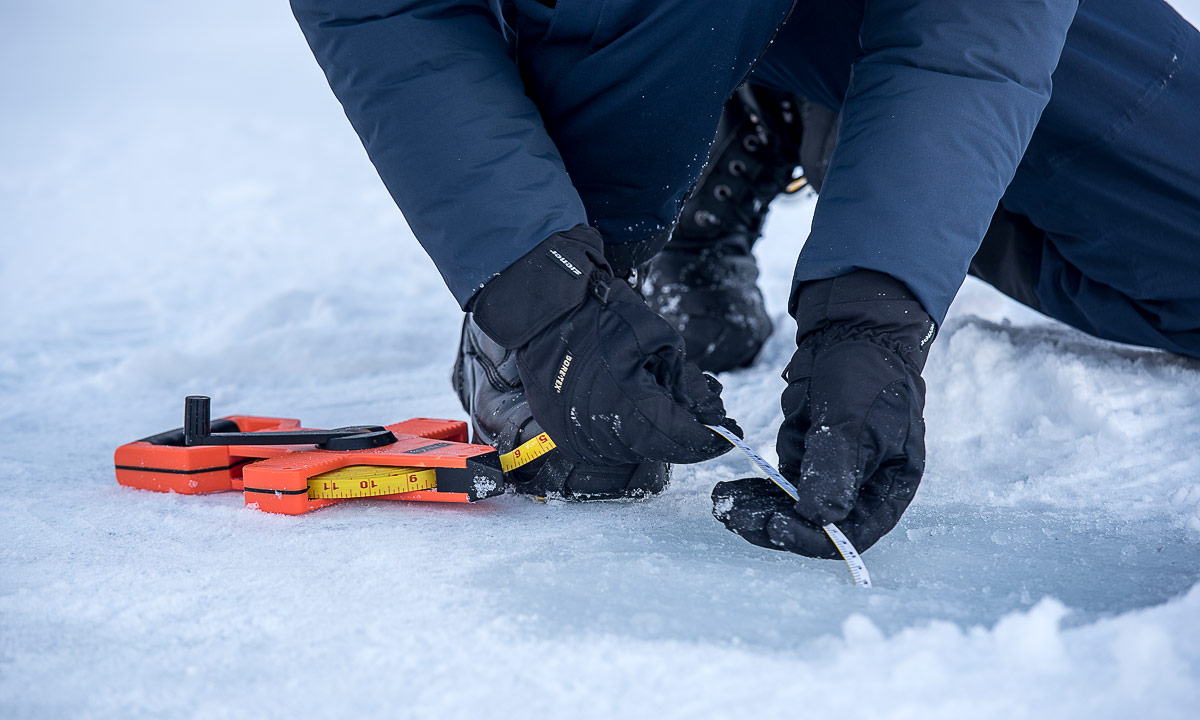
We are split in two groups. Our group will do measurements of ice and snow depths first and take ice core samples after lunch break. I won’t go here into details too much, because I’m a newbie to all this and I do not want to write half-understood nonsense. I’ll have to look up some details of today’s stuff later.

Although I drill holes in the ice, help calibrating the GEM2 device, measure temperatures in a freshly taken ice core and use a MagnaProbe to measure a transect of snow depths I have a lot of time to take photos, too. So, let’s just start with this.

Being on the ice with a bunch of nice people is not only a lot of fun but it will help me in doing my job at the polar institute. Part of it is to manage scientific data. The deeper my understanding on collecting data the better I can do my work. The most interesting thing today was observing the coexistence of advanced sensor technology paired with GPS tracking and the usage of rulers, pencils and paper as in the early days of polar research.


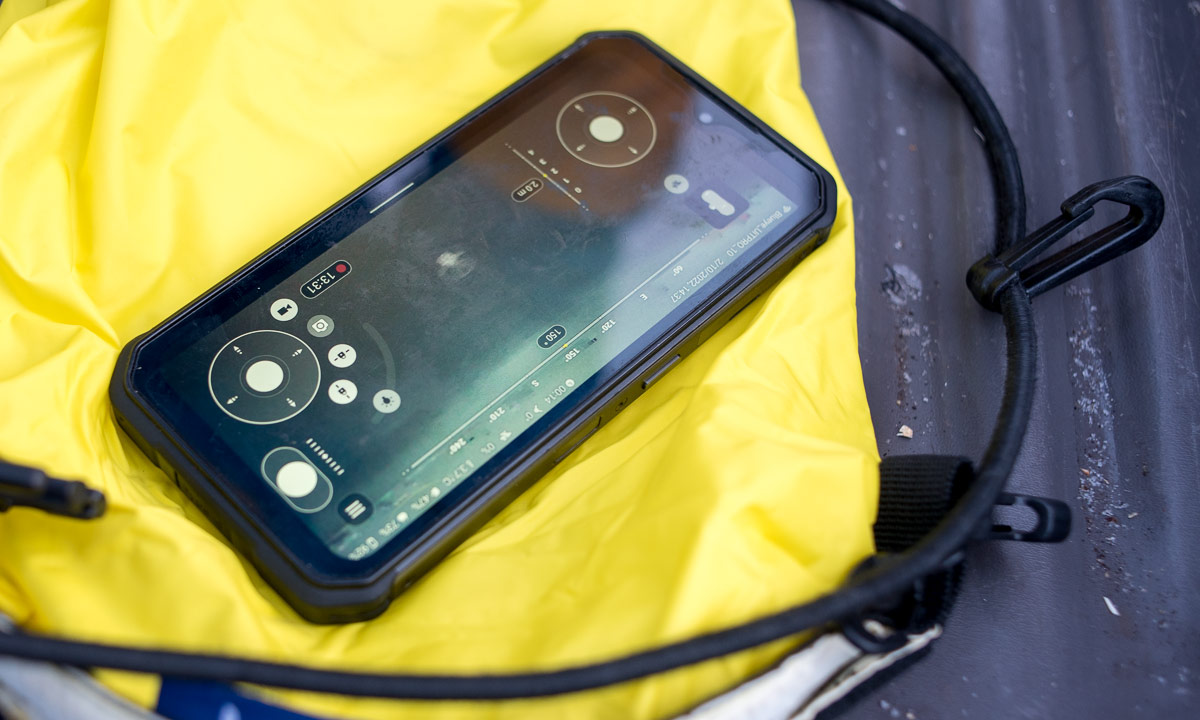
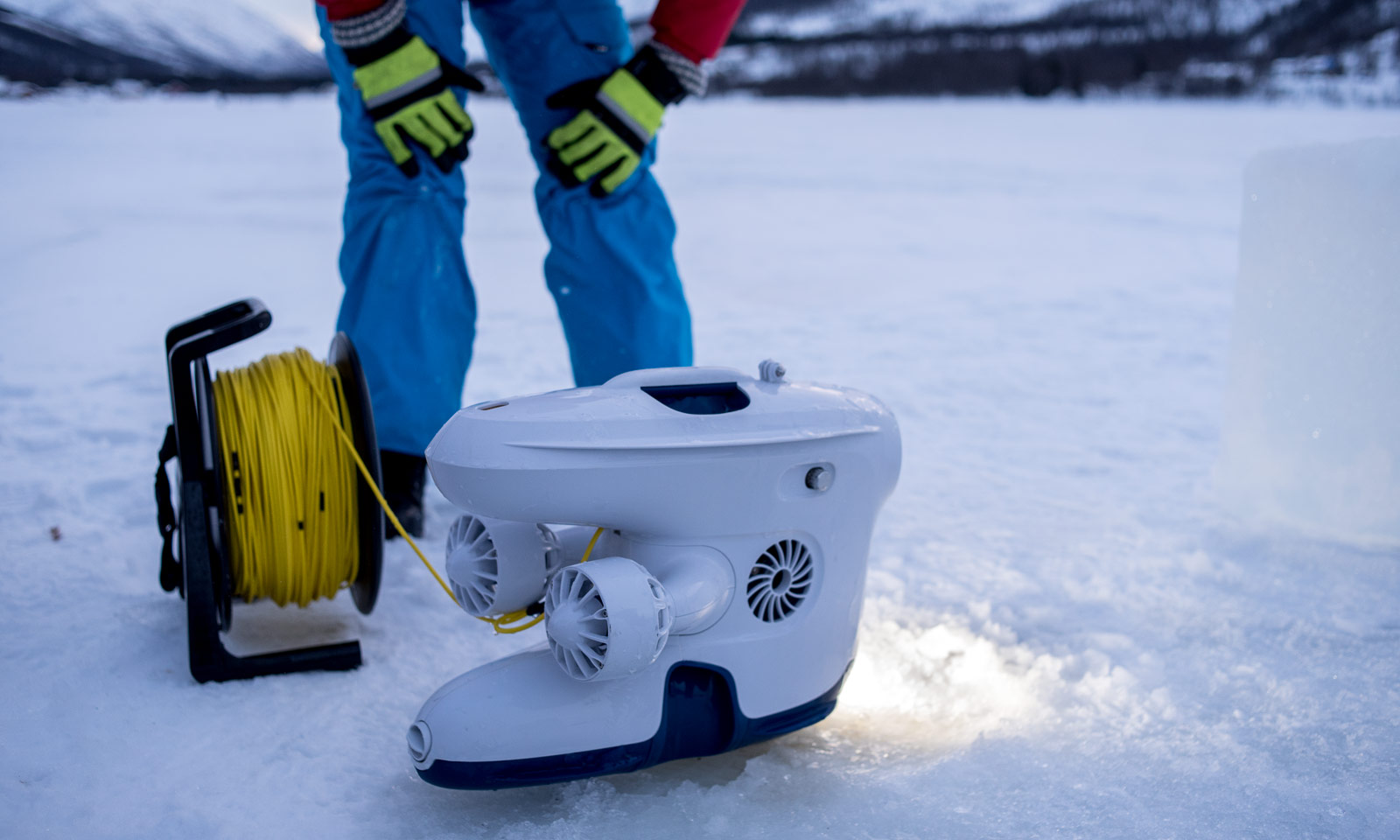
There was one thing I wasn’t involved in: The usage of a remote-controlled underwater drone. We clearly could see some fishes and jellyfish (do you spot it on the 1st image below?) on the live display. I know that it’s used for research, but I would love to have it just as a toy.

Hopefully this was not the last time that I was involved in field work this year. And perhaps we’ll be lucky with the weather again next time. For while we had calm conditions and even sunshine, wind drove heavy snow squalls over Tromsø just some hours after we called it a day.

Sea ice field work training – preparations

My job at the Norwegian Polar Institute is both to write applications and to manage scientific data. Since I’m not a scientist it’s hard to understand sometimes, how data is collected and digitalised.

To learn more about this I’ll participate a sea ice field work training tomorrow. It is organised by the polar institute and UiT, the Arctic University of Norway. We’ll be on the sea ice of Sørbotn – part of the fjord Ramfjorden the whole day and learn different measurement methods as coring and magna probe. (Don’t ask me any questions today. I hope I’ll know a bit more tomorrow.)

The instructors measured the ice depth yesterday. It is round 50 cm and absolutely safe to walk and work on. We had two preparative meetings where we discussed possible risks and how to dress properly. Although it is forecasted to be only -5 °C and hardly any wind it’s always good to have enough stuff to stay warm when being outside on the ice. I started packing today.

Some of the items I’ll take with me:

  • Thick Kamik rubber boots with inner shoe – really warm!
  • Red hard shell jacket and matching bibs. Not warm, but absolutely wind proof.
  • Grey down parka. For resting and having lunch outside.
  • The brown fur hat. 100% polyester, H&M, EUR 9.90. I used it once in -37 °C and although cheap it’s warm and works well.
  • Ski goggles – just in case.

The hard shell jacket and bibs are not mine. Yet. They belong to the polar institute and I got them recently. After five work years they are mine. The attached fur is my private one.

Maybe some of us will get a Regatta floatation suit, a warm, water- and windproof coverall, but I’m not sure yet so I’ll take all the private stuff with me. I love winter. I do not love freezing.

More to come after the training …

Back in Tromsø

This article is part of the series “2021-07: Back in Tromsø”.

After eight months of home office home I travelled back to Tromsø last Saturday to continue working at the Norwegian Polar Institute. My wife Annika has joined me for a week and I took some days off. Yesterday she travelled back to our home to Obbola. Tomorrow my Tromsø everyday life starts –at least for three weeks, then Annika and I will meet again for a two week vacation.

Sunday, 25 July

A grey day, a foggy day. Good for relaxing after a long journey from Sweden with train car and bus, that took eighteen hours.

Monday, 26 July

My first working day onsite since 20 November 2020. My boss has bought suksessterte (success cake) to celebrate my return. The seagulls have occupied my windowsill.

Tuesday, 27 July

Annika and I planned to hire a car for a trip, but none of the car rentals have free cars. Instead we are looking for a 2nd hand car for me. We find an old Subaru XV and may test drive it for 24 hours! Road trip to Sommarøya. Lunch at the hotel, watching private kayak lessons at one of the many beaches. Realising that the car fits onto my small parking place.

Thursday, 29 July

After work (well, after lunch) Annika and I take the bus to Tromsdalen on the other side of the sound Tromsøysundet. Here we use Sherpatrappa to hike up the mountain Storsteinen. Sherpatrappa is a stone staircase with 1203 steps built by Nepalese mountain road workers and finished in 2019. Then we hike to the summit of the mountain Fløya (671 m a.s.l.). After a break we return to the mountain station and enjoy our dinner in the sun. Then we walk down the stairs again. My knees are sulky, but that’s worth it.

Friday, 30 July

After lunch we fetch my car that I bought on Wednesday. Not the Subaru XV, but a three year old Suzuki S-Cross. After that we take a road trip to Tromvik and Rekvik on the island Kvaløya. And – oh – it’s so beautiful at many places here! Personal highlight: the two relaxed reindeer at the beach.

Saturday, 31 July

Farewell Annika! Now we are separated by at least 930 kilometres but fortunately for only three weeks. After I farewell Annika at the airport I drive to a parking place on the island Kvaløya and take two promenades. One at the beach, one over the bogs. The variety of landscapes is so impressive.

Sunday, 1 August

After a more or less lazy a short trip by bus to the center of Tromsø. The Indian restaurant is fully booked, but the sushi restaurant has place. 12 bits 189 NOK. Regular Norwegian prices. On the way there I find this narrow shortcut. Old dustbins, but a photo exhibition.

Hejdå home office

Hejdå home office – hejdå Obbola – hejdå Sweden.

This picture is from yesterday, my last day in home-home office. One “home” is for not being in the office, another “home” for working from home in Obbola, not in Tromsø.

This room was my home office for eight months.

In normal times you meet colleagues in real life and have landscape photos on your computer monitor as a desktop background. The last eight months it was the opposite: I met my colleagues digitally but the view of the Baltic Sea was real. And so were the sail boats, the screeching sea birds and the roe deer passing by.

While I write this Annika and I sit in the train to Riksgränsen that departed in Umeå at 2:08(!). In Riksgränsen we’ll get a private lift to Narvik crossing the Norwegian border and then take the bus to Tromsø. If everything works well we’ll arrive there this evening. After a week Annika will return home while I’ll stay in Tromsø to continue my work for the Norwegian Polar Institute on-site.

Eight months Annika and I had together in Obbola. I appreciated every single day of this unexpected gift caused by the COVID-19 restrictions and I’ll keep this time in my heart.

What the future brings? Too early to say.

My new work: Overingeniør @ Norsk Polarinstitutt

Today I got the confirmation: From 1 October I will work as a senior engineer at the Norwegian Polar Institute in Tromsø.

The story began on 14 March when I found a job offer “Utviklere, web/dataforvaltning” (developers, web/data management) at the Norwegian Polar Institute in the world wide web. It was just two days before closing date and I hurried to write an application for the job. The idea of working as a software developer with research data in the field of polar research was too tempting.

The whole process took a long time because of the restrictions due to corona, but on 29 April I was invited to a short video conference with the head of department and one of the developers. In the end of May I solved two programming exercises and on the 4th of June I had my job interview. I would have loved to travel to Tromsø for the interview but because of corona this was impossible and we took another video interview.

I was quite proud that I had come so long in the whole process – a former jazz pianist and web developer, although with 18 years of professional experience within software development. The following week I got a message that I had been accepted for the job. Today I got the formal confirmation in form of an offer that I gladly accepted.

So today I pronounce that I am feeling honoured to be able to work for the “Norsk Polarinstitutt”, the Norwegian Polar Institute in Tromsø. A new area of work begins.

There’s a lot of more to tell, but not tonight. The blog will continue.