Anticipation is the greatest joy

This article is part of the series “2023-03: Svalbard”.

In Germany this means “Vorfreude ist die schönste Freude”. I never liked this proverb. I’m too impatient! Or is it true? Even for impatient people like me? Perhaps.

Yesterday I asked the map section of the Norwegian Polar Institute if I may have a map of Svalbard. And I got one. Since my part of our shared office does not have any walls I decided to put in on the wall in my Hybel – my small apartment in Tromsø. Here it hangs, just between the two windows.

Last week I got to know, that I may collaborate with L. for a week. He does not work at the Polar Institute, but at UNIS, the university centre in Svalbard.

Today my boss told me – he knows me well – that I may work there. So, If L. and I really find a common time to work together and there is accommodation and payable flights, I’ll be in Longyearbyen within the next months for a week. Plus some extra days when possible.

I have been in Longyearbyen before, but only a couple of hours after last years expedition. It would be so great to travel there again with much more time.

Of course it’s not carved in stone yet, but I’m looking forward to it already very much.

Anticipation is the greatest joy.

From Tromsø to Obbola

Friday, 18 November – walking back from work

It’s weekend. Today I stopped working already at 14:15. Sunset was 40 minutes ago and the light is beautiful while I’m walking home.

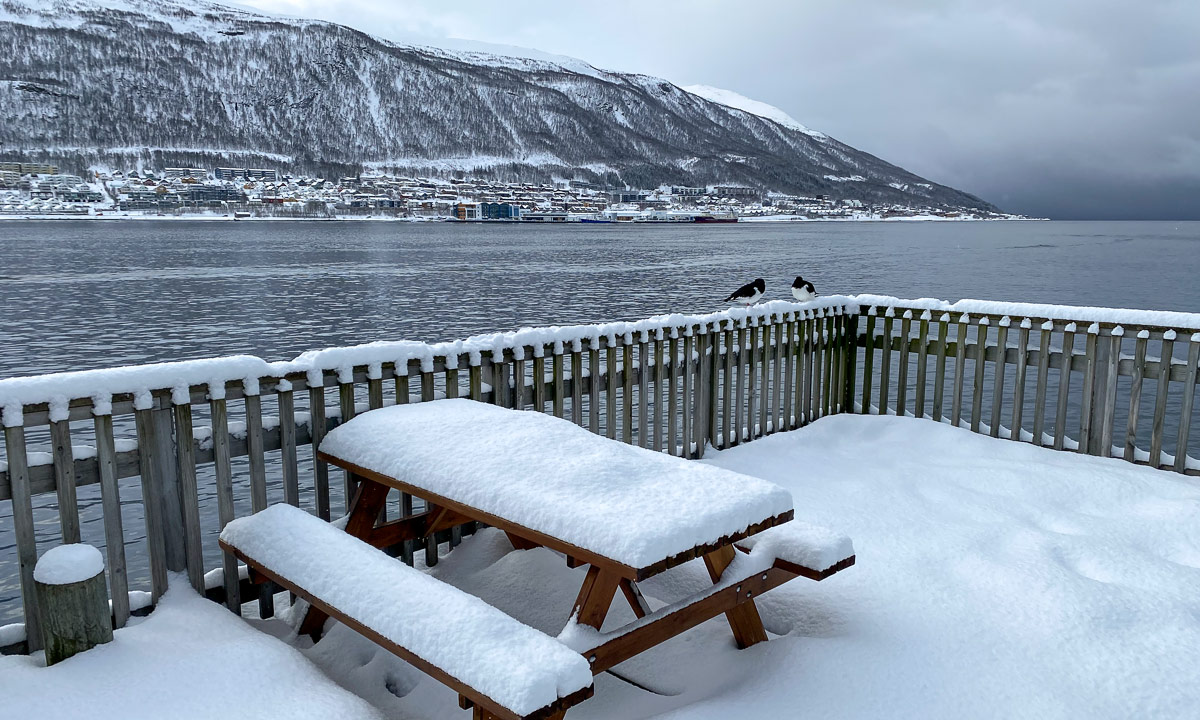
In Tromsø there’s hardly any snow, but a lot of rime. In the evening there’s polar light, but I only take a smartphone snapshot – tomorrow is a long day.

Saturday, 19 November – taking the bus to Narvik

Today is travel day. Round 16–17 hours it will take me from home to home.

Yes, I have two homes. One “work home” in Tromsø where I work and one “Home home” in Obbola where my wife Annika and I have a house by the Baltic Sea.

The weather is gorgeous and I take many photos through the window of the bus. Therefore some of the motives are blurred. The last one – the large bridge Hålogalandsbron is jittery because it has become dusky.

Saturday, 19 November – taking the train to Umeå

It’s a long ride from Narvik to Umeå. Departure 15:10, arrival 1:40 in the night. But it is a though train. I don’t have anything more to do but being awake on the arrival in Umeå. While I eat my take-away sushi outside of the train station it gets dark and so there is not much to see from the landscape in the train unless it stops.

In the frosty inland where it is quite cold I witness a special phenomenon. The whole forest we are passing is lit in green light. Another aurora? No, it’s cloudy. There are passages where the power lines for the train are coated with rime ice. The layer is so thick, that the current collector of the train looses contact and the electricity jumps over emitting bright green light that illuminates the dark forest.

The train arrives in Umeå in time and Annika already waits at the station. Another half an hour and I’m home home. Bed is waiting!

Sunday, 20 November – winter feelings

Oh, what a blessing it is to be home home. Normally we are supposed to work at the offices of the Norwegian Polar Institute but my boss knows about our long-distance relationship (or is it called long-distance marriage?) and allowed me to do home office until Christmas. Tusen takk! And it is even wintry and a bit sunny and a bit snowy.

From now on I can enjoy the view from my home office.

Monday, 21 November – the first home office day

Enjoying the view from my home office is a pleasure but when all of the sudden the morning sun peeks through the clouds I just have to go outside and make some photos!

And what do I do at lunchtime? This:


An intangible longing

This blog article is a bit special. It’s not about the places I visit but about a special place of longing. The article is more personal than the others and probably I write it mostly for myself. I decided to publish it anyhow. You are welcome to read it and share your thoughts in the comment section. That would be nice!

I’m feeling sad and wistful. This map shows the reason for my melancholy and the place of my longing:

The image above is a clip of the map North Circumpolar Region. A large version of the map hangs in my work room home in Sweden. In the middle of the cropped image there it is: The North Pole! Unreachable. But …

Let’s first go back in history. 20 years ago. I lived in Essen, Germany and I just had stopped working as a professional jazz musician and made my first work experiences in web programming. Everything was new. And I started to develop a new passion: The Scandinavian winter.

That winter I had been in Lapland for the first time and I loved it! With the exception of the following year I have been north of the Arctic Circle every single year since then. In 2004 I first moved to the opposite direction – Munich – but in 2010 I moved to Sweden. 2020 was a very special year. Annika and I bought a house and moved in together in May. And in August we have married ! At the same time I got a job at the Norwegian Polar Institute in Tromsø. As a matter of fact that is too far away from home but this job is just a once-in-a-lifetime opportunity. That’s why I have had two places to live since then. Right now I’m in Tromsø.

Since I not only like maps but also graphics, I photoshopped a bit today. A graph about “way-up-north” the last 20 years. The x-axis shows the time and y-axis shows the latitude. The bars show were I lived and the dots my northernmost latitude per year.

You see the green dot this year? 82 °N – that’s quite out of my normal Northern Scandinavian boundary box. How I came there? As part of my job I got the opportunity to join a polar expedition with the ice breaker Kronprins Haakon. The three week journey took us to the Polar Ocean north of Svalbard. I was really touched and overwhelmed by the beauty of the sea ice and I fell in love with the high Arctic.

Last week Kronprins Haakon started another polar expedition for five weeks. Oh, I was longing for being in the high Arctic again and I wished to join that cruise so much!

It doesn’t make it easier that I know 9 of the 27 participants. And it doesn’t make it easier either, that the ship is probably not fully booked. There might have been a place (although no budget)! But today it became even harder when I read that yesterday Kronprins Haakon has reached the North Pole for the first time. The North Pole! Imagine – the NORTH POLE! Being there is one of my two strongest dreams in life! The other I’ll keep secret ;-). But of course it is not my main field of work travelling around. Unfortunately.

So that’s why I have been feeling sad and wistful the last two weeks.

But there are things that help.

Annika is coming to Tromsø next Friday and then we have three weeks of holiday together! Since we do not see each other regularly, each day together is something special. I’m so looking forward to see her!

Other thing that help? Hiking in the mountains (last Sunday and tomorrow), paddling kayak (yesterday), taking a bath in the sea (this afternoon).

But still visiting the North Pole will be one of my big dreams!

Mai snow in Tromsø

2 May – shall it be spring soon?

With melting snow, slush and strawberries (from the Netherlands)?

Yesterday, 3 May – no.

Today, 4 May – definitely no!

8 cm of fresh snow fell over night. Beside the roads there’s even a layer of crusty, old snow.

If the weather forecast is right, a lot of rain will wash the snow away, but not before the weekend. Let’s see, how long you have to read those “still snow”articles, but when there’s snow, I’ll post about snow.

Polar expedition AeN JC3 – day 21: Longyearbyen · time to say farewell

This article is part of the series “2022-02: Winter cruise KPH”.

Day 21 · 11 March 2022

It’s the night before 11 March, the last day of the polar expedition JC3 in the program Arven etter Nansen that I have been allowed to take part the last three weeks.

As often before I stand on the helicopter deck of the icebreaking research vessel Kronprins Haakon. It’s dark but I can see pale mountain schemes on both sides of Isfjorden. Mountains and fjords, that feels almost unreal after two and a half weeks with hardly any land in sight.

The first lights, the first other ships, the first mobile connection for weeks – we are definitely approaching civilisation. The airport is already in sight and soon the illuminated settlement Longyearbyen, the largest inhabited area of Svalbard is visible.

At 1:30 in the night we arrive at the harbour of Longyearbyen and the ship is moored. Time to catch some sleep.

After some hours of sleep the alarm clock wakes me up – time for breakfast. We have to leave our cabins at 8:00, the first farewell. Goodbye cabin 385 at the port side of the ship’s bow. After breakfast I stand again on the helicopter deck to welcome the sun and the blue sky.

Some of us leave the ship to visit town. Is it possible to go there without the threat of polar bears? Apparently, although we are at the coast and polar bears can swim. For two hours I stroll through the town, first with others than alone. Many of the others have lived here for a while – a normal place for people who are involved in polar research.

I head to the University Centre in Svalbard (UNIS). It’s not only the university that is located there, my employer the Norwegian Polar Institute has offices there as well. Hopefully I may work here for some weeks someday. I want to spend more time in Longyearbyen.

Together with J. who works there we had back to the ship. Here we will meet the taxis to the airport but before that we get lunch – the last meal on board.

Some hours later. Seven of our team sit in the waiting hall of the airport. Others already left with the earlier flight. And then we enter the airplane. It’s surprisingly cold in row 3 near to the open front door and after some minutes I put on my down parka. It may look ridiculous but soon I’m getting warm again. And then the plane starts.

The plane is rapidly gaining altitude and more and more the whole wintry beauty of the island Spitsbergen is revealed. I’m so touched by the view of mountain chains, glaciers and ice covered fjords.

And then we leave Spitsbergen’s southern tip behind and a layer of clouds slide between airplane and sea. A journey far beyond the ordinary comes to its end. Time to say farewell.
On the arctic sea iceFarewell

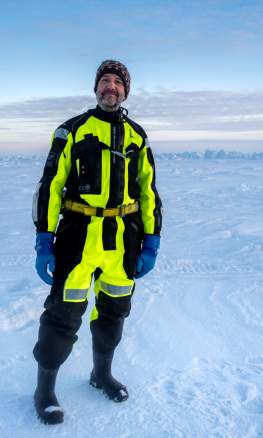
I stand on the Arctic sea ice
far in the north. The sun hangs low
over the horizon and there lies
an ice ridge lit by the morning glow.

The silence feels as infinite
as the extent of the frozen sea
and with every subsequent minute
my heart grows with boundless glee.

I stood on the Arctic Ocean
It’s past now and I should say good bye.
But an overwhelming sad emotion
shades my soul. And I cry, and I cry.


Olaf Schneider – 24 March 2022

My heartfelt thanks to all people that made this journey possible.


Polar expedition AeN JC3 – day 17 and 18: An incredibly beautiful day on the ice

This article is part of the series “2022-02: Winter cruise KPH”.

Day 17 and a bit of 18 · 7 and 8 March 2022

7 March

We have arrived at a place somewhere between Svalbard’s second largest island Nordaustlandet (14.443 km²) and the easternmost island Kvitøya (682 km²). No one lives permanently on these islands.

The ice experts have found an ice flow and examined it. The ice near the ship has some holes so the dress code is survival suits for the first time. In opposite to the formerly used Regatta suits they have attached boots and neoprene arm and neck cuffs. They shall keep you warm and dry in case you fall into cold water – or in our case break through the ice.

I am very interested to join and observe ice coring, a missing link on this expedition. I wasamhowever quite doubtful whether I will be allowed to enter the unreliable ice on this station. But I am lucky again, I may follow M. and L. onto the ice.

Earlier I was told that I may join the scientists taking ice cores but won’t get the opportunity to take ice cores by myself. That’s understandable. To my huge surprise – and delight! – plans were changed: L. shows me how to do it once and then it’s up to me to take five more ice cores. Give me snow or ice and something to play with and I’m happy ;-).

No, I’m no experiences ice corer after five cores. But at least I get an idea and a bit of a routine. In measuring snow depths, ice depths, the freeboard and writing down the values with a pencil. In mounting the large ice core attachment onto the electric drill and removing it after coring. In putting the ice core onto the gutter-shaped cutting board without flooding the electric drill or touching the snow (happened once – sorry!). While M. is cutting the core into slices and putting them into wide-necked plastic bottles I continue with my work. And I have to continue, because I’m still slow and M. shall not wait too long. I think, I could do that for weeks. Standing on the ice and drill cores out of the sea ice.

I have asked Pernille to take some photos from me while coring. These are probably the only photos that prove that I actually did something on the expedition beside of taking photos.

Photo credit: Pernille Amdahl, Nansen Legacy –tusen takk!

And the afternoon? I am allowed just to go onto the ice once more as long as I find some team lead to join. I find one and so get my 7th opportunity on this cruise. Two and a half more hours on the ice. I overhear a radio message. No polar bear warning but the information that our ice flow drifts with more than 2 km/h and the water depth is decreasing. This could damage instruments when they are too deep in the water.

Just some more photos:

And later, when we are on the ship again another polar bear approaches. This time it is a curious one that is very interested in the scientist’s equipment. And since it could harm the bear when it eats cables or plastic it is shooed away with a flare gun. **BANG**. It gallops some metres and then walks away. No polar bears were harmed and as far as I know no cables.

By the way – it was a good decision to use the survival suits. One of the scientists went through the ice today. All of a sudden and quite near the ship. It did not take long to pull the scientist out of the water but without the survival suit this would have been a very wet, cold and unpleasant experience.

8 March

The next day some additional measurements are done on the ice and then we leave last ice station of Arven etter Nansen JC3.

Ha det bra, Arctic sea ice. Farewell! It was a great pleasure to meet you and I definitely will miss you!

Polar expedition AeN JC3 – day 14 – 17: Travelling south

This article is part of the series “2022-02: Winter cruise KPH”.

Day 14 – 17 · 4 – 7 March 2022

4 March: after our second polar bear encounter we leave the ice station P7 at the 82th degree of latitude behind and slowly head south.

This journey will take more than two days although its only 250 km to sail. That’s because many scientific activities go on. Not from the ice but from the ship. Just an excerpt from the activity log:

  • CTD with water sample (19×)
  • Box core (4×)
  • Håv-trekk stasjon (2×)
  • Multinet (2×)

I help the benthos people in the lab and learn a lot, I discuss data matters with scientists, I edit photos. At the same time the character of this polar expedition has started to become a bit more leisure-like. A “no-talent show” is organised as well as a table tennis tournament. A quiz evening takes place and J. shows some of his favourite movies. And from time to time I stand on the helicopter deck and take new photos.

7 March: In the morning we arrive at a place between Svalbard’s second largest island Nordaustlandet and the island Kvitøya, that we already passed a week ago. Here we will have a last 24-hour ice station with the adhoc name SIce Kvitøyrenna.


Polar expedition AeN JC3 – day 13 and 14: Polar bear ahead!

This article is part of the series “2022-02: Winter cruise KPH”.

Day 13 and 14 · 3 and 4 March 2022

3. March 2022, the second ice day at P7. I have polar bear watch on the bridge at 9:30 +2h so there is some time to relax after breakfast. While I am writing my diary there is a loudspeaker announcement, the first one on this journey:

Polar bear at the front of the ship.

I grab my camera equipment including the large telephoto lens and slip into my Canada Goose clothes. The best deck at the front of the ship is the helicopter deck and there I go.

I am not alone. Ice station was about to begin so some scientists were already clad in Regatta suits. Now they stand at the rail watching. But where’s the polar bear? I cannot see it. Until I go to the rail as well and look straight down. Whoa!

It is hard to believe, but this is my very first photo of a polar bear taken in the wild. Not some blurry spot far in the distance but a polar bear less than 10 metres away – vertically. It is quite interested in the icebreaker with all these funny colourful beings that has appeared in his world.

We are only guests in the Arctic world of the Polar Bears. We are not allowed to chase them off just to do our work. We are not allowed to chase them off to prevent them from destroying scientific equipments. We humans do not matter. Only the polar bears do. But we are allowed to chase them off for two reasons:

  • The polar bear should not eat plastic, rubber or other materials that could harm it.
  • The polar bear should not learn, that it is a nice experience to visit humans and teach this to its cubs. This could result into dangerous encounters in the future.

The polar bear realises that the ship’s bow is boring and continues to Z’s tent, sniffing and licking around ther…

**BANG** – a loud noise alarms me. **BANG** again. K. has used a flare gun to shoo the polar bear away before it starts eating the equipment. The flare gun is not used to hit a target but to make a loud noise. The noise however does not frighten the bear at all and K. gives some more shots. The bear decides that this sucks and slowly continues its way over the sea ice. Even when I have started my polar bear watch on the bridge I can see it in the far distance.

When I am on the sea ice again the afternoon to help K. with the Blueye ROV I see the armed polar bear guards with other eyes. It comforts me even more, that a whole team protects us – three watches on the bridge and several guards on the ice. Polar research works only in a team.

By the way: I am allowed to steer and control the underwater vehicle. It is not easy because the ROV lags a lot and the tension in the cable doesn’t make things easier. But in the end I manage to navigate it back to the ice hole again and we get it out of the water. It has some technical issues, probably because of the cold.

In the evening I stand on the deck and look over the ice.  It was become slightly colder, -26 °C and the air is crisp. Snow and ice look as if carved from marble in the sharp spotlights of the ship.

Later this night a female polar bear with a cub is spotted. And another single bear. I miss them, exactly as I missed the walrus encounters and that of the rare bowhead whale. What this ship misses is some kind of messaging system that informs you in these cases. You cannot be everywhere and you have to sleep sometimes.

The next day I help A. and B. in the benthos lab again. When I go to the locker room to get rid of my boots for lunch I meet E., who is putting on the Regatta suit. Why that? E. tells my another polar bear has been spotted, a kilometre away.

Shortly later we stand on the helicopter deck again and watch the other polar bear approaching. This time I see it when it is still pretty far away, but it discovers our ship and comes nearer and nearer and nearer.

This bear however is less interested in us and just passes by. Good for him and less noisy for us, no flare gun involved this time.

Polar expedition AeN JC3 – day 12: ice station on the Arctic Ocean

This article is part of the series “2022-02: Winter cruise KPH”.

Day 12 · 2 March 2022

Yesterday we arrived at P7, the northernmost transect station on this cruise. Here, a bit north of the 82th degree of latitude and round about 3400 metres above the seabed of the Arctic Ocean we will start our second ice station today.

The morning I start with two polar bear watches. It snows and the visibility is not the best but still good enough to watch out for polar bears.

This is my workplace for 2×1 hour this morning:

And this is the workspace for some of the scientists:

After lunch I get another opportunity to join researchers on the sea ice.

I join Z. again and help her erecting the tent over the already existing ice hole. Then A. uses the hole – now in the tent – to test his ROV (short for remotely operated underwater vehicle). After that Z. continues with MMS measurements. I want to help her but J. who joined our team as well will do that. Z. says that I shall take photos, she never has time for that. Well, when I get a carte blanche to take pictures I use it!

Taking photos in the tent however is not easy. It is quite dark and there is a lot of moisture that my Nikon does not like at all. But here it’s not the technical quality but the motives that matter. (Says Olaf, the perfectionist who is still angry with himself that he did not made bigger efforts to get better photos.)

K., our polar bear guide looks quite impressive standing upright on the nearby ice ridge in front of a purple sky. And the sky is purple. In the Arctic winter it is the sun that colorises the landscape and blends purple and orange of clouds and sky with blue and turquoise of the ice to always new colour palettes.

K. gives my clearance to walk around a bit. To the ice ridge and 30 metres on the snowmobile track to the ship. I enjoy my gained freedom and take some photos of the ship, the sun, the ice, of K. driving snowmobile. And it is such a beautiful day!

More than two hours I am on the ice before we return to the ship. But before that I have to bore you with another selfie ;-)

This selfie is for you, my friend Chris. It was Chris that surprised Annika and me with a generous gift a few years ago: A balaclava for each of us knitted by her. One of these balaclavas now has been in the high Arctic. It is one of the garments I definitely will pick again when I should have another opportunity to travel way up north! Thank you, Chris!

Will I be on the sea ice the next day again? Yes, but first there’s another story to tell. Bear that in mind ;-)

Polar expedition AeN JC3 – day 11 · transit to P7

This article is part of the series “2022-02: Winter cruise KPH”.

Day 11 · 1 March 2022

Today is travel day. Our destination is station P7 (82° N, 30 °E), further north than Svalbard and even Franz Josef Land.

From the documentation of Nansen Legacy (Arven etter Nansen):

P7 – Located in the deeper Arctic Ocean. P7 is suitable for comparing the shallow Barents Sea with the deeper Arctic Ocean. P7 will have extensive sea ice coverage during winter, and varying sea ice cover during summer. P7 might be suitable for geological coring.

When we arrive there the sea ice is a bit thin. Therefore we continue a bit further north where we find a suitable ice floe. So, tomorrow: the second ice station of this cruise.

Some ice photos from this day:

(Photo 5 and 6 are switched for layout reasons)