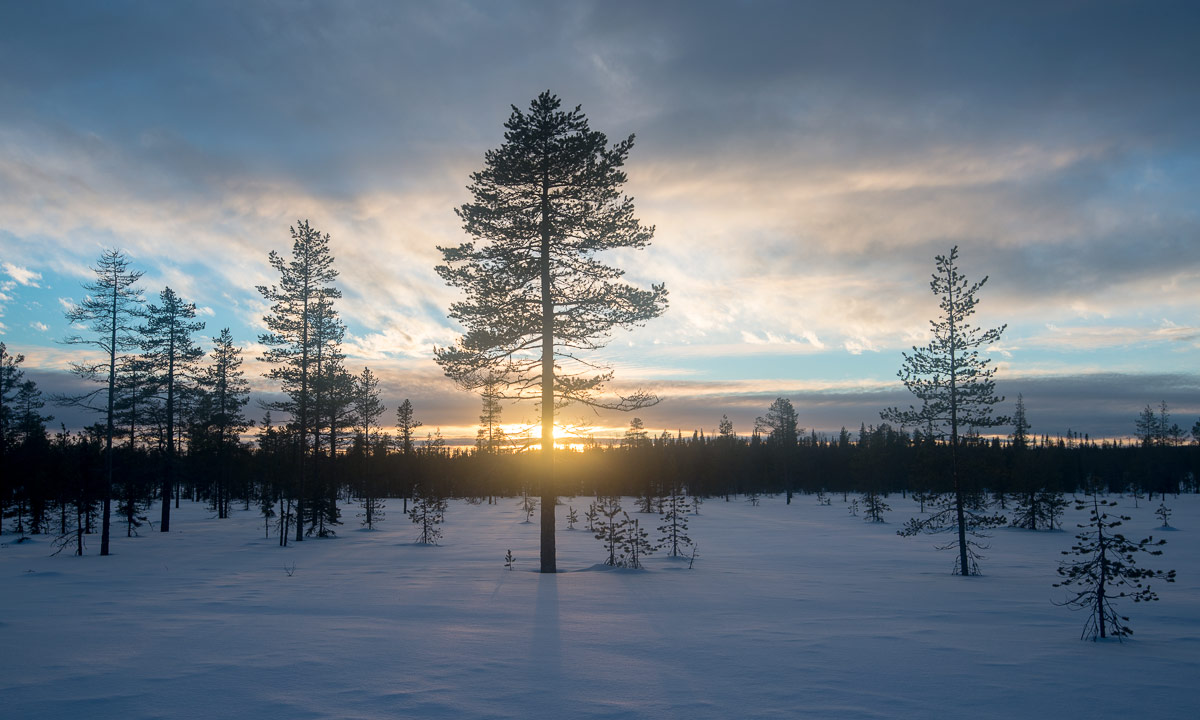
From Nallo to Vistas, Alesjaure, Abiskojaure and back to civilization

This article is part of the series “2015-08: Kungsleden hike”.

August 30 – September 2: Day eight to eleven of the summer hike through the mountains of Swedish Lapland

Nallo – Vistas

After two days in Nallo Annika and I were eager and keen to move on. After our breakfast we said goodbye to stugvärd Janne and started to ford the stream behind of the hut. Fortunately the water level dropped to normal again and quite easily we could cross the stream.

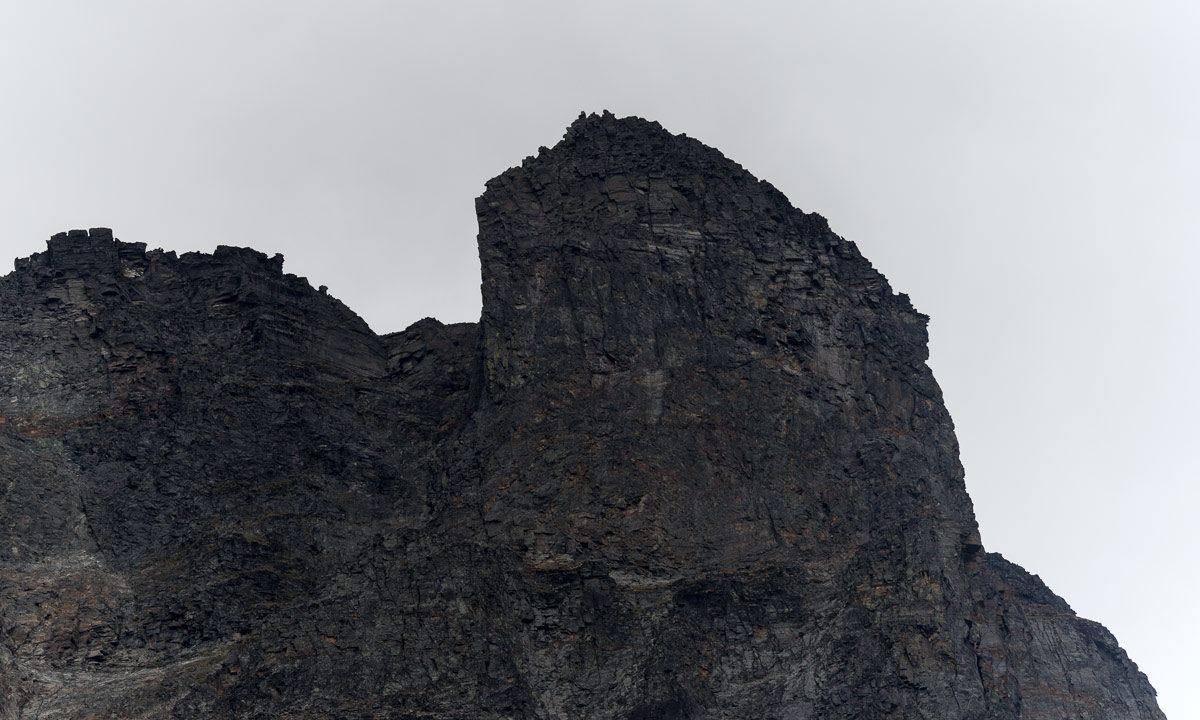
Then we went along the Nallú, a fantastic mountain that changed its appearance every other second because of the moving clouds and the changing light situations. We never tired of looking at this big mountain that seemed to accompany us a long way.

After a while another stream that we had to cross, came down from the lake Nállujávrrit. While I managed to splash through with my high rubber boots, Annika decided to take of her shoes and wade through it in her sandals – brr, the water was really ice cold!
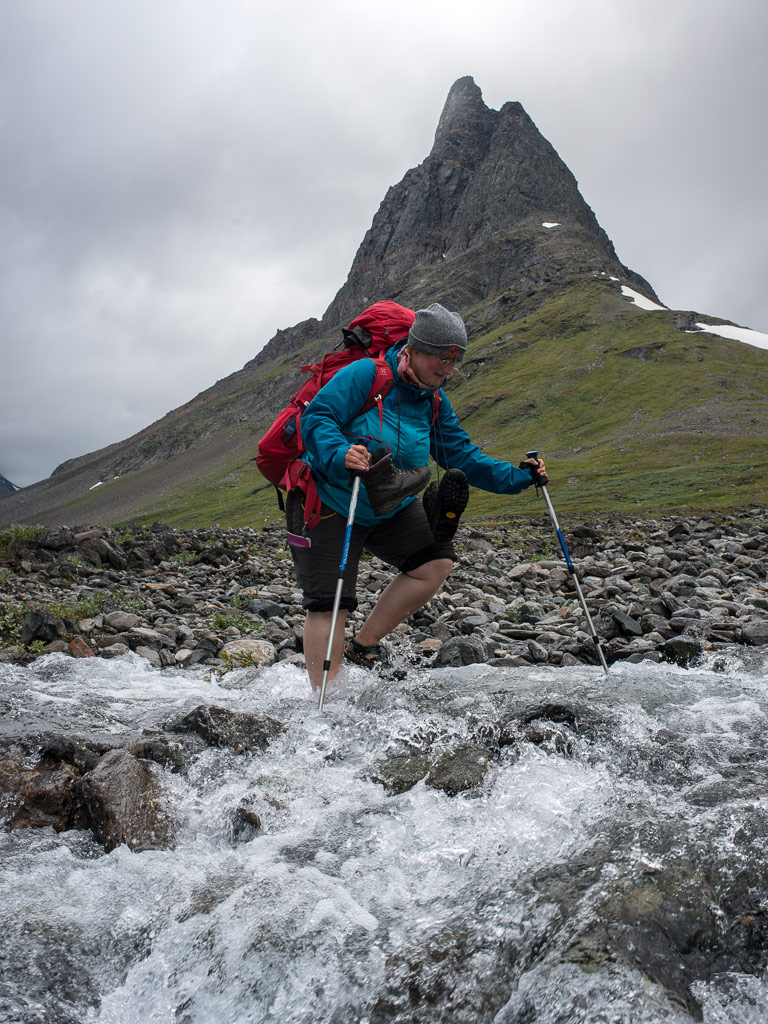
We continued the hike through the fast-changing scenery. Quite soon we saw the first trees and realised that the big mountain ahead was the Vássačorru, that lies behind the valley Visttasvággi, where our next destination, the Vistasstuga is located.

Soon we crossed the Visttasjohka on the chain bridge and arrived at the cabin to meet the stugvärd – the warden.

Oh look: Coke and beer are priced down! That’s because the season only lasts three other weeks. After that the huts are closed down until their reopening for the skiers in February or March. But because none of the cans would survive the frost, all liquids has to be drunk in the next three weeks or poured away. We decided to save some cokes from this cruel destiny.

We were placed in the outhouse – the main building was in the act of being renovated. There we sat on the front stairs, ate, drank and looked on the river Visttasjohka. And we took a bath in this cold river. Chilling but refreshing! Finally the sun came out. I crossed the bridge to make a photo of our cabin.

Later – it started getting dark – we got a visitor: A big moose stood beside the river. I went out, where I could observe this huge animal, how it ate leaves and grass, less than 10 meters away. It looked at me but wasn’t disturbed by me at all, it even passed quite near until it vanished between some trees. This was one of the moments were I was glad and touched as a “normal person”, but a bit grumpy with myself, that I was too lazy to carry my big tele lens for better and sharper pictures. I never experienced a moose so near and so fearless.

Vistas – Alesjaure

The trip the day before was short: only 9 kilometres, this day it would be twice as much: 18 km. The first kilometres were a bit boring since they went through birch forests and quite muddy passages. But after a while the landscape opened and we could see the mountain Siehtagas with its glacier Siehtagasglaciären. In front of the mountain there were alpine meadows and small birch forests. In front of that the turquoise water of the Visttasjohka glimmered in the sunlight.

We went up again until we again were over the treeline. This part of the valley Visttasvaggi is beautiful and very varying. The first rest we made in the lee side of a huge cuboid rock. We weren’t the first – someone built a bench by laying a plank over two stones. The second rest we made at the Tjatjajaurekåtan (there’s not much left of it).

After a while I saw some reindeers grassing. There were shy and quickly went away when I came nearer. We saw (probably) them again when we had a view at the sami village Alisjávri that lies at the lake with the the same name. From that it’s not far to the mountain huts of Alesjaure – the Swedish version of Alisjávri. The Alesjaurestugorna are the biggest mountain huts of the STF – the Swedish tourist association. I prefer the smaller ones as e.g. Nallo, but it’s fine to have a shop, a drying room and especially a sauna. And we used it all! It’s nice to go to sleep after being in the sauna and having a wash in the river Aliseatnu.

Alesjaure – Abiskojaure

I didn’t make many pictures of this part of our tour. I was a bit bored of this part of the trail and found nothing special in the landscape. Just some photos of human evidence: Tent poles for a lavvu and a crossing over a long reindeer fence.

It was the first time, that I was really impatient and just wanted to arrive. Some kilometres before Abiskojaure we came below the treeline. Most of the birch trees still were green but you could see, that autumn is near. No wonder, it was the 1st of September, beginning of autumn for the meteorologists.

Finally we reached another chain bridge and shortly after it arrived in Abiskojaure. The sun came out and even though it was much colder than one week ago we could sit and lie on the short-cut lawn in front of the hut. I took the last bath of the journey and strolled around making some photos. After crossing a small swamp I came to a quite huge sandy beach beside the lake Ábeskojávri. A beautiful place!

The evening it started to become chilly, hardly 3 °C. I was curious if we would get the first frost of the season next morning …

Abiskojaure – Abisko Östra

… and yes, we got frost. -2.5 °C showed the scientific thermometer of the swedish weather service, when I had my first look. On the water surface of the buckets lay a layer of ice and round the leaves of lower plants I could see the first autumnal hoarfrost.

I was up very early that morning and I went to the beach at the lake again. First it looked quite normal but then it started to get foggy and misty while the sun rose behind the mountain Giron. What a beautiful sight! I stood there for at least an hour and only walked back to get another full battery for my camera. Later I met Annika, showed her the place and was glad that I could share this awesome experience.

I was a bit sad – this would be the last day of hiking through the wonderful mountain landscape of Swedish Lapland. But each journey has some kind of end and so had ours. We started our tour through the birth forests along the lake Ábeskojávri, than along the river Abiskojåkka.

After a while a famous landmark came into sight: Lapporten – “The Lapponian Gate”, a U-shaped valley framed of two mountains that give this valley its specific and recognizable shape. However, since this photo is taken from the backside, it hardly shows this special shape.

Since Alesjaure we followed the Kungsleden – the King’s Trail, but right after the bridge over the stream Nissonjohka we left the main trail that leads to the Abisko Mountain Station and turned right to Abisko Östra, the village, were we planned to stay for two other days. The way, however, was not much fun to go. A lot of all-terrain vehicles has turned the way into mud. Since I lost my lens cap and I was afraid that mud would splatter my lens, I packed the camera into its waterproof bag long before the worst mud patches. And that’s why this is the last photo of our hiking tour:
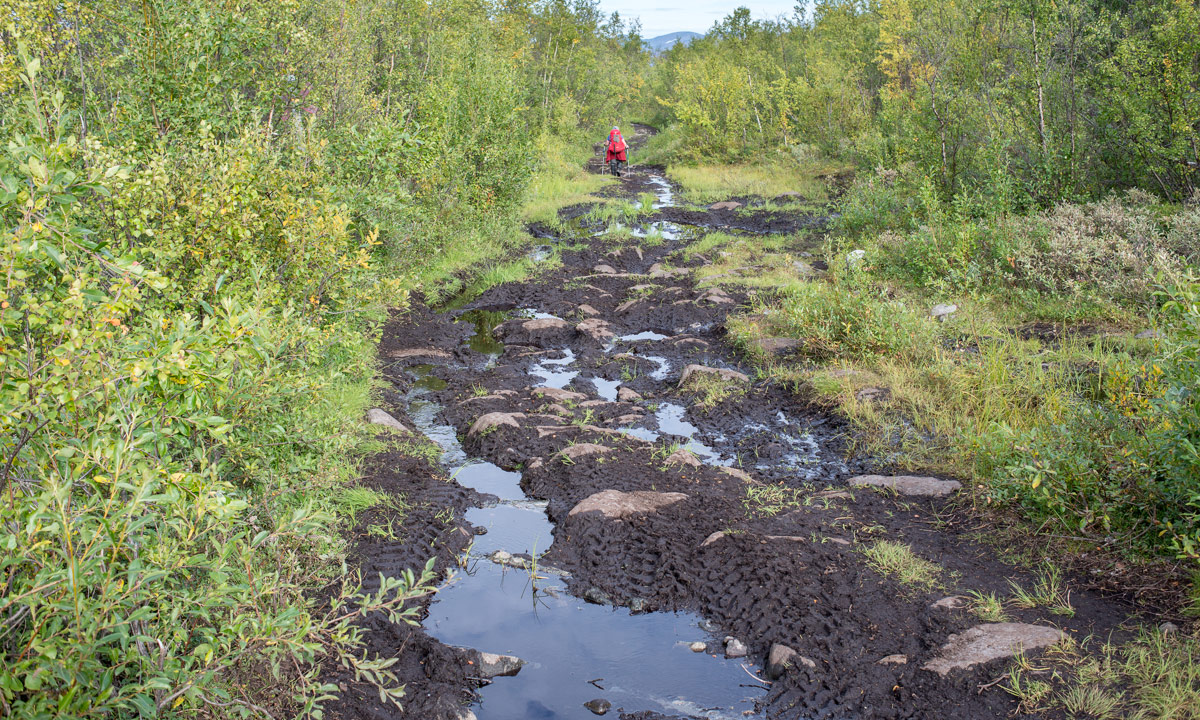
Thank you Annika, för trevligt sällskap – for nice company. Where should we hike next?

Any suggestions?

From Nikkaluokta to Kebnekaise Fjällstation

This article is part of the series “2015-08: Kungsleden hike”.

August 23: Day one of the summer hike through the mountains of Swedish Lapland

It’s hardly imaginable that it was only two weeks ago, that Annika and me started our tour through the mountains of Swedish Lapland.

On Saturday, August 22 I shouldered my packed backpack and travelled from Skelleftehamn to Nikkaluokta, this time not by car but by bus and train: The bus to Skellefteå, the bus to Luleå, the train to Kiruna, the bus to Nikkaluokta. The journey took the whole day – hardly surprising, it’s more than 550 kilometres and travelling in Northern Sweden takes time.

The most popular way through the Swedish mountains is the kungsleden, the “King’s trail”. It’s not only possible to sleep in cabins, you even can buy food in some of them to keep your package small. We however preferred another route on the Norwegian side. There’re cabins, too, but you cannot buy food. That’s why we started with quite heavy backpacks that included food for more than a week. (It included my camera, three lenses and a tripod as well, but that’s another story …)

Sunday morning was a sunny morning and already very warm. Our destination today: The Kebnekaise Fjällstation, 19 km away. We started our trip right behind the cabins of Nikkaluokta and soon we left “civilisation” and were out in the beautiful Lappish nature.

But we were not alone. Some other hikers were on their way but most of all there were a lot of helicopters flying there and back. Soon we gave up counting them, they were too many. We were glad that the aerial traffic calmed down after a while.

Our first stop was the beginning of the lake Láddjujávri, quite popular for two reasons: Here you can take a boat over the lake to shorten your trip to the Kebnekaise Fjällstation and you can eat a reindeer burger at “Lap Dånalds”. We neither took the boat (too lazy) or a burger (too early), but we ate waffles with cloudberry jam. Tasty!

The day was really warm: 24 °C. You even may call it hot when you carry 20 kilos on your back. Beads of sweat ran down and before we ordered our waffles, I took a bath in the fresh and cool water of the lake.

After a quite long and relaxed rest we continued our tour. The path is extremely well marked and changes between rocky and wet parts. Almost all wet and muddy passages are bridged with spångar – wooden walkways – but there are exceptions …

After 6 km walk we came to the other pier. Time for a rest, some water and food and another bath. This part of the lake was much colder and the bath was merely a dip into the icy water.

What a nice resting place: Warm, quite and not too many mosquitoes. It was hard to get up and to continue, both because of the great weather and our heavy backpacks that felt quite uncomfortable on the very first day of our hiking trip. But finally we managed to pick ourselves up and continued.

After a while the first chain bridge came into view: The bridge over the Darfáljohka. That meant, it was less than two kilometres to the Kebnekaise Fjällstation where we would stay over night. But before that I saw the first patch of snow. As a snow lover I just had to take a picture of it even though I knew it wouldn’t be the last snow on our journey.

Finally we arrived at the mountain lodge which is quite huge. The Kebnekaise is the highest Swedish mountain and so the lodge is used by many people: Hikers, climbers, mountaineers, and fly-in tourists – remember the helicopters?
Annika invited me to dinner – thank you, Annika! – but sadly it was a bit disappointing. The restaurant changed the menu without letting us know in advance and the cod was so soaked in butter that it hardly had any own taste left. Anyway the starters were great!

But anyway – a really nice first day of our tour.

A hike and three tests

Do you remember Nokia? Cell phones and rubber boots? Today I tested a quite similar combination: Rubber boots and a Nikon lens. Plus a hiking trail.

A few weeks ago I discovered a big information board at a forest edge in Skelleftehamn. It describes the “kraftleden”The force trail or The energy trail. Perhaps the trail is named after Skellefteå Kraft, one of the sponsors I thought when I read the information.

Today I decided to try to hike the 18km long trail. I had two new things with me: My new rubber boots Tretorn Sarek which are made for hiking and my new lens Nikon 100mm f/2.8 (Series E), that I bought secondhand some days ago.

After a one kilometer walk I was at the starting point.

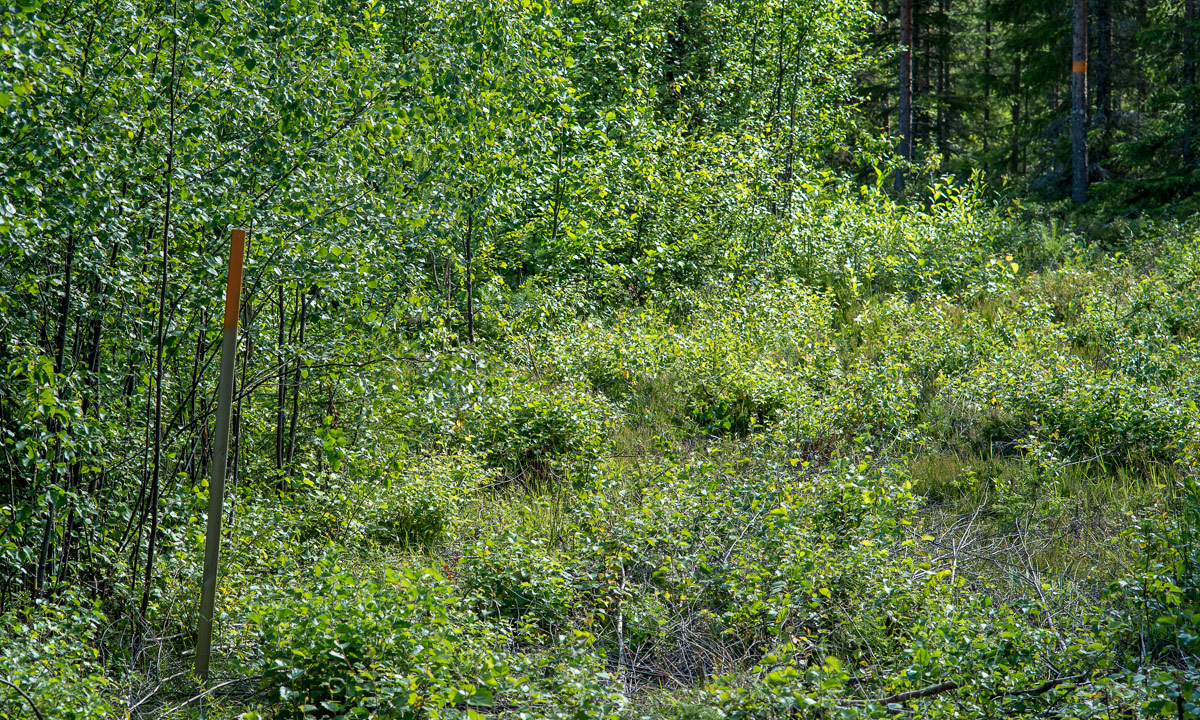
At the first junction I was lost, since I couldn’t see a sign. But after checking my photos of the information board I learned that the way marks where orange coloured blazes round the trees. That’s easy. The trail itself however wasn’t easy at all. It looked more like an area where you cut down trees and bushes. Like a stork I stalked through the cut down branches and twigs that lay criss-cross on this so-called trail hoping for a better path.

And the trail got better. But I still was slow. This time not because of the trail but of my new lens. It’s my first lens ever without an autofocus. This means that I have to focus manually at the lens itself. It took some time until I got used to it, but I still had to control every single shot on the display and I had to make some photos five times until I was satisfied.

I continued the trail – now a nice stony path until I came to the Örberget – altitude 40 meters, 30 meters higher than the starting point. It doesn’t take much to be called a mountain here. I made a photo of a “gravröse”, a tomb from the Bronze Age. Probably it was build at the shore some thousand years ago but the land has been rising round a centimeter a year since then.

I continued the walk. The ground became wet and muddy and after a while I stood in front of a bog. In the middle of the bog I saw a wooden post with an orange blaze. OK, let’s go …

… now I knew, that the new rubber boots were not only comfortable but really waterproof. I didn’t get soaked, but it was quite close.

I always had to look down carefully to avoid the deep water and mud puddles, and I had to look forward to find my way. When I looked up I started to suspect why the trail was called kraftleden. Almost the whole trail followed the transmission lines and the Swedish word for transmission lines is kraftledning. That’s a really pragmatic approach to make a trail since some kind of path was made already to mount the power poles. But it’s not very inspiring just following the lines and not beautiful neither.

After round 11 kilometers I made a rest on a high seat normally used for hunting moose.

I continued the tour but I started to lose interest a bit. Parts of the way were hard to walk, harder than many mountain trails but without the reward of a beautiful landscape or great views. In addition of that I started the tour round half past two and I didn’t want to come to town too late. So I left the kraftleden and walked southwards through the forest. At the beginning I found some nice flowers and I changed the lens to a macro. First two additional test images of the new 100mm lens, then two flowers – a dactylorhiza maculata and a linnaea borealis:

OK, I have to admit: I tested four different things, not only three. Number four was a mosquito protection jacket, that came in quiet handy when I shot the macros of the flowers. Flocks of mosquitos darted for my blood, but they didn’t had a chance beside of biting into my unprotected hands.

After taking the flower images I had to walk some other kilometers until I came to the main road and another one to come to the bus station where I had to wait half an hour for the next bus. Happily I slipped of my rubber boots to try my socks, sat down and waited. Finally the bus came and half an hour later I was home. The GPS displayed:

19.0 kilometers · average when moving: 4.3 km/h · total average: 3.3 km/h

And here come todays test candidates:

Rubber boots Tretorn Sarek: Really nice and comfortable boots, perhaps a nuance too tight for me. They are made of natural rubber and it’s easy to turn the upper upside down. They could be a bit higher.

For me: 8 points out of 10.

Nikon 100mm f/2.8 (Series E): A small, lightweight lens with manual focus. I have to practise focussing. I prefer my huge Nikon 70-200mm VR II, but there’s a reason why I bought the former one: At the end of August I’ll start a two week hiking tour in the Scandinavian mountains and I want to save weight. The 70-200 weights more than 1500 gram, the new 100mm only 215 gram. Got the point? And it was cheap, too – only 53 Euros.

For me: 7 points out of 10.

The trail kraftleden: The only advantage of the trail is that you avoid navigation. Beside of that it’s an awkward combination of a trail a bit too hard to be nice and a bit too boring to be beautiful. I wouldn’t recommend it. If you want to give it a try, take high rubber boots and plenty of time with you. Take care and follow the way marks if you don’t want to end in almost knee deep mud as it happened to me today.

For me: 3 points out of 10.

The nameless mosquito jacket: Perhaps it’s not fun to walk within some kind of mosquito net but it was great, when I took the macro photos of the flowers. The hood is too big. Since it’s very light – only 214 gram – I will take it with me on all summer photo tours and perhaps even on the planned mountain hike. And with costing only 18 Euros it was a bargain, too.

For me: 6 points out of 10.

Translations:

EnglishGermanSwedish
Dactylorhiza maculata / heath spotted-orchid / moorland spotted orchidGeflecktes KnabenkrautFläcknycklar
linnaea borealisMoosglöckchenLinnea
upperSchaft (am Schuh)skaft

Midsommer colours

Finally it’s summery and warm in Västerbotten! Yesterday the car thermometer showed  20 °C for the first time this year, if only for two seconds. All people were out yesterday to celebrate midsommar. All mosquitos were out as well; there are a lot of them this year because of the wet May. Today I didn’t drive the direct way home but took some detours. It’s like loading the batteries with fresh colours and save them for the winter to come. The photos below are all taken in Kvarnbyn, a nice village near Burträsk.

Just beautiful!

Valborgsmässoafton

Valborgsmässoafton, that’s the Swedish name of the Walpurgis Night, which is celebrated on April 30, which is today (or has been 15 minutes before). A friend invited me to celebrate valborgsmässoafton with her family in Aspliden and I accepted gladly.

Beside of nice people to celebrate with you need three ingredients for a typical valborgsmässoafton:

1. Good food.

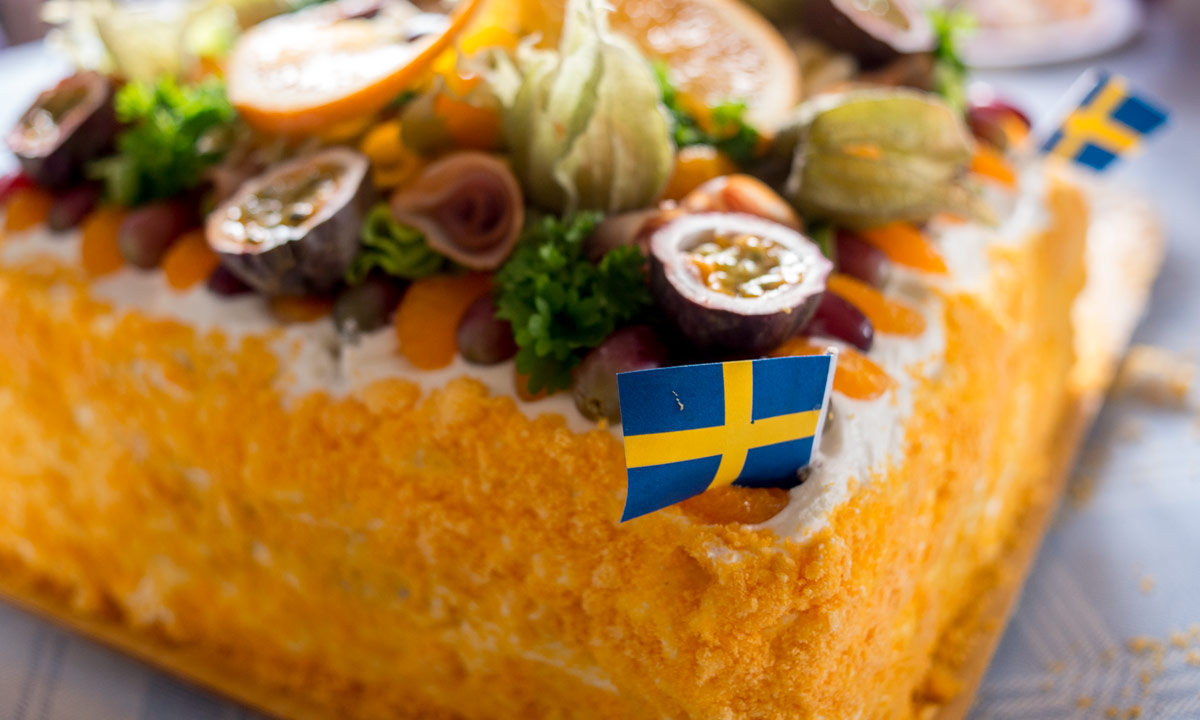
In this case a so called “Smörgåstorta” – a sandwich cake which is a very popular dish for special days as today.

2. A big bonfire.

The bigger the better. It can be quite hard to light a bonfire, because the cut down trees, twigs and branches are mostly very cold and soaking wet.

3. Cold weather, preferably with wind and snow showers.

While the first half of the day was sunny, clouds came in in the afternoon and round 8 o’clock we got our first snow shower. Last year it snowed as well.

Most Swedish people don’t think at all that chilly and snowy weather must be a part of the valborgsmässoafton, put it’s quite typical.

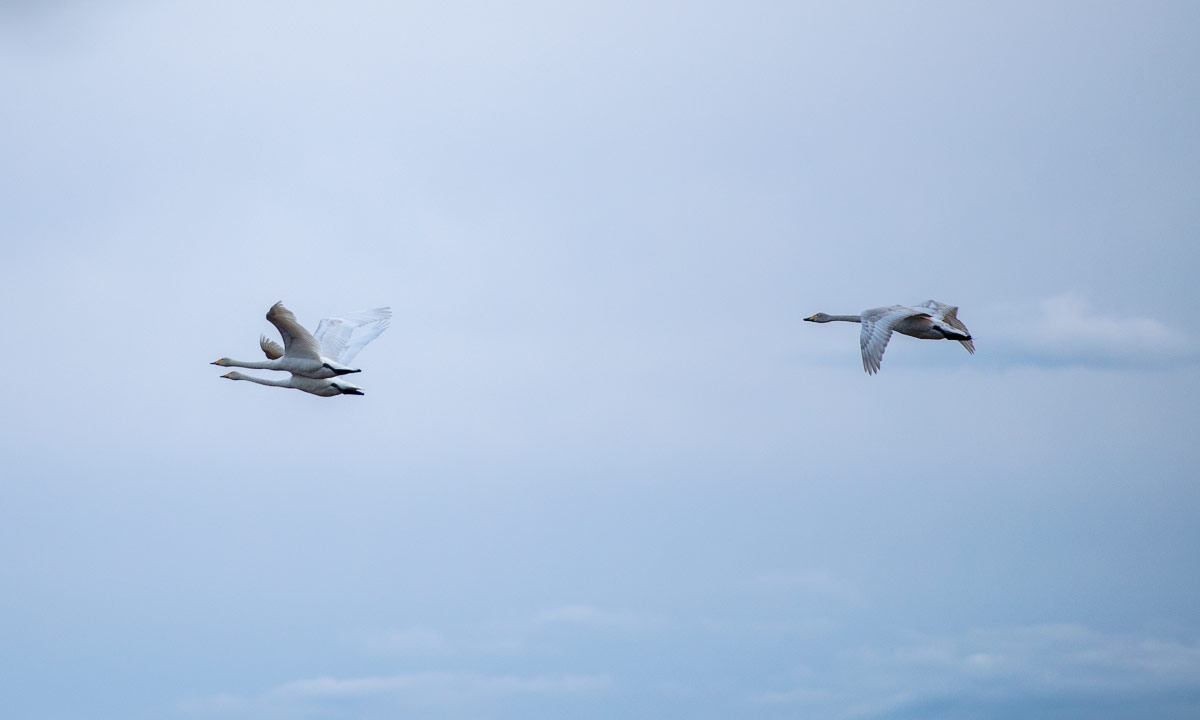
And just an off-topic photo from today. Three whooper swans that I saw today at the same place.

Five years in Sweden!

Today I have been living in Northern Sweden for exactly 5 years,

first in Skellefteå, then in Skelleftehamn. For those who are able to read German I’d like to recommend today’s article of my German Blog nordwärts:

Jubiläum – 5 Jahre Schweden

All others have to wait for the enormous article “Ten years in Sweden!” that I’ll write some day …

Two months ago – first aid course in Solberget

Day 31 – 38

Today when I look outside the window, I realised that winter finally has left Skelleftehamn. The patch of snow that I stood upon ten days ago to view the Northern Lights has melted away and some trees start to show their first little leaf buds.

Well – it looked different when I was in Solberget in Swedish Lapland two months ago, where a first aid course of the “Outdoorschule Süd” took place. The week was filled with many actions – both course units indoors and outdoors and leisure, too. If you are one of the course participant you will realise, that I left out quite much.  That’s because I tried to keep the text very short – it’s more keyword style – and focus more on the photos.

Saturday

Arrival day: an incredible starry night with even a bit of faint Northern Lights

Sunday

Course unit outdoors, training recovery position (“Stabile Seitenlage”) – course unit indoors, training cardiopulmonary resuscitation (“Herz-Lungen-Wiederbelebung”) – and a beautiful coloured evening sky.

Monday

How to move injured people: a lot of teamwork is needed – frost patterns again – Lars, the Sámi, tells us about the reindeer herding

Tuesday

How to evacuate injured people from an observation tower – reindeer sledge ride. (No people were harmed)

Wednesday

Ski tour to Polcirceln, where we’ll stay to nights. I slept in my tent since the two cabins are really small.

Thursday

A misty morning – another “real life case”: hypothermia – a beautiful dusk. (No people were harmed)

Friday

Ski tour back to Solberget – another fantastic dinner, this time: salmon.

Saturday (again)

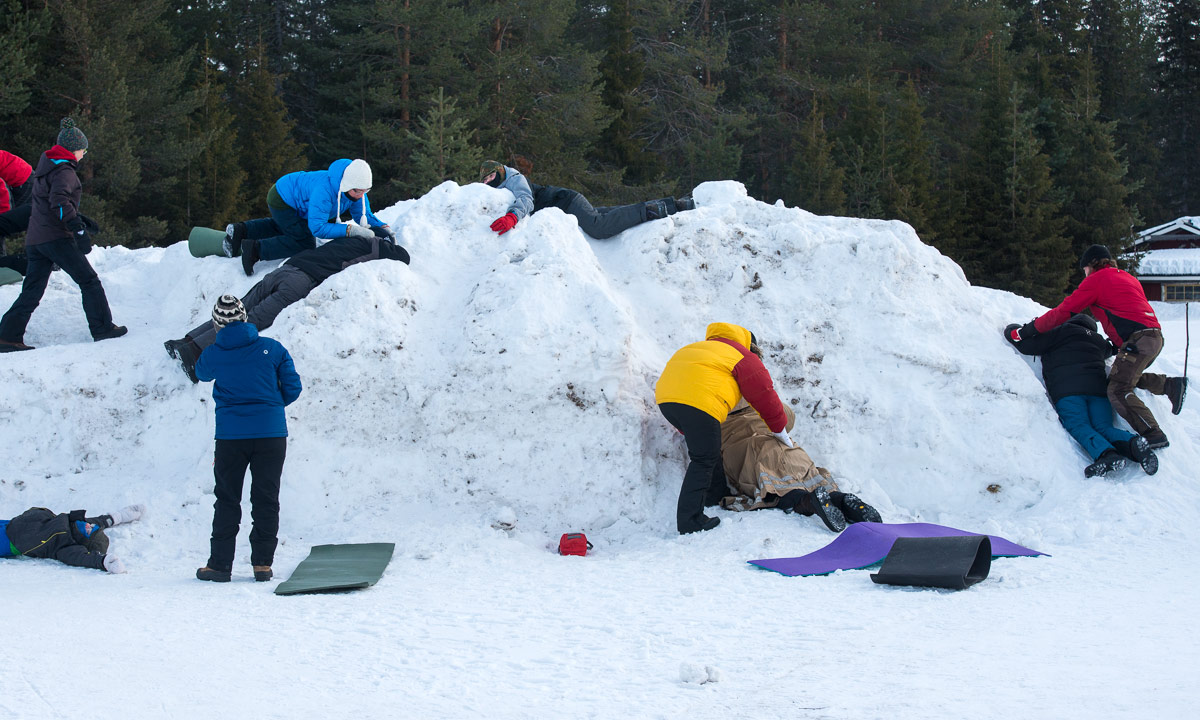
The last day – many serious studies as: How many people fit into the igloo (Answer: all!) or who wins the snowball fight

Thank you, Angela and Stefan from the “Outdoorschule Süd” for a great week!


Deforestation in Skelleftehamn

When I moved to Skelleftehamn in July 2010 I directly fell in love with the nature around. The Baltic sea with the stony shores, the islands and the pine and birch forests. One place I really love is Storgrundet, which is name of both an island and the tiny sandy beach at the mainland. It’s my favourite starting point for kayaking, because you’re into nature directly, but I guess I have to wait some more days until I’ll be able to start there, since the sea is still partly ice covered. Two images of yesterday:

Storgrundet – a beautiful place. The way that leads to it however has changed. Last autumn it was framed of dense forest, now many of the trees are cut down and the way is framed by piles of tree logs. It brings to my mind that almost all forests in Sweden are no wild untouched primeval forests but commercial forests. There’re not only used for collecting berries and hunting moose, but for hugging down trees, too.

Now I’m sitting a bit on the fence – on the one hand I like wooden houses and furniture made of wood and I love to fire a cabin or a sauna with birch logs. On the other hand I really loved the forest around and when I walked cross-country today, I felt a bit sad seeing the clear-felled areas. I’m glad that the terrain is not too easy to enter with forestry machines. There are some really big rocks and many shallow ponds and swamps. I guess that’s why there’re a lot of single trees left. But it’s not the same anymore.

Now, that many trees are gone, you can look much farther and I realised, how many swampy areas were hidden in the woods. Now they are quite visible and they look fascinating and desolate at the same time.

I do not have anything against using the forest and cutting down trees, but anyhow I felt sad, when I walked through the destroyed landscape today.

Cross-country skiing in Äkäslompolo – part two

Last Friday I travelled to Kittilä in Finland, to make a one week holiday with Annika and and Medi, a friend of hers. I wrote already about the first days in “Cross-country skiing in Äkäslompolo – part one”.

Wednesday. We took the ski bus to Äkäsmylly and we were not the only ones. Some busses arrived at the parking place and spit out round hundred cross-country skiers, most of them dressed in skin-tight racing suits. And if the children were too small to stand on their own skis, they were pulled behind in a pulka sledge. That looked really snugly.

We didn’t like to start within a crowd and so we waited, until the most skiers had started. But we didn’t go very far. The Äkäsmylly Café is just round the corner and it’s really extremely cozy. An old man played traditional Finnish songs on his accordion and yes – they all were in moll. We peeked into the text books to sing along, but even if we knew the melody the Finnish language with its long and unfamiliar words gave us a hard time. But it was fun anyway!

Finally we broke away from the warm Café and started the tour. As the days before it snowed most of the day. I made less and less photos each day but today I had to make a break and leave the ski trail for this lonely tree in the snow fall. It took some time, because the snow didn’t bear the thin cross-country skis and I was up to my knees in snow.

I didn’t have to leave the comfortable ski trail for the next photo, a bridge over a completely snowed in brook.

We made our last stop in the Karilan Navettagalleria, the beautiful café and gallery that I already visited the day before.

Thursday. With 25 km our longest tour from Totovaara via Tammitupa, Karhunkota Hanguskurun and again Karilan Navettagalleria back to Äkäslompolo, and by the way my birthday tour.

I think, this is the first day where we neither used the private sauna in our lodge nor lit the fireplace after the ski tour. Instead we went to a bar nearby and listened again to the karaoke. It was just wonderful, listening to the singers – some men had really nice voices. People browsed the set lists to see what they could sing next and at least one pair was dancing to the karaoke songs all the time. Unfortunately some of the people got extremely drunk quite quickly. One of them was so intrusive and pushy that we left the bar soon. I guess that’s also part of the Finnish culture, just as karaoke.

Friday. A short but more demanding tour in the south-west with some nasty descents. I was glad that the trails were in good shape and hardly icy, although it was so warm. I didn’t make a single photo, because I started to get bored of the cloudy sky and the forest, that looked more or less alike everywhere. I enjoyed the week, but since I’m more in nature for the landscape than for the sports, a week was long enough for me and I started to long home a bit. And again I had back luck with the weather; the two weeks before were cold and sunny.

Saturday. Phew, that was early! We stood up at 4:45 local time (that’s 3:45 Central European Summer Time) and 5:35 I said good-bye to Annika and Medi that took the early bus to the airport. Then I drove home. After 425 km and six hours (some ways were in quite bad shape) I was home in Skelleftehamn again.

Addendum:

I hardly saw any animals when I was on the ski trails. That changed on my way back to Skelleftehamn: I saw a fox, a mountain hare, two reindeers, two squirrels and some black grouses, all from my car. I guess, animals are seen best when driving ;-)

Cross-country skiing in Äkäslompolo – part one

Since Saturday I’ve been in Äkäslompolo with Annika and Medi, a friend of hers. Äkäslompolo is famous for cross-country skiing and has a total of  330 km of cross-country ski tracks. And that’s what we are here for: Cross-country skiing. My first almost real sport holiday for a zillion years.

On Saturday we used the skis only for a shopping trip to the other side of the lake. I gave my old cross-country skis a quite suspicious look, they are so much thinner than my tour skis (not to mention the broad wooden Tegsnäs skis). Will I be able to ski on these sticks or will I fell right onto my nose after five steps? But the shopping trip (no ascents or descents at all) went well. And in the evening even the grey sky cleared up, patches of fog appeared over the snowy terrain and temperature dropped to -10 °C. We took an evening walk and watched the starry night in hope for Northern Lights, but unfortunately they didn’t come out.

Sunday. Our first ski tour to the cabin Kotamaja. It gave me a quite sportive feeling when I mounted the skis right before our lodge, crossed the road and entered the ski trail. The sportive feeling disappeared quite soon, because almost all other skiers were extremely skilled, extremely athletic and extremely fast, even the much older ones. I had the feeling of accidentally having got into an olympic training race, but it was fun anyway. Earlier than expected we reached Kotamaja and took a break. And we were not alone …

We continued and headed for Hangaskuru where we planned to take our lunch. And we were well equipped: We didn’t only have sandwiches, but sausages and extendable barbecue forks as well. Yummy!

When we headed home more and more skiers were on the ski tracks, it was really crowded and it got worse and worse. “That’s no fun anymore”, I thought but rather like driving on a German autobahn. Hopefully it would be less crowded under the week.

Monday. We took the airport bus that left us at Ylläs-Lainion. The track was in inferior condition, since it had started snowed a bit, but we were almost alone and that’s more the way I like being outdoors. With relaxed but steady movements we slid through the wintry Finnish landscape. However we did not hesitate to take short or longer breaks in the cozy little huts. After round about 20 km we were home again.

Tuesday. It hadn’t stop snowing the whole night and it should continue snowing the whole day. That was the view through our window this morning:

We decided not to make a longer tour, because cross-country skiing on tracks is less fun when the tracks are covered with snow.

I took a walk to the supermarket – partly with Annika, partly alone and tried to continue a snowshoe trail, but the trail was only prepared partly and the snow mobile track, that I followed instead a while, headed to the wrong direction. So I had to return the same way. Äkäslompolo is made for cross-country skiers.

In the afternoon I took a short circular ski tour. Since yesterday fell 10-12 cm new snow accumulating to at least 100 cm snow on the ground.

On the short tour I’ve been in Karilan Navettagalleria,  a nice café, that Medi discovered in the morning, but I took only two pictures and continued my tour. We already have planned another tour for tomorrow and included the café in our plans.

Now I’m sitting in a cozy couch in a typical Finnish bar. And what’s typical Finnish? Right – Karaoke! The Finns love it and I love listing to all these melancholy melodies. Next time I have to learn some melodies and join the singers, too. They probably will laugh their heads off when I try to sing in Finnish.