Sol, sol, kom igjen, sola er min beste venn!

This article is part of the series “2023-03: Svalbard”.

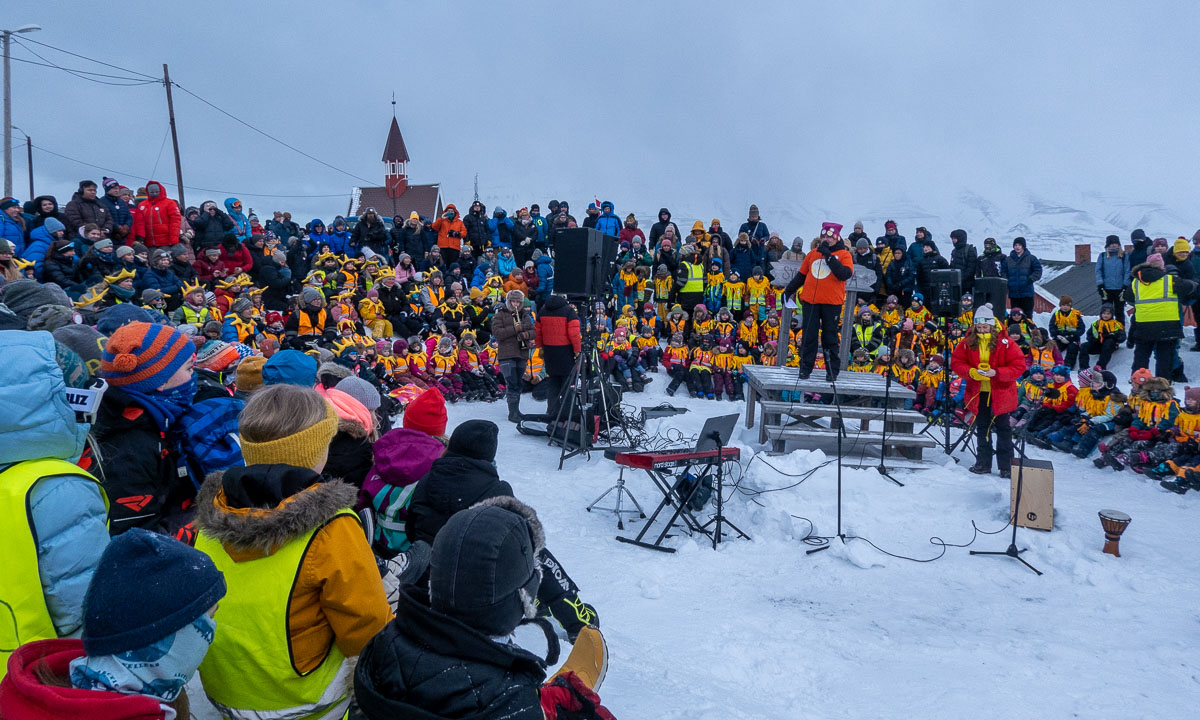
It is 8 March 2023, a special day in Longyearbyen. While polar night ended already three weeks ago today is the first opportunity to see the sun in Longyearbyen above the mountains in the south. A special day after the sun disappeared in October last year. And as you can see it is a big celebration!

After some singing the moment has come. All people are shouting: “Sol, sol, kom igjen, sola er min beste venn!” – Sun, sun, come back, the sun is my best friend!

But the chanting was in vain: the sun didn’t appear. Some children are in doubt – was it the clouds or didn’t they shout loud enough.

But now it’s only a matter of waiting. Already in six weeks the time of polar day and midnight sun will begin.

Kudos for the musicians. Must be hard to play guitar or piano when windchill is round -23 °C. Brrr!

Two-day dogsledding tour in Svalbard – ice cave

This article is part of the series “2023-03: Svalbard”.

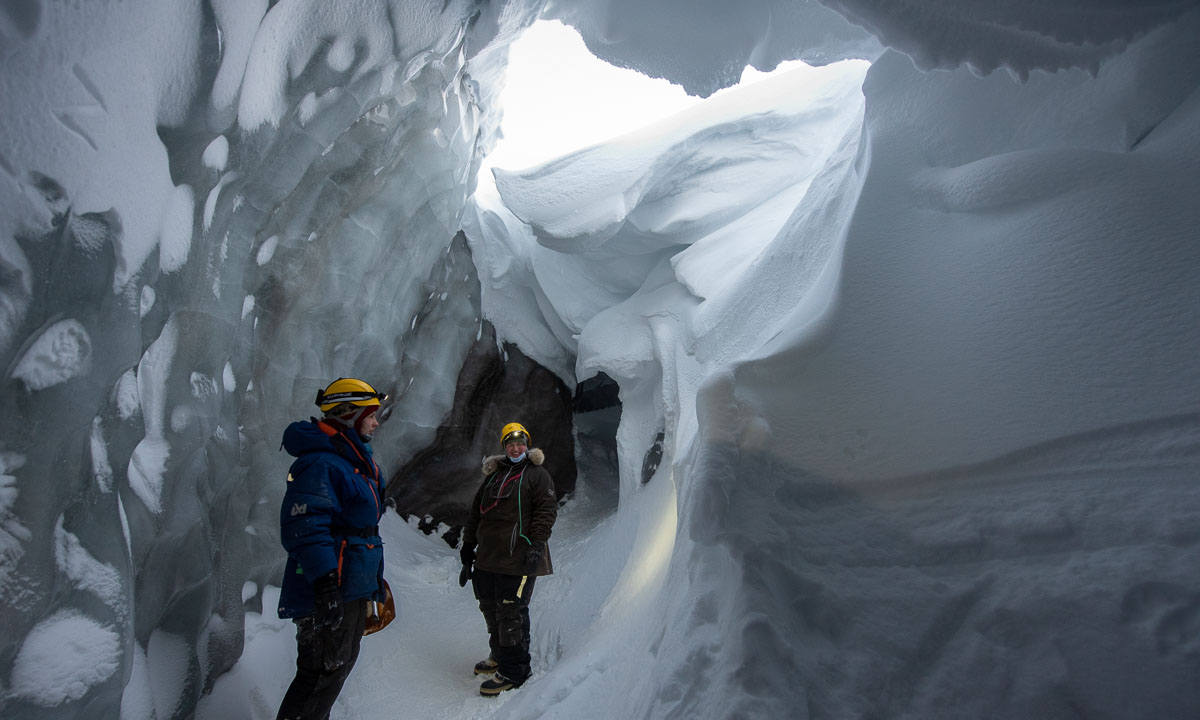
There is a hole in the snow. You can crawl in and then you are in another world. Down the rabbit hole …

It is the second day of Annika and my dogsledding tour and we are on our way back to the dog yard. Our tour guide Adelheid however makes a detour to the Scott Turner glacier. Here is the entrance to an impressive cave formed by meltwater in the summer. Now it is winter and we can walk through ice, that at the bottom is roughly 1000 years old.

We have time and can follow the main cave passage through the glacier’s art exhibition.

I try to take many photos, but it’s not easy. Parts of the cave are quite dark and the cave is so humid that my Nikon telephoto lens fogs up. It’s not the first time, that my iPhone rescues me in such situations.

Thanks for the guiding, Adelheid.

Two-day dogsledding tour in Svalbard – day 2

This article is part of the series “2023-03: Svalbard”.

Last night I dreamt that a heavy polar bear was lying on top of me. It had sneaked into our sleeping room. In reality a polar bear could never have approached the cabin unnoticed. We have seventeen polar bear guards outside: the sled dogs.

It is half past seven. I just started a fire because the inside temperature of the cabin in Tverrdalen has dropped to 5.7 °C, while it is -20 °C outside. It is the second day of Annika’s and my dogsledding tour in Svalbard and despite some stormy gusts of wind the weather looks quite promising.

Snow is blown around the dog sleds. Most dogs are still sleeping, some of them half snowed in. Snow will keep them warm, it is a good isolator. Not all dogs have slept outside, some have slept in wooden boxes to be protected against the wind.

I hurry to go in again, the glove livers were much too cold in the cold wind and my fingertips hurt. The next hours we are busy with taking breakfast, packing things, tidying the cabin, putting our clothes on and taking care of the dogs. While we are outside the wind is calming down and the sun shines on the snowy mountains round Tverrdalen.

We say goodbye to this wonderful place and start our journey back to the dog kennel in wonderful winter weather. Annika and I have put the bulky isolated anoraks into the sledge, they were too warm the day before and use our own windproof jackets. The fur-rimmed hoods are a good protection against wind and coldness.

We take a lunch break at the Scott Turner glacier, but before that we visit an impressive ice cave. I’ll write an own blog article about that later.

After a warm lunch break – Real Turmat outdoor food only needs hot water – we walk the dogs to the sledge and start our last stage of our dogsledding adventure.

It is not only the great weather, the beauty of the valley Bolterdalen and the mountains around, it’s the dogsledding itself that is great fun. After only a day Annika and I know how to work together, help the dogs, shift weight, brake and release the brakes again. Now we hardly have to help the dogs by pedalling or pushing the sledge. It goes downhills and the dogs know that they are on their way home where they will be rewarded with treats. So we glide effortlessly through the snowy landscape enjoying this extraordinary experience. And then we are back at the dog yard, were our sled dogs are eager to get loose and run around a bit, greet friends and wait for their goodies.

Annika and I get to know Foxi as well, the famous dog that led Tommy’s sledge on the Iditarod race and has also been at the North Pole. While Tommy and Adelheid are taking care of both dogs and other tourists Annika and I are sitting in the living room of the dog yard’s cabin and are chilling. Adelheid’s jeep needs a jump start – it does not like the cold – then she brings us back to town.

@ my colleague Y.: Thanks for the tip. Great tour. We enjoyed every minute!
@ Janne and Tommy: Thanks for the organisation of this extra tour!
@ Adelheid: Thanks for the guiding and cooking! It was a pleasure meeting you!
@ the dogs: Thanks for your hard work and your relaxed attitude 🐾!

Two-day dogsledding tour in Svalbard – day 1

This article is part of the series “2023-03: Svalbard”.

Annika and I are sitting in a car. The sky is mostly blue at temperatures round -20 °C. The side windows are freezing. Longyearbyen lies behind us.

The story has begun in the end of January. I have just learned, that I will work in Longyearbyen / Spitsbergen / Svalbard for a week in March. Annika and I decide to be on vacation there for another week. I ask my colleague Y., who has lived and guided there for several years for tipps what to do. He almost commands us to make a dog sledding tour with Arctic Husky Travellers with an overnight stay at the cabin in the valley Tverrdalen. Oh! It is fantastic! It is soo beautiful there! You have to do it! Soon we booked the tour.

Now Adelheid, our tour guide for the next two days drives us to the dog yard. When we arrive there we go into the house and get an introduction. Adelheid will take one sledge, Annika and I the other. We will both stand on the sledge and work together – steering, braking and helping the dogs when we drive uphill.

Tommy, one of the owners arrives and we get properly dressed. We get huge insulated bibs and enormous anoraks, that Tommy imported from the US. You cannot buy this type of dogsledding equipment in Europe. Then we get a hat, working gloves and mittens that do not look especially warm, but they definitely are. We slip into the warm Kamik boots and then everything goes quite fast.

I have never seen so relaxed dogs like those on Tommy’s dog yard. It is incredible. They are calm, they run around by themselves and then come back. It’s we humans that are busy to prepare everything. No time for photos. We get a last instruction: Take the first descend standing on the left runner and brake with the right foot. That’s important. Now in the final minutes the dogs start howling and off we go!

I do not have time to be nervous or frightened. Annika and I manage the first obstacle, Tommy accompanies us by snowmobile for a short while. We make some stops to check if everything is ok – thumbs up – and get another dog from Adelheids team. Tommy returns and we others continue alone. 17 dogs, two sledges, 3 humans.

Annika and I soon get into the flow and I cannot find words to describe the feeling of sliding through the snow covered valley Bolterdalen with exceptional views on the sunlit Arctic mountains. Annika is standing in front of me, I’m standing in the back. On a straight passage I dare to make some snapshots with my smartphone.

We both have brakes to slow down the dogs when we go downhills. But now we go uphills. We are too heavy for the dogs so I have to push. As soon as I do that the sledge becomes lighter and the dogs faster and I have to run while pushing. Although the snow is not deep I’m really out of breath and have to take short breaks to catch breath again. Fortunately it is only some shorter passages that are steep.

I don’t have a feeling for how long our trip was. Time doesn’t seem to matter while sliding through Svalbard’s Arctic landscape. We arrive at two a clock. While Annika and Adelheid are giving the dogs a snack and put them on the stake out lines I finally have the opportunity to take some photos. From the cabin, the polar bear safe food storage, the dogs and the hazy mountains around. Beautiful and extraordinary.

Being in the Scandinavian mountains in wintertime is nothing new to me, but this is like being in another world. I am standing there, just gazing until I finally do my job: helping the others with the dogs. But finally the dogs are all taken care of and most of them have been fallen asleep with the nose under the tail, because the wind gusts from the mountains are bitter cold.

Now it’s time for us to go inside, take a snack and relax a bit. We still sit there with woollen cap and jacket. It will take hours until the wood fired oven and the gas oven warm up the spacious but cosy living room up to round 15 °C.

Outdoors the full moon has risen above the eastern mountains and illuminates the scenery: A snowy place, 17 dogs and a warm and cosy cabin.

Annika and I go in “tourist mode”. While Adelheid is moving some dogs to protect them from the cold wind and starts preparing dinner we fire the sauna. First we have our bulky jackets on, but the sauna oven is strong and soon the sauna is hot. Then dinner time at 19:00. Adelheid cooked reindeer stew with rice – delicious. And – believe it or not – we even get a glass of white wine.

Now the dogs have rested enough to get their well-deserved dinner. There are not enough bowls for them all, but that does not matter. Sled dogs can be fast eaters and while we portion the food the first ones already have finished their meal.

The dogs are dozing and we are chilling in the cabin. I am reading “Foxi – sledehunden ingen ville ha”, a book about one of Tommi’s dogs. First unwanted it became an outstanding lead dog in a Iditarod race and was at the North Pole, too.

Then it’s bedtime for us as well. It does not take long until I fell aslee…

z-z-z…

Adventdalen by snowmobile

This article is part of the series “2023-03: Svalbard”.

Yesterday it looked like sunny weather today so Annika and I looked for an activity today. We found and booked a three-hour tour with snowmobiles organised by Hurtigruten Svalbard. At 10:30 we were fetched by our tour guide by minibus that picks up tourists as us at their accommodations.

At the Hurtigruten Svalbard Expedition centre our group of nine got an introduction about how to drive a snowmobile. While others did it before it was Annika’s and my very first time to drive by ourselves. After that: dressing time!

When it’s -20 °C and you want to drive snowmobile you need to be properly dressed. What we needed by ourselves is woollen underwear, socks, a sweater and thin gloves. What we got from tour operator was bulky winter boots from Kamik, an insulated overall, thick mittens, a woollen balaclava and of course a helmet.

As soon as we were properly clad we fled the building because being dressed for a windchill of -30 °C is not very comfortable inside. TOO WARM! With the helmet and raised visor I look quite silly but safety first!

Then we went to the parked snowmobiles. These were quite special: they are electric. The range is quite limited but they do not produce as much noise as their more common fuel-powered cousins and more important: no stinking exhaust gases at all!

And then off we went into the large valley Adventdalen.

First impression: the snowmobile seems to follow the track. Steering hardly necessary. If it leaves the track then steering needs a bit of power. Second impression: the visor of the helmet is frosted within seconds and it is quite hard to see.

After ten minutes we took a first break. The guide asked us if everything was ok and then loaded her rifle. We were out of town and we could meet a polar bear. You may not shoot a polar bear, you have either to retreat or use a flare gun to shoo it away, but you need a rifle as a last resort.

We continued our tour through Adventdalen. We even saw the sun although it was much cloudier than forecasted. It will take three other days until it is visible again in town after more than four months of absence.

We took another stop. The guide spotted some reindeer. The Svalbard reindeer is an own subspecies that looks more compact than the reindeer on Scandinavias mainland. The photo is a cropped image, because we were quite far away to not to disturb the wildlife animals.

Next stop: coffee break. We decided to take the coffee and cake outside because the weather was cold but calm.

After the break we took the short way to the cabin anyhow to have a brief look. Here you can seek shelter if the elements are not as friendly as today. The cabin is private because tour operators are not allowed to use public ones. Understandable since there are a lot of tourist on Svalbard and this year a new peak is expected.

After that visit we headed back to Longyearbyen. This time Annika sat behind me to give another tourist the opportunity to drive alone. I cannot say that I felt completely confident on the snowmobile but at least I was more relaxed than in the beginning.

A nice beginner tour and a good opportunity to drive snowmobile and leave town. What I really liked was that the snowmobiles were electric. Great for shorter tours!

A first day in Longyearbyen

This article is part of the series “2023-03: Svalbard”.

Today Annika and I have the first full day in Longyearbyen. There’s a lot to see, even for us, for whom Northern Norway in general is nothing new.

House on mountain slope

We have seen houses, we have seen mountains, we have seen houses by and in mountains. But the mountains in Svalbard are really special and quite recognisable.

Arctic town

It is not only the mountains, that give Longyearbyen a very special character. It is amongst others the traces of the coal mining that is still present although there is no active mining in town any longer.

Avalanche fences

In December 2015 an avalanche buried ten houses in Longyearbyen. Two people died. Today some houses in Longyearbyen are abandoned because they lie in critical areas and the mountain Sukkertoppen (the sugar peak) is covered with avalanche fences.

Snowmobiles

In Northern Sweden snow mobiles are very popular, for work, transportation and for leisure. In Northern Norway there are much more restrictions and you do not see them as often. In Svalbard there are more snow mobiles than people. No wonder in a place with very long winters and hardly any road network.

Chilly temperatures

In Northern Sweden temperatures of -19.7 °C are not seldom in winter, but then it is mostly calm weather. Today in Longyearbyen it was pretty gusty and windy which made the temperature appear significantly lower.

Fjords

Yes, there are fjords in Tromsø. But there are roads and settlements, too. On Svalbard there are not many settlements at all and the fjords do not only look much more icy and arctic, but also untouched. The small dots on the right of the first image however tell another story: There is a lot of snowmobile traffic.

Northernmost church?

There is a church in Longyearbyen lying on a small hill. It looks cosy and if you go in you realise, it is. It is the northernmost Lutheran church in the world, only topped by an Eastern Orthodox church in the Russian Franz Josef Land. (Source: wikipedia)

Mukluks

Of course people in Longyearbyen have warm clothes. When it comes to boots Mukluks are quite popular. The origin of these shoes lies in the Inuit culture of the North American Arctic and there are great for dry and cold weather. You hardly see them in mainland Scandinavia.

Impressive mountains

Did I mention the impressive mountains? I did? Well, anyhow – they are impressive!

Surprises

This solitary house goes by the name Huset – the house. The name is as pragmatic as the architecture. But it contains a surprise. The restaurant Huset does not only have quite high-priced dinner, but also a “Saturday beef” on Saturdays 15-18. By chance we passed the house at 14:45 and it is Saturday today. So we decided to eat there. A good choice because the food was very delicious and costed only 190 crowns – a bargain in Norway!

Polar bears

One of the very special things about Svalbard: there are more polar bears than human beings on this Archipelago. While the town Longyearbyen is protected the surroundings aren’t. If you leave town you have to carry a rifle and a flare gun and must know how to handle incidents with polar bears. Signs warn you when you leave the safe space.

Neither Annika nor I can and may handle a rifle so we stay within town beside of guided tours.

Treacherous weather

When we left the restaurant Huset, weather had changed. It was as windy as before but now it was snowing and the wind gusts blew snow everywhere. Into the face and into the pockets of my parka. It was however less than a kilometre walk until we reached our accommodation Coal Miner’s Cabin.


Svalbard – arrival

This article is part of the series “2023-03: Svalbard”.

Today Annika and I took the plane from Tromsø to Longyearbyen, Spitsbergen, Svalbard. We’ll be here together for a week, then Annika is leaving and I’ll work here for another week.

We arrived at 13:45 and were lucky. I met the colleague with whom I will work later and he gave us a lift to our first accommodation, the Coal Miners’ Cabins. Here we’ll stay the first two days before we change housing.

Just some photos from today’s walk to the centre of Longyearbyen. -12 °C and quite windy. More blog articles will come, but I don’t know when. Stay tuned …


Anticipation is the greatest joy

This article is part of the series “2023-03: Svalbard”.

In Germany this means “Vorfreude ist die schönste Freude”. I never liked this proverb. I’m too impatient! Or is it true? Even for impatient people like me? Perhaps.

Yesterday I asked the map section of the Norwegian Polar Institute if I may have a map of Svalbard. And I got one. Since my part of our shared office does not have any walls I decided to put in on the wall in my Hybel – my small apartment in Tromsø. Here it hangs, just between the two windows.

Last week I got to know, that I may collaborate with L. for a week. He does not work at the Polar Institute, but at UNIS, the university centre in Svalbard.

Today my boss told me – he knows me well – that I may work there. So, If L. and I really find a common time to work together and there is accommodation and payable flights, I’ll be in Longyearbyen within the next months for a week. Plus some extra days when possible.

I have been in Longyearbyen before, but only a couple of hours after last years expedition. It would be so great to travel there again with much more time.

Of course it’s not carved in stone yet, but I’m looking forward to it already very much.

Anticipation is the greatest joy.

Polar expedition AeN JC3 – day 21: Longyearbyen · time to say farewell

This article is part of the series “2022-02: Winter cruise KPH”.

Day 21 · 11 March 2022

It’s the night before 11 March, the last day of the polar expedition JC3 in the program Arven etter Nansen that I have been allowed to take part the last three weeks.

As often before I stand on the helicopter deck of the icebreaking research vessel Kronprins Haakon. It’s dark but I can see pale mountain schemes on both sides of Isfjorden. Mountains and fjords, that feels almost unreal after two and a half weeks with hardly any land in sight.

The first lights, the first other ships, the first mobile connection for weeks – we are definitely approaching civilisation. The airport is already in sight and soon the illuminated settlement Longyearbyen, the largest inhabited area of Svalbard is visible.

At 1:30 in the night we arrive at the harbour of Longyearbyen and the ship is moored. Time to catch some sleep.

After some hours of sleep the alarm clock wakes me up – time for breakfast. We have to leave our cabins at 8:00, the first farewell. Goodbye cabin 385 at the port side of the ship’s bow. After breakfast I stand again on the helicopter deck to welcome the sun and the blue sky.

Some of us leave the ship to visit town. Is it possible to go there without the threat of polar bears? Apparently, although we are at the coast and polar bears can swim. For two hours I stroll through the town, first with others than alone. Many of the others have lived here for a while – a normal place for people who are involved in polar research.

I head to the University Centre in Svalbard (UNIS). It’s not only the university that is located there, my employer the Norwegian Polar Institute has offices there as well. Hopefully I may work here for some weeks someday. I want to spend more time in Longyearbyen.

Together with J. who works there we had back to the ship. Here we will meet the taxis to the airport but before that we get lunch – the last meal on board.

Some hours later. Seven of our team sit in the waiting hall of the airport. Others already left with the earlier flight. And then we enter the airplane. It’s surprisingly cold in row 3 near to the open front door and after some minutes I put on my down parka. It may look ridiculous but soon I’m getting warm again. And then the plane starts.

The plane is rapidly gaining altitude and more and more the whole wintry beauty of the island Spitsbergen is revealed. I’m so touched by the view of mountain chains, glaciers and ice covered fjords.

And then we leave Spitsbergen’s southern tip behind and a layer of clouds slide between airplane and sea. A journey far beyond the ordinary comes to its end. Time to say farewell.

On the arctic sea iceFarewell

I stand on the Arctic sea ice
far in the north. The sun hangs low
over the horizon and there lies
an ice ridge lit by the morning glow.

The silence feels as infinite
as the extent of the frozen sea
and with every subsequent minute
my heart grows with boundless glee.

I stood on the Arctic Ocean
It’s past now and I should say good bye.
But an overwhelming sad emotion
shades my soul. And I cry, and I cry.


Olaf Schneider – 24 March 2022

My heartfelt thanks to all people that made this journey possible.


Polar expedition AeN JC3 – day 17 and 18: An incredibly beautiful day on the ice

This article is part of the series “2022-02: Winter cruise KPH”.

Day 17 and a bit of 18 · 7 and 8 March 2022

7 March

We have arrived at a place somewhere between Svalbard’s second largest island Nordaustlandet (14.443 km²) and the easternmost island Kvitøya (682 km²). No one lives permanently on these islands.

The ice experts have found an ice flow and examined it. The ice near the ship has some holes so the dress code is survival suits for the first time. In opposite to the formerly used Regatta suits they have attached boots and neoprene arm and neck cuffs. They shall keep you warm and dry in case you fall into cold water – or in our case break through the ice.

I am very interested to join and observe ice coring, a missing link on this expedition. I wasamhowever quite doubtful whether I will be allowed to enter the unreliable ice on this station. But I am lucky again, I may follow M. and L. onto the ice.

Earlier I was told that I may join the scientists taking ice cores but won’t get the opportunity to take ice cores by myself. That’s understandable. To my huge surprise – and delight! – plans were changed: L. shows me how to do it once and then it’s up to me to take five more ice cores. Give me snow or ice and something to play with and I’m happy ;-).

No, I’m no experiences ice corer after five cores. But at least I get an idea and a bit of a routine. In measuring snow depths, ice depths, the freeboard and writing down the values with a pencil. In mounting the large ice core attachment onto the electric drill and removing it after coring. In putting the ice core onto the gutter-shaped cutting board without flooding the electric drill or touching the snow (happened once – sorry!). While M. is cutting the core into slices and putting them into wide-necked plastic bottles I continue with my work. And I have to continue, because I’m still slow and M. shall not wait too long. I think, I could do that for weeks. Standing on the ice and drill cores out of the sea ice.

I have asked Pernille to take some photos from me while coring. These are probably the only photos that prove that I actually did something on the expedition beside of taking photos.

Photo credit: Pernille Amdahl, Nansen Legacy –tusen takk!

And the afternoon? I am allowed just to go onto the ice once more as long as I find some team lead to join. I find one and so get my 7th opportunity on this cruise. Two and a half more hours on the ice. I overhear a radio message. No polar bear warning but the information that our ice flow drifts with more than 2 km/h and the water depth is decreasing. This could damage instruments when they are too deep in the water.

Just some more photos:

And later, when we are on the ship again another polar bear approaches. This time it is a curious one that is very interested in the scientist’s equipment. And since it could harm the bear when it eats cables or plastic it is shooed away with a flare gun. **BANG**. It gallops some metres and then walks away. No polar bears were harmed and as far as I know no cables.

By the way – it was a good decision to use the survival suits. One of the scientists went through the ice today. All of a sudden and quite near the ship. It did not take long to pull the scientist out of the water but without the survival suit this would have been a very wet, cold and unpleasant experience.

8 March

The next day some additional measurements are done on the ice and then we leave last ice station of Arven etter Nansen JC3.

Ha det bra, Arctic sea ice. Farewell! It was a great pleasure to meet you and I definitely will miss you!