Polar expedition AeN JC3 – day 3 and 4: transit to P1

This article is part of the series “2022-02: Winter cruise KPH”.

Day 3 and 4 · 21 – 22 February 2022

Monday, 21 February

Yesterday afternoon we left Tromsø behind for the transit to P1. The program Arven etter Nansen has seven so called process study stations called P1 to P7. P1 is the southernmost station with the approx. coordinates 76° N 31°13′ E. That’s almost five degree more north then I’ve ever been in my live. And it is planned to reach P7 at 82° N later on this cruise. Will we make it?

ETA (estimated time of arrival) is set to tomorrow 8:00. So today is travel day.

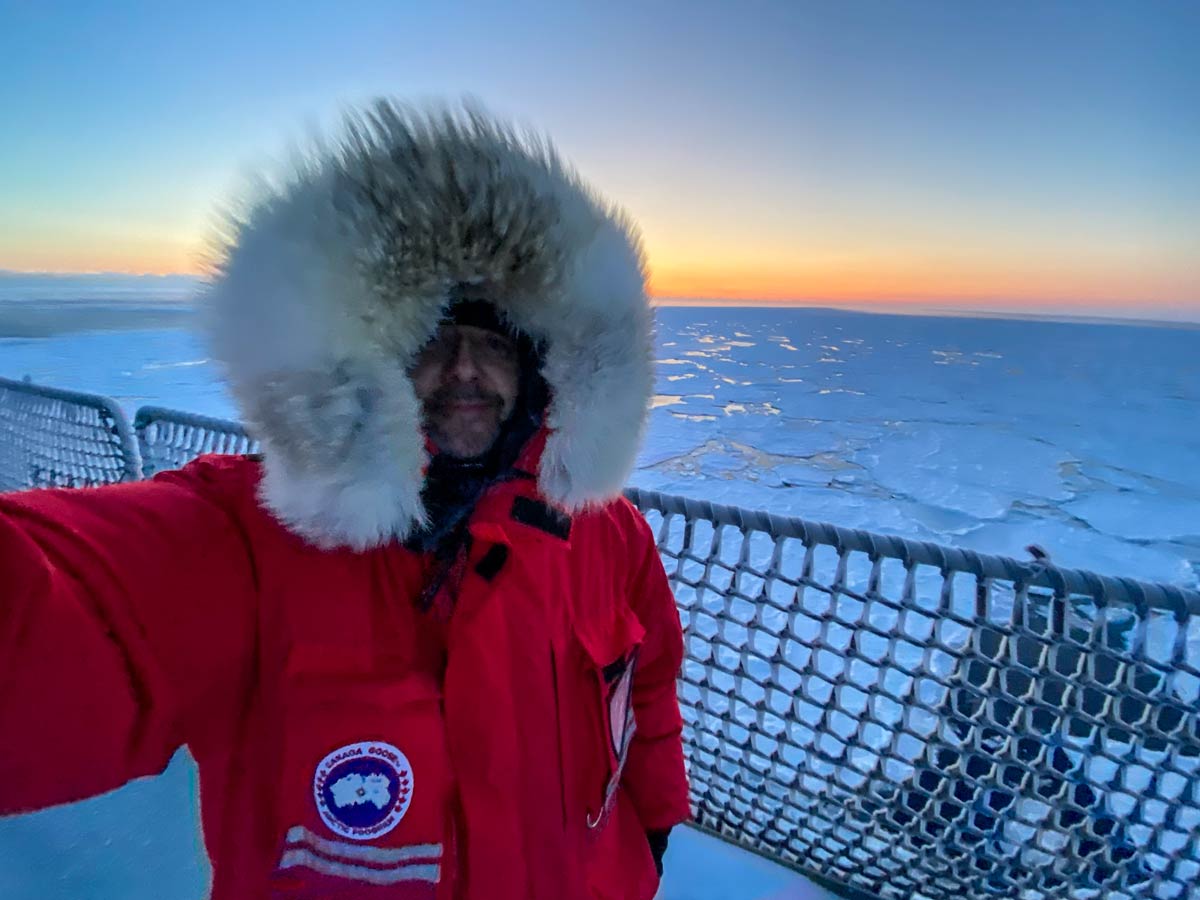
After I woke up I take a short lookout on the helicopter deck before breakfast. This starts to be a personal tradition on this cruise. With -11 °C it is colder than the days before but wind is calm and the temperature feels still very moderate.

I expected that we had left the mainland far behind and would cruise through open sea. To my surprise I can see mountains and lights. Where are we!?

Internet reveals that we are just passing the island Melkøya near Hammerfest. Melkøya is illuminated by the lights of the processing plant Hammerfest LNG. Interesting!

After a rich breakfast I stand on the same deck again. Today I feel more like a cruise tourist then a data manager on a work trip. Even the photos look like beautiful but quite random pictures taken from a Hurtigruten ship.

And indeed the icebreaker Kronprins Haakon follows the very same route as the Hurtigruten ships. Aside from that we do not call any ports. (Spoiler: next port is Longyearbyen on Svalbard 18 days from now.)

What do you do on a transit day on sea? Participating the mandatory sea ice training for example. It’s from 9:00 to 14:00 with a lunch break and we are told a lot about the different risks we might be confronted with on this cruise.

What I know is cold weather. Hypothermia, frost bite. I tented at -35 °C, I skied in blizzard-like conditions. I guess I have a bit of experience.

What I hardly know is arctic sea ice. I’ve been on the ice of the northern Baltic Sea countless times, but that water has only the tenth of the salinity compared to the water of the Barents Sea. The sea ice is softer and the conditions are quite different.

I  definitely know nothing about polar bears and a lot of the training is learning the procedures to avoid contacts.  I’ll talk more about this in another blog article.

At 13:30 we meet at the quarterdeck and train the handling of throw bags. Inside the bag there is a rope attached to a hip belt. When someone breaks through the ice the rescuer can throw this bag. The person to be rescued catches the rope and can be pulled back to safety. By having a long rope it is possible to keep distance. This minimises the risk that the rescuer breaks through as well. I know this from kayak courses but I’m glad to give it some tries again. Yes, it’s me on the next photo.

Photo: Adam Steer, Norwegian Polar Institute

At 16:00 I go on deck 3 again. It has got dark and started snowing.

Later that day the arrival time for P1 has been postponed to 19:00, eleven hours later than the ETA before. So much to the letter E in ETA ;-) It is almost impossible to plan with conditions as unsure as in the Arctic.

Tuesday, 22 February

My sis has birthday today. Hooray! Will we still have internet that I can wish her a Happy Birthday? Don’t ask me why, but we have internet in this remote place and I can send her a message.

Again I am on the helicopter deck before breakfast. Three differences to the day before: The deck is covered with snow, it is slightly warmer and no land is in sight. Finally we have left mainland Norway behind. And more and more I’m able to realise that I am really on a scientific polar expedition!

Still it will take another 11½ hours until we reach P1. I use the time to finally start working. My goal on this cruise is to understand the flow of scientific data. Where do the unique IDs come from? Where location and time? How are physical samples tied to the digital data? And can I improve these processes? I ask many stupid question to scientists to get a basic understanding.

And since I cannot ask questions for 11½ hours – I don’t want to be thrown overboard by my “victims” – I use more time to stand outside and take pictures.

Dinner 17:30. I forgot what I ate but it was delicious! For sure, because every single meal has been delicious on Kronprins Haakon.

But after dinner it is time to recover a glider. This is the first scientific activity on this cruise. Finally!

 

Internet is back!

This article is part of the series “2022-02: Winter cruise KPH”.

Hello, dear blog readers!

After twelve days without the internet came back today though slow. So I’m kind of online again.

I do not even try to summarise all the extraordinary experiences I was able to make the last two weeks. I just say it was a lot! And it was awesome!

So today I just say hei and that I feel excellent! More from this scientific polar cruise with Arven etter Nansen I will tell when I’m back in Tromsø in some days.

For the stats: 3319 photos taken, 3473 lines of diary written. It will take a bit of time to sort and recap.

Stay tuned.

Short sign of life

This article is part of the series “2022-02: Winter cruise KPH”.

We are at 76°45′ N, 31°08′ E and still have internet. Today we entered the sea ice and the ship is jerking when it cuts through.

After days with open sea and moderate temperatures between -5 °C and -8 °C it got significantly colder today. At time we have -24.9 °C (falling) with a relative wind speed of 8.2 m/s. That makes a wind chill of round about -39° C.

So, why am I alone out at the helicopter deck?

Otherwise: too much interesting stuff going on. This arctic research cruise is definitely one of the most gorgeous things I’ve ever experienced in my life!

I hardly manage to be up to date with my notes and I don’t have time to write more. And it’s dinner time, too. See you …

Arctic research expedition with the Norwegian Polar Institute

This article is part of the series “2022-02: Winter cruise KPH”.

Kronprins Haakon is a Norwegian icebreaking polar research vessel. It was build 2018, can cut through one metre of solid ice, has 15 different laboratories on board and place for 35 scientists or other staff in addition to the crew.

Four days ago Kronprins Haakon had arrived in Tromsø. It was travelling 26 days since it left Cape Town, the only stopover on its return trip from Antarctica.

This morning I went on board of Kronsprins Haakon. Not as a visitor to look around but with a suitcase, an enormous bag full of warm clothes, a heavy camera backpack and my Canada Goose down parka. I will stay on board for three weeks to participate the winter cruise “Arven etter Nansen JC3” that will lead us to the Barents Sea east of Svalbard and a bit beyond.

What happened?

Some of you may know that I’ve been working as a data engineer at the Norwegian Polar Institute in Tromsø since autumn 2020. In this position I’m not only a software developer but a data manager of polar research data.

Three and a half weeks ago my colleague M. told me she would join the winter cruise and mentioned that there might still be an available place.

Of course I was very eager to participate. Beside of my private passion for the Arctic I wanted to get a deeper and hands-on understanding of the research data. Where does it come from? How is it measured? And how is it transferred to the digital world? And nothing would teach me better than joining this very winter cruise, where conditions could be quite rough.

I mentioned it to M., another colleague and he introduced me to the expedition leader. There I was told that there was indeed a vacancy on board and that I was welcome to join if my boss would agree.

Since then it had been crazy times with some organisation, a lot of worries and little sleep.

  • 1 Feb: My boss had to check the budget for my participation.
  • 4 Feb: A seafarer’s doctor examined me and gave me my helseerklæring – a medical certificate that proves me “seaworthy”.
  • 16 Feb: I had to take a PCR test and wait for the result for two days. Then I had to take another PCR test, but that’s a whole story in itself.
  • 18 Feb: I had to do a survival suit training in the Tromsøsundet.
  • 18 Feb: I had to pack clothes and equipment I will need on the cruise. Everything beside of two pairs of boots, a helmet, a floating suit and a survival suit. These are provided by the Norwegian Polar Institute.
  • 19 Feb (today): I took a taxi to the port of Tromsø. I was driven directly to Kai 25, took some photos and then went on board.
  • Still today: passport control through the police, a security briefing, lunch and dinner, carrying boxes to the labs, entering the rescue boat and some more …

The next weeks

When Kronprins Haakon will leave Tromsø tomorrow morning we will sail north. First destination is a point referred as P1. It is approx. 500 km east of Svalbard’s southern tip. From there we will continue heading north to the other stations, if weather and sea ice conditions allow it.

The northernmost position is planned to be approx. 82° N, somewhere in the Arctic Ocean. That’s more than 10 degrees of altitude further north than I’ve ever been and less than 900 km to the North Pole.

I’m so excited, that’s really way up north!

We will work both on the sea ice and on the ship using various measurement and sampling methods. Some of them I learned a bit last week but most of them I do not know yet. I’m a newbie. I’m here to learn. And hopefully I’ll learn a lot on this cruise.

After three weeks of tokt (Norwegian for “cruise”) we are supposed to arrive in Longyearbyen on 11 Mars. There I’ll take a flight back to Tromsø the same day.

I will not blog on this cruise because there will be a lot of work and hardly any reliable internet connection. But I’ll definitely take photos, both for the Norwegian Polar Institute and in private for this blog.

So, my dear readers, cross your fingers that I do not get seasick, we can reach our planned destinations and most of all that no one has Covid on board.

You can check the live position of the Kronprins Haakon on the map below. And you are welcome to leave a comment. See you again in mid-March when I’ll answer your comments and start posting articles.

23. Feb, 13:03: Just a short note: This map does not seem to work in polar regions. At time we have internet. Outside temperature -17.4 °C. Position round about 76°29′ N 31°11′ E.