Roof avalanches

Rumble! Roar!! Crash!!!

It’s three a clock in the night. A tremendous noise that shook the house had just waked me up. An earthquake?

No, it was a roof avalanche. It’s the time of the year when temperatures rise and vary between frost and thaw. This causes the snow to partly slide down the roof until all of a sudden large parts of the snow cover can fall down with an enormous crash. And since the snow layer had been frozen over the night this type of snow avalanche would not bury you, it would knock you out or even worse.

There are much larger roof avalanches than the small one on the photo. Yesterday a facebook friend experienced a roof avalanche home. We wrote about 20 to 30 m³ having slid down with blocks weighing between 40 and 150 kilos!

So if you see a sign in the street with the word snöras just give that place a wide berth to protect yourself.


Ongoing winter

It has been a long winter and it’s continuing. The fence behind my backyard is still mostly snowed under and this night it has started snowing again.

The temperatures however have been gradually rising. While the minimum temperatures have been mostly between -5 °C and -15 °C the last weeks the minimum of the last night was a mere -1.2 °C. And the permanent frost stopped. Day temperatures have been above zero the last ten days and despite the mean temperatures still being below zero the snow has started to melt, especially on and beside the streets.

And if the Swedish weather forecast is right we’re expecting a sunny week with temperatures up to 7 °C. This will cause more snow to melt making the streets especially in town extremely ugly and rubber boots the preferred footwear, but that’s a necessity for the spring to come.

The other years?

April 2017 – the Baltic Sea is mostly open, some snow showers. The first tussilago flowers on 8 April.
April 2016 – open Baltic Sea, some rain and small streams cause local flooding.
April 2015 – kayak tour on the Baltic Sea, whooper swans and again the first tussilago.

Snowmobile tracks

When the sea ice is safe + the weather is calm and sunny + it’s Easter holidays you can bet that many, many people are outside. A zillion times more than in January or February when the locals think it’s too cold.

Some people walk, some even ski but most people use their snowmobiles. And that’s how the snow covered ice on the Baltic Sea looks like: covered with snowmobile tracks. Sometimes only one or two of them, but often it’s many tracks making the ice look like a German autobahn.

What a contrast compared to my hike less than two weeks ago where I was almost alone on the ice.


The climate shift is there!

Now it happened!

According to the Emmerich Institute of Exoclimatical Research a new ice age is near. Already this year the snow in Northern Scandinavia will not melt anymore and glaciers will arise along the coast of the Baltic Sea. Authorities recommend to build a snow wall as a defence work round all buildings to protect them against the approaching glaciers. Today I started with the snow wall round my house in Skelleftehamn and I’m hoping for the best.

Wish me luck!

#escapism – an icy camp site

Yesterday

Yesterday at 17:40 my tent was set up on a snowy plane near the sea ice where I planned to stay for the night.

The dinner was part luxury (a really cold coke), part pragmatism (some instant curry chicken of dubious consistency) and part necessity (chocolate!). After the dinner I walked along the shore, which was completely covered with ice and snow. First I walked on land, then on the sea ice. You may think, that a landscape that solely consists of snow and ice must be quite colourless, but no, when there’s light there are colours!

When I came back to my tent, it already had become dark and the almost full moon hovered over the tent. And that was my view from the tent, too: The moon, some stars, snow, ice and the icebound sea.

You might wonder, where I am. Good point, I’ll explain. Let’s go back half a day.

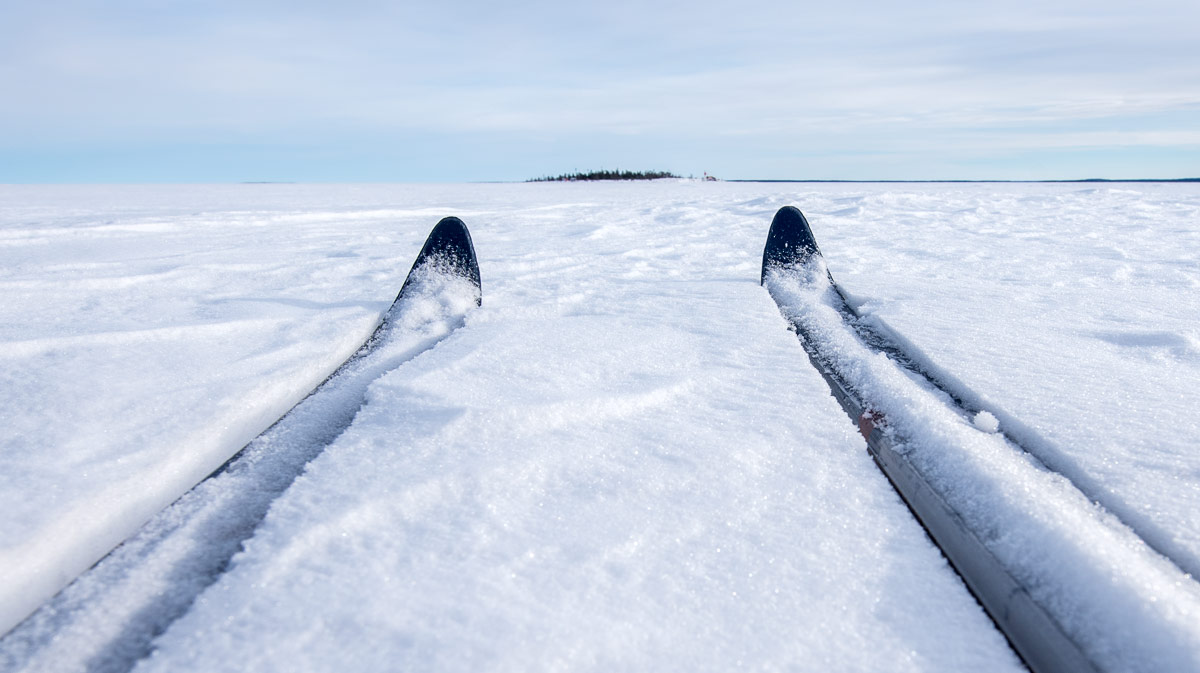
Yesterday I worked only half a day and was home early. I had a plan in my mind: as long as the sea ice is as thick as just now, why shouldn’t I ski over the Baltic Sea to the island Gåsören and spend the night there. I’ve done that in summer twice by kayak but never in wintertime. So I picked myself up, packed skis and pulka and took the car to the small harbour Tjuvkistan.

While the Baltic Sea was open one year ago it is still covered with thick ice this year. Instead of open water one can spot only a snow covered plane and some tracks – made by hare, a moose, another skier, but mostly by snowmobiles, the favourite winter vehicle of many locals. I however do not own such a snöskoter but prefer skiing anyway.

The linear distance between Tjuvkistan and  Gåsören is only 2,3 km and so I arrived at the island soon. In summer it’s hard to find a tenting place (I know only one), since almost the whole island is covered with stones and rocks. This winter however Gåsören is covered with at least 50 cm of snow and so it was easy to find a good place to tent. Scroll up to the first photo and you see it.

OK, back to the story …

At nine a clock it was quite dark and a layer of clouds approached. Good arguments for cuddling up in my warm down sleeping bag and go to sleep. Good night, world.

Today

At five a clock I woke up and felt fairly well rested. I got up for taking some photos. Although it’s already the end of March the nights can be quite chilly and I guess that we had temperatures round -10 °C. I put on more or less all clothes that I had with me and made some photos. The moon had wandered on its orbit to the west and hovered above Gåsören’s old lighthouse.

That photo looks like being shot at the dead of night, doesn’t it? So let’s turn around and look to the east:

It’s less than 8 minutes between the previous two images and it’s more the cardinal direction than the time difference that is responsible for the different light and colours. I walked around for two hours and was just happy to be there at that fantastic place that fantastic morning and to experience all these different kinds of ice and light.

I became hungry so I returned to the tent. or tried … . Just a photo of the lighthouses behind the ice. And another one of my camp site.

But now: finally breakfast. Water, crisp bread and cheese. That may not be the most exciting food, but I didn’t care, I enjoyed the  incredible view over the icebound Baltic Sea in winter.

After breakfast I walked around another time and took some more photos.

Another break. This time just pure luxury. Since I wasn’t in a hurry the tent was still set up. So I could cuddle up in my cozy sleeping bag again and took a long daytime nap. The temperature was still below zero but the sun was high up in the sky and warmed the tent. And there was even chocolate left. Just “gemütlich”!

When I woke up an hour later a layer of stratus clouds had approached and the light had become dull. A good time to pack anything back into the pulka, to put on my skis again and to start the “long” way home. Good bye, Gåsören. Next time when I visit you it will probably be with the kayak. I love winter, but paddling in summertime is great, too.

When I had arrived at the car after Jonas’ and my previous ski tour, it was in Kvikkjokk, 400 km from home. This time the car was parked less than 3 km from my house. I’ve been living in Skelleftehamn for many years now but still I’m happy about the beautifulness of it.

This article is the first one of the new series #escapism. It’s about being outdoors and leaving civilisation behind in excursions that take less than 24 hours. Everyone should have time for such!

My packing list (excerpt)

tent with snow pegs · inflatable camping mat · down sleeping back (a warm one!) · clothes for skiing · spare clothes · winter anorak · thermal pants · warm boots · woollen cap · 2 pairs of gloves · down west · skis with poles and boots · pulka with hip belt · water (both cool and hot) · food (a lot!) · knife · camping stove · matches · kitchen stuff · mobile phone · power bank · headlamp · sunglasses · thermometer (it broke) · compass · isdubbar (essential emergency equipment in case of breaking into the ice) · toilet paper · snow shovel · camera equipment · tripod · grand piano (just kidding)


Mountain hares in the night

I woke up from a bad dream tonight and stood up to get something to drink. I peeked though the kitchen window, it was snowing. On the snow wall in front of the neighbours front yard I could see a large snowball. It was moving. What?! I looked again and saw a mountain hare sitting on top of the snow wall. I spotted even two other pairs of white ears behind the snow wall.

Luckily I still had the big telephoto lens on my camera, so I adjusted the ISO value to 256000 (!) and tried to make some photos of the hare. The best one:

It’s not raining on the photo, it’s snowing, but even with this extreme ISO value I had to expose ⅛ second.

Then I got my tripod to get better images but the mountain hare seemed to spot me through the window and all hares run away in a flash. But only to hide on the street behind the snow wall in my front yard. (We still have at least 85 cm of snow in Skelleftehamn.) Some minutes later I spotted two of the hares in the street again but only for seconds before they ran away once more, this time for good.

This hare is a mountain hare. In Sweden this species is called Skogshare (“forest hare”) while in Germany its name is Schneehase (“snow hare”).

Now I’ll continue to sleep …

Winter is not over

It has been snowing 5 cm since last night, the day temperatures are round -6 °C and the ski track in Skelleftehamn was prepared hours ago. Although I’ve been in quite a lazy mood today I took my cross-country skis (hardly used the last weeks) and skied for an hour.

Ah, that felt good!

Note to myself: be more outdoors, be it skiing, hiking, kayaking, cycling, tenting, that doesn’t matter. Just be more outdoors!

Beginning of spring 2018

According to the meteorologists spring already had started on 1 March. They love to calculate in whole months. Astronomically the beginning of spring is just today.

Well, kind of …

Today I didn’t work but enjoyed the marvellous weather. Bright blue sky and sun, a good day to go to the beach.

Well kind of …

The temperatures were between -10 °C and -5 °C and the Baltic Sea is still covered with a thick layer of ice up to the horizon. Sometimes it’s solid ice, sometimes it’s packed ice. No open water is in sight and therefore no sea birds neither. Just snow and ice and the blue sky.

I left the mainland at the boat harbour Tjuvkistan and crossed the ice to the islands Norrskär and Bredskär. Now I walk along the eastern shore of Bredskär and then to the island Gråsidan.

At the eastern shore there’s a long wall of ice, up to two meters high.

I walk along the shore and look at the fantastical landscape of ice and snow. Sometimes I feel like being in an open air museum. I call the exhibitions “below zero, above sea”. Here’s one of my favourite exhibits:

I go round half the island and then cross it. Although the snow feels solid – like that green floral foam used for flower arranging – I mostly sink knee deep into it. I walk back along the western shore and then cross the ice to the southern edge of Bredskär. The island has a ice wall at the eastern shore as well, partly up to four meters high. Where shall I go? Right beside of the ice wall there are snow drifts, knee deep or even deeper. A bit farther there’s water between the solid ice and the covering layer of snow. Good to have rubber boots.

I cannot decide for the best way to go. So I’m walking king of zig-zag, constantly watching the ice edge. Sometimes there’s a long line of icicles …

… and once there’s even a quite large ice cave. A pity that it will melt within the next weeks (or months?).

I continue my walk, sometimes plunging through deep snow, sometimes just walking on solid ice, sometimes breaking through the snow into water and slush (don’t worry, there’s always a thick layer of ice beneath). I cross the natural gravel bank between the islands Bredskär and Norrskär and talk the same way back to Tjuvkistan.

Today I walked only round seven kilometres, but it was good to be outside, breathing air, letting my eyes wander, catching some sun and the colours of the sky. At 12:30 I reach the car. It’s very warm in the sun and I’m dressed too warm, but the air temperature is still -5 °C. It’s a season between winter and spring which is called vårvinter – spring-winter. A suitable name.

And here comes my favourite picture of today’s exhibition-expedition. I call it “layers of ice”.

Side note: did you notice the huge rubber boots I’m wearing on the first photo? I bought them in Murmansk a month ago. They are made for ice fishing and they are lightweight, comfortable, very warm and of course waterproof. And they were quite cheap. The only drawback: They have spikes that do the opposite of what they are made for. Instead of improving the grip the spikes just slide on the ice making the boots incredibly slippery on ice. I have to check if I can remove the spikes.