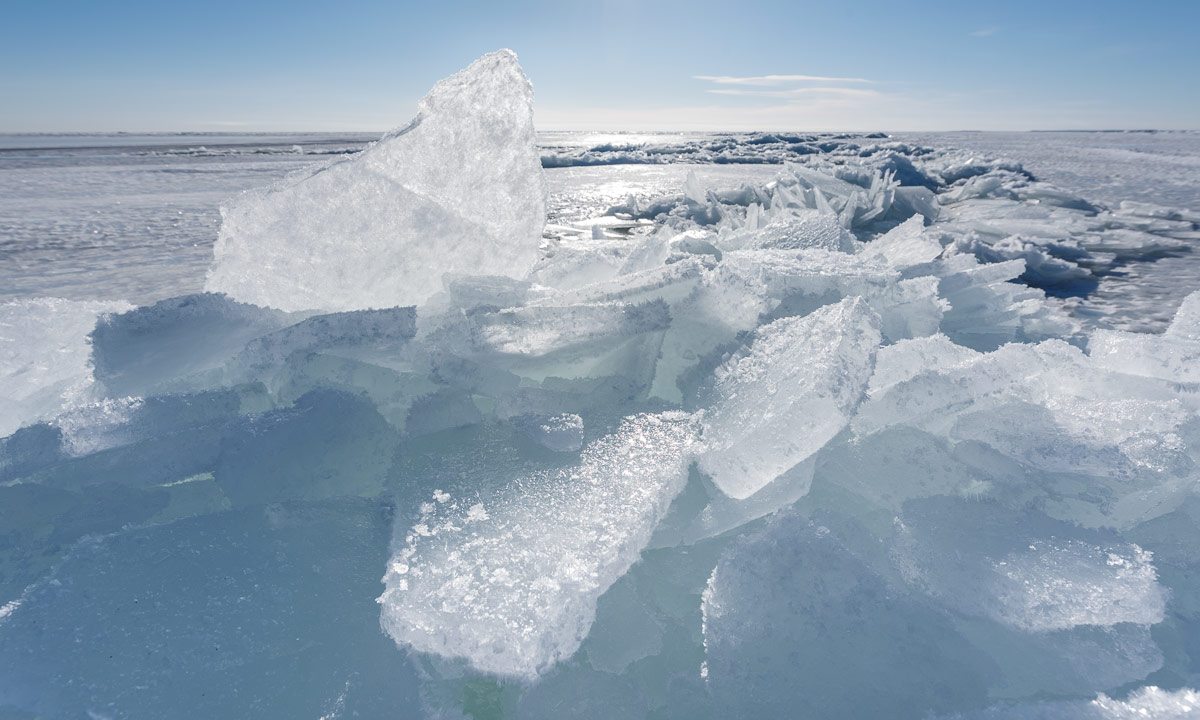
The ice weakens

The Baltic Sea is still covered with ice. The warmth of the last days however has not only melted away a lot of snow on land but also warmed up the ice on the Baltic Sea. The layer of snow has vanished and you can see the first open water round the stones.

Parts of the sheet of ice look soft and unstable. Probably it’s still thick and solid and probably it’s still possible to walk the two kilometres to the island Gåsören, but I wouldn’t dare to do it anymore.

I’m waiting for open water and the first opportunity for a kayak trip instead.

Almost spring …

A day trip in direction Lapporten

Start at 10:00 – up through birch forests – against the sun – looking through sun glasses at the multicoloured clouds – gaining height – over the treeline – less and less snow and more and more stones and rocks – fantastic views over the lake Torneträsk and the Swedish and Norwegian mountains – too rocky (and too late) to continue – skiing down – birch trees again, first some solitary, then denser and denser woods – back at 17:15 – too lazy to write more …

Torneträsk and Port of Narvik

On thursday – three days ago – Annika and I drove to Abisko to enjoy some winter days in the Swedish mountains. Skelleftehamn is in Northern Sweden, Abisko is in Northern Sweden, but it’s still 570 km to go by car.

Yesterday I stood up quite early, because the sun was shining and I wanted to go onto the lake Torneträsk (one of Sweden’s biggest lakes – 70 km long) to make some photos. The whole lake is covered by a thick layer of ice and a thin layer of snow.

In the front you can see stacked up ice that builds along the fissures in the sheet of ice, in the background you can see Lapporten – the landmark of the region.

After a while fog came down and when you looked against the sun you only could see vague shades and pale colours. It looked more like standing in a sandy desert, not on the icy surface of the Torneträsk.

Some hours later: Annika and I had planned to do a ski tour near the Swedish-Norwegian border. We packed the car with our skis, cameras and hot tea and set off. It’s 38 km to the border. Behind that border – on the Norwegian side – there’re a lot of cottages and since it’s Easter and probably every single Norwegian is in his cottage there were a lot of parked cars, too.

We looked for a parking place as well. The most parking places were stuffed with cars and were furthermore only for private use. I continued driving and we looked for a public parking place. Well, we found one but the surrounded mountains were too steep for skiing. We stopped anyway to check our position on the map. After that we helped some Norwegians to dig out their car that was completely stuck in the packed snow – on the very same parking place! There’s a reason, that most of the locals have all-terrain vehicles or at least cars with all-wheel drive.

My Saab doesn’t have such and from now on I was even more cautious in choosing a potential place to park. To make a long story short: We didn’t found a single parking place that was (a) available, (b) public, and (c) not too snowy. That’s why we changed plans and continued to Narvik, which is 46 km behind the border.

There’re (at least) three signs for leaving the mountain plateau and approaching Narvik:

  • The road is narrower
  • The road has much more curves and bends
  • It gets much warmer. (down to -9 °C in Sweden, +5 °C near Narvik)

Soon we saw the first fjord, the Rombaken:

We continued to Narvik that seemed to be completely closed due to the Easter Saturday. Therefore we headed to the Port of Narvik and looked around there. Most ports I know are locked and fenced off. Not in Narvik. Here it’s possible to walk around, enter the piers and have a closer look to the ships. And we were completely alone.

Narvik is a huge contrast compared to Abisko! Even if I prefer landscape and nature to towns, I like this place.

But anyway we drove back to the wintry mountains of Swedish Lapland quite soon and round an hour later we arrived again at our fine and cozy room at Abisko Cabin.

Wintry Scandinavia in a nutshell (without the skiing).

Långhällan again

Two days ago Annika and I walked on the sea ice outside of Långhällan and had a view on large patches of open water.

Today I visited this place once more, but the whole area was covered with ice again. Some areas were covered with dark solid ice, some with ice floes that have frozen together. You could see walls of broken ice and dark channels between the different parts.

When I entered the terra incognita I half expected to fall through the ice and was equipped with the following:

  • my immersion suit, which is completely waterproof (and warm due to the thick neoprene)
  • isdubbar – handles with sharp peaks for pulling oneself out of an ice hole
  • my Nikon AW1 – a waterproof camera

To my big surprise all ice was thick and stable enough to bear my weight.

I couldn’t see any open water, but I could hear the sounds of ice and water below me. The cracking and clicking, the low, sonor pulsing drones echoing under the icy surface and sometimes even rhythmical beeping noises – like the Baltic Sea sending Morse code. An experience both fascinating and frightening.

Some impressions of today:

First day of spring

Today it’s the first day of spring. In the forest you could see the first snowless patches of soil covered with blueberry plants and the first birds sang their spring songs. But if you continued your walk through the woods until you reached the shore and had a look over the Baltic Sea, it looked like winter would be endless and continue forever:

But if you went on the ice and looked closer you could see, that the frozen surface only covered parts of the Baltic Sea. There was open water ahead. Blue open water. Blue open water with tiny little waves.

Oh, what I longed for my kayak – I would have loved to paddle on the crystal clear sea to the icebergs that you could see near the horizon.

The first day of spring in Skelleftehamn – still wintry but with a promise of spring coming soon.

Magnitude 4.3

Things you can experience in Skelleftehamn:

Ice fishing · heavy snowfall · northern lights · moose · frozen Baltic Sea · earthquakes · cold …

“Wait a moment, did you say “earthquakes”?”

“Yes.”

“In Skelleftehamn?!”

“Yup.”

Yesterday evening, when I stood in the bathroom, I heard a noise and felt a shaking like the biggest truck ever would speed through the streets. But it was a short event, I forgot it quite soon and lay down to sleep.

Today, when I browsed through my Facebook timeline, I realised that so many people from different places wondered, if this could have been an earthquake, that it really had to be one. And it was!:

GEOFON Program

According to GEOFON, Potsdam, the earthquake had the magnitude 4.3 and the epicentre was in the Baltic Sea, 19 km deep, round 60 kilometres from where I live.

Fortunately 4.3 is a quite weak earthquake and I don’t believe, that it had any impact at all.

By the way, this was not the first earthquake I experienced in Skelleftehamn, there was another one in June 2010, two months after I arrived here.

Thaw

When it’s more than 10 °C in mars for two days a lot of snow thaws and transforms normal streets into a proving ground for jeeps. Soft slush, sheer ice, deep tracks and huge puddles cover the streets and crossings and I wait for the day where I’ll get stuck twenty metres from home.

On the other side the scenery can look almost nice, at least when you lower your camera as much as possible:

Vårvinter

Where are we – Annika and I? In the Arctic on our way to the North Pole?  Looking for polar bears?

Well, not really! We’re on the frozen Baltic Sea on our way to the island Gåsören, enjoying the blue sky and the warm sun.

But we didn’t only enjoy the warmth of the sun, but the warmth of the sauna, too – even if we didn’t fire it as hot as it should be for a real sauna experience.

We were not the only ones on the ice of the Baltic Sea yesterday.

There were ski tracks and skiers.

There were snowmobile tracks and snowmobile drivers.

There were moose tracks …

… and there were moose on the ice, too. Far, far away, but clearly visible.

“vårvinter” means “spring winter” and describes this season, where the land is still covered with snow and ice, but the temperatures aren’t longer as cold as in January or February.

Kungsleden: returning to civilisation

This article is part of the series “2016-02: Ski tour on the Kungsleden”.

From the Tjäktjastuagn to Alesjaurestugorna

27 February · 13 km · Link to map

This day I continued to the Alesjaurestugorna, the last mountain hut in the kalfjäll –  the treeless mountain landscape in Lapland. Perhaps that’s why I was a bit sad, because I love the bare mountains and I felt that I had to say farewell to this outstanding landscape soon. I said farewell to quietness a bit, too, since I knew, that Alesjaure would be quite crowded:

But first of all I had a nice trip of thirteen kilometres to go. Weather was good and the way was short and easy, even if there were some patches with hardly any snow that I had to bypass. So I arrived in Alesjaure already at a quarter past one, being the first guest.

Other guests came, from Austria, from Germany, from France and from Denmark – many interesting people. And in between five scooters arrived – all with a trailer loaded with figures dressed in huge black down parkas and ski goggles – the Englishwomen. Their plan was to go back to Abisko on skis in two days with some detours to make it a full marathon distance.

The rest of the day was relaxed and easy-going. First I sat the sauna, then I made dinner (an outdoor meal called “Rice with basil” – quite boring). After that I sat together with all those kind and interesting people. At half past nine one of the Danes started to make pancakes – and I was invited! The Danes told me, that each of them has a surprise for the others on their tour and the pancakes were the first surprise. What a great idea (especially, since I benefitted from this surprise). I went to bed at half past ten – much later than the last days.

From Alesjaure to Abiskojaure

28 February · 20 km · Link to map

The next day I wanted to continue to Abiskojaure, that’s the longest part of my journey. The last tour days had quite short distances between 12 and 14 km and I was rather slow. As a photographer I have a good excuse: It’s making photos, that takes time, not my slow speed! Anyway, today I planned to start very early and decided to go a bit faster to avoid arriving in darkness. But first I had to get water, there was hardly any left.

If you tent in the winter, you’ll have to melt snow in most cases – this takes a lot of time and doesn’t taste well. The mountain huts on Kungsleden have ice holes to get fresh water, either in lakes or rivers. The ice hole of Alesjaure lies exactly below the summer bridge. It is covered with a wooden look to reduce freezing over, but I had to break the fresh ice anyway. It’s almost impossible to fill a 25 litre container with water (lowering the bucket into the small hole – pull it up again – pour water through the funnel – de-ice the funnel – pour water through it again) without getting wet hands. Oh, what I longed for waterproof gloves. My fleece gloves were completely soaked and my fingers got so cold that they itched when I “defrosted” them above the gas oven.

That’s why I started a bit later than planned and at the same time as the marathon skiers. They followed the official winter way, I took the short cut over the frozen lake Alisjávri. Although I took pictures I was faster than the skiers – some of them probably stood on skis the first time – and when I left the lake to join the winter way they already lagged behind.

I tried to go a bit faster, but stopped for some photos:

After I went more than half the way I took a break. It’s quite warm: -5 °C and even the cloud-covered sun warms a bit. For me it was a bit like saying good-bye. Good-bye to the treeless kalfjäll. Soon I will enter the narrow valley Gárddenvággi where terrain declines. And soon after I finished my break and continued the tour I saw the first small birch woods. The sun has disappeared behind a cloud layer and the landscape got monochrome. Dark birches, white snow, only interrupted by some red waymarks.

The last descend to the woodlands is quite steep. I decided to unmount my skis and go on foot. Even so the pulka tried to push me down towards the valley and I had to lean back to avoid being knocked over. After some minutes I was almost level with the Abiskojaurestugorna and went the rest of the tour through denser birch forests on skis again. I have to admit that I found this part a bit boring – we have snow and trees in Skelleftehamn, too, but soon I arrived at the mountain huts, where I spent the rest of the day.

In the evening I met C. who wanted to go to Abisko the next day and we planned to do this last part together.

From Abiskojaure to Abisko Östra and home

29 February · 15 km · Link to map

Let’s make it short: This day was travel day. C. and I woke up at 6 o’clock. Not by our own will but because we had the loudest snorer ever in our room. Jet engine level! We took a short breakfast, packed our pulkas and started our tour. Not to Abisko Turiststation, the classical start and end of the Kungsleden, but to Abisko Östra, the station of the village Abisko. I went on skis, C. just with normal boots, since the snow on the snow mobile tracks was packed and easy to walk on. C. was much faster than I use to be, but we headed for the 12-o’clock-train and I was keen to get it, too. We took two breaks: One for elevenses (or some kind of pre-lunch), one for the reindeer posing in front of the kåta.

We mad it, we even had an hour time until the train arrived. 14 km in 3 hours, 8 minutes (including the two breaks) – that was the fastest part of my tour. Thank you, C. for helping me leaving my comfort zone a bit.

The rest of the tour: Train from Abisko Östra to Luleå. Bus from Luleå to Skellefteå. Bus from Skellefteå to Skelleftehamn. I was home at 21:30 – 13½ hours after starting on skis in Abiskojaure.

Now it’s midnight. I’m sitting in the living room of my house in Skelleftehamn. I really like this place, but I’m already longing to the Swedish Mountains again. Perhaps another ski tour later in April?

Well, we’ll see …