No winter bath today

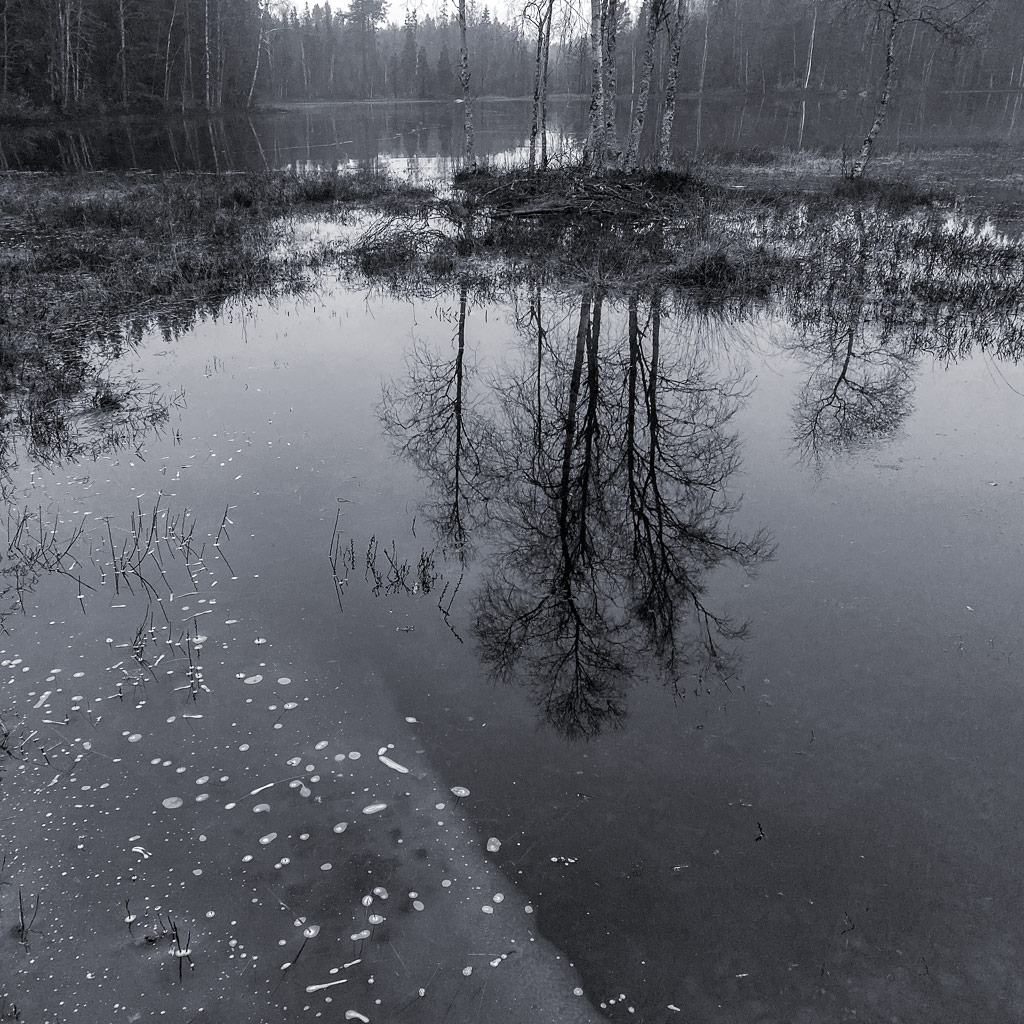
Five days ago at Vitskärsudden, Annika’s and my favourite all-season bathing place looked like this:

Looks like bathing season would be over there soon, I thought but last night’s hard wind had crushed a lot of the sea ice along the coast. Annika and I packed our bathing things, wrapped ourselves up in warm winter clothes and headed to the beach for a winter bath.

Well, it didn’t look looked too promising, but I gave it a try. The first obstacle was the ice wall at the beach – at least half a metre high. Slowly I crossed it barefoot until with the last step the wall collapsed and I stood in the shallow water. Well, standing in water was part of the plan. Check.

Then a wave came. Not a huge one but nevertheless it covered me with sea spray from tip to toe. Brr! At the same time the wave pushed ice floes and crushed ice against my shin with more power than expected. The water was too shallow to knock me over but the sharp ice cut my shin on several places.

So I just shouted “Back!” to Annika in case of her making a try as well and instantly returned to the snowy beach to dry myself off and got dressed again. I’m glad, that I didn’t try it any longer. Probably I would have got so many cuts the I would look like a survivor of a piranha fight.

So – home again. No winter bath today.

Later I took the car to the same beach again to make some photographs. The pictures hardly transport the energy of the overlapping waves and the impression of wind and snowfall. Anyhow, here are some of the photos:

Was the action stupid? Well, perhaps. At least it wasn’t dangerous since we never planned to go into deeper water. So it’s more under to motto: “Another good idea that didn’t work!”
Two-digit minus temperatures

And suddenly, after some days with temperatures below -10 °C the Baltic Sea at our house has started to freeze over.

And suddenly even Vitskärsudden, the bay where Annika and I took a winter bath just two days ago is covered with ice, too.

Finally winter

December was an odd month regarding the weather. It was quite warm and extremely cloudy. There was hardly any sun and when it snowed it turned into sleet and rain. But at the turn of the year the weather finally changed. We got 10–15 cm of snow before New Year’s Eve, a short warmer period and then finally permanent frost. Right now, at the morning of 3 January the thermometer shows -12 °C.

Yesterday Annika and I made a short excursion to Strömbäck-Kont by the sea, where we took a promenade by the mostly open sea. It is 4 km linear distance to Strömbäck-Kont, but 30 km by car due to a long bay that separates the island Obbolaön where we live from the mainland in the west.

Some photos from our tour. The first 5 are made at Strömback-Kont, the other three in Degernäs on the way back.

Winter bath

Yesterday I enjoyed my lunch break that included a promenade through fresh snow and a winter bath. Today it has got warm again and the snow has started melting away. What a pity!

Two photos of Grundviken

It seems, that the shallow bay outside of our house is nameless. I cannot find any name in the maps of Lantmäteriet, OpenStreetMap, Eniro or Google. So I decided to give the bay a name today. From now on its name is “Grundviken” (shallow bay), at least in this blog.

After one millimetre of snowfall and waves crushing the thin ice on Grundviken it looked like this today. I shot the first photo at 9:30 and the second at 13:35.

The next wintry photos of Grundviken may take some time, since warmer temperatures and rain are forecasted for the rest of the week.

An almost normal sunrise

It was fresh in Obbola this morning. Blue sky and -6 °C. Time to take a break from my work and make some photos.

I went to a place with a better view on the sunrise at 8:41. I had however to wait a while because there was a layer of grey clouds above the horizon. Some locals in Skelleftehamn use to call this cloud layer vinterväggen – the winter wall – since it is quite dense like a wall and typical for the beginning of winter. But that’s not a common term.

So I had some spare time for crouching and taking this photo of the ice covered plant standing in the water – a reminiscence to the high water level the last days.

And then the sun finally rose above the vinterväggen and everything was illuminated in warm shades.

In the lunch break I took the car to “Obbola town” to have a pizza for lunch. Parts of the mouth of the river Umeälven were already covered with ice.

Sunset today was 14:11 but I was in online meetings from 13 to 15, so no sunset photos for today.

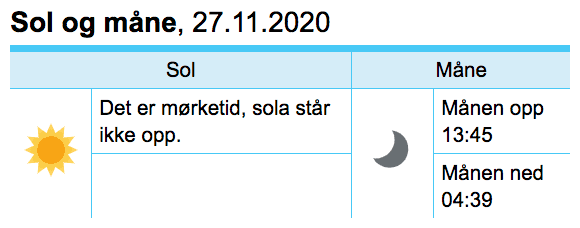
Why I write about this? Because without the Corona restrictions I would have worked in Tromsø today.  And in Tromsø  I wouldn’t have seen a sunrise. And neither for the rest of the year. That’s what the Norwegian weather service yr shows for Tromsø today:

Sun and moon, 27. Nov 2020 | Sun: ut is polar night, the sun does not rise.

So today is the first day of the period of polar night that will last until 14. January. Maybe I’ll be able to work in the office in Tromsø right after New Year. Then I’ll experience the polar night there. For the first time in my life.

Bathing gets colder

Yesterday afternoon. It had been quite foggy the whole day and so it still was at the small sandy beach at Vitskärsudden. Annika and I had bathed several times the week the last months. We both could see and feel how the water temperature slowly had decreased. Yesterday the bath thermometer showed 10 °C and slightly above and the water started to feel cold, especially in the fingers. But we still enjoyed the bathing, the beauty of the place and the sensation afterwards.

Today I’ll fly to Tromsø and probably I won’t be back home before Christmas. I’m curious whether the sea at Vitskärsudden will already be frozen over or if there will be open water where we can take a real winter bath.

A walk in the bog Torsmyran

Annika googled it, then we visited it shortly last Saturday, yesterday I took the opportunity to visit this bog with more time: The Torsmyran Nature Reserve.

The parking place is right next to the E4, 45 km southwest from Umeå. You open a gate (and close it behind you to keep the moose away from the road). Then you walk to a small forest strip and follow a round 100 metres long wooden ramp leading into the bog. The platform at the end of the ramp is raised so you have a nice view over the 8.3 km² large bog.

That’s it.

As long as you don’t dare to enter the bog by foot. At first the bog looks flat, but if you take a closer look you see that there are slightly higher parts, mostly covered with heather. Even pine trees grow here and the ground is safe to walk. Beside of these parts there are large areas covered with peat moss, a sure sign that you will get wet walking onto. Even with rubber boots! And there are depressions. Some are covered with water, others with brown mud.

Is the mud deep? Well, have a look at the next photo:

You see the bit of a stick sticking in the mud? That’s my walking stick that I use when hiking through bogs. It’s two metres long. Without any effort I could stick it into the mud like that. Anyhow it was possible to avoid such treacherous places in this labyrinth of humps and pools, even though I came quite near to take same pictures.

After a while I come to a line of wooden planks. Old wooden planks. Old, half rotten planks with rusty nails looking out. I decide to follow the path. First it is quite easy, but then the planks go submarine. Since both my camera and I myself are packed waterproof I continue. Although the planks were slippery I succeed without taking a bath.

There is a signpost in the middle of the bog, leading to cities and places in the area. Who needs a signpost at such a remote place? Well, winter is coming and the bog will be frozen and covered with snow. Then the whole area is easily accessible by snowmobile. And that’s what the signpost is for: Helping the snowmobile drivers.

I leave the signpost behind and continue the path. Partly the planks lie directly on the mud. *Crack!*. One of the planks breaks under my right foot but still supports my weight. When I come to another watercourse to cross and see the the planks deeply sunken into the water I decide to turn back. This passage looks quite challenging and for a round trip I would have to cross the watercourse again at another place.

Slowly I walk back to the platform at the end of the ramp. I have to zigzag a lot to avoid open water or muddy patches but I arrive. I’m quite wet and muddy from taking some photos. I however already suspected that and have spare clothes in the car and a canister with water for cleaning. And something even more important: Chocolate and something to drink!

Disclaimer: It’s not the first time that I hiked on boggy ground. It needs some experience to avoid the soft patches and knowing how to free yourself when sinking in mud. That’s why I have a long and stable walking stick with me that could support my weight in case of sinking. Take care!