#escapism – an icy camp site

Yesterday

Yesterday at 17:40 my tent was set up on a snowy plane near the sea ice where I planned to stay for the night.

The dinner was part luxury (a really cold coke), part pragmatism (some instant curry chicken of dubious consistency) and part necessity (chocolate!). After the dinner I walked along the shore, which was completely covered with ice and snow. First I walked on land, then on the sea ice. You may think, that a landscape that solely consists of snow and ice must be quite colourless, but no, when there’s light there are colours!

When I came back to my tent, it already had become dark and the almost full moon hovered over the tent. And that was my view from the tent, too: The moon, some stars, snow, ice and the icebound sea.

You might wonder, where I am. Good point, I’ll explain. Let’s go back half a day.

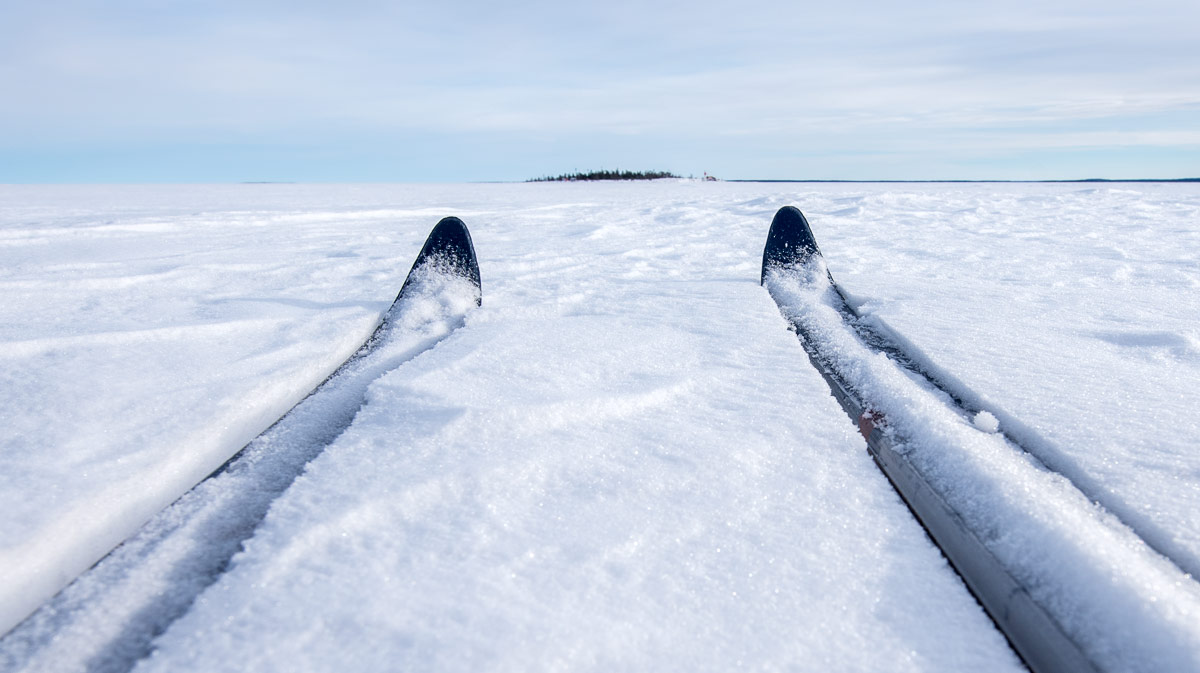
Yesterday I worked only half a day and was home early. I had a plan in my mind: as long as the sea ice is as thick as just now, why shouldn’t I ski over the Baltic Sea to the island Gåsören and spend the night there. I’ve done that in summer twice by kayak but never in wintertime. So I picked myself up, packed skis and pulka and took the car to the small harbour Tjuvkistan.

While the Baltic Sea was open one year ago it is still covered with thick ice this year. Instead of open water one can spot only a snow covered plane and some tracks – made by hare, a moose, another skier, but mostly by snowmobiles, the favourite winter vehicle of many locals. I however do not own such a snöskoter but prefer skiing anyway.

The linear distance between Tjuvkistan and  Gåsören is only 2,3 km and so I arrived at the island soon. In summer it’s hard to find a tenting place (I know only one), since almost the whole island is covered with stones and rocks. This winter however Gåsören is covered with at least 50 cm of snow and so it was easy to find a good place to tent. Scroll up to the first photo and you see it.

OK, back to the story …

At nine a clock it was quite dark and a layer of clouds approached. Good arguments for cuddling up in my warm down sleeping bag and go to sleep. Good night, world.

Today

At five a clock I woke up and felt fairly well rested. I got up for taking some photos. Although it’s already the end of March the nights can be quite chilly and I guess that we had temperatures round -10 °C. I put on more or less all clothes that I had with me and made some photos. The moon had wandered on its orbit to the west and hovered above Gåsören’s old lighthouse.

That photo looks like being shot at the dead of night, doesn’t it? So let’s turn around and look to the east:

It’s less than 8 minutes between the previous two images and it’s more the cardinal direction than the time difference that is responsible for the different light and colours. I walked around for two hours and was just happy to be there at that fantastic place that fantastic morning and to experience all these different kinds of ice and light.

I became hungry so I returned to the tent. or tried … . Just a photo of the lighthouses behind the ice. And another one of my camp site.

But now: finally breakfast. Water, crisp bread and cheese. That may not be the most exciting food, but I didn’t care, I enjoyed the  incredible view over the icebound Baltic Sea in winter.

After breakfast I walked around another time and took some more photos.

Another break. This time just pure luxury. Since I wasn’t in a hurry the tent was still set up. So I could cuddle up in my cozy sleeping bag again and took a long daytime nap. The temperature was still below zero but the sun was high up in the sky and warmed the tent. And there was even chocolate left. Just “gemütlich”!

When I woke up an hour later a layer of stratus clouds had approached and the light had become dull. A good time to pack anything back into the pulka, to put on my skis again and to start the “long” way home. Good bye, Gåsören. Next time when I visit you it will probably be with the kayak. I love winter, but paddling in summertime is great, too.

When I had arrived at the car after Jonas’ and my previous ski tour, it was in Kvikkjokk, 400 km from home. This time the car was parked less than 3 km from my house. I’ve been living in Skelleftehamn for many years now but still I’m happy about the beautifulness of it.

This article is the first one of the new series #escapism. It’s about being outdoors and leaving civilisation behind in excursions that take less than 24 hours. Everyone should have time for such!

My packing list (excerpt)

tent with snow pegs · inflatable camping mat · down sleeping back (a warm one!) · clothes for skiing · spare clothes · winter anorak · thermal pants · warm boots · woollen cap · 2 pairs of gloves · down west · skis with poles and boots · pulka with hip belt · water (both cool and hot) · food (a lot!) · knife · camping stove · matches · kitchen stuff · mobile phone · power bank · headlamp · sunglasses · thermometer (it broke) · compass · isdubbar (essential emergency equipment in case of breaking into the ice) · toilet paper · snow shovel · camera equipment · tripod · grand piano (just kidding)


Mountain hares in the night

I woke up from a bad dream tonight and stood up to get something to drink. I peeked though the kitchen window, it was snowing. On the snow wall in front of the neighbours front yard I could see a large snowball. It was moving. What?! I looked again and saw a mountain hare sitting on top of the snow wall. I spotted even two other pairs of white ears behind the snow wall.

Luckily I still had the big telephoto lens on my camera, so I adjusted the ISO value to 256000 (!) and tried to make some photos of the hare. The best one:

It’s not raining on the photo, it’s snowing, but even with this extreme ISO value I had to expose ⅛ second.

Then I got my tripod to get better images but the mountain hare seemed to spot me through the window and all hares run away in a flash. But only to hide on the street behind the snow wall in my front yard. (We still have at least 85 cm of snow in Skelleftehamn.) Some minutes later I spotted two of the hares in the street again but only for seconds before they ran away once more, this time for good.

This hare is a mountain hare. In Sweden this species is called Skogshare (“forest hare”) while in Germany its name is Schneehase (“snow hare”).

Now I’ll continue to sleep …

Winter is not over

It has been snowing 5 cm since last night, the day temperatures are round -6 °C and the ski track in Skelleftehamn was prepared hours ago. Although I’ve been in quite a lazy mood today I took my cross-country skis (hardly used the last weeks) and skied for an hour.

Ah, that felt good!

Note to myself: be more outdoors, be it skiing, hiking, kayaking, cycling, tenting, that doesn’t matter. Just be more outdoors!

Beginning of spring 2018

According to the meteorologists spring already had started on 1 March. They love to calculate in whole months. Astronomically the beginning of spring is just today.

Well, kind of …

Today I didn’t work but enjoyed the marvellous weather. Bright blue sky and sun, a good day to go to the beach.

Well kind of …

The temperatures were between -10 °C and -5 °C and the Baltic Sea is still covered with a thick layer of ice up to the horizon. Sometimes it’s solid ice, sometimes it’s packed ice. No open water is in sight and therefore no sea birds neither. Just snow and ice and the blue sky.

I left the mainland at the boat harbour Tjuvkistan and crossed the ice to the islands Norrskär and Bredskär. Now I walk along the eastern shore of Bredskär and then to the island Gråsidan.

At the eastern shore there’s a long wall of ice, up to two meters high.

I walk along the shore and look at the fantastical landscape of ice and snow. Sometimes I feel like being in an open air museum. I call the exhibitions “below zero, above sea”. Here’s one of my favourite exhibits:

I go round half the island and then cross it. Although the snow feels solid – like that green floral foam used for flower arranging – I mostly sink knee deep into it. I walk back along the western shore and then cross the ice to the southern edge of Bredskär. The island has a ice wall at the eastern shore as well, partly up to four meters high. Where shall I go? Right beside of the ice wall there are snow drifts, knee deep or even deeper. A bit farther there’s water between the solid ice and the covering layer of snow. Good to have rubber boots.

I cannot decide for the best way to go. So I’m walking king of zig-zag, constantly watching the ice edge. Sometimes there’s a long line of icicles …

… and once there’s even a quite large ice cave. A pity that it will melt within the next weeks (or months?).

I continue my walk, sometimes plunging through deep snow, sometimes just walking on solid ice, sometimes breaking through the snow into water and slush (don’t worry, there’s always a thick layer of ice beneath). I cross the natural gravel bank between the islands Bredskär and Norrskär and talk the same way back to Tjuvkistan.

Today I walked only round seven kilometres, but it was good to be outside, breathing air, letting my eyes wander, catching some sun and the colours of the sky. At 12:30 I reach the car. It’s very warm in the sun and I’m dressed too warm, but the air temperature is still -5 °C. It’s a season between winter and spring which is called vårvinter – spring-winter. A suitable name.

And here comes my favourite picture of today’s exhibition-expedition. I call it “layers of ice”.

Side note: did you notice the huge rubber boots I’m wearing on the first photo? I bought them in Murmansk a month ago. They are made for ice fishing and they are lightweight, comfortable, very warm and of course waterproof. And they were quite cheap. The only drawback: They have spikes that do the opposite of what they are made for. Instead of improving the grip the spikes just slide on the ice making the boots incredibly slippery on ice. I have to check if I can remove the spikes.


That arctic feeling

Have a look at the following photo:

It could have been taken at some spot at the Arctic Sea, couldn’t it? But it wasn’t. I made that photo just today, only 2 km away from home!

Today I wanted to test whether the camera backpack worked well together with the waist harness of my pulka. Therefore I made a small ski tour. First I crossed the ice between mainland and the island Storgrundet. The water between mainland and island is well protected and always calm. Therefore the ice is about 40 cm thick and more than safe to cross. I crossed the forested island, which is partly less than 200 meters wide and soon stood on one of the snow drifts at the outer shore. Beside of some smaller other islands and an old boat shed all I could see was clouds, snow, and ice.

There were many thick ice floes along the shore, but the ice between them was hardly a centimetre thick. No surprise, since large parts of the sea had been free of ice last week. I pierced the new ice with a stick and measured 60 cm water beneath. Not life-threatening, but I definitely didn’t want to get soaked and therefore sticked to the shoreline of Storgrundet. That’s where I took the photo above.

The other photo? Yes, that’s me with my Norrøna jacket (light and windproof), my Lowepro camera backpack and my Fjellpulken pulka. The test succeeded: pulka and backpack do work well together! Good to know for the ski tour in the Swedish mountains that I’ll start next week …

Question: Do you see the mistake I’m making on the 2nd photo? Please comment.

Waiting for the roof box installation

My ancient roof box, that fitted well on my Saab is quite incompatible to my Subaru Outback. Today I had an appointment with the car repair shop. While I waited for them I took a promenade and made some photos on the nearby property of the boat club Ursvikens Segelsällskap. Nothing special and – due to the dull light – in black and white.

3× winter coast

Yesterday, 13:30

After having lunch, Annika and I drove to Näsgrundet, where the Baltic Sea had been mostly clear of ice three days before. Still most of the sea was ice-free, only at the coast some meters of new thin ice had formed.

It had started clearing up and the temperatures dropped to -15 °C already in daytime. The cold air over the open water created sea smoke, that gleamed in the colours of the low sun.

Yesterday, 23:00

It continued getting colder and soon the temperature dropped below -20 °C. Before sleeping I was out again, this time to check for an optical effect, that can appear when it’s as cold as then: light pillars. Even though it was round -23 °C I wasn’t lucky, but I took some photos of the Rönnskär industry anyhow.

Today, 8:00 – 9:00

This morning was the coldest yet this winter with temperatures round -24 °C. That’s when I start wearing two pairs of gloves for taking pictures. The inner fleece glove for handling the camera and a thick woollen mitten for staying warm when I just wait or look for motives.

The first motive may look quite boring but I love motives like these: just different cloud layers and ice up to the horizon plus the first gentle sunrise colours.

Remember, this part of the Baltic Sea had been clear of ice the day before. Due to the cold weather it has frozen within a range of several kilometres within less than twenty hours. It still amazes me how fast this process can be.

After I had made the former photo I detected that purple-red spot beside of the island Gåsören. The sun started to rise. I changed the lens and made a telephoto shot. (It’s quite blurred due to the atmospheric conditions)

Then I waited for the sun to rise. And really – after some minutes the sun succeeded to rise above the lower cloud layer. But only seconds later the upper cloud layer, that approached from the southwest covered the red orb again and the sun disappeared for the rest of the day.

Though it was still below -20 °C it started to snow.

Varning! Isvak!

The river Skellefteälven between Skellefteå and the coast of the Baltic Sea. That particular place is called Stackgrönnan. On warm summer weekends the café is quite crowded. In winter it’s closed.

This sunday however the small snow covered way is crowded, even though it’s mid-January. Many cars are parking, many people are standing around, warmly dressed for winter. Some of them have bags or rucksacks with them.

The Skellefteälven is completely frozen and covered with snow. Snowmobile tracks lead to the opposite riverside. On the river ice there are signs round a cordon.

They say “Varning! Isvak!” – “Warning! ice hole!”. And there is an ice hole indeed, four square meters big. Some people stand around with spearlike tools and remove the last thick ice blocks from the hole.

So that ice hole seems to have a purpose and it has: It’s an ice hole maintained by the association Mörkrets och Kylans Glada Vänner, or in english Happy Friends of Cold and Darkness.

I’ve been member of this association almost from the beginning and had the pleasure, honour (, and work) of being part of the organisation team for the very first Swedish Winter Swim Championship in Skellefteå in 2012. It was the coldest day of the winter with temperatures below -30 °C, but that’s another story …

Back to the plot: All people have come to take a winter bath or at least to cheer to those who do. Annika and I have winter-bathed before but not yet this winter. We aren’t the only one’s who want to take a bath, there are at least 30 others and the changing rooms are stuffed with people, some wearing winter parkas and warm boots, others just their swimwear and a cap. The same outside: Woollen mittens and down jackets on the one side, wet semi-nude bathers with towels on the other side.

And what is in the ice hole? One winter bather after the other. First looking tensed or even shocked, since the water temperature is round 0 °C (and yes, that’s cold!), then relaxed and happy because the body releases endorphins. But have a look by yourself:

After the last bather – most people and cars already have gone – wintry silence starts to set in again. The snow covered tables and benches are still untouched and the fairy lights round the big flag pole are on. Temperature is -11 °C. If you ask me, a perfect winter day.

Appendix one

On 17 February 2018, the Open Scandinavian Championship which is a part of the World Cup will be held in Skellefteå for the seventh time. And you can apply!

Appendix two

Evidence photos of me in the ice hole? Thanks to Annika, who took photos with her mobile they exist. Var så god:


Checking the winter …

This winter has been quite lagom yet. It hadn’t been too warm for a longer period, nor it was it really cold. We got snow several times, but we didn’t get any lake effect snow neither as e.g. five years ago where it snowed more than 80 cm within 24 hours.

Yesterday and today it snowed round 20 cm. Since we already had round half a meter of snow, the fence of my garden is about to disappear in the snow.

I took the photo above through the window of my living room. It shows my (and the neighbours) backyard. The fence is round 80 cm high.

Today I took the car to the Näsgrundet, one of my favourite places in Skelleftehamn. When I had been at the same place 12 days ago, the Baltic Sea was covered with ice as far as the eye could see. When I arrived today I was really surprised to see the Baltic Sea clear of ice again.


The photo above shows a small bay beside of Näsgrundet. The ice had been broken by wind and the floodwater two days ago. The wind was pushing the ice floes slowly offwards and some of them already had started to drift seawards.

That was the view to the northeast. The view to the southwest is completely different: there is the peninsula Rönnskär with the copper smelter of the same name. It snowed but the low sun managed to peek through the airy cloud layer. Temperature was -9 °C and the chimneys smoked.

In front of the industrial plant is the “cape” of Näsgrundet, which is a peninsula as well. I took a short discovery tour and found another motive. When I was standing up, Rönnskär and some trees were visible but when I knelt down I was able to hide the background and to make a completely different photo:

I intensified both contrast and colours to give this photo a more irreal appeal. The motive itself however is unchanged.

What type of winter comes next? I could take a look at the weather forecast of SMHI, but I have difficulties to take it seriously. Beside of the overall temperature and wind direction trends the web forecasts for Skelleftehamn are quite bad. The 20 cm of snow for example weren’t forecasted at all.

But in the back of my mind I know that lake effect snow could be possible again as long as the Baltic Sea is open and wind comes from eastern directions …