Kp 6-7

People, who love watching auroras need, the higher the Kp, the better. The Kp index measures the disturbances in the Earth’s magnetic field and therefore is a good indicator for the possibility of auroras a.k.a. polar lights. The Kp index ranges from 0 to 9.

When I moved to Skelleftehamn in 2010, I was on the look-out for auroras when the Kp was 3 or higher (and the first winter was extremely dull, when it came to Northern lights). Nowadays I consider looking out when the Kp is 4 or (better) above – or randomly if it’s dark and starry.

Today the Kp was (and still is) really high; between 6 and 7 with a forecast of 7⅔, which is really extraordinary!

When I looked out right after 6 o’clock, I already could see a bright band of Northern light above me. Keep in mind, that this was just 40 minutes after sunset, still in the time of civil twilight and the sky itself was still bright, too.

Ten minutes later I stood at the stony shore of Näsgrundet and took the first photo:

This is probably my favourite shot of today, since the polar lights look so delicate and fragile. I’ve seen such only once before, when the Kp index was as high as today.

Five minutes later: The moon illuminates the Baltic Sea, the island Gåsören is clearly visible at the horizon. The aurora weakened a bit and is not visible in this direction.

16 minutes later, now being 18:40: It became darker and there were enough stars shining to see the constellations. The aurora, that had weakened for some minutes, started to get stronger again.

And I mean stronger! Six other minutes later half of the sky was filled with a huge vortex of polar lights. My wide angle lens (14-24mm) could only catch a part of it.

I switched my place, from the rocky northern shore to the pier for the pilot vessels. Now it’s quite dark and the twilight colours almost had vanished. But now the aurora has weakened to a “nice” one, nothing impressive anymore.

I waited a bit, but nothing extraordinary happens any longer. I head home. Perhaps I’ll be out once more again later …

Photographer’s issues:

My nice Gitzo tripod broke some weeks ago. So I’ve been using another one which slows me down. When you take photos of moving motives – yes, polar lights do move – it can be important to know your equipment to be fast. Some shots weren’t made today just because of the unusual (and inferior) tripod.

Have a look at the last photo. Do you see the rainbow coloured arcs on the left side? Nice for you, because I didn’t. At least not directly after taking that photo. Otherwise I would have taken another photo covering the light source on the right side with my hand (making the hand part of the photo). Then I could have merged these two photos into one and got rid of these lens reflections. Well, perhaps next time …

Boat bridge by day and night (featuring Aurora)

Two photos of the small wooden, floating boat bridge at Storgrundet, the nearest beach from my house in Skelleftehamn. Both are made today.

One is a snapshot, made 10:30 in broad daylight. The sky is bright blue, the birch leaves are still yellow, slowly turning brown. A boat has just put out to the near island. The sun still warms, but it is windy and the air is fresh. Tiny waves make the boat bridge wobble and you can hear the waves gurgle.

Almost twelve hours later, att 22:08 I make the second image, this time with a tripod and 10 sec exposure time. The sun went done at 6 o’clock and the temperature has dropped to 4 °C. A cloudless and starry sky arches above the near island and the rests of a polar lights are flickering above the horizon. Just as this morning the boat bridge is wobbling in the tiny gurgling waves – that’s way this photo is jittered.

I like either views, both the autumn leaves in the sun and the polar light in the night. However while I enjoy the autumn days just as they are, the polar light increases the anticipation of the coming winter – still months away, but coming for sure.

The first polar light of the season

When Annika woke me up, a strong and colourful polar light covered the northern sky. In the short time it took to go in for getting my camera and tripod it already got much weaker, but it was still strong enough to take a picture with a quite short exposure time.

The first polar light of the season is always something special, especially when it’s still August. Almost unbelievable, that only one month ago the nightly sky was so bright, that you hardly could see a single star.

To see the Northern lights from your own garden is still pure luxury. Now I’m looking forward to the next time …

(ISO 800 · 14mm · f/2.8 · 5.0 sec)

Kungsleden ski tour: From Nikkaluokta to Singi

This article is part of the series “2016-02: Ski tour on the Kungsleden”.

It was 2005 when I was asked by C. from Switzerland, if I wanted to join him on a ski tour on the Kungsleden – the King’s trail. That’s how I came to my first ski tour in the mountains of Swedish Lapland. More tours followed, but sometimes it was hard to find a tour mate. Same thing this year; that’s why I decided to do my first ski tour on my own.

Kungsleden would be ideal for that, since there’s infrastructure as mountain huts and I won’t be alone. Good to know, since even twisting an ankle could be a serious problem in winter if no one’s around. I wanted to start 19 February, the day, when the huts open.

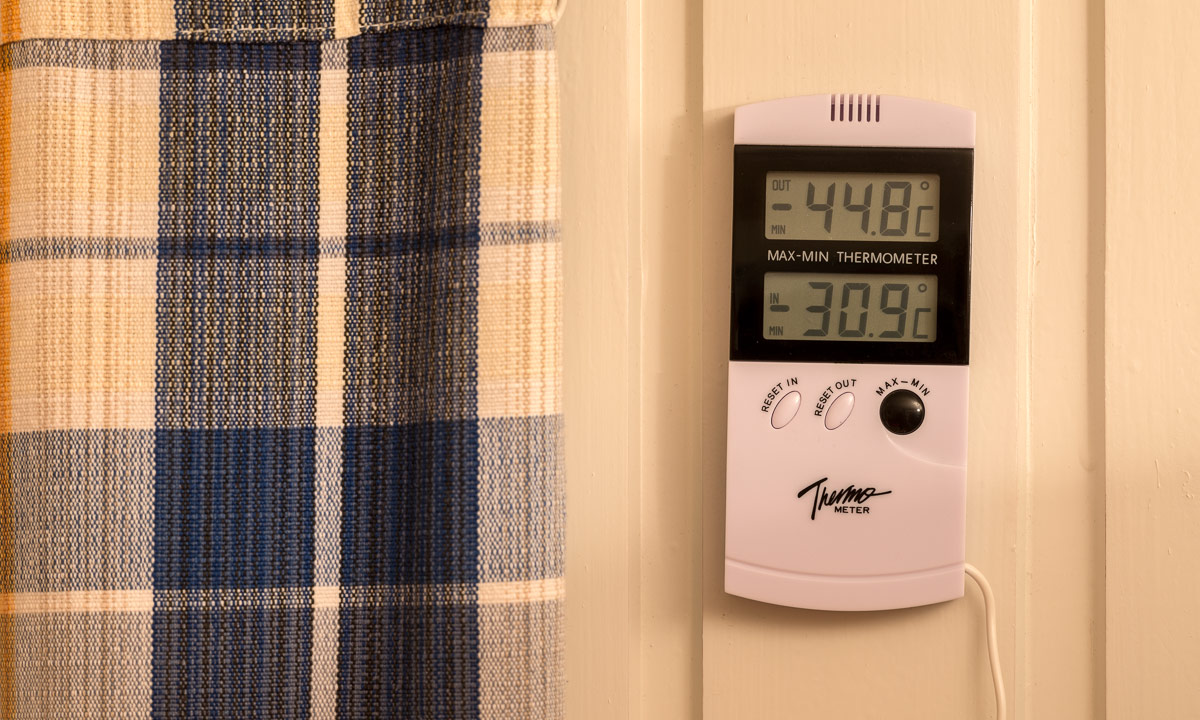
After a long trip I reached Nikkaluokta (many thanks to A. for the lift from Kiruna!) on the evening of the 17th I had one spare day in one of the cosy cabins of family Sarri. This place can be very cold and I had a look at the digital thermometer in the cabin: -44.8 °C minimum since the last reset – brr, that had been a cold day!

I climbed the small church hill and looked west. That’s were I’ll go the next day.

From Nikkaluokta to Kebnekaise Fjällstation

19 February · 19 km · Link to map

Time: 7:40, temperature -17 °C, weather: cloudy. Time to start the tour. I mount my skis, put the belt of the pulka (a sled for transportation) round my hips and after some gliding steps I see the first mark of the winter way to Kebnekaise.

It’s the only mark for a long time, the winter way to the Kebnekaise Fjällstation is not marked, neither on the map nor in real. But it’s easy to find the way, since many snowmobiles take this way and you only have to follow their tracks. Soon I’m at the place where the trail crosses the stream Čievrragorsa. In summer I used the chain bridge, In winter the snowmobile goes right over the frozen and snow covered stream. I can hear the sound of water running underneath the ice – a strange feeling.

After some kilometers I come to the lake Láddjujávri. Here you can eat waffles with cloudberries or burgers at “Lap Dånalds” and even take the boat over the lake to shorten your trip a bit. Well – in summer …

Hardly imaginable that I took a bath here six month ago on a hot summer day, when I was here with Annika. Not it’s winter, all is closed down, the boats lie on land and are covered with snow and I’m completely alone. Anyway it’s not too cold and I take a first rest on my tour. Without waffles, without a refreshing bath, but with the same beautiful view as in summer, since the sky starts to clear up and one mountain top after the other starts to get free from clouds, fogs and haze.

When I continue my tour over the ice of the frozen lake I soon can see the same mountain range as I did in summer. And it’s as beautiful as in summer, too.

After some kilometres the trail leaves the lake and continues through scattered birch forests and over frozen swamps, some of them covered with ice. The weather is fine and sky is of a clear blue with some clouds.

Another rest, this time on top of a rock, with hot tea, chocolate, and a bit of salami. What a beautiful day! I could sit here for hours, but I shouldn’t. I have to reach the huts of the Kebnekaise Fjällstation. I do reach them, but before that I have to work. The trail ascends and I have to make wide V-steps with my skis to be able to pull the pulka uphills. Finally I arrive. This mountain resort is quite huge, since Kebnekaise is the highest mountain in Sweden and very popular among hikers, skiers, and climbers. Anyway it is not opened yet beside of the cabin Jägarn (“the hunter”). Here I’ll stay overnight before I’ll continue to the Singistugorna the next day. Twice I climb on the small hill with the radio mast, first after sundown, then at half past six – where I see the first polar light of the tour.

From Kebnekaise Fjällstation to the Singistugorna

20 February · 14 km · Link to map

When I wake up sky is blue again and -17 °C. I take a short breakfast with muesli and prepare for leaving. That means: packing all things – doing the dishes – cleaning the kitchen and my bed room – checking that I have everything with me – putting on skis and pulka belt. Meanwhile the sky is overcast and it has started snowing. Weather can change quickly in the mountains.

After I have walked some kilometres it clears up a bit, just so much, that you can see some mountain tops shining through the hazy fog.

When I enter the narrow passage of the valley the mountain tops hide again, which is a pity. The mountains here are so beautiful.

There is not much snow in the mountains this winter. Parts of the marked winter way lead over stony passages with no snow at all. I have to go round these passages to avoid ruining my skis and pulka. Mostly I follow the snowmobile tracks, hoping that the locals know the best way.

This way leads over the frozen river, but sometimes it’s hard to see, since the snow under the overcast whitish-grey sky don’t show any contours. Wind increases, snow falls as well and the snow starts to drift in the increasing wind. In the narrow valley between the mountains Siŋŋičohhka and Liddubákti more snow lies on the ground which makes it easier to ski but worse to see.

That’s when you are really glad about the winter way marks: Red crosses set on long poles. Sadly plastic crosses are used nowadays. They are ugly, in my opinion harder to see and many of them are broken. But I’m glad to have them anyway. They do not only show you the way, they help you even in guessing whether it’s going up or down, which you cannot see, if visibility and sight are poor.

I always have compass and a good map with me on such tours. Anyway, if you cannot see any landmark these tools are of limited help if you do not count steps or know how fast you are on your skis. That’s when a GPS can be very handy. When I make another rest, longing for the mountain huts Singistugorna, the GPS revealed, that it’s only 970 meter to go. Easy!

Well, not really. The valley opens, wind increases and there are many rocks and snow-free parts on my way. I decide to circumnavigate a steeper passage and ski a bit to the right. To my big amazement I don’t go down but keep on level. Suddenly I feel part of the ground collapsing a bit and realise that I stand on the rim of a soft snow drift, about two meter high. It was absolutely impossible to see it. I’m lucky, that I didn’t fell down! I go back and circumnavigate my circumnavigation until I’m on the marked trail again. There I can see the cabins shining through the drifting and blowing snow. It takes some time to find a good way down to Singi but finally I arrive. Here the wind seems to be even stronger and the snow falls even more intense.

Stugvärd J. shows me my room, light fires in the ovens of the kitchen and my bed room and allows me to take my pulka inside since I’m the only guest. After doing some work he leaves and heads to his own cabin against hard wind and snow.

According to the forecast wind will increase even more and snow fall round 20 cm are expected. I’m glad, that I have time and plan to stay at least one other day in the Singistugorna, perhaps two.

The next article: Singi – from blizzard to clear sky >>

Another polar light

Just three-quarters of an hour ago on the near lake Snesviken.

Some notes: -12 °C outside of the house, probably colder on the lake. The jacket was not too warm. First time this winter, that I made some steps onto the ice of the lake. I just dared because of the many other footprints and the knowledge, that water is less than a meter deep at this place.

Another aurora

I cannot remember a year with so much Northern Lights as this year. Since August I saw them at least 20 times, if not even more often. Today the forecast was quite good and when I saw the first pale aurora at 22:30 I drove to the beach. The Northern Lights covered half the sky but were quite weak. But after a while they became stronger.

For a short time they were very strong, but I was too slow with the camera. I didn’t catch the two bright shooting stars neither, but if was beautiful to see them. As beautiful as the aurora weakening again but then flickering very fast over half of the sky – like dancing a secret dance too swift to follow. Unphotographable – you have to come, be lucky and have a look by yourself.

Click the image for a better quality – the computer-calculated preview is quite bad.

Strange skies

Three days ago Aurora Alerts by Soft Serve News showed a forecast for very strong polar lights, first for last night, than for tonight.

That’s why I took camera and tripod with me when I drove to the rehearsal with the Chamber Choir. When we had finished and I left the building it was cloudy – as expected – but you could see the green light of a quite strong aurora shining through the spots were clouds were less dense.

I hoped for the sky to clear up and drove to Långhällan – a favourite place at the seaside. Unfortunately however the sky hardly cleared up and finally the clouds became even denser. Suddenly I could spot a bright red light at the horizon. Is it a strong spotlight of a ship? But why is it so red? It took a minute until I realised that it’s really the moon rising above the horizon. I cannot remember seeing the moon in such an extreme red colour – even redder than at the total lunar eclipse five weeks ago.

The next photo is a bit special. It is much more edited than I use to edit photos to show the colder green colours of the Northern lights behind the clouds and the warm, now bright orange colour of the moon. I lit the foreground with a flashlight to make it visible. Not very easy to light it evenly without overexposing it. Even here I had to edit some spots that were too bright or too dark.

There may be less clouds at 4 or 5 o’clock. Ant perhaps still polar lights. But I guess I’ll be sound asleep … .

Scandinavian luxury – I

What is Scandinavian luxury?

When you drive home from a good rehearsal with the chamber choir and see a faint polar light through the front side window of your car.

When you arrive home and ignore the aurora, because you saw it already at least five times since August.

When you, just before going to bed, open the door and look outside.

When you sit on the wooden panel just in front of your front door and look at the intensifying Northern Lights, already wearing your pyjamas.

And make some photos – just half a meter from your front door. They won’t be the best, but you don’t care.

When you just slip into your boots and take another shot from the garden.

When you can experience this without being in a holiday – like it happened to me one and a half hours ago: That’s Scandinavian luxury!

Aurora – just for the records …

When I really put on some clothes in the middle of the night, grab the camera bag and tripod and take the car to drive to the beach or a small boat harbour, than it’s a proof for that the aurora was beautiful. At least in the moment, where I started to put on my clothes. However when I’ve reached the destination, the aurora quite often already has decreased to some shapeless something that is not at all attractive on photos.

And so it was today. Anyway the strongest Northern Lights I’ve seen so far this season, which just has begun. And the forecast for the next days looks quite good …