Arrival in Haukenes and greeting the sun

Day four

Today I only had 80 more kilometres to drive making it a total of 906 since my departure in Skelleftehamn. I started early and arrived in Haukenes on the Vesterålen at 9:30. The only picture I took was the view of the town Sortland seen from the Sortlandsundet.

The reason why I wanted to arrive so early was the plans of my friends that I’m visiting here. Today it’s the first day where you can see the sun again from their upland meadow Langbakken. The last day with polar night, that means no sun at all was 8th of January, but it took ten more days until the sun rose high enough to climb over the mountain tops of the Lofoten in the south.

We went up the hillside to the lavvu – a sami tent – where we first stood outside to greet the neighbours joining us and than sat in the tent round the fire altogether and ate and talked.

And finally – much later than expected – the sun found a gap in the mountain skyline! We all jumped out of the lavvu and looked at the first sun you could see from Langbakken since late November. Hooray!

The place where I am and will stay for the next days: Nøisomhed Gård, Haukenes, Vesterålen.


From Sweden to Norway

Day three (part II)

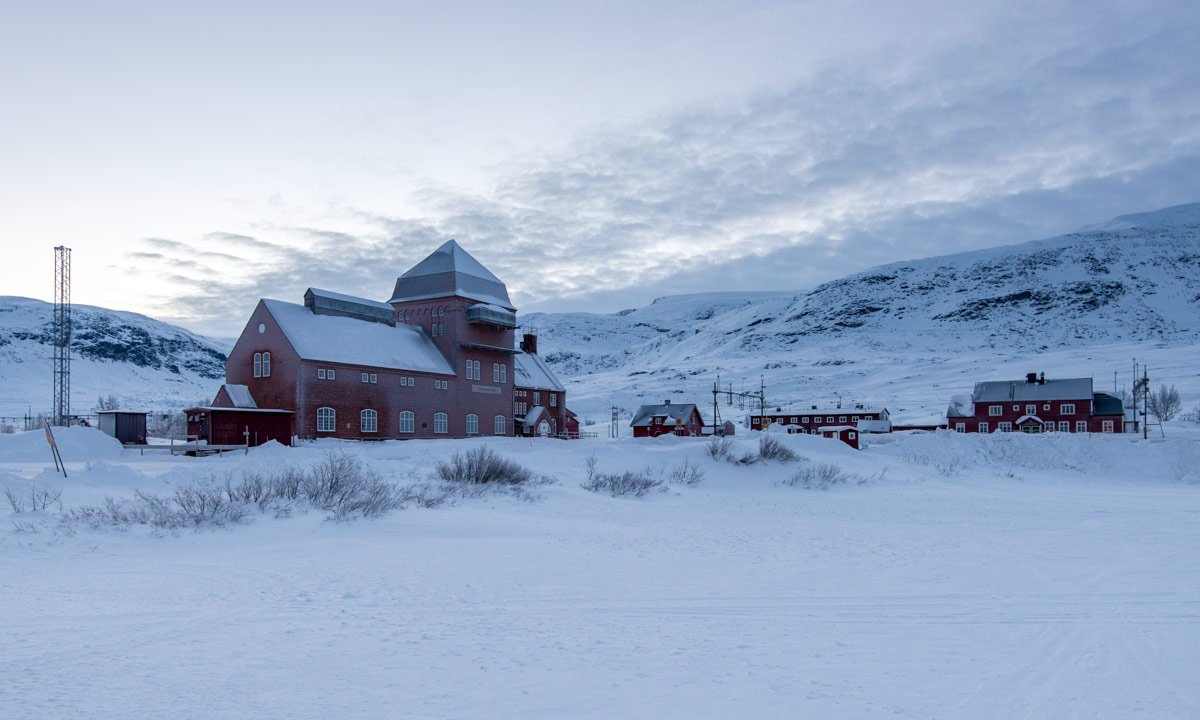
After leaving the reindeers behind I continued to the Norwegian border. But first I made a picture of the strange looking railway station in Vassijaure, the last photo from Sweden for some time. Soon I reached the village Riksgränsen and right after it the Swedish-Norwegian border. I took the first parking opportunity and made the first photo in Norway of my tour.

Just some miles (a Scandinavian mile is 10 km) later I could see the first fjord. And shortly after this another typical Norwegian happened to me: A construction site with a “follow me” car because due to work in the tunnel the road was only one-way.

I continued on the E10 to Bjerkvik. Shortly before Bogen i Ofoten I took a side road and took a picture of the beautiful sunset colours above the snowy mountains. Soon I reached Bogen and made two other pics:

… and another image in Kongsvika in the dusk:

The whole trip was amazing, mostly because of the varying landscape. Sometimes the road follows the coast line of a fjord, sometimes it crosses the fjell – the mountains. Once temperature dropped from 0 °C to -15 °C within two minutes just because I left the coast and entered the fjell.

I changed plans and made an additional stop in Lødingen where I am right now. When I arrived it was already too dark to take pictures, but I had a nice two-hour evening walk. First I followed the coast line (including wading, almost slipping on the ice and a bit of simple climbing) and then followed a forest path back to civilisation. It was great just walking through the lonely nature after having been sitting in the car for three days!

Tomorrow morning I’ll head to Stokmarknes and take a (late) breakfast with my friends. I’ll stay there for some days and I’m really looking forward to be outdoors instead of sitting in the car.

Reindeers – many, many reindeers

Day three (part I)

Today I got up early, no wonder after more than 10 hours sleep. I packed my things, cleaned the room and left Abisko heading westwards. It was still twilit and I was quite alone on the road.

That changed after 18 kilometres: A huge herd of reindeers blocked the road. I slowed down and slowly, slowly drove through the reindeers. Right after the reindeer crossing I found a parking place. Good to exit the car and take some images of these beautiful and gentle animals.

The reason why the reindeers were hanging around was probably the pile of big bags lying beside of the road. I guess they contain reindeer food.

After half an hour of taking pictures and watching I entered the car again and continued my journey to Norway.

Starting the journey

Day one and two

Round half past nine I started “Nordkalotten 2015”, my long journey through Northern Sweden, Norway and Finland. The first destination is Stokmarknes, which is 880 km away and according to Google Maps it takes eleven hours, nine minutes from my home in Skelleftehamn. I’m not a long distance driver therefore I divided the journey into three parts.

Day 1: Skelleftehamn – Solberget

When I started sky was completely cloudy and overcast but right after Vidsel the sky started to clear up and the temperatures dropped from -8 °C in Skelleftehamn to -21 °C in Solberget (with a daily minimum of -23 °C). On the journey I had to cross the river Luleälven three times and on one of the long bridges I could see the sun slowly going down.

I’ve been in Solberget many times and I’ll be there again in February. This time I stayed only to sleep and continued the next day. I one woke up when Sesam, the tom cat and secret owner of Solberget lay down on my feet in the dead of night.

Day 2: Solberget – Abisko

The evening before temperatures increased and it started snowing. When I woke up almost 10 cm fresh snow covered the ground and my car and it was only -2 °C. Half past nine I continued my journey heading for Gällivare, Kiruna and Abisko. It was cloudy the whole time but fortunately almost no snow fell. That made driving as easy as on the first day. Just some kilometres before Abisko sky cleared up a bit. I was lucky and could hire the same nice room where I already stayed last February for a week.

Tomorrow I’ll enter Norway and continue to Stokmarknes.

Just testing the travel computer

I just have to test the computer I take with my on my journey before I leave tomorrow.

Copying images to Lightroom: CHECK
Finalising in Photoshop: CHECK
Uploading photos to the blog: CHECK

And here’s the test photo from today: The fence in my back garden.

I’m almost a bit sad to leave this fine place but the pleasant anticipation prevails.

Oh yes.

Publishing a blog article: CHECK

T minus 35 hours

Now I’ve made up my decision: I’ll start my journey on Thursday round 11 o’clock. That’s only 35 hours left! I’ll have to work all day tomorrow to manage my departure in time. Mostly it’s packing the zillion things I’ll want to take with me, but I have to continue and finish the installation of my travelling computer (my old MacBook Pro) and we all know: Working with computers always takes more time than planned and excepted.

Anyway, I managed to take a photo of the cement carrier Sunnanvik that regularly goes ashore in the bay nearby. Look how ice-covered the foredeck is! I would have preferred a wide angle lens shot from a lesser distance, but the whole bay was clear of ice some days ago and the new ice is much too weak to bear me.

That’s probably my last photo made in Skelleftehamn for long. When I’ll write the next blog post, I’m probably in the midst of Swedish Lapland already.

The magic ice world

Today I was in another universe. At least it looked a bit like it.

After my adventure on the “ice shelf” last night I longed to see the place by daylight. Breakfast was late but so was sunrise and right after I’ve eaten I drove to Näsgrundet again. We had -17 °C (more or less the whole day by the way) and some snow crystal fluttered out of the grey stratus clouds. I put on my grödels – simple crampons – to be able to go on the ice slope. Soon I stood at the rim and looked down into the calmed down sea. The view was quite impressive …

… but …

it would be great to see the ice walls with its icicles from the seaside. It’s not, that I didn’t think about it before, that’s why I had both my waterproof camera and my waterproof survival suit with me. I undressed a bit (not the funniest thing when it’s -17 °C outside) and slipped into the red suit. Then I took the camera and glided into the water. And that’s where I entered another universe. But enough words, the photos! Here they are:

I really loved to paddle in the ice water and to look at the ice walls that where decorated so beautifully wich icicles. Since the attached rubber gloves are waterproof, but not warm at all, my right hand index finger didn’t like the adventure as much as I did and got a bit of frostbite (it still hurts a bit but nothing serious, fortunately). And that’s how I looked like today when I took all these photos:

Winter intensifies

Did I write about the “just normal” winter two days before? Well that changed a bit. Right after I wrote the last article the snowfall intensified and brought 10 cm new snow within 16 hours. It got both windier and colder and still snowed a lot.

Today¹ I took a walk round the small lake Rudtjärnen. Snow fell in thick, heavy flakes and made it impossible to look farther than 100 meters. The squalls whirled up the snow morphing the view into a grey-white nothing. And it was even windier on the slope by the lake. The trees on the 2nd photo were hardly 50 metres away!

That was a nice and not so long walk (which was intended since I don’t want to overstrain myself right after the infection), but it wasn’t enough. I wanted to go out again. And so I did. This time with food and drink, (of course) my camera, my new flashlight and my new down clothes for some testing. I already guessed that I couldn’t drive to the small boat harbour because the way wasn’t ploughed and snow was too deep for my car. So I decided to continue to the peninsula Näsgrundet. What a piece of luck!

I dressed up for cold weather, lit my new strong flashlight and went to the rocky beach. Normally the shore descends to the open sea but not tonight where – I couldn’t believe my eyes – the shore was an ice shelf rising up at least one meter before dropping into a black nothing. I could hear the sea behind but I couldn’t see it. Where am I? What happened? Then I heard a rolling wave and – SPLAT! – I could see water and foam rising high up behind the brink and clashing onto the ice shelf! It took a moment or two until I realised what happened: The brisk northern wind presses the waves ashore where they rocket up into the air several meters. I guess that the water and foam first landed on the rocks where it probably froze almost instantly – remember, it’s -15 °C  out there. The rocks became more and more ice covered until they vanished under a growing layer of ice. When I came to this place this evening some parts of the ice were already two meters above sea level! And still some of the waves managed to toss a lot of water onto the ice where it froze and enlarged the ice shelf. What a fantastic experience!

I was both happy to be out there and a bit disappointed that I couldn’t share this moment. If I at least could take a photo, but how to take pictures of waves when it’s so dark. Wait a moment – dark? – My new flashlight was described as extremely bright – Let’s test. I switched the flashlight to the brightest mode, laid it onto my backpack and adjusted the beam to the waves. Then I took tripod and camera and started to experiment. And that’s the result:

I’m impressed. The new Flashlight is really bright. So bright that I can take such pictures at night time. (For the photo freaks: 1/20 sec at f / 4.5, ISO 1600. 35mm)

OK. The flashlight succeeded the test. But what’s with the rest? I was curious how warm the new bought down parka and down pant would be. I just wore a single layer of woollen underwear and my thin but windproof Norrøna-jacket, mostly to test the fur under the down clothes, that was all. (Not mentioning boots and gloves, of course). I’ve been out more than an hour, first taking pictures, then measuring wind and temperature, than taking my frugal evening meal. And yes – the Marmot down combination is as warm, snugly and cozy as it looks like. Almost too warm when sitting although we had an average wind speed of 10 m/s resulting in a wind chill of  -27 C. That’s good to know.

Now I’m longing to sunrise. I want to visit the spot again and take some daylight pictures. That’s perhaps evan a reason to postpone my journey another day. I’m not in a hurry. But tomorrow, when I’ll visit the place again I’ll wear something less water-sensitive than down, because tonight I always expected a huge monster wave would flood half the shelf and soak me completely.

Finally just two selfies from today, one when I walked round the lake, the other when I sat outside after the evening meal.

Foot note:

¹ As a matter of fact: Yesterday. It will already be Monday when I publish this article.

Some vocabularies for my German readers:

squall – Windböe
down – (hier) Daune
foam – (hier) Gischt
flashlight – Taschenlampe
fur – Pelz

For equipment nerds:

Flashlight: Nitecore EA41 Pioneer
Down clothes: Marmot 8000M Parka, Marmot 8000M Pant. Older (or simpler) models.

Just for the archives:

Friday 2015-01-09 21:45 ca. 30 cm -4.6 °C
Saturday 2015-01-10 13:40 ca. 40 cm -7.1 °C
Sunday 2015-01-09 09:15 ca. 45 cm -8.6 °C
Sunday 2015-01-09 16:55 ca. 52 cm (47 cm backyard, 57 cm front yard) -15.0 °C

Just a normal winter

Living at the coast of the Bothnian Bay, the most northern part of the Baltic Sea can be a bit surprising, when it comes to weather. Let’s take the weather one year ago, for example. January started with rain falling on the frozen ground and the roads where so slippery that you hardly could use the car, even with spiked tyres on it. (German article: “Eisflächen”). One week later we had a lake effect in Skelleftehamn and got 83 cm of snow on bare ground within 24 hours! The city Skellefteå, hardly 20 kilometres away got a millimetre! (German articles: “Schneekanonen 2014”).

Just now we have winter. Just winter. It’s -5 °C – not too warm, not too cold. There a 30 cm of snow in the backyard – not very much but not very little neither. And it has been snowing for almost two days, not much, but anyway. That’s what the Swedes call lagom, a word that’s perhaps translated best with “just the right amount”.

The high water mark of the Baltic Sea sank from +104 cm to +40 cm within the last days, leaving the beach of Storgrundet covered with ice and fresh fallen snow making the high water completely invisible.

The lake Snesviken is covered with ice and snow, too and parts of the old boat that I photographed two month ago have been vanished in snow as well. The sky is grey and the trees on the other side of the lake look a bit blurred since it is still snowing. Not much, just lagom.

I’ve been ill since sunday but today is the first day where I feel better. Tomorrow I’ll start with the last preparations for the tour and I planned to depart on next Wednesday, the 14th. I’m really looking forward to travel way up north and will hopefully provide you with many articles and photos – as long as my laptop doesn’t freeze do death.

At high watermark

Today we had a really high watermark in the Baltic Sea: Up to one meter above sea level. You may laugh if you live nearby the Northern Sea or the Atlantic Ocean, but that’s a lot for the Bottenviken, the northern part of the Baltic Sea and hasn’t happened for several years. Despite of my cold I took the car and drove to several places to make pictures of the flooded shores. But I realised, that most motives were extremely boring. What differs a shore with high water of a shore with sea level? Almost nothing!

But the beach at Storgrundet was a bit different. The ice was covered with 60 cm water and slush and the whole sand beach was flooded and many of the small pines that grow beside the beach where partly or completely under water. What a pity, that I didn’t have my waterproof camera with me.