Kayaking in the sunrise

“BING-BINGA-BINGA-BING-BING-BING-A-BINGA …!”

… yells the alarm on my mobile. I open my eyes, still partly caught in my dreams. Then I realise: It’s 5 o’clock in the morning and I’ve planned a paddle trip today. Out there it’s still pitch black and reluctantly I get up and get some breakfast. I’ve already packed the day before: dry suit – neoprene boots, gloves and hood – camera in a waterproof bag – water and chocolate. The compass and the live vest are already in the kayak. I leave, pulling my kayak behind on its trolley and the temperature is -4.5 °C – the coldest day since April. Round half an hour later I’m ready to start the tour. The sun hasn’t risen yet and some pink clouds hang in the blue sky.

At the sandy beach I drag the kayak into the water, lay the paddle on both the boat and the shallow ground to avoid tipping and climb in. I do some strokes, unfold the rudder that helps my steering the kayak and turn right. It’s low water and much more stones and rocks are visible as usual. I turn right again to paddle between the island Brambärsgrundet and the mainland. After that I turn left again and see the horizon and an archipelago of stones. I have to make my way through and more than once I hear the typical clicking sound, when the sea is so shallow, that the rudder at the rear touches ground and is lifted up.

The colours start to change: From light pink to something you could call apricot to warm orange. And then the sun starts to rise. It’s not that I’ve never seen sunrises before, but still I love to watch.

The sun rises a bit higher and starts to illuminate the colourful trees on the island Storgrundet which I’m approaching. Before I reach that island I turn right again and head to the open water. All I see in front of me is water, waves, the sky, clouds and midmost: the horizon. It looks like I just could paddle straight ahead to the horizon for ages. Probably it would take ages: it’s round 150 kilometres to the Finnish mainland.

So I turn left again and paddle along Storgrundets outer shoreline, go round the western peak and to the same beach were I started my tour one and a half hours before. A quite short, but pleasant kayak trip.

I go ashore and drag the kayak to the beach. It’s still below zero. The spray water on the kayak is frozen and there’s hoar frost on leaves and wood, especially in the shadowy places.

Now I exchange the dry suit for pants and jacket and the neoprene hood for a woollen cap. Dry suit and such is great for protection in case of falling into the cold water, but the “normal” clothes feel much more comfortable. I make a last photo of the beach and the island Storgrundet in the back, then I return home dragging the kayak behind.

At 9 o’clock I start my normal work.

“New Year’s resolution”: Be more outdoors in my everyday life, even if it’s short.


Boat bridge by day and night (featuring Aurora)

Two photos of the small wooden, floating boat bridge at Storgrundet, the nearest beach from my house in Skelleftehamn. Both are made today.

One is a snapshot, made 10:30 in broad daylight. The sky is bright blue, the birch leaves are still yellow, slowly turning brown. A boat has just put out to the near island. The sun still warms, but it is windy and the air is fresh. Tiny waves make the boat bridge wobble and you can hear the waves gurgle.

Almost twelve hours later, att 22:08 I make the second image, this time with a tripod and 10 sec exposure time. The sun went done at 6 o’clock and the temperature has dropped to 4 °C. A cloudless and starry sky arches above the near island and the rests of a polar lights are flickering above the horizon. Just as this morning the boat bridge is wobbling in the tiny gurgling waves – that’s way this photo is jittered.

I like either views, both the autumn leaves in the sun and the polar light in the night. However while I enjoy the autumn days just as they are, the polar light increases the anticipation of the coming winter – still months away, but coming for sure.

Jämtland hike part II: hejdå Sweden, hei Norge!

This article is part of the series “2016-09: Jämtland and Norway”.

Annika and I are in the mountains in Jämtland and have just reached our first destination: Blåhammaren, where we slept in a 14-bed room.

Tuesday, 13. September

Sleeping in a 14-bed room can be quite demanding, especially if you have this kind of snorers in your room, that could awake a frozen mammoth. However Annika and I were really lucky, no snorers at all! After our breakfast we had to decide where to continue our tour. From Blåhammaren you can hike back to civilisation or continue to two other destinations. Most of the hikers continue to Sylarna which is very central and part of the Jämtland Triangle, a very popular three-day-tour, that connects Storulvån, Blåhammaren and just Sylarna. We were keener to cross the border and hike to the Norwegian lodge Storerikvollen and so we did.

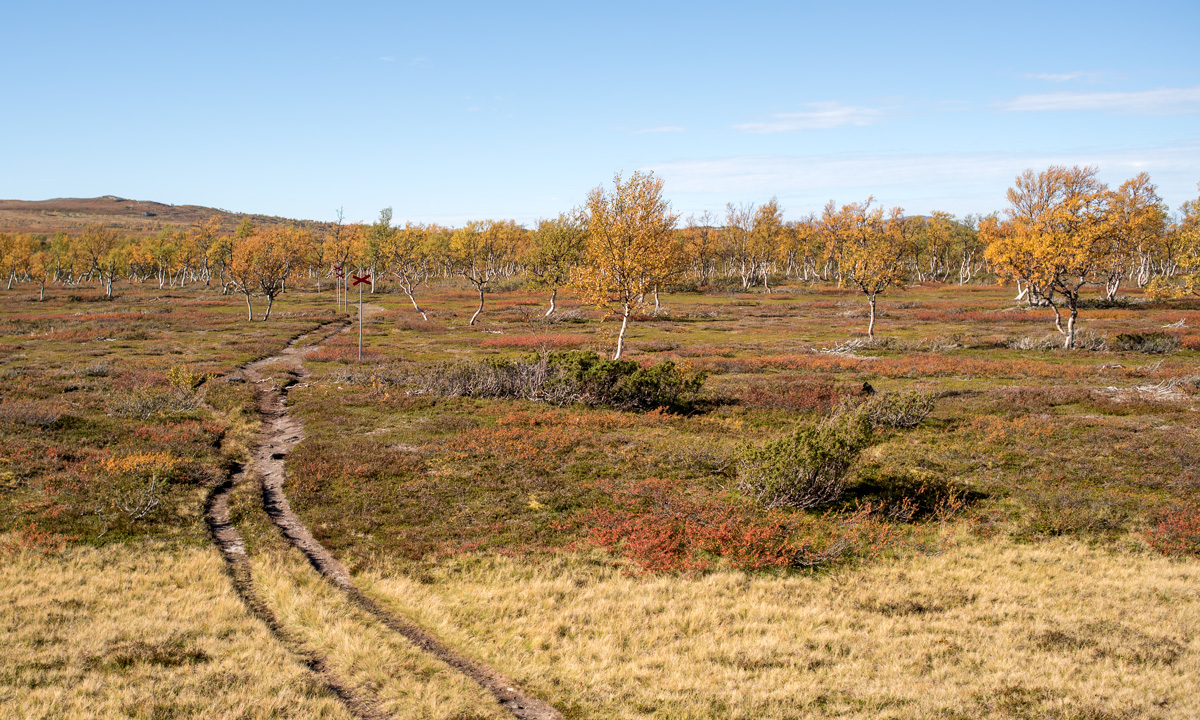
With an altitude of 1086 m Blåhammaren is the highest tourist station of the STF – the Swedish Tourist Association – so first the trail ran over the treeless mountain plateau, over rocks and moss, crossing some swamps and brooks. After a while we descended and the first yellow coloured birch trees came into view again.

Swedish summer trails are marked with red coloured dots on rock or tree, while winter trails are marked with poles bearing red crosses. You really shouldn’t follow the winter trails in summer unless you want to stand in front of a lake or find yourself deep in a bog – both are easy to cross only in wintertime. But quite often there’s a year round trail which makes navigation extremely easy even on less walked routes.

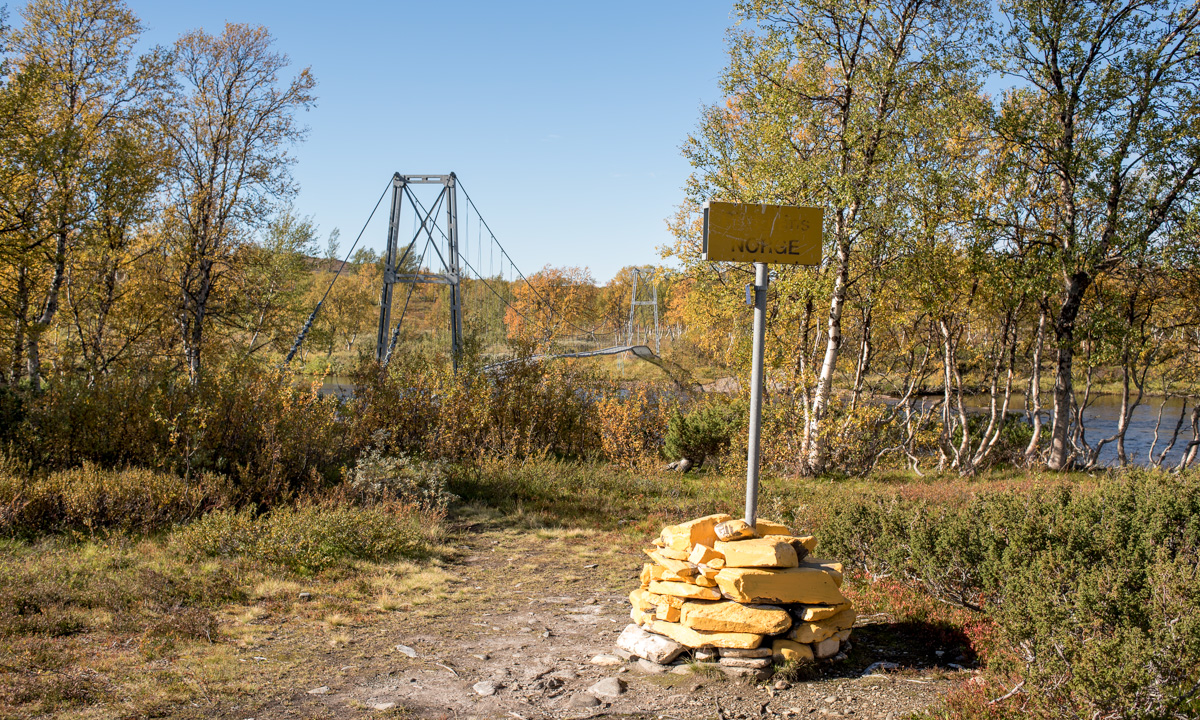
One kilometre behind Endalen, an emergency shelter, where we rested for a short while, the Sweden-Norwegian border came into view. It’s hard to mark a border less spectacularly than this one: A sign amidst of a pile of yellow painted stones, that’s it. The large bridge that crosses the river Enan (Sami: Äjnänjohke) directly after the border offers far more spectacularity.

We detected a real nice resting place on the other side of the river, where we planned to enjoy the warm summerly weather, but two other hikers – by the way the first ones we met that day – coming from the other side chose exactly the same slab of rock to rest. Luckily we found another place, at least as nice as the first one. We unmounted our backpacks, took of our boots and dangled our feet into the ice-cold water.

(I like the photo with the drifting yellow birch leave and the dead mosquito. It illustrates, why I prefer the autumn to summer: Beautiful colours and no biting insects left!)

In Norway the summer trail marks change, now the trail was marked with big bright red T-s. The red T is also the logo of the DNT, the Norwegian Trekking Association.

Do you see the dark piece of something on the top of the stone? It’s animal droppings, but I’m not sure of which species. I asked for help on Facebook and the favourite answers are reindeer and (arctic) fox.

We continued our tour until we came to another swing bridge, this time crossing the river Djupholma. On the other side of that river lies a nice sandy beach where I took a refreshing bath (the only one of the whole tour). It was only two other kilometres to walk to our destination, the cabin Storerikvollen, where we arrived round six o’clock.

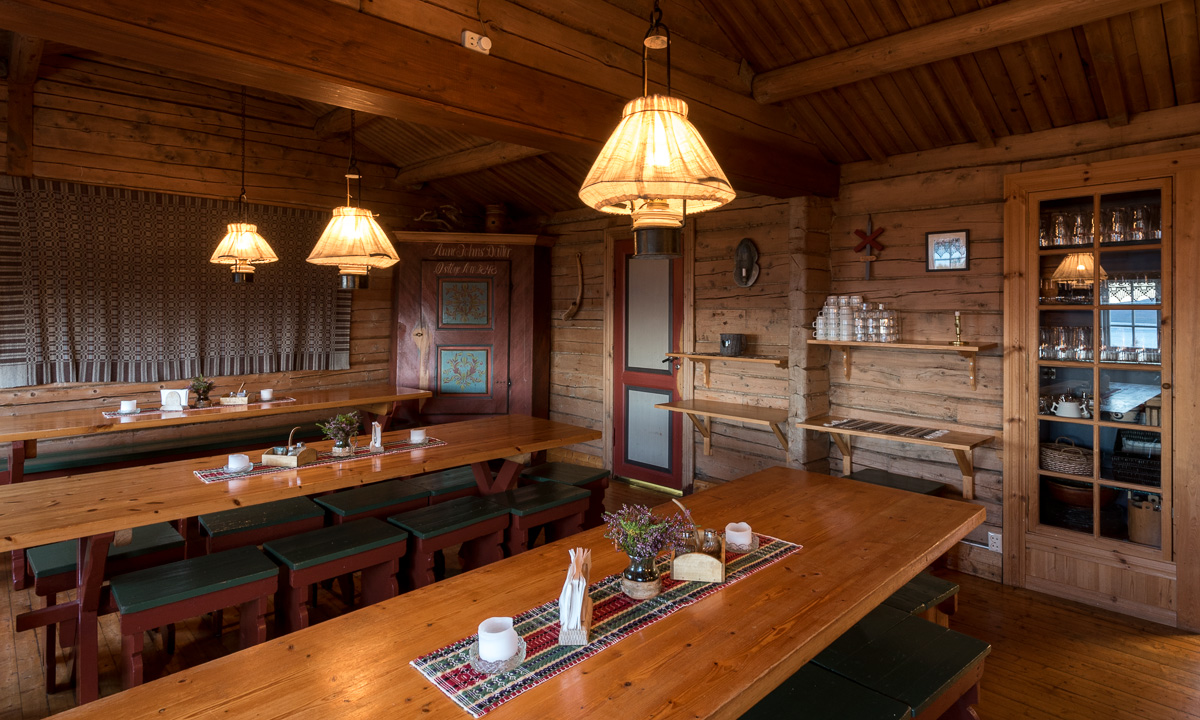
Oh, so nice these Norwegian lodges are. They seem less “funkis” (the Swedish functional style) and more “hyggelig” (the Norwegian word for cozy, snug, or homelike). Just gemütlich! And we got a two-bed-room for a good price. The only thing you should know, when you visit the Norwegian side: These cabins hardly sell any food and there is no public kitchen as in the Swedish cabins. So you have three options: (1) take a camp stove with you and cook outside. (2) cold dishes! Hopefully you have all with you. (3) eat the dinner and breakfast provided by the lodges (and pay the Norwegian price).

We chose (2) and had a nice dinner with salami, crisp bread and fresh water outside in the evening sun, enjoying both our simple meal, the warm air and the beautiful view. Later the almost full moon rose above the reddish mountain chain – what a beautiful evening!

Wednesday, 14. September

The next day would lead us to the Nedalshytta, which is between 20 and 24 km away, depending on which map or sign post you rely on. So we got up quite early.

We had to go back yesterdays route 2 or 3 km where the trail divided. Now we turned south and had to ascent. Soon again we were above the treeline. When we looked back, we could see parts of the big lake Essandsjøen and even spotted – beside of some reindeers – the now tiny Storerikvollen, that we left some ours ago.

After a while we came to the river Fiskåa, where we had to ford. My rubber boots were high enough and I just splashed through the water, whereas Annika changed boots with trekking sandals and waded through the river.

Since rivers use to flow through valleys we had to ascend again and walked up along a reindeer fence. The weather was still warm and sunny, but you could see a cloud layer approaching afar. Would it rain in the evening as the forecast told us?

Only the map showed us the progress of our longest tour so far. We went a bit up, a bit down, a bit to the left, a bit to the right, down a small valley and up again. But finally trees came into view once more and soon we stood on an exposed plateau not far away from the yet invisible Nedalshytta.

Come on, just less than a kilometre to go … . Final spurt! A short while later we arrived at the beautiful lodge. Again we got a nice two-bed room, this time right below the grass roof. And we got: pizza! Perhaps not the best I ate in my life, but walk 20 – 24 kilometres with a backpack by yourself and you’ll know, how delicious a warm pizza slice can be!

The tour so far:

Continue with part three …

The first polar light of the season

When Annika woke me up, a strong and colourful polar light covered the northern sky. In the short time it took to go in for getting my camera and tripod it already got much weaker, but it was still strong enough to take a picture with a quite short exposure time.

The first polar light of the season is always something special, especially when it’s still August. Almost unbelievable, that only one month ago the nightly sky was so bright, that you hardly could see a single star.

To see the Northern lights from your own garden is still pure luxury. Now I’m looking forward to the next time …

(ISO 800 · 14mm · f/2.8 · 5.0 sec)

Noctilucent clouds

19 days ago it was dark enough to see the first star. Since then it got a bit darker each night and tonight – which is a clear night – you can see the first constellations as for example Cassiopeia.

It would be dark enough for the first polar lights of the season but there aren’t any this night. Anyway I spotted something even better in my opinion since it is not often that you can see it so lucid as tonight: Noctilucent clouds, which are clouds so high up in the sky that they are illuminated by the sun the whole night through. Cirrus clouds, the highest “normal” clouds exist in altitudes of round 4 – 12 km, noctilucent clouds however occur in altitudes round 50 km! And I think there are really beautiful.

Translation:

EnglishGermanSwedish
Noctilucent cloudsLeuchtende NachtwolkenNattlysande moln

Balloon hunting

Actually I was prepared for a relaxed evening home and I was already in my pyjamas, when I saw a friend’s post on Facebook: A photo of a balloon hanging over the city of Skellefteå right now.

Some people know, that I’ve been fond of balloons since I was a child. I loved to spot them and when I was older, I was a well-known guest at the gas balloon starting place in Marl-Sinsen. Here I made my first balloon flight with the gas balloon D-KABEL in 1994. Some other balloon flights, mostly with hot-air balloons followed. Since I’ve been living in Northern Sweden this passion fell asleep – there are hardly any balloons flying here.

But back to today. I guess, it took me only three minutes to dress, to check wind direction and speed, to take my binoculars and camera equipment and to get in my car to try to track that balloon. Will I manage to see it?

I was lucky – already in Ursviken I could perceive the hot-air balloon above the trees. At the roundabout I turned right and then, after a while, left again onto the E4 to drive up vitberget – the white mountain for getting a better view. The view was fine, but the balloon not within sight, it was behind that hill. So I turned, got onto the E4 again and headed north. When I approached Boviken I could see the balloon again, it hovered on the left side. I took the next departure in Kåge and tried to come closer. Not easy, when you don’t know all those small ways and gravel paths. But I was extremely lucky, came quite near and could take a photo before the balloon landed.

I continued the gravel path and soon was side by side with the low flying balloon.

I could see the chase vehicle ahead. It continued the path and I followed. The chase vehicle succeeded to find a cross road without any power lines in the balloon’s flying direction. That’s perfect, since the pilot will get the opportunity to land quite near the road, that simplifies the packing of the balloon. I parked my car and waited for the balloon to land.

Wow – I’ve seen some balloon landings, but this was the most incredible one I’ve ever seen! The trailer of the chase vehicle was exactly in the heading of the balloon, which approached the trailer more and more. The surface wind was so weak, that the balloon almost could hover above the trailer, where one of the ground crew and I could clutch the basket and with the pilot’s help drag it down onto the trailer! The pilot has been ballooning for forty years, but never managed such before. Chapeau, P.!

Normally helping hands are very welcome after a balloon has landed, but this was a larger balloon carrying nine passengers, so I could stroll around and for example have a look into the inside of the balloon cover (of course with the Pilot’s permission).

It was great to see a balloon again and to talk to the pilot. Now I’m quite interested in taking a ballon flight here, too. I realised that I already met the Pilot on the Arctic Ballon Adventure in Gällivare in 2012. Today he told me, that this event will take place again in March and now I’ll try to get at least one balloon flight next winter. Keep your fingers crossed for my first arctic winter balloon flight.

Meanwhile the moon rose over the green pastures of Ersmarkbodarna, where the balloon has landed. Another sphere in the sky.

Thank you, Nazia, for your Facebook post! You brought me a fantastic evening!

Now it’s already “tomorrow” – almost one o’clock in the night. Something happened, that I’ve been waiting for for many weeks: It’s dark enough to see the first star! It took some efforts (hint: look up and shake your head to see the tiny changes of lightness), but I could see it: Vega in the constellation Lyra.

Summer solstice – “night shot” in Skelleftehamn

Summer solstice– the longest day – the shortest night, that’s today.

I was out at the coast to take a photo at 0:37 – in the darkest minute of the brightest night 2016. The sun is hardly 2° below the horizon and so it looks more like an evening sunset or an early morning sunrise than a real “dead of night” shot.

The summer solstice marks the beginning of the astronomical summer, but it’s also the day, where nights will get longer and longer. And one day in August it will be dark enough for the first star shining through the pale nightly sky.

Colourful sunset

After a really warm day (+12 °C!) we got a colourful sunset. Unfortunately I was too late to catch the most colourful period.

The ice on the Baltic Sea is still thick, but the snow melted and left many ice water puddles between the snowmobile tracks.