Polar expedition AeN JC3 – day 5: marine fauna · entering the ice · temperature drop

This article is part of the series “2022-02: Winter cruise KPH”.

Day 5 · 23 February 2022

12:30 – it gets colder

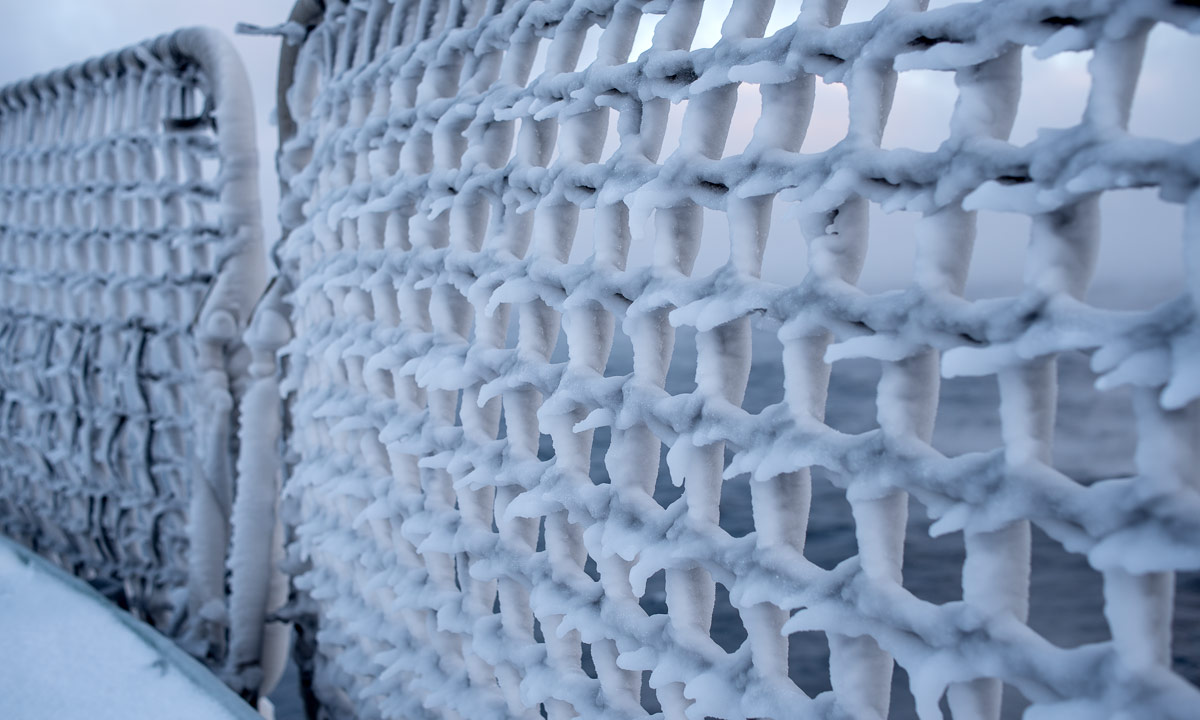
Over night it has become much colder and windier. Temperature has dropped to -17 °C and the relative wind speed has increased to 17 m/s (ca. 60 km/h). According to the wind chill formula that feels like -33 °C. The taut nets around the deck are covered with ice structures and ice fog hovers over the still open sea.
14:00 – marine fauna

A large trawl net is being pulled up. Scientist are waiting on deck, they look eager. What will the trawl reveal?

The net is up and the haul is emptied onto the deck.

At once the marine biologists gather round the catch and start browsing, identifying, sorting. I know some of the animals, but neither taxonomy nor latin name. It’s a childhood’s memory – me walking along the shore, my eyes glued to the soil to search for shells, jellyfish, worms, starfish. As a child I wanted to become a researcher but live has changed many times. Anyhow it finally brought me here on this polar expedition on Kronprins Haakon. But I digress, back to some photos of marine fauna and scientists:

I would love to know a bit more about the taxonomy of all these species but this will take some time and efforts, nothing you will get for free.

14:37 – the first sea ice

And there it is. The first sea ice is ahead.

The photo is awful. Noisy, underexposed two levels but I want it here in the blog. Not only for you but also for me because it’s the very first photo of sea ice on this cruise.

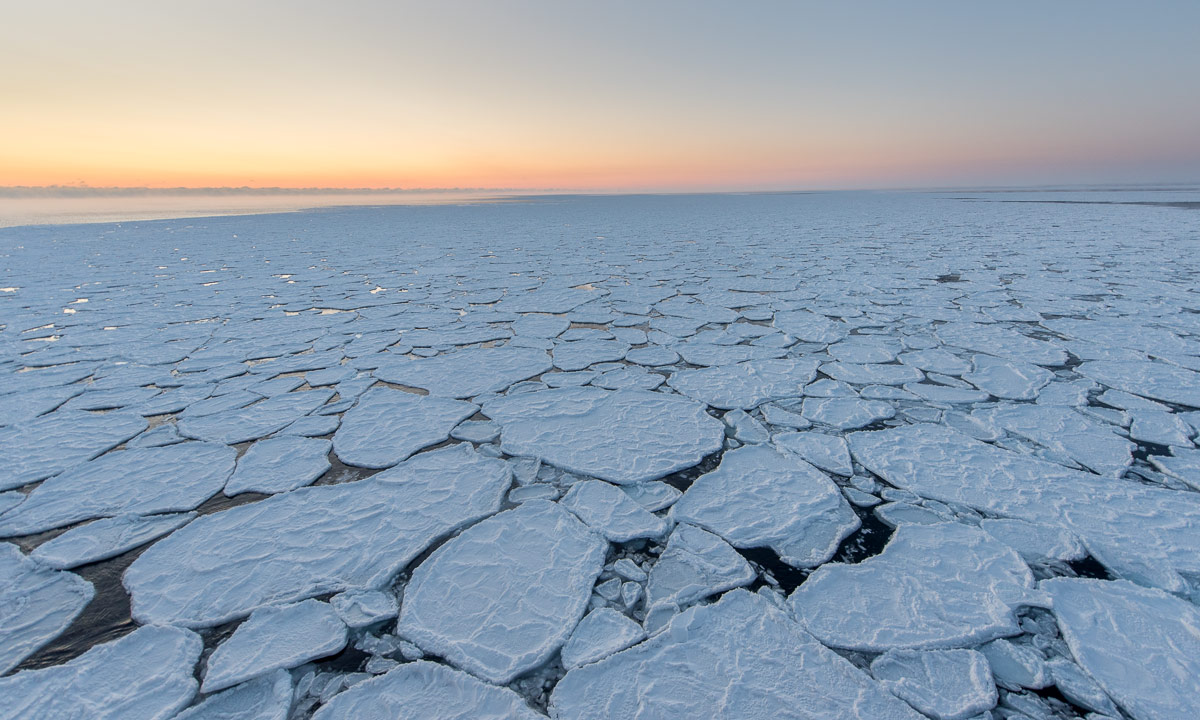
But there is more. While we continue north, soon the Barents Sea gets covered with pancake ice – called because of the rounded shapes of the ice floes – that soon make place for larger ice floes. That takes only 20 minutes.

(The images are not in chronological order for layout reasons)

For more than an hour I stand at the bow of the heli deck and watch the changes of the ice coverage. I love ice, I love the sea, I love cold winter and here I can get it all together. I feel happy! And cold it has become. Temperature -22 °C, relative wind speed 16 m/s resulting in a wind chill of -39 °C. The Canada Goose Snow Mantra parka starts to make sense. It shows what it can: keeping me warm under these conditions.

I use a pair of gloves and two pairs of mittens to keep hands and fingers warm. With one exception: Smartphone selfies. These I take bare-handed. While doing that the pinky of my right hand gets really cold and I will feel this for many hours. I’m lucky, the fingertip has no frostbite but I decide to stop making selfies in such harsh conditions. I love the arctic, but I play piano, too. I need my fingers. All of them.

15:59 – dinner pleasures

The haul caught a lot of animals, amongst others a lot of shrimps. Only some of them are needed for research. I help cleaning them, plucking away starfish and other species while a huge pot with salt water starts boiling. And at dinner we all get shrimps. Freshly caught in the Arctic. Delicious!

19:00 – photo shooting

A. a marine taxonomy expert asks me if he can borrow a tripod, he wants to take photos of some of the animals. Oops – I forgot the mount for attaching other cameras. I make another proposal: I’ll drop by and take pictures by myself. From this day I’m the “official court photographer” of non-microscopic animals. That’s work I really like. The first results are not the best, but I’ll share them anyhow:

Species identification taken from the cruise report of Andreas Altenburger. Thanks a lot!

21:30 – Sailing through the night

It’s dark. Ice has become thicker and you can hear the cracking and feel the vibrations from Kronprins Haakon breaking the ice. Again I stand on the heli deck looking ahead. Two strong spotlights illuminate the ice.

And for some minutes there is even a Northern light palely glowing in the sky.

While I stand there, happily watching the ice and the sky, muffled up warmly in my down parka and pants, temperature has dropped even more. -28 °C, windchill -44 °C.

temperate in °C | wind speed relative to the ship in m/s | resulting windchill in °C.


Kayaking in the fog

Before I post some more black-and-white photographs from our car trip through Finland I’ll show you some photos from Annika’s and my kayak tour today. I cannot remember a week as foggy as this one since I moved to Sweden and it was foggy today, too. We couldn’t see the islet Lillskär from our house because it was hidden in the fog. It was however visible from the place where our kayaks lie. Or should I write float, because we had a water level of +45 cm.

Our tour wasn’t long but fun as every kayak tour. Now our kayaks lie on land and are waiting to be cleaned and dried. Then mine will be stored in the garage because I’ll travel to Tromsø on Tuesday and won’t be here before next year.

Saskarö in the fog

From Monday and Thursday Annika and I made a trip that I had in mind for a longer while. Travelling round the Bothnian Bay which is the northernmost part of the Baltic Sea. The first days we travelled by car along the sea. The last hours we travelled by ship from Vaasa in Finland to Holmsund in Sweden. From there it’s only a 12½ additional km to our house in Obbola where we live.

On our way to Haparanda we made a detour to Seskarö, an island that is connected to the mainland by several bridges. As the whole day (and half our journey) it was quite foggy.

Especially by the shores there was not much to see. A near island, a bit of ice, some rocks and and a white sea merging seamlessly into the white sky.

The last cold morning?

A clear blue sky, -20 °C – this may be the last cold morning here in Obbola. I was up early and went to the coast to catch the sunrise. The sea, where I paddled yesterday afternoon was completely frozen over again. Patches of ice fog drifted by – a clear sign that other parts of the sea are open (and that it’s cold). The fog partly hid the island Bredskärssten.

When did you watch your last sunrise? Do it again! It’s always fascinating to see the sky and the clouds change colours– from soft pink to deep purple, from crimson red to bright orange. The sunrise position has moved more and more westwards. Now it’s behind the larger island Bredskär. The sun illuminated the drifting fog in spots of orange.

Now in mid-March the sun rises much faster than in midwinter and soon the colours went pale. Time to go back and to warm up. The parka and mittens kept me warm, but the ski pants were a bit too thin when sitting on the ice.

Ice fog and hard rime

When it’s cold – -17 °C yesterday morning – and large parts of the Baltic Sea is still open ice fog forms over the sea. When this fog turns to the land hard rime will cover the bare trees making them look like fragile snow sculptures. A wonderful view.

Bathing gets colder

Yesterday afternoon. It had been quite foggy the whole day and so it still was at the small sandy beach at Vitskärsudden. Annika and I had bathed several times the week the last months. We both could see and feel how the water temperature slowly had decreased. Yesterday the bath thermometer showed 10 °C and slightly above and the water started to feel cold, especially in the fingers. But we still enjoyed the bathing, the beauty of the place and the sensation afterwards.

Today I’ll fly to Tromsø and probably I won’t be back home before Christmas. I’m curious whether the sea at Vitskärsudden will already be frozen over or if there will be open water where we can take a real winter bath.

12 + 31 + 29 + 31 + 13

Exactly five years ago I posted an article called “108 free days”. I was still working as an employer but I was on leave for a while with the result of having 108 days on vacation – almost the whole winter!

Yesterday was the last day of a quite tough project I was working on since early August. Today is my first free day and – if I do not change my mind – the start of en even longer period of free time. 116 days I have time for travelling, taking pictures and – finally – writing and publishing an online shop for my photo website.

Hopefully the weather will improve. Instead of the forecasted 6 cm of new snow we had freezing fog today and the last weeks were hardly better.

This weather makes it easier to say goodbye. Today Annika and I will take the night train to Stockholm Arlanda and then fly to Munich where it’s for sure that we won’t have a white Christmas. But after the holidays, when I’m back and want to travel through Northern Norway, Swedish and Finnish Lapland I hope for better weather. And snow more like this:

I’m sitting in the bus to Umeå and the fog has turned into rain. But I don’t care the weather. (Hopefully the bus driver and other car drivers do!) Now it’s visiting family and friends that matters!

Since I probably won’t post anything anymore this year I’ll wish you a merry Christmas and a happy new year.

See you next year – in 2020!

Fog in Skelleftehamn

Yesterday fog patches pulled up from the sea. At the coast was quite dense and hid anything further than 20 meters away.

But fog does not only hide things farther away, it also reveals other things nearby. For example the many spider nets in a small bog nearby.


A lake named after Anders

This article is part of the series “2019-02: Northern Norway”.

Ascending and descending hills and mountains and three selfies at three different places

The forecast was right, today it was sunny. Morning temperatures were round -9 °C – good conditions for another snowshoe tour.

Chris gave me some tour tips and I decided to go south to a nameless hilltop. I crossed the road and followed the snowmobile trail that cross the river Katojoki. To be honest, without having looked on the map before I hadn’t realised that it was a river. Now I put on my snowshoes and left the trail.

It was quite exhausting to walk through the snow because even with snowshoes I sank 20 – 40 cm into the snow with each step. Snow was falling on top of the snowshoes giving them additional weight. The terrain was rising and I had to make several short breaks to catch my breath. When I came near the hill, it got steeper but since the hill is only 151 meters above see level I was soon on the summit, a snowy platform with a 360 degree view. Here I took a break.

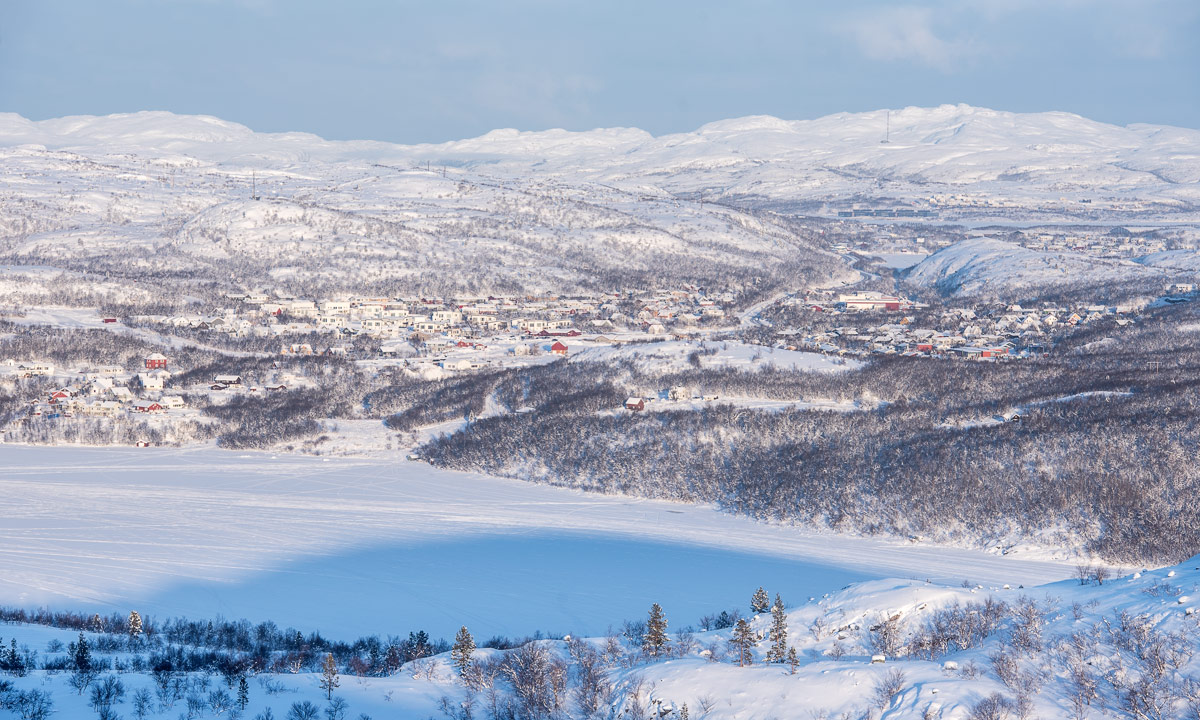
To the north I could see the small town Bjørnevatn and snowy mountains at the horizon. To the east I could see the Fjord Uhcavuotna or Langfjorden. On the snow covered frozen fjord I watched the snowmobile groups and the dogsleds. It’s high season for tourists. Looking to the south I saw the fjord disappearing in the fog. In the colours of the still low sun the scenery looked quite unreal.

It was half past ten. Definitely too early to return. In the southwest I spotted a higher mountain range, which I already knew from the map. Between the mountain range and my resting place on the hilltop there was a valley. I wasn’t sure if I would manage to climb the mountain range but I could try. I zigzagged down the hill to avoid the steeper parts, crossed the valley – phew, deep snow again – and went up a small snowy hill.

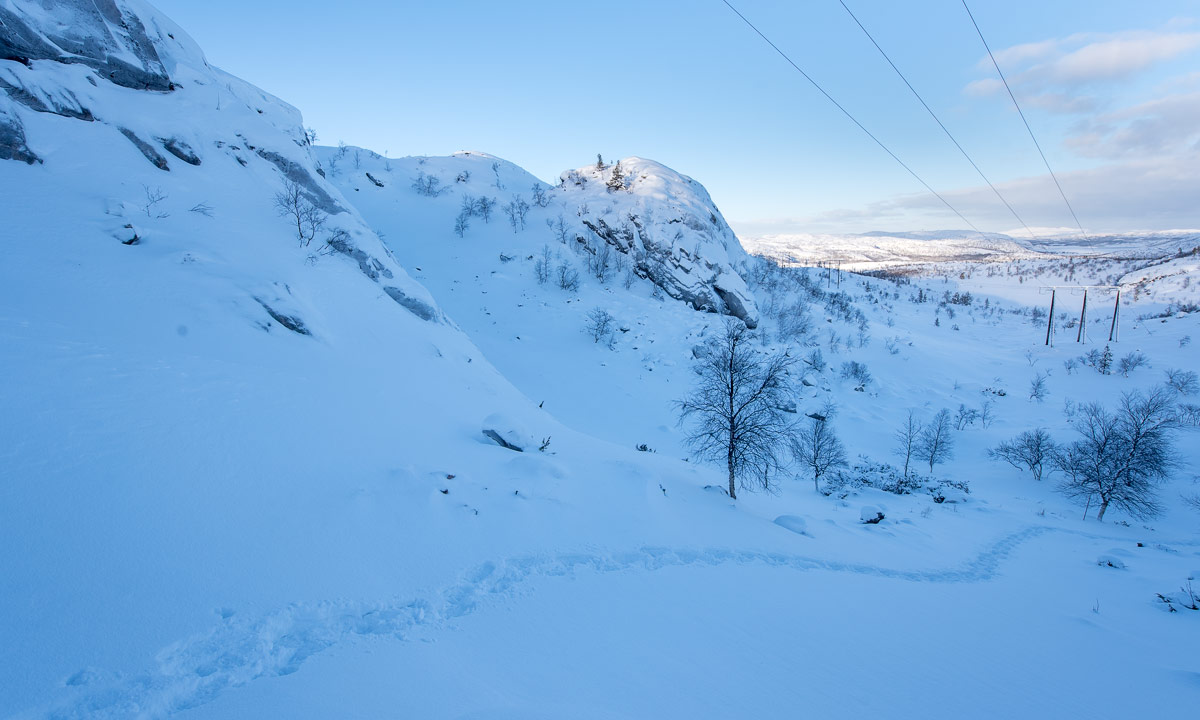
You see the picture above? There are two possible ways up the mountains. A steeper and higher one to the right and a shorter and less steep one to the left. The right one could be too steep for me and my snowshoes and I was afraid of avalanches. Therefore I chose the left one. It worked! After ascending the snowy slope I stood on a small plateau.

I had to climb another slope, shorter but steeper, then I reached the sunny vidda. Vidde is Norwegian for expanse and for plateau or tableland. You may know the word from Hardangarvidda, a large plateau between Bergen and Oslo.

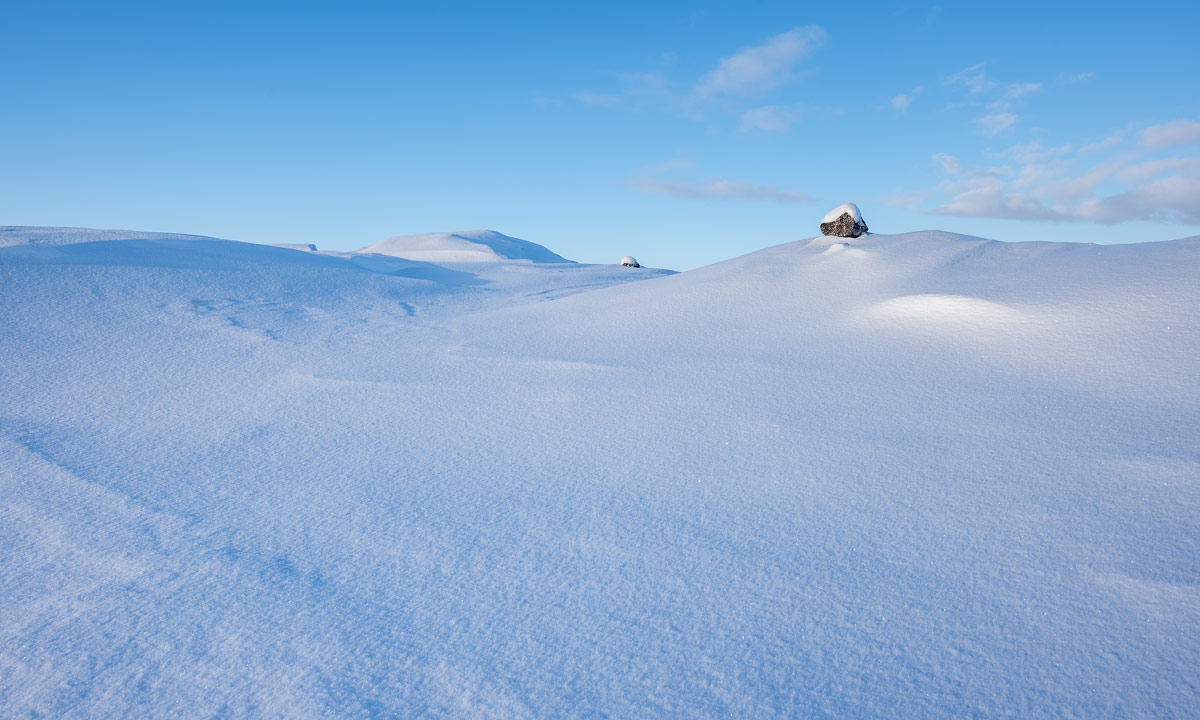
That’s the landscapes I love – less is more!

After walking around and going up another small top I reached a flat snowy plane. If it’s completely flat it’s probably not a bog but a lake and so it was. It was the lake Andersvatnet (136 m above sea level).

On the other side another hilltop, according to the digital map 183 m above sea level. Strange that all these summits and tops do not have any names, at least not in the official maps. I decided to climb this top, too. The borrowed snowshoes are not very good for steeper passages so I had to look for a good way up and more than once I slid back or had to use my hands to pull me up. But finally I “conquered this hostile mountain”!

The first photo above shows Andersvatnet. If you look at the enlarged picture you can see my snowshoe tracks.

I didn’t make a long break because I wasn’t sure about the continuation of my tour. I would love to stay up for a while and then descend at another place, but according to the map it could be quite steep. I went northwest and went along the edge of the mountain range.

I looked for a possibility to descend the plateau but finally I had to realise that all slopes were much too steep to descend. Therefore I continued by circular route until I could see the same power pole again that I passed on my way up. I ascended another small top, again with a gorgeous view. Time for another break.

I felt cold. Probably it was because I was exhausted and a bit sweaty. While I didn’t close the down parka at all at my first break I closed it completely this time and even put on the woollen mittens. Wrapped up like this I could enjoy the sun and the views in all directions. But then it was time to continue the tour and to leave the bare mountains. I found my old snowshoe tracks, followed them and went down, mostly in my own tracks.

After I left these mountains behind I went back straight ahead. Again deep snow, but less exhausting than climbing all hilltops. I was back to civilisation. I could hear the roaring of the snowmobiles and the barking of the huskies. Later I saw them both. A group of white dressed snowmobilers – probably hunters – and the huskies pulling the dogsleds. Still I was 100 meters above sea level – high enough to have wide views. Do you see the dogsled on the next photo?

I reached a large trail prepared for the dogs. It was solid enough that I could go there without snowshoes. What a blessing! Snowshoes are great for mountain tours like today but I always feel clumsy wearing them. I passed some dog teams – guides sorting the dogs and tourists wrapped in winter coveralls sitting in the sleds or taking pictures.

The inner of my nose started to tickle, normally a sign that it’s -15 °C or below because then the nose hairs start freezing. Even my eyelids started to freeze together. When I arrived home the thermometer showed -16 °C. So it has become colder over the day.

Now it’s 22:15 and outdoor temperature has dropped to -22 °C. Probably the last cold night for a long time, since much warmer weather is on its way.


Mirages, vintervägg and sea smoke

After the warm but chilly weather on Holmön it’s nice to have colder weather at home. The sky has been clear all night and day and the morning temperatur was -14 °C.

The whole open sea was smoking. A common view when the sea is free of ice but the air is cold.

At the horizon I could see the vintervägg, a local meteorological phenomenon that is typical for this season. Vintervägg means “vinter wall” and names a cloud layer on sea. Sometimes it’s quite near, sometimes it’s far away. Today it was far away and a third meteorological effect came into view: A mirage, also called Fata Morgana. It has the same origin as the sea smoke: abrupt temperature differences. This is why these mirages mostly are found in deserts and polar regions.

Skelleftehamn is not really part of the polar region but shares at least some of the meteorological phenomenons.