Jämtland hike part II: hejdå Sweden, hei Norge!

This article is part of the series “2016-09: Jämtland and Norway”.

Annika and I are in the mountains in Jämtland and have just reached our first destination: Blåhammaren, where we slept in a 14-bed room.

Tuesday, 13. September

Sleeping in a 14-bed room can be quite demanding, especially if you have this kind of snorers in your room, that could awake a frozen mammoth. However Annika and I were really lucky, no snorers at all! After our breakfast we had to decide where to continue our tour. From Blåhammaren you can hike back to civilisation or continue to two other destinations. Most of the hikers continue to Sylarna which is very central and part of the Jämtland Triangle, a very popular three-day-tour, that connects Storulvån, Blåhammaren and just Sylarna. We were keener to cross the border and hike to the Norwegian lodge Storerikvollen and so we did.

With an altitude of 1086 m Blåhammaren is the highest tourist station of the STF – the Swedish Tourist Association – so first the trail ran over the treeless mountain plateau, over rocks and moss, crossing some swamps and brooks. After a while we descended and the first yellow coloured birch trees came into view again.

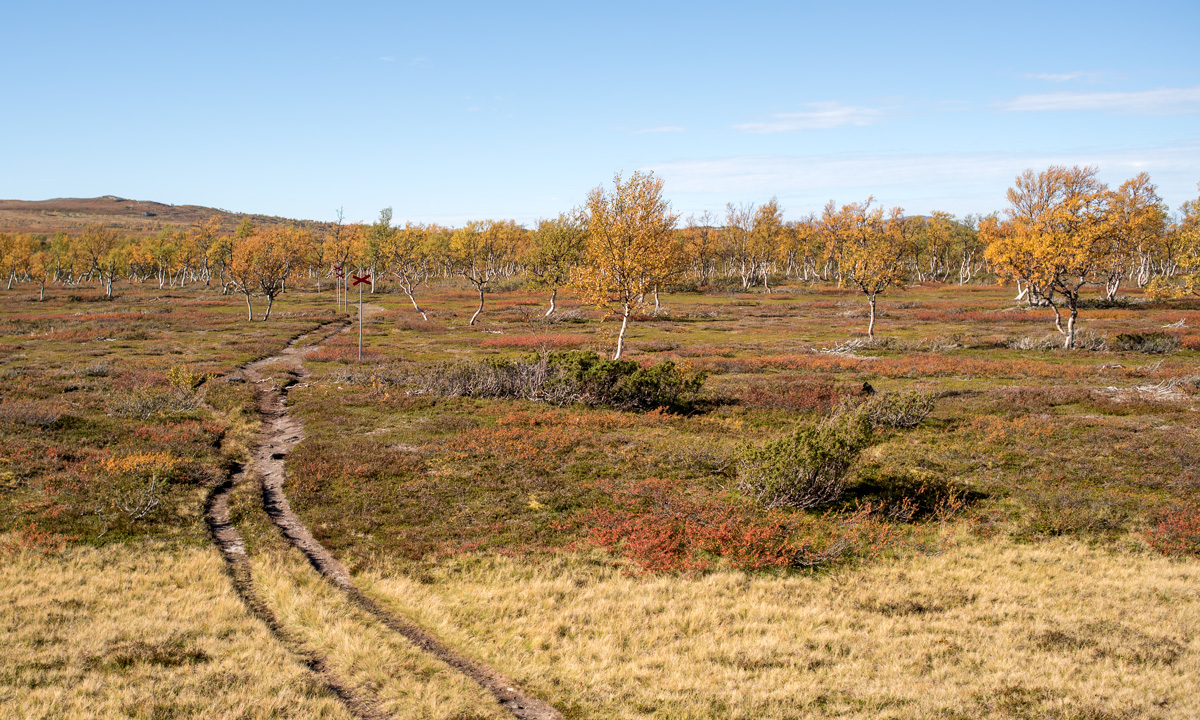
Swedish summer trails are marked with red coloured dots on rock or tree, while winter trails are marked with poles bearing red crosses. You really shouldn’t follow the winter trails in summer unless you want to stand in front of a lake or find yourself deep in a bog – both are easy to cross only in wintertime. But quite often there’s a year round trail which makes navigation extremely easy even on less walked routes.

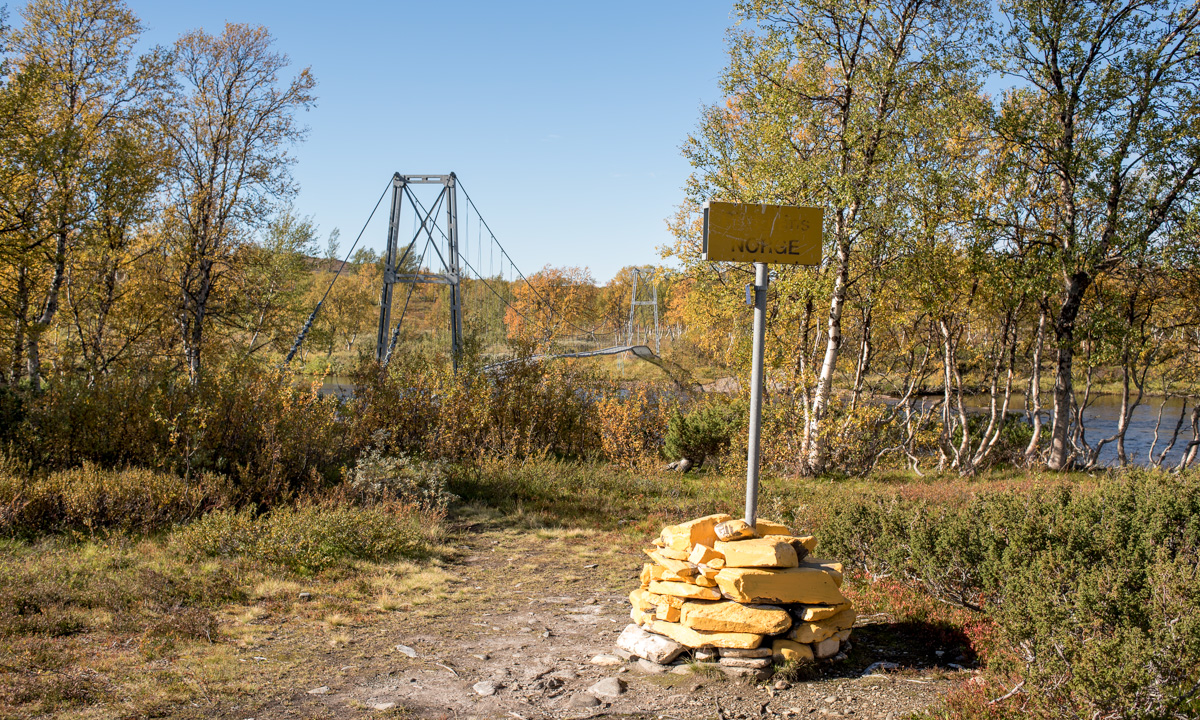
One kilometre behind Endalen, an emergency shelter, where we rested for a short while, the Sweden-Norwegian border came into view. It’s hard to mark a border less spectacularly than this one: A sign amidst of a pile of yellow painted stones, that’s it. The large bridge that crosses the river Enan (Sami: Äjnänjohke) directly after the border offers far more spectacularity.

We detected a real nice resting place on the other side of the river, where we planned to enjoy the warm summerly weather, but two other hikers – by the way the first ones we met that day – coming from the other side chose exactly the same slab of rock to rest. Luckily we found another place, at least as nice as the first one. We unmounted our backpacks, took of our boots and dangled our feet into the ice-cold water.

(I like the photo with the drifting yellow birch leave and the dead mosquito. It illustrates, why I prefer the autumn to summer: Beautiful colours and no biting insects left!)

In Norway the summer trail marks change, now the trail was marked with big bright red T-s. The red T is also the logo of the DNT, the Norwegian Trekking Association.

Do you see the dark piece of something on the top of the stone? It’s animal droppings, but I’m not sure of which species. I asked for help on Facebook and the favourite answers are reindeer and (arctic) fox.

We continued our tour until we came to another swing bridge, this time crossing the river Djupholma. On the other side of that river lies a nice sandy beach where I took a refreshing bath (the only one of the whole tour). It was only two other kilometres to walk to our destination, the cabin Storerikvollen, where we arrived round six o’clock.

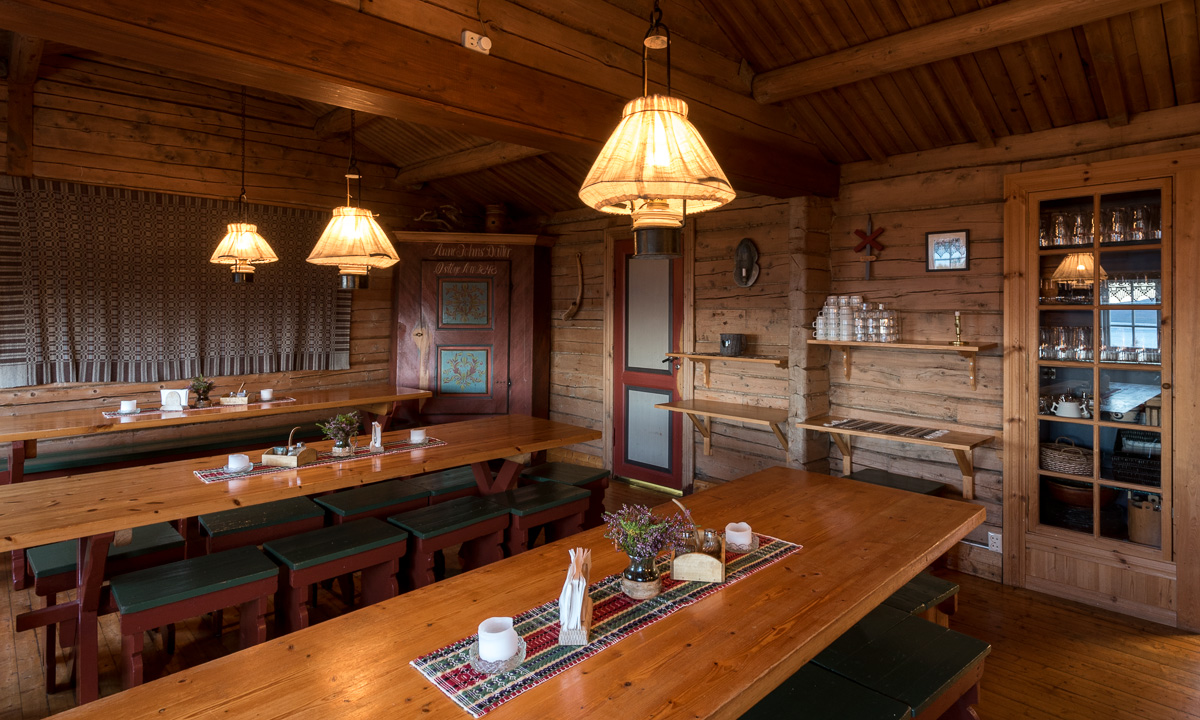
Oh, so nice these Norwegian lodges are. They seem less “funkis” (the Swedish functional style) and more “hyggelig” (the Norwegian word for cozy, snug, or homelike). Just gemütlich! And we got a two-bed-room for a good price. The only thing you should know, when you visit the Norwegian side: These cabins hardly sell any food and there is no public kitchen as in the Swedish cabins. So you have three options: (1) take a camp stove with you and cook outside. (2) cold dishes! Hopefully you have all with you. (3) eat the dinner and breakfast provided by the lodges (and pay the Norwegian price).

We chose (2) and had a nice dinner with salami, crisp bread and fresh water outside in the evening sun, enjoying both our simple meal, the warm air and the beautiful view. Later the almost full moon rose above the reddish mountain chain – what a beautiful evening!

Wednesday, 14. September

The next day would lead us to the Nedalshytta, which is between 20 and 24 km away, depending on which map or sign post you rely on. So we got up quite early.

We had to go back yesterdays route 2 or 3 km where the trail divided. Now we turned south and had to ascent. Soon again we were above the treeline. When we looked back, we could see parts of the big lake Essandsjøen and even spotted – beside of some reindeers – the now tiny Storerikvollen, that we left some ours ago.

After a while we came to the river Fiskåa, where we had to ford. My rubber boots were high enough and I just splashed through the water, whereas Annika changed boots with trekking sandals and waded through the river.

Since rivers use to flow through valleys we had to ascend again and walked up along a reindeer fence. The weather was still warm and sunny, but you could see a cloud layer approaching afar. Would it rain in the evening as the forecast told us?

Only the map showed us the progress of our longest tour so far. We went a bit up, a bit down, a bit to the left, a bit to the right, down a small valley and up again. But finally trees came into view once more and soon we stood on an exposed plateau not far away from the yet invisible Nedalshytta.

Come on, just less than a kilometre to go … . Final spurt! A short while later we arrived at the beautiful lodge. Again we got a nice two-bed room, this time right below the grass roof. And we got: pizza! Perhaps not the best I ate in my life, but walk 20 – 24 kilometres with a backpack by yourself and you’ll know, how delicious a warm pizza slice can be!

The tour so far:

Continue with part three …

Picking cloudberries

One week ago I still was in Mosvik in Norway. On Saturday we went out to pick cloudberries. These berries that look a bit like orange raspberries are rich in taste and very healthy due to the high amount of vitamin C and trace elements. There’s only one disadvantage: They can be quite hard to pick.

First of all they prefer wet and swampy soil. Then they ripe in July, the heyday of mosquitos and biting horseflies. Then they grow quite solitary – one berry here, one over there.

H., J., F. and I were quite lucky last Saturday when we collected two buckets of these little delicacies for it rained almost the whole day. And much rain means less mosquitos. When we came home, A. directly started to make jam from our collected cloudberries. One glass of jam I took home. It is still closed and I will save it for later. I love cloudberries!

Translation:

EnglishGermanSwedishNorwegian
cloudberryMoltebeerehjortronmulte

757.5 – from Mosvik to Skelleftehamn by car

Last week I’ve been in Mosvik (Norway) to visit friends. Yesterday I drove back home, not directly but with a detour via Nordli and Røyrvik (Norway) and Stekenjokk, (Sweden).

According to google maps the direct way is 671 km, taking 8 h 38 min. With the detour it is only 67 km, but 1 h 46 min longer. That says a lot about the small and steep gravel roads near the Swedish–Norwegian border …

For me the journey didn’t take 10.5 hours, but more than 15. For one thing I don’t drive fast, especially in Norway and for another thing I took many smaller rests for taking pictures as well as a lunch and a dinner break. I left at 9 o’clock; at quarter past midnight I finally was home again. Total distance by car: 757.5 km.

See my travelogue of the journey by clicking the first image and navigating through the images. Swipe on touch devices and click or use arrow keys on other computers.

By the way: After nineteen articles without any photo with snow, this is the first article showing at least some patches of snow again.

A trip above the treeline

Today the weather was really nice in Venneshamn in Norway. I took the car to drive to a mountain area not far away. At least, if you can fly … . If you take the car in Norway, there’s always at least one fjord you have to drive round, in this case the Verrasundet. So it took a bit longer than excepted taking the ways 191, 193 and 720 round the fjord. Finally I approached the street to the lake Ormsetvatnet. Street, well … it’s more like a steep gravel path, that you can drive up some kilometres to a parking place. The last kilometre to the lake is closed for cars and I had to walk it.

At Ormsetvatnet I crossed a dam wall, walked up a tree covered slope and soon was above the treeline. To be honest, I’m not too fond of forests, when it comes to taking pictures and I’m always glad, when I leave the trees behind when doing a mountain trip.

Now I was on a hilly plateau, the Vakkerheia. Some of the flat mountain tops were marked with piles of stones.

In the plain valley between the hilly tops the ground is soft and wet. Sometimes I had to go round shallow ponds and bogs, but mostly the ground was easy to go. In and round the swampy ponds the cotton grass was blooming. To my big delight there were many cloudberries plants growing in the lesser wet parts and the berries were ripe and ready to eat!

Picking cloudberries can be tedious, because of the many bloodthirsty horseflies that seem to guard them. I think, I slew most of them, but some bit me anyway.

After some hours of a really relaxed mountain hike I took another way back until I came to the gravel road again, where my parked car waited for me.

Half a day later

A thunderstorm approaches from the west. The center seems to be above the very same area that I wandered some hours earlier. The thunder and lightnings were as impressive as the intense colours, that I could see from the other side of the fjord. I was glad, that I haven’t been on that plateau – there would be hardly any place to seek shelter from the massive rain fall or to protect from the dangerous lightnings.

Addendum

And since we’re living in the age of selfies …

Mud walking

Last weekend I walked along the sandy beach of Storsanden, which reminded me of the beaches of the Northern Sea. But there are differences. First of all the water of the Bothnian Bay is hardly salty (only 0.3% – 0.5%). That’s why you cannot find shells, jellyfish, shore crabs and other animals.

Wait, there are exceptions: On the beach of Storsanden I found three tiny mussels, hardly two centimetres long. The shells were so soft, that I squished the first two just by touching them. Anyway I succeed in taking home the third one. Here it is:

There’s another difference: We hardly have any tidal movements. The change between ebb and flood is too weak to notice. Sometimes the water is high or low anyway, although independently from any tides. Yesterday we had more than 50 cm below and since many coastal areas are shallow you could see many mud flats along the shores. This may not sound much, but it happened only once that I experienced a water level that was even lower.

That’s how I came to a rare occasion of a mud walking tour along the bays Ytterviksfjärden and Norra Innerviksfjärden yesterday. The sky was grey, it was quite windy and cold. That may sound quite uncomfortable, but at least it hardly rained and I saw not a single mosquito due to the strong wind.

I guess I walked only six or seven kilometres, but the ground was quite muddy and I was really exhausted after plodding through calf to knee deep mud. When I arrived at the car again, it started to rain.

When I came home, I first showered off my neoprene boots (they have flexible soles and won’t get stuck in the mud) and then myself. Great – a hot shower is just great after such a walk, both for cleaning up and for comfort!

It rained the whole night with temperatures dropping to 3.7 °C. I almost expected snow as for example in Kiruna yesterday. What a contrast to the warm summer days last week.

They say, warm and sunny summer weather is on its way. Let’s see …

Art, sound, and spring flowers

In contrast to the weather forecast yesterdays morning was sunny and sky was blue. I’ve been in Umeå the weekend and after the breakfast Annika and I decided to make just a small trip before weather would get worse.

We drove to Baggböle, 8 km west from Umeå. Here’s the “Arboretum Norr”, a tree collection (or arboretum) along the river Umeälven. We enjoyed the springlike temperatures and the many small flowers that started to blossom everywhere.

It was a bit too early for an extensive visit, since many trees just started to get their leaves, but we had another destination anyway.

In an abandoned turbine sump you can find an orange figure sitting cross-legged just as a statue of a meditating monk. The figure is reflected in the shallow water. This artwork is part of the Konstvägen sju älvar, a 350 km long tourist and sculpture route in Västerbotten. Sju älvar (seven rivers) sounds almost like sju elva (seven eleven), that’s how this artwork got its name: 8 11. Outside it was warm and sunny, inside it was dark and chilly. The ground was still frozen.

Probably the weather missed the forecast, because outside it continued being warm and sunny. So we continued our car trip, first toVännäs to visit another artwork: Eldsoffa (fire sofa) – a brick sofa that you can heat by fire (no picture).

After that we took a detour via Pengsjö and headed to another artwork between Vännäs and Bjurholm: Hägring (mirage).

A model of a church built of pieces of mirror glass seems to hover above a bog. It reflects it’s surroundings and if you go there over the wet boggy ground it reflects you yourself.

If you want to go to that artwork: Take rubber boots with you or you’ll get wet feet, at least in May.

After going round that artwork we continued our tour, had a brief look to Bjurholm and after that we started to return to Umeå again. We took the 353 southwards and would have been in Umeå one hour later if not my curiosity made me turn right into the road to Ågnasbacken, a local ski area. I love standing on hill and mountain tops and enjoy the views, but we discovered something better: The klangvägen (the sound path), a 1.5 km long path on two of the ski slopes with sound objects. Especially Sofie Weibull’s Klockspel – a wind driven installation of metal pieces sounding like bells – fascinated us very much. I did not make any photos because in my opinion it was sound that mattered, not the optical appearance of the installations themselves.

Anyway, I made a photo from one of the ski slopes and the view. And some leftover snow …

We came back to Annika’s flat eight our nine hours after start. Sometimes a short trip can get out of hand a bit …

Sunset over the bog

When Annika and I drove from Bygdeträsk to Umeå yesterday evening the sky was dull and grey and it rained at temperatures round 4 °C, but some minutes after sunset the cloud layer in the northwest was lit from below and glowed in strong sunset colours. Minutes later the colourful spot has disappeared and sky was dull and grey again, just a bit darker.

Hunting the cold – day #2

This article is part of the series “2016-01: Hunting the cold”.

Yesterday I travelled to Pajala to search the cold. With a minimum of -39.6 °C i missed the -40 °C.

Day #2 I stood up quite early, took a short breakfast and drove again to Käymäjärvi, where I measured the coldest temperature yesterday. It seemed to be colder than last night and directly after I turned left into the small road to Käymäjärvi, the thermometer showed -40.3 °C. First time below -40 °C – yay! At 08:37, nine minutes later it showed -40.7 °C , which turned out to be the coldest temperature I measured this day.

I continued the road to the end. Here a couple of lonely wooden building stand beside the road, obviously uninhabited, at least in the winter.

But now it was time to pack the pulka – a transportation sledge – and mount the skis. I wanted to make a ski tour, at least a short one. I parked the car at the place where I saw the aurora the day before.

I filled the pulka with warm clothes, hot tea, a bit of food, the camera equipment and such. Then I dressed for skiing. Here it was -37 °C and I dressed carefully to stay warm and avoid frostbite.

One of the telescope tracking poles was not possible to fix. I tried a workaround with the result, that it broke after 5 meters. I’ll have to buy new ones.

First skiing was easy, even with only one ski pole. The snow on the frozen swamp was hard and it was easy to pull the pulka behind.

But then I entered the forest. Of course pulkas are not made for woodland and this forest was like a thicket of birches which sometimes bend down and build low hanging arcs.

I tried to turn left to find more open land (I was quite unprepared and hadn’t any map with me) and had to cross several small brooks. One of them was a bit larger, a bit deeper and I could here water floating under the ice. I had to unmount me skis and was quite nervous crossing the brook that I probably would jump over easily in summer but all went well.

I continued and wanted to make another photo, but not the camera. It didn’t work any longer. The D-800 just showed an ERR on the display, that was all. Now I was a bit of fed up: Only one ski pole in the midst of a thicket of birch trees and the camera not working. I turned and went back. This probably was one of the shortest ski tours ever.

That’s what I looked like. The first photo is taken 10 minutes after beginning, the second right after the end of the tour. That was not easy: The Nikon D-800 was out of order, the iPhone is not made for cold temperatures and the batteries of my auxiliary camera were left in the car and didn’t work neither. But at last I found a battery that worked for the moment.

You see the fur cap? Some equipment that I have is really expensive, for example by Canada Goose down parka (not on the photos above). The fur cap however is from H&M and costed only 10 Euros. You can hardly call this professional equipment but it worked extremely well.

When you exhale in this cold the air flickers as it does over open fire. No surprise, the temperature difference is round 75 °C. When you inhale you should wear a buff or a scarf to protect your lungs. Remember the temperature difference?

I was so glad that the car copes with the cold. It was -36.9 °C outside and -35.1 °C inside when I started the car after the tour. It took only two seconds and the motor was running. Only changing gears is heavy as long the system is so cold.

On the way back temperatures dropped again below -40 °C. Time to many another selfie – a ridiculous one: The camera inside, holden by a long arm, me outside in front of the car. To my big relief the Nikon camera worked again. The motive: The temperature at the left, me outside with my parka at the right. It didn’t work as excepted. Where’s my face?!

Back in Pajala I admired the fragile birch trees covered with frost beside of the river Torneälven. In the background the clear sky with colours from pink to azure. It seemed to be even colder on the bridge that led over the river back into the city. I could feel the wind through my gloves and mittens and even the nose started to freeze together with the camera when taking photos! I closed my hood completely which looks a bit ridiculous, but I stayed warm.

I took my anemometer (A birthday present to myself) and measured the wind: 20 km/h. The temperature: -36 °C. That makes a wind chill of -51 °C! That’s what I call coldness!

I took a lunch and headed home since weather in this region should worsen, while the forecast for Skelleftehamn looked quite good. It was hardly warmer than -25 °C on the whole journey back home.

At 7 o’clock I arrived home. -28 °C outside – time for a hot bath!