Hunting the cold – day #1

This article is part of the series “2016-01: Hunting the cold”.

Two days ago it looked like that it could by quite cold in Northern Sweden yesterday and today. I checked several places and their weather forecasts and Pajala with a forecasted temperature of -40.4 °C won. That’s good news, since Pajala is only 350 km away. Nikkaluokta for example is one of the coldest places in Sweden, is 537 km away and it will take more than 6 hours to travel to (when conditions are good).

Yesterday – 6 Jan, 2016 – I packed kamera, very warm clothes and all you need for ski tours into my Saab and started the trip. In Skelleftehamn it was -17 °C, but already 20 km away the temperature dropped to -20 °C.

I made a stop in Jävre. I’ve passed this place several times and every time I planned a future stop. Well, future was yesterday. Jävre -23.3 °C.

I continued the trip and the temperature continued dropping. Round half past ten I could see the sun – it was bright red (the camera couldn’t catch this) and because of the higher latitude it was even lower above the horizon. -27 °C.

Now I continued driving to avoid arriving too late. Right after Svartbyn (E10) the thermometer dropped below -30 °C the first time. Round 40 km later I turned right. Here temperatures dropped below -33 °C. Near Pentäsjärvi – 25 km before Pajala – it got even colder: -36.9 °C. I probably experienced colder temperatures, but never saw such low numbers on a thermometer.

I found a quite low-priced room in the Hotell Smedjan but I continued driving around looking for nice (and cold!) places.

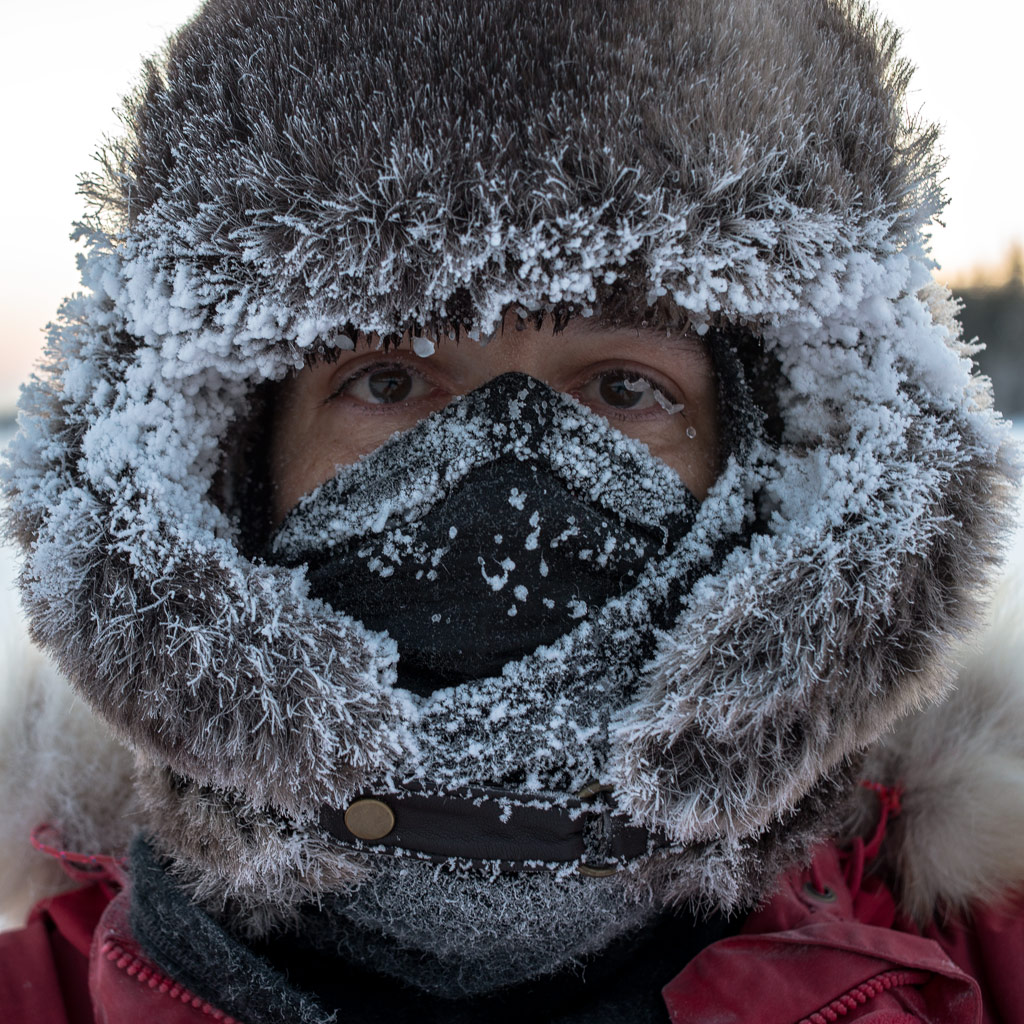
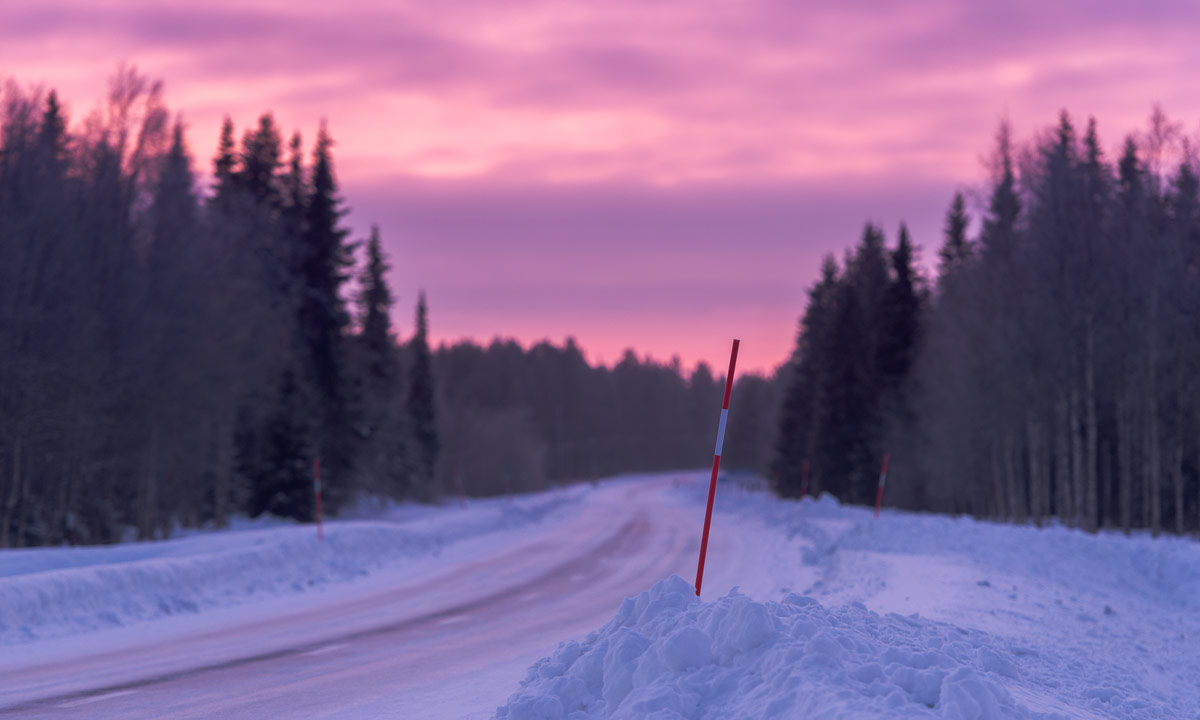
One of the most fascinating things in my opinion is the light in wintertime. Twilight may last hours or even the whole short morning, day, and evening and there are always soft pink colours in the sky. Just beautiful, but cold to take pictures of if you don’t have warm clothes. But when I have one thing, it’s cold weather equipment.

I looked for the airport, which is a bit out of town and quite tiny. It was closed. It’s the first airport I saw with an own parking place for reindeers. Good to know!

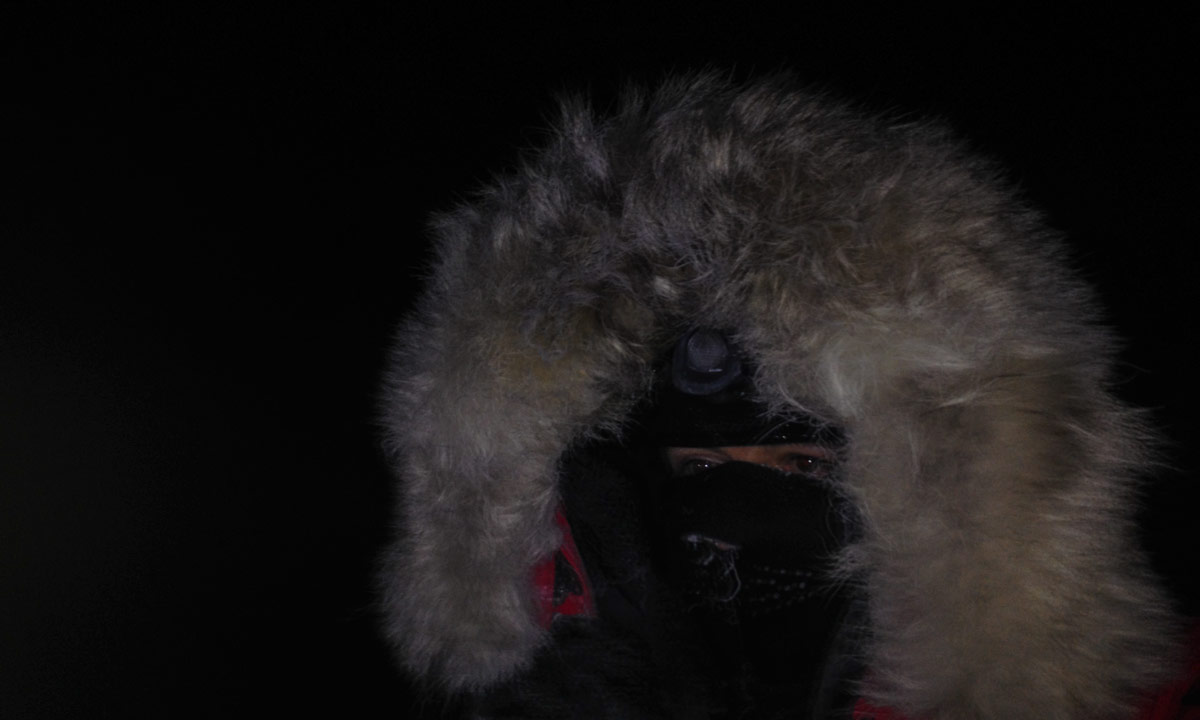
On my way back to Pajala I found a side road that headed to a small national park. I parked the car and walked the 700 meters to the cabin and the grill place in darkness. Of course it wasn’t pitch black, the snow and some thin clouds reflected the light of the city, giving enough light to see and walk. (The selfie is made with the iPhone which can take two photos until it will shut down because of the cold.

On the way back it was even colder: -38.8 °C. Now I got really hungry, drove back to the hotel and walked to the pizza restaurant. (Pizza and burger bars rule the Scandinavian north). Pajala by night:

Then I went home. I was glad that I have all I need for such a trip: A camera, food and a warm winter parka.

After a while I considered if I could catch the -40 °C now. It was warmer than expected, but let’s give it a try.

This time I took the road to Käymäjärvi (the name proofs, that Finland is not far away). Yes, here it was quite cold – below -39 °C. Between a swamp and the lake I stopped, since these low lands can be cold traps. I didn’t get lower temperatures but a view on the village and northern light (quite strong until I was ready to take pictures …)

On the way back to the main road I got my new personal cold record: -39.6 °C (sorry, no -40 °C)! When it’s really cold in Northern Sweden people take pictures of thermometers and show them in the internet. I will join this tradition. Voilà:

>>> read about day 2 of the journey >>>

Another frosty morning

-5.6 °C showed the thermometer when I woke up at 6:15. I don’t need to look through the window to know that it’ll be a nice morning with mostly blue sky when it’s so cold in early October. And so it was.

The photo above is taken almost at the same place as the 1st photo three days ago. I prefer the older motive but like the intense colour of the sunlit clouds in the background. To other shots:

Have a look at the second photo, the one with the grass in the foreground. Why isn’t the horizon straight? That’s because I stood knee deep in the water myself, breaking the ice. When this happens, water from the hole will start to cover the ice. I just could take my camera, look through the finder and – click! – take a picture. One second later parts of the ice were covered by a thin layer of water.

That was the main problem: There is no save ground round these swamp ponds, where you could take your time for making pictures or even use a tripod. No, you stand knee deep in water on unstable ground, knowing that another step could bring you in much deeper water. I’m always afraid I could fall into the water and drown my expensive camera. It will me much easier when the ice is thick enough to stand on.

After a while the sun started to rise. Time for some more experimental images:

I realised the frozen bug on the second photo first, when I looked through the images at home. It’s hardly 2 mm big but looks quite huge on this macro photo. Learning: look at the motive even more precisely.

Two sides of an autumnal morning

A cold side and a warm side. The difference? 19 Minutes and 500 meters.

It’s really fascinating that even larger water areas than mud puddles start to freeze over after just three mornings with temperatures below freezing; today round about -5 °C.

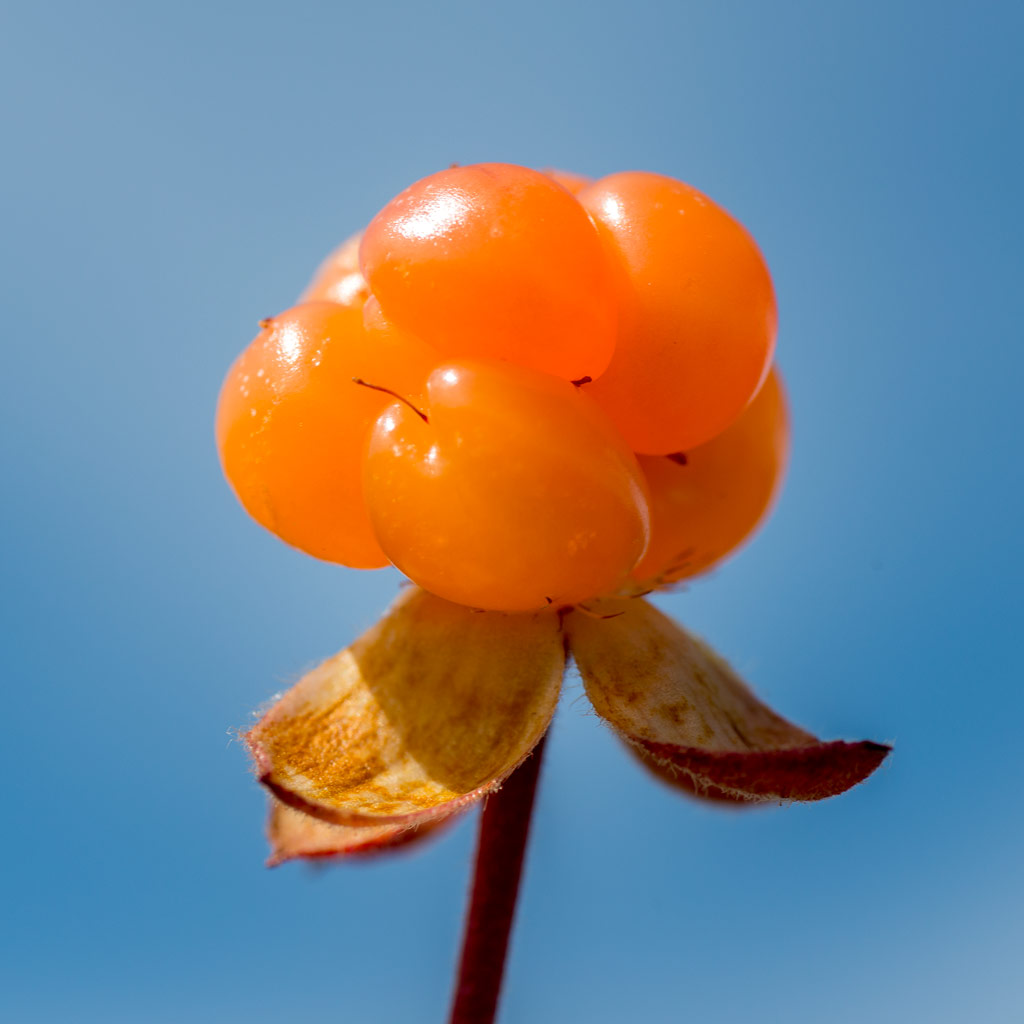
Cloudberries – the gold of Lapland

The very short version:

The longer version for those who don’t know these berries:

These berries are called cloudberries (German: Moltebeere, Swedish: hjortron, Norwegian: multe). Cloudberries like bogs and wetlands where they bloom and bear fruit in July and August. That’s exactly the heyday of the mosquitos, that like bogs and wetlands, too. The berries are found quite outspread and it takes some efforts to collect them. (Remember the wetlands? Remember the mosquitos?)

Cloudberries have a quite special taste. I love them but not all share this liking. They are very healthy and contain three times more vitamin C than oranges.

I went berrying yesterday and checked some bogs near Bygdeträsk, where I stayed the weekend with good friends. I wasn’t very lucky. I hoped I would find enough of them to freeze them for later use, but this small amount will not survive the next days. But I was lucky in another way: hardly any mosquitos.

But I found other things. A small deep pond in the middle of the first pond, a so-called bog pond. If you stand beside such a bog pond you should remember that you’re standing on water or mud, that silted up and became overgrown. Be careful, this ground can be very treacherous!

And I found another thing: A plant, that’s special because it’s flesh-eating: A sundew. What a pity that it didn’t bloom yet.

Sundew is quite common here and grows on wet patches and mud. This one, however, grew directly on water that was covered with just one millimetre of peat. I never saw this before.

By the way: I met a neighbour today, he went cloudberry picking as well. He was a bit disappointed because he picked only 4 kilos. I definitely have to check more bogs to find better places.


Translations:

EnglishGermanSwedish
cloudberriesMoltebeerehjortron
to silt upverlanden
sundewSonnentausileshår
peatTorftorv

Continuing to the Vesterålen

This article is part of the series “2015-07: Lofoten and Vesterålen”.

Our third day started with a lot of rain. We put the wet tent into the car and continued our tour to Kabelvåg where we visited a friend of mine. We took a small mountain hike but it was cloudy and wet. Only far away in the east you could see some sunny patches on the top of the snowy mountains.

After the hike Delle and I looked for a camp ground. But first I had to take a picture of the beautiful rainbow near Sildpollen.

This time we tented on a bigger campsite in Sandsletta. When I woke up quite early the next day I could see another rainbow over the Vatnfjorden, but later it started to rain and pour down again. And again we put the soaked tent into the car. We continued on the road 888 to Fiskebøl. The clouds were hanging low and you could hardly see any mountain, just some white and light grey schemes.

Soon we arrived in Fiskebøl where we waited for the ferry. Again we were lucky – we waited hardly half an hour until we entered the ferry for the short crossing to Melbu, the southernmost city of the Vesterålen. We visited friends of mine, this time in Haukenes were we tented near the friend’s house. The cocks tried to wake me up ridiculously early, but in vain. I continued sleeping until 8 o’clock.

Alas it was the first morning without rain (and the only one, too) and we could dry the tent. After a long and lazy breakfast with my friends we said farewell and continued our car trip. We got a tip to visit Stø at the northern end of the Vesterålen island Langøya. What a good tip and what a beautiful landscape – especially after the weather was nice and sunny. We made a short photo stop between Strengelvåg and Klo before we continued to Stø.

In Stø we parked our car and took a short hike over the mountains to a beautiful white sanded beach were we made a rest and I took a short bath. There’s a 15 km hiking trail as well; next time I’ll definitely will go it.

After our rest we slowly walked back and continued by car. First we had to head south to Sortland were we crossed the Sortlandsundet and headed north on the other side. The sky became more and more cloudy and we looked for a nice campground. Finally we found one in Bleik, quite near Andenes, a town at the northern end of the Vesterålen. We put up the tent and – guess what – it started to rain.

It had been raining the whole night and it continued raining. Again a soaking wet bunch of a tent lay in the back of the car. After a while of driving through the greyness we decided to head back to Skelleftehamn. It’s more than 900 kilometres and it took the whole day. Rain became less near Abisko and after we passed Jokkmokk the sky cleared up and we could see the full moon slowly rising. The next photo, which is the last of our car trip through the Lofoten and Vesterålen is taken near Storforsen, one of Europe’s biggest rapids. At 23:50 we were in Skelleftehamn again – and I was home.

  • 2296 kilometres in six days
  • a lot of clouds and rain, but two nice and sunny days, too
  • one night in the car, four in the tent (three of them on campgrounds)
  • two bathes and at least four rainbows
  • – a nice trip!


A hike and three tests

Do you remember Nokia? Cell phones and rubber boots? Today I tested a quite similar combination: Rubber boots and a Nikon lens. Plus a hiking trail.

A few weeks ago I discovered a big information board at a forest edge in Skelleftehamn. It describes the “kraftleden”The force trail or The energy trail. Perhaps the trail is named after Skellefteå Kraft, one of the sponsors I thought when I read the information.

Today I decided to try to hike the 18km long trail. I had two new things with me: My new rubber boots Tretorn Sarek which are made for hiking and my new lens Nikon 100mm f/2.8 (Series E), that I bought secondhand some days ago.

After a one kilometer walk I was at the starting point.

At the first junction I was lost, since I couldn’t see a sign. But after checking my photos of the information board I learned that the way marks where orange coloured blazes round the trees. That’s easy. The trail itself however wasn’t easy at all. It looked more like an area where you cut down trees and bushes. Like a stork I stalked through the cut down branches and twigs that lay criss-cross on this so-called trail hoping for a better path.

And the trail got better. But I still was slow. This time not because of the trail but of my new lens. It’s my first lens ever without an autofocus. This means that I have to focus manually at the lens itself. It took some time until I got used to it, but I still had to control every single shot on the display and I had to make some photos five times until I was satisfied.

I continued the trail – now a nice stony path until I came to the Örberget – altitude 40 meters, 30 meters higher than the starting point. It doesn’t take much to be called a mountain here. I made a photo of a “gravröse”, a tomb from the Bronze Age. Probably it was build at the shore some thousand years ago but the land has been rising round a centimeter a year since then.

I continued the walk. The ground became wet and muddy and after a while I stood in front of a bog. In the middle of the bog I saw a wooden post with an orange blaze. OK, let’s go …

… now I knew, that the new rubber boots were not only comfortable but really waterproof. I didn’t get soaked, but it was quite close.

I always had to look down carefully to avoid the deep water and mud puddles, and I had to look forward to find my way. When I looked up I started to suspect why the trail was called kraftleden. Almost the whole trail followed the transmission lines and the Swedish word for transmission lines is kraftledning. That’s a really pragmatic approach to make a trail since some kind of path was made already to mount the power poles. But it’s not very inspiring just following the lines and not beautiful neither.

After round 11 kilometers I made a rest on a high seat normally used for hunting moose.

I continued the tour but I started to lose interest a bit. Parts of the way were hard to walk, harder than many mountain trails but without the reward of a beautiful landscape or great views. In addition of that I started the tour round half past two and I didn’t want to come to town too late. So I left the kraftleden and walked southwards through the forest. At the beginning I found some nice flowers and I changed the lens to a macro. First two additional test images of the new 100mm lens, then two flowers – a dactylorhiza maculata and a linnaea borealis:

OK, I have to admit: I tested four different things, not only three. Number four was a mosquito protection jacket, that came in quiet handy when I shot the macros of the flowers. Flocks of mosquitos darted for my blood, but they didn’t had a chance beside of biting into my unprotected hands.

After taking the flower images I had to walk some other kilometers until I came to the main road and another one to come to the bus station where I had to wait half an hour for the next bus. Happily I slipped of my rubber boots to try my socks, sat down and waited. Finally the bus came and half an hour later I was home. The GPS displayed:

19.0 kilometers · average when moving: 4.3 km/h · total average: 3.3 km/h

And here come todays test candidates:

Rubber boots Tretorn Sarek: Really nice and comfortable boots, perhaps a nuance too tight for me. They are made of natural rubber and it’s easy to turn the upper upside down. They could be a bit higher.

For me: 8 points out of 10.

Nikon 100mm f/2.8 (Series E): A small, lightweight lens with manual focus. I have to practise focussing. I prefer my huge Nikon 70-200mm VR II, but there’s a reason why I bought the former one: At the end of August I’ll start a two week hiking tour in the Scandinavian mountains and I want to save weight. The 70-200 weights more than 1500 gram, the new 100mm only 215 gram. Got the point? And it was cheap, too – only 53 Euros.

For me: 7 points out of 10.

The trail kraftleden: The only advantage of the trail is that you avoid navigation. Beside of that it’s an awkward combination of a trail a bit too hard to be nice and a bit too boring to be beautiful. I wouldn’t recommend it. If you want to give it a try, take high rubber boots and plenty of time with you. Take care and follow the way marks if you don’t want to end in almost knee deep mud as it happened to me today.

For me: 3 points out of 10.

The nameless mosquito jacket: Perhaps it’s not fun to walk within some kind of mosquito net but it was great, when I took the macro photos of the flowers. The hood is too big. Since it’s very light – only 214 gram – I will take it with me on all summer photo tours and perhaps even on the planned mountain hike. And with costing only 18 Euros it was a bargain, too.

For me: 6 points out of 10.

Translations:

EnglishGermanSwedish
Dactylorhiza maculata / heath spotted-orchid / moorland spotted orchidGeflecktes KnabenkrautFläcknycklar
linnaea borealisMoosglöckchenLinnea
upperSchaft (am Schuh)skaft

A short trip to Umeå

I have to admit, that it felt a bit strange to travel to Umeå. For one thing it’s a big town and for another thing it’s south from Skellefteå and that’s not my usual travel direction.

You may laugh at me calling Umeå a big town. Umeå has 80000 inhabitants and that may not sound very much, but the whole city with its many big buildings and streets feels much bigger, especially if you compare it to Skellefteå – the next town nearby – which is less than half as big and appears only a tenth as busy as Umeå.

I stayed over night in a hotel in the 12th floor with a nice view over the town and the river Umeälven. What a pity that it rained almost the whole time.

Today it still rained a lot and I didn’t have any interest in city sightseeing. So I fled the town and took a long walk in nature. That’s much more my cup of tea.

Two months ago – first aid course in Solberget

Day 31 – 38

Today when I look outside the window, I realised that winter finally has left Skelleftehamn. The patch of snow that I stood upon ten days ago to view the Northern Lights has melted away and some trees start to show their first little leaf buds.

Well – it looked different when I was in Solberget in Swedish Lapland two months ago, where a first aid course of the “Outdoorschule Süd” took place. The week was filled with many actions – both course units indoors and outdoors and leisure, too. If you are one of the course participant you will realise, that I left out quite much.  That’s because I tried to keep the text very short – it’s more keyword style – and focus more on the photos.

Saturday

Arrival day: an incredible starry night with even a bit of faint Northern Lights

Sunday

Course unit outdoors, training recovery position (“Stabile Seitenlage”) – course unit indoors, training cardiopulmonary resuscitation (“Herz-Lungen-Wiederbelebung”) – and a beautiful coloured evening sky.

Monday

How to move injured people: a lot of teamwork is needed – frost patterns again – Lars, the Sámi, tells us about the reindeer herding

Tuesday

How to evacuate injured people from an observation tower – reindeer sledge ride. (No people were harmed)

Wednesday

Ski tour to Polcirceln, where we’ll stay to nights. I slept in my tent since the two cabins are really small.

Thursday

A misty morning – another “real life case”: hypothermia – a beautiful dusk. (No people were harmed)

Friday

Ski tour back to Solberget – another fantastic dinner, this time: salmon.

Saturday (again)

The last day – many serious studies as: How many people fit into the igloo (Answer: all!) or who wins the snowball fight

Thank you, Angela and Stefan from the “Outdoorschule Süd” for a great week!


Deforestation in Skelleftehamn

When I moved to Skelleftehamn in July 2010 I directly fell in love with the nature around. The Baltic sea with the stony shores, the islands and the pine and birch forests. One place I really love is Storgrundet, which is name of both an island and the tiny sandy beach at the mainland. It’s my favourite starting point for kayaking, because you’re into nature directly, but I guess I have to wait some more days until I’ll be able to start there, since the sea is still partly ice covered. Two images of yesterday:

Storgrundet – a beautiful place. The way that leads to it however has changed. Last autumn it was framed of dense forest, now many of the trees are cut down and the way is framed by piles of tree logs. It brings to my mind that almost all forests in Sweden are no wild untouched primeval forests but commercial forests. There’re not only used for collecting berries and hunting moose, but for hugging down trees, too.

Now I’m sitting a bit on the fence – on the one hand I like wooden houses and furniture made of wood and I love to fire a cabin or a sauna with birch logs. On the other hand I really loved the forest around and when I walked cross-country today, I felt a bit sad seeing the clear-felled areas. I’m glad that the terrain is not too easy to enter with forestry machines. There are some really big rocks and many shallow ponds and swamps. I guess that’s why there’re a lot of single trees left. But it’s not the same anymore.

Now, that many trees are gone, you can look much farther and I realised, how many swampy areas were hidden in the woods. Now they are quite visible and they look fascinating and desolate at the same time.

I do not have anything against using the forest and cutting down trees, but anyhow I felt sad, when I walked through the destroyed landscape today.

Cross-country skiing in Äkäslompolo – part one

Since Saturday I’ve been in Äkäslompolo with Annika and Medi, a friend of hers. Äkäslompolo is famous for cross-country skiing and has a total of  330 km of cross-country ski tracks. And that’s what we are here for: Cross-country skiing. My first almost real sport holiday for a zillion years.

On Saturday we used the skis only for a shopping trip to the other side of the lake. I gave my old cross-country skis a quite suspicious look, they are so much thinner than my tour skis (not to mention the broad wooden Tegsnäs skis). Will I be able to ski on these sticks or will I fell right onto my nose after five steps? But the shopping trip (no ascents or descents at all) went well. And in the evening even the grey sky cleared up, patches of fog appeared over the snowy terrain and temperature dropped to -10 °C. We took an evening walk and watched the starry night in hope for Northern Lights, but unfortunately they didn’t come out.

Sunday. Our first ski tour to the cabin Kotamaja. It gave me a quite sportive feeling when I mounted the skis right before our lodge, crossed the road and entered the ski trail. The sportive feeling disappeared quite soon, because almost all other skiers were extremely skilled, extremely athletic and extremely fast, even the much older ones. I had the feeling of accidentally having got into an olympic training race, but it was fun anyway. Earlier than expected we reached Kotamaja and took a break. And we were not alone …

We continued and headed for Hangaskuru where we planned to take our lunch. And we were well equipped: We didn’t only have sandwiches, but sausages and extendable barbecue forks as well. Yummy!

When we headed home more and more skiers were on the ski tracks, it was really crowded and it got worse and worse. “That’s no fun anymore”, I thought but rather like driving on a German autobahn. Hopefully it would be less crowded under the week.

Monday. We took the airport bus that left us at Ylläs-Lainion. The track was in inferior condition, since it had started snowed a bit, but we were almost alone and that’s more the way I like being outdoors. With relaxed but steady movements we slid through the wintry Finnish landscape. However we did not hesitate to take short or longer breaks in the cozy little huts. After round about 20 km we were home again.

Tuesday. It hadn’t stop snowing the whole night and it should continue snowing the whole day. That was the view through our window this morning:

We decided not to make a longer tour, because cross-country skiing on tracks is less fun when the tracks are covered with snow.

I took a walk to the supermarket – partly with Annika, partly alone and tried to continue a snowshoe trail, but the trail was only prepared partly and the snow mobile track, that I followed instead a while, headed to the wrong direction. So I had to return the same way. Äkäslompolo is made for cross-country skiers.

In the afternoon I took a short circular ski tour. Since yesterday fell 10-12 cm new snow accumulating to at least 100 cm snow on the ground.

On the short tour I’ve been in Karilan Navettagalleria,  a nice café, that Medi discovered in the morning, but I took only two pictures and continued my tour. We already have planned another tour for tomorrow and included the café in our plans.

Now I’m sitting in a cozy couch in a typical Finnish bar. And what’s typical Finnish? Right – Karaoke! The Finns love it and I love listing to all these melancholy melodies. Next time I have to learn some melodies and join the singers, too. They probably will laugh their heads off when I try to sing in Finnish.