Tromsøya crossing in winter

An almost true story to be read out loud with a deep and rough voice.

I survived one of mankind’s largest expeditions of our times – the crossing of the arctic island Tromsøya from south to north! Probably I’m the first one, who dared to face this extraordinary challenge.

The arctic ice breaker could not approach the harsh coastal line of Tromsøya’s southern tip. Too mighty the storm, too sharp the rocky cliffs, too high the enormous waves! I was forced to row the last mile in a wooden dinghy. When I approached land I realised that despite of months of planning I was without food! Would I survive? Well, the tour must start, with or without provisions. One has to go on in live.

The land was wild and it was hard to find the entry point of my expedition. Where is Sydspissen, the Southern tipp? With my extraordinary orientation skills I finally managed to find this unexplored promontory which would be the starting point for my crossing.

I followed the coastal line through a field of invincible rocks. The storm howled and the surge of waves covered everything in spray. I decided to leave the exposed coast and seek shelter in the inland. To my surprise I found some ancient dwellings.

It seemed that this hostile island had been inhabited earlier. What a discovery! I continued my way and realised that I was not alone. People still seemed to live here. While most of the indigenes hid inside some dared to be outside, guarded by their dogs. The houses were shocking. While the people seemed to have some basic skills in woodcraft, they still lacked the knowledge of constructing right angles.

I continued my way through the forbidding terrain. After a while it opened and gave view to an extent of ice. Could it be a lake? Probably it had been frozen for centuries. Here I spotted more locals. As the others before they ignored me. Didn’t they dare to seek contact? I do not know. First I though they would hunt seal or walrus but they just seemed to wander around without any goal.

Soon I was alone again in the rough mountain scape of this arctic island. Orientation was extremely difficult. Without my compass and sextant I probably would have been lost forever in this pathless country. I was completely on my own.

The terrain descended and gave view to a strange installation. Scaffoldings pointing up to the sky were erected randomly on that slope. Was is temples or other places of worship? Who build them? When? And why? Probably one never will find out.

Since I lost my food I was forced to continue my expedition. Time was precious. The land was bleak and barren. No trees, no bushes, nothing. Maybe some moss seeking shelter between the stone could survive under the eternal snow. For other plants this place is too hostile. 

The mountains became even higher and I got view on a small coastal village, probably abandoned ages ago. One wooden house lay nearby but it lacked a door and most of the walls.

I looked for walkable paths that would lead me further north. The more north I came the more glaciers covered the land.

It started to get dark but without food I did not dare to seek shelter. I was forced to go on and on without any rest. Amidst the mountains I spotted two indigenes. They sat on some kind of toboggan well clad in furs to keep them warm in the harsh sub-zero climate. I did not dare to disturb them and only managed to get a blurred photo as a proof of my observations.

According to my positional measurements the northern tipp of Tromsøya could not be far. I had survived until now. Would I make it to Nordspissen, the northern tip?

Alas – after more efforts and privations I managed to reach Nordspissen. I was grateful that fate allowed me to be the first human who reached this remote spot on foot. To my big surprise the legend was true: There is a mystic monument at Tromsøya’s northern tip and I can prove it:

But my efforts were in vain. I was too late! The last ship of the season just had passed by. Now I was forced to live here on this remote and solitary polar island for another year. But that’s daily routine for tough explorers like me.


Not reaching the top of the Nordtinden

Today I hiked the last daylight tour this season. Next Saturday sunrise is 11:25 and sunset is 11:38. The following day a seven week period of polar night will begin.

I wanted to hike onto the top of the Nordtinden (640 m), which I assumed to have a lot of snow after last Sunday’s experience. But it turned out different than planned.

Let’s start with a funny selfie:

What’s that? Winter jacket and no snow? Aren’t you overdressed, Olaf? Well, first I was glad about the fur-rimmed hood, because it was quite stormy already in the lowlands and then I wanted to gain 600 metres in altitude. It would be colder and windier on the top of the mountain.

Part 1 – hiking the icy gravel road

At 9 o’clock – round one hour before sunrise – I parked my car in Skulsfjord on the island Kvaløya. There was enough light to start the tour. First I followed a gravel road for 2.4 km. Easy peasy when not the whole road had been covered with ice. I had snow shoes with me for later use, but no spikes for the shoes. Mistake.

Part 2 – following the trail up

After 2.4 km I turned left to follow the hiking trail up to the mountain Nordtinden. Well, mostly I avoided following it because it was very icy and slippery. I considered cancelling the tour but often I could walk on the bouncy patches of heather beside the trail and so continue the tour.

Part 3 – gaining height

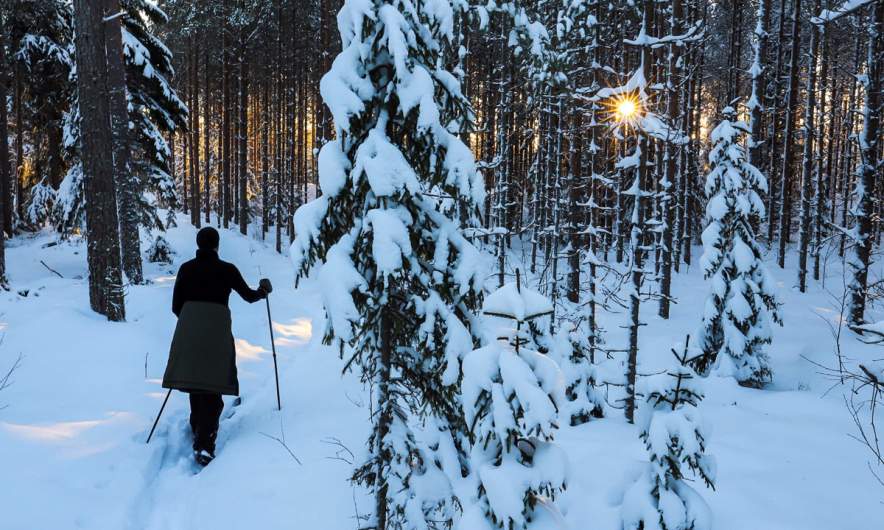
A steep passage made me doubt again. Shall I return? Continue? Well, let’s go a tiny bit further, just ten other metres up. I was lucky. Now the terrain was less steep. First only a bit of snow covered the stones and the heather but soon more and more snow covered the ground.

Part 4 – coming to a dead end

I knew that I lost the regular way. The way itself was not visible anymore, but I could see on my interactive map that I was a bit lower than the trail. Maybe I could go up somewhere else.

It was stormy and gusty and the wind tried to blow me down several times. The snow was not fluffy but wind pressed and hard and therefore slippery. When I had to traverse a slope I mounted my snowshoes. It took a while because I had some issues with the bindings. Now it dared to traverse the snow field, but since I didn’t take my walking sticks with me (mistake) it was a bit hard to walk up in the wind and gain balance.

And then I came to a dead end. A quite beautiful dead end, but still a dead end. I had to return.

Part 5 – returning, retrying and finally returning

So I walked back until I finally met the trail again, at least according my iPhone map. The way itself was hidden under the snow. Beside of that Norwegian hiking trails can be marked quite poorly, you have to navigate by yourself.

OK, I can navigate. I even had paper map and compass with me. But where the trail supposed to be there were only snow and rocks. And it was quite steep. And the snowshoes were a bit bitchy. And sun would set at 13 o’clock. Therefore I made the decision to not to try to reach the summit but abandon the tour and return. And so I did.

First I walked on snow but then I had to put off my snowshoes. In the lower part I ignored the icy trail and walked down on the heather. Much easier! Three and a half hours later I arrived at my parked car.

Résumé

It was a pity that I didn’t reach the top, but it was a fine though rough tour anyhow. From next week I have to find alternatives that are doable in twilight and darkness using a head torch.

For the records: 9.6 km, ca. 600 metres in altitude.

From autumn to winter – a tour to the Litjeblåmannen

This article is part of the series “2021-07: Back in Tromsø”.

My first concert with the chamber choir Ultima Thule was supposed to be today but due to the increasing COVID-19 cases in Tromsø the board decided to cancel the concert. That’s a pity but gave me a free day and the opportunity to continue with my #onceaweek project. I decided for a tour to the Litjeblåmannen (860 metres above sea level).

At 8:40 I have parked my car and start the tour. Temperature is -5 °C. Brr! I regret that I left my long johns home. That changes quickly when I take the first steep climb up the forest path and start to sweat. All trees have shed their leaves and are bare.

At 8:40 is sunrise. Half an hour later I can see the sun rise above the mountains. Ten minutes later I have left the birches behind and the landscape opens. I am gaining altitude and soon the path starts to cross the first snow fields.

Ten other minutes later snow and rocks start to dominate the landscape. It looks like winter. The autumn is left behind in the valley. I see a radio mast, part of the radio station on the Rundfjellet (472 m). Well, that was easy.

I decide to continue the tour. But where? The tour description mentions that I have to go down 50 metres. I hardly see any waymarks or a track but soon some foot steps that I follow. According to map and compass it’s the right direction. The terrain gets rockier, steeper and is partly icy but at least I spot some waymarks again. I stop to strap my spikes under the boots. Safety first! Less than an hour later I pass another radio station. I do not look closer because the terrain behind the building is very steep.

The terrain continues being steep and rocky but after a while I reach a plateau. Now it’s winter. Beside of some tufts of grass covered with frost there’s only snow and rocks.

From now on it’s much simpler to walk on this snow covered plateau and soon I reach the mountain summit Botnfjellet (844 m).

That’s however not my destination. Well, the summit of Litjeblåmannen looks far away but it takes only 20 more minutes to go there.

Break! Summit selfie!

The fur hood is not only for looking wintry on the selfie. It was colder than expected and after the selfies I put on my down pullover. Checking the temperature at Tromsø airport and subtracting 0.6 °C per 100 metres altitude I guess that the temperature is round -7 °C. The wind makes my mind change about wearing long johns a second time.

I eat a bit of chocolate and drink some Sprite before the frost transformed it into slush. I’m completely alone and I haven’t met anyone yet. It’s just beautiful up here with views on snowy mountain chains everywhere but on the snowless lowlands and the fjords as well.

After 20 minutes break I start my way down. First I follow my own tracks until I met the first mountain hiker today. Now I follow her steps. Does she know a better way?

Some impressions from the way down:

While I descend more and more the sun starts to set. I hike cross-country. Less and less snow covers the ground until I reach a terrain consisting of terraces of wetlands and dense birch thickets. The wetlands are easy to cross, since the ground is mostly frozen and I have rubber boots. The birch thickets however take some time to squeeze through. Looking back I can see purple clouds indicating that the sun already has set.

At 14:40 I arrive at the car. -4 °C. According to my app I walked 15 km and 1120 metres in altitude. I started before sunrise and arrived after sunset. This gives me the right to be very lazy the rest of the day. The blog article I want to write anyhow.

I met three persons in total:

  • A woman in my age in clothes that probably have been used on countless tours for many years,
  • A young woman in a grey woollen sweater hiking up quite fast while talking loudly on her cell phone.
  • A packed sleeping bag on a stone in the wetlands. A sleeping bag with a book. Wait! No, it’s a hood with a book. Wait! No, it’s a person leaning against a large rock reading. In the middle of some wet slope on the island Kvaløya. People here really like being outdoors.

So much for today. And now I have to stretch!

Appendix:

I just went to the kitchen and felt, that the outside light had changed. It had! It had snowed some centimetres and is still snowing. Everything is white. Beautiful!

Saskarö in the fog

From Monday and Thursday Annika and I made a trip that I had in mind for a longer while. Travelling round the Bothnian Bay which is the northernmost part of the Baltic Sea. The first days we travelled by car along the sea. The last hours we travelled by ship from Vaasa in Finland to Holmsund in Sweden. From there it’s only a 12½ additional km to our house in Obbola where we live.

On our way to Haparanda we made a detour to Seskarö, an island that is connected to the mainland by several bridges. As the whole day (and half our journey) it was quite foggy.

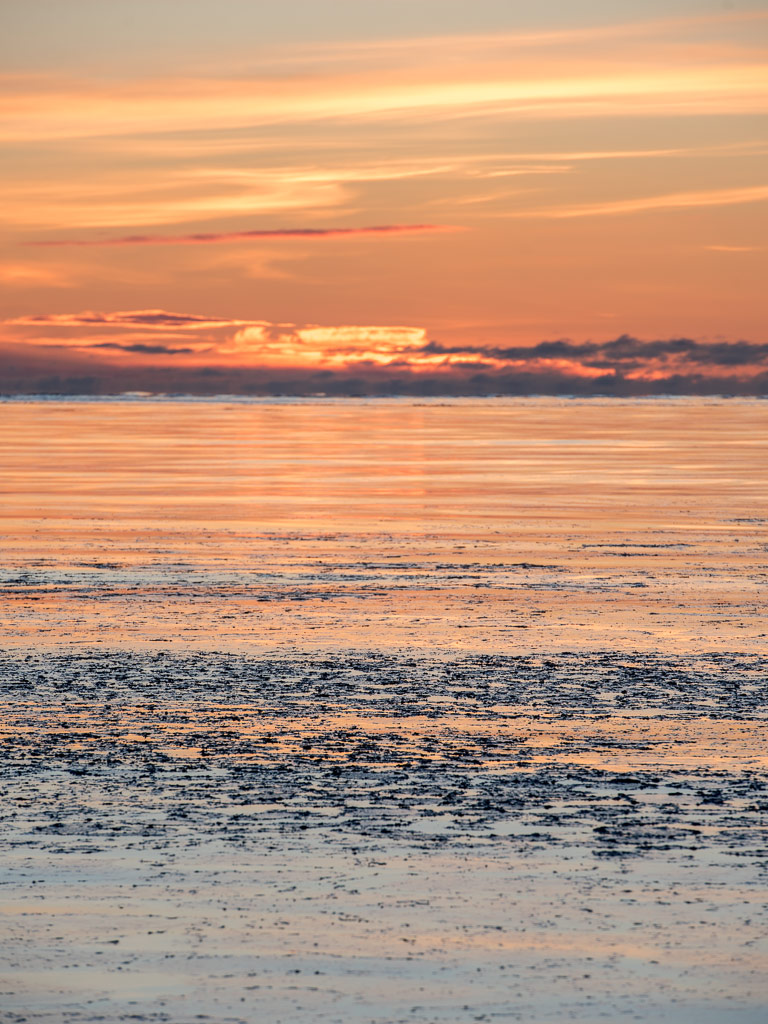
Especially by the shores there was not much to see. A near island, a bit of ice, some rocks and and a white sea merging seamlessly into the white sky.

Norwegian summer journey I

This article is part of the series “2021-08: Northern Norway”.

Annika and I have two weeks holiday and are travelling through Northern Norway. Our southernmost point: Lofoten, right now we are in Hammerfest.

Ten images looking back:

10 – We are on the high plateau Sennalandet. There are hardly any trees and the road E6 crosses the plateau in a straight line. I can imagine how rough and lonely this place may be in winter.

9 + 8 – The Øksfjordjøkelen is definitely worth the 16 km detour. The parking place and the small path leading through the sparse birch forest grant impressive views on this glacier. When the weather is clear.

7 – It’s grey on our passage from Andenes, Vesterålen to Gryllefjord, Senja. I stand on the top deck of the ferry and wonder how many tourists may have rung this bell and what had happened then.

6 – We just left Andenes by ferry. The razor sharp mountain line of Bleik will soon transform into a whitish grey scheme slowly vanishing in the drizzle.

5 + 4 – It is grey on our short ferry passage from Fiskebøl, Lofoten to Melbu, Vesterålen, too.

3 – One of the typical features of the Norwegian landscapes is the presence of high summits and fjords. Sometimes the mountains are reflected in the water surface of the sea.

2 – Hauklandstranda is one of these incredible beaches on the Lofoten islands with white sand and turquoise water. The sun is shining – time for a bath. Air temperature 11 °C, water 12 °C. Not as cold as expected.

1 – We pass Sildpollnes kapell on the Lofoten twice. Once on our way south and once when heading back again. There’s a parking place by the road where stairs and ways lead up to some hills that present a view over the landscapes around.

0 – On Saturday I leave Tromsø to fetch Annika from Riksgränsen train station in Sweden. It’s still not possible to travel further to Narvik by train. Our destination today: a room in Tjeldsundbrua.

April weather – kayaking through the snow

Yesterday the whole day was sunny. The sun was warm enough that we could take breakfast on the terrace. At lunch time we took a bath at Vitskärtsudden. Of course the water temperature is hardly above zero, but it felt springlike to go barefoot over the sand of the beach. Yes – sand, no more ice or snow!

Today however:

In the morning it has started snowing and since then it has been constantly snowing at temperatures round 0.3 °C. A good opportunity for …

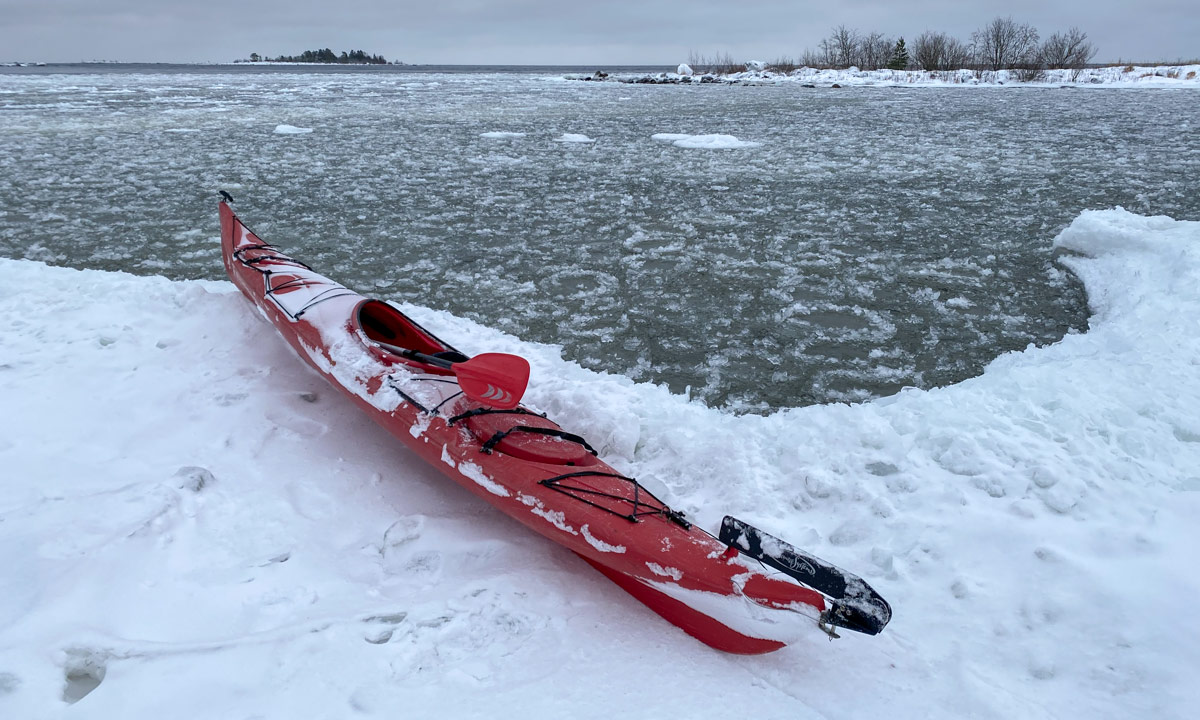
… kayaking! Although wind had become stronger the Baltic Sea still was calm. Maybe it was the snow, that created a wet blanket of slush and made parts of the surface slow and doughy, but that I don’t know.

I just took a tour round Lillskär, but took some photos with my Nikon. That took time, because each time I took photos the wind blew me back 50 to 100 metres again. But as I said, the water was calm and it didn’t took long to round the island, cross a field of floating slush, disturb some geese and return home.

Short experiences can be great and memorable experiences!

A photo from the afternoon – still snowing. The original photo looked almost black-and-white and so I made this composition completely black-and-white with a slide blueish tone.

The background: a line of trees, dimmed by the intense snow fall. The middle layer: A line of rocks in the sea, covered with snow. The foreground: The sea, covered with a layer of slush.

Spring kayaking – kind of …

In the last weeks a lot of snow has melted and the sea ice has vanished. Only in some shallow, protected bays as Grundviken behind our house some ice is left. Spring is near!

Today I took advantage of the calm and sunny weather and took a short kayak tour round the island Bredskärssten. This island is 900 m from the mainland and round 300 m long.

Paddling to the island was easy. That’s, because we mostly have wind from the west and many kayak tours start with tailwind. Some ice floes floated in the lee of Bredskärssten.

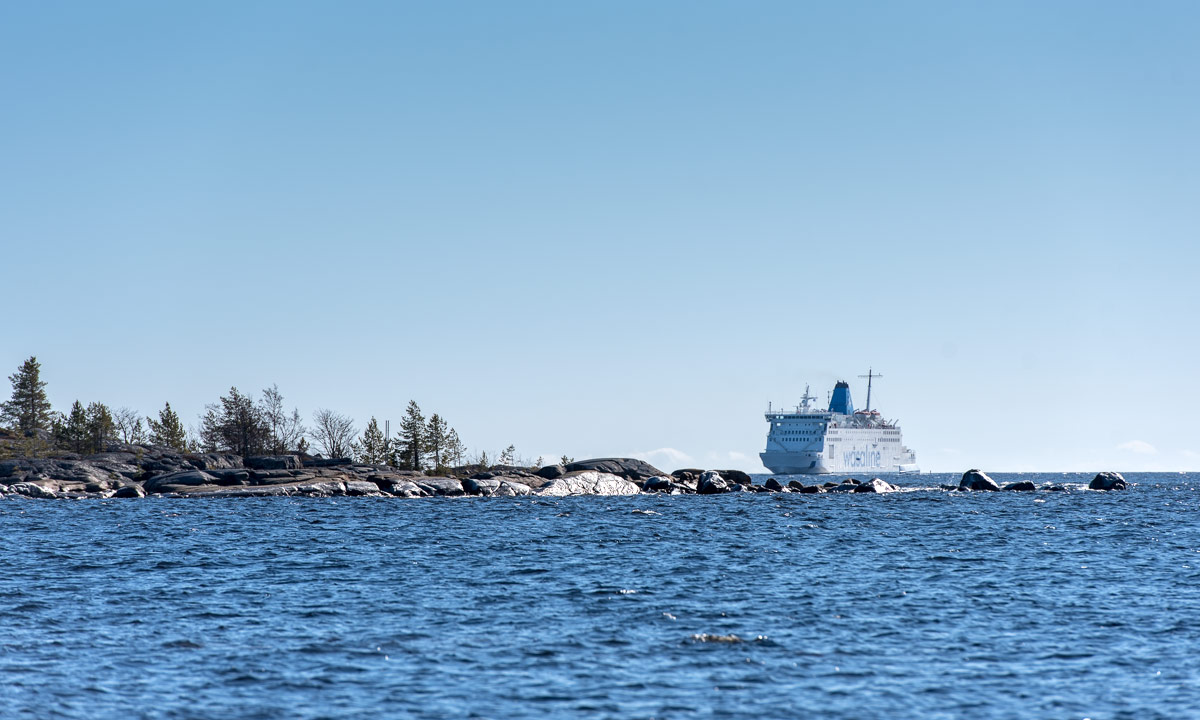
I could hear a deep droning sound. A ship? I looked over my shoulder and behind Bredskär – the larger island nearby – the bow of Wasaline, the ferry to Finland appeared. I “parked” between the ice floes to take some images. with my mobile phone.

I continued paddling round the island. Two geese fleed loudly quacking from the island. I saw the reason seconds later: an eagle wheeling above the island.

Of course I had headwind on my way back. But the mainland was near and home in view all the time. Soon I arrived at the very same ice floe where I had started the tour. Time to continue my work in my home office …

With dressing, undressing, dragging the kayak and all the tour took an hour.

Black and white weather

+1 °C, grey and hazy with some rainy showers. I ignore the weather and go out for a longer walk. Time to put a black and white film in the iPhone.

The ice is breaking

The first own video on way-up-north.com – just a rough edit

It is wind and waves that break the sea ice in the spring. And it already feels like spring. Last weekend I saw the first whooper swans and then the first seagulls – either swimming or standing on the ice bridge to the near islet Lillskär.

One week ago I dragged my kayak over the ice to that islet to start a short paddle tour from there. Since then Annika and I could watch how the open sea nibbled at the ice from both sides until only a broad ice bridge was left over.

This ice bridge became narrower and narrower. Today I used my lunch break to slip into my waterproof suit and walk to Lillskär. Even the solid ice had become cracks and these future ice floes raised and sank with the waves. As if the sea would inhale and exhale under my feet.

I went to the island, trudged to the snow and watched the waves at the outer shore. When I returned I saw, that the ice bridge almost had gone. I managed to walk back without wading or swimming, but it was close. Half an hour later the last ice shield was crushed away by the waves and Lillskär is an island again.

Today I don’t show photos but a video. I apologise for the lousy editing but I’m a video newbie and wanted to publish the video today.