Skiing from Viterskalet Fjällstuga to Syter Fjällstuga

This article is part of the series “2019-03: Ski tour Vindelfjällen”.

Monday, 4 March

I wake up early in our four-bed room. Annika and I are in the Viterskalet Mountain Cabin in the Vindelfjällen, part of the Swedish mountains. I get up, take tripod and camera and go out. The temperature in the kitchen has dropped to 7 °C, but that’s almost 30 °C warmer than outside, where it’s -22 °C according to the outdoor thermometers at the windows.

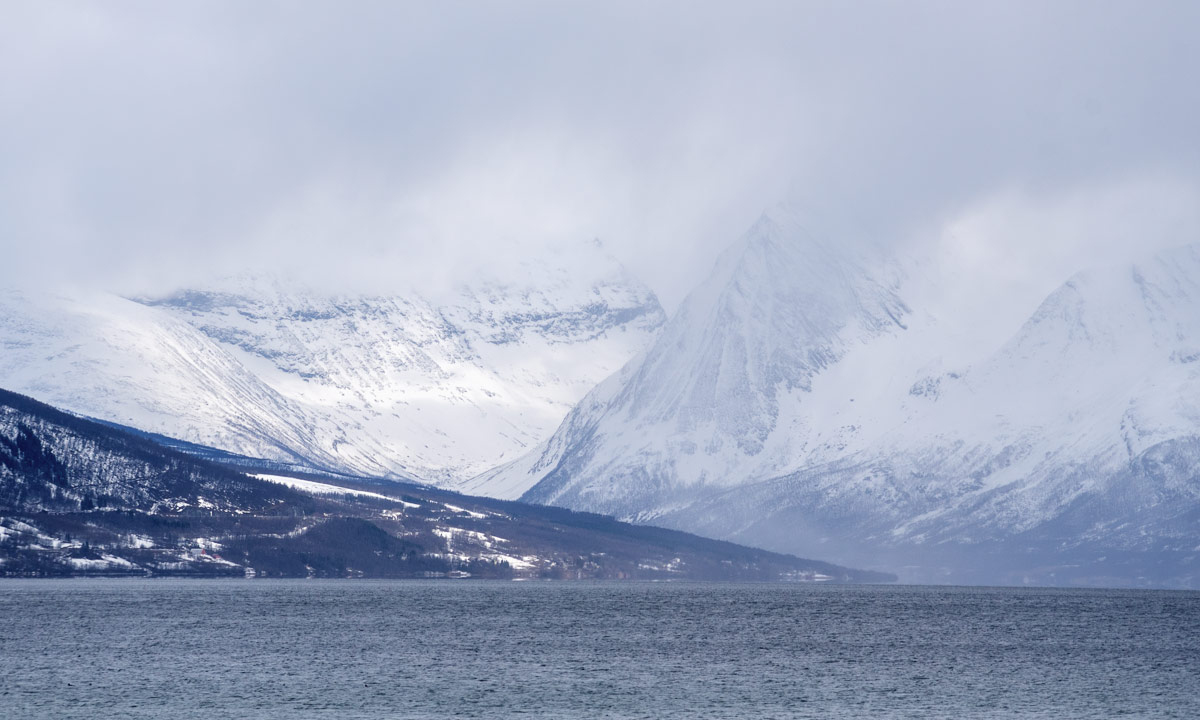
I love it when the rising sun colours the snowy mountains in purple, pink, orange and yellow until it stands so high, that the snow looks white.

At ten o’click we start our tour: 12 or 13 km to Syter Fjällstuga, the next mountain cabin. We follow the winter trail that slowly bends eastwards into the valley Syterskalet.

Here we walk in the shadow of the mountains. First it’s a nameless top (1603 m), then the Södra Sytertoppen (1685 m) that blocks the sun. Round a kilometre before the emergency cots– also named Syterskalet – we leave the shadow and walk into bright sunlight. We take a break at Syterskalet, both for eating and drinking and for attaching the climbing skins to our skis.

After the rest we have to climb a bit, round 100 metres in altitude. That’s why we mounted the climbing skins. With them the ascend is easier than expected.

When we reach the peak I remove the skins. Although I’m a lousy downhill skier I want to try anyway. The terrain is difficult for me, because parts of it are icy and others are hardly covered with snow. With large bends and a bit of luck I manage to ski downhill the slope. Annika skis downhill with climbing skins that slow down her skis. Because of that she can use the snowmobile tracks that are to steep for me. We meet at the chain bridge over the stream or Svärfarbäcken. The Syter Mountain Cabin is on the other side. We don’t have to use the bridge to cross the stream, it is completely frozen. There’s only a marked hole in the ice for fetching drinking water.

We arrive at the cabin and the stugvärd – the host – welcomes us with hot juice; a nice tradition on the mountain cabins. We realise that we met before in Nallo, a small cozy cabin in August 2017, when we took a day off.

We get a cozy room with a bunk bed and take it easy the rest of the day.

Of course I have to go to the toilet again in the night and the sky is as starry as the night before. I made some photos and due to the long exposure you even can see polar lights on the photos. These polar lights however were hardly visible to the naked eye.

Tuesday, 5 March

Today we are going to take a day off and stay at the Syter Fjällstuga. I’m an early bird and get up before sunrise. Again it’s -22 °C and the temperature will not rise above -15 °C for the whole day.

After a breakfast (we have crisp bread, butter and cheese plus hot cocoa) we start a small day trip on skis. We want to go up the slopes north from Syter. It is fun to go without pulka. Flocks of ptarmigans (snow grouses) are overall. First you hear them, then you can see them as white spots. If you come closer they fly away and you realise that you hardly spotted half of them.

Today we do not follow any marks, we make our own tracks. The tour is shorter than expected. Annika still has climbing skins under the skis and does not have any problem with the many icy patches on the slope, but I have. Instead of descending any further we turn right and make our way to the Kungsleden that continues to the northeast. Here we ski back to the cabin.

The rest of the day we stay in and round the cabin. It’s awesome to ski through the incredible beautiful winter landscapes but it’s just as great to meet interesting people.

  • Stugvärd G. with whom we talk a lot. She travelled a lot in the whole world.
  • Myra de Rooy, who is going to go the 440 km to Abisko, the first week with a friend. She writes books, mostly about her adventures in Tibet and Nepal.
  • the man who temporary helps with the cabin. He seems to know every path and every rock of the Vindelfjällen, where we are.

Annika realised that today is fettisdagen, the day in the year where the Swedes eat en semla, a barm filled with marzipan and cream. And right – the man mentioned above prepares semlor for him and his family. We are invited to take one and gladly accept. The rest of the day is a lot of talking, resting, eating and Annika making pancakes. But we even start to pack our things. Tomorrow we are going to Umasjö and that’s 22 km to go. We want to get up at 6 o’clock to start the tour as early as possible.

The last photo shows a typical situation in the Swedish mountains in wintertime: Sitting on the loo. It is dark, so you need a headlight to go there. It is cold (-23 °C), so you need a warm jacket, too. You think, that’s uncomfortable? Then you never tented in wintertime where you long for such a utedass (the Swedish word for this type of outdoor toilet).

Skiing from Hemavan to the Viterskalet Fjällstuga

This article is part of the series “2019-03: Ski tour Vindelfjällen”.

Sunday, 3 March

A perfect day for a ski tour awaits us when Annika and I wake up in Hemavan, where we arrived the evening before. The ski is blue, the air is calm and the outside thermometer at Hemavans Fjällcenter shows -23 °C.

Today Annika and I will start our first ski tour together. We are going to be in the Vindelfjällen mountains for four days and stay overnight in two mountain cabins of the Swedish tourist association: Viterskalet and Syter. Annika is going to use a backpack and I a pulka sledge. Hopefully Annika’s backpack will hold, she already had to fix a friable strap the day before. After a breakfast we take my car and drive up the slope to park it near the Kungsleden sign.

Here the Northern Kungsleden starts, Sweden’s most popular hiking trail which is 450 km in total. We will follow the Kungsleden for two days and then turn west to Umasjö or south to Solberg back to civilisation.

At half past nine we are ready to start the tour. An employee of the ski area takes some pictures of us, wishes us a good tour, sits down on his snowmobile and drives away.

Now we have to climb up the ski slope, luckily not directly. Anyway we have climbing skins under our skis that prevent slipping back when ascending slopes. It’s no fun at all to use a pulka without them. We ski on broad prepared ski trails. It doesn’t take long and the fixed strap of Annika’s backpack breaks again. At the small hut of a ski lift she replaces it provisionally by another strap. Luckily this makeshift solution will work for the rest of the tour.

Although the sport holidays started the day before the ski resort is anything but crowded. When we however leave the ski resort behind us we are really alone for a while. Only another pair of skiers faster than us overtakes us at the steepest slope of the day. We are above the tree line. Only some solitary birch trees interrupt the snowy kalfjäll.

After a while we meet the snowmobile track. This track is quite popular because the Viterskalet cabin serves waffles – a welcome destination for snowmobile enthusiasts. For us as skiers it is a bit boring to walk on a five to ten meter broad “snowmobile Autobahn” and the exhaust fumes of the less modern snöskoter stink terribly.

We pass the summer bridge over the Västra Syterbäcken. Here’s even a toilet in the middle of the snow covered mountains. Only four other kilometres to go.

The whole winter trail is marked with red wooden crosses and there are many of them. In nice weather this seems a bit overdone but all people who followed such a winter trail in snow storm know that it can be very hard to find the next mark even when it is near.

Another hour of skiing and we arrive at the Viterskalet cabin. The stugvärd who is responsible for the mountain cabin greets us. There are two larger buildings: The cabin of the stugvärd with shop and even a small café and the guest cottage. The shop is tiny but has everything you need. Therefore we can buy most food in the shops and do not need to bear everything for four days.

We allow ourselves the luxury of a cold coke and a waffle. Then we move into the guest cottage. It is huge and hasn’t been heated for a while. Our sleeping room is heated by gas and temperature is at least over 10 °C but the huge kitchen has only 1 °C and it will take hours to warm it up some centigrades. The other guests have left. We will be the only ones to stay overnight.

I stroll around and take photos while the sun is slowly going down.

Annika and I still have garlic bread bought in Hamavan and eat it with a goulash soup bought in the shop. It doesn’t take long and we cuddle ourselves in our sleeping bags. Soon we fall asleep. Mountain air makes you tired!

I however have to pee in the night. For that I have to go outside. That means putting on boots, mittens and a down parka, because it’s -20 °C. This seems to be very uncomfortable but it has its advantages. I can watch an incredible starry night in the Swedish mountains. It is so bright and clear that it only takes seconds to spot the milky way. I just have to go in to fetch my camera and tripod. The green lights over the horizon is a Northern light, but a very weak one.

Old ice, new ice

Just one cold night with calm weather and temperatures round -11 °C was enough to freeze the coastal Baltic Sea after yesterday’s stormy weather. Between the thin and dark new ice are thick old ice floes, most of them grounded on rocks, because most free floating ice floes were blown away yesterday.

If you were there and looked really closely you would see the new ice floes moving up and down a bit. There are still not frozen together.

Last day of February – farewell sea ice

Yesterday I stood on the ice edge of Kågnäshällan. It was warm and felt like the end of April. And so it looked like, too, because large parts of the Bothnian Bay were free of ice. Only protected bays and shallow waters round the islands were still frozen.

It became colder and stormy in the night. It even snowed a millimetre.

When I got up this morning it was -4 °C and still quite gusty and stormy. At 8 o’clock I took the car to have a look at the ice conditions.

I passed the nearest bay Kallholmsfjärden, just 400 metres from my house. Some ice fishers were sitting on the ice, but only some hundred meters from open water. I however wanted to drive to Näsgrundet, one of my favourite places. Yesterday afternoon the sea east of this peninsula had been completely covered with a new ice shield that had been created one week ago. Today it was … well, different …

Gale-force wind gusts tugged at my hood. Waves splashed sea spray and tossed pieces of ice onto the ice walls in front of the coast. Ice floes floated to and fro, cracking, shaking, turning, breaking. Sometimes I could feel the vibration of another wave hitting the ice wall I was standing on. Some of the ice already had been squelched to slush. I cannot remember such an impressive view of the forces of the Baltic Sea in winter time. Farther away a ship was leaving the port, accompanied by a tug boat and the small icebreaker Baus.

I tried to make pictures of the say spray of the waves. Not easy …

Behind the curtains of spray waves came rolling and small and large ice floes pivoted and danced while going up and down.

After 45 minutes the Baus came back heading for the port.

Partly I was taking pictures, partly I was just enjoying the energy of the elements and listened to the different sounds. I tried to make some videos, but all you can hear is the swooshing wind at full volume.

After one and a half hours of photographing I left this scene and drove to the small boat harbour Tjuvkistan nearby. Here the ice uses to be safe to cross to the islands Norrskär and Bredskär until the end of March or even mid-April.

Well, not this year. Even here the ice layer was being destroyed by the waves. The northern wind blew the ice floes away, so they will not freeze together again, or perhaps in Finland.

When I returned home I passed the Kallholmsfjärden a second time. The ice fishers were gone – there was just no ice left to sit on and fish from.

So, the sea-ice-season is over, four to six weeks earlier than usual.

Last day of February – polar light

Just one hour ago: finally a polar light above Skelleftehamn that was more than a pale green arc. It was just a short intermezzo and when I had found a good place for photographing it already weakened. That’s normal. Many of the beautiful auroras do not last long. I got some shots anyway.

You see the open water on the last image? Well, that’s another story to tell.

Kågnäshällan – between land, ice and sea

Kågnäshällan is a small island in the Baltic Sea with a lighthouse. The linear distance is only 7 km, but it’s 18 km by car. Since I cannot fly (and neither skies or kayak would do neither) I took the car this morning to Kågnäsudden, the cape nearby to take some photos on Kågnäshällan.

The sea is almost free of ice, only at the coast and between the islands there’s a thick layer of ice left. That makes the area quite amphibian. I took snowshoes and pulka for walking along the coast and for crossing the wet but safe ice between mainland and Kågnäshällan. Then I wanted to get near the ice edge and chose waterproof equipment. The waterproof Nikon AW-1 for taking photos and my red immersion suit to keep my warm and dry in the ice cold water. I felt like a bright red seal hunting for photos, not for fish.

Farewell winter

Yesterday afternoon: a snapshot of the coast. That’s how I like winter. Either a lot of snow or cold, crisp and sunny days at the coast.

This morning at 7 o’clock the weather was still fine. An almost cloudless blue sky at -19 °C. Would it be another beautiful winter day? Well …

Since days the weather services SMHI, Klart and yr had been predicting much warmer weather from today. Unfortunately they were right. At 8:00 the temperature already had risen to -9 °C, at 9:30 to -4 °C. In the afternoon some snowfall was predicted by SMHI. Instead of snow we got freezing rain for hours and soon black ice covered the roads and made them incredibly slippery. Even the snow-covered surface became extremely icy. The rain created an ice shield everywhere, for example on the southern windows of my winter garden.

Both SMHI, Klart and yr predict warm weather with plus degrees up to 8 °C for the rest of the month. Much too warm for February!

The rubber boots and the matching spikes are already at the door and probably will become standard equipment for days.

Farewell winter. I hope you come back with snow and coldness in March.

No kayaking today

Yesterday the Baltic Sea was open. Some ice floes drifted in the waves, the rest between mainland and the island Gåsören was open water. Just the photo from yesterday afternoon one more time:

When I saw the open see yesterday I thought about kayaking today. Temperatures below -15 °C were expected. What to wear beside of a dry suit? How many layers?

I started to dig out the door and gate of my garage to be able to get my kayak. That was hard work. The upper layer of the frozen snow that had slid from the roof was as hard as concrete. Even the avalanche shovel with the metal blade could be hug into the snow centimetre by centimetre. But finally I made it, my kayak was free.

Today at 7 o’clock the outdoor thermometer showed -18 °C. Again – what to wear on a kayak winter tour? Two layers of underwear? The winter anorak? The earflap cap made of thick polyester fur? Well, first let’s check the situation by the sea.

Oops …

The sea had been frozen overnight. A stripe of at least several hundred metres was covered with soft and thin ice, exactly that type of ice hardest to handle when sitting in a kayak.

Kayaking plans cancelled! Time for another photo.

Meanwhile in Skelleftehamn – snow and sea ice

Arrival home in SkelleftehamnI expected the worst in Skelleftehamn. The worst regarding winter. I wanted to have a real one – it’s mid-February – but had heard about the warm temperatures last week. Three days with temperatures round 7 °C, at least in town. But I was lucky, it hadn’t rained these days. The snow had fallen together but was still there. All minor streets where still white with some fresh snowdrifts from today’s strong and gusty wind and in my backyard lie still round 55 cm of snow.

Of course I had to shovel away the snow before I could use my car. Its a car with all-wheel drive but no snowcat. Although the snow was hard it was easier than expected.

The special thing about a trip with the Hurtigruten ship is that the Norwegian Sea is free of ice the whole year round and most parts of the Barents Sea, too. The Bothnian Bay – the northernmost part of the Baltic Sea – however is covered with a thick solid layer of ice. That’s what I thought until I read a Facebook post today:

Öppet vatten runt Gåsören. – Open water round [the island] Gåsören.

I could hardly believe it and took the car to the coast. And yes – large parts of the sea were free of ice, even the ice floes had gone beside of some remains. I guess there won’t be a ski tour to Gåsören this winter.

Two weeks ago I had made ski tours on the Baltic Sea with Chris. Although there’s solid ice left between the other islands I doubt that we could do the same tours today.

Here’s a comparison of the ice situation today and two weeks ago:

Legend:  fast ice |  very close or compact ice |  open ice | open water
Source: SMHI Sea Ice – Archived charts and reports