Sun down behind the ice encircled old pier

 Today I would have loved to be either in Longyearbyen on Svalbard or on the Føroyar, the Faroe Islands. Then I could have seen the first total solar eclipse in my life. But at least we had fantastic weather with clear blue sky and I could watch the partial solar eclipse.
OK, the eclipse photo first. As a matter of fact it’s a composition of two images. The sun itself, that I photoed with a so called “big stopper” that takes away 99.9% of the visible light. Also a good eye protection, even through the tele lens. But the sky is pitch black on this filtered photo, that’s why I made a shot of the blue sky and merged both images in Photoshop.
Even if it’s quite fascinating to watch the solar eclipse I want to mention the surrounding as well: I stood on the thick ice at the rocky shore of the Baltic sea. Water is open, most ice floes are away, but the shore is still covered with thick ice that is underpinned by large rocks. Therefore the ice is hovering above the sea water and the tiny waves created funny-looking icicles underneath the ice.


Back to the solar eclipse. I never saw a total solar eclipse in my whole life and I’m really longing to see one. I had checked the next total solar eclipses, to check where I can see one.
I have to check if there’re any opportunities to travel to Antarctica to see this eclipse. But I guess, it’s coming to be expensive! Are there any rich people out there? Who is willing to sponsor me a trip to Antarctica in December 2021? Or parts of it? Please contact me, I have a warm jacket.
“4:45” showed the clock when I woke up this sunday. Seventy minutes later I stood at the shore – just on time to see the sunrise. My kayak still was fixed on its cart with paddle, camera and dry suit inside.

I put on the dry suit, pushed the kayak into the water and started the tour. When I left home it was -6 °C and parts of the sea where covered with thin new ice. Thin enough to melt under the day but thick enough to give me a hard time to break through with the kayak.
I’m always a bit nervous when I stick my paddle into the ice. Will it break one day? But until now it went well. Sometimes it was easier to take the hand and pull the kayak ahead. And sometimes, when the ice got really thick I used the paddle to hack small holes into the ice that I used as handles for pulling me forward.
But after a time I reached open water and paddled along some old ice floes that were much, much thicker.


And a bit later I came to the huge icy surface, that lays between the mainland and the islands Norrskär and Bredskär. I got out and stepped onto the ice. I think, this is the first time that I stepped onto the sea ice from my kayak. I wasn’t nervous, first of all is this old ice really thick, I should guess at least 30 centimetres, probably more. Then I always wear my completely waterproof immersion suit when I make a kayak trip in winter.


After a short break I continued the tour and headed to the island Gåsören. On the outer shore there were some impressive ice floes left.


It took a while until I could go ashore, because I had to cross another field of new ice. I took a longer rest and took of the dry suit. Ugh! Like always I sweated in the thick neoprene suit and now I smelled like a dead Puma. I took on some other clothes and first it was quite chilly. The spring sun however had enough power to warm me up and soon I took of my gloves and cap.
Most snow has melted and beside of the ice covered rocks at the eastern bank Gåsören almost looked like spring was here.

After a while I dressed for paddling again, entered the kayak and returned to the starting place. With the last ice behind I had a beautiful view of the islands Klubben, Flottgrundet, Gråsidan and Nygrundet. With the blue sky and the blue sea I had the feeling of leaving the winter behind me and paddle into the spring.

When I was home again the thermometer showed +7.3 °C. Almost spring!
I’ve been home again for some days. The weather in Skelleftehamn is between winter and spring. The sky is clear and the nights are cool (last night for example -7 °C) but as sun the sun comes out the temperatures rise soon to degrees above zero.
Parts of the ground are covered with hard snow – in my backyard i measured 45 cm – but other parts are completely free of snow and I’m waiting for the first flowers to come out and blossom.
The Baltic sea is mostly free of ice, but near the shore and in some sheltered harbours there is still a thick layer of ice covering the water. And since the night was quite cold, parts of the near harbour that was completely open yesterday was covered with thin new ice this morning.
Two photos that I made near the small boat harbour Tjuvkistan this morning:


I could walk over the ice to some islands that still are connected to the mainland or I could take the kayak and paddle to some islands, too. But to be honest – I’m quite lazy after the long journey and I guess I stay home today and take it easy.
Yesterday I was on one of the tours, that the Kirkenes Snow Hotel has in its program: King crab fishing. These huge crabs are caught in big crab traps.
First we were provided with scooter overalls, big leather mittens and helmets, because we were driven to the place by snow mobile. The crab trap of the snow hotel is located at the end of the Langfjorden. Normally it would be necessary to free the hole from new ice but yesterday it was too warm and the trap, that looks like a big cage, could be pulled up directly. And yes – we were lucky – a lot of king crabs were in the trap. Bry, the guide, took four of them and showed them to us. There are fascinating animals and looking at them closer they look like aliens.


Gry killed them with a knife and they’re dead in a split of a second. Then she took the legs, that’s the eatable parts and threw back the rests that instantly were eaten by cods swimming around. We took the snow mobile to the restaurant, Gry driving, me sitting behind her and the other seven tourists in the trailer. There’s an outside kitchen where the crab lags are steamed for 16 minutes. They look red after steaming. They’re eaten with white bread, butter, lemon and mayonnaise and they taste extremely delicious. I ate lobster twice in my life and many other types of crabs and crayfish but I liked king crabs best. And there’s a lot of meat in the legs. Three legs were more than sufficient to be full, I ate four and really was stuffed. Delicious!


What a beautiful morning! -6 °C and blue sky. I was accommodated near the Kirkenes Snow Hotel where my friend I’m staying with works. I had a look into the Snow Hotel first, It has an impressive lobby with tables and a bar and round about 20 rooms where tourists can stay over night.


After looking around I drove into the centre of Kirkenes and had a walk at the port. First I discovered the commercial fishing part: Big piles of traps for the big King crabs and fisher boats lettered with latin and cyrillic letters. But not far away you could see the touristic part: The Hurtigruten ship Kong Harald that landed nearby.


I walked at the shore a bit and tried to make photos of the big ice floes that lay ashore but clouds had approached and the light was a bit dull. So I took the car and took the road E105 to Му́рманск (Murmansk). No, I didn’t plan to travel to Russia but I wanted at least to see the Russian border. It’s not far away and soon I parked my car just in front of the border.
I’m child of the cold war. It was great to see, that there is a normal border now (even if you need a visa for travelling to Russia) and that you are allowed to take pictures. On the other side this border seemed to be more the “end of the world” to me than the North Cape. On the right-hand side there is the lake that is marked with orange warning signs. This is part of the Norwegian–Russian border that crosses this lake. You shouldn’t set foot on the lake, but at least I went to the shore to take a picture of the Russian custom.
Maybe I will cross this border one day and take the car or the bus to Murmansk, who knows …


It already started snowing on the way to the Russian border but on the way back the snow fall intensified. It was still easy to follow the road but hills that very a bit farer away where hardly visible.


Back at the snow hotel it was still snowing a lot and quite windy but warm as well: +1 to +2 degrees. Some of the 140 huskies were still out on tour while the rest of the dogs could take it easy.

The forecast for the next day promised sunny weather. We’ll see …
Day 50
To be honest: I never planned to visit the Nordkapp (The North Cape), but when I was in Alta I continued to Hammerfest and after that I travelled to Honningsvåg and from that place it’s only 29 kilometres. So I visited the North Cape yesterday.
The first part is a normal road showing some beautiful views. I also completed 5000 km on this road.

If you go to the North Cape in winter by bus or your own car, you have to drive the last part in convoy. Convoys are starting at 11 and 12 o’clock.
When I came to the convoy place I was an hour too early. Time to try to make a rest on a wooden bench (it was degrees above zero again), but the wood was too wet to stay.


11 o’clock we started. The snow plough came first, then two minibusses, then me and two other cars. The street seemed to be alike as the first part: Snow and mud, partly frozen and some steep passages. The weather changed every single minute and I looked into a rainbow while following the other cars.


When we arrived I parked my car, almost jumped into the building to get an entrance ticket and ran to the famous landmark to make a photo with the rainbow without any other tourists. Even although the rainbow started to vanish I was lucky and I got my pictures. Only my own shadow was unavoidable.


But more than of the landmark I was fascinated by the weather. You could see single rain showers wandering over the sea like extraterrestrial animals and I never saw the weather change so fast and so often than yesterday at the North Cape.

I wandered round and made some photos, both inside and outside. I saw fog and approaching and I saw the many tourists, that came in big busses with the second convoy. I had a look into the tiny chapel in the basement and I ate a waffle with Norwegian cheese, jam and whipped cream.


And of course I made a selfie.

I took the convoy back at 1 o’clock (the earlier one) and I was alone. But so I had time to take the car on another road and drive to Gjesvær, a little fishing village in the northwest part of the island Magerøya. I had to stop again, the light on the far mountains was just breathtaking and the photo is just a poor copy of reality.

There’s apparently no tourism in Gjesvær under the winter but I could see several fishing boats going out and coming in.

After a short strolling I returned back over the fjell until I was at my hostel in Honningsvåg again.


Even if I’m usually not attract by touristic attractions I do like the place somehow.
Yes, it’s neither the northernmost point of mainland Europe (that’s Cape Nordkinn near Mehamn), nor even the northernmost point of the island Magerøya (that’s Knivskjellodden), but it’s a symbol! A symbol for being at the north peak of Europe and as long as you travel by car it is the northermost place you will reach.
I wouldn’t travel far just to reach the North Cape but when you are nearby I think it is worth both the travel and the entrance fee of NOK 255. If you have your own car, take the first convoy and you will get a chance of taking pictures without a zillion other tourists, at least as long it’s not too foggy.
For me this is kind of a peak of my journey Nordkalotten 2015 and now I’ll travel southward again. Probably Karasjok today and Kirkenes tomorrow. What I will do after this depends on the weather. If winter still is much too warm as most of the time I might return to my house in Skelleftehamn and take it easy for two weeks before I drive to Finnland again the last free week. But we’ll see. No plans yet …
Day 50
Hooray, I had a travel jubilee today! My journey Nordkalotten 2015 turned 5000 km this morning. My car found a fine place for the jubilee and I just stopped on the road to take some pictures (when I took the picture of the 000.0, the car was still rolling). Dear Saab 9-5, thank you for supporting me on this long trip. What would I do without you.


By pure chance it is also day 50 of the journey, that means I had an average of 100 kilometres a day (including all the days where I didn’t even touch my car).
Day 49
Quite early I left Alta yesterday and continued the E6 in direction Kirkenes. To the left I could see the Altafjorden but soon the street turned right and went a bit up. Half of the Finnmark is above the tree line and so are parts of the E6. But it’s still amazing that you leave the coastal area with green pine trees and wet snow and after a bit of driving up you are in an area with snow covered mountains and just some downy birches here and there.

But after a while the road went down again and I turned left to visit Hammerfest. I made a short stop in Kvalsund before I drove over the bridge onto the island Kvaløya where Hammerfest is situated at the western coast.

I know the name Hammerfest for ages, I guess it was mentioned in my children’s encyclopedia. As many other towns in Norway Hammerfest is a modern town, since it was destroyed almost completely in WW2. For me the name sounds quite German, both “Hammer” and “fest” are German words as well. When I had a look in the tourist information I thought, that Hammerfest is a German town, because all people talked German. But that’s probably only because the Hurtigruten was just in town and many tourists that make a cruise with one of these ships come from German speaking countries.


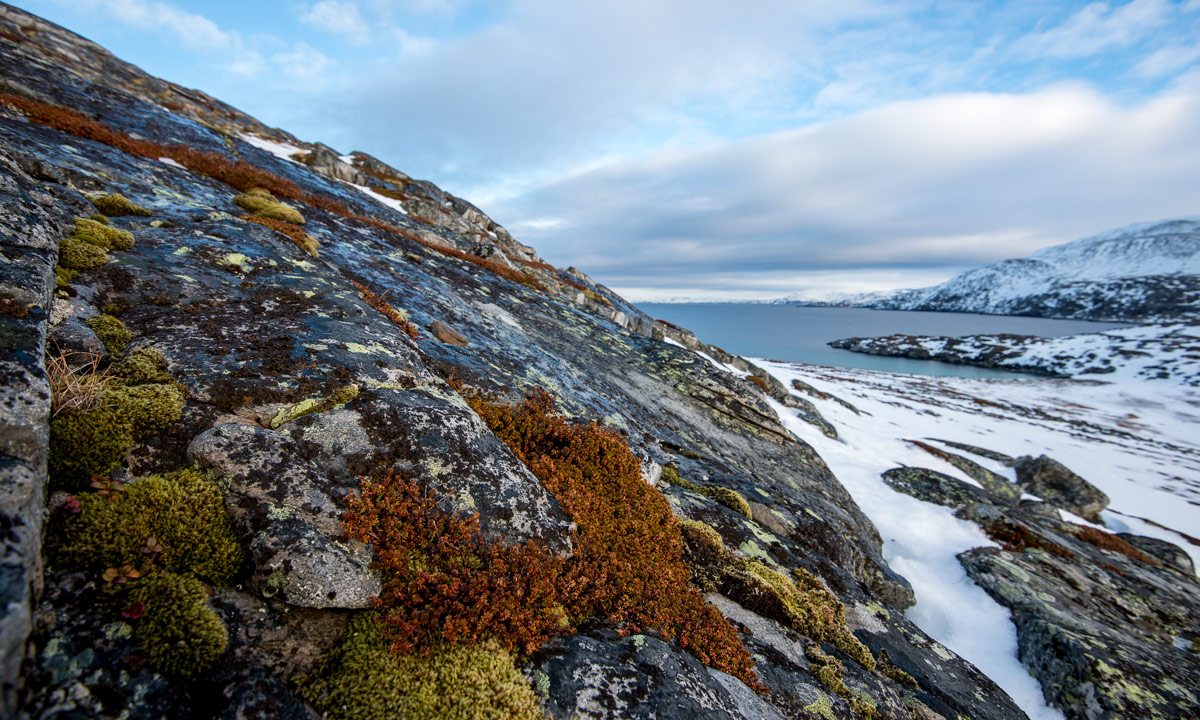
After a shorter strolling through town I continued the road to Forsøl in the north of Kvaløya. Again the road went through treeless, snow covered hills and mountains. But the rocks at the coast showed moss and other creeping plants due to the mild coastal climate.


I returned and planned to continue my journey to Honningsvåg, one of the northernmost towns in Europe. Driving back was not easy in the beginning because the streets where wet and it was hard to see something against the low standing sun, even with sun glasses and flapped down sun shields. But soon the road changed direction and driving became easier. Now I continued the E6 a bit and turned left into the E69 (that’s where I made the pictures of the Purple Sandpipers) that leads to the town Honningsvåg and to the Nordkapp. It started to dawn and even to snow a bit.


After a while it was dark. I could see grey snow, dark rocks and the dark sea. After a while I couldn’t see anything anymore, just the reflecting tape round the plastic marks and the tunnels. Meanwhile we had +3 °C and it rained. (I guess, it can be alike in summer …) Already from distance I could see the lights of Honningsvåg. The last tunnel went beneath the sea and came out again on the island Magerøya. Some minutes later I was in Honningsvåg.


Now I had three wishes: Food, internet and a room. It took a while to find the only open restaurant, a pizzeria. Check! There I was allowed to use the private WiFi to get internet. Thank you, guys! Check! And there, with the help of Annika who was online I found a room in a hostel. Expensive but hey, we’re in Norway. Check!
Now, the morning after, I will have breakfast and then I will pretend to be a real tourist and visit the Nordkapp, the northern most point in Europe you can reach by car.
Day 49
Today in Olderfjord: I only went to the beach to make a photo of the mountain reflecting in the fjord …

… when I came across a huge flock of resting birds that turned out to be Purple Sandpipers. Cautiously I changed the lens and tried to get nearer, nearer, nearer. The birds got a bit nervous but didn’t fly away. But suddenly – I didn’t move at all – the whole flock arose into the air, wheeled over the sea in a large circle, divided into two minor flocks and one of them came back to the place where I stood landing just some metres in front of me. Just great!


