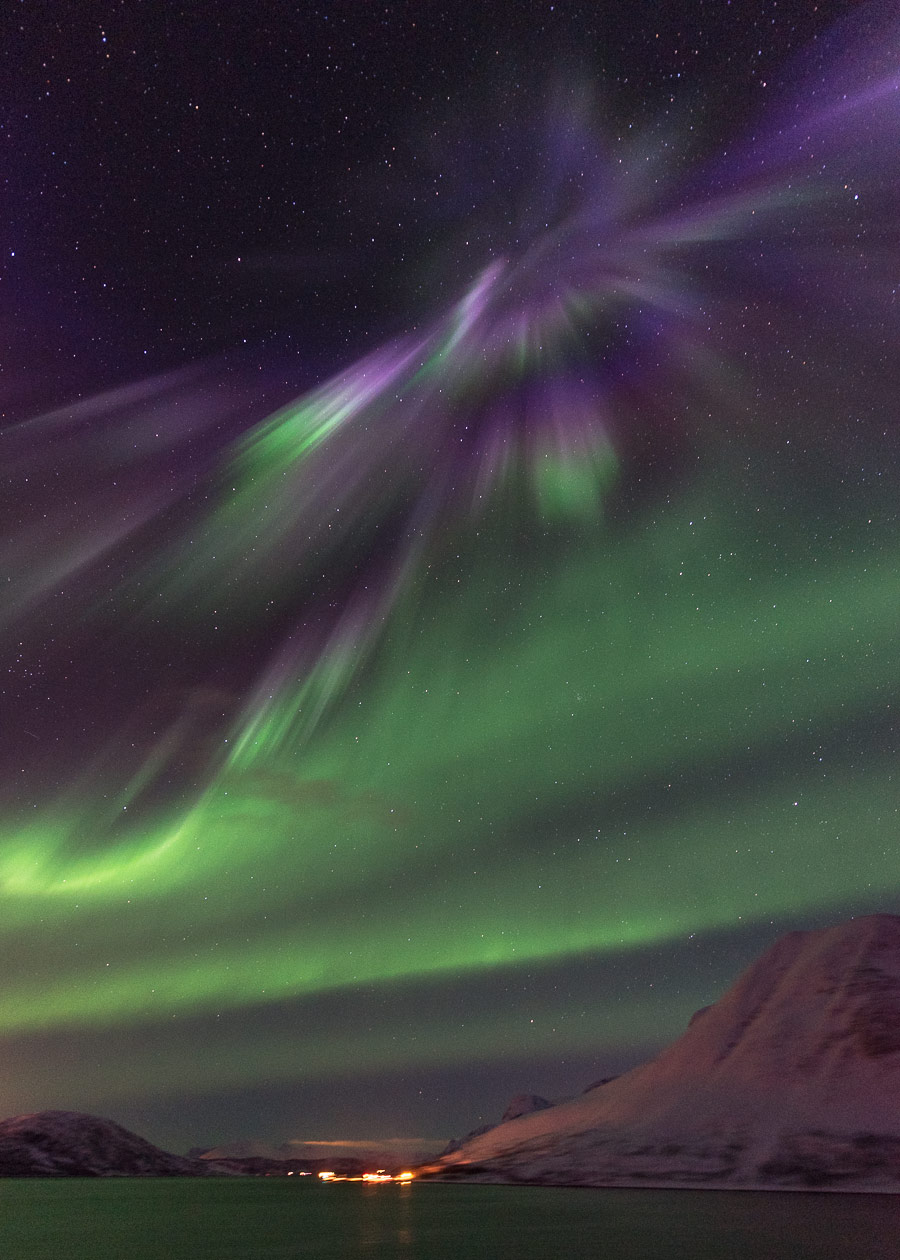
Blue hour – golden hour

Some winter days are grey and colourless. The photos taken on such dull days appear almost look black and white as long you don’t have a colourful motive.

Some other winter days are clear and colourful. There are two colours, that are especially prominent: orange and blue.

Orange is not only the colour of candlelight and cozy fires, but of the golden hour, too. The golden hour is defined by the time, when the sun’s altitude is between -4° (thus below the horizon) and 6°.

Blue is the complementary colour of orange. If you look at snow in the shadow you may realise, that it’s not of perfect white but looks a bit blueish. And the whole landscape gets a blue tinge when the sun’s altitude is between -6° and -4°. This period has a name, too, it’s called the blue hour.

Both images are made today. The first one at 09:32 (sun ±0°), the second one at 08:30 (sun -4.5°). If you have a closer look to the 2nd photo you can see the first sunrise colours on the left part of the sky. I should have make it a bit earlier.

It’s a good thing for such to live way up north. In Skelleftehamn the sun won’t rise more than 6 °C for two months, that’s golden hour even at lunchtime! And since the path of the sun is quite flat, these time periods are quite long. Today I didn’t need to rise up very early since the days are still short, but this will change soon:

Sunrise was 09:35 on 1 January and will be 08:20 on 1 February and 06:44 on 1 March. Then it’s time to get out of bed really early! Or to travel even more north, but that’s another story …

Links

The Baltic Sea freezes over

I guess, another kayak season has come to an end when I have a look at the photo I made two days ago.

The night before last was cold in Skelleftehamn with a minimum of -17.4 °C, since then it got warmer and it snowed 5 – 10 cm. Tomorrow I’ll have another look at the same place and take some other photos.

Even though temperatures have been mostly subzero for a while it will take some more weeks until it’s save to enter the ice and walk or ski to the island Gåsören, which you can see in the background.


Winter solstice 2017

It’s winter solstice today which means that it’s the shortest day of the year, at least in the northern hemisphere. Here in Skelleftehamn it was only 3 hours 44 minutes between sunrise and sunrise today and the sun rose hardly above the horizon. From now on the days will grow longer which feels a bit like winter’s ending. But far from it – it’s fortunately the astronomical beginning of winter today, not the end!

Hopefully the rain that we occasionally got the last weeks (e.g. yesterday) will come to an end and more snow will fall. Much more snow! I also hope that it will get colder to make the Baltic Sea freezing over so that I’m able to walk or ski to the islands. But this will probably take some more weeks.

This photo by the way is taken at 10:35, 58 minutes before the sun reached its highest point.

A clear winter morning at Långhällan

Today I took time off work. I stood up quite early and at 7:30 I took the car to Långhällan, a place by the coast which I love for photographing. Today I tried out my new Tamron telephoto lens (150 – 600 mm) and I’m very contended. All photos shown here are made with this lens and focal lengths between 400 and 600 mm.

The morning was cold with temperatures round -10 °C and the sky was completely clear beside of a layer of clouds at the southeastern horizon. The locals call this cloud phenomenon “vinterväggen” – the winter wall. Although it was more than one hour before sunrise, the horizon was already of a bright orange colour. The first photo.

As usual the other side of the celestial sphere was of a pale purple colour. The ice and rocks however were still of cold blueish colours. I could have waded to the rock with its shining ice cap, but I wanted to test my new lens. Photo number two.

Långhällan’s shore is partly solid rock, partly round stones of different sizes. Each of the stones, that are partly below and partly above water has such an ice cap as on photo number two. Photo number three – just for the impression.

On one of the rocky salients there’s a small but deep puddle of water which was covered with ice too thin to bear me. I could have tried to walk on it (I wore waterproof chest waders) but probably I would have destroyed the motive: a small ice pane sticking out from the icy surface. Another good argument for a telephoto lens. Photo number four.
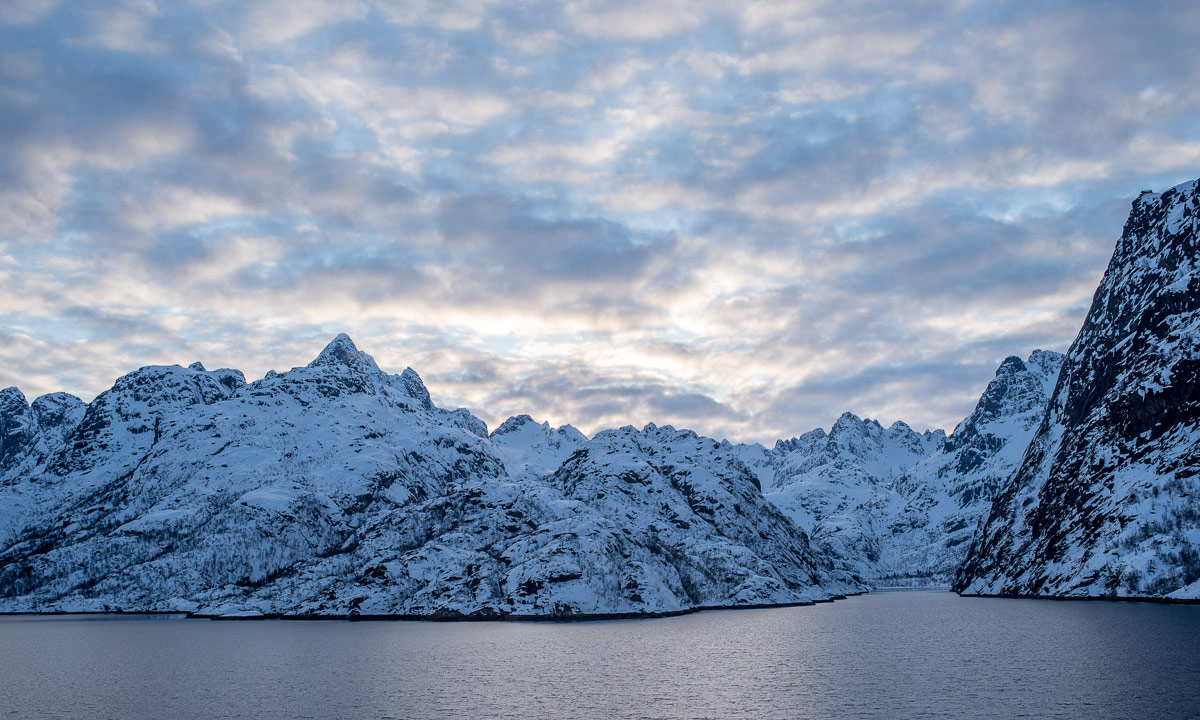
While I looked round and breathed the crisp air the sun has started to rise, still invisible since it was behind the vinterväggen but the rim of the clouds were illuminated in a bright glowing orange. I had taken some other pictures of the lighthouse before, but this photo wins. Photo number five.

When waves splash water on the frozen stones long chains of icicles are formed. Some of them were already in the sun (Photo number six) …

… while most others still were in the shadows of other rocks. These icicles had reached the ground and created a row of ice pillars in a ice portal. Photo number seven.

I looked at the sea. Parts of the ice covered rocks were sunlit and glowed orange-colours as if they would gleam from the inside. The good thing with chest waders is that you can kneel down into the water for a better perspective without getting wet. Photo number eight and the last one of today’s series.


A short visit at the coast

Yesterday morning temperatures were +3 °C, it rained and the still frozen roads were wet and incredibly slippery. Half a day later temperatures had dropped to -3 °C and it snowed – much better in my opinion!

This morning it was -6 °C and 5 cm of white fresh snow covered the ground. Not enough for skiing but enough for looking nice and most of all for brightening the day.

That’s a photo of the coast line at Näsgrundet this morning. While the sky is still clear in the south, a thick layer of clouds approaches from the north. Unfortunately the clouds doesn’t bring any snow, but according to the weather forecast more snow is to come as from tomorrow.


Kayakvideo – my thing – winter kayaking in Skellefteå

Last summer I was asked by filmmaker Johan Granstrand if I would be interested in making a small film about my winter paddling. I felt honoured to be asked and gladly accepted.

Despite to this year we got a lot of snow already in the beginning of November last year. Since weather was nice (and cold) we decided to make the film on November 12, exactly one year ago.

I already blogged about this day in my post “Kayak – is it a boat or a sledge?”. Some weeks ago I got the permission to share the link to the video and that’s what I do today.

“Min Grej – Kayaking i Skellefteå på vintern” on Vimeo.

(I really like this film but I don’t like listening to me talking. My Swedish sounds awfully!)

Late autumn paddling

It’s so nice to kayak on a sunny summer day, wearing just shorts and t-shirt, feeling the warm breeze, taking a bath and having dinner on a warm sunlit rock by the sea.

I wonder, why I hardly do that! This summer I paddled exactly twice – once in May, once in June. Now it’s November!

When I saw the thin layer of ice at Storgrundet this morning I was kind of alarmed – the days of paddling this year are numbered.

I fought a while with my weaker self but finally it was me who won. I put on my drysuit, neoprene boots, hood and gloves, took my little waterproof camera and fetched my kayak from the garage. The weather was still a bit sunny and temperature round -4 °C. (According to the weather forecast it should have been cloudy for hours, temperatures above zero and rain on its way. But well, the Swedish weather forecasts are hardly reliable.)

It took less than ten minutes till I reached the small bay Killingörviken where I launched my kayak. Within this short time period clouds have been approached from the sea covering half the sky.

The first 70 meters were hard work. Even when the ice is only 7 mm thick it’s not easy to paddle through because you have to break the ice not only with the kayak itself but with the paddle as well to be able to push forward. But soon I reached open water, crossed the street and reached the larger bay Kallholmsfjärden, home of the port Skellefteå Hamn. At the rear the sky was still blue but in front of me dark clouds approached and soon it started to snow …

No! Wrong! It didn’t snow. Snow stayed home and sent his asshole cousin: Freezing rain. (Rain indeed, sometimes the weather forecast is right.)

I thought back to the time, where I had lived in Essen. In that time I used to say “winter is coming, the rain is getting colder”. And so it felt today. It was chilly, wet, grey, twilit and dull. A typical autumn day in Essen. Or winter day. Or … . But I get off the point …

Anyway when I crossed all the bridges that traverse the channel Kejsar Ludvigs kanal, my mind wandered back again. Here it even looked like Essen.

But there are differences. First of all I never paddled in Essen and then Skelleftehamn is a coastal town which means that you reach the sea in less than no time:

Near the coast there was another layer of ice and again I had to cut through. My plan was to paddle round the peninsula Kallholmen, meaning that I would have to cross the sheltered bay Kurjoviken. Would I manage it or would the ice shield be too thick to be easily crossed? Well, I’ll see …

I paddled along the southern side of Kallholmen. There was hardly any wind and hardly any waves. Time to stop photoing and just enjoying the motion. Kurjoviken however came nearer and when I went round the west tip my misgivings became true. The whole bay was iced.

I gave it a try and started paddling through ice a third time this day. Already after ten meters the ice was 10 mm thick and I knew that I had 500 meters more to go. I decided to give up my original plan and returned. Backwards since it’s hardly possible to turn in ice.

It was still grey and quite dark, but it stopped raining and there was a a silver lining on the horizon.

It started to rain again. The raindrops were so tiny that I hardly could see the drops impacting the water surface. The surrounding looked hazy and mysterious and it was hard to guess distance and size of other objects.

“Is there a man standing on a rock amidst the sea? Or is it just a rock? Did it move or not? It moved! Is it a bird? I’m not sure. Yes, it’s a seabird, perhaps a cormorant. And the four dark spots ahead? Is it small rocks? Or big rocks? Or seals? Or trees far away in the haze?” Probably it was trees, that spot was further away than excepted.

Finally I reached “Ice Shield II” were I used the ice-free channel that I created an hour before. A second time I paddled along Kejsar Ludvigs kanal and reached the harbour.

A second time I crossed the bay, reached “Ice Shield I” and soon went ashore.

Well, let’s say I tried to go ashore. It was easy to leave the kayak but hard to go up the shallow slope, since the cold rain had instantly become ice on the still frozen ground and it was extremely slippery. Did you ever tried to drag a trolley with a kayak behind on freshly frozen streets? With neopren shoes made for water, not for ice? One patch on the street was so slippery that I really felt stuck. I could not move in any direction but finally I made it and some time later I arrived home.

My plan for 2018: Much more kayaking. In sun or rain, night or day – doesn’t matter as long as it’s save.